The Day the Dream Book No Longer Belonged to Them
Part I — The White Kitchen
Stephanie tasted strawberry before she understood why her eye was burning.
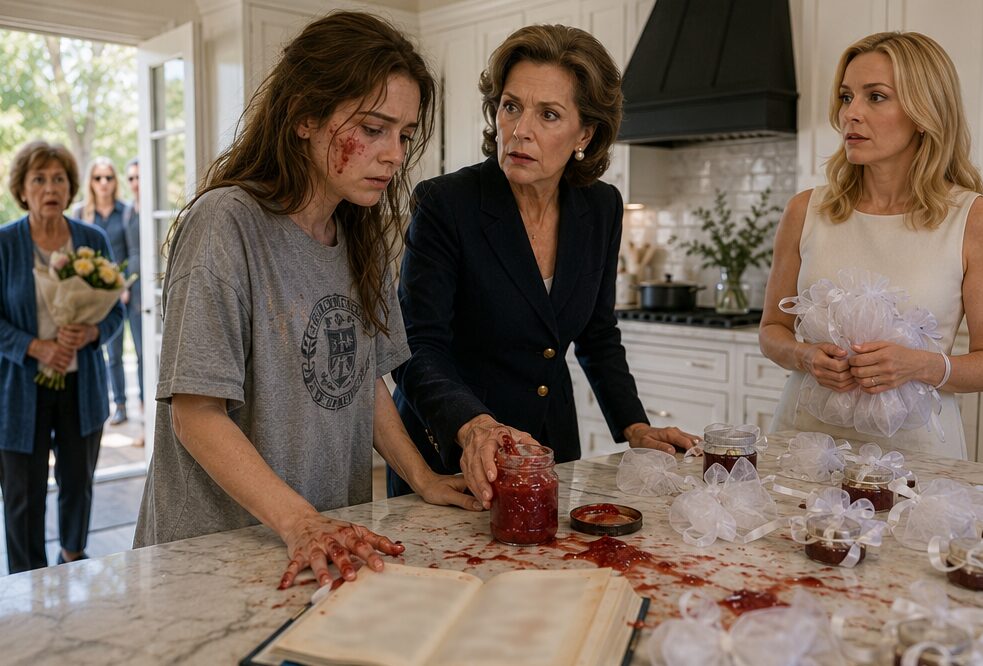
Her cheek was pressed close to the marble island, close enough to see a thin red line of jam running into the crease of an open book titled Our Dream Brunch. Margaret’s fingers were twisted in Stephanie’s hair, holding her down with a strength that felt impossible for a woman who wore pearl earrings to unload a dishwasher. On Stephanie’s other side, Heather laughed with a bundle of white organza favor bags clutched against her chest.
Then someone gasped at the back door.
Only then did Stephanie remember the windows.
Margaret’s kitchen faced the whole cul-de-sac. Not directly, not rudely, but perfectly enough for neighbors to admire the pale cabinets, the black range hood, the long island, the copper pot rack that never seemed to hold a pot with water spots. Perfectly enough for the kitchen to look like a magazine spread from the street.
Perfectly enough for people to see this.
Stephanie tried to lift her head.
Margaret’s hand tightened.
“Don’t you dare,” Margaret said, but her voice was strange now. Smaller. Not angry exactly. Afraid.
Heather’s laugh flickered and died.
The jam slid warm and sticky along Stephanie’s jaw. She could smell sugar, lemon, and the faint metallic bite of the stainless-steel sink behind her. Her gray college T-shirt was smeared where she had tried to wipe her face with her shoulder. One of the little handwritten favor tags stuck to her wrist.
It said, in Stephanie’s careful cursive: Thank you for sharing our sweet beginning.
The words made her want to laugh, but the sound that came out of her was closer to a sob.
At the open back door stood two women from the neighborhood, both frozen with serving trays in their hands. Behind them, in a blue cardigan buttoned wrong at the top, was Stephanie’s mother, Brenda.
Brenda did not look at Margaret first.
She looked at Stephanie.
And that, somehow, was worse.
Because until that second, Stephanie had still been trying to make this into something that could be cleaned up.
Part II — A Family Tradition
That morning, Stephanie had arrived at Margaret’s house at 8:07 wearing jeans, sneakers, and an old gray T-shirt from the state college where she had learned to paint with one hand while holding a cafeteria coffee in the other.
Margaret opened the door in a dark blazer.
“Sweetheart,” she said, her smile already measuring. “You came dressed to work.”
Stephanie glanced down. “You said jam favors.”
“I did.” Margaret stepped aside. “And that is very generous of you.”
The word generous landed oddly, as if Stephanie had offered to scrub the gutters rather than help with her own engagement brunch.
The house smelled like lemon oil and expensive candles. On the entry table, beside a vase of white hydrangeas, sat the planning book Margaret had ordered custom-made. The cover was cream linen stamped in gold: Our Dream Brunch.
Stephanie had thought it was sweet when Margaret first showed it to her.
A little intense, maybe. But sweet.
“I put everything in here,” Margaret had said. “Guest list, seating, menu, floral notes, speeches, vendor contacts. Memories matter.”
Stephanie had touched the cover with two fingers and tried not to think about how her mother planned birthday dinners on the back of electric bills.
In the kitchen, rows of tiny glass jars waited on the island. The strawberry jam glowed in a heavy pot on the stove. White organza bags lay stacked beside handwritten labels, satin ribbon, and a silver pen Margaret said photographed better than black.
Andrew, Stephanie’s fiancé, was supposed to help. Instead, he had called while Stephanie was parking.
“Dad needs me to pick up the folding chairs,” he said. “I’ll be there in an hour. Two tops.”
“Your mom is already wearing a blazer.”
“That’s actually casual for her.”
Stephanie laughed because he wanted her to. She loved that about herself and hated it a little, too.
“Just keep breathing,” Andrew said. “She likes you.”
“She corrects me every time I breathe.”
“That’s how she likes people.”
When Stephanie stepped into the kitchen, Margaret handed her an apron so white it looked unused.
“The jam is my mother’s recipe,” Margaret said. “We give it at family celebrations. Baby showers, bridal luncheons, anniversaries. It’s tradition.”
“That’s nice,” Stephanie said.
“Not nice.” Margaret stirred the pot twice, then set the spoon down exactly on a folded towel. “Meaningful.”
Stephanie nodded. She had learned quickly that Margaret preferred precision, especially with feelings.
By nine, Stephanie had filled twenty-three jars, tied eleven bags, and rewritten five labels because Margaret felt the first batch looked “a little rushed.”
“They’re handmade,” Stephanie said gently.
“Yes,” Margaret said. “But handmade and careless are cousins people confuse.”
Stephanie swallowed the answer that rose in her throat. She had spent seven years teaching elementary school students that imperfect lines could still make beautiful drawings. In Margaret’s kitchen, every line had to apply for permission.
At 9:32, Heather came in through the side door carrying iced coffee and confidence.
She was blonde, polished, and dressed in a white sleeveless top that looked casual only because it was expensive enough to pretend. She kissed Margaret’s cheek, set three coffees on the counter, then looked at Stephanie’s hands.
“Oh,” Heather said. “You’re doing the tags.”
Stephanie smiled. “Trying to.”
Heather picked one up. “‘Thank you for sharing our sweet beginning.’ That’s cute.”
“Thank you.”
“No, I mean actually cute. Like a kindergarten teacher did it.”
Stephanie kept her smile in place.
“I am a kindergarten teacher.”
Heather blinked, then laughed. “Right. See? Perfect.”
Margaret lifted one hand. “Heather.”
It sounded like a correction. It functioned like permission.
Heather leaned against the island and sipped her coffee. “Does your mom know what garden casual means? Not being rude. I just remember at the shower she wore those shiny sandals.”
Stephanie tied a ribbon too tight. The organza bunched like a fist.
“She knows what it means.”
“Of course,” Margaret said. “Brenda is very herself.”
Very herself.
Stephanie had heard Margaret say it three times. Once about Brenda’s laugh. Once about Brenda’s casserole dish with the faded daisies on the lid. Once about the fact that Brenda hugged people with both arms.
Very herself meant unedited.
Very herself meant not like us.
Stephanie looked at the jam jars lined up before her, each one capped, labeled, dressed in white. She wondered whether that was what Margaret wanted from people, too. To cap them. Label them. Tie them up beautifully enough that no one could see what they were.
Part III — The Book on the Counter
The first neighbor arrived at ten carrying two silver serving trays.
Margaret transformed before she reached the back door.
Her shoulders softened. Her smile warmed. Her voice dropped into the intimate brightness Stephanie had first mistaken for kindness.
“Michelle, you are saving my life,” Margaret said.
Michelle, a slim woman in tennis clothes, stepped inside and looked around the kitchen with open admiration. “Margaret. Every time I come in here, I want to go home and apologize to my own house.”
Margaret laughed. “Don’t be silly. Stephanie has been doing the real work.”
For one second, Stephanie brightened.
Then Margaret added, “She’s learning how we do things.”
Michelle looked at Stephanie the way people looked at a rescue dog whose manners were improving.
“How sweet,” she said.
Heather smiled into her straw.
By eleven, three neighbors had stopped by. One borrowed a cake stand. One brought extra linen napkins. One asked whether the HOA garden walk would still be routed past Margaret’s hydrangeas after the brunch setup was removed.
Every time someone entered, Margaret praised Stephanie just enough to display her.
“She has such enthusiasm.”
“She’s been very willing.”
“We’re helping her find her footing.”
Helping her.
Stephanie was filling jars, wiping counters, tying ribbons, and trying not to resent a woman whose house she would one day enter on holidays with a pie she would suddenly feel ashamed of.
Andrew texted at 11:14.
Still at rental place. Dad forgot the order number. You good?
Stephanie looked at the message while Margaret watched over her shoulder.
“Everything all right?” Margaret asked.
“Yes,” Stephanie said.
She typed: All good.
She deleted it.
Then typed: Your sister just asked if my mom knows how to dress.
She deleted that, too.
Finally she wrote: Please come soon.
The three dots appeared, vanished, appeared again.
Trying. Love you.
Stephanie placed the phone face down.
Margaret slid the planning book toward her. “Would you mind rewriting this page? The ink smudged.”
Stephanie looked down. It was the brunch timeline. She had written most of it the night before while Margaret dictated over the phone.
10:30 — guests arrive
10:45 — mimosas passed
11:00 — toast from Margaret
11:10 — toast from Brenda
11:20 — brunch served
12:00 — family photos by hydrangeas
“The ink looks fine,” Stephanie said.
Margaret’s smile held. “It’s a little uneven.”
“I can fix the one line.”
“I’d prefer a clean page. Our Dream Brunch should look like someone cared.”
The sentence went through Stephanie so quietly that it took her a moment to feel it.
She had cared.
She had driven over early. She had skipped breakfast. She had burned the side of her thumb on the sterilizing pot and hidden it under a Band-Aid because Margaret had said the photographer might take detail shots of their hands tying favors.
Stephanie picked up the silver pen.
“Of course,” she said.
Heather drifted behind her and glanced at the page. “Mom, did you still want Andrew’s baby pictures near the beverage station?”
“Just the tasteful ones,” Margaret said. “Nothing sticky-faced.”
Heather laughed. “So none of Stephanie’s childhood photos, then.”
The pen stopped.
Margaret’s eyes lifted. “Heather.”
Again, that almost-correction.
Again, not enough.
Stephanie kept writing.
10:30 — guests arrive.
10:45 — mimosas passed.
11:00 — toast from Margaret.
The silver ink shone wetly under the kitchen lights.
When she reached 11:10, she paused.
In Margaret’s original book, Brenda’s toast had been there.
On the page Margaret had asked her to rewrite, it was gone.
Instead, in Margaret’s clean block handwriting, written on a sticky note attached beside the timeline, were the words:
11:10 — Stephanie welcome remarks.
Stephanie stared at the sticky note.
Below it, in smaller script, Margaret had drafted the first sentence.
Thank you, Margaret, for showing me what a real home can be.
For a moment, the kitchen disappeared.
There was only that sentence.
A real home.
As if Brenda’s apartment with the mismatched mugs and the leaning bookshelf and the window unit that rattled in July had been pretend.
As if the place where Stephanie learned to make pancakes on a hot plate when the gas was out had been a waiting room for this house.
As if love became real only when it had marble counters.
“Where is my mom’s toast?” Stephanie asked.
Margaret did not look surprised. That was the worst part. “I thought we’d spare her the pressure.”
“She was excited.”
“She gets emotional.”
“She’s my mother.”
“And we love that,” Margaret said, gently enough to bruise. “But not every feeling needs a microphone.”
Heather made a small sound. Not quite a laugh. Not quite not.
Stephanie looked at the book again.
Our Dream Brunch.
For the first time, she wondered whose dream it had ever been.
Part IV — What People Call Peace
Stephanie called Andrew from the pantry because it was the only room in the house without a window.
Rows of labeled glass jars lined the shelves: fig preserves, pickled onions, imported mustard, peach chutney. Margaret even stored generosity alphabetically.
Andrew answered on the fourth ring.
“Hey. I’m five minutes away from loading chairs.”
“Your mom took my mom out of the toast schedule.”
There was a pause.
“What?”
“She replaced her with a speech for me.”
“What speech?”
Stephanie closed her eyes. “One where I thank your mother for showing me what a real home is.”
Silence.
“Andrew.”
“I’m sure she didn’t mean it like that.”
A laugh escaped Stephanie, sharp and small. “How else could she mean it?”
“She gets intense about events.”
“Your sister asked if my mother knows how to dress.”
“Stephanie—”
“Your mother called my family emotional like it’s a stain on linen.”
“Can we just get through today?” Andrew asked.
There it was.
Not cruel.
Worse.
Familiar.
Stephanie leaned her forehead against the pantry door. “Get through today.”
“Mom has spent a lot of money. The neighbors are coming. My dad’s already stressed. If we push back now, it becomes a thing.”
“It is a thing.”
“I know. I’m not saying it isn’t.”
But he was. In the softest way possible, he was saying exactly that.
Stephanie looked at the shelves, the perfect jars, each one sealed so tightly nothing could breathe.
“I need you here,” she said.
“I’m coming.”
“I need you on my side before you get here.”
He was quiet too long.
When he finally spoke, his voice had that gentle tiredness she had once mistaken for maturity. “I am on your side. I just don’t want a fight at our engagement brunch.”
Stephanie pressed her thumb into the Band-Aid covering her burn.
“Neither do I,” she said.
She hung up first.
For a few seconds, she stayed in the pantry and let herself feel the small, humiliating truth: she had not been waiting for Andrew to rescue her from Margaret.
She had been waiting for him to prove Margaret was not the family.
When Stephanie returned to the kitchen, Margaret was arranging jars in groups of six.
“Everything all right?” she asked.
Stephanie looked at the open planning book.
The silver pen lay beside it.
Heather was scrolling on her phone, bored now that no one was bleeding socially.
Stephanie sat down on the stool and turned the book toward herself.
“What are you doing?” Heather asked.
Stephanie did not answer.
She wrote Brenda’s name back into the timeline.
11:10 — toast from Brenda.
Then she drew one clean line through Margaret’s sentence.
Not angry.
Not messy.
Just a line.
Thank you, Margaret, for showing me what a real home can be.
Gone.
Heather stared.
“Oh,” she said softly. “That’s not going to go well.”
Stephanie put the cap back on the pen.
“No,” she said. “Probably not.”
Heather walked to the refrigerator, opened it, closed it, then walked to Margaret with a face arranged into concern.
“Mom,” she said. “You need to see what Stephanie did.”
Margaret looked over.
For one second, her face emptied.
Then she smiled.
That smile frightened Stephanie more than anger would have.
“Stephanie,” Margaret said. “May I speak with you?”
“We’re speaking.”
“In private.”
“This is your kitchen,” Stephanie said. “Isn’t that private enough?”
Heather’s eyebrows lifted.
Margaret moved to the island. Her watch caught the light as she placed one hand beside the book.
“I understand you’re feeling sensitive.”
“No,” Stephanie said. “I’m feeling clear.”
Margaret blinked.
It was the first time all day Stephanie had surprised her.
“This brunch is important,” Margaret said. “It is the first time many of our friends will meet you as Andrew’s future wife.”
“Our friends?”
“Our family’s friends.”
“My mother is family.”
“She is included.”
“You removed her voice.”
Margaret’s nostrils flared, barely. “I adjusted the flow.”
“You wrote a speech for me.”
“I offered language.”
“You offered gratitude I don’t feel.”
Heather sucked in a breath like Stephanie had broken a glass.
Margaret’s voice lowered. “You are very young.”
“I’m twenty-nine.”
“You are very new to this family.”
“I’m engaged to your son.”
“That does not mean you understand what this family has built.”
Stephanie looked around the kitchen. The white cabinets. The marble island. The polished fixtures. The jars dressed like tiny brides.
“No,” she said. “I think I’m starting to.”
Margaret’s hand moved to the open jar of jam. The one Stephanie had been using to top off the last favors. “This is exactly what I was trying to prevent.”
“What?”
“You embarrassing yourself before people arrive.”
Stephanie stood. “It’s my engagement too.”
The jar hit the counter hard.
Not thrown. Margaret would never throw.
But slapped down with enough force that the jam jumped over the rim and spread across the marble in a red, shining burst.
It ran under the planning book.
For once, Margaret’s perfect kitchen did not know what to do.
Part V — The Page That Would Not Stay Clean
“Now look,” Margaret said.
But she was the one looking.
At the jam spreading into the linen edge of the book. At the red smear crawling under the word Dream. At the island she had wiped twice before anyone arrived.
Heather started laughing.
At first, it was nervous. A little burst she tried to hide behind her hand.
Then she looked at Stephanie’s face and laughed harder.
“Oh my God,” Heather said. “It looks more like your family now.”
The room changed.
Stephanie felt it before she thought it.
Not because the insult was the worst thing anyone had ever said to her. It wasn’t. Margaret had been saying it all morning in nicer shoes.
But this time, it had no wrapping.
No concern.
No “sweetheart.”
No family tradition.
Just the thing itself.
Stephanie reached for the book.
Margaret grabbed her wrist. “Don’t touch that.”
“It has my mother’s name in it.”
“It has my house covered in jam.”
“Then let go.”
Margaret’s grip tightened. “You will not walk out there and make a scene.”
Stephanie looked toward the windows.
Beyond the glass, Michelle was crossing the patio with another neighbor. They were carrying trays and talking, unaware that the kitchen had gone still around a single open book.
“You’re worried about a scene?” Stephanie asked.
Margaret’s eyes flicked to the windows.
That was the answer.
Ashley saw it too. Her laughter faltered, then returned in a thinner version. “Maybe we should all just take a breath.”
Stephanie turned on her. “You’re not funny.”
Heather’s mouth opened.
Stephanie looked back at Margaret. “And you’re not kind.”
Margaret’s face went white in a way powder could not help.
For a heartbeat, no one moved.
Then Stephanie pulled her wrist free and reached for the planning book again.
Margaret moved faster.
Her hand caught Stephanie’s ponytail as Stephanie bent over the island. Pain flashed at the back of Stephanie’s scalp. She gasped and stumbled forward, one cheek coming down near the book. The open jar tipped. Jam smeared across Stephanie’s face, hot from the counter, sticky over her eyelid.
Heather laughed again.
Not because it was funny.
Because she did not know who she was if she stopped.
“Margaret!” someone called from the back door.
The name cracked through the kitchen.
Stephanie blinked through red blur.
Margaret’s hand was still in her hair.
The book lay beneath her.
The white favor bags hung from Heather’s fist like tiny flags of surrender.
And in the doorway stood the neighbors.
Behind them stood Brenda.
Stephanie had imagined her mother arriving later, after the favors were tied, after the drinks were poured, after Margaret had inspected Brenda’s shoes with her eyes and found a polite way to survive them.
But Brenda was here now.
In the wrong cardigan.
With her lipstick slightly outside the line on one side.
Holding a grocery-store bouquet because she never came to anyone’s house empty-handed.
Brenda took one step inside.
No one spoke.
Margaret released Stephanie’s hair as if it had burned her.
“Brenda,” Margaret said, and the warmth came back so fast it was almost impressive. “There was a little accident.”
Stephanie slowly straightened.
The jam pulled at her skin. Her eye watered. Her scalp throbbed. She could feel the room waiting for her to help.
To laugh.
To say, It’s fine.
To become the kind of woman who could be hurt beautifully.
She looked at Heather. Heather looked down.
She looked at Margaret. Margaret’s mouth trembled, not with guilt yet, but with the terror of being misunderstood by witnesses.
Then Stephanie looked at Brenda.
Her mother’s face had gone still. Not weak. Not emotional. Still.
Stephanie picked up Our Dream Brunch.
The book was ruined. Jam had soaked into the page, blurring the timeline, softening the line where Stephanie had crossed out Margaret’s sentence. Brenda’s name was still visible.
That mattered.
Stephanie carried the book to the doorway.
Each step felt too quiet.
She handed it to her mother.
Brenda looked down. Her thumb stopped on her own name.
“Stephanie,” Margaret said, warning in the shape of a plea.
Stephanie did not turn around.
“I don’t think this is our dream,” she said.
Brenda’s eyes lifted.
There were a dozen things Stephanie could have said then. She could have explained the speech, the toast, the sentence about a real home. She could have told the neighbors everything from the first coffee to the last laugh.
She did not.
She turned back to Margaret.
“You can keep the kitchen,” Stephanie said.
The silence after that was cleaner than the room had been all morning.
Part VI — The Porch
Andrew arrived seventeen minutes too late.
Stephanie was in the powder room off the hall, wiping jam from her face with one of Margaret’s guest towels. The towel had an embroidered M in the corner. Stephanie almost apologized to it.
Her eye was red. Her hair had come loose. A stripe of jam had dried along her jaw, dark and tacky, like the day had signed her.
Through the door, she heard Andrew’s voice.
“What happened?”
Then Margaret’s.
“I don’t know. She became upset.”
Stephanie stopped wiping.
There it was. The version.
Not a lie loud enough to fight. A soft rearranging of the furniture around the truth.
Heather said something Stephanie could not hear.
One of the neighbors murmured, “Maybe we should go.”
Brenda said nothing.
That was how Stephanie knew her mother was waiting for her.
Andrew knocked once. “Steph?”
She opened the door.
He stood in the hallway wearing khakis and a blue button-down, his hair slightly windblown from carrying chairs, his face already trying to love everyone at once.
Then he saw her.
Really saw her.
The red in her eye. The sticky hair. The towel in her hand. The place near her scalp where it still hurt.
His expression changed.
“Stephanie,” he said. “What happened?”
She looked past him.
Margaret stood in the kitchen now, crying quietly into a napkin while Michelle touched her shoulder. Heather was collecting the favor bags from the island, her movements small and quick. The ruined book was not on the counter anymore.
Brenda had it.
Stephanie could see the cream cover under her mother’s arm.
Andrew stepped closer. “Tell me.”
The old Stephanie would have.
She would have taken him into a corner and made it easy. She would have chosen careful words. She would have said, Your mom got upset, and then I got upset, and it all happened so fast. She would have rounded the edges until the truth could fit into his family without scratching the walls.
She was tired of sanding herself down.
“Do you want the truth,” Stephanie asked, “or a version that keeps everyone comfortable?”
Andrew flinched.
Not because the question was cruel.
Because he knew the answer he had been living by.
“Stephanie,” he said softly.
She waited.
He looked toward the kitchen. Margaret was watching them now through tears. Heather was watching too. Everyone was watching.
Andrew opened his mouth.
Closed it.
That silence did what shouting could not have done.
Stephanie nodded once.
Not because she understood everything. Because she understood enough.
She walked past him.
On the porch, the afternoon had turned bright and ordinary. A lawn mower hummed somewhere down the block. Someone’s dog barked twice. Folding chairs leaned against the garage in white stacks, still wrapped in plastic.
Brenda sat on the top step with Our Dream Brunch in her lap.
Beside her was one white organza favor bag Stephanie had somehow carried out with her. It must have stuck to her wrist or caught in her fingers when she picked up the book. Inside was a tiny jar of strawberry jam, sealed and perfect.
Brenda looked up.
For a moment, her mouth did something it had done all Stephanie’s life when she wanted to say too much and knew her daughter could not carry it yet.
So she said nothing.
Stephanie sat beside her.
The porch boards were warm under her palms.
Brenda took the guest towel from Stephanie’s hand and dabbed carefully at the jam along her jaw. She did it the way she had wiped paint from Stephanie’s face when she was seven and came home crying because another child said her picture of a house looked wrong.
Back then, Brenda had looked at the paper and said, “Maybe they’ve never seen your kind of house.”
Now she wiped the last sticky trace from Stephanie’s chin.
“Come home for tonight,” Brenda said.
Stephanie looked at the favor bag between them.
Thank you for sharing our sweet beginning.
The tag was still tied perfectly.
From inside the house, Margaret’s voice rose, then broke. Andrew answered in a low tone. Heather said something sharp, then softer. The beautiful kitchen held them all, bright and polished and unable to hide what had happened inside it.
Stephanie picked up the little favor bag.
For a second, she thought about leaving it on the porch.
Instead, she held it in her palm.
Not as a keepsake.
As evidence to herself that sweetness could be packaged, labeled, and handed out to guests while something bitter waited underneath.
Brenda brushed Stephanie’s hair back, careful near the sore place.
Stephanie leaned into the touch before she could stop herself.
“Yes,” she said.
Not loudly.
Not dramatically.
Just enough for her mother to hear.
Behind them, the front door opened.
Stephanie did not turn around.
For the first time all day, she did not need to see who was watching.