The Red Purse
The Red Purse
Part I — The Man Who Ran
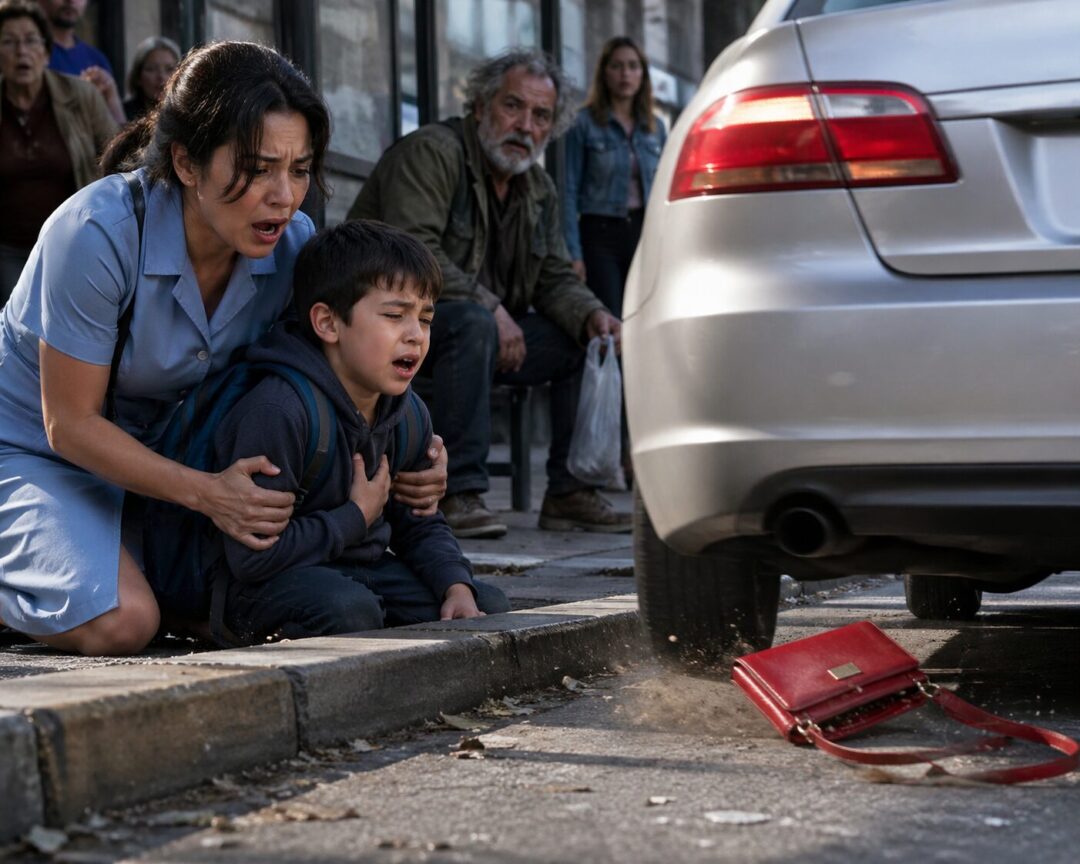
The red purse hit the asphalt like a dropped heart.
It bounced once, spilled open, and skidded beneath the back wheel of a silver rideshare car that had already started pulling away from the curb.
“Stop!” Lena Brooks screamed.
The driver did not stop.
Her son Miles grabbed her wrist with both hands. His small fingers dug into her skin.
“Mom,” he said, and the word came out too thin.
Lena looked down and saw the look she feared most on her seven-year-old’s face: eyes wide, mouth open, chest working too hard for too little air.
The inhaler was in the purse.
Her phone was in the purse.
Her keys, wallet, insurance card, everything she would need in the next five minutes of her life was in the bright red purse now trapped beneath the car that was rolling away.
For one frozen second, no one moved.
People saw things happen all the time on that block. They saw arguments, fender benders, shoplifters, delivery drivers blocking traffic. They saw trouble and measured how close it was to them before deciding whether to care.
Then a man in an army-green coat exploded from the bus stop bench.
He was older, maybe late fifties, with a gray beard and boots that looked like they had walked through every bad season the city had ever had. He had a plastic grocery bag tied around one wrist and a face most people had trained themselves not to study.
He ran straight into the street.
“Hey!” Lena shouted, because she did not know what else to shout.
The man did not turn around.
He chased the car.
For three terrible seconds, Lena thought he was chasing the purse because he had seen money.
Then the car lurched forward, dragging something red against the street, and the man threw himself toward it like the purse was a child.
“Miles, stay with me.” Lena knelt in front of her son. “Breathe slow.”
“I can’t.”
“Yes, you can. Look at me.”
But Miles was looking past her.
At the man running.
At the red purse.
At the car that was not stopping.
Lena stood so fast the sidewalk tilted beneath her. “Somebody help!”
A woman outside the nail salon raised a hand to her mouth. A teenage boy lifted his phone. Two men near the grocery carts stared.
The only person actually moving was the man everyone on that block had already decided was not worth noticing.
The silver car reached the corner just as the light turned yellow.
The man kept running.
His plastic bag slapped against his leg. His coat flew open. For a flash, Lena saw something tucked inside the breast pocket: an old photo sealed in a cloudy plastic sleeve.
Then he was gone around the corner.
So was her purse.
So was the inhaler.
Miles made a small sound that broke her open.
“Mom.”
“I know, baby. I know.”
Lena scooped him against her side and started after them.
She had worked nine hours on her feet that day. Her blue dress stuck to her back. Her shoes were not made for running. Her son could not run at all.
But she ran anyway.
Behind her, someone said, “That guy took her bag.”
Someone else said, “I knew he was trouble.”
The words hit Lena, but she could not sort them. There was no room in her mind for judgment, fairness, or doubt.
There was only one thought.
The inhaler is in the red purse.
And the man in the green coat had it, or the driver had it, or the street had swallowed it whole.
At the grocery entrance, Marcus Reed heard the scream and stepped out.
Marcus was a broad-shouldered security guard with a shaved head, a radio clipped to his shirt, and the tired authority of a man who spent all day being blamed for everything he could not prevent.
He saw Lena running with a gasping child.
He saw the old man in the green coat cutting across the far end of the parking lot with something red in his hands.
Marcus did not think.
He acted.
“Hey!” he shouted. “Stop right there!”
The old man did not stop.
Marcus ran after him.
And just like that, the only person trying to save Miles became the man everyone was chasing.
Part II — What People See First
Walter Hayes knew how people looked at him.
They looked quickly, then away.
They saw the coat before the man. The beard before the mouth. The cracked boots before the feet inside them. They saw the plastic bag and decided whatever story came next was probably his fault.
Walter had stopped being surprised by it.
Surprise required expecting something better.
He had been sitting at the bus stop because it had shade. Not waiting for a bus. Not really waiting for anything. He had half a turkey sandwich from the church basement in his bag and three dollars folded into an old receipt.
Then the red purse hit the street.
Then he heard the child.
That sound did not belong to the city. It cut through horns, brakes, music, voices. It went straight past Walter’s ears and found an old locked room inside him.
A child trying to breathe.
His daughter, Elise, had made that sound once.
Then more than once.
Then, one night, not enough.
Walter was already moving before memory could finish hurting him.
The silver car dragged the purse half a block before the strap tore loose and flung it toward the gutter. Walter lunged and missed it by inches. His knee struck the asphalt. Pain flashed white.
The car slowed at traffic.
Walter grabbed the purse.
“Stop!” he shouted at the driver. “You hit her bag!”
The driver, a young man with one earbud in, glanced in the mirror. His face tightened, not with concern but irritation.
Walter slammed a palm against the trunk. “There’s a kid back there!”
The light turned green.
The car jumped forward.
Walter held the purse strap with one hand and stumbled hard. For one stupid second, he thought the strap would snap again and send the bag under the wheels.
It didn’t.
He yanked it free and staggered backward.
The car sped off.
“Coward,” Walter breathed.
Then he heard another voice.
“Stop! Drop it!”
Walter looked over his shoulder.
A security guard was charging toward him across the lot.
Behind him, farther back, the woman in the blue dress was struggling forward with the boy.
Walter lifted the purse. “It’s hers!”
The guard kept coming.
Walter had learned a long time ago that explanations were luxuries. People heard them only if they had already decided you deserved language.
The boy bent forward, one hand on his chest.
Walter looked down at the purse.
It was zipped halfway open. Lip balm, a receipt, a set of keys, a little dinosaur sticker on a wallet corner. No time to be polite. No time to be believed.
He searched with shaking fingers.
“Where is it?” he muttered. “Come on. Come on.”
A blue inhaler flashed inside a side pocket.
Walter grabbed it.
A hand slammed into his shoulder.
The world tilted.
Marcus hit him from the side, hard enough to drive both of them into the side of a parked car. The purse flew from Walter’s grip. The inhaler bounced once, twice, then rolled under a dusty black sedan.
Walter’s cheek struck pavement.
For a moment, he could taste blood and summer heat.
“I said stop!” Marcus snapped, pinning him down.
Walter twisted, trying to see under the car. “The inhaler.”
“What?”
“The boy needs—”
“Don’t move.”
Walter laughed once, but it was not humor. It was disbelief so old it had no edge left.
“You people always tell me that,” he said.
Marcus pressed a knee into his back. “Stay down.”
Lena arrived breathless, Miles sagging against her hip.
“My purse,” she gasped. “Please, my son’s inhaler—”
Marcus looked at the red purse lying open near the curb. “I got him.”
Lena stared at Walter on the ground.
At his hand reaching not for the purse, not for the wallet, but toward the space under the black car.
Walter’s fingers were stretched toward nothing.
“The inhaler,” he rasped. “Rolled under.”
Lena dropped to her knees.
Miles wheezed beside her.
Marcus’s grip loosened.
For the first time, doubt entered his face.
Walter did not wait for permission.
He shoved Marcus off as much as his tired body could manage, flattened himself onto the burning pavement, and reached under the sedan.
His shoulder screamed.
His ribs ached.
The inhaler was just beyond his fingertips.
Behind him, Miles tried to breathe and failed beautifully, terribly, with the stubborn courage of a child who did not want to scare his mother.
Walter pushed farther under the car.
His coat caught on metal.
The old photo in his pocket pressed against his chest.
Elise at six years old, missing one front tooth, holding up a purple balloon.
Walter reached again.
His fingers closed around the inhaler.
Part III — The Thing Under the Car
“Here,” Walter said.
He held the inhaler out before he even pulled himself free.
Lena snatched it with trembling hands.
“Miles. Baby. Look at me.”
She shook the inhaler once, twice, fitted it to his mouth, and counted.
“Breathe in.”
Miles tried.
“Again.”
The second breath went deeper.
The third one sounded less like a door closing.
Walter lay half under the car, one cheek against grit, watching the child’s shoulders rise and fall. He did not move until he saw the boy’s eyes focus.
Only then did he drag himself out.
Marcus stood over him, breathing hard. The radio at his shoulder crackled with someone asking if he needed backup.
Walter sat up slowly.
His palm was scraped. His knee was bleeding through his pants. One side of his face had gone numb.
The crowd had grown.
Of course it had.
People who had not moved when the purse fell now moved closer for the part where someone might be arrested.
Lena held Miles against her and looked at Walter.
Her face changed in pieces.
Fear first.
Then confusion.
Then the awful recognition that she had been wrong, even if only for a moment.
“I thought—” she began.
Walter wiped blood from the corner of his mouth with the back of his hand. “Most people do.”
That was all he said.
It landed harder than an accusation.
Marcus looked at the purse, then the inhaler, then Walter.
“I saw you running with it,” he said, but his voice had lost its force.
Walter tried to stand. His left leg buckled.
Miles stepped forward before Lena could stop him.
“Mister,” he said softly.
Walter looked at him.
“You okay?”
The question did something the tackle had not. It almost knocked him down again.
Walter nodded once. “I been worse.”
Miles studied him with the serious eyes of a child who knew adults lied to make children feel safe.
“You knew what it was?” Lena asked. She held up the inhaler.
Walter shook his head. “I guessed.”
“How?”
He should have shrugged. He should have said nothing. He had survived years by giving strangers less of himself than they wanted.
But Miles was still breathing hard.
And the sound had opened that locked room.
“My daughter had one,” Walter said.
Lena’s grip tightened around Miles.
“Had?” Miles asked.
The word was small.
Walter looked away.
Lena touched her son’s shoulder. “Miles.”
But Walter answered anyway.
“Yeah,” he said. “Had.”
No one in the crowd spoke.
Not because they understood. People rarely understood that quickly.
But grief, when spoken plainly enough, can make even strangers lower their voices.
Marcus stepped back.
“I didn’t know,” he said.
Walter looked at him then. Not angry. Not forgiving. Just tired.
“You didn’t ask.”
Marcus swallowed.
The police siren came from the far end of the block.
Someone must have called. Someone always called once the hard part was over.
Lena picked up her red purse. The strap was torn. The side was scraped black from the road. Her wallet hung halfway out, and her keys had tangled in the lining.
It looked ridiculous now.
A cheap red purse from a discount store, bought because it made her feel a little brighter on days when her life felt like bills, bus schedules, and careful grocery lists.
She had almost hated it when it hit the street.
Now it felt like evidence.
The first officer stepped out of the patrol car already looking at Walter.
Lena saw it happen.
The same quick inventory.
Coat. Beard. Blood. Ground. Problem.
The officer put one hand near his belt. “What’s going on?”
Marcus opened his mouth.
Lena stepped in front of Walter.
The movement surprised everyone, including herself.
“This man saved my son,” she said.
The officer blinked. “Ma’am?”
Lena lifted the red purse. Her voice shook, but it did not break.
“A driver hit my bag and dragged it. My son’s inhaler was inside. Walter chased the car and got it back.”
She did not know his name until she looked down and saw it stitched faintly on the old army patch near his chest.
HAYES.
“Mr. Hayes got it back,” she said, correcting herself. “Then this guard tackled him because he thought he stole it.”
Marcus flinched.
Lena turned toward him.
She did not soften it.
“He was wrong.”
The crowd shifted.
It is one thing to watch a man be suspected.
It is another to watch him be defended.
Marcus took a breath. His jaw worked once.
“She’s right,” he said.
The officer looked at him.
Marcus nodded toward Walter. “I made a bad call. He was helping.”
Walter stared at the sidewalk.
Miles slipped his hand out of his mother’s and walked to him.
Lena almost pulled him back.
She didn’t.
Miles stood in front of Walter and held out the inhaler.
“Thank you for getting it.”
Walter looked at the boy’s small hand.
Then at the inhaler.
Then at the child’s face, still pale but alive with breath.
“You keep that closer next time,” Walter said.
Miles nodded solemnly. “I will.”
Walter almost smiled.
Almost.
Part IV — The Photo in His Coat
The officer asked questions because officers ask questions.
Name. What happened. Did anyone get the plate? Was anyone injured? Did Walter need medical attention?
Walter said no to that last one too quickly.
Lena heard it.
“You’re bleeding,” she said.
“I’ve bled before.”
“That doesn’t mean you have to keep doing it.”
Walter looked at her as if kindness were a bill he had not agreed to pay.
Marcus brought napkins from the grocery entrance and a bottle of water. He held them out awkwardly.
Walter did not take them at first.
Marcus lowered his voice. “Please.”
That word did what the apology had not.
Walter took the napkins.
The crowd began to thin once it became clear no one would be dragged away. Phones lowered. The nail salon door shut. The teenage boy stopped recording when Marcus stared at him long enough.
Life on the block resumed its rude little rhythm.
But Lena could not resume with it.
Her hands would not stop shaking.
She sat on the curb with Miles beside her and watched Walter dab at the cut near his cheek. He did it badly, like a man used to injuries but not care.
The old photo had slipped halfway out of his coat pocket.
Miles saw it first.
“Is that your daughter?”
Walter’s hand froze.
Lena whispered, “Miles.”
But Walter pulled the photo out.
The plastic sleeve was cloudy and cracked at the corner. Inside, a little girl grinned at the camera with one missing tooth and a balloon string wrapped around her wrist.
“She was,” Walter said.
Miles leaned closer. “She had asthma too?”
Walter nodded.
Lena felt the answer before he gave it.
Some grief has a shape.
It sits in the air before anyone names it.
“I was late once,” Walter said.
No one asked him to continue.
That was why he did.
“Not by much. Minutes. Maybe less. Her mother called me from work. Said Elise was wheezing, said she couldn’t find the spare inhaler. I was two blocks away.”
He looked down at the photo.
“Two blocks can be a whole country when you don’t make it in time.”
Lena closed her eyes.
Miles reached for her hand.
Walter slid the photo back into his pocket as if he had already said too much.
“I heard him,” he said, nodding at Miles. “That’s all.”
That’s all.
As if running into traffic, chasing a car, being tackled, crawling under a vehicle, and handing breath back to a child were a small errand.
Lena looked at the torn strap of her purse.
She had spent the morning angry about ordinary things: the rent increase, Miles’s school shoes, her supervisor changing her shift without asking. She had moved through the day feeling alone in the way working mothers often feel alone, surrounded by people but carrying every consequence herself.
And then a stranger everyone ignored had heard her son breathe wrong and moved faster than anyone with more to lose.
“I’m sorry,” she said.
Walter shook his head. “For what?”
“For thinking—”
“You didn’t say it.”
“I thought it.”
He looked at her then.
The honesty seemed to matter more than the apology.
Walter pressed the napkin to his cheek. “Thoughts are quick. What you do after, that’s the part that counts.”
Marcus stood a few feet away, still holding the water bottle cap.
“I’m sorry too,” he said.
Walter did not look at him.
Marcus took the hit in silence.
Then Miles unzipped the front pocket of his backpack.
He pulled out a small red toy car, chipped along one side. The paint was worn from being loved too hard.
He held it toward Walter.
Walter stared at it.
Miles said, “You can have this.”
Lena started to protest. That car went everywhere with him.
But Miles’s face stopped her.
Walter shook his head. “I can’t take your car.”
“You chased a real one,” Miles said. “This one is nicer.”
The line broke something open in Lena’s chest.
Walter took the toy car carefully, the way some men hold medals, or ashes, or a hand they are afraid will disappear.
“Thank you,” he said.
Miles nodded like the exchange was official.
Marcus cleared his throat. “There’s a diner across the street. I can get you something. If you want.”
Walter’s first instinct was refusal. Lena saw it rise in his shoulders.
Then he looked at Miles.
Then at the toy car.
Then at the red purse in Lena’s lap, torn but returned.
“Coffee,” Walter said at last. “Just coffee.”
“And food,” Lena said.
Walter gave her a tired look.
She gave it back.
For the first time, he smiled.
Barely.
But enough.
Part V — What Respect Looks Like
The diner booth was too small for all the things nobody knew how to say.
Walter sat on one side, nearest the aisle, as if leaving needed to remain possible. Lena and Miles sat across from him. Marcus stood at the counter ordering more food than Walter had asked for.
The waitress brought coffee first.
Walter wrapped both hands around the cup and closed his eyes for half a second.
Not long.
Just long enough for Lena to understand that warmth could be a private event.
Miles placed the red toy car on the table between them.
Walter looked at it. “You sure?”
Miles nodded. “You have to keep it.”
“Have to?”
“It’s for remembering.”
Walter’s throat moved.
Lena turned her purse in her lap. The torn strap hung loose. She would have to replace it. Maybe she would keep it anyway. Maybe she would stitch the strap badly and carry it until it fell apart.
Some objects survive a moment and become too honest to throw away.
Marcus brought plates to the table.
Eggs. Toast. Bacon. Pancakes for Miles, though no one had asked.
He set Walter’s plate down first.
“I should’ve asked,” Marcus said.
Walter looked up.
Marcus kept his hands on the edge of the table. “Before I grabbed you. Before I decided. I should’ve asked.”
The diner noise filled the silence around them.
Walter picked up his fork.
For a moment, Lena thought he would say something hard. Something deserved.
Instead he said, “Next time, ask faster.”
Marcus nodded.
It was not absolution.
It was instruction.
Maybe that was better.
Lena took her phone from the purse. The screen was cracked at the corner, but it still worked. She opened the rideshare app with shaking anger and found the trip.
Driver name. Car. Plate.
Her thumb hovered.
Walter saw.
“Report him,” he said.
“I will.”
“Good.”
“You could give a statement.”
He looked toward the window.
Outside, buses sighed at the curb. People crossed the street with bags, phones, strollers, coffees, all of them carrying private emergencies no one else could see.
“I can,” Walter said.
Lena heard the difference.
Not I will.
I can.
A door, not a promise.
She did not push.
Miles ate two bites of pancake, then leaned against her side, exhausted. His breathing had steadied. Every normal inhale felt like a gift someone had almost stolen.
Lena looked at Walter.
“Do you have somewhere to go tonight?”
His expression closed gently.
Not angrily. Gently.
Like a man shutting a drawer that held sharp things.
“I know places.”
“That isn’t what I asked.”
“No,” he said. “It isn’t.”
She accepted the boundary.
Respect was not the same as rescue.
That was the part people liked to skip.
So she did not ask him to become a lesson, or a project, or a story she could tell to make herself feel generous. She did not offer a speech about fresh starts. She did not pretend one meal could repair a life that the world had been stepping over for years.
Instead, she reached into her purse and pulled out a small clear photo sleeve from her wallet. It had held an old school picture of Miles from kindergarten.
She removed the photo and slid it into another pocket.
Then she placed the empty sleeve on the table.
“For your daughter’s picture,” she said. “The corner on yours is cracked.”
Walter stared at it longer than he had stared at the food.
This time, when he took it, his hand trembled.
“Her name was Elise,” he said.
Lena nodded. “That’s a beautiful name.”
“She hated carrots,” he said.
Miles looked up. “I hate carrots too.”
Walter’s smile came easier now, but it hurt more.
“She would’ve liked you,” he said.
Miles considered this with great seriousness. “I would’ve shared my pancakes.”
Walter looked down at his plate.
For a few seconds, no one touched the moment.
They let it sit there, whole and fragile.
When Walter finally replaced the old cracked sleeve with the new one, he did it slowly. The photo slid in cleanly. Elise’s grin became clearer under the fresh plastic, her missing tooth bright, the balloon string looped around her wrist like she had been caught mid-laugh and kept there.
Walter put the photo back in his coat.
Then he placed Miles’s red toy car in the same pocket.
Not hidden.
Protected.
Outside, the silver rideshare car was gone. The crowd was gone. The people who had misread Walter had returned to their errands, their lunches, their phones.
But Lena knew the story had not ended there.
It would continue every time Marcus saw someone and paused before deciding what kind of person they were.
It would continue every time Miles reached for his inhaler and remembered the man who crawled under a car to get it.
It would continue every time Lena carried the torn red purse and felt, beneath her gratitude, the shame of how close she had come to believing the easiest version of a stranger.
When they stepped out of the diner, Walter stopped at the curb.
The afternoon light caught in his beard. His coat still looked old. His boots still looked ruined. His plastic bag still hung from his wrist.
Nothing about him had changed enough for the world to treat him differently.
That was the bitter part.
Lena held out her hand.
Walter looked at it.
Then he shook it.
“Thank you,” she said.
“You already said that.”
“I know.”
Miles stepped forward and wrapped both arms around Walter’s waist before anyone could stop him.
Walter went still.
Then, carefully, he rested one hand on the boy’s back.
Not too much.
Just enough.
When Miles let go, Walter touched the pocket where the photo and toy car sat together.
“Keep that inhaler close,” he said.
“I will,” Miles promised.
Walter nodded and started walking toward the bus stop.
Lena watched him go.
Not because he looked heroic.
Because now she knew he was.
The red purse hung from her shoulder by its torn strap, bright against her blue dress, scraped from the street but still holding everything that mattered.
For once, nobody on the block said the wrong thing.
For once, they simply made room as Walter passed.