The Morning Everyone Watched Her Walk Beside Him Without Understanding Why
Part I — The Walk Down the Aisle
By the time Stephanie reached the middle of the church aisle, her hand hurt from gripping her father’s arm too tightly.
People thought she was emotional.
They smiled at her with wet eyes and pressed tissues against their faces while the organ music drifted softly through Saint Andrew’s. Everyone in town knew what this walk meant. For years they had watched Stephanie drive her father to appointments, carry groceries into his bungalow after winter storms, leave church halfway through service because he suddenly “wasn’t feeling right.”
Now she was finally getting married.
Finally leaving.
Her father’s cane clicked unevenly against the polished floor.
Click.
Pause.
Click.
The sound made her shoulders tense harder every few seconds.
“Slow down, sweetheart,” Carol whispered from the front pew, smiling warmly. “He’s doing his best.”
Stephanie nodded automatically.
Doing his best.
People said that about her father constantly.
Frank stood at the altar waiting for her, hands clasped tightly in front of him. Even from halfway down the aisle she could tell he was worried. Not nervous. Worried.
He had asked twice that morning if she wanted to postpone.
Not because he doubted her.
Because he knew what the last six months had looked like.
The canceled apartment tours.
The delayed honeymoon plans.
The late-night medication alarms.
Her father calling her three times in one dinner because he “couldn’t remember” where she’d put the electric bill.
“You look pale,” Frank had said while fastening his cuff links earlier that morning.
“I’m fine.”
“You don’t have to survive your wedding.”
She almost laughed at that.
Survive.
Her father stumbled slightly beside her now, and the congregation collectively inhaled.
Stephanie tightened her grip instinctively.
There it was again.
That feeling.
Not love exactly.
Responsibility.
Reflex.
Fear.
Her father leaned closer, his breath shaky near her ear.
“Everyone’s looking at us,” he murmured.
“They’re looking at me,” she whispered back.
“No,” he said softly. “They’re looking at the daughter who stayed.”
A pulse flickered painfully behind her eyes.
At the altar, Frank shifted his weight.
The aisle suddenly felt impossibly long.
Click.
Pause.
Click.
Stephanie noticed Linda sitting near the back pews. Linda gave her a small, unreadable look instead of the usual encouraging smile.
It unsettled her.
Then her father leaned closer again.
“You’ll come back in six months,” he whispered.
Her spine stiffened.
“You always do.”
The music continued.
Nobody else heard him.
The church smelled faintly of lilies and old wood polish.
“Don’t,” Stephanie whispered.
But her father kept talking in the same fragile voice everyone trusted.
“Don’t pretend anybody else will keep you.”
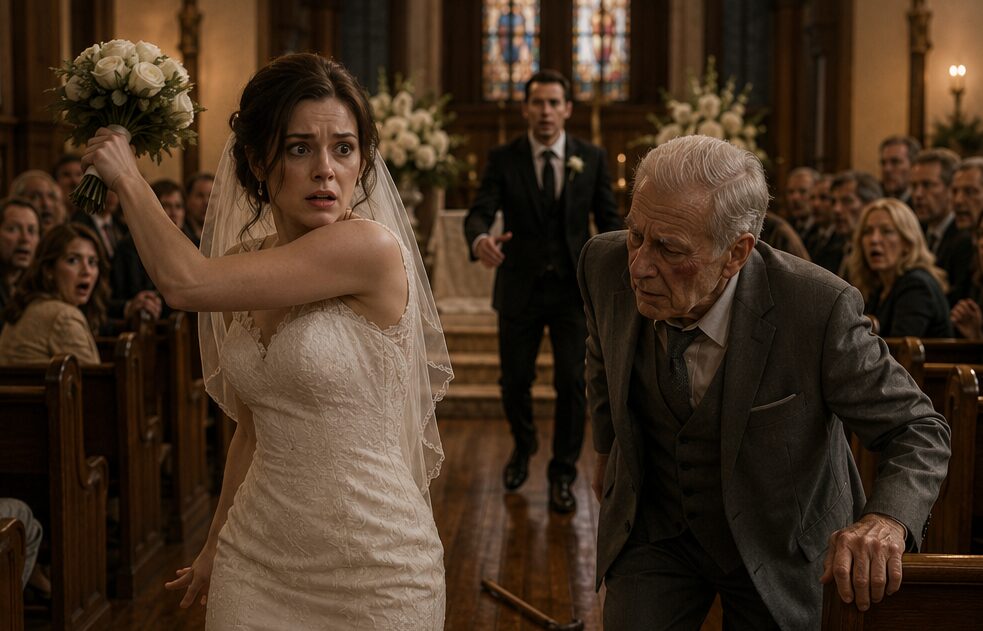
Something inside her snapped before she even understood it had happened.
The bouquet swung backward sharply in her hand.
White roses struck her father across the cheek and shoulder.
A horrible cracking sound echoed as the cane flew sideways across the floor.
Gasps tore through the church.
Her father bent awkwardly, grabbing at the pew beside him.
The music stopped mid-note.
Stephanie stared at her own arm like it belonged to someone else.
Frank took one instinctive step forward.
Then stopped.
Because Stephanie looked more horrified than anyone.
Her father pressed a trembling hand to his face.
The church had gone completely silent except for someone near the back whispering, “Oh my God.”
Stephanie wanted to explain.
But explain what?
That one sentence could carry twenty years inside it?
That exhaustion could become physical before you recognized it?
That sometimes love turned into a room with no windows?
Her father slowly straightened.
“It was an accident,” he said before anyone else could speak.
His voice sounded calm. Generous.
Protective.
Which somehow made it worse.
Carol rushed into the aisle. “Robert, are you alright?”
“I’m fine,” he said gently.
People stared at Stephanie.
Not angrily.
Confused.
Like they were trying to fit what they had just seen into the version of her they knew.
The dependable daughter.
The patient one.
The woman who had stayed home until thirty-four because her father needed help after the stroke.
Frank came toward her carefully.
“Steph,” he said quietly.
She looked at him and saw the question already forming.
Not what happened.
Who are you?
Her father bent slowly to retrieve the cane.
Frank moved to help him, but Robert waved him off and managed it himself with stiff dignity.
“It’s alright,” Robert repeated. “Wedding nerves.”
A few nervous laughs floated through the church.
Nobody believed them.
But nobody wanted the alternative either.
Stephanie realized then that the wedding had not actually stopped.
It had simply become something else.
And everyone in the room would remember it forever.
Part II — The Reception Hall
The reception continued because stopping it would have made the moment real.
That was the unspoken agreement.
People drank champagne too quickly. Conversations broke apart whenever Stephanie walked past. Elderly women squeezed her hand with aggressive sympathy.
“You’ve been under so much pressure.”
“Your father adores you.”
“He looked so proud walking you down the aisle.”
Every sentence felt like a small weight added to her chest.
Frank stayed close without hovering.
That almost made her cry.
At one point she caught him watching her father from across the room.
Not with anger.
With concentration.
Like he was trying to solve something.
Robert sat near the window table while people rotated around him offering concern and admiration. His gray suit hung loosely on his narrow frame. The bruise near his cheek had already started darkening faintly beneath the reception lights.
Stephanie couldn’t stop staring at it.
She carried a plate of food to him automatically.
Another reflex.
“You should eat,” she said.
Robert looked up at her with tired eyes. “You don’t have to take care of me tonight.”
The sentence sounded kind.
But she heard the second sentence underneath it.
You always will anyway.
Frank appeared beside her. “Can I get either of you anything?”
Robert smiled faintly. “You’ve got enough responsibilities now.”
Frank’s jaw tightened almost invisibly.
Stephanie noticed because she had spent years learning how to notice tiny changes in men who rarely spoke directly.
After Robert’s stroke, everything in the house had become indirect.
“Maybe your father shouldn’t be alone tonight,” Carol said later near the dessert table.
Stephanie froze.
“Just until tomorrow,” Carol added quickly. “After all the excitement.”
Frank answered before Stephanie could.
“We already arranged overnight help.”
Carol blinked. “Oh.”
The disappointment in that tiny word startled Stephanie more than criticism would have.
People liked her father needing her.
It made sense to them.
It made them feel warm and useful and morally certain.
Frank guided Stephanie toward the edge of the dance floor once the conversation ended.
“You okay?”
“No.”
“Do you want to leave?”
She almost said yes.
Instead she looked toward her father again.
Three church members stood around him now while he spoke softly. Stephanie knew exactly how the scene looked from a distance.
Fragile widower.
Devoted daughter.
New husband pulling her away.
“I hit him,” she whispered.
“You swung flowers at him.”
“I hit him.”
Frank studied her face.
“What did he say to you?”
Her throat tightened immediately.
“I don’t know how to explain it without sounding insane.”
“Try.”
She stared down at her wedding ring.
“He always says things quietly. Tiny things. Like he’s just talking.”
Frank waited.
“He makes everything feel temporary. Every job. Every apartment. Every relationship.”
“When?”
“All the time.”
That answer sounded weak even to her.
Frank rubbed his hand slowly across the back of his neck.
“You think he meant to upset you?”
“No.” She paused. “Yes. I don’t know.”
Across the room, Robert laughed softly at something someone said.
Then he looked toward Stephanie.
Not angry.
Wounded.
Which was somehow more unbearable.
That expression followed her into every memory afterward.
Especially the old ones.
The years after the stroke.
The medication charts taped to the refrigerator.
The physical therapy appointments he eventually stopped trying at because “there wasn’t much point.”
The time she got offered a marketing position in Chicago and turned it down because Robert had stared at the kitchen table for ten minutes before quietly saying, “I suppose I’ll figure something out.”
He never asked her to stay.
That was the problem.
He made staying feel like the only version of herself she could survive.
Later that night, while guests danced awkwardly to old Motown songs, Stephanie found herself standing beside Linda near the coffee station.
Linda handed her a napkin.
“You need this more than the cake does.”
Stephanie laughed once despite herself.
Then Linda said quietly, “You looked trapped walking down that aisle.”
Stephanie’s eyes lifted sharply.
Most people had looked confused.
Linda looked like she understood too much.
“I’m sorry about earlier,” Stephanie said automatically.
Linda studied her for a moment.
“That’s not actually what you’re sorry about.”
Before Stephanie could answer, someone called Linda’s name from across the room.
The moment disappeared.
But it stayed under Stephanie’s skin all night.
Part III — The Daughter Who Stayed
Three days after the wedding, Stephanie stood in her father’s kitchen opening pill bottles while he sat at the table pretending to read the newspaper.
This was not supposed to happen.
They were supposed to be leaving for Vermont that morning.
Instead the honeymoon had been “delayed a week.”
That was the phrase everyone approved of.
Delayed sounded responsible.
Temporary.
Reasonable.
Frank leaned against the doorway watching her sort medications into plastic compartments.
“You know the overnight nurse can do that.”
“She doesn’t know his schedule yet.”
“She has a chart.”
Stephanie snapped one compartment shut too hard.
Her father lowered the newspaper slightly.
“You two should go,” he said mildly. “I told everyone I’d manage.”
Frank’s eyes flicked toward Stephanie.
Everyone.
Stephanie knew exactly what that meant.
At church yesterday, three different people had stopped her to praise her devotion.
One woman had squeezed her arm and whispered, “Your father’s lucky you’re not the kind of daughter who disappears after marriage.”
Frank walked outside a few minutes later without another word.
Stephanie found him standing beside the car.
“You’re angry.”
“No,” he said.
That meant yes.
“You think I’m choosing him over you.”
“I think you don’t know how not to.”
The sentence landed harder because he said it gently.
Stephanie crossed her arms tightly.
“He had a stroke, Frank.”
“And you’ve been drowning ever since.”
“I’m not drowning.”
He looked at her for a long moment.
“You hit your father in front of two hundred people because he implied you’d never leave him.”
Her face burned instantly.
“I know.”
“No, Steph. I don’t think you do.”
Inside the house, the screen door creaked open.
Robert stepped slowly onto the porch with the cane.
“I don’t want to cause problems,” he said quietly.
Frank closed his eyes briefly.
There it was again.
Not accusation.
Not demand.
Something worse.
Fragility used like gravity.
Stephanie suddenly felt exhausted clear down to her bones.
That evening she drove to the grocery store just to sit alone in the parking lot for ten minutes.
Instead she found Linda loading bags into the trunk of her sedan.
“You look terrible,” Linda said bluntly.
“Thank you.”
Linda shut the trunk. “You want coffee?”
Stephanie should have said no.
Instead she followed Linda to the diner near the highway.
Halfway through their coffee, Linda stirred cream into her cup and said, “Your father almost moved into assisted living four years ago.”
Stephanie frowned. “No he didn’t.”
“Yes he did.”
Stephanie stared at her.
Linda looked uncomfortable now, which made the story feel immediately true.
“He toured two places,” Linda said quietly. “Nice ones too.”
“Why didn’t he go?”
Linda hesitated.
Then she said, “He told me if he stopped needing you, he was afraid you’d stop coming.”
The diner suddenly felt airless.
Stephanie leaned back slowly.
“No,” she whispered.
Linda nodded once.
“He said after the stroke, you became his whole life.”
Stephanie looked down at the untouched coffee between her hands.
A memory surfaced instantly.
Her father refusing physical therapy because the exercises “worked better” when Stephanie helped him at home.
Him calling her at work over tiny things.
The relieved expression whenever plans got canceled.
“Oh my God,” she said softly.
Linda’s face tightened with guilt.
“I should’ve said something years ago.”
“Why didn’t you?”
“Because he loved you.”
Stephanie laughed once under her breath.
A broken sound.
“That’s the problem.”
Linda reached across the table slowly.
“Honey, love can still trap people.”
Stephanie drove home with the windows down despite the cold.
For the first time, the aisle whisper sounded different in her head.
Not cruel exactly.
Terrified.
That should have made her feel better.
Instead it made her feel tired in a way she couldn’t explain.
Part IV — The Gathering
The church ladies called it a recovery supper.
As if the wedding itself had been an illness everyone needed to survive together.
Stephanie almost refused to attend.
Then Carol left a voicemail saying, “People are worried about your father feeling lonely.”
So she went.
The fellowship hall smelled like baked pasta and coffee.
People hugged Robert carefully when he arrived, touching his arm like he might break.
Stephanie noticed how naturally he fit into their sympathy.
How easily she fit into their expectation.
“You’ll still come by every day, right?” someone asked while handing her a paper plate.
Another woman smiled warmly. “Your father pretends he’s fine, but we know better.”
Frank stood beside Stephanie stiffly polite.
Nobody asked him anything.
At one table, Robert quietly told a story about forgetting where Stephanie had put the sugar last week.
Everyone laughed gently.
Stephanie stared at him.
Not because the story was cruel.
Because it sounded like a husband talking about a wife.
A life partner.
A permanent companion.
The room suddenly felt unbearable.
She stepped outside into the parking lot.
Frank followed a minute later.
“You were right,” she said before he could speak.
He looked surprised.
“About what?”
“I don’t know how to leave.”
The words shook coming out.
Frank leaned against the brick wall beside her.
“You don’t have to abandon him.”
“That’s what everyone thinks leaving means.”
Including me, she almost added.
Inside the hall, laughter drifted faintly through the doors.
Stephanie remembered being twenty-six and canceling a weekend trip because her father said he got nervous sleeping alone.
Twenty-nine and turning down a condo because it was “too far.”
Thirty-one and ending a relationship because the man finally admitted he felt like he was dating both of them.
At the time each choice had seemed temporary.
Reasonable.
Loving.
Now they stacked together like years disappearing quietly.
“I don’t even know who I am without being needed,” she admitted.
Frank took her hand.
“You’re allowed to find out.”
She nearly cried right there in the parking lot.
Inside, someone called for Stephanie to help carry leftovers to Robert’s car.
Of course they did.
When she returned to the hall, she saw Linda watching her carefully from across the room.
Not pitying.
Witnessing.
That felt harder somehow.
By the time the gathering ended, Robert looked exhausted.
Stephanie offered to drive him home before anyone else could volunteer.
The ride was mostly silent.
Streetlights moved across the windshield in soft intervals.
Finally Robert said, “People were very kind tonight.”
Stephanie kept her eyes on the road.
“Yes.”
“You’ve always had good people around you.”
The sentence irritated her instantly because it avoided everything real.
“You told them I might postpone the honeymoon.”
A pause.
“I said you were worried about leaving.”
“You made it sound like my choice was selfish.”
“I never said that.”
“No,” she said quietly. “You just let everyone else say it.”
Robert looked out the passenger window.
Neither spoke again until they reached the house.
Part V — What Was Left Unsaid
Stephanie helped her father up the walkway slowly.
The porch light flickered weakly above them.
When they reached the front door, Robert stopped.
For a second neither moved.
The night felt strangely still.
Then Robert said, without looking at her, “I thought if you stopped needing me, I’d disappear.”
Stephanie’s chest tightened painfully.
Not because the sentence shocked her.
Because she finally believed it.
He turned toward her slowly.
For the first time in years he looked old instead of difficult.
Just old.
“I know what people think,” he said quietly. “That I lean on you too much.”
“You do.”
He nodded once.
“I didn’t mean to ruin your wedding.”
“You didn’t ruin it.”
But part of him had.
Part of her had too.
Robert looked down at the cane in his hand.
“When your mother died, the house got so quiet I could hear the refrigerator humming at night.” His voice weakened slightly. “After the stroke, I couldn’t even open jars by myself anymore. Then you stayed.”
Stephanie felt tears rising before she could stop them.
“You never asked me what I wanted.”
His face tightened.
“I was afraid of the answer.”
That hurt more than the whisper in church.
Because it was honest.
Stephanie covered her mouth briefly with her hand.
For years she had imagined some dramatic explanation.
Manipulation.
Control.
Cruelty.
Instead it was something smaller and sadder.
Fear turning selfish one quiet day at a time.
“I already disappeared,” she whispered.
Robert closed his eyes.
The porch light buzzed softly overhead.
Neither of them moved for several seconds.
Finally Stephanie stepped forward and opened the front door for him.
She helped him inside.
Set the medication tray on the counter.
Adjusted the blanket folded over his recliner.
The familiar routine almost swallowed her again right there.
She could feel it happening.
One more night.
Then another.
Then six months.
Then years.
Robert looked at her carefully.
“You don’t have to stay.”
The sentence sounded different this time.
Not a test.
Not bait.
Just sad.
Stephanie picked up her purse slowly.
“I’ll come tomorrow afternoon,” she said. “The nurse will handle the morning.”
Robert nodded.
No argument.
That nearly broke her.
She walked to the front door.
Behind her, the house sounded painfully familiar.
The clock ticking.
The hum of the refrigerator.
The life she almost mistook for herself.
When she opened the door, Frank was standing beside the car waiting quietly under the porch light.
Stephanie looked back once.
Her father stood in the hallway with the cane beside him.
Watching.
Not stopping her.
That mattered.
She walked down the steps anyway.
Part VI — The Distance They Learned
By autumn, people at Saint Andrew’s still mentioned the wedding sometimes.
Never directly.
Just careful little comments.
“How’s your father doing these days?”
“Glad to see you finally took that honeymoon.”
“You always were such a devoted daughter.”
Stephanie stopped explaining herself.
That was new.
She and Frank moved into the apartment near the river three weeks after the wedding. The first month felt strangely uncomfortable, like wearing clothes that belonged to someone else.
Sometimes she still reached for her phone in panic at nine o’clock because she forgot she no longer handled every nighttime medication reminder herself.
There were outside caregivers now.
A physical therapist twice a week.
Meal deliveries.
Boundaries that felt both cruel and necessary.
Her father resisted some of it.
Accepted some of it.
But he survived it.
So did she.
One Sunday after church, Stephanie found him walking slowly along the sidewalk outside Saint Andrew’s.
The cane tapped steadily against the concrete.
For a few seconds, he moved without noticing her nearby.
Not helpless.
Not abandoned.
Just older.
Human.
Then he saw her.
Something complicated passed between them.
Love.
Embarrassment.
Relief.
Loss.
Stephanie walked toward him slowly.
This time, when she took his arm, it was because she chose to.
Not because the whole town was watching.