The Night He Finally Let the Whole Room See the Bill
Part I — The Number on the Screen
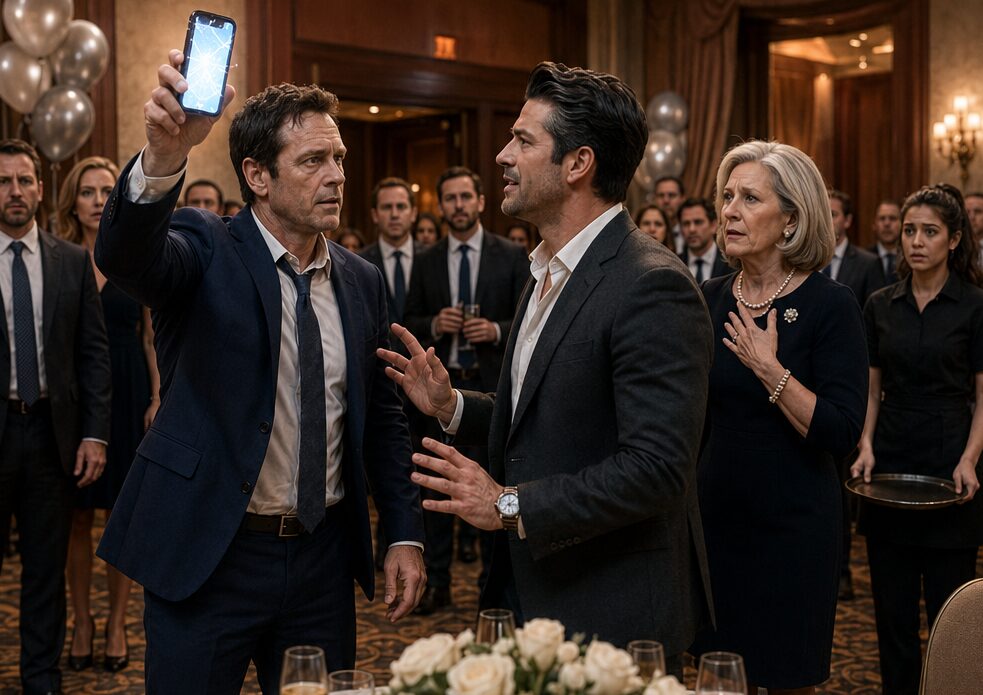
Charles stood under the gold lights of the Lakeside Grand Hotel ballroom with his cracked phone raised in one hand.
Behind him, silver balloons bobbed against a white banner that read:
CLASS OF 2008 REUNION
On his screen, beneath a thread of messages, one number glowed brighter than everything else.
$250,000
The room went quiet in pieces.
First the table nearest him.
Then the women by the dessert station.
Then the men at the bar, still holding their beers halfway to their mouths.
James stood two feet away in a charcoal blazer, his smile frozen in place like someone had painted it on him.
“Put it down,” James whispered.
Charles did not.
The phone trembled slightly, not because Charles was afraid of James, but because every person in that ballroom knew some version of him. They knew him as the quiet one. The tall one. The boy who fixed engines behind the gym. The man who still fixed decks, sinks, cabinets, roofs, anything people broke and wanted repaired before they had to be honest about how badly they’d let things go.
They knew James differently.
Former homecoming king. Local business owner. Donor. Speaker. The man whose face had been printed on the reunion program beside the words Built From Nothing.
Charles looked at the last message on his phone.
Don’t embarrass me tonight. I’ll pay you after the reunion.
He read it once more, silently.
James’s eyes flicked to the crowd, then back to Charles.
“Don’t do this,” James said, still smiling for everyone else. “Not here.”
That was the thing about James.
He always knew where he was standing.
Charles had spent too many years pretending not to.
Mary, James’s mother, stood near the front table in a dark dress and pearls, one hand resting on the back of a chair. Her face had the polished alarm of a woman who believed unpleasant things became worse when spoken out loud.
Rachel stood near the service doors in a black catering uniform, a tray pressed flat against her stomach.
Charles saw his daughter’s face before he saw anyone else’s.
Not embarrassed this time.
Waiting.
James stepped closer and lowered his voice.
“Charles. Put the phone down.”
Charles’s thumb moved over the screen.
He didn’t raise his voice.
He didn’t need to.
“Two hundred and fifty thousand dollars,” he said.
The ballroom changed shape around the words.
Part II — Before the Ballroom
Six hours earlier, Charles had not planned to go.
His navy suit hung from the laundry room door in its plastic dry-cleaning sleeve, though it had not been dry-cleaned. Rachel had steamed it herself in the bathroom while Charles sat at the kitchen table with three bills, one coffee mug, and his phone facedown beside a college brochure.
“You said you’d go,” Rachel said.
“I said I’d think about going.”
“That means no when adults say it.”
“You’re seventeen. Don’t start talking like you pay property taxes.”
Rachel held the suit up against him from across the room. The jacket was clean, but the shoulders looked tired. Like it remembered a version of Charles that had stood up straighter.
“You should go,” she said. “People ask about you.”
“No, they ask if I still do handyman stuff.”
“You do.”
“Not the same thing.”
Rachel looked at the kitchen table.
Charles followed her eyes too late.
The assisted-living statement sat under the mug. He had turned it facedown, but the red balance line still bled through the cheap paper.
Rachel set the suit over a chair.
“I can pick up more catering shifts,” she said.
“No.”
“You don’t even know what I was going to say.”
“I know the shape of it.”
Her mouth tightened. She had inherited his stubbornness and none of his patience for being managed.
His phone buzzed.
Charles picked it up and saw the name he had been trying not to see.
James: You coming tonight? We should talk after. Big night. Lots of people around.
Charles stared at the message until the screen dimmed.
Rachel moved closer. “Is that him?”
“No.”
“Dad.”
He put the phone down.
James had been saying “we should talk” for almost four years.
After closing.
After inspection.
After tax season.
After the next flip.
After the lake house sold.
After the investors came through.
After one more big thing made all the small wrong things easier to fix.
Charles had replaced floors in James’s rentals, rebuilt cabinets in kitchens James later filmed for social media, repaired plumbing at midnight, fronted materials when James’s card “had a temporary hold,” and carried invoices from one month into the next until the numbers no longer looked like money. They looked like a punishment for believing a man who used the word brother when he meant discount.
Rachel’s phone buzzed next.
She glanced down, then made a small, bitter sound.
“What?” Charles asked.
She held it out.
It was a post from James.
A reunion photo taken outside the Lakeside Grand Hotel, James standing in front of a row of white columns with his watch showing and his grin wide.
Caption: Built everything from nothing. Never forget where you started.
Behind him, in the corner of the picture, was a glossy image on a promotional banner for James Homes.
A lake house with cedar siding, black windows, and a stone patio.
Charles had spent nine months on that house.
He had slept in his truck twice during the winter because the inspector was coming in the morning and the heat wasn’t working yet.
James still owed him for the patio, the flooring, the emergency roof repair, and half the kitchen.
Rachel watched his face.
“You built that,” she said.
Charles put the phone facedown.
“I helped.”
“No. You built that.”
He reached for the assisted-living statement and folded it once, then twice.
His mother, Elizabeth, had always hated being called difficult. She preferred particular. Particular about her coffee. Particular about curtains. Particular about not being talked to like she had disappeared just because her hands had started shaking.
The facility text had come in that morning.
If the overdue balance was not addressed by Monday, Elizabeth would be moved to a shared-care room.
Charles had read the message three times before breakfast and told Rachel he had a slow work week.
Rachel picked up the college brochure from under the mail. It was for a campus two states away. She had circled a weekend visit in blue pen, then crossed it out so neatly it looked like a design choice.
Charles noticed.
She noticed him noticing.
“I changed my mind,” she said.
“You wanted that visit.”
“It’s just a visit.”
“You don’t cross out things you don’t care about.”
She looked at him, and the anger in her face broke into something younger.
“You don’t have to protect me from knowing we’re broke.”
He almost said they weren’t broke.
Then he looked at his hands.
Drywall dust still lived in the cracks of his knuckles no matter how hard he scrubbed. The hands of a man who had touched half the town’s homes and owned none of their ease.
Rachel picked up his suit jacket.
“Go tonight,” she said. “Ask him in person.”
“He’ll have people around him.”
“Good.”
“Rachel.”
“I’m tired of watching people treat you like you’re lucky they remember your name.”
The sentence hit harder because she said it quietly.
Charles stood, took the suit from her, and carried it to his bedroom.
Behind the closed door, he sat on the edge of the bed with the jacket over his knees. He remembered his father’s fists. Not the worst things. Just the way people stepped back when his father got loud in public. The way Charles had promised himself, at fourteen, that no one would ever look at him like that.
He had mistaken quiet for safety ever since.
His phone buzzed again.
James: Tonight’s not the night for old invoices. Let me enjoy this. I’ll pay you after the reunion.
Charles looked at the message for a long time.
Then he put on the suit.
Part III — The Man Everyone Liked
The Lakeside Grand Hotel smelled like lemon polish, perfume, and expensive food kept warm under silver lids.
Charles had barely made it through the check-in table when James found him.
“There he is!” James called, loud enough for three tables to turn. “My guy.”
Before Charles could brace, James threw an arm around his shoulders.
The grip looked friendly.
It felt like a clamp.
James was still handsome in the easy way that made people forgive him before he asked. His hair had silver at the temples now, but it only made him look more expensive. His open-collar white shirt showed no sign of sweat. His watch caught the chandelier light every time he moved his hand.
“You clean up,” James said. “Look at you.”
Charles smiled because people were watching.
James turned him toward a cluster of classmates. “This man right here can fix anything except his dating life.”
The laugh came fast.
Not cruel enough to object to.
Just easy enough to survive.
Charles felt Rachel watching from across the room, where she stood beside the catering staff with a tray of water glasses.
He wished she had not taken the shift.
He wished she had not seen that laugh.
A woman Charles half remembered from chemistry asked, “So you still do handyman stuff?”
“Contracting,” Charles said.
“Oh, that’s great.” Her eyes had already moved past him toward James. “And you must be doing amazing. I see your signs everywhere.”
James gave a modest shrug. “We’ve been blessed.”
Blessed.
That was James’s favorite word for other people’s labor.
A man in a navy vest joined them, and James brightened.
“Charles, this is an investor I was telling you about. Charles does some subcontractor work for us.”
Charles looked at James.
“Independent contractor,” he said.
James squeezed his shoulder.
“Same difference.”
It wasn’t. It had never been.
But James was already talking about market timing, custom finishes, community revitalization. People leaned in when he spoke. He made money sound like weather, like some men simply knew when it would rain.
Charles excused himself and went to the bar for water.
He had promised himself he would ask privately.
No drama. No raised voices. No scene.
He found James fifteen minutes later near the hallway to the restrooms, checking his reflection in a darkened window.
“I need part of it tonight,” Charles said.
James did not turn right away.
When he did, the friendly face remained. The eyes did not.
“Part of what?”
Charles waited.
James sighed. “Come on.”
“My mother’s facility called. I need enough to keep her room.”
“Tonight?”
“I’ve been asking for months.”
James glanced toward the ballroom. “Not here.”
“You told me to come.”
“I told you we should talk.”
“This is talking.”
James smiled without warmth. “The number you keep throwing around isn’t real money, Charles. You padded that invoice like crazy.”
Charles felt his jaw tighten.
“You approved every change order.”
“You know how these projects go.”
“I know how mine went.”
James stepped closer. “Let me remind you of something. Before me, you were doing basement patch jobs and clogged sinks for people who paid you in casseroles. I brought you real work.”
“You brought me work you didn’t pay for.”
James’s face sharpened.
Then, just as quickly, he looked over Charles’s shoulder and smiled.
Rachel was there with a tray of empty glasses.
She pretended she had come to collect from the hall table.
James’s voice softened for her benefit. “Hey, kiddo. Your dad and I are just catching up.”
Rachel did not smile.
James took a glass from her tray though it was empty. “Working hard, huh? That’s good. Builds character.”
After he walked away, Rachel stood still.
Charles said, “Don’t.”
“I didn’t say anything.”
“I know your face.”
“Then read it.”
She left before he could answer.
A few minutes later, Mary took the microphone.
If James made a room lean in, Mary made it sit up straight.
She had chaired school auctions, bake sales, booster clubs, charity luncheons, and every committee where good manners could pass as leadership. She stood near the reunion banner in her dark dress and pearls, smiling at the room as if she had personally arranged everyone’s better qualities.
“We are so proud tonight,” Mary said, “to honor not just where we came from, but who among us remembered to give back.”
James lowered his head modestly.
Charles already knew what was coming.
Mary spoke of James’s donation to the new athletics wing. She spoke of leadership. She spoke of never forgetting one’s roots.
People clapped.
Charles looked at the ice melting in his untouched glass.
The number on his phone sat in his pocket like a hot coal.
Two hundred and fifty thousand dollars.
Materials. Labor. Emergency calls. Loans dressed up as advances. Invoices James had joked about, delayed, disputed, buried under charm.
Rachel appeared at the edge of the room again, her tray tucked against her hip.
Charles did not want to see her eyes.
But he did.
And for the first time all night, what he saw there was not embarrassment.
It was fear.
Not fear of James.
Fear that Charles would let this become normal.
Part IV — The Cost of Quiet
Rachel found him in the service hallway beside stacked banquet chairs and a rolling cart of coffee cups.
The music was muffled there. So were the voices. It was the kind of hallway where people went to become less presentable for a minute.
Charles had one hand braced against the wall.
Rachel set her tray down.
“Why do you let him talk to you like that?”
He let out a tired breath. “Not tonight.”
“It is tonight. It keeps being not tonight.”
“You don’t understand what it costs to make enemies in a town this small.”
Rachel’s answer came fast.
“I understand what it costs when you don’t.”
Charles looked at her then.
Her ponytail had loosened. A strand of hair stuck to her cheek. She looked too young to be wearing black catering clothes at her father’s reunion and too old to still believe he could hide the truth from her.
“I saw the bill,” she said.
He closed his eyes.
“Rachel.”
“I saw the facility text too.”
“I was handling it.”
“You were folding it under coffee mugs.”
The sentence had no cruelty in it. That made it worse.
She reached into her apron pocket and pulled out a folded college brochure. The same one from the kitchen table. The crossed-out visit was visible under the hallway light.
“I told them I couldn’t come that weekend,” she said.
Charles felt something in his chest move downward.
“You didn’t have to do that.”
“Yes, I did. Because you keep acting like if you don’t say things out loud, they don’t land on anybody else.”
He wanted to tell her she was wrong.
He wanted to tell her adulthood was compromise and patience and timing. He wanted to tell her that public scenes had consequences. That men like him did not get to be angry in rooms like this without people remembering every story they had already decided about him.
Instead he saw his father in a VFW hall, red-faced and loud, while people pulled their chairs away.
He heard his mother say, later, “Your father always thinks volume is the same as truth.”
Charles had built a whole life around being quieter than that.
Rachel stepped closer.
“You think you’re protecting me,” she said. “But sometimes it feels like you’re teaching me how to disappear.”
That one found him clean.
There were lines a person heard and forgot.
There were lines that rearranged the room.
Charles looked toward the ballroom doors.
Inside, James’s laugh rose over the music.
Rachel wiped one eye quickly, angry that it had betrayed her.
“I’m proud of what you do,” she said. “I’m just tired of watching people make you act like you should be grateful for being used.”
Charles reached for her shoulder, then stopped, because she looked like she might break if he was gentle.
“I’ll talk to him,” he said.
“You keep saying that.”
“I mean it this time.”
She nodded, but not like she believed him.
That was what pushed him toward the parking lot.
Not courage.
Not rage.
The look on his daughter’s face when she tried not to hope.
Outside, the air was cold enough to clear the noise from his head. He walked across the hotel lot toward his old truck, intending to leave before he became someone he could not respect.
James was waiting by the driver’s door.
Of course he was.
He had both hands in his pockets and the tired expression of a man inconvenienced by someone else’s need.
“You scared me for a second back there,” James said.
Charles stopped several feet away. “Move.”
James held up his phone. “I’m sending you five thousand.”
Charles stared at him.
“That should help with whatever emergency you’re having.” James tapped the screen. “There. See? I’m not the villain.”
Charles’s phone buzzed in his pocket.
Five thousand dollars.
The exact amount of money a man offers when he wants credit for mercy and escape from math.
Charles did not take out his phone.
“That doesn’t touch what you owe.”
James’s jaw moved.
“Don’t be stupid. You need it.”
“Yes.”
“Then take it.”
“No.”
The word landed between them harder than Charles expected.
James laughed once. “Look at you. Standing on principle in a hotel parking lot with a truck that sounds like it’s held together by prayer.”
Charles reached for his keys.
James moved in front of the door.
“Don’t do the whole Reed-family explosion thing,” he said.
Charles went still.
James watched the line hit. He had known exactly where to place it.
“You’re better when you stay useful,” James said.
For a moment, Charles was fourteen again, standing outside a bar while grown men decided whether his father was dangerous or pathetic.
His fists curled before he could stop them.
James saw that too.
“There it is,” he said softly. “That’s why you don’t want a scene, right? Afraid people will remember where you came from?”
Charles looked down at his own hands.
Large hands.
Good hands.
Hands that had built porches, lifted beams, fixed leaks, carried Rachel asleep from the couch when she was small.
Hands that had never touched his daughter in anger.
He opened them slowly.
Then he stepped around James and pulled open the truck door.
“You’re leaving?” James asked.
Charles got in.
James leaned toward the window. “Smart.”
Charles sat with both hands on the steering wheel, breathing until the old version of himself went quiet.
Then, through the windshield, he saw Rachel inside the lobby doors.
She was watching.
Not judging.
Just watching the lesson.
Charles turned off the engine before he started it.
He got out of the truck.
James frowned.
Charles walked back toward the hotel.
Behind him, James said, “Charles.”
Charles did not turn around.
Part V — The Room Chooses Silence
James had the microphone when Charles returned.
The ballroom was brighter than before, or maybe Charles was simply seeing every face too clearly now.
James stood beneath the reunion banner with one hand over his heart.
“I just want to say,” James told the room, “that coming back here reminds me what work really means. Nobody builds anything alone, but some of us learned early how to bet on ourselves.”
People clapped.
Charles stopped just inside the doors.
Rachel stood at the back wall, tray in hand.
Mary smiled up at her son like he was proof that good families produced good outcomes.
James continued. “That’s why James Homes is proud to announce a scholarship fund for graduating seniors who believe in hard work, accountability, and giving back.”
More applause.
The word accountability passed over Charles like a hand over a bruise.
He could still leave.
He could still protect the room from discomfort.
He could still protect James from the consequences of being known.
Then James saw him.
For half a second, worry flashed across his face.
Then he did what he always did.
He made the room laugh.
“And hey,” James said, pointing toward Charles with the microphone, “if any of you need a deck fixed, Charles is still your man. Just don’t let him invoice you like he’s building the Taj Mahal.”
The laugh rose automatically.
It did not last.
Because Charles had started walking.
Not fast.
Not angry.
Just forward.
The kind of walk that made people stop deciding what they thought and start waiting to see what would happen.
James lowered the microphone an inch.
“Charles,” he said, the smile still trying to work.
Charles reached the front of the room.
He took out his phone.
Its cracked screen caught the chandelier light in broken lines.
James’s voice dropped. “Don’t.”
Charles opened the invoice.
Then the text thread.
Then he lifted the phone so the first row could see.
A woman near the floral centerpiece covered her mouth.
Someone whispered, “What is that?”
Charles spoke clearly.
“Two hundred and fifty thousand dollars.”
The room went very quiet.
James’s face tightened. “This is not the time.”
Charles read from the screen.
“‘Don’t embarrass me tonight. I’ll pay you after the reunion.’”
James’s smile vanished.
Charles scrolled once.
“‘I know I owe you. Let me get through the event.’”
A glass clinked somewhere in the back.
Charles kept his eyes on the screen because if he looked at Rachel, he might not finish.
He read the final line.
“‘You know I’m good for it.’”
No one laughed now.
Mary stepped forward.
“Charles,” she said, her voice sharp with manners, “this is not appropriate.”
Charles looked at her.
For years, Mary had sent him thank-you notes when he fixed things at the church auction booths. She always wrote his name in perfect cursive. She always paid late.
“No,” Charles said. “It isn’t.”
James came close enough that only the first two tables could hear the first words.
“You don’t get to do this to me.”
Charles looked up.
“I’m not doing it to you,” he said. “I’m stopping you from doing it to me.”
Something in James broke then.
Not loudly.
Not visibly to everyone.
But Charles saw it.
The instant James understood charm had reached the end of its road.
He swung his hand and slapped the phone from Charles’s grip.
The sound was small.
The gasp was not.
The phone hit the ballroom carpet beside a white floral centerpiece and bounced faceup, screen still glowing.
For one second, nobody moved.
Not even James.
Charles’s cheek stung where James’s fingers had grazed him after the phone left his hand.
His fists closed.
He heard his own breath.
He heard, from somewhere far away, his father’s voice in a room full of people pulling back.
He saw Rachel.
She had not covered her mouth.
She had not looked away.
Charles bent down.
Slowly.
He picked up the phone.
The room watched him as if watching a man choose what kind of story they would tell about him tomorrow.
He wiped the screen once against his jacket sleeve.
Then he placed it on the nearest banquet table, faceup.
“You can keep the five thousand,” Charles said.
His voice carried farther than he expected.
“My lawyer can handle the rest.”
James lunged.
It was not a punch. It was uglier because it was smaller than that. A desperate grab at Charles’s jacket, a schoolyard pull from a grown man who had run out of rooms to control.
Charles took one step back.
James came with him.
The jacket tore at the seam.
Charles planted his feet.
All those years of lifting plywood, bracing walls, carrying refrigerators up narrow stairs, holding things steady while other people panicked—his body knew what to do before his anger did.
He shoved James off.
James stumbled backward, caught his heel on a chair leg, and went down hard beneath the reunion banner.
The room erupted.
Not applause.
Not approval.
Just noise.
A woman said, “Oh my God.”
Someone else said James’s name.
Mary rushed forward, one hand over her mouth, pearls shifting against her throat.
Charles stood where he was.
Breathing hard.
Fists clenched at his sides.
He did not move toward James.
He did not speak.
He did not smile.
He had never felt less like his father.
And never more visible.
Part VI — What Stayed Unsaid
The room divided without anyone announcing it.
Some people moved toward James.
Some stayed seated and stared at the phone glowing on the table.
A few looked at Charles with something like apology, though not enough of them found words for it.
That was fine.
He had spent too many years accepting almost.
Almost paid.
Almost respected.
Almost treated like a man whose work had weight.
Rachel crossed the ballroom.
She did not hurry. She set her tray down first because even then, even in the middle of everything, she knew what work required. Then she picked up Charles’s torn suit jacket from where James had yanked it loose.
James was sitting up now, red-faced, furious, one hand gripping his mother’s arm.
Mary looked at Charles like he had spilled something permanent on the carpet.
“You should go,” she said.
Charles nodded once.
“I was already leaving.”
Rachel held out his jacket.
He took it.
Their fingers touched for half a second.
That was the closest either of them came to crying in the ballroom.
As they walked toward the exit, people made a path. Not a dramatic one. Just enough space to avoid being touched by the consequence of what they had witnessed.
Near the doors, a man Charles barely remembered leaned toward him.
“Did he really owe that much?”
Charles kept walking.
Outside, the cold air felt honest.
The hotel doors closed behind them, muting the music, then the voices, then the version of Charles that had walked into that room trying not to take up space.
Rachel followed him to the truck.
For a while, neither of them spoke.
He unlocked the passenger door for her out of habit, then came around to the driver’s side. His hands shook when he put the key in the ignition.
Rachel noticed.
He hated that.
She stared through the windshield at the hotel entrance, where silhouettes moved behind the glass.
Finally she said, “You didn’t hit him.”
Charles laughed once, but there was no humor in it.
“I wanted to.”
“I know.”
He looked at her.
Rachel’s face was pale under the parking lot lights. She looked older than she had that morning and younger than she would tomorrow. Something had been taken from her tonight—the easy belief that adults with nice clothes and microphones deserved their place at the front of the room.
But something else had been given back.
“That’s why it matters,” she said.
Charles swallowed.
His phone buzzed in the cup holder.
Then again.
Then again.
He looked down.
A message from a classmate: I’m sorry. I didn’t know.
Another: He owes my brother too.
Another: Call me Monday. I have a bathroom remodel, and I pay deposits upfront.
Charles turned the phone facedown.
Not because he was afraid of what it said this time.
Because for once, the room could wait.
The truck engine coughed, caught, and settled into its old rough idle.
Inside the hotel, the reunion music started again, softer now through the glass, as if the building itself had learned to be careful.
Rachel buckled her seat belt.
Charles pulled out of the parking space.
At the edge of the lot, he stopped before turning onto the road. Across the street, the lake was black and still. For years, he had thought dignity meant leaving quietly before anyone could say he had made a scene.
Now he knew better.
Sometimes dignity was a cracked phone on a banquet table.
Sometimes it was a daughter watching you choose not to swing back.
Sometimes it was driving away from a room that finally knew the truth and not needing to stay to hear what they did with it.
Rachel leaned her head against the window.
“You okay?” he asked.
She did not answer right away.
Then she said, “I’m proud of you.”
Charles kept both hands on the wheel.
The light changed.
He drove home with his phone buzzing facedown between them, the bill still unpaid, the future still uncertain, and his daughter no longer looking ashamed to be seen beside him.