The Day the Backyard Barbecue Stopped Feeling Like a Gift
Part I — Smoke Over the Patio
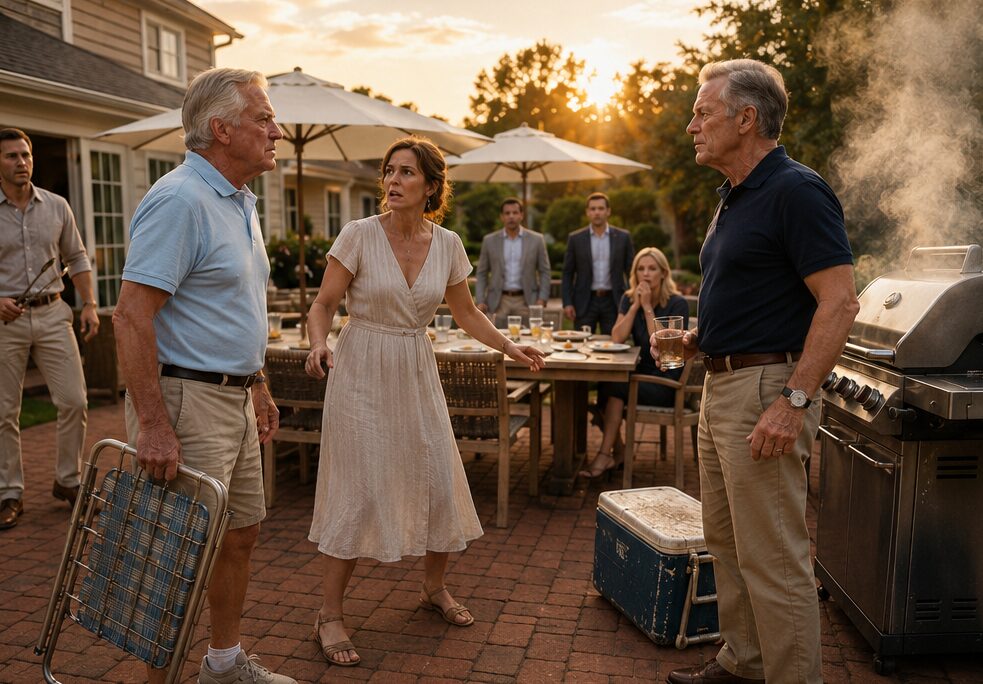
Paul was on the brick patio with one hand pressed flat against the warm ground, his light blue polo darkened with spilled lemonade, while Edward stood over him in a navy shirt as if the backyard still belonged to him.
No one moved.
Not the neighbors gathered near the hydrangeas.
Not Mark, who held a pair of grill tongs like he had forgotten what hands were for.
Not Karen, Paul’s sister, sitting stiffly at the patio table with both palms over her mouth.
Only Anna moved.
She dropped beside her father, knees hitting the brick, and whispered, “Dad, don’t get up.”
Paul heard her, but he also heard the grill.
The smoker behind Edward hissed and breathed, sending a ribbon of gray into the golden air. Ribs blackened on the rack. A paper plate had tipped sideways near Paul’s sneaker, baked beans sliding into a pink puddle of lemonade. Somewhere near the sliding doors, someone’s phone was half-raised, then lowered as if shame had finally caught up with curiosity.
Edward was breathing hard.
He did not look sorry yet.
He looked surprised that the room—no, not room, yard, patio, kingdom—had gone silent on him.
Anna touched Paul’s elbow. “Are you okay?”
His first instinct was to say yes.
His second was to look up at Edward and say something that would make the man step back.
But he was sixty-four years old, flat on another man’s patio at his daughter’s engagement barbecue, and the entire neighborhood had just watched him land there.
There were losses a man could explain.
This was not one of them.
Earlier, before the smoke got in everything, before Anna’s face changed, before the guests started pretending they had not seen what they had seen, Paul had stood in his own driveway with a tray of deviled eggs balanced on the roof of his truck.
He had made them because Anna liked paprika on top, not the fancy smoked kind, just the orange grocery-store kind her mother had used.
The cooler beside him was old, blue, and scuffed white at the corners. It had belonged to his wife before she left, before divorce turned ordinary objects into things nobody wanted to claim. Anna had asked him not to bring too much.
“Dad,” she had said on the phone, gentle but tired, “Edward’s handling most of the food.”
Handling.
Paul had laughed. “I know how to attend a barbecue without installing a deck.”
Anna had gone quiet for half a second too long.
That was how he knew she was nervous.
So he brought the eggs, the cooler, and the folding chair Edward had borrowed in April and returned in June with one aluminum leg bent like a bad promise.
Paul had fixed it.
Of course he had.
He had fixed worse things for better men and better things for worse men. A chair was nothing. A chair did not know it had been disrespected.
When he pulled up in front of Edward’s house, the place looked ready for a magazine spread about people who had never had to ask how much a repair would cost. Fresh mulch. White umbrellas. Clean patio cushions. A stainless-steel smoker large enough to feed a church picnic. A row of wineglasses catching sun on a side table.
Edward came down the front walk before Paul had shut the truck door.
“Paul,” he called, smiling with all his teeth. “There he is. The man who knows what to do with his hands.”
Paul lifted the deviled eggs. “Brought these.”
“Perfect, perfect.” Edward took one look at the cooler and folding chair. “You didn’t have to bring equipment. We’ve got plenty.”
“It’s just a cooler.”
“And the chair?”
“You gave it back crooked.”
Edward laughed, too loud for a thing that was not funny. “Did I? Well, look at that. Good as new.”
Paul could feel Anna watching from the backyard gate.
She wore a pale summer dress and sandals, her hair pinned up badly, the way it got when she was rushing and pretending she was not. She had inherited her mother’s ability to smile while calculating everyone’s mood at once.
“Dad,” she said, coming over fast. “You made eggs.”
“I was allowed one dish, right?”
“One dish,” she said, and kissed his cheek.
For three seconds, the day was simple.
Then Edward clapped his hands once.
“Paul, since you’re here, would you mind giving me your eye on the smoker? It’s running a little hot. I know you know vents better than I do.”
Anna’s smile stayed in place.
Paul felt the old reflex rise in him.
Be useful. Be easy. Do not make your daughter manage you.
“Sure,” he said.
He set the deviled eggs on the patio table and followed Edward into the smoke.
Part II — The Kindness That Came With Instructions
Edward’s backyard was arranged so no one could forget it was Edward’s backyard.
The older neighbors sat under the umbrella nearest the house. Mark’s college friends stood by the lawn with craft beers. The women from two houses down praised the patio lights as if Edward had invented electricity. Every chair faced inward toward the grill, where Edward stood with a towel over one shoulder and a meat thermometer in his hand.
Paul adjusted the smoker vent in twenty seconds.
“It’ll settle,” he said.
Edward leaned in, nodding. “That’s what I like about you. No drama. Just practical.”
It sounded like praise.
It always did, at first.
“Could you help me shift that umbrella too?” Edward added. “Sun’s hitting the dessert table.”
Paul glanced at Anna.
She was arranging napkins beside a woman from Edward’s side of the family. She looked over just long enough to give him an apologetic smile.
Paul lifted the umbrella.
After that came the chairs from the garage.
Then the cooler had to be moved to the shade.
Then Edward wanted his opinion on whether the ribs needed more time.
“Mark,” Edward called, “watch this. Paul can tell by looking.”
Mark came over with his anxious smile and rolled-up sleeves. He was a decent young man. Paul believed that. He loved Anna in the soft, careful way of men who were afraid of breaking anything.
But Mark had a way of standing near conflict without entering it.
“What do you think?” Edward asked Paul, lifting the smoker lid.
Smoke pushed into Paul’s face.
The ribs were fine. Maybe a little dry. Nothing worth saying.
“They’re coming along,” Paul said.
Edward looked pleased, as if Paul had passed a test he had not asked to take.
“See?” Edward told Mark. “This is why you keep people around who know things.”
Keep people around.
Paul wiped smoke from his eyes and told himself it was nothing.
The first hour passed like that. A joke here. A request there. Edward’s hand on Paul’s shoulder when introducing him to neighbors.
“This is Anna’s dad, Paul. Retired contractor. He helped us with that fence line situation last spring.”
Fence line situation.
Paul had spent two Saturdays helping Edward replace a section of fence that technically sat between their properties. Edward had ordered the materials, yes, but Paul had done the measuring, cutting, digging, leveling, and sweating. When Paul tried to refuse the check Edward offered, Edward had tucked it into his shirt pocket in front of two neighbors.
“Take it,” Edward had said. “I don’t like owing people.”
But he did like people owing him.
That was different.
At the patio table, Karen caught Paul’s eye. She lifted her eyebrows in a way that said, You hearing this?
Paul took a sip of beer to keep from answering.
He had only one.
He would remember that later, when it mattered.
Anna came over and touched his arm. “You okay?”
“Fine.”
“Dad.”
“What?”
“You have the face.”
“What face?”
“The face you get when you’re being fine in a way that costs everyone later.”
That almost made him laugh.
Then Edward called from the grill, “Paul, come settle a debate for me.”
Anna shut her eyes for half a second.
Paul said, “It’s your party, honey.”
“It’s our engagement barbecue,” she said.
But it did not feel like hers.
That was the part neither of them said.
By four o’clock, the yard was full, the patio was warm, and Edward had praised Paul’s usefulness seven different ways.
Then he made the joke.
Paul was standing near the drink table, trying to decide whether the lemonade was too sweet, when Edward said to a neighbor named Bill, “Paul knows his way around a grill better than most contractors know their way around a level.”
Bill laughed.
So did two other people who did not know whether they were allowed not to.
Paul turned slowly.
Edward had that host’s smile on, the one that never touched his eyes unless people were looking.
“Compliment,” Edward said, lifting both hands. “That was a compliment.”
Anna appeared at Paul’s side before he knew she had moved.
“Dad, come taste the pasta salad,” she said brightly. “I think it needs salt.”
He looked at her.
She knew it did not need salt.
They both knew.
Still, he followed her because she was his daughter and because he had promised himself he would not be the reason she remembered this day badly.
At the food table, Anna handed him an empty fork.
“I’m sorry,” she said under her breath.
“For what?”
“For him.”
Paul kept his voice low. “You don’t have to apologize for a grown man.”
“I know.”
But she did it anyway.
That was Anna’s problem. She took responsibility for every room she entered, then wondered why she was tired.
Before Paul could answer, Edward tapped a spoon against a glass.
“Can I have everyone for just a minute?”
The yard turned toward him as naturally as sunflowers turning toward light.
Edward stood beside the grill with Mark on one side and Anna on the other. He put an arm around his son. Then he reached for Anna’s shoulder too, though she was half a step too far away and had to lean in to make it work.
“I’ll keep this short,” Edward said, which meant he would not. “Today is about family. Two families. Two histories. Two sets of values. And we could not be happier to welcome Anna into ours.”
Applause rose.
Paul clapped.
Of course he clapped.
Edward continued, “Now, Mark’s mother and I wanted to give these two a little surprise. Weddings are expensive, and planning can take the joy right out of joy. So we’ve decided to take care of the photographer and the venue deposit.”
The applause grew louder.
Anna’s face went still.
Paul stopped clapping before he meant to.
Edward beamed. “We want them to start this chapter without unnecessary pressure.”
Unnecessary pressure.
Paul had promised Anna the photographer.
He had made the promise at her kitchen table with a calculator beside his coffee and a little shame under his tongue. He could not pay for the whole wedding. He knew that. But the photographer, he had said, that was his.
“You’ll have pictures,” he told her. “Good ones.”
Anna had cried a little, and he had pretended not to see.
Now everyone was congratulating Edward.
Mark looked relieved.
Anna looked trapped.
Paul set down his beer.
Karen, across the table, whispered, “Paul.”
He did not answer.
Some gifts were not gifts.
Some gifts came with a hand at the back of your neck.
Part III — One Thing to Be Easy
Paul tried to make it through the next hour by doing what he had always done.
He worked.
He refilled ice. He stacked empty plates. He showed one of Mark’s cousins how to fold the broken chair so it would not pinch fingers. He smiled when people said Edward was generous. He nodded when someone told him Anna was lucky to marry into such a stable family.
Stable.
That was a word rich people liked to use when they meant expensive.
Edward kept circling back.
“Paul, you want another beer?”
“No.”
“You sure? Big day.”
“I’m sure.”
“You did good with Anna,” Edward said, loud enough for nearby guests to hear. “Single parenting isn’t easy. Takes grit.”
Paul looked at him.
Edward’s smile stayed smooth.
“And look at her now,” Edward continued. “Marrying a man with a plan.”
Mark laughed weakly.
Anna’s jaw tightened.
Paul wanted to ask whether Edward had ever gone a full day without turning praise into a measuring tape.
Instead he said, “She had a plan before she met Mark.”
“Of course,” Edward said. “Of course.”
Then he turned to the nearest neighbor. “That fence over there? Paul helped me fix it. Wouldn’t take proper payment at first. Proud man.”
Proud man.
Not generous. Not skilled. Proud.
Paul’s hands closed around the edge of the cooler.
The plastic creaked.
Anna saw it. She crossed the patio quickly and took his wrist.
“Can we talk?”
He wanted to say no because he knew what talk meant. It meant she would ask him to hold himself together so no one else had to be uncomfortable.
But her hand was small around his wrist, the same hand that had once held his thumb crossing parking lots.
So he followed her through the side gate, past Edward’s trimmed shrubs and the narrow strip of lawn between the houses.
The sound of the party softened behind them.
Anna stopped beside the fence Paul had helped build.
That almost made him laugh too.
“What is going on?” she asked.
“You tell me.”
“Dad.”
“When were you going to tell me about the venue?”
She looked down.
There it was.
Not surprise.
Guilt.
Paul felt something in him drop lower than anger.
“You knew,” he said.
“I knew he called them,” Anna said. “I didn’t know he was going to announce it like that.”
“But you knew he paid.”
She rubbed her forehead. “He put down a deposit. He said it was refundable.”
“Refundable,” Paul repeated.
“I was going to talk to you.”
“When? After the wedding?”
Her eyes filled, and that made him hate himself a little, but not enough to stop.
“I wanted one thing to be easy,” she said.
The words landed harder than Edward’s joke.
Paul looked at the fence boards he had measured twice and cut once. Straight. Even. Solid. He had spent his life making things that stayed where they were placed.
His daughter was looking at him like he was one more thing that might collapse.
“I was going to pay for the photographer,” he said.
“I know.”
“Do you?”
“Yes.”
“You could have told him no.”
“I tried.”
“Not very hard.”
That hurt her. He saw it.
Good, some ugly part of him thought.
Then he hated that part most of all.
Anna folded her arms across her stomach. “Do you know what it feels like to have both of you making my wedding about what kind of father you are?”
Paul opened his mouth.
Nothing clean came out.
She kept going, quieter now. “You think I don’t see what he does? I see it. I see him. But I also see you walking into every room already bleeding from things nobody said yet.”
He looked back toward the yard.
Through the gate opening, Edward was laughing with a glass in his hand. The grill smoked behind him like a machine built to make weather.
“He tells people he rescued this party,” Paul said.
Anna blinked. “What?”
“He told Bill I couldn’t afford anything decent.”
Her face changed.
So she had not known that part.
For a second, Paul felt vindicated.
Then he saw what the vindication cost her.
“Dad,” she said softly.
“I’m going home.”
“No, please don’t.”
“I’m not going to stand around and be thanked for letting another man buy my place.”
“Your place is not for sale.”
“Then why does it feel like he already made an offer?”
Anna had no answer.
From the backyard, Edward’s voice rose again, bright and commanding.
“Dessert in five, everybody!”
Anna closed her eyes.
Paul knew then that she was exhausted in a way he had mistaken for disloyalty.
But knowing came too late to soften him.
He walked back through the gate.
Not fast.
Not loud.
Just with the steady steps of a man trying to leave before he became the worst version of himself.
Part IV — The Toast
Paul almost made it to the driveway.
He had the cooler in one hand and the repaired chair tucked under his arm when Edward called after him.
“Leaving before dessert?”
The patio quieted in layers.
First Mark’s friends.
Then the neighbors.
Then Karen, who set down her fork and stood halfway.
Paul did not turn around at first.
“Long day,” he said.
Edward came toward him with a glass in hand. “Stay a minute. I was about to make one more toast.”
“No need.”
“Oh, there’s always need for gratitude.”
That did it.
Not the words by themselves.
The way Edward said them. Like gratitude was a bill Paul had left unpaid.
Paul turned.
Anna stood near the patio table, eyes moving from one man to the other. Mark was beside her, holding napkins he no longer needed. His mouth opened once, then closed.
Edward raised his glass.
“To both families,” he said, though he was looking at Paul. “To the people who carry what they can. And to the privilege of taking some pressure off people who have carried enough already.”
A few guests murmured warmly.
Someone said, “That’s lovely.”
Paul felt the yard tilt.
He saw the expensive smoker. The white umbrellas. The guests who had eaten Edward’s food and applauded Edward’s money. He saw Anna standing in the middle of it all, already bracing for him.
He should have walked away.
That was the truth he would have to live with later.
Instead he set the cooler down.
“You don’t get to buy your way into being the better father,” he said.
The words cut the air clean.
Edward’s smile held for one second too long.
“Paul,” Anna whispered.
Edward lowered his glass. “I think maybe you should take a breath.”
“I’ve been taking breaths all day.”
“Good. Take another.”
“You announce money like it’s kindness.”
Edward stepped closer. “It is kindness.”
“No. It’s ownership with nicer wrapping.”
The guests stared at their plates.
Karen put a hand to her chest.
Mark finally moved. “Dad, maybe we should—”
Edward lifted one finger without looking at him.
Mark stopped.
Anna saw it. Paul saw Anna see it.
Something in her face hardened.
Edward’s voice dropped. “Do not embarrass your daughter.”
There it was.
The leash.
Paul laughed once, but there was no humor in it. “You don’t get to use her to shut me up.”
“I am trying to protect her from a scene.”
“You built the scene.”
“You brought it.”
Paul pointed toward the patio, toward the chairs he had carried, the smoker he had adjusted, the table where his deviled eggs sat half-eaten beside catered trays.
“You’ve treated me all day like the help with a daughter attached.”
No one breathed.
Edward stared at him.
Then he smiled.
It was small and terrible.
“Paul,” he said, clearly enough for the nearest guests to hear, “how many beers have you had?”
Anna’s head snapped toward him.
Paul felt heat rise into his face.
“One.”
Edward gave the crowd a pained look. “All right.”
“One beer,” Paul repeated.
“Of course.”
“Don’t do that.”
“Do what?”
“Make me look drunk because you don’t like what I’m saying.”
Edward’s expression stayed calm. That was the worst part. Calm made him believable.
Paul stepped toward the grill.
Smoke rolled between them.
“You can’t even cook without making someone else stand in it,” he said.
Edward reached for his chest, not hard at first. A guiding hand. A host’s hand. A hand that said move along, old man, before you ruin the evening.
Paul jerked back.
“Don’t touch me.”
Anna moved fast. “Stop. Both of you.”
She stepped between them, but Paul was already speaking over her.
“I fixed your fence. Fixed your chair. Fixed your damn smoker. And every time you say thank you, you make sure everybody knows I needed thanking.”
Edward’s eyes flashed.
“This is my house,” he said.
Paul looked at the patio. The guests. The grill. The daughter who had been standing in the middle of two men’s pride all afternoon.
Then he said the only true thing he had left.
“Then stop inviting people over so you can own them.”
The yard went dead silent.
Even the smoker seemed to pause.
Karen covered her mouth with both hands.
Mark said, “Dad, back off,” but it came out too soft, too late, like a note slid under a locked door.
Edward’s face changed.
Not much.
Enough.
He reached again, this time gripping Paul high on the shoulder, fingers pressing into the fabric of the light blue polo.
“Go cool off,” Edward said.
Paul slapped his hand away.
The sound cracked across the patio.
Edward stepped in.
Paul swung.
It was not a brave swing. It was not a clean one. It was the motion of a humiliated man who had run out of language and reached for the only ugly proof he had left that he was still there.
His hand caught Edward across the cheek.
A few people gasped.
Edward barely moved.
For one impossible second, Paul thought he had done something.
Then Edward shoved him.
Not wildly.
Not like a man out of control.
Like a man moving furniture back where it belonged.
Paul’s heel came down in the slick lemonade near the tipped cup.
His foot slid.
The cooler handle banged against his knee.
The repaired folding chair clattered open and collapsed sideways.
And Paul went down.
Hard.
The brick struck the heel of his hand, his hip, then his elbow. Heat shot up his arm. Smoke poured over him. The sky swung once, blue and white and full of faces.
When he looked up, Edward was standing above him.
Navy polo neat.
Jaw tight.
Watch shining.
The winner.
Then Paul saw the guests.
No one was applauding now.
No one was smiling at Edward’s generosity.
They were staring at the thing his house had made visible.
Anna knelt beside Paul.
“Dad, don’t get up.”
Edward said, “Anna, I—”
She looked up at him.
Her voice was quiet.
That made it worse.
“We’re not having the wedding you paid for.”
Edward blinked.
Mark looked at her as if she had finally said something he had been afraid to want.
The smoker hissed behind them.
Paul stayed on the ground because his daughter had asked him to.
For once, he did not make her ask twice.
Part V — The Smaller Wedding
Most people left without saying goodbye properly.
That was how shame exited a backyard. Quietly, carrying covered dishes and pretending to check the time.
Karen helped Paul to Anna’s car. He refused the passenger seat at first because refusal was the last dignity he knew how to reach for. Then his elbow throbbed and Anna opened the door without speaking, and he got in.
They did not go far.
Anna drove two blocks to her townhouse and parked under the maple out front. The sun had dropped behind the roofs. The whole street smelled like cut grass and somebody else’s dinner.
Paul sat on her front step with an ice pack wrapped in a dish towel against his elbow.
Not one of Edward’s patio chairs.
Not the repaired folding chair.
A concrete step, cool through his shorts, honest in its discomfort.
Anna sat beside him, leaving a foot of space.
For a while, neither of them spoke.
Then Paul said, “He had no right.”
Anna looked straight ahead. “You scared me.”
“He put his hands on me.”
“You swung at him.”
“He—”
“Both things can be true.”
That shut him up.
The words were not loud. They did not need to be.
Across the street, a sprinkler clicked back and forth over a square of lawn. Paul watched the water reach the sidewalk and retreat.
He wanted to say he was sorry.
He wanted to say Edward started it.
He wanted to say he had been trying all day, all year, maybe all his life, to matter in ways that did not make him look needy.
Instead he said, “I didn’t want him taking over.”
Anna’s face softened, but not enough to rescue him.
“You don’t get to protect me by making me manage you too.”
That one stayed.
Paul pressed the ice pack harder against his elbow.
“I know,” he said, though he only partly did.
The front gate clicked.
Mark came up the walkway slowly, sleeves still rolled, hair no longer neat. He looked younger without the yard around him. Less like Edward’s son. More like a man who had just discovered silence could damage people.
“Can I sit?” he asked.
Anna did not answer right away.
Then she nodded.
Mark sat on the lower step.
For a moment they looked like a family waiting for a door to open.
“I should have said something earlier,” Mark said.
Paul snorted before he could stop himself.
Mark accepted it.
“I should have,” he repeated. “Not at the end. Not after everything was already on the ground.”
Anna’s eyes filled, but she did not cry.
“My father thinks helping means deciding,” Mark said. “I know that. I’ve always known that.”
“Knowing quietly is still choosing,” Anna said.
Mark looked down.
“Yes.”
Paul had not expected that.
He had wanted Mark to defend Edward so he could stay angry in a clean direction. It was harder, this way, with the boy admitting what Paul had needed him to admit.
Anna leaned back on her hands and stared at the darkening sky.
“The wedding’s going to be smaller,” she said.
Neither man spoke.
“Maybe the community center. Maybe my friend Christine’s backyard. Maybe no plated dinner. Maybe folding tables and grocery-store flowers.”
Paul almost said, I can help.
The words rose automatically.
I can pay for the photographer.
I can build the arch.
I can fix whatever needs fixing.
He almost handed her his love in the only shape he trusted.
Then he stopped.
The silence stretched.
Anna turned to him, waiting.
Paul swallowed.
“Tell me what you need me to do,” he said. “Not what I need to prove.”
Her face changed.
Not forgiveness.
Not yet.
But something loosened.
Mark rubbed both hands over his knees. “I’ll talk to my dad.”
Anna looked at him. “No. You’ll set a boundary with your dad. Talking is what you do when you want credit for noticing.”
Mark nodded.
Paul almost smiled.
There she was.
Not the little girl holding his thumb in parking lots.
Not the bride being passed between two men’s egos like a fragile dish.
His daughter.
Tired, angry, steady.
A woman building a life with both feet on the ground.
The porch light clicked on behind them.
Paul looked at the scraped skin on his elbow, the red mark where brick had met bone. Tomorrow, it would look worse. Tomorrow, Karen would call and say she had told him so. Tomorrow, neighbors would tell the story in kitchens and driveways, each version kinder to whoever was listening.
Edward would probably say Paul had lost control.
He would not be entirely wrong.
That was the part Paul hated most.
Anna leaned her shoulder lightly against his.
It was not absolution.
It was not the old easy comfort.
It was only contact.
For that moment, it was enough.
Across the street, the sprinkler stopped. The evening settled. Somewhere two blocks away, in a backyard that no longer felt like a gift, smoke was probably still caught in Edward’s expensive grill.
Paul sat on the concrete step with his daughter beside him and did not offer to fix anything.
He just stayed.