The Stand Behind Him
The Stand Behind Him
Part I — The Shape of Ruin
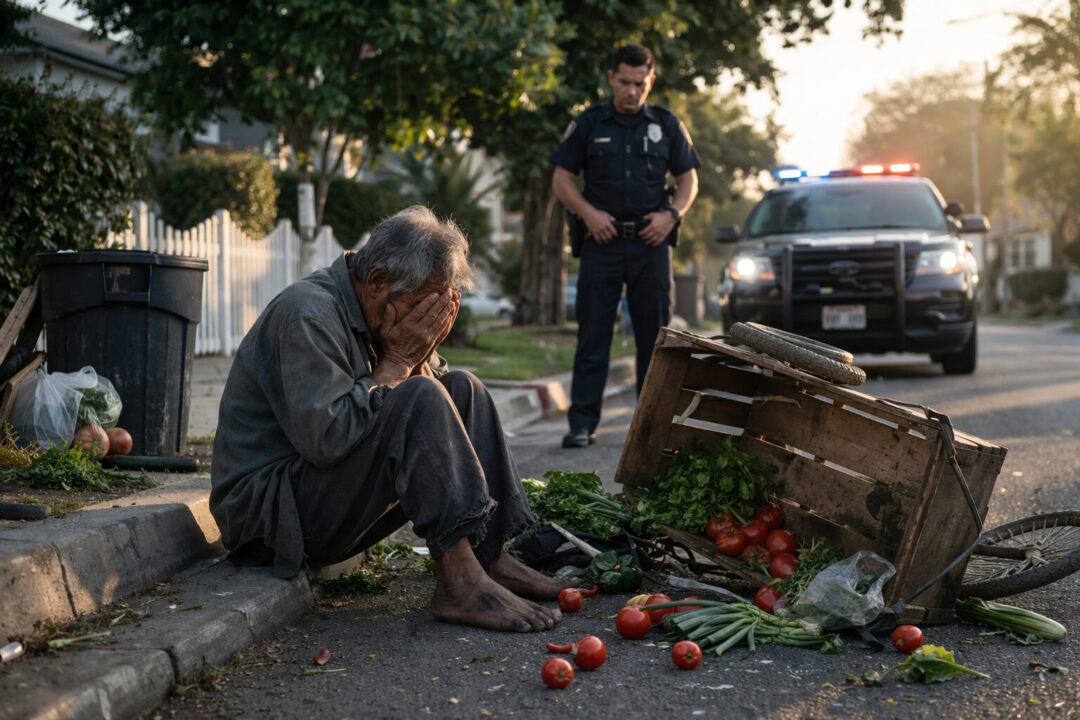
By the time Leon saw the vegetables on the ground, he already knew what kind of day it was.
Not because the tomatoes were bruised or because the cilantro had come loose from its string. Not even because his old cart had tipped sideways near the trash bins, one wheel still spinning as if it had been trying to save itself. He knew because something inside him went quiet all at once, the way it did when life stopped asking for patience and simply took.
For a second, he just stood there in the pale morning light, staring.
The street was too clean for a moment like this. Freshly watered lawns. White fences. A row of trimmed hedges that looked like they had never known dust. Even the sky seemed unnecessarily kind, all blue and gold above a man whose whole living had just spilled into the gutter.
Leon’s chest tightened.
He had been walking that neighborhood since sunrise, the same way he had walked three others earlier that week, and four the week before that. He went where people still opened their doors before work, where retired women sometimes bought parsley even when they did not need it, where a father rushing a child into the car might stop long enough to buy onions, bananas, whatever would make dinner easier.
He sold what he could pull with his own hands.
That was the beginning and end of his business.
A little cart. A few crates. Whatever he could afford from the wholesale market after counting bills so many times that the corners went soft. If the weather was kind and people were kinder, he came home with enough for rent on the tiny room behind the laundromat and enough for food that was not just bread and tea.
If not, he told himself tomorrow could still behave differently.
Now tomorrow looked like crushed tomatoes on the asphalt.
“No,” he whispered.
Then louder, because the word had not changed anything the first time.
“No… no…”
His bare feet felt the cold of the pavement through the thin skin at his heels. He took a shaky step toward the cart, then another, as if perhaps he had understood the scene wrong. But there it was: the axle bent, the box of peppers overturned, green onions streaked with dirt, one side panel split where the wood had given way.
Everything he had woken up at four to protect lay in pieces.
“That’s everything…”
The words came out cracked and small, but in the silence of the street they sounded like a confession.
A police SUV stood a short distance behind him.
Leon had noticed it when it first rolled slowly up the block, though he had tried not to look back more than once. At his age, with his clothes and his cart and his tired face, he was used to the double glance. He was used to people thinking he did not belong in places with neat sidewalks and decorative mailboxes. He was used to the quick calculations made about men like him.
Still, something in the presence of the vehicle had quickened his pulse.
He had heard stories. Street sellers warned each other in market alleys and bus stops. Someone’s permit questioned. Someone’s setup confiscated. Someone moved along because a resident complained. You could do everything softly, humbly, apologetically, and still be treated like you were taking up too much air.
Leon had spent years learning how to lower his eyes before anyone asked.
Now the SUV door opened behind him.
He did not turn at first. He was too busy looking at the wreck of his cart, too busy trying to calculate impossible things. What could still be sold. What had to be thrown away. How much money he had left in the pocket sewn inside his pants. Whether the room behind the laundromat would still be his by the end of the week.
Then he heard measured footsteps on the pavement.
He sank onto the curb because his knees had decided before the rest of him did.
His hands went to his face.
He hated crying in public. Hated the helplessness of it, the humiliation. But grief did not ask permission from dignity. It came the way rain came—sudden, complete, and impossible to argue with.
He pressed his palms into his eyes and bowed his head.
He thought of the room where he slept, with the rusted fan that clicked all night. He thought of the half-used bag of rice by the wall. He thought of the small photograph tucked into his Bible, the one he only looked at on the loneliest evenings: his daughter at twelve, smiling before she moved three states away and before pride and silence and money problems built years between them.
He had never liked to ask anyone for help.
He had liked even less becoming the sort of man people pitied.
The footsteps stopped near him.
Leon waited for the words he had been dreading since he first noticed the lights. A warning. A reprimand. Something official and final. Something that would make his loss feel not just accidental, but deserved by some rule he had never been rich enough to understand.
Nothing came.
Only a stillness.
That was somehow worse.
Part II — The Weight of Looking
Before the cart, before the market mornings, before the neighborhoods where he walked from block to block with his shoulders curled inward, Leon had worked in a kitchen.
Not a glamorous one. A lunch place downtown where the oil always smelled a little too old and the owner talked fast when business was good and faster when it was bad. Leon had chopped onions, washed pans, hauled sacks of potatoes, done whatever needed doing. It had not been much, but it had been steady until it wasn’t. The owner’s brother came in. Hours were cut. Then shifts disappeared altogether.
Leon had been too old for most second chances and too proud for most desperation.
The cart had come later.
It had belonged to another man first, someone who sold fruit outside a train station until his knees gave out. Leon bought it cheap because one wheel dragged and the handle was rough and the wood looked as tired as he felt. He fixed it over a month with scraps, wire, and the kind of patience people only learn when they cannot afford replacements.
That cart embarrassed him.
It also saved him.
There were days he hated the way people looked at it, at him. The same way he hated having to choose neighborhoods carefully, reading which streets tolerated his presence and which ones did not. On harder mornings, he told himself he was only continuing until he found something else.
But “something else” never arrived. What arrived was routine. Dawn markets. Long walks. Small sales. Aching shoulders. A little cash folded carefully into his wallet. Enough to continue being a man who survived without begging.
That mattered to him more than anyone understood.
Now, with his elbows on his knees and his face still hidden in his hands, Leon felt that whole fragile system collapsing inward. Not only the cart, but what the cart represented. The last structure between him and complete dependence.
He lowered his hands slowly.
The officer stood a few feet away.
He was younger than Leon expected—not a boy, but young enough that exhaustion still sat awkwardly on him. Broad-shouldered in a dark navy uniform, jaw set in that controlled way men in authority learned early. His hair was cropped neatly. His badge caught a glint of light but offered no comfort.
Leon looked at him the way cornered people look at weather. Not with anger at first. With fear.
The officer did not reach for his radio. He did not write anything down. He did not lecture.
He just stood there, upright and unreadable.
Leon swallowed. His throat hurt.
If the man was waiting for an explanation, Leon had none that would save him. He had only the truth, and the truth often sounded weak in front of uniforms.
“I was leaving,” Leon said, though no one had asked. “I wasn’t staying long.”
The officer’s expression did not change.
Leon glanced at the ruined cart again and felt the shame return, hot and immediate. Of course. Maybe this was not even about staying. Maybe it was about the eyesore he had made of himself. A poor old man with muddy produce and a broken wheel in front of houses where packages arrived on time and lawns got edged every Thursday.
He laughed once, bitterly, then stopped because there was no strength in it.
What frightened him most was not punishment anymore.
It was indifference.
That his loss might not even be important enough to explain.
The officer finally moved, not toward Leon but slightly past him, and for a terrible second Leon thought he meant to inspect the damage, to confirm that the mess truly had to be cleared. Leon braced himself.
Instead, the officer lifted one hand and gestured behind him.
Not a sharp motion. Not impatient. Just deliberate.
Leon frowned.
For a moment he did not understand the gesture at all. His grief had narrowed the world into one direction only: down. Toward the pavement. Toward the broken wheel. Toward the little scattered evidence that he had failed again.
“Look again,” the officer said.
His voice was calm. Not cold. Not kind, either, at least not in any obvious way. Just steady.
Leon blinked through the wetness in his eyes and turned.
At first he saw only the side of the police SUV and the bright edge of sunlight beyond it.
Then he saw what stood behind it.
Part III — The Thing He Couldn’t Believe
The stand was bigger than his old cart.
That was the first impossible thing about it.
Not luxurious. Not grand. But sturdy. Straight. Built with clean wood and proper balance, with shelves that held neatly stacked vegetables in rows that looked almost ceremonial after the chaos at his feet. Cucumbers, tomatoes, onions, greens, all arranged with a care that made them seem not merely for sale but protected.
Leon stared at it as if it might vanish if he breathed too hard.
His body forgot how to remain seated. He rose halfway from the curb, then stopped, one hand on his thigh to steady himself.
The officer waited.
Leon looked from the stand to the broken cart, then back again, trying to force meaning into the moment. Perhaps it belonged to someone else. Perhaps the officer was directing him away from the mess, telling him where he was allowed to stand. Perhaps this was not about him at all, and the humiliation was about to deepen into confusion.
“For me?” he asked.
The question escaped before he could stop it.
The officer’s mouth softened, only slightly.
“You deserve better.”
Leon did not realize until that moment how tightly he had been gripping the idea that the world expected him to accept less. Less comfort. Less patience. Less room. Less dignity. It had settled into him so quietly over the years that he no longer noticed the weight of it until something lifted it.
He stared at the stand again.
A memory rose up so suddenly it nearly stole his breath: his daughter, many years earlier, maybe seven or eight, watching him repair a broken cabinet door in their first apartment. She had said, with the certainty children gave to love, You can fix anything, Papa.
He had wanted that to remain true.
He had wanted it through layoffs, through eviction notices, through the long silence after her mother died and grief changed the grammar of their household. He had wanted it when his daughter moved away with tears in her eyes and too much hope in her suitcase. He had wanted it in every small humiliation since.
But there came a point in a man’s life when fixing things with his own hands no longer felt enough.
Sometimes what broke was not wood or wire.
Sometimes it was the part of him that still believed repair would come from himself alone.
Leon took a step toward the stand.
The vegetables were real. The wood was solid beneath his fingertips when he touched the side. Someone had thought about the height of it, the balance, the handles. Someone had made sure it would roll smoothly, that it would not fight him with every block.
His throat tightened again, but now from a different pain.
He turned to the officer, really seeing him for the first time rather than the uniform.
There was no performance in the man’s face. No hunger to be thanked. No speech prepared about generosity or community or whatever words people used when they wanted their goodness witnessed. He seemed almost uncomfortable with attention, as if the simplest version of the act had always been the point.
“How—”
Leon could not finish.
The officer gave a small shrug. “A few people on the block pitched in.”
Leon looked down the street. Curtains shifted in one window. A woman standing with a coffee mug near a porch rail gave a quick embarrassed nod before pretending to study her garden. Farther off, a man by a pickup truck lifted a hand and then looked away.
So they had seen him.
Not only the poverty. Not only the inconvenience.
They had seen him.
Leon covered his mouth for a moment, stunned by the cruelty of his own earlier assumption and equally stunned by how reasonable it had felt.
The officer stepped closer and held out a hand.
Leon took it.
The grip was firm and warm and brief, but something in Leon gave way when their hands met. Not pride exactly. Not pride as people usually meant it. More like the hard shell he had built around needing no one.
“Thank you,” he whispered.
The words were too small for what he felt. Too thin for the enormity of being wrong about the world in a way that healed instead of wounded.
Still, they were what he had.
The officer nodded once, and Leon, overcome by an emotion too large to carry politely, leaned forward and pulled him into a clumsy embrace.
For a fraction of a second he worried he had crossed some invisible line.
Then the officer’s hand came to rest gently between his shoulder blades.
And Leon understood that dignity did not disappear when it accepted kindness. Sometimes it returned through it.
Part IV — What Stayed
The story of that morning could have ended there and still been enough.
An old man. A broken cart. A misunderstanding. A stand waiting behind a police vehicle like mercy itself had chosen the most unlikely entrance.
But lives do not end at revelation. They continue in the quieter work of what comes after.
Leon used the new stand the next day.
And the day after that.
It moved cleanly, almost effortlessly, and each time his hands closed around the smooth handle he felt a little shock of disbelief. He sold more with it too. The produce looked better arranged. People stopped more easily. Something about the stand made him look less like a man clinging to survival and more like a merchant with a place in the morning.
That difference should not have mattered.
It did.
The neighborhood where it happened changed first. People began waving to him before he reached their houses. Children asked for oranges. One woman started leaving him a bottle of water on hot days. The man with the pickup truck helped him oil one wheel after hearing the faint squeak it made. The officer—Elias, Leon learned later, though he mostly still thought of him simply as the officer—passed by now and then and lifted two fingers in greeting.
They never made a spectacle of what they had done.
Leon appreciated that most.
His daughter called three weeks later after he finally gathered the nerve to leave a voicemail that was less apology than invitation. He told her about the stand in an awkward, edited version, as if speaking too directly about kindness might break it.
She cried anyway.
Then she laughed at herself for crying.
Then she asked him to send photos.
A month later she came to visit.
She stood beside the stand with her hand over her mouth for a long moment, much the way he had that first morning, and then she hugged him so fiercely that his old bones protested. She was older now than her mother had ever been. That realization stunned him each time he looked at her long enough.
“You should have told me sooner,” she said.
“I was trying to understand it first.”
She touched the wood of the stand and smiled through wet eyes. “Looks like somebody finally did.”
Leon did not answer right away.
Because the truth was, the stand had not only changed the practical shape of his days. It had altered something inward and more difficult to name. For years he had mistaken endurance for isolation. He had believed that to remain respectable, he had to remain self-contained, asking nothing, expecting less, needing no witness.
But survival, he was learning, was not always a lonely discipline.
Sometimes it was a bridge built by hands you had never expected to reach toward you.
That winter, when the mornings turned sharp and the sky stayed gray longer, Leon began keeping a folded blanket under the stand for one of the younger street sellers near the bus stop. The kid was too proud to ask for help and too thin not to need it. Leon said nothing sentimental when he handed it over. He only said, “Cold gets worse before sunrise.”
In spring he started setting aside extra greens for the woman with the coffee mug because he had discovered she was caring for her husband after a stroke. In summer he kept spare bottled water in a crate beneath the stand.
None of this made him a saint.
It only made him attentive.
He had been seen once in the exact hour he thought he was disappearing. That kind of thing left a mark.
Years later, when the stand’s wood had softened at the edges from use and weather and time, Leon still remembered the sight of it waiting behind the police SUV, hidden until the last moment. He would remember, too, the shame of his first assumption and the tenderness of having it overturned.
The world remained what it had always been: uneven, impatient, capable of hardness without warning.
But now, when a morning began badly, he no longer took ruin as the truest shape of things.
He had learned that mercy sometimes approached in the costume of authority. That help could stand silent long enough to be mistaken. That what looked final from one angle could, from another, be the doorway to something steadier.
And on certain bright mornings, when the sidewalks were just waking and the produce caught the first light, Leon would rest both hands on the handle of the stand and pause before moving on.
Not because he was tired.
Because gratitude, he had discovered, also asked to be carried.
So he carried it with him, block after block, street after street, the wheels gliding more smoothly than the old ones ever had.
And whenever someone looked at the stand and then at him with curiosity, Leon would smile a little to himself.
They saw a vendor.
He saw the morning he had thought everything was lost.
And the impossible thing that had been waiting just behind his fear.