No One Listened to the Boy on Seat 14
The Boy by the Window
Part I — The Look She Couldn’t Ignore
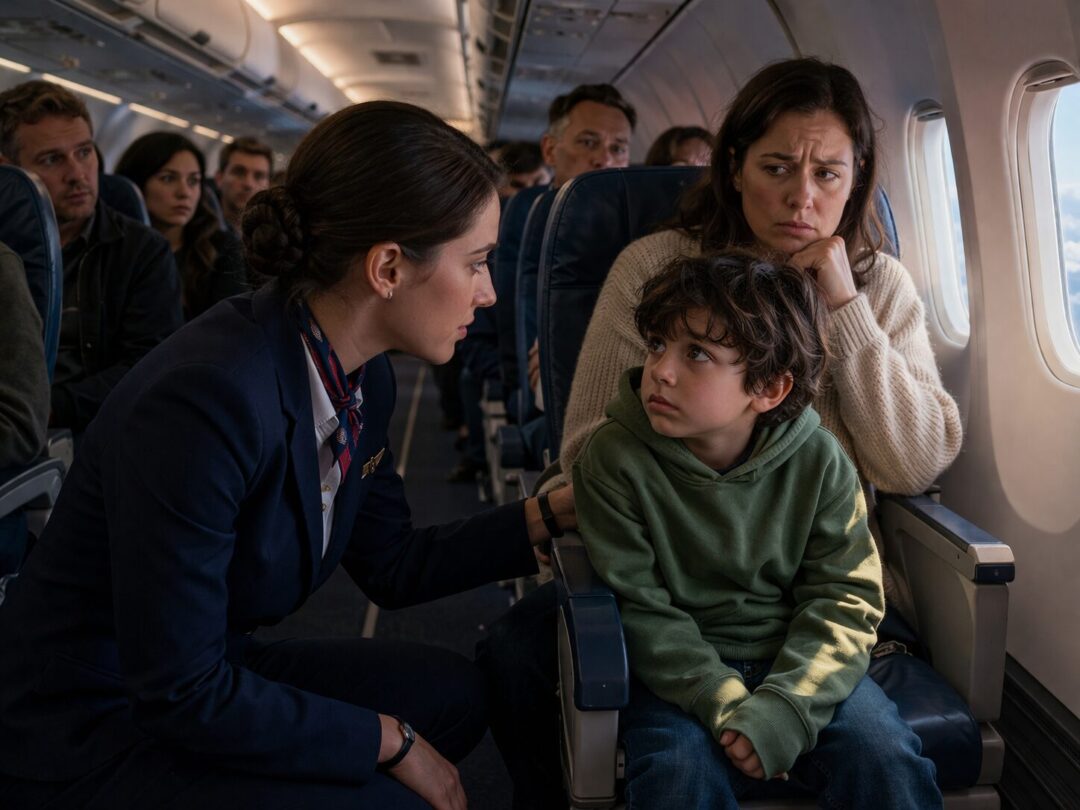
By the time Maren reached row fourteen, the cabin had already changed. It was still full of the ordinary things that made a plane feel safe—muted lights, buckled seatbelts, the stale coolness of recirculated air, passengers pretending patience—but something in the aisle had gone tight and wrong. People were no longer looking at their phones. They were looking at each other.
And one little boy was staring straight ahead like he had been waiting for someone to believe him.
Maren stopped so hard the hem of her navy jacket brushed the armrest beside him. “Who ignored him?”
The words came out sharper than she intended. A few nearby heads turned. A man across the aisle blinked in surprise, then quickly looked away. Nobody wanted to be involved once the mood in a cabin shifted from inconvenience to accusation.
The woman seated beside the child stiffened under Maren’s gaze. She was in her mid-thirties, travel-worn and pale, with a beige sweater pulled too tightly around herself as if it might protect her from blame. Her lips parted, then closed again.
Maren had been a flight attendant for nine years. She knew panic when she saw it. She knew airsickness, hidden arguments between couples, parents on the verge of losing patience, and men who pretended not to hear instructions because they disliked being corrected in public. She knew the thousand small frictions of a crowded flight.
This was not any of those things.
It had started six minutes earlier when she was checking the rear galley and heard the maintenance hum beneath the engine noise change pitch for half a second. Not enough to alarm most people. Barely enough to notice. But Maren noticed sounds for a living. Then, almost immediately, she had seen the boy in row fourteen twist in his seat and look toward the window with a kind of frozen concentration she had never seen in a child that age.
She had been about to move toward him when another passenger stopped her to complain about a bag overhead.
By the time she looked back, the boy was smaller somehow. Folded into himself. And the woman next to him—mother, aunt, stranger, it didn’t matter—had bent close and said something that made him go silent.
Now the silence around him felt heavier than the engine noise.
“He said something strange,” the woman muttered.
Maren looked past her and focused on the boy.
He was maybe eight years old. Thick curls fell over his forehead. His muted green hoodie looked a size too big, swallowing his wrists and making him appear even more fragile than he was. But it was his face that stopped her. Children were usually easy to read. Fear, boredom, excitement, stubbornness—they flashed across them like weather.
This boy looked like he had already learned what happened when adults decided not to listen.
He was clutching his sleeve so hard his knuckles had gone pale.
Maren lowered herself into the aisle until she was at eye level with him.
The public confrontation softened around the edges. The passengers, the overhead bins, the woman’s guilty posture, the harsh little triangle of fluorescent light above the row—they all fell back. There was only the child’s face and the terrible restraint in it.
“You tried to tell them?”
For the first time, his eyes lifted fully to hers.
He did not answer right away. He seemed to be studying her, not with trust but with caution, as if deciding whether she was going to become one more adult who nodded and then turned away.
His throat moved.
A very small nod.
Maren felt something tighten under her ribs.
Across from them, the man who had first turned to stare now looked down at his lap again. Nobody wanted the truth if the truth made them responsible.
The woman in beige exhaled too loudly. “He gets nervous,” she said. “He’s been jumpy all morning.”
Maren didn’t look at her. “That isn’t what I asked.”
The woman fell silent.
The boy’s eyes shimmered, but he held himself still with a discipline that didn’t belong in a child. Maren had seen that kind of stillness in adults after bad news. In people who had learned that being emotional made others dismiss them faster.
“What’s your name?” she asked softly.
“Eli,” he whispered.
Maren gave him her own. She always did that with frightened children. It made the moment less like authority and more like an agreement.
“Okay, Eli. I’m listening.”
His lower lip trembled once, then steadied.
“Nobody listened,” he said.
The sentence was quiet. Almost delicate. But it landed in the row like a dropped glass.
Maren had heard many kinds of distress in her life. Complaints that were really demands. Tears that were mostly frustration. Raised voices that wanted an audience more than help. This was different. This was the plain, unprotected hurt of someone who had done the right thing and been taught, immediately, that it did not matter.
Only then did she turn to the woman beside him.
“What did he say?”
The woman looked past Maren, toward the window, toward anywhere else. “I thought he was scared,” she said. “He said he heard something. Kids say things on planes. He hates takeoff. I didn’t know—”
“You didn’t ask,” Maren said.
The woman flushed.
Eli was still staring toward the oval window, though all he could likely see now was a slab of white cloud and his own faint reflection.
Maren followed his eyeline.
“What did you hear, Eli?”
His breathing caught. His gaze stayed fixed to the side of the plane, beyond the glass.
“The noise,” he said. “It started first.”
And the fine hairs on the back of Maren’s neck rose.
Part II — Before the Door Closed
Eli had not wanted to fly that day.
That was how the adults would have told the story if asked. The simple version. The manageable version.
He had been quiet in the airport. He had asked too many questions at the gate. He had stood by the window while the other children nearby played with rolling suitcases and half-eaten snacks, and he had watched the plane arrive with a seriousness that made his aunt Renata laugh under her breath.
“You look like you’re inspecting it,” she had told him.
He had been.
Eli liked patterns. He liked things that behaved the way they were supposed to. Elevators should hum, not jerk. Radiators should clank in winter and then go still. The old refrigerator in his father’s apartment had a tired knocking sound that meant the ice tray had shifted. Once you learned a machine’s moods, you could tell when something changed.
Adults often treated this as oddness.
His father had called it paying attention.
But his father was two states away, waiting to see him at the other end of the flight, and Renata had spent the entire morning in a hurry. Their rideshare had arrived late. Security had taken too long. Someone from work kept calling her phone. By the time they reached the gate, she was all frayed edges and apology, the kind of adult who smiled while silently begging the world not to give her one more thing to manage.
Eli tried not to be one more thing.
Still, while passengers lined up to board, he had watched a mechanic crouched near the wing for a little longer than anyone else did. There was nothing obvious about the man’s movements. No panic. No dramatic gestures. Just a pause. A second look. A hand pressed against metal, then removed.
Later, once they were seated, Eli heard it.
Not the engine itself. The plane was full of noises before takeoff—air vents, seatbelt clicks, overhead bins shutting, voices blending into a dull indoor weather. But beneath all of it, from somewhere outside his window side, came a brief, jagged sound. Not loud. Not violent. A scraping whine that seemed to stutter and then disappear.
He turned immediately.
“What?” Renata had said, half-reading an email on her phone.
“There was a noise.”
“There are a lot of noises.”
He looked back at the window. Ground crew moved below in practiced routines. The wing looked smooth and distant and impossible to understand from where he sat.
“No, a different one.”
Renata sighed without meanness, but without attention either. “You’re okay.”
He tried once more when the plane began to taxi. He said he thought it came from outside, near the wing. She patted his arm, the automatic kind of comfort adults used when they had already decided what a child felt.
“It’s just nerves.”
Eli knew the shape of dismissal even before he had a word for it.
So he stopped.
He kept listening, though.
On takeoff, as the cabin pressed them backward and the roar deepened, he heard nothing strange at all. For a moment he wondered if he had imagined it. Maybe Renata was right. Maybe flying made every sound feel important.
Then, after they leveled slightly and the tension in the cabin loosened, it came again.
Shorter this time. Fainter. But wrong in exactly the same way.
He must have made a noise himself, because Renata finally looked over.
“What now?”
He wanted to say I heard it again. He wanted to say Please tell someone. He wanted, more than anything, not to sound childish. There was a particular humiliation in being afraid of something adults had already decided was nothing.
“The wing side,” he said. “Something’s wrong.”
Renata closed her eyes briefly, a woman with work calls, delayed messages, and too much life to carry. “Eli. Please. Not right now.”
He had gone still after that.
Not because the sound stopped frightening him.
Because he understood that if it happened again, he would be alone with it.
Part III — The Shape of Being Heard
Maren stood up slowly, every instinct sharpened.
She signaled discreetly to the senior attendant farther up the cabin, then crouched again before Eli could mistake her sudden alertness for disbelief. If she frightened him now, he might fold back into silence.
“When did it start?” she asked.
He swallowed. “Before takeoff.”
Renata made a startled sound under her breath, and Maren turned to her.
“He told you before takeoff?”
“I thought—” Renata stopped. Her face had changed. Not into innocence. Into memory. Into the sickened replay of every moment a person realizes they had been given a chance to do better and failed.
“I thought he was anxious,” she said again, but this time it sounded less like defense than confession.
Maren knew there were procedures for everything. There were checklists and cabin calls and discreet codes passed to the cockpit in voices trained never to alarm the passengers. She knew exactly what to do next, and she did it quickly.
But even while she rose and stepped into the aisle and relayed the necessary information, part of her attention remained pinned to row fourteen, to the boy who had been carrying fear alone because it had come packaged in a child’s voice.
The captain was calm when he responded. Calm in the way seasoned professionals were calm when they had already moved past emotion and into action. There would be an inspection of systems. There would be monitoring. There would be the possibility of turning back if the indicators aligned badly enough. There would be no dramatic announcement, no cinematic panic.
Real danger almost never arrived that way.
Real danger arrived wrapped in uncertainty.
Minutes stretched.
Passengers sensed the change in atmosphere long before anyone was told anything. Cabin crew moved with extra precision. Words became quieter. Eyes measured each other too carefully. Renata sat very still beside Eli, both hands clasped now, no phone in sight. She tried once to touch his shoulder, but stopped before making contact.
Eli didn’t look at her.
Maren returned when she could.
She leaned close enough that only he could hear. “You did the right thing.”
His eyes lifted, searching hers for the trap. There was no trap. She let him see that.
“I should’ve said it louder,” he whispered.
The sentence broke something open in Renata.
A soft, wounded sound escaped her before she covered her mouth with both hands. The shame on her face was almost unbearable to witness—not because it was theatrical, but because it was genuine. She had not ignored him out of cruelty. She had ignored him the way adults ignored children every day: by sorting their words too quickly into categories like imagination, nerves, overreaction, not now.
And that ordinary failure was somehow worse.
“No,” Maren said, looking at Eli while meaning the words for both of them. “You already said it enough.”
It turned out later that the issue was real, though not catastrophic. A panel near the wing root had not seated properly after maintenance. Under specific vibration, it produced an intermittent resonance—strange, metallic, easy to miss unless you were listening for what did not belong. It was serious enough to send the plane back. Serious enough that the captain thanked the cabin crew for catching the early clue.
Maren never corrected him in front of the others.
But she knew who had caught it.
When the aircraft finally rolled back toward the gate, relief did not come as cheering or applause. It came as a thinning of tension. A release in shoulders. The tentative return of noise. The private gratitude people felt when fear had stayed just abstract enough to remain survivable.
Ground crews met the plane. Passengers were told there would be a delay, a transfer, a series of inconveniences they would complain about later with no understanding of how narrowly their day had bent.
Eli remained quiet through all of it.
As they prepared to disembark, Renata turned to him with a face stripped of excuses.
“I’m sorry,” she said.
Children were often expected to rescue adults from their guilt by forgiving them quickly. Eli didn’t. He just looked at her.
“I heard you,” she said, voice shaking now. “I didn’t listen. Those are different. I know that.”
For the first time since Maren had knelt in the aisle, something in Eli’s posture loosened.
Not all the way. But enough.
Maren watched them from the front as passengers filed out. She had the odd, dizzy feeling that sometimes came after a crisis had passed and left behind something quieter but more lasting than fear. A correction. A truth spoken at last.
When Eli reached her row, he paused.
“Was it bad?” he asked.
Maren considered lying. Adults loved lies that sounded gentle.
Instead she chose the kindest honest answer she had.
“It was important.”
He nodded as if that made sense to him, which it did.
Renata murmured another apology, maybe to him, maybe to herself. Then they moved on into the bright tunnel of the jet bridge, carrying their bags and their delay and the rest of their day.
Maren thought that would be the last of it.
It wasn’t.
Part IV — What Stayed After
Three weeks later, on a layover in Denver, Maren found an envelope waiting at the hotel desk.
No return address. Just her first name, written carefully.
Inside was a folded sheet of notebook paper.
The handwriting was uneven but deliberate.
Thank you for listening to me. My dad says hearing is not the same as listening. I think that is true. I still don’t like planes but I like that you believed me. Aunt Renata says she is practicing listening slower now. I think she means better. I drew the wing from memory but it does not look exactly right.
Below the note was a child’s sketch of an airplane wing under a cloud line, all angles and attention. Near the root, a tiny dark mark. Not realistic. Not technically meaningful. But precise in the way memory could be precise when emotion had fixed it in place.
Maren sat on the edge of the hotel bed for a long time holding the paper.
In her work, people thanked flight attendants for many things. For extra napkins. For finding lost phones. For managing turbulence with a calm face. For smiling through delays they did not cause. Those thanks passed through a day and vanished.
This one settled deeper.
Because the truth was, she had almost missed him too.
She had heard the odd sound. She had noticed the boy’s face. And then a complaint about an overhead bag had diverted her for seconds that now seemed accusatory in memory. Not disastrous seconds. Not enough to change the outcome, perhaps. But enough to remind her how easily attention could be stolen from what mattered by what was loud.
She thought of the first time she had learned that lesson.
She was ten, sitting at a kitchen table while her mother argued softly with a landlord in the next room. The pipes in the building had been making a knocking sound for weeks, and Maren had said it didn’t sound right. Her mother had shushed her without thinking. Two days later, one pipe burst and flooded half the downstairs hall.
Afterward, her mother had laughed tiredly and said, “You notice everything.”
It had sounded like praise. Years later, Maren realized it had also been apology.
She wrote back to Eli that night on hotel stationery. She told him that paying attention was a strength. She told him not to let embarrassment teach him silence. She told him there would be people, many of them kind, who still failed to listen the first time because the world trained adults to sort, assume, hurry, and move on. She told him that being right did not always feel good, but it mattered.
Then she hesitated, pen hovering.
Finally, she added one more line.
You helped more people than you know.
Months passed.
Flights blurred into one another. Winter softened into spring. But every so often, when a child spoke from the edge of a crowd and an adult answered too quickly, Maren felt her body turn, attentive now in a slightly different way. Not suspicious. Responsible.
Listen slower, she thought.
Better.
One evening, during descent into Seattle, a little girl in a yellow sweater tugged at her sleeve and whispered that the man across the aisle looked sick. He did. Pale, sweating, trying hard not to draw attention. Maren got him help before the plane landed.
Afterward, when the girl’s mother apologized for bothering her, Maren smiled and said, “I’m glad she told me.”
The mother looked surprised, then thoughtful.
That was how change traveled sometimes. Not as a grand revelation. As a sentence carried forward into another moment. A better habit replacing an old one. One person teaching another, often without meaning to.
On certain flights, when the cabin lights dimmed and the window rows turned reflective, Maren still thought of Eli’s eye in extreme close-up—the way fear had lived there, yes, but also patience. The exhausting patience of a child waiting for the world to catch up.
She hoped he kept that part of himself that noticed what others missed.
She hoped the world earned it more often.
And whenever the metal body of a plane sang its thousand ordinary songs around her, Maren listened not just for danger, but for the smaller things that arrived before danger had a name: hesitation, restraint, the silence that followed dismissal, the voice that had already tried once.
Because sometimes the first warning sign was not a noise in the wing.
Sometimes it was a child who had stopped speaking.