He Built His Machinery Shed Across Her Farm Line—Then the Roses Beside the Survey Pin Died
Chapter 1: The Concrete Reached the Roses Before Noon
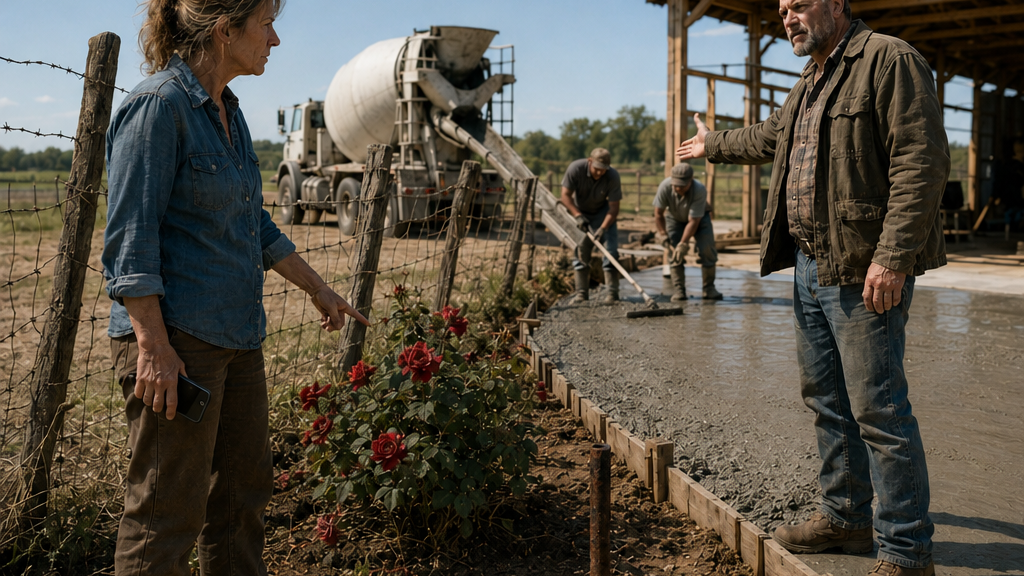
By the time Kathleen Carter understood where the concrete was going, the gray slurry had already reached the first rose cane.
She set her coffee on the fence post so fast that some of it sloshed over the rim.
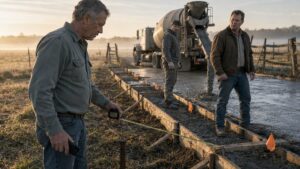
Across the narrow strip between the two farms, a concrete truck idled beside the skeleton of Benjamin Walker’s new machinery shed. Two men worked the wet mix toward a row of wooden forms. The unfinished building rose behind them in pale lumber and steel brackets, open to the morning light.
Kathleen stared at the forms.
Then at the roses.
Then at the rust-dark metal point barely visible between two clumps of grass.
“Hold it,” she called.
The men looked up, but neither stopped.
Kathleen stepped over the sagging bottom wire of the old fence.
“Hold the pour.”
Benjamin emerged from behind the framing with work gloves hooked into one back pocket. He was broad through the shoulders, sunburned across the neck, and carried himself with the impatient energy of a man who had been answering questions since dawn.
“What is it?”
Kathleen pointed.
“That pin.”
Benjamin followed her finger.
The iron survey monument stood no more than an inch above the soil, directly beside the oldest rose bush. Her mother had planted three bushes there years ago, not because the spot was particularly sensible but because Lisa Carter had once said a boundary ought to have something prettier than wire on it.
“The forms are over it,” Kathleen said.
Benjamin glanced at the pin, then back at the concrete.
“That old thing?”
“It’s the property marker.”
“It might be.”
“You know it is.”
One of the workers waited with his rake in the wet concrete. The truck churned behind him.
Benjamin rubbed his jaw.
“We’ve always treated the fence as the line.”
Kathleen looked at the fence. It wandered slightly around a shallow dip, then bent around an old hedge stump before straightening again. Nobody could have mistaken it for survey work.
“The fence is three feet inside my side at the lane,” she said. “You know that too.”
Benjamin’s face tightened.
“This apron’s barely over anything.”
Kathleen felt the words hit harder than they should have.
Barely over.
As though ownership changed according to width.
She stepped closer to the rose bush. The outer leaves were still wet with morning dew. One bloom, dark red and nearly open, leaned toward the concrete form.
“My mother planted these.”
Benjamin exhaled through his nose. “Kathleen, I’m not trying to hurt your flowers.”
“Then stop the truck.”
“The crew is here. The concrete is here.”
“Stop it long enough to check.”
He looked past her toward the mixer, then at the half-framed shed.
“I’ve got a schedule.”
“And I’ve got a property line.”
For several seconds neither moved.
Kathleen had known Benjamin for nearly twenty years. They had borrowed implements from each other. He had once pulled her tractor from a mud hole after a spring rain. She had carried soup to his house when he was recovering from shoulder surgery.
That history was exactly why she had not made more of the stakes when she noticed them three days earlier.
She had been mowing along the edge of the hay field when she saw the orange flags and wondered why one sat so close to her roses. Benjamin had been unloading lumber. She asked whether he was sure about the line.
He had said, “We measured off the fence.”
Kathleen had frowned, but she had let the answer stand.
She had told herself she would check later.
Later had become Saturday morning and wet concrete.
“Benjamin,” she said, quieter now. “I’m asking you once. Stop until we know.”
He looked at her for a long moment.
Then he turned toward the crew.
“Keep it moving.”
The rake scraped through the concrete.
Kathleen’s throat tightened.
“You heard me.”
Benjamin did not face her. “And you heard me. It’s a little over at most.”
The concrete slid another few inches along the form.
Kathleen stepped forward instinctively, then stopped herself.
She could kick the form loose. She could stand in the path of the crew. She could call somebody and make the morning ugly enough that the whole road would know about it before lunch.
Her hands had already curled into fists.
She forced them open.
The rose bush trembled when one worker brushed a cane aside with his boot.
“Careful,” Kathleen snapped.
The worker immediately moved his foot.
Benjamin said, “Nobody’s trying to wreck anything.”
She looked at him.
The smirk was slight, almost tired rather than cruel, but she saw it.
That was what changed her.
Not the size of the shed. Not the truck.
The certainty.
Benjamin believed the fact that work had started mattered more than the question of whether he had the right to finish it.
Kathleen took her phone from her pocket.
She photographed the pin.
Benjamin noticed.
“What are you doing?”
She photographed the edge of the form with the pin visible beside it.
“Keeping track.”
“Kathleen.”
She took a wider picture showing the shed framing, concrete truck, roses, forms, and boundary fence in one frame.
Her hands shook badly enough that the first photograph blurred.
She took another.
Then another.
Benjamin’s expression lost the smirk.
“This doesn’t need to turn into something.”
Kathleen almost laughed.
“You’re pouring concrete on it.”
She crouched beside the roses.
The old survey monument remained visible for the moment, dark against wet soil. She put the phone low and took a photograph that showed the iron pin in the foreground and the concrete behind it.
Then she stood.
One of the workers asked Benjamin something Kathleen could not hear.
Benjamin nodded.
The pour continued.
Kathleen watched gray concrete fill the final section. It did not cover the metal pin itself, but the apron came close enough that the rose roots disappeared beneath its edge.
The outer canes bent awkwardly away from the form.
Her mother had planted those bushes six summers before she died.
Kathleen remembered Lisa kneeling there in an oversized straw hat, pressing soil around a root ball with both hands.
“Roses don’t care where men think the line is,” she had joked.
Kathleen had forgotten the sentence until that morning.
She went back across the fence.
Inside the farmhouse, she did not call Benjamin again.
She opened the drawer beside the refrigerator and removed a small field notebook with a cracked brown cover. She normally used it for hay yields, fuel deliveries, veterinary appointments, and machinery repairs.
On a clean page she wrote the date.
Then:
9:43 a.m. — asked Benjamin Walker to stop concrete pour pending boundary verification.
She looked at the kitchen clock.
9:47 a.m. — pour continued.
Her pen paused.
The anger was still there, but writing the time changed its shape. It became something narrower. More useful.
Kathleen found the folder containing her deed and tax map. Neither gave her enough confidence to say exactly where the line ran.
That bothered her more than she wanted to admit.
She had accused Benjamin with absolute certainty.
But the truth was that she had relied on the same old fence he had.
She picked up her phone and searched through old contacts until she found the number of the surveyor who had marked a drainage easement for her several years earlier.
James Davis answered on the fourth ring.
“Kathleen?”
“James, I need a boundary checked.”
“When?”
She looked through the kitchen window.
The concrete crew was still working beside the roses.
“As soon as you can get here.”
Chapter 2: The Fence Everyone Had Treated as Truth
James Davis had been on the property less than ten minutes when he told Kathleen the one thing she did not want to hear.
“That fence doesn’t prove anything.”
Kathleen folded her arms.
“It’s been there longer than I have.”
“That makes it old. It doesn’t make it surveyed.”
James stood beside one of the weathered posts with a receiver pole in one hand and a field controller in the other. He was lean, gray at the temples, and annoyingly calm.
Kathleen had hired him because of that calm.
At the moment, she disliked it.
Benjamin’s fresh concrete had cured from dark gray to pale gray over the previous two days. The unfinished machinery shed cast striped shadows across it. The roses beside the corner looked dulled now, their leaves powdered with dust from the construction.
Kathleen pointed at the iron monument.
“What about that?”
“That matters.”
“Then we’re done.”
James looked at her over his glasses.
“No. That means we have a monument. I still need to establish what it represents and whether it controls the recorded line.”
Kathleen hated the word whether.
Benjamin was not outside. His pickup was gone, although his adult son moved equipment on the far side of the yard and kept carefully out of the conversation.
James began working along the boundary.
He found another old marker near the county road, then spent nearly an hour taking measurements between recorded points.
Kathleen followed at first.
Eventually he stopped and said, “You don’t have to walk every foot with me.”
“I know.”
“You’re still doing it.”
“I know.”
He smiled faintly and returned to his equipment.
Near the lower field, the old woven-wire fence swung almost four feet onto Kathleen’s recorded-use side before straightening again.
James pointed to the bend.
“Why’s that there?”
“Used to be a hedge apple tree.”
“Used to be?”
“Tree came down twelve years ago.”
“And nobody moved the fence.”
“No reason to.”
James typed something into his controller.
Kathleen heard herself become defensive.
“That doesn’t mean Benjamin owns the ground.”
“I didn’t say it did.”
“But you’re writing it down.”
“I write things down for the same reason you called me.”
That quieted her.
At noon they sat at Kathleen’s kitchen table with copies of deeds, an old plat, and county GIS maps spread between coffee cups.
James traced a line with one finger.
“The original descriptions are usable. The monuments I’ve found are consistent enough that I’m comfortable reconstructing the boundary.”
“So the pin by the roses is real.”
“It appears to be.”
Kathleen leaned back.
Relief came first.
Then she saw James was not finished.
“What?”
He tapped the aerial photograph.
“Both of you have treated the ground loosely over the years.”
He indicated the fence bend.
“Here, Walker’s fence is on your side.”
Then he moved farther north.
“Here, your mowing pattern extends past the likely deed line.”
“That’s because Benjamin never mows the ditch.”
“I’m not accusing you of taking land.”
“It sounds like you are.”
James took off his glasses.
“Kathleen, my job isn’t to decide which one of you has better manners.”
The words stung because they were fair.
He continued.
“You asked where the line is. I’m telling you that the old fence isn’t a reliable substitute for it. Maybe nobody cared because none of these little differences mattered until somebody poured a slab.”
Kathleen looked toward the window.
The top of the new shed framing showed beyond her barn.
She remembered the orange construction stakes.
Three days before the pour.
She had seen them.
She had asked one question and accepted one casual answer.
“I should’ve called you then,” she said.
James did not pretend not to understand.
“Probably.”
Kathleen looked at him sharply.
He shrugged. “You hired a surveyor, not a priest.”
Despite herself, she almost smiled.
Then her eyes fell on the roses outside.
The nearest cane had developed a yellowing strip along several leaves.
The smile disappeared.
“My mother planted those.”
James glanced through the window.
“I remember Lisa.”
Kathleen said nothing.
People in the county remembered Lisa in fragments. Her pies at the church supper. Her old red pickup. Her habit of carrying fencing pliers behind the truck seat. Kathleen remembered everything at once, which was harder.
“My mother hated land fights,” Kathleen said.
“That so?”
“She watched two of her brothers stop speaking over a lane after my grandfather died. Fifteen feet of gravel. Twenty years without Christmas together.”
James waited.
“I told myself I wasn’t going to live that way.”
“And?”
Kathleen looked down at the maps.
“And maybe I confused not fighting with not dealing with things.”
James put his glasses back on.
“That happens.”
In the afternoon, he returned to the boundary.
This time Kathleen stayed mostly by the roses.
She brushed concrete dust from several leaves. The soil on the shed side had been compacted by boots and machinery, and part of the root zone disappeared beneath the new apron.
She could not tell yet whether the plant would survive.
Benjamin returned near three.
He climbed out of his pickup, saw James’s equipment, and stopped.
For the first time since Saturday, uncertainty crossed his face.
“What’s all this?”
“Survey,” Kathleen said.
“I can see that.”
James gave him a professional nod.
Benjamin walked to the old fence and looked at the stakes already set along the lower section.
“You really went ahead with this.”
Kathleen stared at him.
“You went ahead with the concrete.”
His jaw worked.
“We’ve used that fence line forever.”
James answered before Kathleen could.
“I’m not using the fence line.”
Benjamin looked toward him.
“So where is it?”
“I’ll tell both owners when I’ve completed the work.”
Benjamin gestured at the marker beside the roses.
“That old pin could’ve been put there by anybody.”
James’s voice stayed mild.
“It could have been. Which is why I’m surveying instead of guessing.”
Benjamin’s son stopped the tractor in the distance.
For a few seconds the entire boundary seemed unnaturally quiet.
Then Benjamin looked at Kathleen.
“You’re making this bigger than it needs to be.”
Kathleen felt the old impulse to retreat from the argument.
She did not.
“I asked you to stop before the concrete was poured.”
“You’re assuming you were right.”
“So were you.”
That landed.
Benjamin looked away first.
By late afternoon, James had established enough of the line to return to the corner by the roses.
He measured twice.
Then he walked onto Benjamin’s new concrete apron with a small drill and a temporary marker.
Kathleen stood several yards away.
Benjamin had gone back to his yard, but she could see him watching from the shed frame.
James placed a bright survey flag at the projected line.
It did not fall beside the concrete.
It fell through it.
The thin stem rose from a drilled point well inside the new apron.
Kathleen stared at it.
“How far?” she asked.
James gathered his tools.
“I’ll give you the final number when I finish the survey.”
Behind them, a hammer stopped striking wood.
Benjamin was watching the same flag.
Chapter 3: Twenty-One Inches Changed the Whole Argument
The red survey flag stood twenty-one inches inside Benjamin Walker’s concrete.
James gave Kathleen the number before he gave her the paperwork.
“Twenty-one at the worst point,” he said. “A little less toward the back corner.”
Kathleen looked from the flag to the new shed.
The building was farther along now. Roof panels covered half the rafters. One wall had been sheathed. Benjamin’s crew had worked through the week as though the survey stakes were weather.
“So I was right.”
“About the encroachment, yes.”
James handed her a preliminary drawing.
A heavy line marked the recorded boundary. Another showed the footprint of the machinery shed and apron.
They crossed.
Kathleen felt something inside her settle.
Not satisfaction exactly.
More like the relief of discovering she had not imagined an insult.
James tapped the plan.
“But don’t turn this into more than it says.”
She looked at him.
“You’re telling me he built on my property.”
“I am.”
“What part am I making bigger?”
“The part where you decide everything that ever happened along this fence was intentional.”
He pointed to two other areas.
The old fence wandered onto Kathleen’s side in one place. Near the drainage swale, her own mowing and a stack of old fence posts had crossed slightly onto Benjamin’s recorded side for years.
Neither use changed the current structure.
But they changed the story Kathleen had been telling herself.
There was no perfectly respected line suddenly violated by one lawless neighbor.
There had been an imprecise line both families tolerated until Benjamin placed something permanent across it.
James folded the drawing.
“That doesn’t excuse the slab.”
Kathleen nodded.
“It just means we were both careless before.”
“That’s closer.”
She hated that he was right.
Later that morning she drove to the county offices with the survey in a manila folder.
The zoning counter occupied the back of a low government building that smelled faintly of paper, floor cleaner, and old coffee. Kathleen waited while a clerk searched the parcel records.
The county zoning officer joined her after several minutes.
“This is the Walker accessory structure?”
“Yes.”
The officer examined the survey.
“How close is the building itself?”
Kathleen showed her James’s measurements.
The officer frowned.
“That’s an issue.”
“Because it’s over the property line?”
“That, and the setback.”
She turned to her computer.
Kathleen watched the cursor move through several screens.
Then the officer stopped.
“When did construction start?”
“Last week. Concrete was Saturday.”
The officer looked again.
“There’s an application in the system.”
“So he had a permit?”
“I didn’t say that.”
The officer rotated the monitor slightly, though not enough for Kathleen to read everything.
“The application was started. It wasn’t cleared.”
Kathleen felt her pulse quicken.
“What does that mean?”
“It means whatever work has been done so far was started before final approval.”
Kathleen pictured Benjamin standing beside the concrete truck saying he had a schedule.
The officer continued.
“The property-line issue needs verification from our side. The setback may be separate depending on how the final structure is classified. I’ll need to inspect.”
“So you can make him stop?”
“I can tell him what the county requires after inspection.”
It was not the sweeping answer Kathleen had imagined.
Nothing in the building seemed designed for sweeping answers.
Forms. Measurements. Notices. Review.
She left with instructions for filing a formal encroachment complaint and a request for copies of her photographs.
Back at the farm, Benjamin was installing siding.
He saw her car and walked toward the boundary.
“Well?”
Kathleen got out holding the folder.
“Twenty-one inches.”
Benjamin’s expression barely shifted.
“At one point.”
“That’s the maximum.”
“Exactly.”
Kathleen stared at him.
“You said barely over.”
“Twenty-one inches isn’t exactly a farm.”
“It’s mine.”
Benjamin wiped dust from his forearm.
“You going to make me tear down half a building over less than two feet?”
“You could have moved it before you poured.”
“And lost the crew, the concrete, and another week?”
“That was your choice.”
His eyes hardened.
“So this is punishment.”
“No.”
“It sure sounds like it.”
Kathleen almost answered with the anger she had carried since Saturday.
Then she saw the stacks of equipment crowded behind him—an older tractor waiting for repair, a baler with one wheel removed, welding carts, tool chests under tarps. The expansion was not decorative. Benjamin had been trying to create working room.
That did not make the twenty-one inches his.
But it reminded her why simple stories were dangerous.
“The county is coming out,” she said.
Benjamin’s mouth tightened.
“You filed something?”
“Not yet.”
The answer surprised both of them.
Kathleen had brought the complaint form home unsigned.
Benjamin glanced at the folder.
“You’ve proved your point.”
“No. James proved where the line is.”
“So let me cut the concrete back.”
“What about the shed?”
“It’s close.”
“It crosses.”
“By inches.”
There it was again.
As though the unit of measurement could decide the principle.
Kathleen looked toward the roses.
The nearest leaves had curled at their edges. Two blossoms hung brown and soft against the stems.
Benjamin followed her gaze.
“I told the crew to work around them.”
“You told them to keep pouring.”
His face changed slightly.
Not guilt.
Not yet.
But discomfort.
Kathleen opened the folder and removed the survey.
“The line isn’t where either of us acted like it was.”
Benjamin gave a short nod, seizing on the concession.
“Exactly.”
“That doesn’t help you.”
His nod stopped.
“It means I was wrong to let the fence stand in for the boundary. It means I should have called James when I saw your stakes.”
Benjamin said nothing.
“But it also means you didn’t know where the line was when you started.”
“We measured.”
“From the wrong thing.”
“So did everybody for thirty years.”
Kathleen held his gaze.
“That’s why you stop when somebody shows you a survey pin.”
The words seemed to close something between them.
Benjamin looked toward the half-finished shed.
Then back at her.
“You really think the county cares about twenty-one inches out here?”
Kathleen had wondered the same thing.
She no longer intended to wonder privately.
“I guess we’ll find out.”
That afternoon the county zoning officer arrived.
She walked the boundary with Kathleen, then with Benjamin, measured from James’s stakes, photographed the structure, and examined the permit status.
Benjamin argued calmly at first.
He explained the old fence. The long-standing use. The narrow distance. The cost of moving framing already tied into concrete.
The officer listened.
Then she asked a question Kathleen had not expected.
“When you laid out this corner, did anybody identify that monument?”
Benjamin looked at the rose bed.
Kathleen went still.
He answered after a pause.
“We saw some iron.”
“Before the pour?”
Another pause.
“I don’t know what it was.”
The officer wrote something down.
Kathleen watched Benjamin rather than the notebook.
There was something in his hesitation she could not yet name.
Not proof.
But not ignorance either.
Before leaving, the officer told both of them the county would issue a written determination after reviewing the survey and permit record.
Benjamin went back to work before her vehicle reached the road.
By sunset, another section of siding covered the shed.
Kathleen stood at her kitchen counter with the complaint form.
For years she had believed peace meant knowing which disputes were too small to pursue.
Twenty-one inches was small enough to step over.
It was small enough to dismiss.
It was also large enough to pour concrete across.
She signed her name.
Then she attached the photographs from Saturday morning: the roses, the exposed iron pin, the fresh form, the concrete truck, and the timestamp.
The last photograph showed the pin clearly before the apron hardened around it.
Kathleen slid everything into an envelope.
At the county drop box the next morning, she hesitated only once.
Then she pushed the formal encroachment complaint through the slot and heard it land inside.
Chapter 4: He Finished the Shed Anyway
Kathleen woke Monday to the sound of an impact wrench and saw that Benjamin had already moved machinery into the shed.
The building had changed overnight.
Gray metal siding covered the walls. The roof was finished. Through the open doors she could see a tractor nose, a welding cart, and the raised tongue of a baler packed into the new space. Someone had stacked split firewood along the outside wall as though the building had stood there for years.
The red survey flag still rose from the concrete.
Benjamin had simply built around it.
Kathleen stood at her kitchen window in her robe, holding a cup she had forgotten to drink from.
For one sharp second, she wanted to call the county and demand to know why nothing had happened.
Then she remembered the zoning officer’s words.
Written determination.
Review.
Procedure.
Benjamin understood something she was only beginning to understand: paperwork moved more slowly than contractors.
By nine, another pickup had pulled into his yard.
Kathleen carried feed to the small barn and deliberately kept her eyes away from the shed. She failed. Every trip across the yard brought it back into view.
The roses looked worse.
One cane had turned brown from tip to base. Kathleen bent beside it and scraped the bark lightly with a thumbnail.
No green underneath.
She cut nothing yet.
Not until she knew.
A tractor started on Benjamin’s side. A few minutes later his adult son drove it toward the shared edge, stopped near the fence, and climbed down.
He hesitated before approaching Kathleen.
“Morning.”
“Morning.”
His gaze went to the rose bed.
“Dad said the county came out.”
“They did.”
He shoved his hands into his work jacket.
“I’m not trying to get in the middle.”
“That’s usually what people say right before they get in the middle.”
He gave a brief, embarrassed smile.
Kathleen softened slightly.
“What do you need?”
“Nothing. I just thought maybe you ought to know why he’s pushing so hard on the building.”
“I know he wanted more space.”
“It’s more than that.”
He glanced back toward the machinery shed.
“The expansion’s tied to a loan. He bought the lift, the welder, some of the equipment before the building was done. He’s got repair jobs lined up for fall.”
Kathleen looked through the open doors again.
“You work with him?”
“Most days.”
That explained things she had noticed without assembling them: the younger man’s truck parked there late, the deliveries, the trailers waiting beside the lane.
“If the building gets held up,” he continued, “it hurts.”
Kathleen wiped soil from her fingers.
“Does that make my land part of the financing?”
“No.”
He answered so quickly she looked at him.
“No,” he repeated. “I’m just saying he isn’t doing this because he wanted to make you mad.”
“I never thought he was.”
That was not entirely true.
For several days she had imagined Benjamin’s smirk as proof of something larger—contempt, entitlement, maybe even pleasure in forcing her to accept what he had done.
Now another possibility sat beside it.
Panic.
Pride.
A man who had committed money before every question was settled and then decided forward was the only direction available.
His son rubbed the back of his neck.
“He thinks if he gets it operational, everybody will see tearing into it makes no sense.”
Kathleen looked at him.
“That sounds like exactly why he finished it.”
The younger man did not answer.
By afternoon, Benjamin himself came to the fence.
Kathleen was replacing a broken hinge on a pasture gate when his shadow crossed the grass.
“We should talk.”
She tightened the nut before standing.
“All right.”
Benjamin carried a folded sheet of paper.
“I’ve been thinking about this.”
“That makes two of us.”
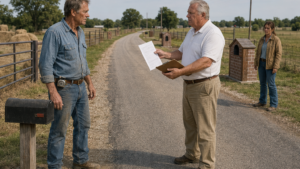
He ignored the edge in her voice and opened the paper on the hood of her utility cart.
It was a rough drawing of the property edge.
“I can buy the strip.”
Kathleen stared at him.
“What?”
“The part under the building. Twenty-one inches at the widest point. We survey off a clean strip, file whatever has to be filed, and I pay you for it.”
“You want me to sell you the ground under your shed.”
“I’m trying to solve it.”
“You could move the shed.”
“That’s not a solution. That’s destruction.”
“No. It’s expensive.”
His jaw tightened.
“Same thing from where I’m standing.”
Kathleen looked at the rough sketch.
There was a dollar figure written beside the proposed strip.
It was more money per acre than the ground was worth agriculturally. Far more.
Benjamin saw her notice.
“I’m not trying to cheat you.”
“I didn’t say you were.”
“I’m offering enough that neither of us has to keep spending money on this.”
Kathleen folded the paper once and handed it back.
“No.”
He did not take it immediately.
“Why?”
“Because I don’t want to sell it.”
“It’s a strip you don’t use.”
She glanced toward the roses.
“I use it.”
“For flowers?”
“For being mine.”
Benjamin finally took the paper.
His face hardened, but not with the easy confidence he had shown during the pour.
“With what I’m offering, you could plant roses all the way to the road.”
Kathleen felt the words land.
He heard them too.
His eyes flicked toward the dead cane.
“I didn’t mean—”
“No.”
He stopped.
Kathleen set the wrench down.
“You keep measuring this in square feet and dollars because that’s the only version that makes your decision reasonable.”
“And you’re measuring it in a plant because that makes mine look worse.”
She looked at him for several seconds.
“That plant was there before your concrete.”
“So was that crooked fence.”
“Yes.”
The answer seemed to surprise him.
Kathleen continued.
“We were both lazy about the line. I’m not pretending otherwise.”
Benjamin’s shoulders loosened a fraction.
“But when I showed you the pin,” she said, “you had a choice I didn’t have three days earlier.”
His face closed again.
“You don’t know what I knew.”
“Then maybe the county will figure it out.”
Benjamin looked across the field toward her house.
“You really want officials crawling through every old boundary use between these farms?”
Kathleen felt something cold settle under her ribs.
“What does that mean?”
“It means these lines have been loose for years.”
“You threatening me?”
“I’m telling you there are consequences to making everything official.”
He picked up his paper.
“Your mower crosses south of the drainage swale. You stored fence posts on my side. My fence crosses yours in two spots. You want the county and lawyers looking at every inch? Fine.”
Kathleen said nothing.
Benjamin stepped back.
“But don’t act surprised when this gets bigger than a shed.”
He walked away.
That evening Kathleen stood beside the rose bed with her notebook.
The dead cane bent when she touched it.
She wrote down Benjamin’s offer.
Then his warning.
She stopped before assigning it a meaning.
For the first time since the concrete pour, she understood that being right about twenty-one inches did not automatically make her right about everything else.
But she also understood something Benjamin did not seem to grasp.
Complication was not the same thing as surrender.
Chapter 5: The Part Benjamin Had Not Admitted
The county zoning officer stood on Benjamin’s concrete apron and pointed at the small metal monument beside the roses.
“Who knew that was there before the pour?”
Nobody answered.
Kathleen stood several feet away with her arms folded against the morning chill.
Benjamin looked toward his shed.
His son stared at the ground.
The officer waited.
She had returned with copies of James Davis’s completed survey, photographs from Kathleen’s complaint, and a measuring wheel. The preliminary review was over. The visit felt different now.
Less conversational.
More exact.
Benjamin finally said, “We saw some metal.”
The officer looked at him.
“Before concrete was placed?”
“I already told you I didn’t know what it was.”
“That isn’t what I asked.”
Kathleen felt her pulse begin to climb.
Benjamin shifted his weight.
“One of the guys uncovered it when they stripped the sod.”
Kathleen looked sharply at him.
This was more than he had said before.
The officer glanced at Kathleen’s photographs.
“These images show the monument exposed before the final section was poured.”
Benjamin’s mouth tightened.
“Kathleen was standing there taking pictures of everything.”
“Yes,” the officer said. “That is why we can see it.”
The quiet reply carried more force than an accusation.
The officer crouched to examine the concrete edge.
The rose canes beside her were mostly bare now. Two dead blossoms remained attached, brown petals curled inward around dry centers.
Kathleen had stopped watering them.
Not because she had given up, she told herself, but because wetting soil trapped under concrete no longer felt like care.
The officer stood.
“The survey confirms the structure crosses the recorded property line. The accessory setback also isn’t met.”
Benjamin rubbed both hands over his face.
“We’ve had buildings closer than this all over the county for fifty years.”
“Possibly.”
“And fences don’t match half the deeds.”
“Possibly.”
“So why am I the one being treated like I stole something?”
The officer did not answer the accusation.
She asked, “Did you receive final permit approval before construction began?”
Benjamin looked away.
“That application was already in.”
“That also isn’t what I asked.”
Kathleen saw his son wince.
The officer wrote something on her clipboard.
Benjamin’s frustration finally broke through.
“I had contractors booked. Concrete ordered. Equipment financing already running. You know what happens if you send everybody home because a neighbor points at a rusty piece of iron?”
Kathleen answered before she meant to.
“You find out what the iron is.”
Benjamin turned on her.
“And lose how much? Ten grand? Twenty?”
“I don’t know.”
“No. You don’t.”
His voice was not loud, but it had sharpened.
“You run hay and keep your own schedule. I’ve got customer equipment sitting outside. I’ve got a loan payment. I’ve got a son trying to make a living here.”
Kathleen glanced at his son.
The younger man looked miserable.
For an instant she saw the situation as Benjamin did: not twenty-one inches of grass, but a chain of bills and deadlines, each attached to the next.
Then she saw the roses.
Understanding did not erase choice.
The officer told Benjamin she would finish the site review and send written requirements to both property owners.
When she walked toward her vehicle, Kathleen followed to ask about timing.
Behind her, Benjamin said, “Kathleen.”
She stopped.
“Can we talk without the county standing here?”
She waited until the officer drove away.
Benjamin’s son returned to the shed without being asked.
For a while Benjamin said nothing.
Then he stepped toward the old survey pin.
“I knew.”
Kathleen felt every muscle in her body go still.
“Knew what?”
“That it might be the corner.”
“Might?”
Benjamin stared at the metal.
“One of the concrete guys asked me about it.”
“When?”
“Morning of the pour.”
Before she had crossed the fence with her coffee.
Kathleen’s hand tightened around her notebook.
“What did you tell him?”
“That the fence had always been the line.”
“And after I showed you?”
Benjamin did not answer.
“Benjamin.”
“I thought you’d let it go.”
The sentence was quieter than anything he had said to her since this began.
Kathleen almost preferred his anger.
“You thought I’d let it go.”
“You always have.”
The words struck deeper than he seemed to intend.
Benjamin continued, perhaps because silence had become worse.
“When the fence sagged onto your place, you never cared. When my equipment crossed at harvest, you never cared. When we used the end of that strip to turn trailers around, you never made an issue of it.”
“That was temporary.”
“I know.”
“Then why would you think a building was the same?”
He finally looked at her.
“Because stopping that morning would have cost me money I didn’t have room to lose.”
There it was.
Not confusion.
Not an old fence.
A calculation.
Kathleen felt anger rise, but underneath it came something worse: recognition.
Benjamin had not believed the land belonged to him.
He had believed Kathleen’s reluctance to fight made her cheaper to ignore than the concrete truck.
“You gambled on me staying quiet.”
His face tightened.
“I gambled on this being something neighbors could work out.”
“You poured first.”
“Yes.”
The admission hung between them.
Kathleen looked down at the notebook.
She could write the sentence immediately.
She could repeat it to the county.
Part of her wanted to watch Benjamin realize that every word had consequences now.
Instead she closed the notebook.
“Why tell me?”
He glanced toward the shed.
“Because you keep acting like I woke up wanting your property.”
“I never said that.”
“You don’t have to.”
Kathleen thought of the paper he had brought her, the inflated price for the strip.
“You wanted the building more than you wanted to know for sure.”
“Yes.”
The answer was almost relief.
Then Benjamin added, “And I was wrong about what you’d do.”
That was the first apology-like thing he had offered.
It was not an apology.
Kathleen was surprised to find she did not need one yet.
Two days later, the county letter arrived by certified mail.
The determination filled three pages.
The structure and concrete apron encroached across the surveyed boundary. Required setbacks had not been satisfied. Construction had proceeded without final permit clearance.
Benjamin was ordered to submit a correction plan and bring the structure into compliance within fifteen days.
Kathleen read the paragraph twice.
Compliance could require removal, relocation, or modification acceptable to both the county and affected property owner.
At the bottom was language about enforcement costs if the deadline was ignored.
She felt no triumph.
Fifteen days meant contractors. Concrete saws. Machinery. Money.
It meant Benjamin’s financing problem was about to become worse because he had gambled on her silence.
That afternoon she found one of Lisa’s roses on the ground.
The blossom had fallen intact, dry and dark.
Kathleen picked it up and placed it on the fence post beside the survey pin.
At dusk, headlights came slowly up her drive.
Benjamin’s pickup stopped beside the porch.
He climbed out carrying the county letter.
He did not approach like a man coming to argue.
He approached like someone who had reached the end of one set of choices and needed another.
“Kathleen,” he said.
She remained on the porch.
He held up the letter.
“I need you to withdraw this.”
Chapter 6: Fifteen Days to Move What Should Never Have Been There
Benjamin offered Kathleen money before he sat down.
“More than I offered before.”
She remained standing beside the porch rail.
“I’m not selling the strip.”
“I’m not asking you to sell it.”
That made her look at him.
Benjamin unfolded the county letter on the small metal table between them.
“I can cut the apron back to the line. I can shift the siding and frame on that corner. We create an easement for the roof overhang and whatever clearance they need. You keep ownership.”
“The building stays across the setback.”
“We ask for a variance.”
Kathleen shook her head.
“You want me to sign off.”
“I want something that doesn’t force me to pull a finished structure apart.”
The porch light made him look older than he had two weeks earlier. There were gray streaks in his beard Kathleen had never noticed.
“How much?” she asked.
Benjamin named a figure.
It was enough to repair her tractor and replace the barn roof section she had been postponing.
For a moment she pictured the check.
Then she pictured the red survey flag rising from his concrete.
“No.”
Benjamin sat back.
“You didn’t even think about it.”
“I already did.”
“When?”
“When you offered to buy the ground.”
“This is different.”
“It leaves the same thing in the same place.”
He pressed his palms against the table.
“Kathleen, fifteen days isn’t enough.”
“The county picked the deadline.”
“You can change what they require.”
“Part of it.”
“Exactly.”
His voice rose slightly, then dropped again.
“I’m not asking you to give away your farm.”
“No. You’re asking me to make permanent the thing I asked you not to do.”
Benjamin looked toward the dark yard.
“I told you why it happened.”
“I know.”
“And that counts for nothing?”
“It counts for understanding why you did it.”
He turned back.
“It doesn’t change what I did.”
Kathleen said nothing.
That was the first time he had said it that plainly.
The next morning, she called the county zoning officer.
She asked a question Benjamin had planted in her mind days earlier.
“If I wanted every historic use along that boundary reviewed, what happens?”
The officer paused.
“You mean the fence deviations?”
“And the mowing. The turnaround. Anything that crosses.”
“That becomes a broader private property matter. Depending on what you claim, you may need counsel. The county’s concern is the current structure and applicable zoning.”
Kathleen looked out the kitchen window.
For years Benjamin had turned wagons across a triangular patch near the lane. For years she had cut grass beyond the record line near the swale because no one else bothered.
She could make a list.
She could turn every casual accommodation into evidence.
“Do I need to raise those issues to make him move the shed?”
“No.”
Kathleen closed her eyes briefly.
“Then I’m not raising them.”
After the call she went outside with pruning shears.
The rose bush beside the survey pin had died back nearly to the crown.
Kathleen knelt in the grass.
For years she had avoided making boundaries explicit because she had believed formal lines invited formal fights. Lisa’s brothers had argued over a farm lane until neither could remember the original insult without adding another one.
Kathleen had promised herself she would be different.
So she had let things slide.
A trailer turning wide.
A fence leaning.
A mower crossing.
An orange stake she should have questioned harder.
Peace, she realized, had slowly become a habit of waiting until someone else decided how much she would tolerate.
She clipped the first dead cane.
Then another.
Near the base, one smaller shoot still showed green beneath the bark.
Kathleen stopped.
She cleared soil carefully around it and found a thin root section extending away from the damaged crown, back toward her field and away from the concrete.
She did not know whether it would survive.
She protected it with loose soil and marked the spot with a small stake.
That afternoon Benjamin came to the fence.
“Any change?”
“Yes.”
Hope appeared on his face.
“I told the county I’m not pursuing the old fence issues or anything else along the boundary.”
The hope faded.
“What about the building?”
“The surveyed line gets restored.”
Benjamin looked down.
“So that’s it.”
“That’s it.”
“You get to decide that?”
Kathleen heard the challenge but did not answer it with one.
“You decided when the concrete truck was here.”
He rubbed his forehead.
“I said I was wrong.”
“Yes.”
“And you still won’t give me an inch.”
Kathleen glanced at the survey.
“I gave you years of inches.”
Benjamin followed her gaze.
For a moment neither spoke.
Then Kathleen said, “I was wrong too.”
He looked at her.
“I should have had the line checked years ago. I should’ve called James when I saw the stakes. I kept telling myself being easy to live beside was the same as taking care of things.”
Benjamin’s expression shifted.
That was not what he had expected.
Kathleen continued.
“But my mistake doesn’t require me to make yours permanent.”
He nodded once, slowly.
It was not agreement.
But it was the first time he seemed to hear the distinction.
On the seventh day, no contractor came.
On the ninth, Benjamin submitted a proposed modification. The county rejected it because the structure still crossed the required line and Kathleen would not grant the requested agreement.
On the eleventh, a concrete saw appeared in Benjamin’s yard, then disappeared without being unloaded.
On the thirteenth, his son removed two pieces of equipment from the shed.
Kathleen watched from a distance and said nothing.
On the fourteenth evening, Benjamin stood beside the building with a tape measure, making marks along the siding.
For a moment she thought he had finally decided to move it.
The next morning, nothing happened.
By dusk on the fifteenth day, the shed still stood exactly where it had stood before the notice.
Kathleen checked the date in her field notebook.
She felt tired rather than victorious.
She wrote:
Compliance deadline expired. No correction completed.
Then she closed the notebook and left it on the kitchen table.
At 7:12 the following morning, the rumble of a diesel engine came up the county road.
Kathleen stepped onto the porch.
A heavy contractor truck slowed at her lane. Behind it came a flatbed carrying cutting equipment, cribbing, and steel supports.
The trucks turned toward the boundary.
Across the field, Benjamin walked out of his shed and stopped.
For several seconds, he and Kathleen stood on opposite sides of the same twenty-one inches, watching the county contractor arrive.
Chapter 7: The Line Stayed, but the Roses Did Not
The concrete saw screamed into the apron at eight nineteen that morning.
Kathleen felt the sound through the soles of her boots.
A county contractor knelt over a chalked line beside the red survey flag while another worker fed water across the spinning blade. Gray slurry ran toward the grass in thin streams. Behind them, steel supports had been placed along the machinery shed, and part of the siding had already been removed.
Benjamin stood near the open doors with his arms folded.
He did not look at Kathleen.
She did not go closer.
The enforcement crew had explained the plan when they arrived. The shed did not need to be destroyed entirely. It could be braced, separated from the offending concrete, and shifted far enough onto Benjamin’s property to satisfy the surveyed line and required setback. The apron section crossing Kathleen’s land would be cut out and removed.
It was still expensive.
It was still unnecessary.
But it was not the spectacle Kathleen had once imagined during her angriest moments.
No wrecking ball.
No cheering neighbors.
Just measurements, machinery, men doing slow work, and a building moving because someone had refused to move it earlier.
The saw reached the corner nearest the roses.
Kathleen stepped forward.
“Watch the root area.”
The worker shut down the blade.
The sudden quiet left her ears ringing.
He looked at the dead canes.
“This plant?”
“What’s left of it.”
He nodded and changed the angle of the next cut.
Benjamin finally looked toward her.
For a moment she expected irritation.
Instead he said, “They know.”
Kathleen nodded.
The saw started again.
By midmorning, the encroaching section of concrete had been separated. A small excavator lifted broken slabs onto a flatbed. Each piece left a clean, pale scar in the earth where the apron had crossed the line.
Kathleen expected satisfaction.
She felt some.
She would have been lying to herself if she denied it.
The red survey flag no longer rose from Benjamin’s concrete. The line James Davis had marked could be followed again without disappearing underneath somebody else’s building.
But satisfaction proved quieter than anger.
It did not fill the space she thought it would.
Two neighboring farmers slowed their pickups on the county road. One raised a hand to Kathleen. Neither stopped.
That suited her.
She had no interest in making Benjamin’s worst week into county entertainment.
Around noon, the workers began shifting the shed.
They had removed enough siding and detached enough of the foundation connection to move the structure in sections rather than dismantling it board by board. Hydraulic jacks lifted the frame inches at a time. Steel beams slid beneath it.
Benjamin stood with his son near the equipment yard.
His son said something Kathleen could not hear.
Benjamin answered without turning.
The younger man walked away toward a tractor.
For the first time since the dispute began, Benjamin looked smaller than the building.
Not defeated.
Just tired.
Kathleen understood that difference mattered.
The county zoning officer arrived shortly after lunch and checked the new measurements. She walked from flag to flag with the contractor, then stood beside Kathleen.
“The structure will clear when they set it down.”
“And the concrete?”
“Everything crossing the line is being removed.”
Kathleen looked toward the old fence.
“What about the rest?”
“The rest of what?”
“The fence deviations. The mowing. The turnaround.”
The officer studied her.
“You didn’t include those in your complaint.”
“No.”
“Do you want to?”
Kathleen watched Benjamin’s shed inch backward onto his own land.
There had been a time, less than two weeks earlier, when she might have said yes simply because she finally had official attention.
She could have demanded every crooked fence post be examined.
Every tire track.
Every casual use.
She could have spent another year proving where each inch belonged.
“No,” she said.
The officer nodded once.
“Then this closes when the current violation is corrected and costs are processed.”
“Costs to Benjamin?”
“The enforcement and contractor costs attributable to his noncompliance, yes.”
Kathleen did not ask for the number.
That was between Benjamin and the county now.
By late afternoon, the machinery shed sat entirely on Walker land.
It looked almost unchanged from the road.
That surprised Kathleen most.
Twenty-one inches had caused weeks of anger, survey work, county visits, threatened financing, and a forced relocation.
Now that the shed had moved, the difference was almost invisible.
Only the ground remembered.
A strip of torn soil ran beside the new concrete edge. The old rose bed sat exposed again, no longer trapped against the apron.
The workers loaded their equipment.
The zoning officer checked the final placement and left.
Benjamin remained.
Kathleen waited until the trucks were gone before walking toward the roses.
She knelt and touched the crown of the oldest plant.
The bark crumbled beneath her thumb.
She cut one cane near the base.
Brown all the way through.
Another.
The same.
She worked slowly around the crown until there was almost nothing left.
Benjamin came toward the boundary but stopped on his side.
Kathleen knew he was there.
She kept cutting.
“Is it dead?” he asked.
She scraped the crown one more time.
“Yes.”
Benjamin stared down at the plant.
“I’m sorry.”
Kathleen closed the pruning shears.
It was the first clean apology he had given her.
For several seconds she could not answer.
Then she said, “I know.”
He looked surprised.
Kathleen sat back on her heels.
“I don’t think you meant to kill it.”
“I didn’t.”
“I know that too.”
Benjamin looked toward the relocated shed.
“That doesn’t make much difference now.”
“No.”
The word sat between them without accusation.
He put his hands into his jacket pockets.
“The county sent the preliminary cost notice.”
Kathleen waited.
“It’s bad.”
She nodded.
“I figured.”
“I could’ve stopped the truck that morning.”
“Yes.”
He let out a breath.
“I kept thinking if I got far enough along, nobody would make me undo it.”
Kathleen looked at the restored strip of ground.
“That was the problem.”
Benjamin nodded.
After a moment he said, “You could still come after the other stuff.”
“The fence?”
“And the turnaround.”
“I could.”
He watched her carefully.
Kathleen rose.
“I’m not going to.”
“Why?”
“Because that wasn’t what this was about.”
Benjamin glanced at the roses.
“No.”
“It wasn’t.”
He seemed to consider saying more, then simply nodded.
Their relationship did not repair itself in that moment.
Kathleen did not expect it to.
There would be awkward waves from tractors and conversations limited to weather or gates for a while. Maybe years.
But the line between them was no longer something either could pretend not to know.
Benjamin turned toward his yard.
“Kathleen.”
She looked up.
“I’ll move the fence this winter. Put it where James marked it.”
She considered him for a moment.
“Talk to me before you do.”
A faint, tired smile touched one corner of his mouth.
“Yeah.”
“Before.”
“I heard you.”
He walked away.
Early the next week, Kathleen returned to the rose bed with a shovel.
The original crown had not recovered.
She had checked twice, though she already knew.
But the small root section she had protected during the compliance period still carried a thin green shoot.
Kathleen dug around it carefully.
The root came free with a small clump of dark soil.
She carried it thirty feet into her field.
Not beside the fence.
Not beside the survey monument.
Well inside her own land.
She chose a spot near the equipment barn where she could see it from the kitchen window but where no future boundary argument would ever reach it.
The hole was shallow.
She placed the cutting inside and pressed soil gently around the root.
For a moment she remembered Lisa kneeling beside the original bushes years earlier, straw hat crooked, dirt beneath her fingernails.
Kathleen had spent much of the past month thinking her mother’s lesson had been about holding onto land.
Now she remembered something else.
Lisa had moved fences.
Not often, but when a gate worked better somewhere else or cattle needed a cleaner turn, she had moved them without ceremony. She had known precisely which acres belonged to her while never confusing a strand of wire with the reason the farm mattered.
Kathleen poured water around the cutting.
Then she walked back to the boundary.
James’s permanent marker stood clearly visible beside the corrected concrete edge.
The old fence still wandered.
For now.
Kathleen removed the faded red survey flag but left the metal monument uncovered.
She did not plant anything over it.
Across the line, Benjamin was working inside the shifted shed. An impact wrench rattled briefly, then stopped.
He saw Kathleen and raised one hand.
She raised hers.
Nothing more.
At her feet, the ground where Lisa’s roses had stood was bare.
The land had been restored.
The roses had not.
Kathleen had once thought justice would feel like getting back exactly what had been taken.
It did not.
Sometimes all it could do was stop the taking.
She looked once more at the visible survey pin, then turned toward the small green cutting planted safely inside her field.
The line would stay.
This time, so would the understanding of why it mattered.
The story has ended.