They Ordered Joshua to Move His Family’s Irrigation Ditch—Then Their Own Water Started Disappearing
Chapter 1: The Friday Deadline Beside the Old Headgate
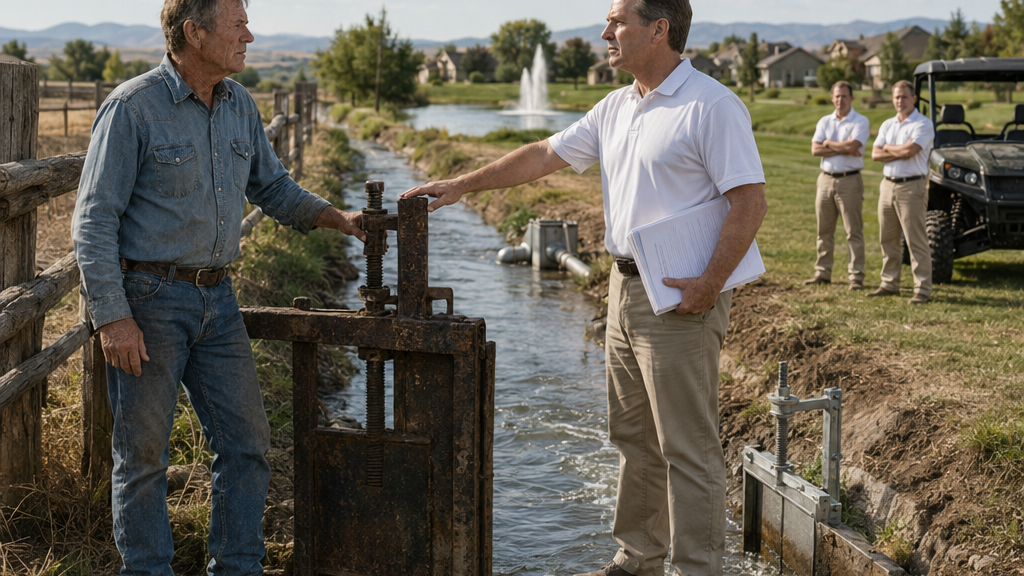
Michael Wilson had his hand on the iron headgate when he told Joshua Allen he had until Friday.
“After that, the daily penalties start.”
Joshua stopped three paces away.
The gate sat where it had sat longer than either man had been alive, bolted between weathered concrete cheeks at the edge of the Allen ditch. Rust darkened its wheel. Mineral scale traced pale lines beneath the lifting plate. Near the bottom, almost hidden by mud and decades of paint, raised iron numbers read 1897.
Michael’s fingers rested on the wheel as though it belonged to him.
Joshua looked at the hand first.
Then he looked at Michael.
“Take your hand off that.”
Michael hesitated. His white polo was still clean despite the dust along the ditch road. His khaki pants had the pressed look of clothes worn for meetings rather than work. He gave Joshua the small, patient smile people used when they believed calmness proved authority.
“We’re trying to resolve this without making it adversarial.”
“You’re holding my gate.”
Michael removed his hand.
That was enough of a victory to keep Joshua from saying the other things gathering behind his teeth.
The irrigation water moved slowly below them, brown-green and cold from the upstream release. On Joshua’s side of the ditch lay a hayfield cut three weeks earlier and already showing new growth. Beyond the opposite fence rose the stone entrance wall and young cottonwoods of Cedar Ridge, the residential development built over what had once been scrub pasture.
Michael opened a thick folder.
“The association has received another insurance recommendation concerning the open ditch. We also have complaints about erosion, standing debris, and the visual condition along the common boundary.”
Joshua stared at him.
“The visual condition.”
“It affects adjacent property.”
“It’s an irrigation ditch.”
“Which is exactly why we’re offering options. Relocation, piping, or screening.”
“On whose land?”
Michael’s smile tightened.
“The association’s attorney believes part of the affected corridor falls within our managed setback.”
Joshua gave a single quiet laugh.
That brought the other men into his attention.
Two association board members stood twenty feet behind Michael beside a spotless utility vehicle. Both wore white polos embroidered with the same small Cedar Ridge emblem. One had his arms folded. The other was studying Joshua with the careful blankness of someone expecting trouble.
Joshua had thought Michael came alone.
Apparently Michael had thought witnesses were useful.
“You brought a board meeting to my ditch?”
“We brought people familiar with the issue.”
Joshua looked back at the gate.
His father had worked that wheel with a pipe slipped through the spokes when Joshua was small. His grandfather had replaced one of the side brackets after a spring flood. There were photographs somewhere in the ranch office of horses drinking upstream before Cedar Ridge had streets, houses or a fountain.
Joshua knew those things.
What he did not know, and hated admitting even to himself, was exactly what the courthouse records said.
He had always treated the ditch as one of those facts too old to require explanation.
Michael pulled an envelope from the folder.
“This is the formal notice. Friday at five is the compliance deadline. After that, the association will assess two hundred dollars per day while the violation remains unresolved.”
Joshua didn’t take it.
“You planning to bill my ranch?”
“We’ll proceed through whatever remedies counsel determines are appropriate.”
“You don’t own my ranch.”
“No one said we did.”
“You’re issuing me fines for something on it.”
Michael lowered the envelope slightly.
“We invited you to an inspection last month.”
Joshua remembered the email. He had deleted it without answering.
At the time, it had sounded like exactly what he hated about Cedar Ridge—someone with a clipboard wanting to explain his own land to him. He had told himself that ignoring it was the same thing as refusing permission.
Now Michael had paperwork, two witnesses and a deadline.
Joshua took the envelope.
Michael’s posture loosened by a fraction.
“Good. Read the engineering recommendation. I think you’ll see we’re trying to find a reasonable solution.”
Joshua turned the envelope over. The association’s return address sat above a block of legal language.
“What happens to the water if I pipe this?”
“That would depend on the final design.”
“My hay depends on the final design.”
“That’s why engineers would handle it.”
Joshua felt the old instinct rise in him: end the conversation, send them off, lock the ranch gate and let them discover how far they could get without his cooperation.
That instinct had served him well against salesmen, contractors and people who mistook politeness for consent.
It had also cost him more than once.
Still, Michael’s last sentence had landed badly.
Joshua stepped to the headgate and brushed dry mud from the casting with his thumb.
“See those numbers?”
Michael glanced down.
“Eighteen ninety-seven.”
“My great-grandfather put the first diversion through here that year.”
Michael looked less impressed than Joshua had expected.
“Historical age doesn’t automatically determine modern jurisdiction.”
“I didn’t say it did.”
“Then we agree that the date by itself isn’t the issue.”
Joshua looked at the two board members. One had shifted his weight. The other was staring at the gate now.
Joshua handed Michael nothing. He folded the envelope once under his arm.
“You brought paperwork,” he said. “I’ll answer it with paperwork.”
Michael studied him.
“Friday.”
“I heard you the first time.”
The board members climbed back into the utility vehicle. Michael lingered a moment, perhaps waiting for Joshua to add something angry enough to justify the audience he had brought.
Joshua did not.
Michael finally walked away.
The vehicle rolled toward Cedar Ridge, leaving dust suspended between the fence posts.
Joshua stayed by the ditch until the sound disappeared.
Only then did he open the envelope.
The first page used phrases like nuisance condition, liability exposure and visual nonconformity. The second referred to remedial authority. The third contained a diagram that showed the boundary in a way Joshua did not recognize.
He read it twice.
Then he walked the ditch.
Fifty yards below the old headgate, the channel bent toward a stand of cottonwoods. Joshua stepped across a narrow service plank and followed the bank until something metallic caught the afternoon light.
A newer gate sat low in the ditch wall.
He crouched.
The steel was galvanized, not old iron. Fresh bolts held it to a concrete box. Beyond it, a buried pipe disappeared beneath the fence toward Cedar Ridge.
Joshua put two fingers against the water.
He could feel the pull.
A steady portion of the ditch was leaving his channel and moving toward the development.
He stood slowly and looked beyond the fence.
Above the trees, he could see the thin white plume of Cedar Ridge’s decorative fountain.
Michael Wilson had just threatened to fine him for an ugly ditch.
And Cedar Ridge was drinking from it.
Chapter 2: The Green Fountain Fed From His Ditch
Joshua followed the diverted water before he let himself touch anything.
The galvanized gate had a numbered position indicator, a recent grease fitting and a square operating stem polished bright from use. Someone maintained it.
That bothered him more than the existence of the pipe.
Old arrangements could be forgotten. Improvised drought measures could survive long past the people who understood them.
Maintained equipment meant intention.
Joshua walked the fence line until the buried pipe vanished beneath a gravel maintenance lane belonging to Cedar Ridge. From there he could trace its direction by valve boxes set at regular intervals through the landscaping.
He knew enough about irrigation to recognize a system that had been planned.
Near the subdivision entrance, the pipe split.
One branch ran toward rows of ornamental trees. Another angled toward the pond.
The fountain rose thirty feet into the air.
Joshua stopped outside the fence and watched sunlight flash across the spray.
Cedar Ridge had spent the last two years complaining about dust from harvest equipment, early-morning machinery and the appearance of his ditch bank. Now the same ditch was feeding a pond surrounded by trimmed grass greener than anything on Joshua’s place.
He took out his phone and photographed the valve boxes, the pipe alignment and the water level at the side gate.
He was kneeling beside the second valve box when Michael’s voice came from behind him.
“I was wondering how long it would take you.”
Joshua straightened.
Michael stood on the paved walking path inside the common area. He had traded the folder for sunglasses, though he removed them as he approached.
“You knew I’d find this?”
“I assumed you knew it was here.”
“Why would I know that?”
Michael frowned.
“Because it’s been operating for years.”
“That doesn’t answer the question.”
“It wasn’t installed last week, Joshua.”
Joshua disliked the use of his first name almost as much as the answer.
“How much water are you taking?”
“I don’t operate the irrigation system.”
“You’re president of the association.”
“That doesn’t make me the maintenance technician.”
Joshua pointed at the fountain.
“That run off this line?”
Michael looked toward it.
“The common-area system draws from several sources.”
“Which ones?”
“Groundwater, stored water, and the existing ditch access.”
Existing ditch access.
The words sounded practiced.
Joshua stepped closer to the fence.
“Show me the agreement.”
Michael’s expression changed—not fear, exactly, but caution.
“You’re assuming there needs to be a separate agreement.”
“There needs to be something.”
“Our attorney’s position is that the use is longstanding and recognized.”
“Recognized by who?”
“Previous owners. Previous managers. Your family, apparently.”
Joshua said nothing.
That last word struck harder than he wanted Michael to see.
His father had handled the ranch books until the year before his death. Joshua had taken over late, during a period when bills were being paid from three accounts and equipment loans were being stretched month to month. There had been boxes of papers. Easement maps. Handwritten notes. Things Joshua promised himself he would organize after calving, then after haying, then after his father’s funeral.
Some he had never opened.
Michael watched him long enough to notice the silence.
“This is what I was trying to explain this morning. These issues aren’t as simple as saying the ditch is old and therefore nothing can change.”
“Neither is fining me two hundred dollars a day.”
“The fine is tied to the boundary condition.”
“The boundary condition supplies your fountain.”
Michael exhaled.
“We’re not going to solve this standing beside a valve box.”
“You showed up at my gate with a deadline.”
“Because you refused the inspection.”
Joshua almost denied it.
He didn’t.
Michael continued.
“The insurer has flagged open-water exposure along the pedestrian side of the development. Residents complain about debris. The banks are eroding in places. The board has responsibilities.”
“So do I.”
“I agree.”
“No, you agree when my responsibilities help your lawn.”
Michael’s jaw tightened.
For the first time, the polished patience slipped.
“You think this is about grass?”
“I can see the grass.”
“You see a common area. I see reserve accounts that are short, insurance premiums going up and homeowners furious every time dues increase. If the entrance deteriorates, they blame the board. If somebody falls into that ditch, they blame the board. If we ignore counsel, they blame the board.”
There it was: not the whole truth, perhaps, but something less theatrical than simple arrogance.
Joshua looked toward the houses.
A woman pushed a stroller along the path near the pond. An older man stood with a small dog beneath one of the cottonwoods. Neither looked like part of Michael’s delegation from that morning.
“That still doesn’t make my land yours.”
“I didn’t say it did.”
“You keep saying that while acting like it does.”
Michael put his sunglasses back on.
“Read the notice. Have your attorney contact ours.”
“I don’t have an attorney on retainer.”
“That’s your choice.”
Joshua felt his temper flare.
Michael must have seen it, because he took one step backward.
Joshua turned instead toward the water.
He followed the pipe farther, past a maintenance shed and a locked enclosure where two filtration units hummed. Through a gap in the fence, he could see a newer manifold with pressure gauges feeding several irrigation zones.
This was no emergency hose someone had forgotten.
Cedar Ridge had built permanent landscaping around the assumption that this water would continue.
Joshua photographed the manifold.
Then something else caught his eye.
A metal tag bolted to one of the older valves carried a faded service date from years earlier—well before Michael had become association president.
That complicated things.
If the system had been openly maintained for that long, somebody on the Allen side should have noticed.
Maybe somebody had.
Joshua walked back toward the ranch as the fountain continued throwing water into the afternoon sky.
At the side diversion, he rested his hand on the operating stem.
One turn might have answered every insult Michael had delivered that morning.
Close it. Make them come ask.
His father would have known exactly what this gate meant.
Joshua could almost hear the older man telling him not to solve a paper problem with a wrench.
That memory irritated him because he wasn’t certain it was real.
He removed his hand.
By dusk he was sitting at the ranch office desk with Michael’s notice, his father’s old file boxes and a yellow legal pad spread before him.
He found tax records. Grazing leases. Machinery receipts. Nothing that clearly explained Cedar Ridge.
At nine-thirty, Joshua stopped searching.
On the notice, the association attorney had cited a parcel description.
Joshua copied it onto the pad.
Then beneath it he wrote three things:
1897 headgate.
Side diversion.
County records.
The gate could wait one more day.
Before anyone turned another wheel, Joshua intended to find out what his family had actually promised.
Chapter 3: The Record That Was Stronger Than Memory
The county records clerk disappeared behind a row of shelves and came back carrying a file Joshua had never seen.
“Allen,” the clerk said, setting it on the counter. “Indexed under your great-grandfather’s surname and the original ditch company.”
Joshua looked at the swollen brown folder.
“That all?”
“For this index number. There may be related water filings downstairs.”
The folder smelled like dust, paper and the dry leather binding of old courthouse books.
Joshua opened it carefully.
The first pages were copies of hand-drawn surveys. Property lines crossed the page in black ink, and the ditch appeared as a narrow blue pencil mark running through parcels whose owners’ names had changed several times since.
Then he found the decree.
The paper itself was a later certified copy, but the recording information was unmistakable. The priority history reached back to 1897.
Joshua read the paragraph twice.
The language was old-fashioned and dense, but he understood enough. The right attached to the Allen ditch was older than almost every developed use in the area. The access corridor was recorded. Maintenance rights were described. The ditch was not simply an old trench nobody had challenged.
It had legal history.
Joshua sat back.
For the first time since Michael touched the headgate, relief loosened something in his chest.
Not triumph.
Not yet.
But relief.
He photographed each page, then asked the clerk for certified copies.
“You dealing with a dispute?” the clerk asked.
“Maybe.”
“That usually means yes.”
Joshua almost smiled.
The clerk placed several pages beside the copier.
“If this is water administration, you’ll want the historical filings too. Different office.”
“I figured.”
“You’d be surprised how many people don’t.”
Downstairs, another set of records gave the old ditch a more complicated life.
There were priority schedules from dry years. Maintenance notices. Correspondence about downstream delivery. Joshua found his grandfather’s name on one inspection form and his father’s on several later pages.
Nothing mentioned Cedar Ridge at first.
That made sense. The development had not existed.
Its parcel had once belonged to a larger tract west of the Allen ranch.
Joshua traced the ownership forward.
Ranch parcel.
Investment parcel.
Development company.
Residential association.
Then he found the first reference to a secondary delivery point.
It was handwritten in the margin of a maintenance report.
Temporary downstream accommodation during shortage.
Joshua stopped.
He read the line again.
The date was from a drought year he remembered.
Not well, but enough.
He had been working cattle out of state for much of that summer. When he returned, the hills had been brown and stock ponds had shrunk to mud rings. His father had complained that everyone wanted water that did not exist.
Joshua turned the page.
A sketch showed the main ditch and a temporary branch toward the western parcel.
Not Cedar Ridge.
Not yet.
But the direction matched.
The first clean certainty he had felt began to fracture.
A temporary accommodation was not a permanent right. He knew that.
But it was also not theft.
Somebody in his family had allowed the water to go there.
The clerk returned with another folder.
“You asked about the western parcel. These were cross-referenced under easement correspondence.”
Joshua opened it.
Letters filled the first half, mostly mundane notices about access and maintenance. One described repairing a washed-out bank. Another discussed a temporary diversion structure during low flow.
Then came a typed letter from years later.
Joshua recognized his father’s clipped signature before he read a word.
The letter allowed continued seasonal use “subject to availability, senior delivery obligations, and revocation.”
Joshua stared at that sentence.
Michael had been wrong to talk as though Cedar Ridge owned unquestioned access.
But Joshua had been wrong too.
The water had not simply been taken behind his family’s back.
His father had known.
Joshua rubbed a thumb over the edge of the photocopy.
He remembered arguments with the old man about smaller things: equipment sold too cheaply to neighbors, hay carried on credit, gates left unlocked for people who ought to have fixed their own fences.
“You can’t run a ranch like a charity,” Joshua had once told him.
His father had answered, “You can’t run a valley like you live alone in it.”
At the time, Joshua had thought it was another excuse for bad bookkeeping.
The sentence came back now with uncomfortable clarity.
He continued reading.
Years of records followed.
The accommodation appeared sporadically. Some seasons showed no use. Others referred to controlled releases. One memo, written after the development company had begun construction, requested clarification of “historic secondary access.”
Joshua found no document granting permanence.
No recorded transfer.
No new priority.
But neither did he find a clean moment when his father had formally ended the arrangement.
The ambiguity was real.
By noon, Joshua had built two stacks.
The first favored him strongly: senior right, recorded ditch, maintenance authority, old priority.
The second bothered him: correspondence showing consent to some downstream use over many years.
He asked for copies of both.
Not just the pages he liked.
Back at the main counter, the county records clerk watched the copier produce the final sheet.
“You want two certified sets?”
“Two.”
“Planning to lose one?”
“Planning not to argue about what was in the other.”
The clerk stamped the copies.
Joshua gathered them into separate folders.
As he turned to leave, a loose page slipped from the second stack and landed face down.
He bent to pick it up.
On the reverse was another handwritten notation he had missed.
Continuation permitted temporarily pending future supply arrangement.
Below it sat a date.
And beneath the date, in the heavy slant Joshua had watched across feed checks and birthday cards his entire life, was his father’s signature.
Joshua stood with the paper in both hands.
Michael’s certainty had cracked that morning.
Now Joshua’s had too.
The word temporarily was underlined once.
His father had allowed the water.
The question was no longer whether Cedar Ridge had ever been given access.
The question was why his father had kept giving it—and what he had expected to happen when temporary finally ended.
Chapter 4: What His Father Had Never Explained
Dennis Hernandez recognized the sketch before Joshua finished unfolding it.
“That’s the west spur.”
Joshua looked up from the scarred workbench in Dennis’s equipment shed.
“You’re sure?”
Dennis wiped his hands on a rag and leaned closer. The paper was a certified copy from the county file, but the drawing itself had been made decades earlier: main ditch, fence line, a penciled branch toward the western parcel.
Dennis tapped the branch with one thick finger.
“I helped your dad clear brush out of that run one summer.”
Joshua felt something close inside him.
“What year?”
Dennis named the same drought year from the courthouse notation.
Joshua folded his arms.
“You knew about it.”
“I knew there was a temporary delivery.”
“That’s not what I asked.”
Dennis straightened. He was a few years younger than Joshua but carried his age differently, broad through the shoulders and permanently bent a little from machinery work.
“You want me to apologize for something your father arranged?”
“I want to know why nobody told me Cedar Ridge was taking water.”
“There wasn’t any Cedar Ridge then.”
“There is now.”
Dennis studied him.
“And you haven’t exactly been asking.”
Joshua almost walked out.
Instead, he put both hands on the workbench.
He had come because Dennis irrigated farther downstream and because the old records contained references to delivery rotations Joshua did not fully understand. He had told himself he wanted facts.
Facts were less comfortable when they came from people who remembered what he had chosen not to learn.
Dennis pulled a metal chair forward.
“That summer was bad. Not regular bad. Bad enough people were selling cattle they’d planned to keep another five years.”
“I remember.”
“You were gone most of it.”
“I remember that too.”
Dennis sat.
“The western parcel had two wells failing. One family still kept stock there. Your dad let them pull through the side run during certain hours. Not much at first.”
Joshua looked down at the sketch.
“And later?”
“Later the parcel changed hands.”
“So why did he keep allowing it?”
Dennis gave him a tired look.
“Because that was your father.”
“That doesn’t explain anything.”
“It explains more than you think.”
Joshua pushed away from the bench.
His father had spent the last five years of his life worrying about operating loans. Joshua remembered bills stacked beside the kitchen phone and arguments about machinery they could not afford to repair. He remembered telling the old man that generosity was expensive.
Now Dennis opened a drawer beneath the workbench and pulled out a stained spiral notebook.
“What’s that?”
“Maintenance notes. Mine and some copied from your dad’s old schedule sheets.”
Joshua took it.
Most pages were ordinary: gate positions, dates, ditch cleaning, approximate flows. Then he saw his father’s initials beside several entries concerning the western spur.
One line read: no charge—emergency use.
Joshua read it again.
“He never billed them?”
“Not then.”
“Why?”
Dennis shrugged.
“Because they were in trouble.”
Joshua shut the notebook.
“That’s exactly how he ended up in trouble.”
Dennis didn’t answer immediately.
Outside, a tractor started somewhere behind the shed, coughed once and settled into a low diesel rumble.
Finally Dennis said, “Maybe.”
Joshua looked at him.
“You think I’m wrong?”
“I think you spent a lot of years being angry that your dad didn’t run the place the way you would’ve.”
Joshua’s jaw tightened.
Dennis continued before he could interrupt.
“And now you’ve got Michael Wilson acting like the ditch belongs to his subdivision, so you want the answer to be simple. They took it. You stop it. End of problem.”
“They don’t have a permanent right.”
“I didn’t say they did.”
“The records don’t show one.”
“I believe you.”
“Then what are we arguing about?”
Dennis walked to the open shed door and pointed down-valley.
“Water.”
Joshua followed his hand.
Several farms lay below them, fields divided into dull green and tan rectangles. Dennis’s lower acreage depended on the same system.
“Your gate affects more people than Michael.”
Joshua’s irritation cooled.
“What’s your point?”
“My point is Cedar Ridge has been pulling harder the last few seasons.”
“How much harder?”
“Enough I’ve noticed my rotation dropping early.”
Joshua frowned.
“Why didn’t you tell me?”
Dennis gave a short laugh without humor.
“I did.”
“When?”
“Twice last summer. Once the year before.”
Joshua remembered conversations at the feed store, complaints about weak flow, Dennis asking whether he had changed anything upstream.
Joshua had blamed dry conditions.
He had never checked the side gate.
That was harder to excuse than Michael’s ignorance.
Dennis opened another page.
“Your dad’s notes show controlled hours. Looks like a limited release. What they’ve got now isn’t that.”
Joshua traced the numbers.
His father had not given away the ditch.
He had made room inside it.
Temporarily.
Carefully.
And somehow, over years of changed ownership and absent attention, temporary generosity had hardened into somebody else’s expectation.
Joshua looked toward the western ridge where the tops of Cedar Ridge houses showed above the cottonwoods.
“I can close the side gate.”
“I know.”
“I could do it tonight.”
“I know that too.”
Dennis’s voice changed.
“But if you close everything before somebody measures what’s actually happening, Michael gets to say you’re the unreasonable one.”
Joshua hated that Dennis was right.
He also hated that his first instinct had been exactly that.
That evening, Joshua returned to the ranch office with the spiral notebook and spread the county copies beside Michael’s notice.
He found more of his father’s maintenance references in a box he had not opened since the funeral.
Dates.
Gate turns.
Short releases.
One note, written in his father’s blocky hand, said: west use only after downstream delivery met.
Joshua sat with that sentence for a long time.
His father’s generosity had contained rules.
Not ownership.
Not surrender.
Responsibility.
By Wednesday morning, Joshua had made his decision.
He drove to the water administration office with both certified sets, the maintenance notes, photographs of the newer diversion equipment, and Michael’s compliance notice.
At the counter, he filled out a request for formal inspection and priority review.
The clerk looked at the stack.
“You’re asking for immediate field review?”
“Yes.”
“You understand an official determination could restrict any diversion found outside the recorded priority?”
Joshua thought of the fountain, Michael’s clean folder, Dennis’s lower field, and his father’s handwriting.
“Yes.”
The clerk stamped the request.
Joshua watched the ink dry.
He could have turned the gate himself.
Instead, he had put the decision where it belonged.
Now he had to live with whatever the law did to everyone standing downstream of it.
Chapter 5: The Yellow Seal on the Side Gate
The water commissioner arrived before sunrise Thursday, and Michael Wilson was already waiting beside the ditch.
Joshua saw his vehicle first, parked near the subdivision maintenance entrance with its headlights off. Michael stood beside it in a jacket over his usual polo, holding a binder against his chest.
No board members this time.
The commissioner stepped out of a state vehicle carrying a measuring rod, clipboard and small case of instruments.
“You Allen?”
Joshua nodded.
“Wilson?”
Michael raised a hand.
The commissioner looked from one man to the other.
“Good. Then nobody needs to explain where the disagreement is.”
He started at the old headgate.
Joshua watched him scrape mineral scale away from the casting until the raised numbers became clear.
The commissioner photographed them, then measured the ditch structure and checked Joshua’s certified records against a map clipped to his board.
Michael shifted beside the fence.
“I’d like it noted that the association does not dispute the age of the ditch.”
The commissioner kept writing.
“What do you dispute?”
“The interpretation of downstream access.”
“We’ll get there.”
Joshua said nothing.
That restraint felt different now. Three days earlier it had been mostly anger under control. Now it was uncertainty under control.
The commissioner moved downstream to the galvanized side gate.
He studied the new hardware.
“When was this assembly installed?”
Michael opened his binder.
“The association replaced deteriorated equipment six years ago.”
“Replaced what?”
“An existing diversion.”
“Same capacity?”
Michael paused.
“I’d have to check.”
The commissioner looked at him.
“That’s something I need you to check.”
Michael found a section in the binder.
Joshua noticed tabbed pages, engineering sheets, maintenance invoices.
Michael had come prepared.
For a few minutes, that worried him.
Then the commissioner asked a different question.
“Recorded entitlement?”
Michael handed over a document.
The commissioner read it.
“This is correspondence.”
“It reflects longstanding recognized use.”
“It reflects discussion of use.”
“There’s more.”
Michael produced another sheet.
Joshua recognized the development company letter from the courthouse.
The commissioner read that too.
“Temporary access subject to senior obligations.”
Michael nodded quickly.
“Which was never revoked.”
“Maybe. But that doesn’t create a new priority by itself.”
Michael’s voice hardened.
“The association has relied on this water for years.”
“I’m not evaluating reliance. I’m evaluating diversion authority and priority.”
The distinction landed cleanly.
Joshua felt satisfaction before he could stop it.
The commissioner asked to see operating records.
Michael gave him another packet.
Halfway through it, the commissioner stopped.
“What’s this?”
Michael leaned closer.
“Board correspondence.”
“Your attorney advised metering three years ago.”
Michael’s jaw moved.
“That recommendation involved several options.”
“He also says here the association should not characterize the diversion as permanently secured until title and water-right review are complete.”
Joshua looked at Michael.
Michael did not look back.
The commissioner turned another page.
“Was that review completed?”
“Our understanding was that historic use supported continued access.”
“That wasn’t my question.”
“No.”
The answer was quiet.
Joshua remembered Michael at the headgate saying historical age did not determine modern jurisdiction.
Apparently uncertainty had applied in both directions.
“You knew,” Joshua said.
Michael faced him.
“I knew counsel wanted more documentation.”
“You came onto my place threatening fines while your own attorney was telling you the water claim wasn’t settled.”
“The ditch condition and water access are separate issues.”
“They weren’t separate enough to keep your fountain running.”
The commissioner raised a hand.
“Both of you stop.”
Joshua did.
Michael took longer.
By seven-thirty, measurements had been taken from the main ditch and the side diversion. The commissioner checked recent flow records from the district, then called the office twice.
When he returned, he carried a yellow seal tag and a heavy lock.
Michael saw them.
“What are you doing?”
“Suspending this diversion at its present operation pending formal review.”
“You can’t cut the entire development off based on a field visit.”
“I can restrict a diversion that is operating beyond demonstrated authority when senior and downstream deliveries are affected.”
Michael stepped toward him.
“We have residents, landscaping contracts, a pond system—”
“And you have no documentation here establishing the present volume as a permanent entitled use.”
The commissioner pointed toward the main ditch.
“The senior delivery stays open.”
Then toward the side gate.
“This closes.”
Joshua expected the moment to feel bigger.
For three days he had imagined some version of it: Michael watching helplessly while the authority he trusted turned against him.
Instead, the actual sound was small.
Metal against metal.
The commissioner lowered the side gate, threaded the lock through its mechanism and fixed the yellow seal where it could not be missed.
Water backed briefly against the plate.
Then the current strengthened in the main channel and carried on downstream.
Joshua heard it before he fully saw it.
More water moving toward Dennis’s farm.
Michael stood rigid.
“How long?”
“Until the review determines lawful terms or the parties reach an approved arrangement.”
“That could take weeks.”
“It could.”
“This will damage the common grounds.”
The commissioner closed his case.
“That’s not a priority determination.”
Michael looked at Joshua.
For one second, Joshua saw the man from Monday again—the certainty, the assumption that pressure would solve the problem.
Then it was gone.
What remained looked more like fear.
“You wanted this.”
Joshua could have denied it.
He didn’t.
“I wanted you to stop acting like you owned something you hadn’t proved.”
Michael looked at the sealed gate.
“That’s not the same as answering me.”
“No.”
Joshua watched the stronger current travel down the ditch.
Part of him enjoyed it.
He did not like that part of himself.
By midmorning, the difference downstream was obvious. Dennis called to say his inlet had recovered. Two other operators reported improved flow.
That should have settled Joshua.
Instead, he drove past Cedar Ridge on his way home.
Sprinklers along the entrance lawn were off.
The fountain still ran, but the spray had dropped noticeably.
Near the pond, an irrigation maintenance worker was opening valve boxes while a resident watched from the walking path.
None of those people had stood behind Michael on Monday.
None had touched Joshua’s gate.
Joshua drove on.
At noon, Michael sent no message.
At one, nothing.
At two-thirty, Joshua heard tires on the gravel outside the ranch office.
He expected Michael.
Carolyn Nelson stepped from the vehicle instead.
Joshua knew her by sight from association meetings he had occasionally been invited to and mostly ignored. She was the treasurer, usually seated two chairs away from Michael.
She carried a thick folder.
Joshua stayed in the doorway.
“If you came to ask me to open the gate, I can’t.”
“I know.”
“The commissioner sealed it.”
“I know that too.”
Carolyn held up the folder.
“I’m not here to ask you for water.”
Joshua waited.
“I’m here to ask for one hour.”
“For what?”
“To show you why Michael was so afraid of losing it.”
She looked back toward Cedar Ridge, where the fountain’s reduced spray was barely visible above the trees.
Then she held the folder out.
“The residents don’t know what’s in our budget.”
Chapter 6: The Property Values Argument Falls Apart
The fountain stopped while Carolyn Nelson was explaining the reserve account.
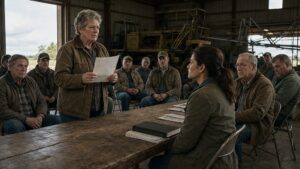
They were sitting in the Cedar Ridge clubhouse with six residents, the association attorney, Michael Wilson and two board members when the steady rush outside became a choking sputter.
Every head turned toward the windows.
The fountain threw one crooked burst of water, dropped to half height, coughed again and went silent.
Nobody spoke for several seconds.
Joshua looked down at the repair estimate in front of him.
The number at the bottom was large enough to replace every section of fence on his north pasture twice.
Carolyn tapped the page.
“That estimate is for converting the common grounds to a fully permitted supply and reducing consumption.”
A resident across the table stared at her.
“When was this done?”
“Last year.”
“You told us the landscaping system was stable.”
Michael shifted in his chair.
“It was operational.”
“That isn’t what she asked,” Joshua said.
Michael looked at him sharply.
Joshua almost regretted interfering.
Almost.
Carolyn opened another folder.
Three years of board correspondence lay inside.
“Counsel recommended metering the ditch diversion,” she said. “Then recommended reducing ornamental irrigation. Then recommended completing a formal water-right review.”
A resident asked, “And did we?”
Michael answered before Carolyn could.
“We evaluated the options in light of cost.”
“That means no?”
“It means there were competing obligations.”
The room changed.
Joshua had expected anger toward Michael to satisfy him.
Instead, listening to ordinary homeowners calculate what the problem might cost them felt different from watching board members stand behind a threat.
One older resident asked quietly, “Are we talking about another assessment?”
Carolyn nodded.
“Possibly, if we have to replace the entire supply arrangement at once.”
The resident looked down.
“My husband died in January. I can’t absorb another ten thousand dollars.”
Michael rubbed both hands over his face.
“That is exactly what I was trying to avoid.”
Joshua studied him.
There was no white polo today. No polished roadside confidence. Michael wore a plain blue shirt with the sleeves rolled up, and for the first time Joshua understood that the man’s obsession with property values had not been entirely vanity.
It was still wrong.
But it was not empty.
Michael looked around the table.
“The board has been dealing with insurance increases, pond repairs, road work and reserve shortages. If we announced that the development might need a new water system before we had a solution, home values would take a hit immediately.”
Carolyn said, “So you treated uncertainty like certainty.”
“I treated an established use as something we had time to resolve.”
“You received counsel’s warning three years ago.”
“I received an opinion.”
“And rejected the meter.”
Michael’s gaze snapped toward her.
“That meter proposal required admitting that our access was limited.”
Carolyn did not look away.
“Yes.”
There it was.
Joshua leaned back.
Not theft.
Not exactly.
Fear.
Michael had inherited an arrangement built on temporary permission, watched the development become more dependent on it, then chosen not to clarify the problem because clarity was expensive.
When Joshua’s ditch became an insurance and appearance complaint, Michael had tried to solve that problem too—by pressing the person whose cooperation the whole arrangement quietly depended on.
The association attorney slid a document across the table.
“The metering proposal would have capped the diversion well below current average use.”
Joshua read the figure.
Then read it again.
“How much are you pulling now?”
Nobody answered immediately.
Carolyn supplied the number.
Joshua looked at Michael.
“That’s nearly double.”
“Peak season,” Michael said.
“Still double.”
“The landscaping expanded.”
“And nobody expanded the permission.”
Michael’s mouth tightened.
“No.”
The answer softened something in the room because it was finally an answer without a defense attached.
Joshua turned to Carolyn.
“What happens if the gate stays closed?”
“We prioritize indoor supply from the wells. Common-area irrigation stops. Pond makeup stops. Some trees may be lost. The lawn certainly will.”
“The fountain?”
Carolyn glanced through the window.
“That already answered for itself.”
A few residents smiled despite themselves.
Michael did not.
Joshua returned to the repair estimate.
Part of it concerned the old headgate.
New measuring structure.
Safer bank stabilization.
A meter at any future side diversion.
Those were changes Joshua would have rejected Monday simply because someone from Cedar Ridge had proposed them.
He saw that clearly now.
Some of Michael’s complaints about the ditch had been used as leverage.
But not every complaint was invented.
The west bank was eroding.
There was no protective barrier near the public path.
The old wheel was difficult enough that Joshua used a pipe for leverage, just as his father had.
Preserving the gate did not require pretending rust was sacred.
One resident asked him, “Do you want the diversion gone permanently?”
Joshua looked around the room.
Three days ago, he would have answered yes before the question ended.
Now he thought of Dennis’s farm.
His father’s note.
No charge—emergency use.
West use only after downstream delivery met.
He looked at Michael.
“What I want is for nobody to pretend anymore.”
Michael’s expression hardened slightly.
“What does that mean?”
“It means my senior delivery is recognized. Dennis and the downstream operators get theirs first. Any Cedar Ridge use gets measured.”
Carolyn was already reaching for a pen.
Joshua continued.
“No unlimited ornamental watering. No assumption that because water ran yesterday, you own it tomorrow.”
Michael said, “You’re asking the development to redesign half its landscaping.”
“I’m telling you what I’d be willing to discuss.”
“And the ditch?”
Joshua looked through the window toward the silent fountain.
“The association pays for the bank repairs where your pedestrian path runs beside it. We upgrade the measuring structure.”
Michael stared at him.
“You’d allow a limited diversion?”
“Maybe.”
The room went still again.
Joshua felt the resistance inside himself immediately.
His father’s gate altered.
New equipment beside the 1897 iron.
Cedar Ridge paying contractors to touch a system the Allen family had maintained for generations.
The old instinct said no.
Then he remembered why his father had opened the west spur in the first place.
Not because the water meant nothing.
Because it meant enough to share carefully.
Joshua folded the estimate.
“There’s one more condition.”
Michael’s eyes narrowed.
“What?”
“You tell them.”
“Tell them what?”
Joshua nodded toward the residents.
“All of it.”
Carolyn stopped writing.
Joshua kept his eyes on Michael.
“You tell them your attorney warned the board. You tell them the permanent right was never confirmed. You tell them you chose not to meter because you were afraid of what it would do to assessments and property values.”
Michael’s face went pale with anger.
“You want a public confession.”
“No.”
Joshua stood.
“I want the people paying for this to know what they’re paying for.”
Michael looked around the clubhouse.
No board members stood behind him now.
No one wore matching shirts.
The residents were simply waiting.
Joshua placed the repair estimate back on the table.
“You wanted me to change my ditch because you said your board had responsibilities.”
He pushed the document toward Michael.
“So do you.”
Then Joshua sat down again and waited to see whether Michael valued his position more than the people whose property values he had spent three years trying to protect.
Chapter 7: The Water Returns Under Different Rules
Michael Wilson came back to the headgate Friday morning without a folder, without board members, and without the white polo.
Joshua noticed all three things.
Michael parked on the gravel shoulder and walked the final hundred feet carrying a rolled set of engineering drawings under one arm. His shirt sleeves were pushed above his elbows. He stopped several feet short of the yellow-sealed side gate.
For a moment neither man said anything.
The main ditch ran full past them, the stronger flow making a low steady sound against the old iron structure.
Michael looked at the raised numbers.
“I told them.”
Joshua rested his hands on the fence rail.
“All of it?”
Michael gave a humorless smile.
“Carolyn made sure I didn’t leave anything out.”
“What happened?”
“A lot of questions.”
“I imagine.”
“A resignation request.”
Joshua looked at him.
Michael shrugged slightly.
“I offered mine before they had to vote.”
Joshua had expected some satisfaction at hearing that.
What came instead was something quieter.
“You didn’t have to resign to talk to me.”
“No. I had to resign because I knew the water status was uncertain and acted like it wasn’t.”
Michael looked toward Cedar Ridge.
“The board can decide later whether they want me involved in anything else.”
He unrolled the drawings across the hood of Joshua’s pickup.
“These are revised terms.”
Joshua did not move immediately.
“What terms?”
“Metered seasonal diversion. Lower maximum volume. Association pays for measuring equipment, stabilization along the public boundary, and repairs to the headgate.”
Joshua’s eyes settled on the last phrase.
“Repairs how?”
Michael pointed to the drawing.
“The engineer wants to replace the lifting mechanism.”
Joshua’s expression hardened.
“With what?”
“A modern assembly.”
“No.”
Michael exhaled.
“We’re going to have this argument again?”
“If the answer is cutting that gate out, yes.”
“The existing wheel is difficult to operate.”
“It operates.”
“With a steel pipe stuck through it.”
“It has for forty years.”
“That doesn’t make it good.”
Joshua felt the old resistance arrive so quickly that he almost admired its consistency.
The gate had become proof of his family’s claim. Now someone wanted to replace part of it just as the claim had finally been recognized.
His first instinct was to protect every bolt.
Then he heard his father’s voice again, not as a memory of words but as a remembered irritation: fix what needs fixing before it decides the timing for you.
Joshua studied the plan.
“What stays?”
“The casting. The frame if inspection says it’s sound. The date plate stays visible.”
“And the wheel?”
Michael pointed.
“Could be retained as part of the manual backup if the engineer approves it.”
Joshua read the page more carefully.
This was not the proposal Michael had brought Monday.
It did not hide the ditch behind concrete.
It did not relocate Joshua’s delivery.
It treated the old structure as something that could continue serving a purpose.
Joshua tapped another line.
“This diversion number is still too high.”
Michael’s face tightened.
“It’s less than half current summer use.”
“Still too high.”
“We’ve already agreed to abandon most turf irrigation.”
“Dennis gets his delivery first.”
“The proposed schedule accounts for downstream obligations.”
Joshua shook his head.
“Not enough.”
Michael stared at him.
“You want us to agree to something that could shut our common areas off in a dry year.”
“Yes.”
“That’s not dependable.”
“It isn’t supposed to be.”
Michael looked away.
The fountain was invisible from here, but both men knew it had remained dry overnight.
Joshua continued.
“My father allowed water when it was available. He didn’t promise there would always be enough.”
Michael ran one hand over his face.
“You understand what that does to planning.”
“Better than you think.”
Joshua pointed toward his hayfield.
“Every farmer down this ditch plans around water that might not arrive in the amount he wants. That’s why priority matters.”
Michael said nothing.
Joshua expected another argument.
Instead Michael nodded once.
“Then write it that way.”
By noon, Carolyn arrived with the association attorney and the commissioner’s preliminary conditions.
Dennis came later.
Joshua had not requested that Dennis attend, but he was glad when the pickup pulled in.
They spread everything across a folding table near the ditch.
The negotiation took most of the afternoon.
Carolyn pushed hardest on cost.
Dennis pushed hardest on downstream protection.
The association attorney objected repeatedly to language that allowed Cedar Ridge’s allocation to shrink during shortage years.
Joshua refused to move on it.
At one point Carolyn said, “If we can’t guarantee some minimum, residents will say this agreement doesn’t solve anything.”
Joshua looked at Dennis.
Dennis said nothing.
He didn’t need to.
Joshua turned back to Carolyn.
“It solves the part where everybody knows what the rules are.”
The attorney tried another approach.
“What if we establish a minimum subject to emergency curtailment?”
“No.”
Michael, who had remained mostly silent, finally spoke.
“He’s right.”
Everyone looked at him.
Michael tapped the old correspondence lying beside the proposed agreement.
“The problem started because temporary access became an expectation. If we write another expectation we can’t support, we’re doing the same thing again.”
Carolyn studied him.
Then she crossed out the minimum guarantee.
By late afternoon they had terms.
Joshua’s senior delivery would be formally acknowledged.
Downstream agricultural deliveries would remain ahead of Cedar Ridge’s ornamental use.
The side diversion would receive a meter and lockable control.
Cedar Ridge would replace most high-consumption turf around the common areas with lower-water landscaping.
The pond could receive limited seasonal makeup water only when senior obligations had been met.
The fountain would operate from recirculated pond water rather than continuous ditch replacement.
And the association would fund stabilization of the eroding west bank and rehabilitation of Joshua’s headgate.
The yellow seal remained until the commissioner approved the installation.
Three weeks later, Joshua stood beside the ditch while contractors lifted the old iron wheel from its shaft.
He hated the sight.
Even knowing it was temporary did not help.
The wheel rested on wooden blocks while a new measuring assembly was fitted downstream. A steel support replaced a bracket that had cracked almost completely through.
Joshua stared at the fracture.
The contractor tapped it with a gloved finger.
“That probably had one hard season left.”
Joshua grunted.
He did not mention that he had spent Monday defending it as though age itself made it trustworthy.
Dennis stood nearby watching the new meter.
“You going to admit they fixed something?”
“No.”
Dennis smiled.
“Thought so.”
By afternoon the old wheel was back in place.
The new mechanism sat behind it, less visible from the road. The 1897 casting had been cleaned but not polished. Joshua had insisted on that.
He did not want it turned into decoration.
When the commissioner arrived for the final inspection, Carolyn and Michael came too.
Michael was no longer association president.
He stood slightly apart while Carolyn signed the operating agreement on behalf of Cedar Ridge.
The commissioner checked the meter, verified the stop setting and removed the yellow seal.
“Ready?”
Joshua looked down the ditch.
Dennis had already confirmed downstream delivery.
The hayfield headgate was set.
The water level was where it should be.
Joshua placed one hand on the old wheel.
For years he had thought protecting the ranch meant preventing other people from changing it.
Now the repaired iron felt different beneath his palm.
Still his.
Still old.
Still useful because someone had finally admitted what needed fixing.
He turned the wheel.
Water entered the side channel slowly.
Not the heavy pull Joshua had discovered Monday.
A measured flow.
The meter began counting.
Carolyn watched it.
“That’s all?”
“For today.”
She nodded.
No complaint.
No argument.
Michael looked toward Cedar Ridge.
“You’ll barely see a difference at the pond.”
Joshua said, “That’s the idea.”
Michael gave a small nod.
Then he held out his hand.
Joshua looked at it.
Monday, that hand had been resting on the headgate as Michael threatened him with fines.
Joshua let the moment sit long enough for both men to remember.
Then he shook it.
Not warmly.
Not coldly.
Enough.
“You were right about the water,” Michael said.
Joshua released his hand.
“You were right about the bank.”
Michael looked surprised.
Joshua pointed at the repaired edge near the pedestrian boundary.
“Don’t make me say it twice.”
For the first time since the dispute began, Michael laughed.
Several weeks later, the Cedar Ridge entrance looked different.
Long strips of thirsty lawn had been removed. The fountain ran fewer hours. The pond sat slightly lower than residents had once preferred.
Property values did not collapse.
Neither did the ranch.
Dennis’s downstream field received its scheduled water.
Joshua’s hay came in on time.
One evening, he walked to the headgate after shutting down the tractor.
The new meter box sat discreetly beside the old iron frame.
For a moment he imagined his father seeing it.
Joshua had spent years believing he understood what the old man had been trying to preserve.
The land.
The ditch.
The family name.
Maybe those were only parts of it.
His father had given water away during a drought, but not carelessly. He had written limits. Kept notes. Watched downstream delivery.
He had understood something Joshua had nearly forgotten.
Owning the first right did not mean being the only person who mattered.
Joshua brushed his thumb across the raised iron numbers.
He had refused the contractor’s suggestion to replace that section.
Not because everything old needed to remain untouched.
Because some things deserved to remain visible after the necessary changes were made.
Water slipped beneath the gate, dividing according to rules everyone now understood.
Joshua listened to it for a while.
Then he left the wheel where it belonged and walked back toward the ranch.
The story has ended.