The Flowers He Stepped On
Part I — The Boy at the Rope
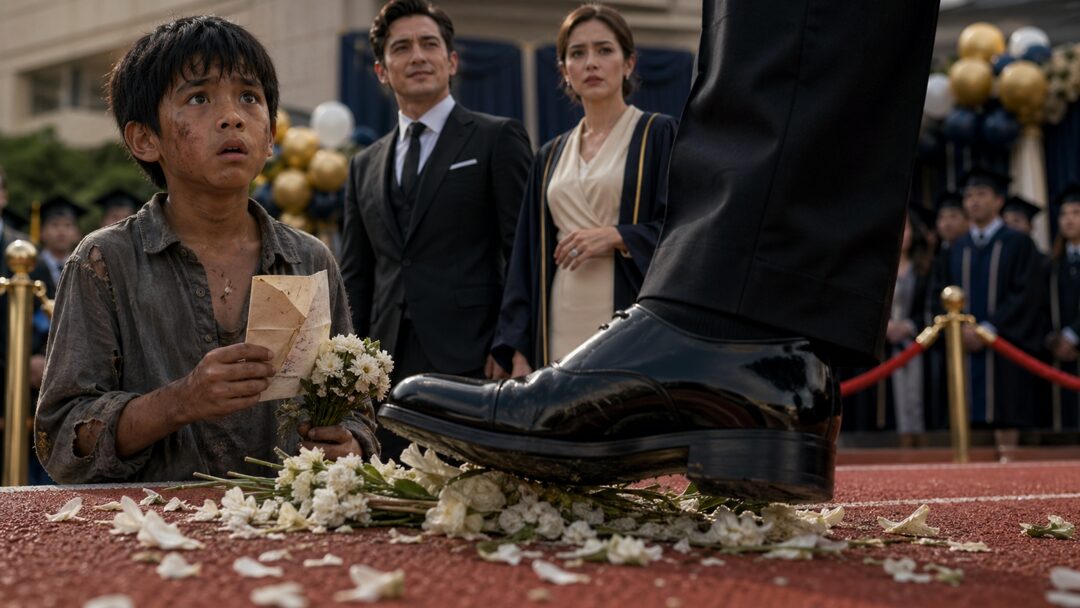
Adrian Vale crushed the white flowers before he ever saw the boy who brought them.
One polished black shoe came down on the small bouquet at the edge of the red track, flattening the stems against the rubber surface. The blue ribbon around them snapped loose. A few white petals stuck to the sole of his shoe when he stepped back toward the stage stairs, smiling at the applause like nothing tender had broken beneath him.
Eli Reyes saw it.
He stood just outside the rope barrier, small and still, with one hand wrapped around a folded card and the other hanging empty where the flowers had been. Dirt marked his cheek. His gray shirt was torn near the collar. His sneakers had dried mud on the sides, the kind that did not belong on the clean track of Westbridge Academy, where even the balloons looked expensive.
Gold and navy ribbons moved in the warm afternoon wind. Graduates in black gowns lined the field. Parents sat beneath white tents, holding programs printed on thick paper. The headmistress waited near the podium with her practiced smile.
Everyone looked like they belonged somewhere.
Eli looked like he had walked out of a storm and into someone else’s photograph.
Adrian Vale did not notice him at first. He was speaking to a donor near the stage, one hand resting lightly on the rail, his posture straight, his dark suit perfect. He had the kind of face that had learned how to be watched: calm, handsome, generous from a distance.
Beside the graduates stood Claire Mercer.
She wore a cream dress beneath a counselor’s robe, her brown hair pinned neatly at her neck. Her engagement ring caught the sunlight every time she adjusted the programs in her arms. Students adored her. Parents trusted her. Adrian loved her, or at least he loved the version of himself he became when she looked at him with forgiveness.
Then Claire saw Eli.
Her smile went still.
Eli bent slowly and picked up the flowers. Three stems were broken. One bloom hung sideways, dirt smudged into its white petals.
He held them carefully anyway.
A security volunteer stepped toward him when he ducked beneath the rope.
“Hey, buddy,” the man said. “You can’t go that way.”
Eli kept walking.
He did not run. He did not shout. That made it worse. A child running could be stopped. A child walking straight through a ceremony with a ruined bouquet and a folded card made people hesitate.
The applause thinned into murmurs.
The headmistress turned first, her smile tightening. “Sweetheart, families are seated over there.”
Eli did not look at her.
Adrian noticed him only when the boy reached the bottom of the stage stairs.
For half a second, annoyance crossed his face. Not cruelty. Not yet. Just the small irritation of a man whose schedule had been touched by something unplanned.
Then he saw the dirt. The torn shirt. The card.
Adrian lowered his voice. “Are you lost?”
Eli lifted the folded paper.
“I brought this for him.”
The nearest graduates leaned slightly, pretending not to.
“For whom?” the headmistress asked.
Eli looked at Adrian.
“For my father.”
The word did not travel far. It was too soft for the tents, too soft for the back rows, too soft for the speakers.
But Adrian heard it.
So did Claire.
So did three graduates standing close enough to see Adrian’s face forget itself.
Adrian recovered almost immediately. He smiled, but the smile had gone thin. “I think there’s been a mistake.”
Eli’s hand did not lower.
The headmistress gave a small nervous laugh. “Let’s find your family, alright?”
“I did,” Eli said.
A sharp silence opened behind the stage stairs.
Adrian’s eyes moved from the boy’s face to the card, then to the front rows where donors were beginning to whisper. His mother, Vivienne Vale, sat beneath the center tent in a pale suit and pearls, her silver-blonde hair shaped into quiet authority. She had not yet risen, but her gaze had found him.
Adrian leaned closer to Eli, still smiling for the audience.
“Whose child are you?” he asked.
Eli looked at the crushed flowers in his hand.
Then he looked back at Adrian.
“Yours.”
Claire drew in a breath so small no one else would have noticed.
Adrian did.
His eyes flicked to her.
And in that instant, Eli understood the first terrible thing.
The man was shocked.
The woman was not.
Part II — The Card
“Take it,” Claire said.
Her voice was quiet, but it cut through Adrian harder than if she had shouted.
He looked at her as though she had betrayed him in front of everyone. Maybe she had. Maybe taking a child’s card could be betrayal when your whole life depended on never touching it.
“Claire,” he said under his breath.
“Take it, Adrian.”
The headmistress shifted near the podium. The microphone gave a low pop. Somewhere behind them, a student laughed too loudly and then stopped.
Adrian reached for the card because people were watching.
That was the first honest thing Eli learned about him: he would do what looked decent before he did what was decent.
The card was made from thick white paper, folded unevenly. Blue marker bordered the edge in shaky lines. A corner had softened from being held too long.
Adrian opened it.
Inside, taped carefully to the left side, was a faded tassel in blue and gold. The threads were old and slightly frayed. Beneath it, in careful child handwriting, were the words:
Mom said you wore this the day you promised you’d come back.
Adrian stopped breathing.
On the other side, written larger, almost too hard into the paper, was one word.
FATHER
The field did not go silent. That would have been easier. The ceremony kept breathing around them. Programs rustled. Balloons tapped lightly against the frame behind the stage. A photographer asked someone to move closer.
But around Adrian, Claire, and Eli, the world narrowed.
Adrian touched the tassel with one finger.
It was not the touch of a man seeing something unfamiliar.
It was the touch of a man recognizing a grave.
“Where did you get this?” he asked.
Eli’s mouth tightened. “My mom kept it.”
“Your mother’s name?”
Eli stared at him.
Adrian already knew. He was asking for time.
Eli gave him none.
“Mara Reyes.”
The name struck Adrian so visibly that the nearest graduate, a tall girl with flowers tucked into her sleeve, covered her mouth.
Claire looked down.
That was the second terrible thing Eli learned: his mother’s name had lived in this place before him.
Adrian closed the card halfway, as if hiding the word could hide the truth.
“This isn’t the place,” he said.
Eli glanced at the podium, the flags, the rows of graduates, the parents holding phones.
“My mom said you liked places where people clapped for you.”
Adrian’s face hardened.
Claire flinched.
The line had not been meant as cruelty. That made it worse. Eli had said it with the flat accuracy of a child repeating something he did not fully understand, but everyone old enough understood it perfectly.
The headmistress stepped in, voice low and urgent. “Mr. Vale, your speech is in two minutes.”
Adrian did not look at her. “Give us a moment.”
He placed a hand near Eli’s shoulder without touching him and guided him away from the stairs, behind the stage, where the balloon shadows trembled against the canvas backdrop. Claire followed before anyone invited her.
“Not you,” Adrian said.
Claire kept walking. “Yes. Me.”
The space behind the stage smelled like hot metal, cut grass, and plastic chairs. From the other side came the bright voice of the student body president announcing the next award to fill time.
Adrian turned on Eli the moment they were hidden.
“What are you doing here?”
Eli held the crushed flowers against his chest. “I came to give you the card.”
“Who brought you?”
“No one.”
“You walked here?”
“Bus. Then walked.”
“How did you know where I’d be?”
Eli lifted his chin, but it trembled once before he controlled it. “Your picture was in the paper. It said you were speaking today.”
Adrian looked toward Claire, accusation already forming.
Claire’s eyes were on the card.
Eli noticed everything. Children who grow up around tired adults learn to read silence like weather.
“My mom died,” he said.
Neither adult moved.
“She died three weeks ago.”
The ceremony noise seemed to dim, though it did not. Adrian’s fingers tightened around the card.
Claire’s hand rose to her mouth. “I’m sorry.”
Eli looked at her. “Did you know her?”
Claire did not answer fast enough.
Adrian did. “No.”
But the word came too quickly.
Eli turned back to him. “She had a box. Your tassel was in it. A picture, but she tore it so I only had half. Letters too. She said if I ever found you, I should give you this.”
“What letters?” Adrian asked.
Claire’s face changed.
There it was again.
A truth moving through her before it reached him.
Eli looked between them. “She wrote to you.”
Adrian swallowed. “I didn’t receive letters.”
“My mom said you might say that.”
Adrian’s jaw flexed. “Your mother and I knew each other a long time ago.”
Eli waited.
“She was—” Adrian stopped. A muscle moved in his cheek. “She was important to me.”
Eli’s eyes did not soften. “Important people don’t disappear.”
Claire closed her eyes.
For a moment Adrian was no longer the board chairman, the keynote speaker, the man donors trusted with their names on buildings. He was twenty-six again, standing in the service hallway of a school gala, laughing with Mara Reyes while she carried a tray of coffee cups she had no reason to refill. She had worn her hair loose that night. He had taken off his graduation tassel and looped it around her wrist like a joke, then said, “Keep it until I come back.”
He had meant it when he said it.
That was the cruelest part.
People ruin lives with promises they meant for only one beautiful minute.
“My mother handled things,” Adrian said, and the weakness of that sentence seemed to shame even him.
Eli stared at him. “Handled me?”
“No,” Adrian said quickly.
But not quickly enough.
Part III — The Name Claire Knew
Claire crouched in front of Eli with a bottle of water.
He did not take it.
“You should drink,” she said. “It’s hot.”
“I’m not thirsty.”
His lips were dry. His hand around the card had left red marks on his fingers.
Claire unscrewed the cap and set the bottle on a folding chair instead of pushing it at him. Then she took a clean napkin from a stack near the catering tray and reached toward the dirt on his cheek.
Eli leaned back.
She stopped immediately.
“I’m sorry,” she said.
He studied her face. “Why are you sorry?”
Claire had spent years helping students survive panic attacks, divorces, scholarship rejections, fathers who did not show up, mothers who showed up angry. She knew how to speak gently without making pain feel small.
But this boy was not one of her students.
This boy was a door she had helped keep closed.
“Because you shouldn’t have had to come here alone,” she said.
Adrian paced once, then stopped. “Claire, don’t.”
She turned on him. “Don’t what?”
“Make this worse.”
Eli looked at Adrian. “Worse for who?”
The question landed cleanly.
Adrian had no answer that did not condemn him.
The program onstage lurched forward. The headmistress’s voice floated through the speakers, too bright now. “And while we prepare for our keynote address, please join me in congratulating the Class of Westbridge Academy…”
Applause rose.
Behind the stage, no one moved.
Claire picked up the bottle again and held it out.
“Eli, listen to me,” she said. “You don’t have to decide anything right now.”
The boy froze.
Adrian turned slowly toward her.
Claire realized it a second too late.
Eli had not told her his name.
The water bottle crinkled in her hand.
“How do you know my name?” Eli asked.
Claire’s face went pale beneath the warm light.
Adrian’s voice dropped. “Claire.”
She stood, but not all the way. She looked caught between kneeling to a child and facing a man.
“How?” Eli asked again.
No one could save her from the gentleness of his voice.
Claire set the bottle down.
“I found letters,” she said.
Adrian stared at her as though the ground had shifted.
“What letters?”
Claire looked at him then, and the hurt in her eyes was old. “The ones you told me not to read.”
His mouth opened, then closed.
Two years ago, in Adrian’s study, she had been sorting speeches for a foundation dinner when a manila envelope slipped from an old file box. Mara Reyes’s name was on the return address. So was a smaller name beneath it.
Eli.
Claire had asked.
Adrian had gone very still. He told her it was from before, from a difficult time, from a woman his mother had already helped. He said reading the past would only give it new teeth. He said he loved Claire because she saw who he was now, not who his family had trained him to be.
He cried that night.
That mattered. It had mattered too much.
Claire had put the letters away.
Not destroyed. Not sent. Not answered. Away.
That was how decent people became cruel sometimes. They did not burn the evidence. They stored it neatly.
“You knew me?” Eli asked.
Claire shook her head, but the denial was useless. “I knew there was a boy.”
“My boy,” Adrian said, but his voice carried anger at Claire, not tenderness toward Eli.
Eli heard that too.
Claire looked at the child. “I told myself I didn’t know enough.”
“Did you know where we lived?”
She was silent.
Eli’s eyes went shiny, but he did not cry. “Did you know my mom was sick?”
“No,” Claire whispered. “No. I swear I didn’t know that.”
“But you knew she wrote.”
Claire’s throat moved. “Yes.”
Eli nodded once, as if adding a number in his head.
One adult who left.
One adult who hid.
One adult who had not yet arrived but whose shadow was already in the room.
Adrian stepped toward Claire. “You had no right.”
Claire laughed once, not because anything was funny. “No right? That is what you want to talk about?”
“You kept this from me.”
“You asked me to.”
“I asked you not to dig up something that would hurt us.”
Claire’s eyes flashed. “No. You asked me to help you stay the kind of man who could sleep.”
Eli looked at the card in Adrian’s hand.
“Can I have it back?” he asked.
Adrian turned. “What?”
“The card.”
For the first time, Adrian seemed frightened in a way that had nothing to do with donors or his mother.
“Eli—”
The boy held out his hand.
“You don’t have to keep it if you don’t want me.”
Claire covered her mouth.
Adrian stared at the card, then at the boy. The word inside seemed to burn through the folded paper.
“I didn’t say that,” Adrian said.
“You didn’t say the other thing either.”
“What other thing?”
Eli’s voice did not rise.
“That I’m yours.”
Part IV — The Woman in Pearls
Vivienne Vale arrived without hurrying.
That was her power. Other people rushed when scandal called. Vivienne moved as though the world owed her time to prepare its manners.
She came around the side of the stage in a pale tailored suit, pearl earrings shining against her hair. Her smile was calm enough to make the situation seem smaller than it was.
“There you are,” she said to Adrian, as if he were late to lunch.
Then her eyes moved to Eli.
They stopped on the tassel visible between Adrian’s fingers.
Something flickered. Not surprise. Recognition.
Eli saw it.
So did Claire.
Adrian’s shoulders lowered in a way that looked almost like relief and almost like surrender.
“Mother,” he said.
Vivienne looked at him briefly. “The headmistress is stalling. You are embarrassing everyone.”
Claire stepped forward. “Mrs. Vale—”
Vivienne did not look at her. “Not now, Claire.”
Two words, softly spoken, and Claire was placed back where Vivienne believed she belonged: useful, decorative, temporary.
Eli gripped the crushed flowers.
Vivienne’s gaze returned to him. She smiled with no warmth.
“You must be Mara’s son.”
The sentence moved through Eli like cold water.
Adrian turned toward his mother. “You knew.”
Vivienne sighed. “Of course I knew.”
No apology. No shame. Just impatience with the inconvenience of truth arriving late and poorly dressed.
Adrian’s face drained. “You told me she left.”
“She did leave.”
“You told me she took the settlement and wanted nothing to do with me.”
“She took the settlement because she was not foolish.” Vivienne’s eyes flicked to Eli. “At least, not entirely.”
Eli’s cheeks flushed.
Claire’s voice sharpened. “He’s a child.”
“He is also standing behind a commencement stage accusing the keynote speaker of fatherhood during a ceremony attended by seven hundred people,” Vivienne said. “Let us not pretend childhood makes this tasteful.”
Adrian flinched, but he did not speak.
Eli looked at him.
That silence did more damage than Vivienne’s words.
Vivienne stepped closer to the boy, not enough to touch him. “Your mother was given help.”
“She worked two jobs,” Eli said.
Vivienne tilted her head. “Many people work.”
“She died owing rent.”
“A tragedy,” Vivienne said. “But tragedy is not inheritance.”
Adrian whispered, “Mother.”
Vivienne finally looked at him. “You have obligations. A foundation. A school waiting on your speech. A fiancée who deserves not to have her future dragged through someone else’s poor decisions.”
Claire’s face tightened, but she said nothing.
Vivienne turned back to Eli. “We can arrange assistance. Quietly. A proper placement. Schooling. Medical care if needed. The Vale Foundation has resources for situations like this.”
“Situations like me?” Eli asked.
Vivienne’s smile thinned. “For children in need.”
“I came for my father.”
“And you found a man with responsibilities far larger than one biological accident.”
The word hung there.
Accident.
Eli looked down at the flowers in his hand. A white petal slipped loose and landed on his sneaker.
Adrian said nothing.
Claire looked at him, and in that moment saw the future with horrible clarity: every dinner, every donor room, every hard thing softened by his hands in private and abandoned by his spine in public.
He could be gentle.
He could be ashamed.
He could love.
And still, when his mother spoke, become a boy waiting to be told what decency cost.
Eli reached for the card again.
Adrian did not give it back.
“My mom said if you didn’t want me,” Eli said, “I shouldn’t keep something from a day you were proud.”
Adrian’s hand closed around the tassel.
For a second, the entire ceremony outside seemed to disappear.
Mara had known.
She had known enough to prepare her son not just for hope, but for rejection. She had sent him with flowers and a card and also instructions for how to leave without begging.
That was love sharpened by disappointment.
Adrian looked at Eli, and his face cracked again.
Vivienne saw it and moved immediately.
“Enough,” she said. “Adrian, the podium. Now.”
The headmistress appeared at the edge of the backstage area, her smile gone. “Mr. Vale, please. We need to continue.”
Behind her, whispers were moving through the graduate line. A few students had turned fully around. One was holding a phone low at her side.
Eli saw them watching.
His face changed then—not with fear, but with the exhaustion of being looked at by people who could go home later and talk about him over dinner.
He stepped back.
“I’ll go.”
Claire moved toward him. “Eli—”
“No.” He looked at Adrian. “You can keep it. Or throw it away. I did what she told me.”
He turned and walked toward the side of the track without the flowers.
He had forgotten them in his hand only because his fingers had gone numb.
A graduate near the rope bent, picked up the loose blue ribbon from the track, and held it out to him. She was crying silently.
Eli did not take it.
Another graduate, the tall girl from earlier, lifted the crushed bouquet from where he had dropped it again and placed it gently back in his hands.
“They’re still flowers,” she whispered.
That almost broke him.
Almost.
He nodded once and kept walking.
Adrian watched him go.
Vivienne leaned close to her son. “Smile. Give the speech. We will handle the boy privately.”
Claire stepped in front of Adrian before he could move.
Her voice was low enough that only he heard the first words.
“Tell the truth now.”
Adrian looked at her as if she had struck him. “Claire.”
“Now.”
“You want to punish me.”
“No,” she said.
Her eyes were bright, but her voice did not shake.
“I wanted to marry the version of you who would not need to be threatened into loving his own child.”
Adrian stared at her.
The applause on the other side of the stage swelled again, desperate and confused.
Vivienne’s voice sliced in. “Adrian.”
He looked at his mother.
Then at Claire.
Then at the boy standing alone beside the red track, holding flowers Adrian had already stepped on.
Part V — The Wrong Speech
Adrian walked to the podium with the card in his hand.
The headmistress looked relieved until she saw his face.
The crowd settled quickly. Wealthy people were good at silence when silence protected them from appearing curious. Parents lowered their phones. Graduates shifted in their gowns. The late-afternoon light turned the gold balloons almost white.
Adrian placed his prepared speech on the podium.
The title at the top read: Legacy and Leadership.
He looked at it for one second.
Then he set Eli’s card on top of it.
A small sound moved through the first row. Vivienne was standing now.
Adrian gripped the sides of the podium. His hands were steady. His voice, when it came, was not.
“I was supposed to speak today about legacy.”
The microphone carried him across the field.
Claire stood near the stage stairs, very still.
Eli had stopped near the rope. He had not left. The broken flowers hung from his small hand.
Adrian looked at him only once, then back at the crowd. Looking too long would have made it easier to beg. He did not deserve easier.
“Before I congratulate these graduates,” Adrian said, “I need to correct a lie.”
The field changed.
Not loudly. Not dramatically. But hundreds of people understood at the same time that the ceremony had slipped out of its program.
Vivienne moved toward the aisle. “Adrian.”
The microphone caught her voice faintly.
He continued.
“Years ago, I loved a woman named Mara Reyes.”
Claire closed her eyes.
Eli’s fingers tightened around the stems.
“She was kind. She was braver than I was. And when our relationship threatened the life my family expected me to live, I let money, silence, and my mother’s name do what I was too ashamed to do myself.”
Vivienne’s face hardened into something no longer polite.
Adrian looked down at the card.
“I told myself I didn’t know enough. That no letter meant no responsibility. That if the past stayed quiet, it had forgiven me.”
He swallowed.
“It had not.”
No one moved.
“There is a boy here today named Eli Reyes.”
Now everyone looked.
The movement was unbearable: hundreds of heads turning toward the child who had spent his life being turned away from.
Eli did not hide.
Adrian’s voice shook once. “He is my son.”
A sound went through the field. Not applause. Not outrage. Something worse: recognition.
Vivienne stepped toward the stage. “This is not appropriate.”
Adrian turned toward her, and for the first time that day, he did not lower his eyes.
“No,” he said into the microphone. “It never was.”
Claire’s ring flashed as she moved.
She walked up the side steps without rushing. For one terrible second, Adrian thought she was coming to stand beside him.
Instead, she removed the engagement ring from her finger.
She placed it on the podium beside the card and the speech.
No speech. No accusation. No scene.
Just the ring.
That was the sound of a future closing.
Adrian looked at it, and pain crossed his face so nakedly that Claire almost reached for him.
Almost.
But pity had been the doorway through which she had entered his cowardice the first time.
She stepped back.
Adrian turned toward Eli.
“Eli,” he said, the name rough in his mouth, “will you come here?”
The crowd waited.
That waiting changed everything.
Minutes earlier, Eli had been an intrusion, a dirty child at the rope, a problem to move behind the stage. Now graduates, parents, donors, teachers, Vivienne, Claire, and Adrian himself were suspended by whether he would take one step.
Eli did not move.
Adrian’s face tightened. He had expected many things: anger, tears, a child running to him because stories had trained adults to confuse confession with repair.
Eli only stood there.
Holding the flowers.
Adrian understood then, not fully, but enough: truth was not a gift he was giving Eli. It was a debt he had finally stopped refusing to pay.
Eli walked forward at last.
Slowly.
Not to Adrian’s open hand.
Not to his side.
He climbed the first stage step and placed the crushed white flowers on the podium beside the ring, the card, and the speech about legacy.
The stems bent outward. Dirt streaked the petals. The blue ribbon lay loose across the wood.
“These were for my mom,” Eli said.
His voice was not near the microphone, but the front rows heard him. The graduates closest to the stage heard him. Claire heard him.
“She thought you’d come.”
Adrian’s face collapsed.
Not dramatically. Not beautifully. Just like a man who had discovered that the person who believed in him most had died before he became worthy of it.
He reached toward Eli.
Eli stepped back.
Adrian let his hand fall.
The field remained silent.
Then, somewhere in the graduate line, someone began to clap.
It was not the kind of applause that rescues a moment. It was uneven, uncertain, almost ashamed. Others joined slowly. A few parents. Then more students.
Eli did not smile.
Claire did not.
Vivienne turned and walked away before the sound could decide what it meant.
Part VI — Tomorrow
Afterward, the field looked smaller.
Without the ceremony holding it upright, Westbridge Academy became folding chairs, trampled grass, empty water bottles, abandoned programs, and balloons sagging in the evening heat.
The graduates had gone to family dinners. The donors had left in careful clusters, carrying the story with them like something expensive they had not paid for. The headmistress had spoken to Adrian in a tight voice and then stopped because there was nothing useful left to say.
Claire was the last staff member near the stage.
She picked up no programs. Directed no students. Comforted no parents.
She stood once at the bottom of the podium and looked at the ring she had left there. Adrian had not touched it.
Then she turned away.
Adrian saw her crossing the track toward the parking lot.
“Claire,” he called.
She stopped.
For one second, the old life stood between them: quiet dinners, his hand at the small of her back, her belief that the better part of him was the truest part. He wanted to say he was sorry. He wanted to say he had told the truth. He wanted her to tell him that mattered.
It did matter.
It just did not fix enough.
Claire looked at him with grief so controlled it felt like distance.
“You loved him today only after everyone saw him,” she said.
Adrian had no answer.
She nodded as if he had given one anyway.
Then she left.
Across the field, Vivienne’s black car pulled away from the curb. Its windows were tinted. It moved without pause, smooth and silent, as though carrying no one who had lost anything.
Eli sat on the edge of the red track with the card in his lap.
The flowers were beside him now. He had pulled one bloom loose from the broken stems, the least damaged one. Its petals were still bruised with dirt.
Adrian approached slowly and stopped several feet away.
He had spent his life entering rooms as though they would make space for him.
This time, he waited.
“Can I sit?” he asked.
Eli did not look up. “It’s your school.”
“No,” Adrian said. “It isn’t.”
That made Eli glance at him.
Adrian sat on the track, leaving space between them. His suit pants creased. The red rubber marked the side of his hand. He had never looked less like the man from the podium.
For a while, neither spoke.
The quiet after public confession was different from the quiet before it. Before, silence had hidden things. Now it showed what remained.
“Do you have somewhere to go tonight?” Adrian asked.
“My caseworker’s coming.”
Adrian nodded. “Good.”
Eli picked at the loose ribbon around the bouquet. “She said I could stay in the group home until they figure it out.”
Adrian flinched at the words group home, but he did not rush to make promises. Not because he did not want to. Because for once, he understood that wanting to sound good was dangerous.
“I’d like to help,” he said. “If you’ll allow it.”
Eli watched the empty stage.
“My mom said you would.”
The sentence cut, but Adrian let it. He had earned no protection from it.
“She believed better of me than I deserved.”
Eli’s mouth tightened. “Don’t make her sound stupid.”
Adrian looked at him. “She wasn’t.”
“She waited.”
“I know.”
“No,” Eli said, turning to him now. “You don’t. You know she wrote letters. You know she kept your tassel. You know she told me your name when she got too sick to keep pretending it didn’t hurt.”
His voice shook, but he held it steady.
“You don’t know what waiting looked like.”
Adrian’s eyes filled.
Eli looked away first, angry at the tears because they made him feel younger than he wanted to be.
“I want to be in your life,” Adrian said. “Not because people saw. Not because of today. Because I should have been from the beginning.”
Eli ran his thumb over the card’s bent edge.
“You can start by coming tomorrow.”
Adrian breathed in once.
Not relief. Not exactly.
Permission with a locked door still between them.
“Tomorrow,” he said.
Eli stood when a gray sedan pulled near the field gate. A woman inside waved gently, not intruding.
He picked up the least damaged white flower and tucked it into the pocket of his torn shirt.
Adrian rose beside him.
For a second, he wanted to put a hand on Eli’s shoulder.
He did not.
They walked toward the gate together, close enough for people to see they were leaving the same place, far enough apart that no one could mistake distance for forgiveness.
At the rope barrier, Eli paused.
The blue ribbon from the bouquet still lay on the track where it had fallen earlier. He bent, picked it up, and wrapped it around the card.
Then he handed the card to Adrian.
Adrian took it like it weighed more than paper.
“Keep it,” Eli said. “So you remember where to come.”
The evening wind moved across the empty chairs.
Adrian looked at the word on the card again.
Father.
This time, it did not feel like a claim.
It felt like an instruction.
Eli walked through the gate first.
Adrian followed, matching his pace, not touching him, not asking for more than tomorrow.
Behind them, on the empty podium, the ring remained beside the wrong speech.
And on the red track where the flowers had been crushed, one white petal stayed behind, bright against the ground, too small to fix anything and too visible to ignore.