The Child at the Golden Doors
Part I — The Girl Who Did Not Belong
The gold ballroom doors opened for Robert Harrington’s toast, and a barefoot little girl walked in from the rain.
For one second, no one moved.
Champagne glasses hung in midair. A violin note trembled from the string section and died there. Two hundred guests in black silk and white collars turned toward the entrance as if the house itself had made a sound.
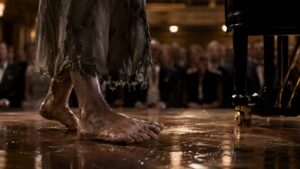
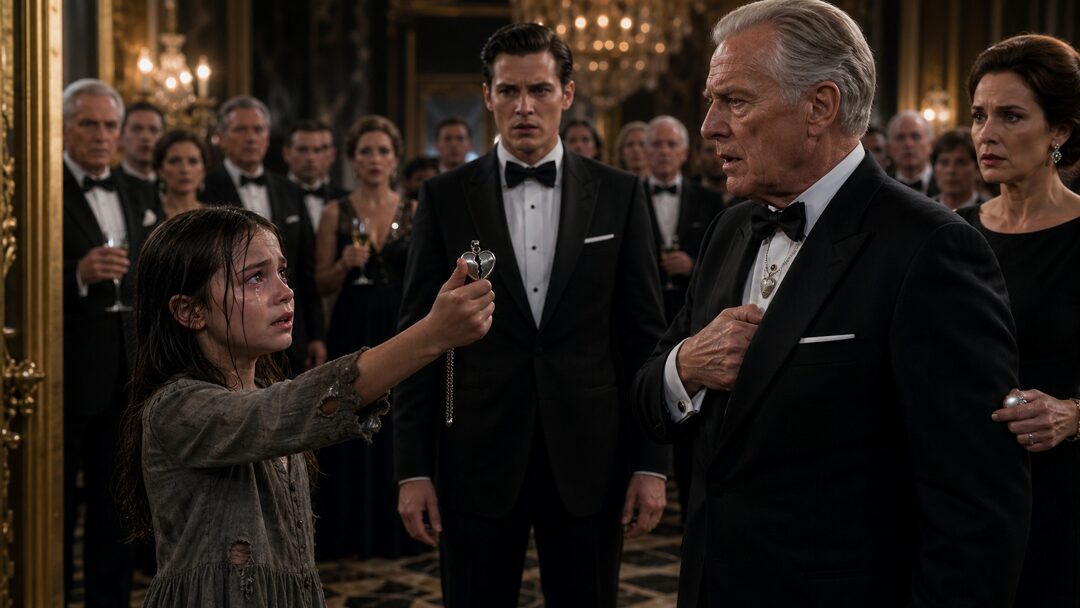
The child stood beneath the carved archway, soaked through, her gray dress torn at the hem. Wet dark hair clung to her cheeks. Her bare feet had left small muddy prints on the marble, each one more offensive to the room than a scream.
In her right hand, she clutched something silver.
Robert Harrington, who had been standing beneath the chandelier with one hand raised, lowered his champagne glass very slowly.
His son, Daniel, stood beside him in a black tuxedo, his face already arranged for the announcement. Sarah, Daniel’s fiancée, rested a jeweled hand lightly on his arm. She wore a black evening gown and diamond earrings, the kind of beauty that looked practiced because it had to.
The girl looked across the ballroom, past the waiters, past the roses, past the guests who had paid ten thousand dollars a plate to watch one old family join another old family.
Then she pointed at Robert.
“Are you the man from the picture?”
The room did not gasp. Rooms like that did not gasp. They tightened. They whispered without sound. They judged through stillness.
Robert’s face did not change.
But his left hand moved.
It went to his chest, just beneath the white shirtfront of his tuxedo, where a chain disappeared under the fabric.
Daniel saw it.
So did Sarah.
The girl raised her small fist. In it was half of a heart-shaped locket, the broken edge jagged and bright.
“My mother said you promised you’d come back.”
A woman near the front set her champagne glass down too hard. Somewhere behind her, a man murmured, “Good God.”
Robert’s voice, when it came, was calm enough to be cruel.
“Child, where did you get that?”
The girl flinched at the word child, as if it were not wrong, only distant.
“From my mom.”
Daniel’s hand slipped off Sarah’s.
“What’s your mother’s name?” he asked.
The child looked at him then, and the smallest confusion crossed her face. It was the look of someone seeing a stranger she had been told to trust.
“Laura,” she said.
Daniel stopped breathing.
Sarah felt it through the air between them. The name did not simply reach him. It struck somewhere old.
Behind them, Robert’s fingers tightened against his hidden chain.
No one in the ballroom needed to be told that something had entered the house besides a child.
Something unfinished had come in with her.
Part II — A Name the Room Remembered
Sarah was the first to move, because Sarah had been raised to save rooms.
She stepped forward with a soft expression, the kind one used for frightened children and photographers.
“You’re freezing,” she said. “Let’s get you somewhere warm.”
She lifted a hand toward a uniformed staff member.
Daniel moved faster.
“No,” he said.
It was not loud. It did not need to be. The single syllable crossed the room and landed sharply enough that Sarah’s hand froze in the air.
Daniel walked toward the girl.
Too quickly, Sarah thought.
Too personally.
He knelt in front of her on the marble, ignoring the mud near his polished shoes. Up close, he saw how blue her lips were, how tightly she held the broken locket, how badly she was trying not to cry in front of strangers.
“What’s your name?” he asked.
“Emily.”
“How old are you, Emily?”
“Eight.”
The answer entered him like a knife placed carefully between ribs.
Eight years.
Sarah watched Daniel’s face and understood something before she had the facts.
This child had arrived from a story Daniel had never told her.
Robert stepped down from the small platform where he had been prepared to announce the future of two families. His movement restored a little order to the room. Guests shifted. A waiter lowered a tray. The string quartet, unsure whether to resume, remained silent.
“Daniel,” Robert said, “stand up.”
Daniel did not.
Emily stared at him.
“My mom said to ask for Daniel too,” she said. “If you weren’t here.”
The whispers began then. Not loud enough to accuse. Loud enough to infect.
Laura.
The name traveled through the older guests like a draft under a door.
“Wasn’t she the waitress from the summer fundraiser?”
“I thought she left town.”
“There were rumors.”
Sarah heard enough.
She kept her smile, but it became a thin, polished thing. Her engagement ring felt suddenly heavy, not like a promise but like a prop.
Robert approached Daniel and Emily with a patriarch’s smooth authority.
“Let’s not frighten the child further,” he said. “We’ll handle this privately.”
Emily looked up at him.
“My mom died,” she said.
The words did what her entrance had not. They broke the room.
Not loudly. Nothing in the Harrington ballroom broke loudly.
But every face changed.
Daniel closed his eyes for half a second.
“When?” he asked.
“Three weeks ago.”
His voice came out rough. “How?”
Emily swallowed. “She was sick. She said not to come here unless things got impossible.”
“And did they?” Sarah asked before she could stop herself.
Emily turned to her. There was no accusation in the child’s face. That made it worse.
“Our landlady said I couldn’t stay anymore.”
A woman near the back covered her mouth. Another looked away, as if pity were embarrassing.
Robert’s jaw shifted.
“Where is whoever brought you here?” he asked.
“I came on the bus.”
“In this weather?” Daniel said.
Emily nodded. “I had the picture.”
She fumbled with the locket. Her fingers were stiff with cold, and for the first time she looked her age. Daniel reached out to help, then stopped, afraid she would pull away.
Emily opened the half-heart herself.
Inside, protected under a tiny cloudy pane, was a folded sliver of paper. She dug at it with a fingernail until it came loose.
A photograph.
Small, creased, old.
Daniel stared at it.
The picture showed a summer afternoon on the Harrington lawn. White tents. Charity banners. Robert in a pale suit, younger by eight years. Daniel beside him, smiling in a way Sarah had never seen. And between them stood a woman with loose brown hair and a simple white blouse, laughing at something just outside the frame.
Laura.
Daniel reached for the photograph, but Emily held it back.
“My mom said not to give it away.”
That broke him more than if she had trusted him.
Robert took one step closer.
“Emily,” he said carefully, “your mother was confused at the end.”
The girl’s eyes hardened in a way no child’s eyes should have to.
“No, she wasn’t.”
Daniel stood at last.
“Father,” he said, “what is this?”
Robert did not look at him. “Not here.”
Sarah laughed once under her breath. It was not amusement. It was disbelief discovering its own voice.
“Of course,” she said softly. “Not here.”
Robert turned to her, and his eyes warned her to remember where she was.
Sarah remembered perfectly.
She was in the ballroom where, in ten minutes, Robert Harrington had planned to present her as the solution to a problem no one had named.
Now another problem stood barefoot on the marble.
And Daniel could not take his eyes off her.
Part III — What Protection Cost
Robert got them out of the ballroom by calling it mercy.
A side door. A smaller parlor. A fire already lit. Heavy curtains. Old portraits. Emily wrapped in a wool blanket brought by a silent maid. Sarah followed without being invited, because she had spent too many years being decorative in rooms where decisions were made about her.
Robert noticed.
“This is a family matter,” he said.
Sarah looked at Daniel.
Daniel did not correct him.
The humiliation was small, almost polite. That made it clean.
Sarah stayed anyway.
Emily sat on the edge of a velvet chair, careful not to let her dirty feet touch the upholstery. She looked as if she expected to be billed for the blanket.
Daniel stood near the fireplace, pale and furious.
“Tell me,” he said to Robert.
Robert poured himself water from a crystal pitcher and did not drink it.
“Lower your voice.”
“No.”
Emily watched them both.
Robert set the glass down.
“I knew Laura.”
Daniel’s face tightened. “You told me she left.”
“She did leave.”
“You told me she took money from you and disappeared.”
“She accepted money.”
Daniel stared at him.
It was Sarah who heard the missing piece first. “Accepted,” she said. “Not asked for.”
Robert glanced at her. “Miss Whitmore, I understand this is uncomfortable—”
“No,” Sarah said. “You understand exactly how to make discomfort useful.”
Daniel’s eyes never left his father.
“Was she pregnant?”
The fire cracked.
Emily’s fingers closed around the locket.
Robert looked at his son then, and for the first time that night, age showed through the polish.
“She said she was.”
Daniel took a step back as if the floor had moved.
“You knew?”
“I knew she intended to destroy your life with it.”
Emily made a small sound. Not a sob. Not yet.
Daniel’s voice dropped. “Don’t talk about her like that.”
Robert’s face sharpened.
“I paid her enough to live comfortably. I told her she could contact me if the child needed anything. She chose pride.”
Emily stood up.
“My mom worked two jobs.”
Daniel turned toward her, stricken.
“She cleaned offices at night,” Emily said. “She said the rich don’t know what clean costs because someone else always does it before they wake up.”
The line landed in the room and stayed there.
Sarah looked down at her ring.
Robert’s mouth tightened. “Laura refused help because she wanted leverage.”
“No,” Emily said. “She kept your letters in a shoebox.”
Robert went still.
Daniel heard it. “Letters?”
Emily looked uncertain now, as if she had said too much. “Not letters. Checks. She never cashed them.”
Sarah watched Robert’s composure harden, layer by layer.
Daniel’s voice was almost unrecognizable. “What did you tell her?”
Robert said nothing.
Daniel stepped closer.
“What did you tell her?”
Robert finally met his son’s eyes.
“I told her the truth that mattered. That you were a Harrington. That you had obligations. That love feels noble until it asks a man to become poor, ridiculous, and owned by someone else’s mistake.”
Emily looked at Daniel.
Mistake.
The word went straight into her.
Daniel saw it and hated his father with a clarity so bright it scared him.
“She was not a mistake,” he said.
Robert’s reply came softly. “You did not choose her when it mattered.”
Daniel went silent.
Because there it was.
Not innocence. Not exactly.
He had believed the version given to him because believing it had let him survive. Laura had taken money. Laura had left. Laura had chosen not to call. That story had hurt, but it had also absolved him. It had turned his failure to fight into injury.
Robert had handed him grief that required nothing of him.
Sarah understood the shape of it then. She had accepted a version of Daniel too: wounded, dutiful, available if she waited long enough. She had known she was not loved the way women wanted to be loved. But she had told herself need could ripen into devotion.
Need did not become love.
Sometimes it only learned to smile for photographers.
Robert turned toward Daniel.
“You will return to the ballroom,” he said. “You will finish the announcement. I will arrange care for the child tonight. Proper care. Discreet care. We will verify everything tomorrow.”
Daniel laughed once, hollow.
“Verify?”
“We are days from signing the merger with Sarah’s family. Days. Do you think scandal waits politely because you feel guilty?”
Sarah’s face burned.
So that was what she was in the sentence now.
Not fiancée. Not future wife.
Merger.
Daniel looked at her, and she saw apology begin in his eyes.
She hated him for being sorry too late.
Robert softened his voice, which made him more dangerous.
“Daniel, listen to me. A child dragged into public disgrace is not protected. A dead woman cannot be helped. Sarah does not deserve to be humiliated in front of everyone because of your old mistake.”
Sarah smiled faintly.
“There it is,” she said.
Robert frowned. “What?”
“The kindness you use to put a knife exactly where you want it.”
No one spoke.
Then Emily held up the locket.
“My mom said you would say things like that.”
Robert turned to her.
The little girl’s chin trembled, but she did not lower her hand.
“She said, ‘If he talks like he’s saving you, check what he’s taking.’”
Daniel looked at the photograph again, still in her fist.
“What else did she tell you?”
Emily looked at him for a long moment.
Then she said, “She said my father didn’t leave us.”
The room went silent.
“She said someone made him disappear.”
Part IV — The Half That Was Hidden
The locket had a second compartment.
Emily had not known how to open it until her mother showed her two nights before she died. Laura’s hands had been thin by then, the bones sharp under skin, but her fingers had still known exactly where to press.
“Not unless they deny you,” Laura had whispered.
Emily had thought deny meant turn away.
She had not understood it could mean standing in front of you and calling your mother a liar with a calm voice.
Now, in Robert Harrington’s parlor, she pressed the hidden hinge.
A second paper slipped out.
Not a photograph this time.
A receipt.
Daniel took it before Robert could move.
It was dated eight years earlier. A private clinic. A prenatal account paid in full.
Paid by Harrington Holdings.
Daniel looked at his father.
Robert closed his eyes briefly.
Sarah saw it. The smallest surrender before the next defense.
“You knew she was having the baby,” Daniel said.
“I knew she claimed to be.”
“You paid the clinic.”
“I made sure the child would be born safely.”
Daniel’s hand shook.
“You made sure she would disappear safely.”
Robert’s expression hardened. “I made sure you had a future.”
“I had a daughter.”
“You had a girl who would have resented you in five years and ruined you in ten.”
Emily’s face crumpled.
Daniel turned so fast Sarah thought he might strike him.
“Enough.”
Robert did not back away.
“No. Not enough. You think this is courage because the room is watching and your guilt finally has a face? You were twenty-six. You were weak. You would have married a waitress out of shame and called it love. Then you would have hated her every morning you woke up smaller than you were born to be.”
Daniel’s eyes filled, but his voice stayed low.
“You don’t know what I would have done.”
Robert’s answer was immediate.
“I knew exactly what you did. You let me tell you she was gone.”
That landed harder than everything before it.
Daniel had no defense.
Sarah saw him absorb the truth: Robert had built the cage, but Daniel had lived in it because it was easier than breaking out.
Emily did not understand all of it. But she understood enough.
She looked at Daniel and asked, “Did you know about me?”
He turned to her.
The question was small. The room was not.
“No,” he said.
Her eyes searched his face for the lie adults used when they wanted children to stop asking.
He knelt again, slowly this time, giving her time to refuse him.
“I didn’t know,” he said. “But I should have known more than I did.”
That was the first answer that did not try to save itself.
Emily’s grip on the locket loosened a little.
Sarah turned toward the parlor doors. From the ballroom came the faint murmur of impatient guests. No music. Just waiting.
Her mother was out there. Her father too. Their family’s creditors were hidden behind smiles and cufflinks. The engagement to Daniel Harrington was not only romantic failure. It was financial scaffolding. If it collapsed, it would not collapse privately.
Robert knew that.
“Sarah,” he said gently.
She hated the gentleness most.
“You understand what is at stake for both families.”
“Yes,” she said. “I do.”
“I would never ask you to endure unnecessary embarrassment.”
“You already did.”
Daniel looked at her.
For once, Sarah did not make his pain easier by pretending not to see it.
Robert’s voice lowered.
“Stand beside him. Smile. Let me handle the rest.”
Sarah looked toward Emily.
The child sat wrapped in the blanket, feet tucked under the chair now, locket in both hands. She was trying to become smaller because every adult in the room had made her existence feel expensive.
Sarah knew that feeling.
Not poverty. Not abandonment.
But usefulness.
Her whole life had been shaped by a quieter bargain: be lovely, be composed, be wanted by the right people, and perhaps your family’s failures will not show.
She had mistaken display for safety.
She looked at Daniel, and for the first time she saw not the man she wanted, but the boy Robert had trained to obey beautifully.
“Do you love me?” she asked.
Daniel closed his eyes.
Robert said, “This is hardly the moment—”
“It is exactly the moment,” Sarah said.
Daniel opened his eyes.
He did not lie.
“Not the way you deserve.”
The answer humiliated her.
It also freed her from waiting for a kinder one.
Sarah nodded once.
“Then don’t use me to hide her.”
Daniel flinched.
Emily looked between them, confused by adult pain that did not look like shouting.
From the ballroom, a staff member appeared at the door. “Mr. Harrington, the guests are asking whether the announcement is proceeding.”
Robert turned immediately, grateful for a practical problem.
“Yes,” he said. “Tell them we’ll begin in two minutes.”
Daniel stared at him.
Robert adjusted his cuffs.
“You will return to that room,” he said. “You will thank everyone for their patience. You will announce your engagement. Tomorrow, we will discuss the child.”
Emily’s eyes widened.
Tomorrow was a word adults used when they meant not you. Not now. Not enough.
Daniel looked at her.
She saw him standing again, buttoning his jacket, becoming tall and formal and far away. He looked like the men in the ballroom.
Like someone who belonged behind doors.
Her face shut down.
She had come all that way because her mother promised one of them would know her.
Now Daniel was going back to the room where she did not belong.
Robert placed a hand on his son’s shoulder.
“Be a Harrington.”
Daniel looked at that hand.
Then he walked toward the ballroom.
Emily did not cry until he passed through the door.
She cried silently, which was worse.
Sarah watched her and made a decision before she knew its shape.
Part V — The Toast
Daniel returned to applause.
It was polite at first, then relieved. The guests wanted the world repaired. They wanted the wet child explained away, the whisper contained, the evening restored to something they could tell elegantly over brunch.
Robert walked in beside him with the expression of a man who had survived a temporary inconvenience.
Sarah followed last.
She had fixed her face in the parlor mirror. Her mascara was untouched. Her chin was level. The ring remained on her hand, bright enough to convince anyone who wanted convincing.
Emily stood just inside the side entrance, wrapped in the blanket, half-hidden by a floral arrangement taller than she was.
No one looked at her directly.
That was the final cruelty.
The room had judged her when she entered. Now it pretended she was not there.
Robert stepped toward the microphone.
“Ladies and gentlemen,” he began, “thank you for your patience. Family evenings are sometimes blessed with unexpected moments.”
A soft, relieved chuckle moved through the room.
Daniel looked at Emily.
Her eyes were fixed on the floor.
Robert continued, “But tonight remains what it was always meant to be: a celebration of continuity, of loyalty, and of the future.”
Continuity.
Loyalty.
Future.
Daniel felt each word turn rotten as it entered the air.
Robert gestured toward him.
“My son, Daniel, has something to say.”
Daniel took the microphone.
For a moment, he saw the evening as Robert saw it: donors, partners, old friends, Sarah’s parents near the front with their desperate dignity, the merger men in dark suits, the portrait of his dead mother over the fireplace, watching from a painted silence.
He saw Sarah beside him.
He saw her hand.
The ring.
He saw Emily near the door, trying not to exist.
And he saw Laura in the photograph: laughing in sunlight, alive in a way he had allowed himself to remember only privately because public memory demanded courage.
Daniel looked down at the microphone.
“I was supposed to announce my engagement tonight,” he said.
The room smiled in expectation.
Robert’s shoulders relaxed.
Sarah did not move.
Daniel continued, “I was supposed to tell you that two families were becoming one.”
A guest lifted a glass.
“But a child came through those doors tonight,” Daniel said, “and everyone in this room saw her treated like an interruption.”
The smile went out of the room.
Robert’s head turned slowly.
Daniel looked at Emily.
“Emily,” he said.
She did not move.
His voice softened. “Will you come here?”
The room drew in one silent breath.
Emily looked at Robert first. Then Sarah. Then Daniel.
She shook her head.
Not boldly. Not dramatically.
Just once.
Daniel felt the refusal land exactly where it belonged.
So he stepped down from the platform and walked to her instead.
The guests parted for him. Not generously. Automatically. Wealth always knew when to create space for its own.
Daniel stopped in front of Emily and knelt, there on the ballroom floor, as he had in the parlor. This time everyone saw.
“I don’t know how to be your father,” he said, low enough that the front rows had to strain to hear. “I don’t know if I deserve the word.”
Emily stared at him.
“But I know what it looks like to be a coward,” he said. “And I won’t let the Harrington name be built on another woman’s disappearance.”
Robert moved.
“Daniel.”
Daniel stood, keeping himself between Robert and the girl.
The word father had not yet been spoken to the room. But it had entered. Everyone felt it.
Daniel raised the microphone again.
“Her mother’s name was Laura. Some of you remember her. Some of you whispered her name tonight as if remembering were a dirty habit.”
Several faces turned away.
“I loved her,” Daniel said.
Sarah’s lips parted slightly. The words hurt. They also told the truth cleanly enough that she could finally stop being asked to compete with a ghost.
Daniel’s voice tightened.
“And I believed what I was told when she vanished because believing it cost me less than fighting for her.”
Robert’s face darkened.
“This is enough,” he said.
“No,” Daniel said. “It was enough eight years ago. Tonight it is finished.”
Robert reached for the microphone.
Daniel did not let go.
For one second, father and son stood close enough that the guests could see the resemblance and the ruin.
Then Sarah moved.
She stepped to the champagne tower beside the platform. Her movements were elegant, unhurried. The room watched with the helpless fascination reserved for beautiful women doing unforgivable things politely.
She removed her engagement ring.
Daniel saw her.
Robert saw her too.
“Sarah,” he warned.
She looked at him as if he had mistaken her for someone still available to command.
Then she dropped the ring into Daniel’s untouched champagne glass.
It struck the crystal with a small, bright sound.
Not loud.
Final.
The diamond sank through the bubbles and came to rest at the bottom.
Sarah turned to the room.
“I will not be the curtain this family pulls over a child,” she said.
Her mother made a small broken sound.
Sarah did not look at her.
She looked at Emily.
For the first time that night, her expression held no performance at all.
“I’m sorry,” she said.
Emily did not know what to do with an apology from someone who had also wanted her removed.
So she did nothing.
That was fair.
Robert stood alone beneath the chandelier, his hand at his chest again. The gesture was no longer hidden.
Daniel saw the chain.
“Take it out,” he said.
Robert’s eyes hardened.
“This is not a trial.”
“No,” Daniel said. “It’s worse. It’s a family.”
The line cut through the room.
Robert did not move.
Emily stepped forward then.
Small. Wrapped in the blanket. Bare feet still visible under the edge.
She lifted her half of the locket.
“My mom said you had the other half.”
Robert looked at her, and for one brief second, everything controlled in him flickered.
Not remorse. Not enough.
Recognition.
Slowly, he pulled the chain from beneath his shirt.
The matching half-heart hung against his white shirtfront, polished by years of being hidden.
A sound moved through the room.
Daniel stared at it.
Sarah closed her eyes.
Emily looked at the pendant, then at Robert.
“Why did you keep it?” she asked.
The question was too simple for him.
Robert’s mouth opened, then closed.
Because he had wanted proof of control.
Because he had wanted to remember what he had conquered.
Because he had told himself it was guilt, and guilt was almost love if no one inspected it.
He said none of that.
Emily lowered her hand.
“My mom kept hers because she said people like you forget what they do unless somebody saves the pieces.”
Robert’s face went white.
No one clapped. No one whispered now.
The room had become what Robert feared most.
A witness.
Part VI — Through the Same Doors
The guests left in clusters, speaking softly enough to pretend they were not carrying the story out with them.
Sarah left before her parents.
Her mother touched her arm near the entrance. Sarah paused, waiting for blame, pleading, strategy.
Instead her mother said, “What will we do now?”
Sarah looked back once at Daniel.
He was standing near Emily, not touching her, not asking for more than she offered. His tuxedo jacket was around her shoulders. It swallowed her.
Sarah’s ring remained in the champagne glass on the platform, shining under the chandelier like something drowned.
“We’ll do what we should have done before,” Sarah said. “Something honest.”
Then she walked out alone.
No one stopped her.
In the ballroom, staff moved carefully around the wreckage of the evening. Half-full glasses. Wilting flowers. Mud on the marble near the gold doors. A napkin on the floor where someone had dropped it and forgotten to be graceful.
Robert stood beneath the family portrait above the fireplace.
It showed three generations of Harrington men in dark suits, posed as if history had selected them personally. Robert’s father. Robert as a young man. Daniel as a child, stiff in a navy blazer, one small hand trapped under Robert’s.
Daniel noticed it now.
Trapped.
Not held.
Robert did not turn when Daniel approached.
“You have no idea what you’ve done,” Robert said.
Daniel was tired. More tired than anger allowed.
“Yes,” he said. “I do. That’s the first honest thing about tonight.”
Robert’s laugh was quiet and empty.
“You think truth feeds people? You think dignity signs payroll?”
“No.”
“Then you are still a child.”
Daniel looked toward Emily.
She was standing by the doors, watching them both, the locket half pressed into her palm. She looked ready to run if either man turned love into a demand.
Daniel lowered his voice.
“You made a child pay for my comfort.”
Robert’s jaw worked.
“I protected you.”
“You protected an idea of me.”
Robert looked at him then.
For a moment, Daniel saw the grief beneath the control. His father had built a life after his wife died by turning the family name into a wall. Every crack in it became a threat. Every person outside it became weather.
But a wall was not a home.
Robert looked past Daniel to Emily.
“She will hate this house,” he said.
Daniel followed his gaze.
“She has reason to.”
Robert flinched, almost invisibly.
That was all the confession he had in him.
Daniel did not wait for more.
He crossed to Emily.
She watched him come closer but did not step toward him.
Good, he thought. Don’t make it easy for me.
He stopped at a careful distance.
“Emily,” he said, “I don’t know what happens tomorrow.”
She looked down.
Adults loved tomorrow. It was where they put everything they did not want to hold.
Daniel understood.
“So I’ll only say what happens now,” he said. “You don’t have to go anywhere with me if you don’t want to. You don’t have to call me anything. You don’t have to forgive me because I didn’t know.”
Her eyes lifted.
“But I’m leaving this room with you,” he said. “If you’ll let me.”
Emily looked toward Robert.
The old man stood very still beneath the portrait, the half-heart pendant exposed on his chest.
She looked at the champagne glass with Sarah’s ring in it.
Then she looked at the muddy footprints she had left when she came in.
She had thought rich houses swallowed marks like hers before anyone could see them.
But there they were.
Proof she had arrived.
Proof no one could polish away fast enough.
Daniel held out his hand.
Emily looked at it.
For one fragile second, something in her face wanted to become a child again. Wanted to run into the promise of a father and let it close around her. Wanted the story to be simple because she was tired.
But her mother had taught her to save the pieces.
So Emily did not take his hand.
Not yet.
Instead, she stepped closer and allowed him to adjust the tuxedo jacket around her shoulders.
That was all.
Daniel accepted it as if it were more than he deserved.
They walked toward the golden doors together.
At the threshold, Emily paused.
She turned back to Robert.
The old man’s face looked smaller now, as if the room had grown around him.
Emily held up her half of the locket.
“You can keep yours,” she said.
Robert’s mouth trembled once.
Emily closed her fingers around her own half.
“My mom said this one was mine.”
Then she turned and walked out.
Daniel followed beside her, not ahead, not behind.
Outside, the rain had softened to mist. The night smelled of wet stone and roses beaten down by weather. Emily stepped carefully onto the covered drive, still barefoot inside Daniel’s too-large jacket.
Behind them, the ballroom glowed like a sealed jewel box.
Inside it, Robert remained beneath the portrait, the pendant cold against his shirt.
The ring still rested at the bottom of the champagne glass.
The muddy footprints still crossed the marble.
And the doors that had opened to let shame in now opened to let the child leave seen.