The Price of Bread
The Price of Bread
Part I — The Coins in His Palm
By the time the woman behind the deli counter said, “You’re short. Move,” everyone in the shop had already decided what kind of man he was.
Tired. Unwashed. Probably asking for more than he could pay for.
That was how the city sorted people now—at a glance, with a wrinkle of the nose and a quick hardening of the eyes. No one needed facts. The frayed tan hoodie, the hollow cheeks, the careful way he counted coins in his palm as if each one carried a prayer—that was enough.
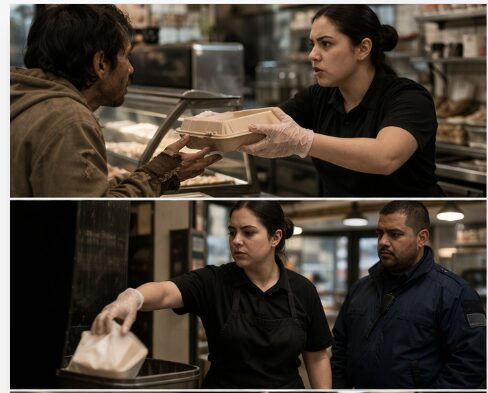
Ronan stood under the white glare of the overhead lights with one hand still half-raised toward the boxed sandwich she had just pulled away from him. He did not argue. Men who lived on the edge learned early that anger cost more than hunger. Anger got you thrown out. Anger got the police called. Anger made strangers feel righteous.
So he swallowed it.
The woman, Maris, had already turned the box back toward herself with the efficiency of someone closing a drawer. Her dark hair was twisted into a low, tight bun. Black polo. Dark apron. Gloves so clean they made his own hands look dirtier than they were. She did not seem cruel at first glance. Just brisk. Just tired. Just unwilling to let his need become her problem.
Ronan looked down at the coins in his hand.
A quarter. Three dimes. Two nickels. Four pennies.
He had counted them ten times on the walk there, and ten times before that while sitting on the low wall outside with Nia asleep against his shoulder, her little body lighter than it should have been. Each time he had reached the same total. Each time he had hoped numbers might change out of pity.
They never did.
He opened his hand again, though he knew how pathetic it looked.
“It’s for my kid,” he said quietly.
It was the truth, and because it was the truth, he hated how much it sounded like a strategy.
Maris barely glanced at him. Her expression did not sharpen, but it did not soften either. There was something worse than contempt in it—routine. As if she had heard every version of human need already, and all of them had become background noise.
“Store policy,” she said.
Then she turned toward the prep area and dropped the boxed sandwich toward a metal discard tray.
Not the trash, not exactly. But close enough. Close enough that the sound of the container hitting steel seemed louder than it should have been.
Ronan flinched.
He didn’t mean to. The movement embarrassed him more than the words had. Hunger could make a man feel ridiculous for grieving a sandwich.
He stepped back from the counter.
Near the doorway, a security guard had been standing so still that Ronan had barely registered him before. Tall. Broad shoulders. Navy jacket. Utility belt resting against one hip. The kind of posture men wore when they spent their days being tested by other people’s bad moods.
He had said nothing through the whole exchange.
But when the boxed meal hit the discard tray, his chin dipped a fraction, and his gaze shifted from the counter to Ronan’s open hand.
Ronan noticed, because when you are humiliated in public, you notice every witness.
He closed his fingers over the coins and shoved them into his pocket. “Sorry,” he muttered, though he wasn’t sure to whom.
Then he turned and walked out before pity or anger or pride could trap him there.
Outside, the late evening air held the last of the day’s warmth, but it would cool fast once the sun dropped. Nia sat where he had left her on the low concrete wall beside the deli window, both hands wrapped around the empty plastic bottle she liked to keep even when there was nothing in it. It made her feel as if she still had something to hold.
She looked up when she saw him.
For one terrible second, Ronan feared she would ask. Children always asked at the wrong moment—not because they were selfish, but because they still believed the world might answer honestly.
Instead she only searched his face.
“Nothing?” she said.
He smiled, because fathers were magicians first and men second. “Not yet.”
Nia nodded as if she had expected that. That nod hurt more than a cry would have.
She was seven years old and already knew how to make room for disappointment.
Ronan sat beside her. The wall was still warm from the afternoon sun. He reached up and smoothed her hair back from her forehead. Her face had narrowed over the last few months, the baby softness gone too quickly. Some children lost roundness when they shot upward into growth. Nia had lost it to smaller, harsher arithmetic.
“Are you tired?” he asked.
“A little.”
“Cold?”
She shrugged.
That meant yes.
He took off his hoodie and draped it around her shoulders despite the chill already creeping over his own arms. She slipped into it with automatic gratitude, the sleeves hanging past her hands.
“Did you eat the crackers from earlier?” he asked.
She nodded.
He knew she was lying because he had split the last packet with her under the bridge at noon, but he let it go. They had become a strange little choir of lies lately, each one sung for the other’s comfort.
From inside the deli came the muted sounds of a place winding down—metal against metal, a refrigerator motor, footsteps, the flattening rhythm of closing time. Ronan kept his gaze on the street.
If he looked back through the glass, he might see the guard still watching.
If he looked back through the glass, he might see the sandwich in the discard tray.
Some things were harder to bear when they stayed visible.
“Dad,” Nia said after a while, her voice soft enough to be mistaken for wind, “we can just go back.”
Back where, he wondered.
To the shelter that was full? To the church basement that only opened on Fridays? To the underpass where the concrete held the day’s heat until midnight and then leached it straight into your bones?
But she meant something simpler than that. She meant back to wherever they had been before hope had asked them to risk embarrassment.
He put an arm around her narrow shoulders.
“In a minute,” he said.
Part II — What the Guard Saw
His name was Ellis, and he had spent most of his working life training his face not to react.
Not to drunks picking fights over nothing. Not to teenagers filming themselves doing stupid things in stores. Not to managers who wanted him to enforce rules they wouldn’t say out loud themselves. Security work was not really about strength, he had learned. It was about absorbing other people’s chaos without letting it become your own.
But that only worked when the chaos came from anger.
Need was different.
Need had a way of slipping past training.
Ellis had watched the man at the counter from the moment he came in. The first thing he noticed was the man’s posture—not aggressive, not evasive, just braced. The posture of someone expecting refusal and trying to make himself smaller before it arrived.
The second thing he noticed was the care with which he counted those coins.
Not a scammer, Ellis had thought.
Not a thief, either.
Just a man trying to make a few pieces of metal turn into dinner.
He had almost stepped in then. Not fully. Just enough to smooth the tension, maybe buy the meal himself without making a scene. But there was always a line in these places, a narrow invisible line security guards were expected to feel before they crossed it. Step in too early and you created trouble where there might not have been any. Step in too late and the moment had already hardened.
Then the worker had said, “Store policy.”
And she had dropped the meal onto the discard tray.
Ellis didn’t think she meant to be monstrous. Most people didn’t. They just got used to choosing systems over faces until the choice no longer felt like a choice.
He looked toward the doorway after the man left, and through the window he saw why the plea had sounded different.
A little girl sat outside on the low wall, wearing no jacket, one hand around an empty bottle, her small back so straight it looked practiced. Children who had stable lives sprawled. They swung their legs. They asked for things. This one sat like she had learned not to take up space.
Ellis stood there a second too long.
Maris noticed. “What?”
He nodded toward the discard tray. “That getting tossed?”
She shrugged. “Can’t resell it.”
“That wasn’t my question.”
Maris turned fully toward him then, and for the first time some defensive heat entered her face. “You want to buy it, buy it. But I’m not handing out food every time somebody says they’ve got a story.”
Ellis thought of the girl outside. The empty bottle. The way the man had said my kid like he was ashamed to use love as currency.
He could have argued. He could have told Maris she was wrong. He could have turned the whole thing into one of those scenes people later relived in self-justifying versions of themselves.
Instead he reached for a fresh meal bag hanging ready near the counter.
Maris stared at him. “Seriously?”
Ellis took out his wallet. “Seriously.”
He paid for two sandwiches, a banana, and the last small bottle of orange juice in the cooler. He added a packet of crackers because little kids always looked hungry again twenty minutes after finishing anything. He knew that from his nephew. He knew it from childhood memories he did not visit often.
Maris rang it up without comment. She still looked annoyed, but now there was something else mixed in with it—discomfort, maybe. Or the beginning of shame. Ellis didn’t push her. Shame was rarely improved by witnesses.
He took the paper bag by the handles.
For a moment, he stood very still, the bag warm against his hand where one sandwich had just come off the grill. Strange, how quickly an object could change meaning. Inside the deli it was inventory. Outside, it would become mercy.
He stepped through the door.
The man looked up immediately, muscles tensing first, as if uniformed men almost never approached with good news. Up close, he looked younger than Ellis had first thought and older at the same time. Hunger had a way of confusing age.
The girl leaned closer to him without speaking.
Ellis stopped a few feet away, enough distance not to alarm them.
“This is yours,” he said.
The man’s eyes dropped to the bag, then lifted again, wary and disbelieving. “I can’t—”
“Feed your kid first,” Ellis said.
He said it quietly. Not as an order. As permission.
That was the moment something changed in the man’s face—not just relief, though relief was there, bright and painful. Something deeper. The look of a person who had been forced all day, all week, maybe all year, to expect the worst from strangers and had just been told, briefly, he was not foolish for hoping.
His hands trembled when he reached out.
The girl looked at the bag like it might vanish.
“Thank you,” the man said.
Two words. Barely more than breath. But Ellis felt them settle somewhere heavier than gratitude. As if the thanks were for more than food. For not making the giving theatrical. For not asking questions first. For not requiring a performance of misery to earn kindness.
Ellis nodded once.
He might have left then. That would have been the neat ending. The one a video would choose. The clean moral beat, the good deed completed in under twenty seconds.
But real hunger kept going after the gesture.
So he asked, “You two got somewhere tonight?”
The man hesitated.
That hesitation told Ellis enough.
Part III — The Shape of Mercy
Ronan’s first instinct was to lie.
It was always to lie.
Yes, they had somewhere. Yes, they were fine. Yes, someone was expecting them. Pride wasn’t the right word for it. Pride sounded grander than what he felt. It was closer to animal caution. The body’s instinct to protect itself from being handled.
But Nia was staring at the orange juice in the bag as if she could see through paper, and Ellis—the guard, though Ronan was beginning to think of him as more than the jacket—was waiting without impatience.
“No,” Ronan said at last. “Not really.”
Ellis took that in with a small breath. Not dramatic. Not pitying. Just a man adjusting to the size of what stood in front of him.
“There’s a church shelter three blocks east,” he said. “Overflow room opens when the weather dips. Most people don’t know because they don’t advertise it well.”
Ronan blinked. “I went there last month. They said full.”
“Main room probably was.” Ellis nodded toward the darkening sky. “Overflow’s weather-triggered. They open it on colder nights. Tonight counts.”
The city shifted around them—traffic in the distance, a bus sighing at the curb, someone laughing farther down the block. Ordinary life continuing with its usual indifference. Yet for Ronan the evening had split into a before and an after.
Nia was already pulling the crackers from the bag with exaggerated patience, the kind children used when they were trying not to look greedy. Ellis crouched slightly so he wouldn’t tower over her.
“What’s your name?” he asked.
She glanced at Ronan first.
“Nia,” she said.
“That orange juice’s all yours, Nia.”
Something like a smile touched her mouth. Small, careful, but real.
Ronan looked away for a second because he could not afford to cry in front of his daughter. Not here. Not yet.
He had once had a room with pale green walls and a leaky tap and a mattress on the floor that was entirely his. He had once had a job unloading produce trucks at dawn. He had once thought losing one thing at a time would give him time to recover. First the job after the warehouse closed. Then the room. Then the temporary couch from a cousin who got tired of temporary things that lasted too long. Then the cheap motel week by week. Then the car. Always something else to sell, somewhere else to go, one more explanation to make.
He had protected Nia from the words for it as long as he could.
But children knew when the world had started shrinking.
Ellis straightened and pointed down the block. “You eat first,” he said. “Then you head east. Brick church with the blue awning. If anyone gives you trouble at the desk, tell them Ellis from Mercer Deli sent you.”
Ronan almost laughed at the absurd grace of it. A name. A direction. A sentence that could open a door.
“You don’t even know me,” he said.
Ellis held his gaze. “I know enough.”
The answer lodged in Ronan’s chest like warmth.
They sat on the low wall while Ellis remained nearby, not hovering, not performing concern, just present. Nia drank the juice in small delighted sips, then tore into the sandwich with both hands. Ronan watched her eat before touching his own.
Feed your kid first.
He had heard orders all his life from men wearing uniforms. Move along. Hands where I can see them. You can’t stay here. None of them had ever sounded like that.
When Nia had finished half her sandwich, she held the rest out toward him with solemn generosity. “You too.”
Ronan took it because refusing would turn hunger into ceremony. They ate in quiet.
From inside the deli, Maris stepped briefly into view near the window. She did not come out. She did not wave. But she stood there for a second, looking at them through the glass, and her face no longer wore the hard flatness it had before. She looked unsettled. Human again.
Ronan didn’t know what to do with that.
Maybe tomorrow she would go back to rules. Maybe tomorrow she would forget them entirely. People rarely changed all at once. But perhaps tonight, when she closed up and carried out the trash, she would remember the little girl with the orange juice and feel the sharp edge of her own decision. Sometimes that was where change began—not in virtue, but in discomfort.
Ellis checked his watch. “Go now,” he said gently. “Before the line builds.”
Ronan stood, the paper bag folded under his arm, Nia tucked into the borrowed shape of his hoodie. For a moment he wanted to say something larger than thank you. Something that measured the distance between being dismissed at a counter and being directed toward a warm room. Something about how mercy was never small to the person standing in its path.
But the words would have been too heavy for the moment.
So he said the simplest true thing.
“You gave her a good night.”
Ellis shook his head once. “You get her there. That’s the good part.”
They started walking east.
Nia slipped her hand into Ronan’s. Halfway down the block she looked back. Ellis was already returning to the deli door, shoulders broad under the navy jacket, posture settling again into the stillness of his job. By tomorrow, no one in that shop would know from looking at him what he had carried outside in a paper bag.
Maybe that was why the kindness mattered.
Not because it was grand.
Because it wasn’t.
Because it had come without spectacle, from someone who could have done nothing and been forgiven for it by the whole world.
At the church with the blue awning, the woman at the desk looked tired enough to distrust everyone. But when Ronan repeated the sentence exactly—Ellis from Mercer Deli sent us—something in her expression changed. She checked a clipboard, sighed, then pointed them toward the basement stairs.
“Overflow’s open,” she said. “Cots are first come.”
The room downstairs smelled like detergent, old blankets, and soup. To Ronan it smelled like reprieve.
Nia lay down without removing the hoodie, still clutching the empty orange juice bottle now that it had become treasure. Within minutes, she was asleep.
Ronan sat beside the cot for a long time, watching the rise and fall of her chest.
He thought of all the ways a day could harden a person. A city could harden a person. Hunger, bills, humiliation, indifference—each one small enough alone, together enough to turn a face into a wall. He had seen it happen. He had felt it happening to himself.
And yet.
One woman had chosen policy. One man had chosen differently.
That was the unbearable thing, and also the hopeful thing. The world did not move on one great moral wheel. It moved on tiny private choices, made in fluorescent light, beside discard trays, in the pause before someone turned away.
Ronan leaned back against the wall and closed his eyes.
For the first time in weeks, tomorrow did not feel solved, but it felt reachable.
In the morning there would still be forms to fill out, calls to make, lines to stand in, explanations to repeat. There would still be the long humiliating labor of trying to return from the edge with a child at his side. None of that had vanished with a sandwich and a church cot.
But something had been restored that night that mattered almost as much as food.
Not pride. Not exactly.
Permission to keep believing that kindness might still appear in the space between rules.
Upstairs, somewhere beyond the basement ceiling, the city kept moving with all its noise and appetite. But down in the dim shelter room, with Nia sleeping under his hoodie and the paper bag folded neatly on the floor beside them, Ronan held on to the shape of the evening as if it were a map.
A hand pulling food away.
A voice saying store policy.
A child waiting outside.
A different voice, low and steady, saying, Feed your kid first.
Years later, he would forget the color of the floor tiles in the deli and the brand name on the juice bottle and the exact route they had walked to the church. Hard lives edited memory in practical ways.
But he would remember the sound of those words.
Not because they fed them for one night.
Because they made the world, for one impossible moment, feel larger than its rules.