What She Carried Home
Part I — The Road at Sunset
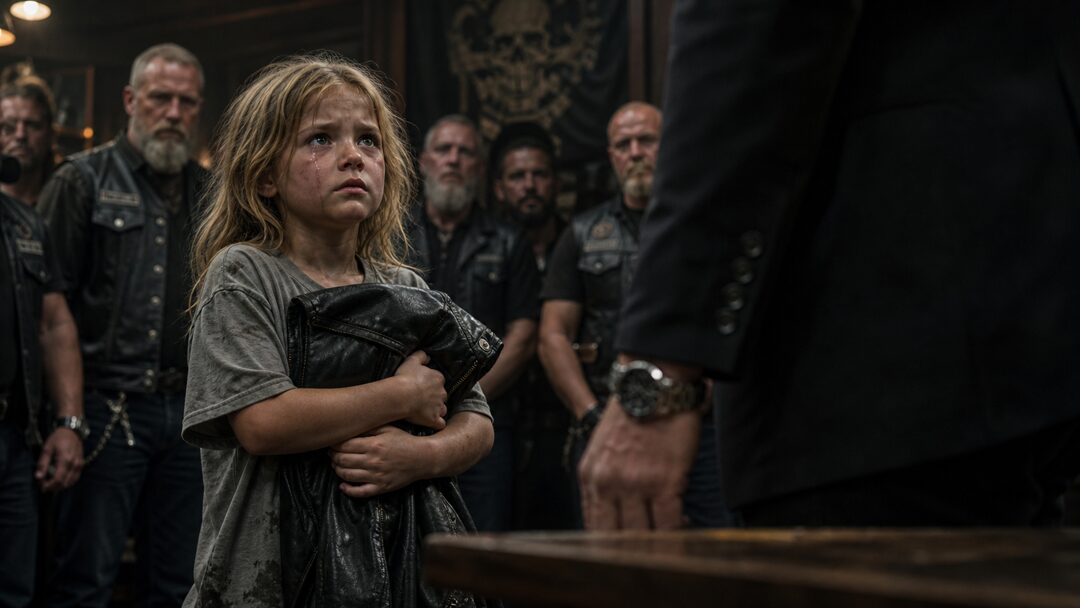
Emily Hayes stepped into the middle of the county road carrying a leather vest that was almost as heavy as she was.
The motorcycles were parked across both lanes, chrome shining under the red-orange sky. Men in black leather stood beside them in a loose wall, broad shoulders and folded arms, their boots planted in the dust as if the road belonged to them. Engines ticked as they cooled. No one spoke.
Emily kept walking.
Her gray T-shirt stuck to her back. Her knees were scratched. Her hair, cut unevenly just below her chin, had dust in it from the ditch where she had slept two hours before. The vest dragged against her jeans, its worn leather folded over both arms like something alive and stubborn.
One of the men moved forward, but another lifted a hand.
That one was older than the others. Bigger, not because he was taller, but because the air seemed to give him room. Silver threaded through his beard. His black vest carried a patch over his heart: PRESIDENT.
Emily knew his name before he said it.
James Walker.
Her mother had said it differently every time. Sometimes like a warning. Sometimes like a curse. Once, near the end, like a prayer she hated needing.
James looked from Emily’s face to the vest.
His expression did not soften.
“Where did you get that?”
Emily’s fingers tightened until the cracked leather creaked.
“My mom said if I ever had nowhere left to go,” she said, her voice rough from thirst and crying, “I should give this to the man who ruined her life.”
The road went quiet in a different way.
Behind James, one of the bikers shifted. Another muttered something under his breath. Emily heard the word Sarah, though no one had said it loudly enough for a child to catch. She caught it anyway. Children who grow up around closed doors learn how to hear through them.
James held out one hand.
“Give it here.”
Emily did not move.
The vest had been under her mother’s bed for as long as Emily could remember, wrapped in a black garbage bag, taped shut, hidden behind a shoebox full of unpaid bills. Every year on Emily’s birthday, Sarah would take it out after dinner. She never let Emily wear it. She never even let her hold it for long.
She would touch the inside lining with two fingers.
Then she would fold it back up and look away.
On the last morning, with her breath too thin and her eyes too bright, Sarah had pushed the vest into Emily’s arms.
“Find James Walker,” she had whispered. “Show him. But don’t trust anybody else with it.”
Emily had asked why.
Sarah had closed her eyes.
“Because men like that need proof before they remember they have hearts.”
Now James Walker stood in front of her, hand out, face carved from old weather and older mistakes.
Emily lifted the vest but did not let go.
He took the other side.
For one second, they held it between them.
Then James saw the front patch.
His jaw changed.
Not much. Not enough for the other men to see, maybe. But Emily saw it. A flinch buried under control.
He turned the vest slightly. The faded name stitched near the chest was barely readable, but still there.
MICHAEL.
James stopped breathing.
A younger biker behind him said, “No way.”
Another spat into the dirt.
James looked at Emily with a new kind of caution.
“What was your mother’s name?”
Emily hated that he asked like he did not already know.
“Sarah.”
His hand closed around the vest.
“Sarah Walker?”
Emily swallowed.
“Sarah Hayes.”
That landed harder.
One of the men behind James cursed softly. Another said, “Michael Hayes had a kid?”
Emily stared at the line of bikes instead of their faces.
“She died two days ago,” Emily said. “She told me to come here before anyone came for me.”
James looked at the vest again.
Twelve years ago, before Emily existed, he had stripped that vest from Michael Hayes in the Iron Saints clubhouse while every member watched. Sarah had told Emily that part once when she thought Emily was asleep. Not the details. Just enough to stain the name.
They took his place. They took his brothers. They took his name.
James’s voice dropped.
“Who brought you here?”
“Nobody.”
“You walked?”
“Some.”
“From where?”
Emily did not answer. If she listed the town, the shelter, the gas station bathroom, the ditch, the rides she had refused, the woman at the diner who had asked too many questions, she would sound breakable. She could not afford breakable.
James studied her for a long moment.
Then he turned to the men.
“Move the bikes.”
No one moved.
James did not raise his voice.
“I said move them.”
The first engine started. Then another. The wall split just enough to let one girl through.
Emily should have felt safer.
She didn’t.
James looked down at her.
“You’re coming with me.”
Emily hugged the vest back to her chest.
“My mom said not to trust you.”
James’s eyes flicked toward the horizon, where the sun had already started to sink.
“She was right,” he said.
Then he walked toward the clubhouse, and Emily followed because she had nowhere else to go.
Part II — The Missing Picture
The Iron Saints clubhouse looked like an old roadside bar that had learned to keep secrets.
A metal sign hung above the door. The paint was chipped. The windows were tinted dark. Inside, the air smelled like beer, motor oil, leather, and wood smoke. Emily felt every face turn when James brought her in.
Men stopped talking.
A woman behind the bar lowered the glass she was wiping.
James did not introduce Emily. He only pointed at a long wooden table and said, “Sit.”
She sat because her legs were shaking.
The vest stayed in her lap.
On the wall across from her were framed photographs. Men on motorcycles. Men with arms around each other. Men younger than they probably deserved to have died. Under some frames were little brass nameplates.
Emily looked for Michael Hayes.
She knew his face only from one photo her mother kept hidden in a cookbook: dark hair, crooked smile, one arm around Sarah, the two of them leaning against a motorcycle like the whole world had stepped aside for them.
He was not on the wall.
Of course he wasn’t.
A man at the far end of the bar said, “That really his?”
James gave him one look, and the man shut up.
But silence did not protect Emily. It only gave the whispers more room.
“Hayes.”
“Thought he was long gone.”
“Traitor’s blood.”
Emily stared at the tabletop. Someone had carved initials into it. Some were old. Some were fresh. She pressed her thumb into a groove and pretended not to hear.
The door opened again.
A younger man stepped in like he owned the space without needing permission. He was not dressed like the others. His jacket was black, but too clean. His boots looked polished. A silver watch caught the light when he lifted his hand to close the door.
Ryan Walker.
Emily did not know his name yet, but she knew his type. Men like him smiled before they cut you.
His eyes went first to James, then to the vest, then to Emily.
“Well,” he said. “That’s inconvenient.”
James’s face hardened.
“Not now.”
Ryan walked closer. He looked at Emily the way landlords looked at late rent notices.
“Who is she?”
Emily answered before James could.
“Emily.”
Ryan smiled politely.
“That wasn’t the question.”
James stepped between them.
“She’s Sarah’s girl.”
For the first time, Ryan’s face moved.
Only a little.
Then it rearranged itself back into calm.
“Sarah didn’t have a girl.”
“I’m sitting right here,” Emily said.
A few men looked at her. One almost smiled, then thought better of it.
Ryan leaned one hand on the table, close enough for Emily to see that his nails were clean.
“And Michael Hayes was your father?”
Emily lifted her chin.
“Yes.”
Ryan’s voice stayed soft.
“The traitor’s kid.”
The room did not gasp. It did something worse.
It accepted the words.
Emily stared at him until her eyes burned.
James heard it. She knew he heard it, because his shoulders shifted. But he said nothing. Not right away.
That silence taught Emily more than any warning her mother had given her.
Ryan looked at James.
“You can’t just bring her in here.”
“She came to me.”
“With his vest.”
“With Sarah’s instructions.”
Ryan’s gaze sharpened.
“What instructions?”
Emily hugged the vest tighter.
James noticed.
He turned to the room.
“Everyone out.”
No one moved fast, but they moved. Chairs scraped. Boots dragged. Men looked at Emily as they passed, curiosity and contempt mixed together in ways she could not separate. Ryan stayed.
James looked at him.
“You too.”
Ryan’s smile thinned.
“That girl walks in with Michael Hayes’s vest after twelve years, and you want me outside?”
“Yes.”
“For the record, that is exactly how you end up with a knife in the family picture.”
James’s voice dropped.
“Outside.”
Ryan held his father’s eyes for a long second, then straightened.
Before he left, he looked at Emily again.
“Careful, Emily. Some names cost more than they’re worth.”
The door closed behind him.
Emily waited until the room was empty before she spoke.
“My mom said people here would talk like that.”
James sat across from her. The table seemed too small for him.
“What else did your mother say?”
Emily wanted to tell him nothing. She wanted to protect Sarah’s words because they were the only thing left that still belonged to them.
But Sarah had sent her here for a reason.
“She said you were her brother,” Emily said. “And that didn’t mean you were family.”
James took that like a punch he did not allow himself to show.
“She was sick?”
Emily nodded.
“How long?”
“Long enough.”
“That isn’t an answer.”
“It’s the one you get.”
James looked down at his hands.
They were large hands. Scarred across the knuckles. Emily imagined them pulling the vest off her father while men watched. She wondered if Michael had fought back or stood still because Sarah was in the room.
“She needed help,” James said.
Emily laughed once, sharp and ugly.
“She had lots of people who offered help. Men who wanted to move in. Churches who wanted her to say thank you right. Ladies who looked at our apartment and talked about forms.” She swallowed. “She said help with a hook in it wasn’t help.”
James said nothing.
Emily hated that he did not defend himself. It made him harder to hate cleanly.
“She kept that vest under her bed,” Emily said. “Every birthday, she took it out. She touched the inside. Then she cried in the bathroom with the water running.”
James looked at the vest.
“The inside?”
Emily nodded.
“She never let me wear it. She said it wasn’t mine yet.”
“Yet?”
“That’s what she said.”
James reached for the vest again, slower this time.
Emily let him take it.
He turned it over in his hands. His thumb passed over the old stitching. He looked older in the yellow clubhouse light.
“Why didn’t she come back?” he asked.
Emily’s throat tightened.
Because you made her choose between being your sister and being my dad’s wife.
Her mother had said that once with fever in her voice. Emily had never forgotten it.
So she said it now.
“Because you made her choose,” Emily told him. “And then you took both away.”
James closed his eyes.
For the first time since Emily had stepped onto the road, he looked less like a wall.
He looked like a man standing in front of one.
Part III — Firefly
James took the vest into the back room and locked the door.
Emily sat alone in the clubhouse with a soda she did not drink. Through the wall, she heard low voices. Men outside. A motorcycle starting, then fading away. Somewhere in the building, pipes knocked.
The empty chair across from her felt like an accusation.
She almost ran.
She got as far as standing when the back door opened and James came out holding the vest as if it had changed weight.
“Emily.”
His voice was different.
Not softer.
Worse.
He looked frightened.
She had never seen an adult man look frightened without making it someone else’s problem.
“What did you do to it?” she asked.
James swallowed.
“Come here.”
“No.”
He stopped.
Good, Emily thought. Learn that word.
James placed the vest on the table. He turned the inside lining toward her. Near the bottom seam, where the leather had always seemed thicker, the black fabric was split open.
Emily stepped closer despite herself.
Behind the torn lining was a patch.
Small. Old. Hand-stitched. Not the big front patch everyone could see, but a private piece of cloth hidden against the inside like a secret heartbeat.
On it was one word.
Firefly.
Emily stared.
“My mom used to say that,” she whispered.
James touched the edge of the patch with one finger, then pulled back like it burned.
“She called him that before any of us did. Michael had this stupid habit of riding at night with no headlight if he thought Robert would catch him sneaking over to see her.” His mouth twisted. “Said he knew the road by stars and porch lights. Sarah said he looked like a firefly pretending to be a man.”
Emily did not smile. The story hurt too much for smiling.
Behind the patch was a folded piece of paper stained dark at the edges. James opened it carefully. There were numbers on it. A receipt. Names Emily did not know. Initials. A date from twelve years ago.
James knew every mark.
She could see it happen.
His face first refused the truth.
Then it recognized it.
Then it hated itself.
“What is it?” Emily asked.
James did not answer.
“What is it?”
“It’s proof,” he said.
“Of what?”
He stared at the paper for so long she thought he might tear it up.
Then he said, “Your father didn’t steal that money for himself.”
Emily’s ears rang.
People had called Michael Hayes a traitor before she ever knew what the word meant. Her mother had never used it, but everyone else had. Landlords. Old acquaintances. A man at a grocery store who recognized Sarah and muttered, “Should’ve picked better.” Emily had learned early that some shame entered a room before you did.
“What did he do?” she asked.
James sat down slowly.
“My father lost club money covering a debt. More than anyone knew. Michael found out. So did Sarah, or enough of it.” He looked at the paper. “Robert told Michael if he opened his mouth, he’d make sure everyone believed Sarah was part of it. That she helped move the money. That she sold out her own blood.”
Emily felt cold.
“Robert was your father.”
James nodded.
“The founder.”
“The man in the big picture?”
James looked at the wall.
At the center hung the largest frame: Robert Walker, broad and grinning, one hand on a motorcycle, the other around James’s shoulders when James was young.
“Yes.”
Emily looked from the picture to the vest.
“So my dad took the blame.”
James’s voice was low.
“He let us put it on him.”
“Why?”
“Because he loved your mother.”
Emily wanted that to feel good.
It didn’t.
Love, in stories, was supposed to save people. Her parents’ love had left Sarah poor, Michael disgraced, and Emily carrying leather down a road asking help from a man her mother hated.
“That’s stupid,” Emily said.
James looked at her.
“Yes.”
The door to the hallway opened.
Ryan stood there.
Neither James nor Emily had heard him come in.
His eyes went to the paper.
Then to the split lining.
Then to James’s face.
“Well,” Ryan said quietly. “There it is.”
James folded the paper once, protecting it in his palm.
“You knew?”
Ryan stepped into the room and shut the door behind him.
“I knew enough to know digging would not help anyone.”
Emily backed closer to the table.
James rose.
“What did you know?”
Ryan sighed, not angry. Disappointed, almost.
“That Sarah sent things. Years ago.”
James went still.
“What things?”
“A letter.”
Emily’s heart changed speed.
Ryan’s gaze flicked toward her.
“And a photograph.”
James took one step toward him.
“You opened my sister’s mail?”
“I protected you.”
James’s hands curled.
Ryan’s calm did not break.
“You were finally steady. The club had stopped whispering. Robert was gone. Michael was gone. Sarah had chosen exile. Then a letter shows up with a baby picture and a name, and what? You were supposed to throw away everything for a woman who already picked against us?”
Emily could not breathe.
A baby picture.
Her mother had tried.
Her mother had reached for the door, and someone inside had locked it twice.
Ryan looked at Emily with something like pity, which was worse than hate.
“You were a complication before you could talk.”
James grabbed the front of Ryan’s jacket.
For one second, the polished man looked younger.
“Say that again,” James said.
Ryan did not flinch.
“You know I’m right.”
Emily heard herself speak from far away.
“My mom didn’t stay gone because nobody knew.”
Both men looked at her.
“She stayed gone because you liked it better that way.”
Ryan’s face cooled.
James let go of him.
The paper shook once in James’s hand.
Emily understood then that proof had power, but only if someone stronger decided not to bury it again.
That was the worst part.
She had walked all that way carrying the truth, and it still did not belong to her unless they let it.
Part IV — The Vote
By evening, every Iron Saint within reach had been called to the clubhouse.
Ryan called it a discussion.
Emily knew a trap when adults gave it a clean name.
The long room filled with men in black vests, their patches bright under the ceiling lights. Someone had moved the tables into a rough half circle. Emily stood in the open space before them with Michael’s vest pressed against her stomach.
James stood near the wall, silent.
Too silent.
Ryan took the center like he had practiced.
“We have a situation,” he began.
His voice was gentle enough to make the room comfortable. That was his trick. He could make cruelty sound like paperwork.
“A girl arrived today claiming connection to a former member.”
Emily stared at him.
Claiming.
“She is Sarah Walker’s daughter,” James said.
Ryan nodded, almost kindly.
“Of course. Sarah’s daughter. And Michael Hayes’s daughter. That is the difficulty.”
The room tightened around Michael’s name.
Ryan turned slightly, letting everyone see Emily without quite pointing at her.
“She’s young. She’s had a hard time. Nobody here wants to see her thrown away.”
Thrown away.
Emily’s fingers dug into the vest.
“But we also need to be honest about what bringing her under club protection means. Michael Hayes was removed from this club for reasons that shaped our history. We cannot rewrite that because a child arrived with an old vest and a sad story.”
James’s face did not move.
Emily looked at him and hated him for making her wonder if he would speak.
Ryan continued.
“We can help her quietly. Money. A safe place. Maybe Sarah had friends somewhere. But putting the Iron Saints behind her publicly means putting Michael’s name back in our house.” He paused. “And I don’t think anyone here wants to dishonor the men who held this club together after he broke it.”
A murmur passed through the room.
Not agreement exactly.
Permission.
Emily knew that sound. It was the sound people made before doing something wrong together.
Ryan turned to her.
“You understand, don’t you? This isn’t personal.”
That was when Emily almost cried.
Not when she saw the bikes.
Not when they called her traitor’s blood.
Not when she learned her mother had sent a letter that never came back.
But then.
Because he said it wasn’t personal while standing in the room where they had made her father’s shame into furniture.
Emily lifted her eyes to James.
He was watching Ryan.
Not her.
Something inside her hardened because it had to.
“You’re only sorry because the patch had proof,” she said.
The room went quiet.
James looked at her then.
Emily’s voice shook, but she did not stop.
“If I came with just my face, you would’ve sent me away.”
No one breathed loud.
Ryan’s polite expression dimmed.
“Emily—”
“Don’t say my name like you know what to do with it.”
A chair scraped.
James moved at last.
“Enough.”
Ryan glanced at him, relief almost showing.
But James was not looking at Emily.
He was looking at the vest.
“Put it on the table,” James said.
Emily froze.
For one terrible second, she thought he meant to take it from her in front of them. To strip Michael all over again through her hands.
James saw the fear.
He did not soften his order, but his voice changed.
“Please.”
That word did something to the room.
Presidents did not say please to children.
Emily walked to the table and laid the vest down.
It looked smaller without her holding it.
James stepped beside her. He turned the vest inside out. Several men leaned forward.
Ryan’s face sharpened.
“Dad.”
James pulled the lining open.
The hidden patch showed first.
Firefly.
Whispers passed through the room, uncertain now.
Then James unfolded the paper.
“My father lost the money,” he said.
The room went completely still.
Ryan’s jaw tightened.
James did not look at him.
“Robert Walker lost it. Michael Hayes found out. Sarah found out enough. Robert threatened them both. Michael carried the blame because he believed it would keep Sarah clean.”
A man near the wall said, “That’s not true.”
James held up the paper.
“It is.”
“No,” Ryan said. His voice was still controlled, but the floor under it had cracked. “You don’t do this.”
James turned to him.
“You intercepted Sarah’s letter.”
Now the room shifted for real.
Ryan’s eyes flashed.
“It was years ago.”
“She sent me a photo of her child.”
“I kept garbage from reopening a wound.”
Emily laughed once. It sounded too adult and too broken.
Ryan looked at her, and for the first time, his calm failed.
“You don’t understand what families have to do to survive.”
James stepped between them.
“That wasn’t survival. That was inheritance.”
Ryan’s face reddened.
“You’re going to dishonor your father for him?”
James looked at the large photo of Robert Walker on the wall.
Then at the missing place where Michael should have been.
“We’ve been honoring the wrong man by burying the living.”
No one spoke.
James reached to his own chest.
His fingers gripped the president patch sewn into his vest.
For a second, Emily thought he would only touch it. Men like James liked symbols. They held them, displayed them, made other people bend around them.
Then he pulled a folding knife from his pocket.
The blade clicked open.
Several men stepped forward.
James cut the first stitch.
Ryan stared at him.
“Dad.”
James cut the second.
“You wanted the Walker name protected,” James said. “This is what it costs.”
The patch came loose in his hand.
He placed it beside Michael’s vest.
The sound it made against the table was almost nothing.
It changed the room anyway.
Emily looked at the wall of photos. The empty place her father should have been was not marked. No dust outline. No gap. They had erased him so cleanly that the wall had learned to pretend he was never there.
She pointed to it.
“Put his name back.”
James looked at her.
Not with surprise.
With respect that arrived too late.
“He wasn’t perfect,” Emily said. “My mom never said he was. I don’t need him perfect.” Her throat closed, then opened again. “I need him not to be what you made him.”
A man in the back bowed his head.
Another would not meet her eyes.
Ryan stood alone in the middle of them, still dressed better than everyone else, still clean, still legitimate, and suddenly smaller than the girl he had tried to send away.
James picked up Michael’s vest.
“Tonight,” he said. “His name goes back.”
Then he looked at Emily.
“And you decide what happens to the vest.”
Emily touched the leather.
For the first time, it felt less like proof.
More like weight.
“I’m not wearing it,” she said.
James nodded once.
“No.”
“It was his.”
“Yes.”
“And hers.”
James’s face tightened.
“Yes.”
Emily folded the vest carefully.
Nobody helped her.
That mattered.
Part V — What Stayed
Morning made the clubhouse look ordinary.
Without sunset, without engines, without men standing like a wall, it was just an old building beside a quiet road. Dust moved in the pale light. A bird hopped near the edge of the gravel lot. Someone had swept broken thread from the floor.
Emily stood outside with Michael’s vest folded over her arm.
She had slept in a back room on a couch that smelled like cedar chips and old smoke. Not well. Every time the building creaked, she woke up reaching for the vest. Every time she remembered her mother was gone, she had to learn it again.
James came out carrying a small frame.
He wore a plain black shirt. No president patch. No vest.
Without it, he looked less like a legend and more like a tired man who had run out of places to hide.
“I called one of Sarah’s old friends,” he said. “Karen. She remembers you. She said you and your mother stayed with her once in Tulsa.”
Emily remembered a yellow kitchen. A woman with soft arms. Pancakes shaped badly on purpose.
“She’ll take you for now,” James said. “If you want that. I’ll handle the rest from here.”
“The rest?”
“Paperwork. Club fallout. Ryan.”
Emily looked across the lot.
Ryan’s motorcycle was gone.
“Where is he?”
James followed her gaze.
“Not here.”
“That’s not an answer.”
“No,” James said. “It isn’t.”
Emily looked at the frame in his hands.
James offered it to her.
She almost did not take it.
Then she saw the photo.
Sarah sat on the back of a motorcycle, younger than Emily had ever known her. Her dark hair blew across her face. Her smile was sharp and bright, like she had just won an argument with the whole world. Michael sat in front, looking over his shoulder at her. One of her hands rested against the inside of his open vest, covering the place where the Firefly patch had been hidden.
Emily stared until the picture blurred.
“My mom looked happy,” she said.
“She was,” James answered.
“Because of him?”
James took a long breath.
“Sometimes. Sometimes because she was impossible and enjoyed making the rest of us admit it.”
Emily almost smiled.
It hurt, so she stopped.
She traced the edge of the frame with her thumb.
“Was my dad good?”
James did not answer quickly.
Emily was grateful for that. Fast answers were usually the ones adults used to get past children.
Finally, he said, “He loved badly sometimes. But he loved true. And he deserved better from us.”
Emily looked at the clubhouse window. Inside, beyond the tinted glass, men were moving around the wall. She had watched them work before dawn. They took Robert Walker’s large frame down from the center and moved it lower, not gone, not erased, but no longer above everyone.
Then James found an old photo of Michael in a storage box.
There had been dust on it.
No one said anything when James wiped it clean.
Emily had not cried then. She had cried later, alone in the bathroom, with the faucet running because she finally understood why her mother used to do that.
Sound needed somewhere to go.
James cleared his throat.
“I don’t expect you to forgive me.”
“Good.”
He nodded.
The answer seemed to hurt him.
It also seemed to relieve him.
Emily shifted the vest in her arms. “My mom hated you.”
“I know.”
“She still sent me.”
“I know that too.”
“She said not to trust you.”
“She was right.”
Emily looked at him then.
James did not ask for better. He did not explain himself again. He did not kneel or open his arms or pretend one night of truth could make him family.
That made it harder not to trust him a little.
She held out the vest.
James looked at it but did not take it.
“What do you want me to do?”
Emily glanced toward the clubhouse.
“Put his name up first.”
James accepted the vest with both hands.
Inside, the room went quiet when they entered. Not the old silence. Not the one that had judged her when she first came in.
This one waited.
James walked to the wall where Michael’s photo now hung. Beneath it, a blank brass plate waited on the wood.
A man handed James a small screwdriver.
James looked back at Emily.
She stayed by the door.
The vest did not belong on her shoulders. Not yet. Maybe not ever. But the name did belong on the wall.
James fixed the plate beneath the photo.
MICHAEL HAYES.
No title. No apology carved into metal. No attempt to make him clean or simple.
Just his name.
Emily held the frame of her mother and father against her chest.
For years, her life had been built around a space adults refused to point at. A missing picture. A missing letter. A missing name. Her mother had carried the truth as long as she could, hidden in leather and silence, waiting for a day when Emily would be old enough or desperate enough to bring it home.
Now the name was there.
It did not bring Sarah back.
It did not give Michael the years they had taken.
It did not make James innocent.
But it changed what Emily had to carry.
Outside, Karen’s car pulled into the lot, slow and careful over the gravel. Emily saw a woman step out, one hand raised against the sun, face already breaking open with recognition and grief.
James handed the vest back.
Emily took it and folded it over her arm.
At the door, she paused.
James stood a few feet behind her, close enough to help, far enough not to claim her.
Emily looked back once.
“My mom said the road here was ugly,” she said.
James waited.
“She was wrong.”
Then she walked into the morning with the vest in her arms, not lighter, exactly, but no longer carrying it alone.