The Little Cake on the Marble Counter
Part I — The Door That Should Have Stayed Closed
Sarah saw her brother before anyone else did, and for one cruel second, she wished she hadn’t.
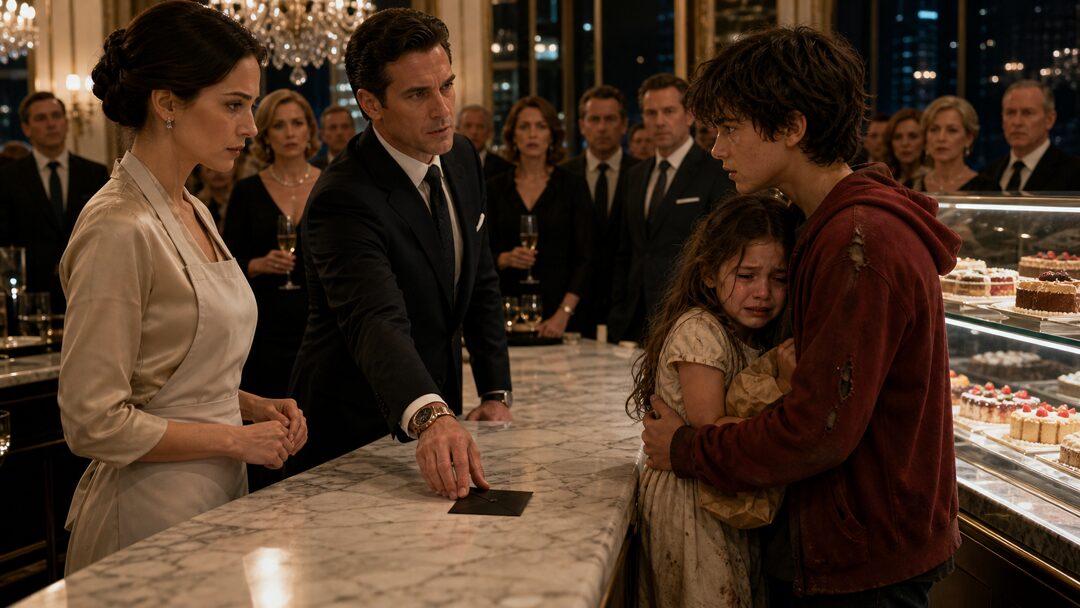
He was outside the glass doors of the bakery, one shoulder pressed against the frame, his red hoodie torn open near the collar. In his arms, Emily clung to him like she had been dropped from the sky and caught only halfway. Her white dress was gray at the hem. Her cheeks were wet. One small fist held a crushed paper bag.
Inside, the room glittered.
Crystal lights hung over marble counters. Champagne flashed in tall glasses. Gold-edged plates carried tiny almond financiers, lemon tarts, and squares of chocolate cake dusted with flakes of salt. Wealthy people laughed softly, the way people laughed when nothing had ever demanded that they be loud.
Sarah stood behind the front counter in a cream silk dress William had chosen for her.
“Not white,” he had said that afternoon, fastening the clasp at the back of her neck. “White feels too bridal before the announcement. Cream is softer. More tasteful.”
He had kissed her shoulder after that, gentle enough to make it feel like love.
Now the glass doors rattled again.
Samuel looked straight at her.
Then he said her name.
“Sarah.”
It was not loud. It did not have to be.
The sound cut through the room anyway.
A woman holding champagne turned first. Then two men near the pastry case. Then William, standing beside his mother with one hand resting casually in his pocket, his face arranged into the pleasant calm he used for investors, staff, and problems.
Sarah’s hand tightened around the silver pastry tongs.
Samuel shifted Emily higher against his chest. He was thirteen, but tonight he looked both younger and older than that. Too young to be carrying a crying child through Manhattan. Too old to still believe adults always opened doors.
“Sarah,” he said again, and this time his voice cracked.
Emily lifted her face. Her mouth trembled.
“I’m hungry,” she whispered through the glass.
The room went quiet in pieces.
Sarah moved because everyone was watching. She came around the counter, each step careful, the marble floor suddenly too bright beneath her shoes.
William’s eyes followed her.
Not angry. Not yet.
Careful.
That was worse.
Sarah unlocked the door and opened it just wide enough for cold air to slide in. Samuel smelled like rain, exhaust, and the sour sweat of fear.
“What are you doing here?” she asked.
The words came out before the better ones could reach her mouth.
Samuel stared at her.
Not Are you hurt?
Not Where’s Mom?
Not Come in.
Just: What are you doing here?
He heard it. She saw him hear it.
His chin lifted, a small hard motion he had learned too early. “We didn’t know where else to go.”
Emily reached for Sarah’s dress with dirty fingers.
Sarah stepped back without meaning to.
Emily’s hand dropped.
Behind Sarah, someone whispered.
Samuel looked past her into the room: the chandeliers, the pastries, the guests, William in his dark suit, William’s mother with pearls at her throat and pity nowhere on her face.
Then he looked at Sarah again.
“Mom left us,” he said.
Sarah’s stomach went hollow.
“She said you married up now.”
A laugh escaped from someone near the champagne table.
Not a full laugh. Not even meant to be cruel, maybe. Just a startled little sound, quickly swallowed.
But Samuel heard that too.
So did Sarah.
William crossed the room with the slow confidence of a man who had never once needed permission to enter any space.
“Sarah,” he said gently. “Let’s not do this in the doorway.”
The kindness in his voice was perfect.
Too perfect.
Part II — Food to Go
William reached the door and placed one hand at the small of Sarah’s back.
It looked intimate.
It felt like instruction.
“Bring them inside for a moment,” he said, low enough that only she could hear. “But not into the dining room.”
Samuel looked from William’s hand to Sarah’s face.
Sarah opened the door wider.
Emily came first, still in Samuel’s arms. Her shoes were scuffed, one strap broken. Samuel stepped in after her, shoulders stiff, eyes sharp with the shame of needing help in a room built to display abundance.
The guests pretended not to stare.
That was worse than staring.
Sarah led them past the pastry counter and through the narrow service door beside the espresso machine. The hallway behind the bakery was fluorescent-lit and smelled of butter, dish soap, and cardboard boxes. The music from the main room softened into something artificial and far away.
Only when the door swung shut did Emily begin to cry properly.
Not the small crying from outside. This was the tired, broken sob of a child who had already cried too long and had no strength left to make it pretty.
Sarah reached for her.
Samuel turned his shoulder.
“She needs food,” he said.
“I know.”
“No, you don’t.” His voice shook. “She hasn’t eaten since this morning.”
Sarah pulled open a storage drawer and took out a napkin, then another, then stopped because napkins were not food. She moved toward the prep table where staff meals were sometimes kept, but the tray was empty. Of course it was. Tonight everything edible had been arranged behind glass.
Pretty food. Sellable food. Food with names printed on cards.
Emily’s gaze drifted toward the service window, where she could see the pastry case glowing in the main room.
Sarah crouched. “Emmy.”
Emily blinked at her.
The nickname landed like a small stone in the hallway.
“You remember me?”
Emily nodded uncertainly. “You’re the lady from the picture.”
Sarah felt Samuel’s eyes on her.
“What picture?”
Samuel shoved a folded piece of paper at her.
It was damp at the edges. Sarah opened it carefully. Her mother’s handwriting slanted across the back of a bus receipt.
Sarah,
I can’t do this anymore. You have William now. You always wanted out, and you got out. Take care of them. I kept them alive long enough.
Don’t call me.
At the bottom, in different ink, a number had been crossed out so hard the paper tore.
Sarah read it once.
Then again.
Her mother had never been good at apologies, but she had been gifted at making abandonment sound like someone else’s promotion.
Sarah looked up. “Where did she leave you?”
“Port Authority,” Samuel said. “She said she was going to get coffee.”
Emily held up the crushed paper bag. “She gave me this.”
Inside was half of a plain donut, hardened at the edge.
Sarah closed her eyes.
When she opened them, William stood at the end of the hallway.
He had followed without making a sound.
“I’ve asked one of the servers to pack a box,” he said. “Croissants, sandwiches, whatever is easy. We’ll call a car.”
Samuel’s face changed.
Not relief.
Something colder.
“A car where?” he asked.
William gave him a polite smile. “Somewhere safe.”
“With Sarah?”
The hallway tightened.
William looked at Sarah instead of Samuel. “We can discuss that after tonight.”
“After what tonight?” Samuel asked.
Sarah stood too quickly. “Samuel.”
His eyes flashed. “No, what’s tonight?”
No one answered.
From the main room came the clear ring of a spoon against a glass. William’s mother was gathering attention.
Sarah knew the timing. The toast first. Then William would bring her forward. Then the ring, though everyone who mattered already knew. Then photographs. Then the announcement would move from whispers to society pages and investor newsletters and the bakery’s expansion campaign.
William’s mother would call Sarah “an extraordinary young woman.”
William would say she had refined the soul of the business.
No one would say she had learned to sleep through hunger as a child.
No one would say she sent money home for years until the requests became threats.
No one would say she had stopped answering her mother’s calls because every call made her feel like a ladder being climbed by hands that never asked if she was bleeding.
William stepped closer.
“They’re children,” Sarah said.
“I can see that.”
“They have nowhere to go.”
“And I’m trying to help.” His voice remained soft. “But there are forty people in there, including my mother, two board members, and the foundation donors. This is not the moment to improvise your family history.”
Samuel flinched at family history.
Sarah heard it too.
William continued, “They can be given food to go. Cash if necessary. A hotel room. A car. Whatever is appropriate.”
“Appropriate,” Samuel repeated.
William looked at him then. Really looked.
“Your sister has worked very hard to build a future,” he said. “I’m protecting it.”
Samuel’s mouth tightened.
Sarah wanted to defend William.
That was the ugliest part.
She wanted to say he was not cruel, only careful. That he had paid for her night classes. That he had recommended her for manager when other people still called her “the girl from the counter.” That he had taught her how to order wine and which fork to use and how not to apologize when entering a room.
He had chosen her.
But somewhere along the way, being chosen had begun to feel like being edited.
Emily tugged Sarah’s skirt.
“Can I have one little cake?” she asked.
Sarah looked through the service window toward the glowing rows of pastries.
A whole case of tiny cakes.
A child asking for one.
Behind them, William’s mother began her toast.
Part III — The Price of Quiet
William’s mother had a voice that made silence feel like obedience.
“To family,” she said from the main room, her tone smooth and bright. “To legacy. To the rare people who understand what it means to elevate what they are given.”
Soft applause followed.
Sarah stood in the service hallway with her mother’s note in one hand and Emily’s sticky fingers in the other.
Samuel had not taken his eyes off William.
“You knew,” he said.
Sarah turned. “What?”
Samuel looked at William. “You knew about us.”
William’s face did not change enough for anyone else to notice.
Sarah noticed.
A pause where there should have been confusion.
A breath where there should have been surprise.
“William?” she asked.
He adjusted the cuff of his shirt. “Your mother reached out to me.”
The hallway became very small.
“When?”
“A few days ago.”
Sarah’s fingers tightened around the note. “You didn’t tell me.”
“I was going to.”
“When?”
“After tonight.”
Samuel gave a short, bitter laugh. “Everything after tonight, huh?”
William ignored him.
Sarah’s voice came out thin. “What did she want?”
“Money.”
Of course.
The word did not shock her. It only landed with the dead weight of something expected and still painful.
“How much?”
“That doesn’t matter.”
“It matters to me.”
William glanced toward the main room, where another round of polite laughter rose and faded. “She said she might come by. She said she had the children with her. She was agitated.”
“And?”
“And I handled it.”
Sarah stared at him.
Handled it.
As if her mother were a delivery mistake. As if Samuel and Emily were a spill on the marble. As if Sarah herself were something fragile that would crack if exposed to the truth.
“What does handled mean?”
William’s jaw flexed once.
“I gave her enough to stay away until we could speak privately.”
Samuel stepped forward. “You paid her to leave us?”
“I paid her not to create a scene.”
“That’s what we are?” Samuel asked. “A scene?”
Sarah whispered, “Samuel.”
But he was not looking at her anymore.
He was looking at the man who had bought their mother’s absence and called it protection.
William’s voice cooled. “I paid because your sister deserved one night without being ambushed by someone who has used her for years.”
That hurt because it was not entirely false.
Sarah hated him for choosing a truth that served him.
“You should have told me,” she said.
“I was trying to protect you.”
“No.” Samuel’s voice cut in. “You were trying to protect this.”
He pointed toward the main room.
The chandeliers. The donors. The pearl necklace. The waiting ring.
William looked at him with the patience adults used when they wanted children to feel small. “You’re very young. You don’t understand what is at stake.”
Samuel’s eyes shone, but he did not cry.
“I understand being left somewhere.”
That line stopped even William.
Emily leaned against Sarah’s leg. “I’m tired.”
Sarah bent and picked her up.
The moment Emily’s weight settled against her, Sarah’s body remembered things her mind had tried to outgrow: a small child sleeping against her chest on a subway bench, Samuel feverish under a thin blanket, her mother’s voice in the next room promising that things would change after the next job, the next man, the next check.
William had not known those nights.
But he had benefited from Sarah wanting to bury them.
The service door opened.
One of the servers peered in, anxious. “Sarah? Mrs. Hart is asking for you. She says it’s time.”
William answered before Sarah could.
“She’ll be right there.”
The server looked at Samuel, then Emily, then quickly away.
Sarah saw the entire future in that glance.
Not scandal. Worse.
Pity.
William stepped close enough that his voice could become private again. “Listen to me. We’ll arrange something. Tonight doesn’t have to be ruined.”
Samuel reached for Emily. “Give her back.”
Sarah looked at him.
His face was closed now. Whatever hope had brought him to the bakery was thinning fast.
“Sam—”
“Don’t.” His voice shook. “Don’t say it like you still get to.”
Emily stirred in Sarah’s arms. “Can we go?”
Samuel took her gently.
Sarah let him because she had no right to hold a child she was still hiding.
William removed a slim black card from his wallet.
It looked almost unreal under the hallway light.
“I’ll give you cash,” he said to Samuel. “Enough for a hotel, food, clothes. Sarah can come by tomorrow.”
Samuel stared at the card.
Then at Sarah.
“She can come by tomorrow,” he repeated.
The words were small, but they opened something large.
Sarah heard what he was really asking.
Will you say I belong to you now?
In front of them?
Before I have to stop believing it?
From the main room, William’s mother called, “Sarah, darling?”
Darling.
The word floated through the service door like perfume.
Sarah did not move.
William’s expression softened in a way that once would have undone her.
“You are too close to everything you wanted,” he said. “Don’t let one bad night take it from you.”
One bad night.
Emily hungry. Samuel abandoned. A mother gone. A brother begging not for money, but for a name.
Sarah looked at the card in William’s hand.
For a second, she almost took it.
That was what shame did. It made the wrong door look like shelter.
Part IV — The Toast
Samuel walked out first.
He did not push past Sarah. He simply moved around her, carrying Emily toward the front of the bakery with the stiff, careful dignity of a boy trying not to fall apart while holding someone smaller.
Sarah followed.
William followed her.
The service door swung open, and the private party turned toward them.
Forty faces.
Forty glasses.
Forty versions of the same question.
William’s mother stood near the center table, champagne flute raised, her smile still in place but thinner now.
“Oh,” she said.
One syllable.
Enough to make the children smaller.
Emily buried her face in Samuel’s shoulder.
Samuel kept walking toward the front door.
Sarah saw the room take him in piece by piece: the torn hoodie, the dirty sneakers, Emily’s stained dress, the paper bag, the fact that Sarah was following them but not touching them.
William’s mother lowered her glass.
“I’m sorry,” she said, not to Samuel, not to Emily, but to the room. “There seems to be some confusion. Staff will handle this.”
Staff.
Sarah felt the word strike like a hand.
A waiter moved uncertainly near the counter, not knowing whether he was being ordered to remove the children or pretend he had not heard.
William did nothing.
That was the moment Sarah understood.
Not when he paid her mother.
Not when he offered the car.
Not even when he said after tonight.
It was now, in the space where one sentence from him could have changed everything.
They’re Sarah’s family.
He did not say it.
He stood beside her, elegant and silent, protecting the shape of the room.
Sarah looked at him.
He looked back.
His voice was almost tender when he leaned close. “If you walk into that room with them, this engagement is over.”
It was not shouted.
It was not dramatic.
It was worse.
It was a door closing softly.
Sarah looked at his mother, still waiting with a hostess smile sharpened into warning. She looked at the guests, who were suddenly fascinated by napkins, glass rims, the shine of the floor.
Then she looked at Samuel.
He had stopped by the pastry case.
Not because he wanted anything now.
Because Emily had lifted her head.
Her eyes were fixed on a small cake in the front row: vanilla sponge, pale pink glaze, a sugared flower no bigger than her thumb.
“One little cake,” she whispered again.
Samuel closed his eyes.
He had carried her across bus terminals and sidewalks. He had found the bakery. He had said Sarah’s name. He had asked for help without saying please too many times because pride was the last thing he owned.
And now his little sister was begging a glass case.
Sarah saw herself reflected in it too.
Cream silk. Pinned hair. Diamond earrings William had called temporary until the real ones.
Beside her reflection: Samuel in torn red.
Emily crying.
Three children, really.
One of them only better dressed.
William came up behind her. His black card clicked against the marble counter.
The sound was small.
Everyone heard it.
“Take whatever they need,” he said quietly. “Just don’t do this in front of them.”
Sarah looked down at the card.
Black. Heavy. Flawless.
The kind of object that opened doors, erased embarrassment, moved people out of view.
Once, she would have thought it meant safety.
Now it looked like a lid.
Sarah picked it up.
William relaxed by half an inch.
That hurt too.
He still believed he knew what she would choose.
Sarah turned toward the main room.
William’s hand caught her wrist.
“Sarah.”
For a moment, all she could see was the man she had loved: the one who brought her coffee during inventory nights, who learned she hated lilies and never sent them again, who looked at her sometimes as if he had discovered something precious in an ordinary place.
Then she saw the other thing.
He had loved her like an acquisition.
Carefully.
Proudly.
Conditionally.
Sarah pulled her wrist free.
“I’m not doing it in front of them,” she said.
William’s eyes narrowed with hope.
Sarah walked to the center of the room.
“I’m doing it in front of everyone.”
Part V — The Counter Becomes a Witness
No one moved as Sarah placed William’s black card on the marble counter.
It lay there between the champagne and the pastry case, darker than everything around it.
Sarah did not raise her voice. She had spent years learning how to make herself acceptable in rooms like this. She knew the power of quiet.
“These children are my brother and sister,” she said.
The room held its breath.
Samuel turned.
Emily lifted her head.
William’s mother’s smile disappeared so cleanly it seemed it had never belonged to her face.
Sarah continued before courage could leak out of her.
“Their names are Samuel and Emily. They were left at Port Authority tonight by our mother.”
A murmur moved through the guests.
William stepped forward. “Sarah—”
She did not look at him.
“William knew they might come.”
That stopped the room.
Now people looked at him.
Not at the children.
At him.
It was the first fair thing that had happened all night.
“He paid my mother to stay away until after this announcement,” Sarah said. “He says he did it to protect me.”
William’s jaw tightened.
His mother said, “This is not appropriate.”
Sarah looked at her then.
“No,” she said. “It isn’t.”
The room went colder.
Sarah turned back to the counter, to the shining rows of pastries that had been too beautiful to touch.
“My sister asked for one little cake.”
Emily’s fingers tightened in Samuel’s hoodie.
Sarah picked up the black card and handed it to the server who had been frozen beside the register.
“Ring up everything in the case.”
The server blinked. “Everything?”
“Yes.”
William said her name again, lower this time. A warning, not a plea.
Sarah kept her eyes on the server. “Every tart, every cake, every sandwich, every loaf. Put some on plates. Pack the rest.”
The server looked at William.
That almost broke Sarah.
Even now, in her own choice, someone else held the permission.
William stared at Sarah for one long second.
Then, because everyone was watching, he gave the smallest nod.
The register began to beep.
One item.
Then another.
Then another.
The sound filled the room like a verdict.
Sarah walked to the pastry case herself and opened the back panel. Her hands shook as she lifted the little pink-glazed cake onto a plate.
Not the largest cake.
Not the most expensive.
The one Emily had chosen.
She carried it across the marble floor.
The guests parted without being asked.
Samuel watched her approach, wary as a stray animal, proud as a prince.
Sarah stopped in front of him.
“I should have opened the door faster,” she said.
His mouth trembled once.
He looked away.
That was fair.
Sarah crouched in front of Emily and held up the plate.
“This one?”
Emily nodded, eyes wide.
Sarah gave her the cake.
Emily stared at it like she had been handed something impossible.
Then she looked at Samuel, silently asking if it was allowed.
Samuel swallowed.
“Go ahead,” he whispered.
Emily took the smallest bite.
Pink glaze touched her upper lip.
She closed her eyes.
That was when Sarah nearly broke.
Not at William’s threat. Not at his mother’s contempt. Not at the guests’ silence.
At the sight of a hungry child trying to eat politely in a room that had made her feel like a stain.
Sarah stood.
William was waiting near the counter.
In his hand was a small velvet box.
Of course he had brought it out. Of course he had chosen this moment to remind her there was still something to lose.
He opened it.
The ring caught the chandelier light.
A clean, expensive flash.
“Don’t make this uglier than it has to be,” he said.
Sarah looked at the ring.
Once, she had imagined that ring as proof. Not just that William loved her, but that she had crossed some invisible border and could never be sent back.
Now she saw it differently.
A circle could be a promise.
It could also be a fence.
William’s voice softened. “You know I love you.”
Sarah believed him.
That was the worst part.
“I know,” she said.
His face changed, just slightly.
Hope again.
Sarah took the ring from the box.
His breath eased.
Then she placed it on the marble counter beside the black card.
The two objects sat there together: what he offered her, and what it cost.
“I finally understand what I’d be saying yes to,” she said.
William’s mother made a small sound of outrage.
William said nothing.
Sarah turned away before his silence could become another hook in her.
Behind her, the server was packing pastries into white boxes tied with gold string, the bakery’s logo stamped on every lid. The absurdity of it almost made Sarah laugh. Luxury boxes for abandoned children. Gold ribbon around a wound.
Samuel still had not moved.
Sarah stepped toward him.
“Come with me,” she said.
His eyes searched her face.
“For tonight?” he asked.
The question was a punishment because it was honest.
Sarah deserved it.
“For as long as you need,” she said. “And after that, we figure it out while you’re standing where I can see you.”
Samuel’s face twisted.
He did not forgive her.
But he did not leave.
That was enough for the first step.
Part VI — Outside, the Cake Was Still Sweet
William followed them to the door.
Not quickly. Never quickly.
He would not give the room the satisfaction of seeing him chase.
Sarah carried two pastry boxes. Samuel carried Emily, who still held the little cake on its plate with both hands. A smear of pink glaze marked her cheek. Her crying had stopped, but her breathing still caught every few seconds.
At the door, William said, “Do you understand what you’re throwing away?”
The bakery behind him glowed with chandeliers and stunned faces. His mother stood rigid near the champagne table. Guests pretended not to listen while listening with their whole bodies.
Sarah looked at him.
She had wanted that room.
Not because she was greedy.
Because she was tired.
Tired of eviction notices folded under magnets on the fridge. Tired of school forms that asked for emergency contacts when no adult could be trusted to answer. Tired of being praised for resilience by people who never had to survive anything.
William had looked like rest.
That was why this hurt.
“Yes,” Sarah said.
His expression shifted.
It was the first time all night he looked young.
“You’ll regret this.”
“Maybe.”
He flinched, as if certainty would have hurt less.
Sarah looked at the ring on the counter behind him. For one wild second, she wanted to run back and take it. Not to marry him. Just to hold the life it had promised close enough to feel its shape one last time.
Instead, she pushed the door open.
Cold air hit her face.
The city outside did not care about announcements or pearls or pastry boxes. Taxis hissed along wet pavement. Steam rose from a grate near the curb. Somewhere down the block, someone shouted into a phone and someone else laughed too loudly.
The bakery door closed behind them with a soft click.
Samuel stood beside her, Emily heavy in his arms.
For a while, none of them spoke.
Then Emily looked up.
“Can we still eat the little cake?”
Sarah laughed once.
It came out broken.
“Yes,” she said. “We can still eat the little cake.”
She led them to the stone ledge beneath the bakery window, just out of reach of the gold light spilling onto the sidewalk. Samuel set Emily down carefully. Sarah opened one of the boxes and found napkins tucked inside, thick and embossed, too fine for what they were about to become.
Emily sat with the plate in her lap and took another bite.
This time, she smiled.
Tiny. Tired. Real.
Samuel watched her, then looked at Sarah.
“You almost let us leave,” he said.
No accusation could have cut cleaner than the truth.
Sarah held the pastry box in both hands.
“I know.”
“You were ashamed of us.”
Sarah’s throat closed.
She could have said she was scared. She could have said William had power. She could have said she had spent years trying to become someone who could not be dragged back into hunger by one phone call, one note, one emergency.
All of that was true.
None of it was an answer a child should have to carry.
“Yes,” she said. “I was.”
Samuel looked away.
A cab splashed through a puddle at the curb. Across the glass, the bakery guests had begun moving again, slow and uncertain, like people waking from a performance they had not agreed to attend.
Sarah saw William inside.
He stood near the counter, looking down at the ring and the card.
He did not pick either one up.
For a second, through the glass, their eyes met.
There was love there.
Still.
That made it worse, not better.
Then Samuel shifted beside her.
“She really left?” he asked.
Sarah followed his gaze to Emily, who was now eating frosting from her finger with solemn concentration.
“Yeah,” Sarah said. “She did.”
“What happens now?”
The question was too large for the sidewalk. Too large for a woman with ruined makeup, no fiancé, two children, and pastry boxes bought with a card that was not hers.
Sarah looked at him.
The honest answer was terrifying.
“I don’t know.”
Samuel’s face hardened.
Sarah reached into the pastry box and took out the pink sugared flower Emily had set aside.
“But I know this,” she said. “You don’t have to stand outside my door again.”
Samuel’s eyes filled before he could stop them.
He turned away quickly, furious at himself for it.
Sarah let him.
Some wounds did not heal because someone finally said the right thing. Some only stopped getting worse.
Emily broke off a small piece of cake and held it up to Sarah.
“Here.”
Sarah looked at the bite of cake in her sister’s fingers.
Inside, the party was over.
Outside, the night was cold.
Sarah bent and ate from Emily’s hand.
The cake was too sweet.
It was also the first honest thing she had tasted all evening.