The Room That Remembered Her
Part I — The Shoe
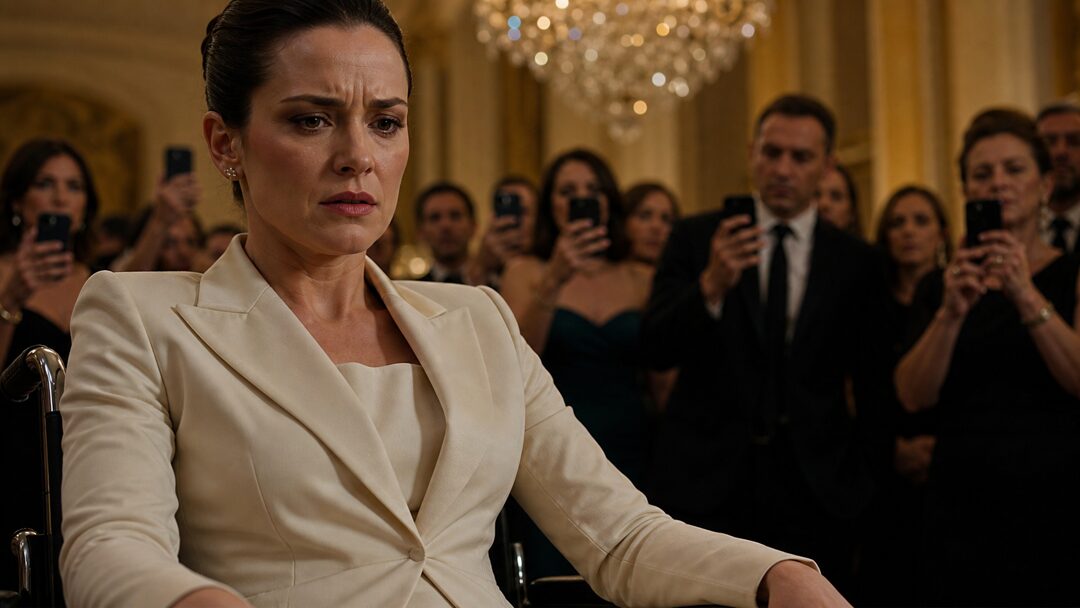
Sarah Miller knew the room had turned when the phones rose.
One second, she was just a woman in a cream suit sitting beside the head table of the Stanton Foundation gala. The next, she was the moment everyone had been waiting to record.
Daniel Brooks was on one knee in front of her wheelchair, his dark suit pulling tight across his shoulders, his scarred hand cupping her ankle like it was something breakable.
In his other hand was a cream-colored heel Sarah had not seen in two years.
Her breath stopped.
“Don’t,” she whispered.
Daniel did not look up.
Around them, forks paused halfway to mouths. Donors leaned out from behind flower arrangements. Officers in dress uniforms turned with their polished smiles already forming. Someone near the back murmured, “Is this part of the ceremony?”
Sarah felt the word ceremony move through the room like a match.
General Richard Hayes stood near the podium beneath the chandelier, silver hair bright under the lights, one hand resting on the folder that held her approved speech. His smile was still there, but it had hardened at the edges.
Daniel slid the heel closer to her foot.
“Sarah,” he said quietly, “you wrote that you wanted these back.”
Her fingers tightened around the arms of the wheelchair.
“I wrote a lot of things when I was drugged.”
His mouth moved, almost a smile, almost grief.
“You wrote this one twice.”
The shoe touched her toes.
A flash went off.
For one wild second, Sarah wanted to kick him. Not because it hurt. Not because she couldn’t bear the room watching.
Because she remembered the last time she wore those shoes.
A cheap hotel outside Fort Bragg. Her hair loose. Daniel laughing from the other side of a takeout container. Michael Reeves banging on the door, yelling that if Captain Miller wore heels to the deployment briefing, half the unit would forget how to breathe.
Sarah had said, “I’ll wear them when this is over.”
Daniel had asked, “When what is over?”
She had said, “All of it.”
Now he was fastening the strap around her ankle in a room that had paid five thousand dollars a plate to watch her be brave.
“Captain Miller,” Hayes called from the podium, voice smooth enough to pass for warmth. “Everything all right?”
Sarah looked at Daniel.
His hands were steady. They had always been steady. Even when the rest of the world fell apart.
“That depends,” she said, low enough only he could hear. “Did you come here to ruin me?”
Daniel finally looked up.
“No,” he said. “I came because they already started.”
Part II — The Approved Version
The Stanton Foundation ballroom had been designed to make grief look expensive.
White marble floors. Tall windows. Gold chairs. Centerpieces of pale roses arranged so high that guests had to lean around them to speak. On the far wall, a banner read: VALOR SHIELD AWARD — HONORING COURAGE, SERVICE, AND RETURN.
Return.
Sarah hated that word most.
People said it like it was a door. As if you crossed a line, came home, put on clean clothes, and became available for applause.
She had returned in pieces.
Not all of them visible.
Before Daniel appeared, the evening had been under control. That was what Sarah did best: control.
Her dark hair was pinned so tightly it pulled at her scalp. Her cream suit was tailored to fall cleanly over the brace locked around her right leg. Her wheelchair had been polished by a foundation volunteer until the chrome reflected the chandelier.
Her speech was six paragraphs.
She had memorized the safest parts.
Thank you to the Stanton Foundation.
Thank you to the donors.
Thank you to the Army family.
Thank you for believing recovery is possible.
Recovery. Another word people loved because it did not ask what remained.
Hayes had reviewed the speech with her in a side room before dinner. He had stood behind her chair, reading over her shoulder as if she were still one of his officers waiting for correction.
“Keep it clean,” he said.
Sarah turned a page. “It’s a charity gala, General. I wasn’t planning to brief a failure.”
His jaw tightened. “Operational grief doesn’t help anyone tonight.”
She looked up at him then.
“Is that what we’re calling it?”
Hayes exhaled through his nose. “We’re calling it survival. We’re calling it resilience. We’re calling it the reason these people fund rehabilitation programs.”
“These people,” Sarah said, “fund what makes them feel generous.”
“And you give them a reason to keep doing it.”
There it was. The bargain.
She gave them the woman in the chair who still smiled.
They gave the foundation money.
Nobody asked what the smile cost.
Then Daniel walked in with a small gray box under his arm, and every plan in the room shifted.
Sarah saw him from across the ballroom before he saw her. He looked wrong in a suit. Daniel had always looked most himself in rolled sleeves, blood on his gloves, talking softly to men who were trying not to scream. In the ballroom, he looked like someone who had entered the wrong life and refused to apologize.
For two years, she had not answered his calls.
For two years, he had sent three letters.
She returned none of them.
The last thing she had said to him before tonight had been in a hospital room, her body pinned beneath tubes and pain and white sheets.
“You disobeyed me.”
And Daniel, exhausted, hollow-eyed, had answered, “Yes, ma’am.”
He had not defended himself.
That made it worse.
Now he crossed the marble toward her with the box, and Sarah knew before he opened it.
“No,” she said.
But the room had already noticed him.
Daniel stopped beside her wheelchair. Not behind her, where people stood when they wanted to push. Not above her, where people stood when they wanted to pity.
In front.
Then he knelt.
That was when the phones rose.
Part III — What He Carried In
“You shouldn’t be here,” Sarah said.
Daniel tightened the first strap.
“You told me that in the hospital.”
“I meant it then too.”
A woman at the nearest table whispered, “That’s Daniel Brooks, isn’t it? The medic?”
Someone else said, “He’s the one who saved her.”
Sarah’s stomach turned.
Saved her.
As if saving were a clean act. As if it did not come with screaming, refusal, blood on gloves, orders broken, names left behind.
Daniel’s thumb paused against the buckle.
“You hear them?” Sarah asked.
“I always hear them.”
“You like it?”
That made him look up.
The hurt crossed his face so quickly that someone farther away would have missed it. Sarah did not. She had once trusted that face with every life in her convoy.
“No,” he said. “I hate that they only know half of it.”
Sarah leaned closer. Her voice stayed small. Her anger did not.
“Then why bring those?”
Daniel glanced at the shoes.
“They were in your storage locker at Walter Reed. Your sister boxed everything else. These were left in a paper bag with my name on it.”
Sarah had no memory of that.
She hated that too.
“How convenient.”
“You wrote a note.”
“I don’t care.”
“I do.”
The room buzzed around them. People did not know whether to clap yet. That was the worst kind of attention, Sarah thought. Attention waiting for permission to become emotion.
Hayes stepped down from the podium and approached with the smile he used for donors, senators, and grieving mothers.
“Brooks,” he said. “This is unexpected.”
Daniel rose only halfway, still between Sarah and the room.
“General.”
Hayes looked at the shoe, then at the phones.
“This is a private moment. Perhaps we should let Captain Miller prepare for her remarks.”
Sarah almost laughed.
Private. In a ballroom of three hundred people.
Daniel stood fully, but he did not move away.
“Are the remarks still the version without Reeves?” he asked.
The name cut clean through Sarah.
Michael Reeves.
For one second, the ballroom vanished.
Heat. Dust. A radio filled with broken voices. Michael laughing that morning because someone had stolen his coffee. Michael’s hand slapping the side of the vehicle as he climbed in. Michael saying, “See you on the other side, Captain.”
Then the other side came.
Sarah gripped the armrests.
Hayes’s smile disappeared.
“Not here,” he said.
Daniel’s voice stayed quiet. “That’s always where you say it.”
Sarah looked between them.
“What version?”
Hayes turned to her. “Captain, this is not the time.”
“What version, General?”
His eyes flicked toward the donors, the cameras, the foundation president hovering near the stage.
“The tribute video was shortened,” Hayes said. “For pacing.”
Daniel laughed once, without humor.
“For innocence.”
Sarah’s mouth went dry.
“What did you cut?”
Hayes bent closer, lowering his voice. “You are being honored tonight. Do not let him turn this into something ugly.”
Daniel said, “It was already ugly.”
A flash went off again.
Sarah felt her pulse in her injured leg, dull and distant, like someone knocking from another room.
Hayes straightened.
“The award begins in twelve minutes,” he said. “I suggest we all remember why we’re here.”
Daniel’s eyes stayed on Sarah.
“That’s exactly what I’m trying to do.”
Part IV — The Missing Name
At dinner, Sarah did not eat.
The steak cooled on its white plate. The wineglass beside it caught the chandelier light and threw small red shapes onto the tablecloth.
Across the ballroom, the large screen above the podium displayed a paused image of Sarah in uniform from three years earlier. Shoulders squared. Eyes clear. A woman who still believed command meant carrying only what you chose to lift.
Guests kept approaching her table.
A foundation board member squeezed her hand too long and said, “You inspire so many people.”
A young journalist asked whether he could get a quote about hope.
An older officer bent down, too close, and told her she looked “remarkably well.”
Sarah smiled at each of them.
She had learned that people became uncomfortable if the woman in the wheelchair did not help them feel kind.
Daniel stayed near the wall.
He did not come to her until the servers cleared the plates and the room began to settle toward ceremony.
“You should leave,” Sarah said when he reached her.
“I will if you ask me after you see it.”
“See what?”
Daniel looked at the screen.
“The video.”
Sarah’s nails pressed into her palm.
“What did Hayes cut?”
Daniel’s face gave her the answer before his mouth did.
The final audio.
Her final order.
Her body remembered before her mind let the words in.
Do not come back for me.
Her own voice in the dust. Daniel screaming that he could reach her. Michael pinned beyond the second vehicle. Six others alive only if the convoy moved.
Sarah had made the call.
She had made the only call.
That was what she told herself at three in the morning when her leg burned and her room smelled like antiseptic even after she had been home for months.
“I saved six,” she said.
Daniel nodded.
“I know.”
“Then don’t look at me like that.”
“I’m not looking at you because of the six.”
Her throat tightened.
“Don’t.”
“That’s not the part you never forgave yourself for.”
The room blurred at the edges.
Sarah wanted to hate him. It would have been easier. If Daniel had come to accuse her, she could become a wall. If he had come to force her, she could refuse. If he had come to be thanked, she could deny him.
But he had come with the shoes.
And a truth she had buried under every speech she had ever given.
“You saved me against my order,” she said.
“Yes.”
“You made me live with it.”
Daniel’s eyes shone, but his voice stayed level.
“No. I made you live.”
The difference landed between them like a third person.
Before Sarah could answer, the ballroom doors opened.
A woman in a navy dress stepped inside with a teenage boy beside her.
Sarah knew her before anyone said the name.
Emily Reeves wore her grief without decoration. No medals. No foundation pin. No eager smile. Just a wedding ring on a chain at her throat and one hand resting on her son’s shoulder.
Daniel saw Sarah see her.
“I invited her,” he said.
Sarah turned on him.
“You had no right.”
“I know.”
“You had no right.”
“She asked me for the truth.”
Sarah’s voice shook for the first time that night.
“You brought Michael’s widow here to watch me be honored?”
Daniel did not flinch.
“No. I brought her here because she was tired of watching everyone else decide what Michael meant.”
Emily crossed the room slowly. People parted for her without knowing why. Her son looked too young for that suit. Too old for that grief.
When she reached Sarah, she did not cry.
That was worse.
“Captain Miller,” Emily said.
Sarah could not make herself say hello.
Emily’s eyes moved to the cream-colored shoes, then back to Sarah’s face.
“I wanted to thank you,” she said. “For bringing everyone home who could be brought home.”
Sarah felt the sentence break something open.
Everyone home who could be brought home.
That was the official language. The kind words. The soft version.
Sarah looked at Emily’s son and saw Michael’s grin around his mouth.
She opened her lips.
No sound came.
Emily touched the ring on her chain.
“I know some of it,” she said quietly. “Not enough. Just enough to know when people are keeping me comfortable.”
Sarah looked toward Hayes.
He was watching them from beside the podium.
Not angry now.
Afraid.
Part V — The Letter
The foundation president tapped the microphone.
The room settled.
Sarah’s speech sat folded in her lap. Six paragraphs. No Michael Reeves. No broken order. No refusal. No Daniel dragging her through smoke while she cursed him for saving the wrong life.
Hayes approached before the announcement began.
“Captain,” he said softly, “I need a word.”
Sarah did not look at him. “You’ve had several.”
His voice lowered. “This room is full of people who came to honor sacrifice. Do not make them question the institution that sacrifice served.”
“There it is,” Sarah said.
His expression tightened.
“Careful.”
Daniel stepped closer, but Sarah lifted one hand.
Not yet.
Hayes saw the gesture. So did Daniel.
For the first time that night, Daniel obeyed her immediately.
That almost undid her.
Hayes bent close enough that only she could hear.
“You think truth helps? It doesn’t. It spreads. It damages. It leaves people with nothing to hold.”
Sarah looked past him at Emily Reeves standing near the side aisle, her son beside her.
“Maybe they should decide what they can hold.”
Hayes straightened.
The microphone cracked again.
“And now,” the foundation president said, “it is our extraordinary privilege to present this year’s Valor Shield Award to Captain Sarah Miller, whose courage reminds us all what it means to come home.”
Applause rose.
Too soon. Too practiced.
The screen lit behind the podium.
The edited footage began.
Sarah saw flashes: the convoy rolling, a dusty road, men laughing under helmets, her own hand waving the camera away. The room watched with reverence. They did not hear the fear under the silence. They did not smell the metal. They did not know where the cut would come.
Then it came.
The footage jumped from smoke to Daniel carrying her.
No command. No Michael. No moment where she chose the six over the one.
Just rescue.
Just hero.
Just the kind of story people could applaud without changing.
Sarah’s hand closed around the speech until the paper bent.
Daniel crouched beside her again.
Not to fasten the shoe this time.
To show her something.
He pulled a folded sheet from his inside pocket. The paper was soft from being opened too often.
Sarah recognized the handwriting before she recognized the words.
Hers.
“I wasn’t going to show you unless I had to,” Daniel said.
“You keep a lot of things you shouldn’t.”
“Yes.”
He unfolded it.
The first line stopped her.
Don’t let them make me into the woman in the chair.
Sarah’s vision blurred.
She remembered nothing of writing it. She remembered pain. Medication. Her sister crying in the hallway. Daniel standing at the foot of the hospital bed because she would not let him come closer.
He read no more.
He did not need to.
Sarah took the letter from him.
Below the first line, in uneven writing, she had written:
If I forget I asked, remind me. If I hate you for it, remind me anyway.
Her fingers trembled.
Daniel looked at the shoes.
“You asked me to keep them,” he said. “You said they were from before, but maybe before wasn’t the point.”
Sarah swallowed hard.
“What was the point?”
His answer came gently.
“That you still got to choose what came after.”
The applause around the video swelled.
On the screen, Daniel lifted her body out of smoke again and again, frozen in the foundation’s chosen version of mercy.
Sarah looked at the crowd.
They were ready for her to stand so they could feel redeemed.
Hayes waited by the podium.
Emily waited by the aisle.
Daniel waited on one knee with his hands empty now.
No rescue.
No push.
Only witness.
The foundation president turned toward Sarah with a bright, trembling smile.
“Captain Miller?”
The room stood.
Phones rose again.
And the strap on Sarah’s right shoe came loose.
Part VI — What She Chose
Daniel saw the loose strap before anyone else.
So did Sarah.
For a second, neither moved.
Then Daniel lowered himself in front of her, slower this time, as if asking permission with his whole body.
Sarah looked down at him.
The room inhaled.
She could already imagine the captions.
The medic who saved her helps her stand.
A beautiful moment of healing.
Proof that courage wins.
She leaned forward.
“Lock the brakes,” she said.
Daniel froze.
Sarah’s voice steadied.
“Lock them.”
His hand moved to the wheels. Click. Click.
The sound was small.
It reached her like a door closing behind one life and opening into another.
Daniel fixed the strap. His fingers brushed her ankle once, then withdrew.
He did not offer his hand.
That was his gift.
Sarah placed both palms on the arms of the wheelchair.
Her right leg resisted before it moved. Pain rose clean and bright. Her left foot found the floor. The cream heel slipped, caught, held.
The room began clapping before she was upright.
They thought they knew what they were seeing.
Sarah hated them for it.
Then she forgave them a little, because maybe people clapped early when they were afraid of what silence might ask from them.
She stood.
Not beautifully.
Not completely straight.
Not like the woman in the photo on the screen.
Her right leg trembled under the brace. The heel wobbled. Daniel’s hands hovered at his sides, close enough to catch her, far enough not to claim the moment.
The applause grew louder.
Sarah lifted one hand.
The room quieted unevenly.
She turned toward the microphone.
Hayes stepped forward, but Emily moved into the aisle.
Not blocking him.
Just standing where he would have to pass her.
Sarah reached the podium.
Her prepared speech remained folded in the wheelchair behind her.
She looked at the screen, at the frozen image of Daniel carrying her.
Then she looked at Emily’s son.
“Michael Reeves,” Sarah said.
The name changed the room.
No one clapped.
Good, Sarah thought.
Her leg shook harder.
Daniel took half a step.
Sarah did not look at him.
“His name was Michael Reeves,” she said. “He was funny when he was tired. He hated instant coffee. He had a son he talked about every morning. And he was part of the mission you just watched disappear.”
Hayes’s face went white.
Sarah gripped the podium.
“The version you saw tonight is not false,” she said. “But it is incomplete. And sometimes incomplete is how people lie while keeping their hands clean.”
A murmur moved through the ballroom.
She kept going before courage could drain out of her.
“The mission failed. I gave an order that saved six people and left one man beyond our reach. Daniel Brooks disobeyed my final order and came back for me. I hated him for that. Some days I still don’t know where to put the gratitude.”
Daniel’s face broke, but he did not move.
Sarah’s breath shortened.
“I am not here because everything ended well. I am here because I survived what did not. That is not victory. It is responsibility.”
The room held still.
No phones lowered.
No one knew whether to record or repent.
Sarah looked at Hayes. Not with rage. Rage would have made it too easy for him.
“We do not honor people by editing them into comfort,” she said. “We honor them by saying their names when the room would rather move on.”
Her right knee buckled.
Daniel moved.
Sarah lifted two fingers from the podium.
Wait.
He stopped.
She turned back to Emily.
“Michael Reeves,” Sarah said again. “I am sorry your family was given a cleaner story than the one he lived. I cannot give you closure. I can only give you the part they took out.”
Emily pressed her lips together. Her son stared at the floor.
Sarah had one sentence left in her body.
She did not waste it.
“I am still in the chair,” she said. “But I am done letting it speak for me.”
Then her strength went.
Daniel caught her only after the final word.
Not before.
He helped her back into the wheelchair as the room stayed silent. The silence was not empty. It had weight. It had work inside it.
Hayes did not return to the podium.
The foundation president looked at the microphone as if it had become dangerous.
Emily crossed the room.
Every head turned, but no one dared shape her grief into performance now.
She stopped in front of Sarah and opened her hand.
In her palm lay a small unit coin, worn at the edges.
“Michael carried this,” Emily said.
Sarah shook her head.
“I can’t take that.”
Emily’s voice remained steady.
“I’m not giving it to the hero.”
Sarah looked up.
Emily placed the coin in her palm.
“I’m giving it to the woman who finally said his name.”
Sarah closed her fingers around it.
The metal was warm.
Daniel stepped back then, out of the bright circle of attention. Sarah saw him do it. She understood.
For two years, she had thought he wanted forgiveness.
Maybe he had.
But tonight he had chosen something harder.
He had let her decide whether to give it.
Sarah looked down at her right foot.
The cream heel was scuffed near the toe where it had scraped the marble during her stand. A small mark. Not dramatic. Not beautiful. Proof.
She touched it once, then let her hand fall.
When she left the ballroom, she was still in the wheelchair.
Daniel walked beside her but did not push.
Emily and her son remained behind, holding each other near the aisle while the room slowly learned how to breathe again.
At the doors, Sarah paused.
Behind her, the chandelier still shone. The donors still had their phones. The officers still had their uniforms. Hayes still had his rank.
But the room no longer had her silence.
Sarah rolled forward into the corridor, the scuffed heel resting on the footplate where everyone could see it.
For the first time all night, no one applauded.
And that felt closer to honor than anything they had prepared.