The Girl at the Velvet Rope
Part I — The Hand She Wasn’t Supposed to Hold
Emily lost one shoe running between the black cars.
She did not stop for it.
A man in a dark suit shouted behind her. A woman gasped. Someone’s phone swung toward her face, already recording. Ahead, beyond the velvet rope and the wall of cameras, Ryan Whitaker sat in his silver wheelchair beside his father, dressed in cream like a boy made for photographs.
Emily ran straight at him with one bare foot slapping the pavement.
“Miss—stop!”
She ducked under an arm, slipped between two reporters, and reached Ryan before anyone could decide whether she was dangerous or merely dirty.
Then she grabbed his hand.
The crowd changed all at once.
The clicking cameras hesitated. The mayor’s smile froze. Donors in dark coats leaned back as if poverty could splash on them. Behind Ryan, Charles Whitaker lifted one hand toward security, but for a single second he did not speak.
Ryan did not pull away.
He stared at Emily’s face, at her tangled brown hair, at the tear in her thrift-store dress, at the dirt dried along her cheek. His fingers were cold in hers. She tightened her grip as if she could hold him to the earth.
“You said you’d come back to the garden,” she whispered.
Ryan’s mouth parted.
Behind him, Charles went pale.
Emily saw it. She saw the exact moment the rich man understood that she had not come for money. She had come with a memory.
A security guard caught her by the shoulder.
Ryan’s fingers twitched around hers before the man pulled her back.
“No,” Ryan said, but his voice was small, swallowed by the street.
Charles stepped forward with the smooth face he used on television. He was tall, gray-suited, silver watch at his wrist, grief and control arranged perfectly in his expression.
“It’s all right,” he said to the cameras. “She’s confused. Someone get her help.”
“I’m not confused,” Emily said.
Two guards held her now. Her bare heel dragged against the pavement. Reporters leaned in.
“She’s in need of assistance,” Charles continued, gentle enough to sound kind. “Please give the child space.”
Emily fought once, not hard enough to break free, only hard enough for everyone to see she had not agreed to be removed.
Ryan kept looking at her.
Not at her torn dress. Not at the guard’s hands. At her.
“Emily?” he said.
The name struck the air softer than a shout and harder than any accusation.
Charles turned toward him so fast that his smile slipped.
Emily stopped struggling.
For years she had imagined this moment. She had imagined Ryan recognizing her in a grocery store, at a bus stop, across the gate of the estate where she used to wait. She had imagined him running to her like he used to, before the chair, before the hospital, before adults taught the world what story to believe.
But Ryan did not run. He sat frozen in a wheelchair in front of a building named for him, looking like someone had opened a locked room inside his own head.
The guards pulled Emily backward.
“You promised,” she said again.
This time it was louder.
The cameras heard it. The donors heard it. Charles heard it.
Ryan heard it last.
His face changed, not into recognition exactly, but into pain.
A flash struck white across Emily’s eyes. For a moment she saw another white thing: an arbor heavy with flowers, sunlight on Ryan’s hair, her mother laughing softly behind them.
Then the street returned.
The velvet rope.
The black cars.
The hands removing her.
Ryan leaned forward in his chair, but Charles placed a hand on his shoulder.
The gesture looked loving.
It stopped him completely.
Part II — The Story They Paid For
By evening, the video had a title.
HOMELESS GIRL CRASHES WHITAKER HOSPITAL OPENING.
Matthew wrote the statement in under twelve minutes.
Charles’s nephew had a face made for fundraisers and a phone that never seemed to leave his hand. He stood in the Whitaker kitchen, scrolling through clips of Emily being dragged away while Ryan sat at the long marble island, still wearing the cream jacket he had worn for the cameras.
“We’re fortunate the public tone is sympathetic,” Matthew said. “Most comments think she needs help. Some are calling for the foundation to sponsor her.”
Ryan looked up.
“She knew my name.”
Matthew did not blink. “A lot of people know your name.”
“She knew about the garden.”
Charles, standing by the window, turned his glass of water slowly in one hand. The ice had already melted. He had not drunk from it.
“There were families who lived near the old estate,” Charles said. “Staff children, groundskeeper children. You were friendly with everyone.”
“Her name is Emily.”
“Apparently.”
Ryan hated that word.
Apparently was what adults said when they wanted a fact to feel uncertain.
He closed his eyes.
The second he did, the memory came again—not whole, only sharp pieces.
White flowers.
A girl’s laugh.
A woman’s voice saying, “Careful, sweetheart.”
Wet gravel.
A gate shrieking.
Then nothing.
Ryan opened his eyes with a breath he did not mean to take.
“Who was Sarah?” he asked.
The glass in Charles’s hand stopped moving.
Matthew glanced up from his phone.
Ryan noticed.
No one answered quickly enough.
“Emily said her mother’s name at the shelter,” Ryan said. “I heard one of the guards repeat it when they were taking her away. Sarah.”
Charles crossed the kitchen. He set the glass down with too much care.
“Sarah worked for us for a period of time,” he said.
“What happened to her?”
“Ryan.”
“What happened?”
Charles crouched slightly beside his chair. It made him look kinder. Ryan had seen him do it with donors’ children, with nurses, with grieving parents. It was the posture of a man offering tenderness from above.
“She became unstable,” Charles said. “She involved you in things you were too young to understand. After the accident, your doctors advised us not to force certain memories.”
“My doctors or you?”
The kitchen went silent.
Matthew cleared his throat. “Ry, this is exactly how online chaos becomes real damage. A runaway says one sentence and suddenly you’re interrogating your father?”
Ryan turned to him. “Don’t call her that.”
Matthew smiled without warmth. “What would you prefer? Guest of honor?”
Charles stood.
“That’s enough.”
But Ryan had already seen the shape of the room. His father near the window. Matthew near the phone. Both of them between him and the door.
Protected, he thought suddenly.
Or placed.
The next morning, Ryan asked one of the drivers to find Emily.
By noon, Charles knew.
By three, a lawyer in a navy coat sat across from Emily in a youth shelter office with a folder, a pen, and a smile that had no child in it.
Emily sat with both feet tucked under her chair. Someone at the shelter had given her sneakers, but they were too big. She had not tied the laces.
“This is not punishment,” the lawyer said. “Mr. Whitaker wants to help you.”
Emily looked at the folder.
Inside was a statement already printed.
I was frightened and confused. I mistook Ryan Whitaker for another boy. I apologize to the Whitaker family.
Beneath that was a number.
Ten thousand dollars.
Emily had never seen that many zeros next to her name.
For one terrible second, she thought of the shelter cot, the vending-machine dinners, the way winter came through the seams of donated coats. She thought of the train overpass where she had slept two nights before the hospital opening, both hands under her arms to keep them warm.
Then she thought of her mother.
Sarah used to kneel in front of her and smooth her hair with fingers that smelled like lemon soap from the Whitaker house.
“Don’t let them teach you to be ashamed of being hungry,” Sarah had once said.
Emily pushed the paper back.
“I didn’t mistake him.”
The lawyer’s smile thinned.
“This money could change your situation.”
“No,” Emily said. “It would change your situation.”
The woman closed the folder.
Emily looked past her, through the small office window. Outside, a social worker was watching with pity. Pity was softer than contempt, but it still looked down.
“Tell Ryan,” Emily said, “I didn’t come for money.”
The lawyer stood.
“Ryan doesn’t need to be involved in this.”
Emily laughed once. It did not sound like a child’s laugh.
“He already is.”
Part III — The Locked Garden Room
The garden room had been closed for six years.
Ryan had passed its door a thousand times.
It was at the back of the old estate, beyond the formal dining room no one used unless donors came. The brass knob was always polished. The keyhole was always empty. His father called it “your mother’s room,” though Ryan’s mother had died when he was small enough that even grief had blurred around her.
That night, while Charles was at a board dinner and Matthew was handling reporters, Ryan took the elevator down alone.
He had stolen the key from a velvet box in Charles’s study.
His hands shook so badly it took him four tries to fit it in the lock.
The room smelled of dust and dried flowers.
Moonlight crossed the covered furniture in pale strips. Old gardening books lined one wall. A pair of gloves lay folded on a table as if the person who left them meant to come back in five minutes and had been gone half a decade.
At the far end stood a locked drawer.
Ryan almost laughed.
One locked room inside another.
He found the smaller key taped beneath the desk, not because he was clever but because a memory told him where to reach.
His fingers found the tape before his mind understood why.
Inside the drawer were envelopes, brittle ribbons, and a stack of photographs wrapped in blue tissue.
The first photo showed the white arbor.
Ryan stopped breathing.
He was in the picture, younger, standing.
Standing.
The sight of his own legs beneath him felt like looking at a stranger wearing his face.
Beside him was Emily, smaller, fierce-eyed even then, holding his hand like she had the right. Behind them, Sarah stood near the arbor, one hand lifted as if she had just warned them not to crush the flowers.
Charles was in the background.
He was not looking at Ryan.
He was looking at Sarah.
No one looked at an employee like that.
Ryan turned the photograph over.
In childish, uneven writing, it said:
Emily and me in our secret garden.
His throat closed.
The door opened behind him.
Charles stood in the doorway.
For once, he did not look prepared.
Ryan held up the photo.
“Why did you hide her?”
Charles looked at the picture, then at his son.
“That room should have stayed locked.”
“Why?”
“Because memory is not mercy.”
Ryan laughed, but it came out broken. “Did you think that sounded kind?”
Charles stepped inside. He moved slowly, as if Ryan were a frightened animal.
“Sarah was not who you think she was.”
“I don’t know who I think she was. You made sure of that.”
“She worked here. She became attached to this family in ways that were unhealthy.”
“In ways that were inconvenient?”
Charles’s face tightened.
For a moment Ryan saw the man beneath the philanthropist, the father beneath the foundation portrait. Tired. Angry. Afraid.
“She tried to take you from the estate the night of the accident,” Charles said. “You and Emily were in the car. She was emotional. She was not thinking clearly.”
Ryan looked at the photo again. Sarah’s smile was small and real.
“Why would she take me?”
Charles came closer and placed a hand on Ryan’s shoulder.
Ryan flinched.
His father noticed.
The hurt in Charles’s face was real, and that made it worse.
“I built everything after that night to protect you,” Charles said quietly. “The hospital, the foundation, the doctors, this house. You have no idea what people do when they want a piece of a family like ours.”
“People like Emily?”
“People who are desperate.”
Ryan looked down at the hand on his shoulder.
It was the same hand that had stopped him outside the hospital. The same hand that had turned him toward cameras, nurses, donors, applause.
A hand could love.
A hand could hold a person in place.
Charles lowered his voice.
“Some people love you by leaving you untouched by the dirt.”
Ryan stared at him.
Then he removed his father’s hand from his shoulder.
“Maybe I’m tired of being clean.”
Charles’s expression hardened, not with rage. With grief he refused to let become apology.
“You are twelve years old,” he said. “You do not understand what truth costs.”
Ryan slid the photo into his lap.
“No,” he said. “But I’m starting to understand who paid for yours.”
Part IV — What Emily Remembered
Emily did not trust the car Ryan sent the second time.
She trusted the note.
It arrived folded inside a children’s book the shelter director said had been donated by mistake.
On the first page, in careful handwriting, Ryan had written:
I found the garden. I found the picture. Please tell me what I forgot.
Emily read it three times before she let herself cry.
They met behind the shelter after dark, because Emily refused to enter any place owned by the Whitakers and Ryan could not get far without someone noticing. The driver waited at the end of the alley, uncomfortable and silent.
Ryan’s wheelchair looked too bright under the security light.
Emily stood with her arms crossed, wearing the oversized sneakers now tied tight.
“You look like him,” she said.
Ryan swallowed. “My father?”
“No. Like the boy who said he’d come back.”
That hurt more.
Ryan held out the photo.
Emily did not take it. She looked at it the way a person looks at a grave.
“My mom kept a copy,” she said. “Until the settlement people came.”
“What settlement people?”
Emily’s mouth twisted. “The ones who tell you grief has paperwork.”
Ryan went still.
Emily sat on the curb across from him, leaving space between them. Not because she hated him. Because closeness had failed her once and she did not trust it yet.
“My mom worked at your house,” she said. “But you know that now.”
Ryan nodded.
“She loved your dad.” Emily’s voice did not shake, but her fingers dug into the sleeve of her sweater. “And he loved her when nobody important was watching.”
Ryan looked away first.
Emily noticed. “That’s what rich people do, right? They love in rooms they can lock.”
Ryan had no answer.
Emily kept going because if she stopped, she might not be able to start again.
“He was supposed to marry someone else. Someone with a name people knew. My mom found out after everyone else did. She said she wasn’t angry that he chose his world. She was angry he wanted to keep her hidden inside it.”
A truck passed at the end of the alley. Its headlights slid over Ryan’s face and disappeared.
“She was leaving,” Emily said. “Not stealing you. Leaving. You were with me because we were in the garden, and you cried when we tried to go. You said you wanted to come with us until your dad stopped lying.”
Ryan’s hands clenched around the photo.
“I don’t remember that.”
“I know.”
The two words were not forgiveness.
They were worse. They were understanding.
“Matthew turned off the gate alarm,” Emily said. “He told my mom later. He was laughing when he said it, like he’d done something smart. He thought if the gate didn’t open right, she’d panic and have to wait. He thought your dad would get there first and fix it.”
Ryan heard it then.
Metal grinding.
Rain on glass.
Sarah shouting.
Emily screaming his name.
Tires slipping.
The memory did not return like a movie. It returned like broken glass under skin.
“My mom got the car through,” Emily said. “But the service road was wet. The gate arm came down late. She swerved.”
Ryan closed his eyes.
“Stop,” he whispered.
Emily did.
That was the first mercy anyone in the story had offered him without asking for silence in return.
After a moment, Ryan opened his eyes.
“What happened to your mom?”
Emily looked toward the shelter door.
“She lived three days. Long enough for your family to say she was unstable. Long enough for them to offer my grandma money if she signed papers. Long enough for newspapers to call her a housekeeper who became obsessed with the family.”
Her voice broke at the last word.
Not loudly.
Just enough.
“My grandma signed because she was scared and sick and I was five. Then she died two years later. After that, people acted like my mother’s shame had been inherited by me.”
Ryan had never hated his house before.
Not the marble floors. Not the elevators. Not the careful ramps and wide doors and silent staff. He hated it now for being built so beautifully over a wound.
“Emily,” he said, “I’m sorry.”
She stood too fast.
“No.”
Ryan flinched.
“No,” she repeated. “Don’t give me sorry like it’s coins. I didn’t come for that.”
“What do you want?”
Her eyes filled, but she did not let tears fall.
“I wanted you to remember me before they told you not to.”
That landed between them harder than blame.
Ryan looked down at the photo again. His younger self smiled from a world where he still believed adults returned what they borrowed.
“I remember the flowers,” he said.
Emily’s face changed.
“I remember you laughing when I fell in the fountain,” he said. “I remember your mom saying we’d ruin our shoes. I remember promising I’d come back to the garden.”
Emily pressed a hand to her mouth.
Ryan looked at her, ashamed of how small the memory was compared to what she had carried.
“I don’t remember everything,” he said. “But I know they lied.”
Emily nodded once.
Behind them, the driver’s phone buzzed. He looked down, then hurried toward Ryan.
“Mr. Whitaker knows,” he said.
Of course he did.
Within an hour, Charles’s people moved faster than children could.
By morning, the shelter director had been advised that Emily was a “potential liability.” By afternoon, Matthew had arranged a private donor dinner to “restore confidence” in the pavilion launch. By evening, Ryan found a speech printed on heavy paper on his desk.
It began:
My family has always believed healing starts with truth.
Ryan read that line until it became unbearable.
Then he folded the garden photo into the inside pocket of his jacket.
Part V — The Room Built on Her Silence
The donor dinner glittered behind glass.
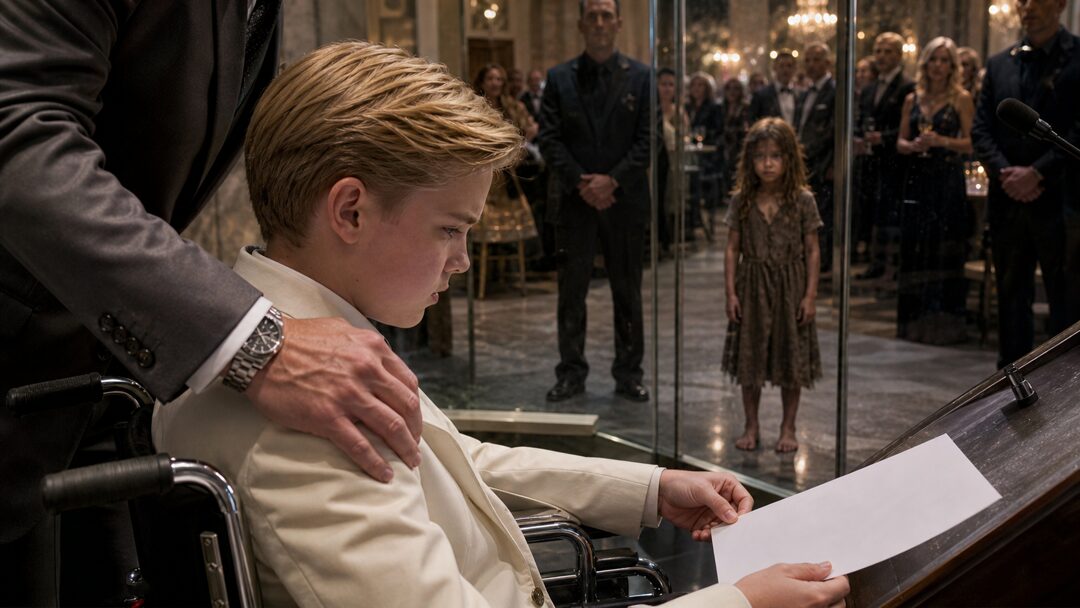
Emily stood outside it in the cold, blocked by two guards who would not look directly at her. Through the clear wall of the Whitaker Pavilion atrium, she could see chandeliers, white tablecloths, flowers in tall vases, women in pearls, men with clean shoes and careful laughter.
Inside, people applauded a story about compassion.
Outside, the child who knew the cost of it was told she could not come in.
“Please step back,” one guard said.
Emily did not move.
She had washed her face in the shelter sink. Someone had given her a blue coat with a missing button. Her hair was combed as much as it could be. Still, she could feel the eyes of guests flicking toward the glass, finding her, dismissing her, returning to dinner.
Being ignored in public was its own kind of stage.
Inside, Matthew stood near the podium, phone in hand, smiling at donors.
Charles sat beside Ryan on the raised platform.
Ryan looked smaller under the lights.
Not weak.
Used.
A woman at the front dabbed her eyes when Charles spoke about resilience. A man raised his glass when Matthew introduced “the brave young man whose journey inspired this extraordinary gift to the city.”
Emily watched Ryan roll toward the podium.
A camera turned. Then another.
His speech waited on the stand.
Charles leaned close to him and said something Emily could not hear.
Ryan looked at the paper.
Then he looked through the glass.
At her.
Emily felt, suddenly, five years old again. Mud on her socks. Ryan crying at the gate. Her mother shouting that everything would be all right because mothers were supposed to say impossible things with confidence.
Ryan lowered the paper.
Matthew’s smile twitched.
Ryan adjusted the microphone. The room softened for him. That was another power he had, Emily realized. People became gentle when they thought someone’s pain was useful.
“My father told me this building was made from love,” Ryan began.
Charles’s hand rested on the arm of Ryan’s wheelchair.
Ryan looked at it.
Then he continued.
“But love that needs someone else to disappear is not love. It’s a locked door.”
A murmur passed through the room.
Matthew stepped forward.
Ryan took the garden photo from his jacket and placed it on the podium.
“This is me,” he said. “Before the accident. This is Emily. This is her mother, Sarah.”
Charles stood.
“Ryan.”
His voice was quiet.
That made the warning worse.
Ryan turned slightly toward him.
“Let her in.”
“No.”
The word left Charles before he could polish it.
The room heard.
So did the cameras.
Charles lowered his voice and leaned close, the way he had in the garden room.
“Do not destroy the only life you have left.”
Ryan looked at his father for a long moment.
Emily could not breathe.
Then Ryan said, clear enough for the first row and the microphones and the people outside the glass:
“It was never my life if you had to bury hers to give it to me.”
The room went still.
A sentence can be a door opening.
A sentence can be a family ending.
Ryan looked at the guards outside.
“Let her in.”
No one moved until one of the hospital board members, an old woman with diamonds at her throat and horror on her face, nodded.
The guard opened the glass door.
Emily stepped inside.
The room smelled of lilies and expensive food. Her oversized sneakers squeaked once on the polished floor. A few guests looked down at them.
She kept walking.
Not fast.
Not desperate.
Every step felt like taking back the space from which her mother had been removed.
When she reached the platform, Ryan held out his hand.
This time he reached first.
Emily looked at it.
For one second, she was back outside the hospital opening, dirty and breathless, trying to make him remember in front of people who saw only a nuisance.
Now the same people watched her decide whether recognition was enough.
She took his hand.
Charles closed his eyes.
Matthew whispered something into his phone and backed toward the side exit, but one of the board members stopped him with a hand on his sleeve.
Ryan turned the photo toward the room.
“Sarah was blamed for my accident,” he said. “That was not the whole truth.”
Charles stepped forward. “Ryan, there are things you do not understand.”
Emily looked at him then.
All her life, Charles Whitaker had existed as a name on buildings, a face in old newspapers, a man her grandmother cursed under her breath until sickness made her too tired. Up close, he looked human. That almost made it worse.
“My mom understood,” Emily said.
Her voice was not loud, but the room had become quiet enough for shame to travel.
“She understood that you loved her when nobody could see. She understood that you chose your name when everybody could. She understood that after she died, you let people call her crazy because it was easier than calling yourself cruel.”
Charles stared at her.
His face did not change much. Only the mouth. Only the eyes.
Emily’s grip tightened around Ryan’s hand.
“You didn’t just leave us poor,” she said. “You made everyone believe we deserved it.”
No one applauded.
No one moved.
That was the first honest silence the Whitakers had ever given her.
Charles looked at Ryan, not at Emily.
“I was trying to protect you.”
Ryan’s face crumpled for half a second, and in that half second Emily saw the cost. Truth did not make him free all at once. It took something from him first.
“From her?” Ryan asked. “Or from knowing you?”
Charles had no answer that would fit in public.
And because there was no answer, the room began to understand.
Part VI — The Path Wide Enough
The hospital opening was postponed before midnight.
By morning, Matthew’s resignation had been announced in language so careful it almost confessed by accident. The foundation promised an independent review. Reporters used Sarah’s name. For the first time since Emily could remember, her mother’s photograph appeared on screens without the word unstable attached to it.
None of it brought Sarah back.
None of it gave Emily her shoe, her apartment, her grandmother, or the years she had spent carrying a truth too heavy for a child.
Still, when a reporter outside the shelter asked how it felt to be believed, Emily gave the only answer that did not feel like begging.
“It feels late,” she said.
Charles did not come to the shelter.
He did not call Emily.
He sent no money, which was almost the first respectful thing he had done.
Ryan saw him once after the dinner, in the garden room.
Charles stood alone with the photo in his hand, looking at Sarah in the background. Not as a scandal. Not as a mistake. As a woman he had loved badly enough to ruin.
Ryan waited in the doorway.
Charles did not turn around.
“I thought if I kept it away from you, it couldn’t hurt you,” he said.
Ryan said nothing.
After a while, Charles added, “I was wrong.”
It was not enough.
But it was not nothing.
That was the cruelest thing about apologies that came too late. They could be true and still fail to repair what they named.
A week later, Ryan asked Emily to come to the old estate.
She almost refused.
Then he said, “The garden is still there.”
So she came.
The white arbor had gone gray. Vines strangled the posts. Weeds grew through the stone path, and the fountain where Ryan once fell was dry and cracked. The place looked smaller than memory and sadder than a ruin, because someone had preserved it without caring for it.
Ryan stopped at the edge of the path.
His chair could not pass.
For a moment, neither of them spoke.
Emily looked at the narrow stones, at the weeds, at the place where her mother had once laughed and warned them about their shoes. She had thought coming back would feel like winning. It did not.
It felt like finding a room that had waited faithfully and still could not give anything back.
Ryan looked up at her.
“I’m sorry I forgot.”
Emily wanted to say it was okay.
It was not.
She wanted to say it was his fault.
It was not that either.
So she said the truest thing she could.
“You were a kid.”
“So were you.”
That made her look away.
Near the arbor, a rusted garden rake leaned against the wall. Emily took it and began clearing the path. The first scrape of metal against stone sounded harsh in the quiet.
Ryan watched.
“You don’t have to do that,” he said.
“I know.”
She pulled weeds from between the stones. Dirt got under her nails. One branch scratched her wrist. Ryan wheeled forward when the path widened enough, then stopped while she cleared more.
They moved that way for nearly an hour.
Not back into childhood.
Not into forgiveness.
Just forward, a few feet at a time.
At the arbor, Emily stopped and looked at the place where the photograph had been taken.
Ryan came beside her.
The garden did not glow. No sunlight broke through in a miracle. No one appeared in white at the end of the path. It was only an overgrown place behind a rich man’s house, holding what people had done and what children had survived.
Emily reached down.
Ryan looked at her hand.
This time there were no cameras.
No guards.
No velvet rope.
He took it.
For a moment, she held him there, not to make him remember, not to prove she belonged, not to drag truth out in front of strangers.
Only because he had come back to the garden.
And because some promises, even broken for years, could still become a path if someone was willing to clear the weeds.