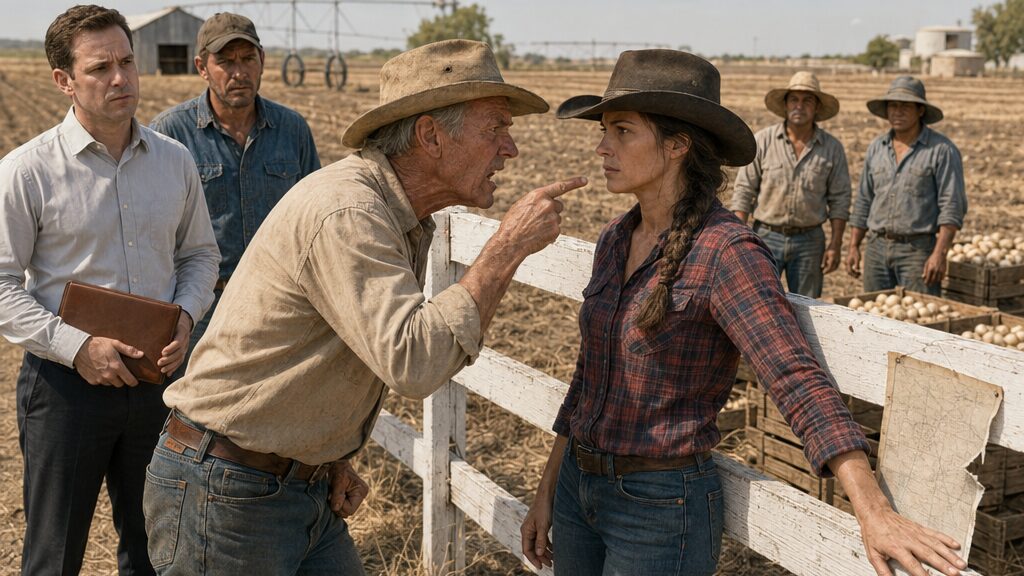
When Rachel Refused to Sell the Dry Field, Her Father Finally Told Her What Bennett Farm Was Hiding
Chapter 1: The Sale Map Nailed to the White Fence
“The failed field is hers.”
Frank Hill said it loudly enough for the produce buyer, David Campbell, and both seasonal workers to hear.
His finger stopped inches from Rachel’s face.
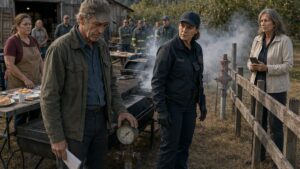
Behind him, a paper map had been nailed to the white roadside fence beneath the weathered Bennett Farm sign. Its lower corners snapped in the dry wind. Beyond the fence, the eastern parcel stretched toward the county road in pale rows of broken soil, weeds, and exhausted vines.
Rachel kept one palm against the top rail.
The wood was hot and chalky beneath her hand. She could feel the roughness where the paint had split, but she did not move away from her father.
Frank leaned closer. “You ran irrigation this year. You chose the schedule. You lost the crop. Now you don’t get to stand here and tell me what I can sell.”
The buyer glanced toward his truck. He wore polished boots that had not gathered any dust despite twenty minutes in the field. A leather folder was tucked beneath one arm.
David stood several feet behind him with his thumbs hooked through his belt loops. He did not look at Rachel.
One of the workers lowered his eyes.
Rachel waited until Frank stopped speaking.
“Are you finished?”
His face reddened. “Don’t take that tone.”
“I asked if you were finished.”
The buyer cleared his throat. “Mr. Hill, we can continue the boundary inspection another day.”
“No.” Frank jabbed his finger toward the dry field. “We finish today.”
Rachel turned to the map.
She had seen survey maps before. She had spent two winters working through old county filings, water-allocation notices, and handwritten crop records because Frank preferred keeping important papers in whichever desk drawer still opened.
The eastern parcel had been shaded in yellow. A thick line marked the proposed sale boundary from the county road to the old cottonwood stand.
The line was clean.
Too clean.
Rachel stepped closer.
Frank caught her arm just above the elbow. “Leave it.”
She looked down at his hand.
He released her.
The buyer shifted his folder to the other arm. “The parcel is forty-one acres, more or less. Access is directly from the county road. No structures included.”
Rachel studied the lower edge of the map.
The irrigation channel was marked. The pump house was marked. The old drainage ditch was marked.
But the narrow access strip connecting the farm’s main line to the eastern gate was not.
She placed one finger on the blank section.
“What is this?”
The buyer came closer. “Unimproved ground.”
“No. What legal access remains here after the sale?”
Frank exhaled sharply. “Rachel.”
She ignored him.
The buyer looked at the map, then at his folder. “The farm retains its existing water rights.”
“That isn’t what I asked.”
His expression tightened.
Rachel traced the blank strip from the gate toward the main irrigation line. “The eastern gate is fed through this corridor. If the parcel boundary crosses it, who controls maintenance access?”
David finally raised his head.
The buyer’s gaze moved to him, then back to Rachel. “There should be an easement.”
“There should be,” she said. “Show me where it is.”
The wind lifted the map against the nails. One corner tore slightly.
For several seconds, nobody spoke.
Frank stepped beside her. “It’s in the paperwork.”
Rachel turned toward him. “Did you read it?”
His jaw shifted.
“Did you read the easement language?”
“I read enough.”
“That means no.”
The buyer opened his leather folder and removed a stapled copy of the preliminary agreement. He flipped through several pages, faster at first, then more slowly.
Rachel watched his thumb pause near the back.
David took one step toward the fence.
The buyer read the page again. “The attached description references the surveyed parcel.”
“And the survey omits the irrigation corridor,” Rachel said.
“It may be covered under recorded access.”
“May be?”
Frank struck the fence rail with the heel of his hand. The map jumped against the nails.
“You think this is some classroom exercise?” he said. “We have a buyer standing here with real money, and you’re trying to kill the deal over a line on paper.”
“A line on paper decides whether we can reach our own gate.”
“You already let that gate run dry.”
Rachel felt the words land harder because the workers were listening.
She looked across the field. The rows were pale, but the soil beneath the surface was still darker where the irrigation had held through July. The crop had failed for more than one reason. Heat. Pump pressure. Timing. Decisions Frank had made. Decisions she had made.
She kept her voice level.
“If the easement is missing, selling this parcel can cut the rest of Bennett Farm off from the legal route to the main line.”
The buyer closed the folder.
Frank stared at him. “That’s not possible.”
“It needs to be confirmed,” the buyer said.
“You said the title review was clean.”
“I said the parcel was marketable. Water-access language is separate.”
Rachel saw the moment Frank understood that the inspection had stopped.
It did not look like defeat. It looked like panic.
He turned on the buyer. “How long?”
“I can request the recorded plat and amended description today.”
“How long?”
“Forty-eight hours, assuming the county responds.”
Frank took off his hat and dragged one hand across his thinning gray hair.
The buyer slid the agreement into his folder. “If the legal description cannot be corrected by then, my client will reconsider the offer.”
“Reconsider?”
“The delivery schedule attached to this purchase depends on closing next week.”
Frank’s hand tightened around the brim of his hat.
The buyer nodded once to Rachel. Not with gratitude. With reluctant recognition.
“You were right to raise it,” he said.
Frank looked at her as though the sentence itself were an insult.
The buyer returned to his truck. David followed him halfway, then stopped.
“Frank,” David said, “you should probably let the county clerk check the old filings.”
Frank did not answer.
David glanced at Rachel. His face held no apology, only concern sharpened by calculation.
“I’ll call later,” he said.
When the trucks had gone and the two workers returned to the packing shed, Rachel pulled the map free from the nails. One tore through the paper, leaving a jagged hole beside the proposed boundary.
Frank stood with his back to her.
“You signed this before telling me,” she said.
“It’s preliminary.”
“You agreed to sell forty-one acres.”
“I agreed to keep this place from being taken.”
Rachel folded the map once. “How far behind are we?”
He put his hat back on.
“Dad.”
He began walking toward the barn.
She followed him through the gate. “The operating loan shouldn’t be due until November.”
“It isn’t the operating loan.”
“What is it?”
He stopped.
The late-morning sun threw the fence shadow across his boots in narrow white bars.
“The bank can take everything by Friday,” he said.
Then he walked away, leaving Rachel beside the open gate with the torn map in her hand.
Chapter 2: The Loan Balance Rachel Was Never Shown
Emily Roberts did not offer Rachel a chair.
She looked at the folded parcel map in Rachel’s hand, then through the glass wall toward the reception desk.
“Why did you come alone?” she asked.
Rachel remained standing. “Because Frank won’t tell me what’s due Friday.”
Emily’s expression changed by less than an inch. That was enough.
“You’re listed as co-manager, aren’t you?”
“I run the farm.”
“That’s not what I asked.”
The farm-credit office smelled faintly of printer paper and burnt coffee. Through the window behind Emily’s desk, Rachel could see the edge of town: the feed store, a gas station, the courthouse roof beyond a row of maples.
She set the folded map down.
“What am I listed as?”
Emily sat slowly. “I need Frank’s written permission before I discuss his full account.”
“Our account.”
“Legally, it’s his.”
Rachel looked at the dust on her palm. White paint and fence grit had worked into the lines of her skin.
“For the last four years, I’ve signed delivery logs, negotiated seed prices, scheduled labor, filed water reports, and handled crop insurance.”
Emily folded her hands. “None of that makes you an owner.”
Rachel felt something in her chest tighten.
“Show me what you can.”
Emily studied her for a moment, then turned to her computer.
“I can confirm public filing dates, collateral categories, and notices already issued to the borrower.”
“That’s enough.”
“It may not feel like enough.”
“Start.”
Emily typed. The clicking keys sounded too loud in the office.
“The current default notice covers three obligations secured together. A real-estate note, an equipment note, and an emergency planting loan.”
Rachel leaned forward. “What emergency planting loan?”
Emily did not answer immediately.
“How much?” Rachel asked.
Emily named the total.
Rachel thought she had misheard.
“Say it again.”
Emily did.
The number was almost twice Rachel’s estimate of what Bennett Farm owed.
Rachel lowered herself into the chair at last.
“That can’t be right.”
“It includes accrued interest and fees.”
“We sold the west combine last winter.”
“The proceeds were applied.”
“We paid down the equipment note.”
“Part of it.”
Rachel looked through the glass wall. A clerk carried a stack of folders past the reception desk. Somewhere farther down the hall, a copier began feeding pages.
“When did this happen?”
“The oldest refinancing was completed during your mother’s treatment.”
Rachel’s eyes returned to Emily.
“How much of it was medical?”
“I can’t break down private disbursements without authorization.”
“You already know.”
“I know what the bank records show. That doesn’t mean I can tell you.”
Rachel pressed her thumb into the dust on her palm until the skin hurt.
“What happens Friday?”
Emily’s professional calm thinned.
“If no cure agreement or restructuring application is accepted, the bank may begin enforcing its remedies.”
“Meaning foreclosure.”
“Meaning the attorney can proceed.”
“On the eastern parcel?”
“On all pledged real estate.”
Rachel looked at the folded map.
“All of Bennett Farm?”
Emily nodded.
The room seemed suddenly too small.
Rachel stood and walked to the window. She had driven past this building hundreds of times. She had assumed the people inside knew she ran the farm because everyone in town knew. She had mistaken familiarity for authority.
Behind her, Emily said, “I thought Frank had added you years ago.”
Rachel turned.
“Added me where?”
Emily’s hesitation answered first.
She pulled a public collateral summary from the printer and placed it on the desk.
Rachel scanned the names.
Frank Hill appeared three times.
Catherine Allen’s name appeared on an older discharged filing.
Rachel’s name appeared nowhere.
Not as owner. Not as borrower. Not as guarantor. Not even as an authorized contact.
The paper trembled once in her hand. She laid it down before Emily could notice.
“My mother helped run that farm for thirty years.”
“I know.”
“She said everything would be shared.”
Emily looked toward the door. “What families say and what gets recorded are often different.”
“Don’t give me banker language.”
“I’m trying not to give you false comfort.”
Rachel unfolded the parcel map and pushed it across the desk. “The sale map omits the irrigation easement.”
Emily studied it.
“That may help delay the sale,” she said.
“I don’t want a delay. I want to know whether we can survive without it.”
Emily looked at the figures on her screen again.
“There may be a restructuring path.”
Rachel waited.
“It would require updated cash-flow projections, a reduced planting plan, proof of water access, and Frank’s cooperation.”
“How long?”
“A complete proposal would need to be in before the attorney acts Friday.”
“That gives me three days.”
“It gives you less. Credit review meets Friday morning.”
Rachel sat again. “What would they accept?”
“Something realistic.”
“I asked what they would accept.”
“Lower acreage. Asset sales. Shared equipment agreements. A firm produce commitment. Possibly a temporary interest adjustment.”
“Possibly.”
Emily met her eyes. “I’m not going to lie to you because we went to school together.”
The old familiarity in the sentence made Rachel angrier than the policy.
“You thought I knew all this.”
“Yes.”
“And you never asked why Frank attended every loan meeting alone?”
“I assumed that was how your family handled ownership.”
Rachel almost laughed.
At Bennett Farm, Frank had spent years telling suppliers to speak to Rachel. Buyers called her when loads were late. Workers came to her when machinery broke. Frank had let her carry every responsibility that did not require a signature.
“What was the emergency planting loan for?” she asked.
Emily looked back at the screen.
“I cannot disclose the invoice details.”
“You can tell me the date.”
Emily did.
Rachel knew the date immediately.
It was three weeks after Catherine’s funeral.
That spring, Rachel had recommended leaving the northern ground fallow. Pump capacity was weak, seed costs were rising, and the seasonal outlook had warned of extreme heat.
Frank had called her cautious.
Then he had told her he agreed.
“What crop?” Rachel asked.
Emily’s voice softened despite herself. “You need to ask your father.”
Rachel gathered the papers.
At the door, Emily said, “Rachel.”
She stopped.
“If Frank signs authorization today, I’ll stay late and go through the account with both of you.”
“He won’t.”
“Then bring me a plan strong enough that refusing to hear it becomes his decision, not yours.”
Rachel looked down at the collateral summary one last time.
Emily’s next words followed her into the hallway.
“The emergency loan financed the northern expansion.”
Rachel turned.
Emily had already looked back at her computer.
Rachel knew exactly which field Frank had planted.
She also knew he had planted it after promising her he would not.
Chapter 3: The Crop Frank Planted Against Her Warning
The irrigation invoices were still sealed.
Rachel found seven of them beneath Frank’s workbench the next morning, wedged behind a rusted toolbox and a broken fence rail. Dust lay thick across the envelopes, but the red overdue stamps were clean enough to read.
She carried them into the equipment shed and dropped them onto the metal table.
Frank looked up from a pump housing he had been pretending to inspect.
“What’s that?”
“You know.”
He wiped his hands on a rag.
Sunlight came through gaps in the shed wall, striping the floor and the broken white rail propped beside the bench.
Rachel opened the first envelope.
“Replacement seals. Pressure regulators. Two emergency service calls.” She opened another. “A rented booster pump for the northern rows.”
Frank’s mouth hardened.
“You planted the north block.”
“We needed the yield.”
“I told you the system couldn’t carry it.”
“You told me it might not.”
“I gave you pressure readings.”
“You gave me estimates.”
“I tested it.”
“Once.”
“Three times.”
Frank tossed the rag onto the bench. “We had contracts to fill.”
“We had acreage enough to fill them.”
“Not after your mother died.”
The sentence stopped her.
He turned away and reached for the pump housing again.
Rachel stared at his back. “What does that mean?”
“It means production dropped.”
“Because we lost her?”
“Because everything stopped.”
“I came home.”
“You came home to a farm already sliding backward.”
Rachel stepped around the table. “So you borrowed money three weeks after her funeral and planted ground we had agreed to leave fallow.”
“I did what I thought would keep us moving.”
“You did it without telling me.”
“You weren’t sleeping. You weren’t eating. You were walking around with a notebook acting like numbers could hold the place together.”
“And your answer was to hide a loan?”
“My answer was to plant.”
The shed amplified his voice.
Rachel lowered hers.
“How much did the north block lose?”
Frank said nothing.
She did the calculation from the seed invoices, leased equipment, labor, and wasted water.
“Enough to trigger the equipment default?”
His eyes moved toward the envelopes.
“That’s why you need the eastern parcel.”
“That’s one reason.”
“One?”
He walked out of the shed.
Rachel followed him toward the northern rows. The failed crop lay in flattened bands, brittle stalks mixed with exposed soil. A wind-scoured irrigation line ran along the edge.
Frank stopped beside a junction valve and kicked dirt from its base.
“I believed the heat would break,” he said.
“It didn’t.”
“I believed the booster would carry the pressure.”
“It couldn’t.”
“I know what happened.”
“Then stop acting like I caused all of it.”
He turned so fast she nearly stepped back.
“You want honesty?”
“Yes.”
“You tested the east pump in June.”
Rachel went still.
Frank pointed toward the distant pump house. “You knew it was losing pressure before the first heat wave.”
Her mouth went dry.
“How did you—”
“The service technician called me after you canceled the replacement order.”
“I didn’t cancel it. I delayed it.”
“You hid it.”
“The part was twelve thousand dollars.”
“And how much crop did we lose?”
“I was trying to find another supplier.”
“You were trying to fix it without telling me.”
Rachel looked across the rows.
The pump test had failed on a Tuesday morning. Pressure had fallen below safe delivery at the eastern gate. She had ordered a replacement assembly, seen the price, then delayed approval while she called salvage yards and regional dealers.
For nine days, she had told Frank the system was holding.
Then the first heat wave arrived.
“I thought I had time,” she said.
Frank gave a short, bitter laugh. “So did I.”
The anger she had carried from the bank shifted beneath her. It did not disappear. It lost its clean edges.
“You still planted more acres than the system could support.”
“And you still knew the system was weaker than I thought.”
“Yes.”
The word stayed between them.
Frank looked older in the open light. His shirt hung loose across his shoulders. For months, Rachel had mistaken the change for grief and hard work. Now she saw fatigue sharpened by calculations he had made alone.
She crouched beside the irrigation line and pressed one hand against the cracked rubber.
“If we had both told the truth,” she said, “we might have shut down the north block before planting.”
“We might have.”
“We might have replaced the pump before July.”
“With what money?”
“The money you borrowed.”
“That money bought seed.”
“Exactly.”
Frank looked toward the farm buildings.
For the first time since the confrontation at the fence, he did not defend himself.
Rachel stood. “Cancel the sale.”
“No.”
“You know the easement is missing.”
“It can be corrected.”
“The parcel controls access to the eastern gate.”
“The buyer can grant access.”
“The buyer can restrict repairs, timing, vehicle use, and future modifications.”
“We negotiate it.”
“We don’t sell the only ground that connects the water line to the rest of the farm.”
Frank’s face closed again. “The sale goes forward if the map is fixed.”
“Why?”
“Because the planting loss isn’t the whole debt.”
Rachel remembered Emily’s careful refusal to separate the records.
“How much was Mom’s treatment?”
Frank picked up a piece of broken stalk and snapped it between his fingers.
“Dad.”
“We refinanced the house first.”
Rachel waited.
“Then the west acreage.”
“How much?”
“The insurance stopped covering one medication. Then there were hospital charges, travel, home care.”
“You told me it was handled.”
“She was dying.”
“That doesn’t answer me.”
“I wasn’t going to discuss invoices beside her bed.”
“You could have discussed them with me.”
“You were twenty-seven.”
“I was her daughter.”
“You were trying to finish your degree.”
“I left school and came home.”
“After.”
Rachel recoiled as if he had raised his hand.
Frank looked down at the broken stalk in his fingers.
He had not meant to say it. That made it worse.
“After what?” she asked.
He opened his hand and let the pieces fall.
“After we knew treatment wasn’t working.”
The field seemed to contract around her.
Rachel had spent five years carrying the shame of not returning sooner. Catherine had told her to finish the semester. Frank had told her there was time. Both had spoken with the same calm certainty.
She had believed them because believing them allowed her to stay away another six weeks.
“How much did you borrow?” she asked.
Frank gave her the figure.
It was larger than the emergency planting loan.
Large enough that selling the eastern field would only bring the account current, not clear it.
Rachel stared toward the white fence in the distance. From here it was only a pale line cutting across the dry land.
“You let me think this was about one bad harvest.”
“I let you run the farm.”
“You let me do the work.”
Frank flinched.
She stepped closer. “That is not the same thing.”
“No.”
It was the first time he had admitted it.
Rachel waited for more, but Frank turned back toward the shed.
“What aren’t you telling me?” she called.
He stopped beside the broken fence rail.
For several seconds, his hand rested on the splintered wood.
“Your mother asked me to do something before she died,” he said.
Rachel could hear the irrigation line ticking as it cooled in the sun.
“What?”
Frank lifted the rail and carried it into the shed.
When he answered, he did not look at her.
“Something I never did.”
Chapter 4: Catherine’s Promise Inside the Seed Ledger
The seed ledger struck the floor and opened to Catherine’s handwriting.
Rachel froze beside the farm-office desk.
The book had fallen from the back of a cabinet she had already searched twice. Its cracked green cover lay against the floorboards, pages spread beneath a thin brown envelope sealed with yellowed tape.
Across the front, Catherine had written one word.
Rachel.
Frank’s boots sounded in the hallway.
She snatched up the envelope and ledger just before he reached the doorway.
“What are you doing?”
His gaze moved from the open cabinet to the folders piled across the desk.
“Looking for what you won’t tell me.”
“I told you to leave those records alone.”
“They’re farm records.”
“They’re mine.”
Rachel held up the ledger. “Mom kept this.”
Frank’s face changed when he saw the envelope.
Only slightly, but she caught it.
“You knew it was here.”
“No.”
“You knew she left something.”
“I said put it back.”
Rachel slid her thumb beneath the brittle tape.
Frank crossed the room in two steps and caught the envelope before she could open it. Their hands closed around opposite ends.
“Let go,” she said.
“You don’t know what that is.”
“It has my name on it.”
“Rachel.”
The way he said her name was not anger. It was fear.
She released the envelope.
Frank nearly stumbled from the sudden loss of resistance. He held it against his chest, breathing hard.
For a moment they stood facing each other across the narrow office, surrounded by unpaid invoices, crop reports, and the old metal filing cabinets Catherine had labeled in black marker.
Rachel looked at the envelope.
“Read it to me.”
Frank’s grip tightened.
“Or give it back.”
He turned toward the hallway.
Rachel stepped in front of the door.
“You can sell the field without telling me. You can borrow against the farm without telling me. You can blame me in front of half the county. But you do not get to take a letter with my name on it.”
Frank looked past her toward the kitchen.
On the wall beside the doorway hung an old photograph of Bennett Farm. Catherine stood beside the white fence, one boot on the lower rail, laughing at something beyond the frame. Rachel was twelve, sunburned and scowling, holding a bucket of green beans. Frank stood behind them with one hand on Catherine’s shoulder.
The fence had looked new then.
Frank followed Rachel’s gaze.
His hand loosened.
He gave her the envelope.
“Your mother wrote it during the last month,” he said.
Rachel opened it carefully.
Inside were four pages and a folded legal form.
The first page was not a letter. It was a draft agreement naming Frank Hill and Rachel Hill as equal managers of Bennett Farm, with authority over planting decisions, water contracts, equipment financing, and land sales.
Rachel read the first paragraph twice.
The signature line beneath Catherine Allen’s name was filled.
Frank’s was blank.
Hers was blank.
She looked up. “What is this?”
“You can see what it is.”
“Why wasn’t it filed?”
“It wasn’t complete.”
“Why?”
Frank sat in Catherine’s old chair.
The movement made him look suddenly smaller.
“She wanted a lawyer to revise it.”
“Did one?”
“No.”
“Did you call one?”
He did not answer.
Rachel unfolded the remaining pages.
The second was Catherine’s letter.
Her handwriting had weakened near the end of each line, but the words were steady.
Rachel read silently until one sentence stopped her.
You understand the farm in ways your father does not, and he understands losses you should never have to carry alone.
Rachel sat on the edge of the desk.
Catherine wrote that the farm should not become a debt Rachel inherited out of guilt. She wrote that Frank must show Rachel the real numbers. She wrote that no field should be sold until Rachel had been given both the authority and the information to choose.
Near the bottom of the last page, Catherine had underlined a sentence.
Promise me she gets to choose whether this life is hers.
Rachel looked at Frank.
“You promised her.”
He stared at the floor.
“You promised.”
“Yes.”
“Then why am I not on anything?”
Frank rubbed both hands over his face. “Because she was sick. Because the lawyer wanted another meeting. Because after she died, there were bills and harvest and people wanting answers.”
“That was five years ago.”
“I know how long it’s been.”
“You let me run the farm without any legal authority.”
“I thought there would be time.”
“You found time to refinance it.”
His head lifted.
The accusation hung between them.
Rachel wanted him to deny it. She wanted the argument to become simple again.
Instead, Frank said, “The bank would not have approved the loan if control had been divided during the refinancing.”
“So you chose the loan.”
“I chose keeping the farm.”
“You chose keeping your name on it.”
Frank stood.
“I chose not to hand you a failing business while you were still grieving.”
“You handed me the work.”
“You needed something to do.”
Rachel’s breath caught.
The sentence was cruel because part of it was true. After Catherine’s funeral, Rachel had stopped answering friends, stopped opening messages from the university, and spent twelve-hour days repairing equipment that did not need immediate repair.
She had used the farm to avoid deciding what came next.
Frank had watched her do it and called it recovery.
“That agreement has limited legal value now,” he said. “Your mother knew that.”
“She also knew what you would do.”
His face tightened.
“She knew you would call control protection.”
“Do not turn her against me.”
“I’m reading her words.”
“You’re reading what she wrote when she was afraid.”
“And you’re using that to ignore her.”
Frank struck the desk with his palm. The seed ledger jumped.
“She was dying, Rachel. She was trying to arrange every life in this house before she left it.”
The anger vanished from his voice as quickly as it came.
He looked toward the photograph.
“She thought if she wrote enough instructions, none of us would fall apart.”
Rachel folded the letter along its old crease.
“Did she ask you to show me this?”
“Yes.”
“When?”
“When you were ready.”
“Who decided that?”
Frank did not answer.
Rachel placed the draft agreement on the desk.
“I’m ready now.”
“It doesn’t change Friday.”
“It changes what I’m allowed to demand.”
“The bank does not care what your mother wanted.”
“No. But I do.”
Frank moved toward the door.
Rachel picked up the letter again.
“Why did you really break the promise?”
He stopped but did not turn.
“Not the loan. Not the lawyer. Not the timing.”
His shoulders remained rigid.
“Why?”
For several seconds, the only sound was the old refrigerator cycling on in the kitchen.
Frank opened the door.
On the threshold, he said, “Because I did not know whether staying here was ever your choice.”
Then he walked out.
Chapter 5: The Contract That Saved Nothing
The refrigerated truck arrived before Rachel had agreed to sell it anything.
Its air brakes hissed outside the packing shed just after sunrise. Two workers stopped repairing the temporary wire fence around the stacked produce bins and looked toward the road.
Rachel stepped from the shed as the driver climbed down with a clipboard.
“You’re early,” she said.
He checked the paperwork. “Bennett Farm. Emergency supply contract.”
“There is no contract.”
The driver looked at the trailer, then back at her. “Dispatch told me to load twenty pallets.”
“Dispatch was wrong.”
A second vehicle turned through the gate.
The produce buyer from the fence inspection parked beside the truck and emerged carrying the same leather folder.
Frank came from the barn.
For one hopeful second, Rachel thought he looked surprised.
Then she saw that he avoided her eyes.
“You called them,” she said.
Frank kept walking. “We need cash.”
The buyer opened his folder on the hood of his truck. “This agreement advances enough to cure the immediate default, subject to delivery guarantees.”
Rachel looked at the refrigerated trailer. The engine hummed steadily, cold air leaking through the rear seals into the hot morning.
“How much produce?”
The buyer named the weekly volume.
Rachel stared at him.
“That is more than our reduced acreage can supply.”
“The contract includes next season.”
“What irrigation allocation did you use?”
The buyer tapped the folder. “Historical average.”
“Our historical average is not available anymore.”
Frank stopped beside her. “The eastern field sale is delayed. This replaces the money.”
Rachel took the contract.
The first pages looked reasonable: advance payment, fixed price, scheduled pickups. Then she reached the delivery requirements.
The buyer had assigned nearly every productive acre to the contract. The water-use estimate assumed the east pump would run at full capacity through late summer.
It also required priority access to the irrigation corridor.
Rachel read the clause again.
“You want control over scheduling at the eastern gate.”
“We need assurance that contracted produce receives water.”
“That gate feeds the rest of the farm.”
“The agreement protects both parties.”
“It protects your deliveries.”
Frank took the contract from her. “Can we meet the numbers?”
“No.”
“You haven’t calculated them.”
“I don’t need a calculator to know the pump cannot carry that acreage.”
“The pump can be replaced with the advance.”
“And after the advance buys the pump?”
Frank flipped through the pages as if the answer might appear in larger print.
Rachel pointed to the repayment schedule. “The first three harvest checks go directly against the advance. Labor, seed, fuel, and fertilizer still come from us.”
The buyer’s tone cooled. “The price is above current market.”
“Because the risk is buried in the delivery terms.”
One of the workers glanced toward the truck. The other continued tightening wire around a fence post, slower than before.
Frank lowered his voice. “We need something.”
“I know.”
“Then stop saying no to everything.”
Rachel took the contract back.
The words landed because she had been saying no—to the sale, to the buyer, to Frank’s shortcuts—without yet producing a plan strong enough to replace them.
The buyer watched her read.
“We can reduce the first pickup,” he said.
“But not the annual volume.”
“No.”
“And not the water-priority clause.”
“That is essential.”
Rachel closed the folder.
“Then we cannot sign.”
Frank stepped between her and the buyer. “Give us an hour.”
“We don’t need an hour.”
“This is still my farm.”
The old sentence no longer shocked her. It exhausted her.
Before she could answer, David Campbell came through the side entrance of the shed.
He removed his cap and looked at the truck.
“So he brought it anyway.”
Rachel turned. “You knew about this?”
David glanced at Frank, then at the buyer.
“I knew there was an offer.”
“You also knew about the eastern sale.”
“Yes.”
The admission was plain enough to stop every other conversation.
Rachel walked toward him. “You stood at that fence and let Frank blame me.”
David held his ground. “I thought selling the parcel was the least bad option.”
“For who?”
“For all of us downstream.”
Frank swore under his breath.
The buyer closed his folder.
David pointed toward the eastern fields. “The company behind his client has been buying ground along the canal for two years. Not for crops. For access.”
The buyer’s expression hardened. “That is speculation.”
“It’s county filings.”
Rachel looked at David. “You encouraged Frank to sell to keep them from buying somewhere else?”
“I encouraged a quick local deal before the larger group moved in.”
“That buyer is connected to them.”
“Not directly.”
“Close enough that you knew.”
David’s jaw shifted. “If they buy the parcel east of mine, they can dispute the maintenance road. If they buy yours, they can pressure every farm using that corridor. I was trying to keep the sale narrow.”
“You were protecting your water.”
“Yes.”
The honesty carried no comfort.
David continued. “I also thought you were being sentimental. I thought Frank had the numbers and you had the memories.”
Rachel looked at the white fence visible through the open shed doors.
“And now?”
“Now I think neither of you has had all the numbers.”
The buyer gathered his papers. “This conversation has moved beyond the contract.”
Rachel handed him the folder.
“The answer is no.”
Frank’s hand closed around her wrist.
“Think carefully.”
She looked at his fingers until he released her.
“I am.”
The buyer nodded to the driver. The truck’s rear doors never opened.
As the vehicles pulled away, the workers returned to the temporary fence. Wire scraped against the posts.
Frank walked into the shed without speaking.
David remained outside.
Rachel watched dust settle behind the truck.
“You said all of us downstream,” she said. “What exactly can you offer?”
David rubbed the back of his neck.
“My planter. My cultivator. Some hauling. Shared fuel deliveries if we coordinate.”
“You are barely keeping your own equipment running.”
“That is why sharing helps me too.”
“What do you want?”
“A written schedule. Costs divided by acreage. No favors.”
“And?”
He looked toward the shed where Frank had disappeared.
“I will not put my equipment into a plan he can change without warning.”
Rachel waited.
David placed his cap back on his head.
“If Frank names you co-manager in front of the lender and signs authority over planting and water decisions, I’ll join the proposal.”
Rachel looked at the rejected contract, still visible beneath the buyer’s arm through the truck window as it reached the county road.
Without it, they had one day.
With David’s help, they might have a plan.
But only if Frank gave up the one thing he had protected more fiercely than the land.
Control.
Chapter 6: What Frank Thought Rachel Had Sacrificed
Frank arrived at the eastern irrigation gate carrying the unsigned papers beneath one arm.
The sun had dropped behind the cottonwoods, leaving the field in long gray bands. Rachel stood on one side of the damaged fence line with a flashlight, a clipboard, and three pages of revised cash-flow figures.
Frank stopped on the other side.
“You brought a pen?” she asked.
“No.”
The co-management agreement shifted beneath his arm in the wind.
Rachel looked at the dry gate. Rust marked the hinge where water had not passed in weeks.
“The lender needs this by morning.”
“I know the deadline.”
“David will share equipment if I have authority over planting and water.”
“I heard.”
“And the reduced acreage covers operating costs if the bank adjusts the interest.”
“I read your proposal.”
“Then sign.”
Frank set the papers on the top fence rail.
“No.”
Rachel had expected anger. The quiet answer was worse.
“What part is wrong?”
“The yields are optimistic.”
“They are below our five-year average.”
“The five-year average includes two good seasons.”
“I reduced them twelve percent.”
“Fuel could rise.”
“I added a contingency.”
“The pump replacement is not guaranteed.”
“I have two bids and a salvage option.”
Frank looked toward the gate.
Rachel lowered the clipboard.
“This is not about the plan.”
“It is a bad plan.”
“It is the only plan that keeps the field.”
“Then maybe the field should go.”
She stepped over the broken lower rail.
Frank did not move back.
“You promised Mom I would choose.”
“I promised to let you choose your life.”
“This is my life.”
“You say that now.”
The words struck with the force of recognition.
Rachel stared at him.
“What does that mean?”
Frank picked up the papers, then set them down again.
“You came back because she was sick.”
“I came back because I was needed.”
“You left school.”
“I finished the semester.”
“You did not go back.”
“I made a decision.”
“You stopped answering everyone who asked when you were returning.”
“That was five years ago.”
“You had an apartment. Work lined up. A whole life that did not smell like diesel and wet soil.”
Rachel folded her arms. “And you decided I must secretly want it back.”
“I decided grief makes people promise things they cannot live with.”
“You never asked me.”
“You could barely say her name.”
“Neither could you.”
Frank looked past her toward the darkening fields.
“I watched you take over every job she did,” he said. “Her books. Her routes. Her place at the kitchen table. You wore yourself down until there was no room left for anything else.”
“So you kept me powerless for my own good.”
“I kept the debt in my name.”
“You kept everything in your name.”
“I thought if the farm failed, you could still walk away.”
Rachel gave a short laugh without humor. “Walk away from foreclosure? From you? From land I have run for four years?”
“You could say it was mine.”
“That is exactly what you have been saying.”
Frank’s face tightened.
The broken fence separated them by less than a foot.
Rachel looked at the papers.
“I did plan to leave.”
Frank went still.
“After Mom died,” she continued. “I had an email drafted to the university. I was going to ask if my place was still open.”
He said nothing.
“I packed a suitcase.”
“When?”
“Two months after the funeral.”
“Why didn’t you go?”
Rachel looked toward the pump house.
The truth had once seemed shameful. Now it felt ordinary.
“Because I wanted to see one harvest through.”
Frank waited.
“Then the combine broke. Then the west field flooded. Then I realized I knew how to fix problems here that nobody else saw.”
“That is obligation.”
“No. Obligation got me through the first year.”
She stepped closer.
“I stayed after that because I chose to.”
Frank shook his head. “You say that because the farm is all you have left.”
“It is not all I have left. It is what I built after losing her.”
The dry weeds moved against the fence wire.
Frank sat on the top rail, careful of the splintered edge.
Rachel had not seen him sit in the middle of an argument since she was a child.
“I thought you would wake up one morning and hate me,” he said.
“For what?”
“For letting you trade your life for mine.”
The answer stripped the anger from her.
Frank looked down at his hands.
“Your mother knew I would cling to this place until it buried me. She thought you would do the same if I gave you authority too soon.”
“That is not what her letter said.”
“No. That is what I heard.”
Rachel leaned against the opposite post.
For years, she had imagined Frank’s secrecy as certainty. He had seemed so convinced that only he understood the farm’s risks.
Now she saw the fear beneath it: not fear that she would fail, but that she would succeed at sacrificing herself.
“I need to tell you something else,” she said.
Frank looked up.
“The pump test did not fail once.”
His expression changed.
“It failed three times. The third reading was worse than I told you. I delayed the replacement because I thought I could find a cheaper assembly.”
“How long?”
“Nine days.”
He closed his eyes.
“I told you the system was stable.”
“You lied.”
“Yes.”
The word hurt less when she did not defend it.
“I cost us part of the east crop.”
Frank looked at the unsigned agreement.
“You expect me to sign after telling me that?”
“I expect you to sign because I told you.”
He studied her.
Rachel continued. “Tomorrow I will tell Emily. I will tell the attorney. I will put the loss in the revised forecast.”
“They may reject it.”
“They may.”
“And then?”
“Then we face what happens together.”
Frank lifted the agreement.
“You think sharing blame makes it lighter?”
“No.”
“Then what does it do?”
“It stops one person from deciding what everyone else is allowed to know.”
The last light caught the dry irrigation gate behind him.
Frank placed the papers on the rail and took a pen from his shirt pocket.
Rachel looked at it.
“You said you didn’t bring one.”
“I said no.”
Despite herself, a faint smile touched her mouth.
Frank noticed. For one second, the old defensiveness returned. Then it passed.
He signed the co-management agreement where Catherine had once left space for him.
The pen scratched loudly across the paper.
He handed it to Rachel.
Before she could sign, he kept hold of the corner.
“One condition.”
“You are not in a position to set many.”
“Tomorrow, you tell them all of it.”
“I will.”
“The pump test. The delayed order. The lost block.”
“Yes.”
“And I tell them about the planting loan.”
Rachel met his eyes.
“No protecting each other.”
“No.”
He released the paper.
Rachel signed beneath his name.
The agreement still needed witnesses, review, and formal recording. It did not solve the debt. It did not restore the lost crop or reopen the gate.
But when Frank gathered the pages, he held them as if they belonged to both of them.
At the damaged fence, he stopped.
“If the lender asks whose mistakes put us here,” he said, “you do not answer first.”
Rachel watched him step over the broken rail.
For the first time, she understood what he meant.
In the morning, Frank intended to tell the truth where everyone could hear it.
Chapter 7: The Meeting Where Neither of Them Could Hide
The bank attorney placed the foreclosure papers beside Rachel’s proposal before anyone had taken a seat.
The two stacks were nearly the same thickness.
“One of these proceeds today,” he said. “Which one depends on what we hear in this room.”
Rachel set the repaired parcel map on the conference table. Beside it, without thinking, she placed a narrow splinter from the broken fence rail. She had found it caught in the folded co-management papers that morning and carried it in her pocket all the way to town.
Emily noticed it but said nothing.
Frank sat to Rachel’s right. David took the chair nearest the door, his cap balanced on one knee. The produce buyer stood at the far end of the table with his leather folder closed in front of him.
Rachel opened her cash-flow binder.
The attorney looked at Frank. “Mr. Hill, before we begin, has ownership changed?”
“Management has.”
Frank slid the signed agreement across the table.
The attorney scanned the names. “This is not yet recorded.”
“It will be,” Frank said.
Emily turned toward Rachel. “Do you accept responsibility for the proposal submitted under this arrangement?”
Rachel felt Frank looking at her.
“Yes.”
“All of it?”
“Yes.”
The attorney leaned back. “Then proceed.”
Rachel began with the part she least wanted to say.
“The eastern crop loss was not caused by one decision.”
Frank shifted beside her.
Rachel continued. “I delayed replacement of a failing pump assembly for nine days while searching for a cheaper option. During that period, I reported the system as stable when it was not.”
Emily’s eyes stayed on her.
“The delay reduced pressure during the first heat wave and contributed to the lost block.”
The produce buyer folded his arms.
The attorney made a note. “Estimated loss?”
Rachel gave him the figure.
It was not flattering. It was not catastrophic by itself. Spoken aloud in that room, it became solid.
Frank cleared his throat.
“The northern expansion was mine,” he said.
Rachel looked at him.
He kept his eyes on the attorney.
“I took the emergency planting loan after my wife died. Rachel advised leaving the block fallow. I planted it anyway. I believed additional yield would cover the medical refinancing and restore production.”
“Did Ms. Hill approve the loan?” the attorney asked.
“No.”
“Did she know about it?”
“No.”
The room became very still.
Frank placed both palms on the table.
“She did not cause that loss. I did.”
Rachel had wanted those words for days. Hearing them gave her no satisfaction. They only made the cost clearer.
Emily looked between them. “Why should the bank trust a new management structure when both managers have admitted withholding material information?”
Rachel turned to the first page of her proposal.
“Because the structure that allowed us to hide those decisions from each other no longer exists.”
She pushed copies across the table.
The plan reduced planted acreage by nearly a third. David would provide planting and cultivation equipment under a written cost-sharing schedule. Bennett Farm would sell its larger tractor, one refrigerated trailer, and two unused implements. The replacement pump would come from a rebuilt regional unit with a limited warranty.
The attorney examined the figures.
“You have no margin for another failed season.”
“We have a small reserve.”
“You have a paper reserve.”
“We also have lower fuel use, lower labor exposure, and water demand within verified capacity.”
Emily turned to David. “Your equipment commitment is binding?”
“If Rachel controls the schedule.”
The attorney glanced at Frank.
Frank nodded once. “She does.”
The produce buyer opened his folder.
“This proposal assumes continued use of the eastern irrigation corridor.”
Rachel unfolded the corrected county plat.
“It is a recorded access easement.”
“It is disputed.”
“No,” she said. “It was omitted from your parcel description.”
“My client has requested legal review.”
“Your client signed a preliminary agreement using an incomplete survey.”
The buyer’s expression hardened. “If the sale does not proceed, my client may seek recovery of inspection and planning costs.”
Frank’s hand moved slightly toward the papers, then stopped.
Rachel felt the old instinct rise in her—the desire to shield him, to answer every threat before it reached him.
She let the silence remain.
The attorney asked, “Was the agreement contingent on a verified legal description?”
The buyer did not answer at once.
Emily reached for the copy. “Page six appears to say it was.”
The attorney read the clause.
The buyer closed his folder again. “That does not resolve our produce discussions.”
“There are no produce discussions,” Rachel said. “We rejected the contract.”
“You may reconsider when the bank declines this plan.”
The words were aimed at her, but Frank answered.
“We won’t.”
Everyone looked at him.
Frank’s voice remained even. “Selling the field without understanding the water access was my mistake. Signing your preliminary agreement was my mistake. She corrected it.”
The produce buyer studied him, then pushed back his chair.
“My client’s options remain open.”
“So do ours,” Rachel said.
He left without another word.
The conference-room door closed behind him.
The attorney placed one finger on the projection table. “Your plan still depends on optimistic collection timing.”
Rachel turned to the revised schedule. “The fall payment is covered by existing stored produce, after labor and transport. The winter payment depends on equipment sales.”
“And spring?”
“Reduced acreage, shared machinery, and the retained irrigation route.”
Emily reviewed the pages in silence.
The clock above the door moved past ten.
The attorney asked questions about insurance, fuel hedging, labor reductions, repair reserves, and the medical refinancing. Rachel answered what she could. Frank answered when the history was his. Once, when he began to minimize the northern loss, he stopped himself and gave the full figure.
David signed the equipment commitment.
At eleven twenty, Emily closed the binder.
“The proposal is viable,” she said.
Rachel did not breathe.
Emily continued. “Barely.”
The attorney slid the foreclosure papers aside but did not remove them.
“We can recommend a seasonal restructuring with quarterly review. The bank will require sale of the listed equipment within sixty days, verified reduction in acreage, and no additional borrowing without joint approval.”
Frank’s jaw tightened at the equipment list.
The larger tractor had belonged to Catherine’s father.
Rachel knew better than to look at him.
“What interest adjustment?” she asked.
Emily named the rate.
It was less relief than Rachel had hoped for and more than she had expected.
“The condition,” Emily said, “is that the management transfer be executed in acceptable form and signed today.”
“It is signed,” Frank said.
“It must be witnessed, notarized, and attached to the restructuring agreement.”
The attorney checked his watch.
“The notary leaves at noon.”
Rachel looked at the clock.
Thirty-two minutes.
Emily placed the final papers before her.
The signature line read Rachel Hill, Co-Manager.
Not operations contact. Not authorized representative. Not daughter of owner.
Co-Manager.
Frank took the pen first and signed where the bank required him to acknowledge shared authority.
Then he placed the pen beside Rachel’s hand.
The splinter from the old fence rail lay between them.
Rachel picked up the pen.
The victory she had imagined would have felt cleaner. Instead, it came with the loss of equipment, smaller fields, quarterly scrutiny, and her own mistake preserved in the official record.
She signed anyway.
The attorney checked the time and gathered the foreclosure papers into a separate folder.
“They will remain inactive as long as the restructuring conditions are met.”
Rachel looked at the folder.
The farm was not saved. It had been given terms under which it might survive.
Outside the conference room, Frank stopped beside the elevator.
“The big tractor goes first,” he said.
Rachel knew what it cost him to say it.
“Yes.”
He pressed the call button, then looked at her.
“What do we plant in the north block?”
It was the first time he had asked.
Rachel folded her copy of the agreement beneath her arm.
“Nothing,” she said. “Not this year.”
The elevator doors opened.
Frank nodded and waited for her to enter first.
Chapter 8: The Fence They Rebuilt Without Calling It Forgiveness
Six months later, Rachel found the old sale notice still stapled beneath the lowest rail of the white fence.
Rain had softened the paper into gray pulp. Only part of the proposed parcel number remained legible.
She worked the staple loose with the claw of a hammer and folded what remained of the notice into her coat pocket.
Frank stood ten feet away, measuring a new rail.
“You planning to keep that?” he asked.
“No.”
“You put it in your pocket.”
“I don’t want it blowing into the field.”
He looked unconvinced but returned to the tape measure.
The fence had leaned toward the road since winter. Two posts were rotten at the base, and the section where Frank had struck the rail during the buyer’s inspection had split all the way through.
They had postponed repairing it through the equipment auction, the pump replacement, and the first quarterly bank review.
Now the eastern gate was open again.
Water moved through the channel beyond them with a low, steady sound. Not much water. Enough.
Rachel carried the new rail to the posts.
Frank reached for her end.
“I have it.”
“So do I.”
They lifted together.
The first reduced-acreage harvest had cleared the restructured payment three days earlier. The margin left afterward would not cover a major breakdown. The larger tractor was gone, along with the refrigerated trailer and both unused implements.
The empty spaces in the equipment shed still caught Rachel off guard.
Bennett Farm had survived by becoming smaller.
Frank set the rail into place and checked it with a level.
“High on your side,” he said.
“Your post is leaning.”
“It is not.”
Rachel pressed her boot against the base and pushed. The bubble centered.
Frank grunted. “Temporary.”
“So is most farm repair.”
“That attitude is why things need repairing twice.”
She looked at him.
He kept his eyes on the level, but the corner of his mouth shifted.
It was not an apology. They had learned not to mistake small kindnesses for completed work.
Frank had attended every lender review. He had answered questions without calling Rachel’s figures cautious or soft. Twice, he had begun conversations with suppliers as though he alone were making the decision. Both times, he had stopped and corrected himself.
Rachel had made her own corrections.
When the rebuilt pump showed irregular pressure in January, she told him before calling the technician. The repair cost more because they acted early, not less. She had entered the expense into the shared ledger in red ink and left it open on the kitchen table.
No hidden orders. No unopened invoices.
Frank reached for the drill.
Before he drove the first screw, he stopped.
“I was looking at seed prices.”
Rachel held the rail steady. “For what?”
“North block.”
Her grip tightened.
“We agreed to leave it fallow.”
“I know.”
“Then why are you pricing seed?”
Frank lowered the drill.
“There is a sorghum variety that uses less water. Short season.”
“How many acres?”
“Twelve.”
Rachel stared across the northern ground. Winter weeds covered the rows where the failed crop had stood. Leaving it empty had been one of the conditions that made the restructuring believable.
“The soil needs another season,” she said.
“Maybe.”
“Not maybe.”
Frank rested the drill against his thigh. Six months earlier, that posture would have meant he had already ordered the seed.
Now he asked, “Will you look at the numbers?”
Rachel studied him.
“You haven’t bought anything?”
“No.”
“You haven’t promised acreage to anyone?”
“No.”
“You haven’t told David to reserve equipment?”
“I asked what dates he had open.”
“That is almost the same thing.”
“It is not the same thing.”
She waited.
Frank exhaled. “I did not commit.”
Rachel set down her end of the rail.
“Bring me the variety data, current soil test, water use per acre, and a price without a volume contract.”
“You want all that for twelve acres?”
“Yes.”
He considered arguing.
Instead, he nodded. “Tomorrow?”
“After the pump readings.”
Frank picked up the drill again.
The exchange lasted less than a minute. It would have been invisible to anyone passing on the road.
To Rachel, it was the clearest proof that something had changed.
Not that Frank had stopped wanting control.
That he had begun asking before taking it.
They fastened the middle of the rail, then moved to the next section.
Near noon, David’s truck crossed the eastern access road pulling the shared cultivator. He raised one hand through the window. Rachel answered with the hammer.
The arrangement had helped both farms, though neither had benefited as much as David originally claimed. Coordinating schedules meant late starts and occasional arguments over repairs. Still, no one had purchased new equipment, and the irrigation corridor remained under the existing easement.
The produce buyer’s client had withdrawn from the eastern parcel.
Another company had approached Frank directly in December.
He had handed Rachel the letter unopened.
She had opened it in front of him, read it aloud, and filed it with the other rejected offers.
Frank carried a damaged rail toward the roadside pile.
“What did the bank say about the payment?” he asked.
“You saw the receipt.”
“I saw the amount.”
“They confirmed it cleared.”
“And the reserve?”
“Still thin.”
“How thin?”
Rachel gave him the figure.
He winced.
She had once hidden numbers to spare him from worry. Now she watched him absorb the truth.
“We cannot expand next year,” she said.
“One good harvest could change that.”
“One bad repair could change it the other way.”
Frank looked toward the empty equipment shed.
The loss of the tractor had aged him more than the lender meetings. He had spent forty years measuring a farm’s health partly by what machinery stood beneath its roof.
Rachel understood the grief without sharing the measure.
“We can rent for harvest,” she said.
“At somebody else’s schedule.”
“Yes.”
He kicked at a clump of grass beside the fence post.
“Your grandfather bought that tractor used.”
“I know.”
“Your mother drove it better than either of us.”
“I know.”
Frank looked at her. “You could let me finish a sentence without proving you know it.”
Rachel almost answered sharply.
Then she saw what he was asking for.
Not authority.
Room.
She rested both hands on the hammer handle.
“Tell me.”
He looked toward the road.
“Your mother drove it the first harvest after Rachel Creek flooded. Brakes barely worked. She tied a red scarf around the gear lever so nobody would forget which range stuck.”
Rachel remembered the scarf, though not the flood.
“She told me she would leave me before she drove it another season.”
“Did she?”
“No. She replaced the brakes herself.”
Rachel smiled.
Frank did too, briefly.
The moment passed without either of them naming it.
They returned to the fence.
By midafternoon, the white rails ran straight from the Bennett Farm sign to the eastern gate. The new paint did not match the older sections. Rachel had refused Frank’s suggestion to repaint everything.
“It should look repaired,” she had said, “not replaced.”
At the final post, Frank held the rail while Rachel checked its alignment.
Beyond him, water flashed through the reopened gate. The eastern field remained dry and unplanted, but it was still theirs—not as a symbol, and not because the land had suddenly become valuable.
It mattered because it kept the route open.
Frank positioned the last screw in the drill.
Rachel stepped back.
He placed the bit against the wood, then stopped.
The drill did not turn.
He looked at her.
It took Rachel a second to understand.
The old Frank would have fastened it and asked afterward whether she thought it was straight. The old Rachel would have noticed the slight tilt, corrected it herself later, and added the irritation to a private list of things she believed competence should solve.
She walked to the rail and put one hand on it.
“Lift your side half an inch.”
Frank adjusted it.
“A little less.”
He lowered it.
Rachel checked the line against the rest of the fence, then looked toward the open irrigation gate.
“That’s right.”
Frank drove the screw.
The sound carried across the reduced fields and into the empty spaces where they had decided not to plant.
Neither of them called what they had built forgiveness.
But when Frank handed Rachel the drill, he did not let go until she had a firm grip.
Then he stepped aside and waited for her to fasten the final corner.
The story has ended.