The Fence Was Only Two Feet Wrong, but It Divided an Entire Neighborhood
Chapter 1: The New Fence Cut Through Living Soybeans
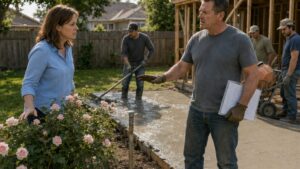
The cedar post struck the ground with a dull, splitting thud, crushing two soybean plants beneath its metal shoe.
Robert Carter heard it from the cab of his tractor.
He shut off the engine before the contractor could drive the post any deeper. The sudden quiet exposed every smaller sound—the ticking engine, the dry rasp of leaves against his tires, the hydraulic whine from the post driver idling beside the new hole.
The contractor looked over, one hand still on the controls.
“You need to stop,” Robert said.
The man glanced toward the Nelson house before answering. “I’ve got a marked line.”
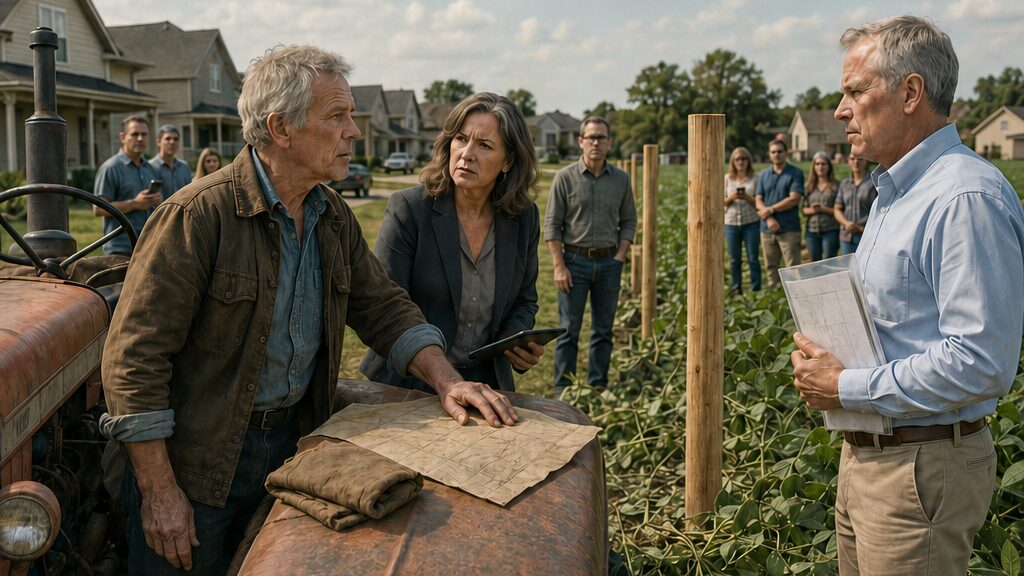
Robert climbed down slowly. At sixty-two, he no longer jumped from the tractor step the way he once had, but there was nothing uncertain in the way he crossed the row. He stopped beside the post and looked down at the broken plants.
The line ran straight through the outer edge of his soybeans.
Not along the grass.
Not along the old hedge scar.
Through the planted row.
Robert crouched and pressed two fingers into the loosened soil. Then he looked south toward the road, following the string stretched between the fresh cedar posts. Every post stood too far west.
“Two feet,” he said.
The contractor removed his gloves. “Mr. Nelson’s survey pins are flagged.”
Robert stood. “Those flags aren’t pins.”
A pale ribbon fluttered from a thin wooden stake near the corner. Robert walked to it, scraping soil away with the heel of his boot. No iron cap. No monument. No old rust stain in the dirt.
Only the sharpened stake.
Behind him, the contractor said, “You’ll have to take it up with the homeowner.”
Robert turned as Jeffrey Nelson came down the slope from his house.
Jeffrey wore khaki pants and a pale blue shirt with the sleeves folded neatly at the wrist. Even crossing the uneven ground, he looked as if he were walking into a meeting rather than a soybean field.
“Robert,” he called. “I was hoping we could avoid this.”
Robert looked past him at the posts. “Then you should’ve avoided my crop.”
Jeffrey stopped several feet away. His expression tightened, though his voice stayed measured.
“The line was professionally surveyed.”
“You told me last week you were still reviewing it.”
“I said I was reviewing the fence placement. The property line itself wasn’t in question.”
“It is now.”
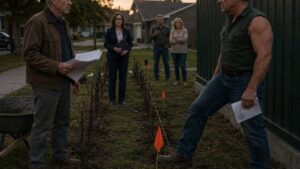
The contractor shifted his weight, caught between them. Robert could see two neighboring homeowners standing on a patio uphill, pretending to inspect a flower bed.
Jeffrey drew a folded packet from a leather folder.
“This was completed last month,” he said. “The association approved the fence based on it.”
He opened the survey across the hood of the contractor’s truck. The paper was clean, bright, and crowded with bearings, measurements, and stamped notes. A red line marked the boundary between the Nelson lot and Robert’s parcel.
Jeffrey tapped the stamp.
“Licensed surveyor. Recorded description. HOA approval.”
Robert ignored the stamp and followed the red line to the northern corner. The notation beside it referred to a utility marker and an offset measurement. He read it twice.
“What monument did they recover?”
Jeffrey frowned. “The corner is right there.”
“That’s not what I asked.”
“The surveyor established it.”
“From what?”
Jeffrey folded his arms. “You’re not a surveyor, Robert.”
“No.”
Robert looked toward the wooden stake.
“But I know there used to be iron in that ground.”
Jeffrey let out a slow breath. “This is exactly why we hired someone. So neither of us had to rely on memory.”
The word settled harder than Robert expected.
Memory.
As if he had wandered into the field carrying an old story instead of a tape measure.
Robert walked back to the first cedar post. He counted the rows, then measured from the wheel track using the marks on the handle of his folding rule. At the southern end, the difference was twenty-three inches. At the northern end, just over twenty-four.
The line was not wandering.
It was consistently wrong.
He showed the measurements to the contractor.
The man scratched his jaw. “I can’t decide property. I build where the flags tell me.”
Jeffrey looked at Robert’s rule. “Your crop rows aren’t legal markers.”
“No,” Robert said. “But they’ve been planted from the same recorded line for thirty-eight years.”
Jeffrey’s calm slipped.
“And that is exactly the problem. Everyone around here has done things by habit. Hedges, mowing, planting, handshake arrangements. Those aren’t boundaries.”
Robert looked at him more carefully then.
There was frustration in Jeffrey’s face, but something else beneath it—something close to fear.
Before Robert could ask, a white SUV turned from the subdivision road and came down the gravel lane. Laura White stepped out with the HOA property manager.
Laura carried a tablet and wore the expression she used at meetings when she intended to sound reasonable until everyone else stopped speaking.
“We received a complaint about interference with approved work,” she said.
Robert looked at Jeffrey.
Jeffrey did not look back.
Laura approached the post line but kept to the grass. “The architectural committee approved this installation based on the submitted survey. Robert, you cannot obstruct the contractor.”
“I haven’t touched his equipment.”
“You stopped the work.”
“I told him he was driving posts into my field.”
Laura glanced at the crushed soybeans, then at the survey on the truck hood.
“The association does not adjudicate boundary disputes.”
“You approved a fence on one.”
“We approved a fence based on the documents provided.”
“That’s adjudicating it with better stationery.”
The property manager lowered his eyes.
Laura’s mouth thinned. “If you believe the survey is incorrect, you may submit contrary documentation. Until then, the approval remains in effect.”
Robert looked from her to Jeffrey.
“And he can keep building?”
Laura hesitated just long enough for the answer to become clear.
“The contractor may proceed within the approved plan.”
The post driver rattled behind them as its engine rose.
Robert stepped in front of the tractor path.
Laura stiffened. “Do not make this worse.”
He thought of pulling the cedar post out with his tractor chain. It would have taken less than a minute. He could already see the hook biting under the wood, the post lifting cleanly from the wet hole.
He also saw the phones on the patio uphill.
He saw Laura’s tablet.
He saw Jeffrey standing beside a stamped sheet that looked complete to anyone who had not lived beside that line for most of a lifetime.
Robert moved his tractor across the row instead, parking it where the next three posts were supposed to go. Then he removed the key.
“I’m not touching your fence,” he said. “You’re not putting more of it in until I see what that survey used.”
Laura raised the tablet. “I’m documenting that you are obstructing approved work.”
“Document the dead plants too.”
The contractor shut down his machine.
Jeffrey gathered the survey, smoothing its folds with both hands. “This could have been handled privately.”
Robert looked at him.
“You started privately. With a post driver.”
Jeffrey’s face hardened, but he said nothing.
Robert walked back toward his pickup at the edge of the field. The old truck had belonged to his father before him. The bench seat was cracked, the passenger door sagged, and the glove compartment had not latched properly in years.
He opened the door and reached for the county plat book he kept behind the seat.
His hand stopped.
Beneath the passenger side, under a stained canvas jacket and an old socket set, was a cloth bundle he had not opened since his father’s funeral.
Robert stared at it.
He could remember the exact weight of it in his father’s hands.
Not papers, his father had once said.
Proof.
Behind Robert, the post driver remained silent.
He bent into the truck and pulled the bundle free.
Chapter 2: The Cloth Bundle Beneath the Truck Seat
The plat tore before Robert had opened it halfway.
The sound was small, no louder than a dry leaf cracking under a boot, but both he and Sandra froze.
Robert held the brittle paper above the barn workbench. A split had opened along one of the deep folds near the title block.
“Don’t move it,” Sandra said.
“I’m not moving it.”
“You’re pulling on it.”
“I’m holding it.”
“You’re holding it like a feed receipt.”
She slid a sheet of clean cardboard beneath the document and eased the folded section down. Robert let go reluctantly.
The cloth bundle had yielded more than one map. Beneath the 1953 plat lay two deed copies, a yellowed survey description, a tax parcel sketch, and several handwritten notes in his father’s square, compressed writing.
Sandra turned on the second work light.
“You kept all this in the truck?”
“Dad did.”
“Your father died eleven years ago.”
Robert did not answer.
She looked at him over the top of her glasses. “So you kept it in the truck.”
He unfolded the newer deed and placed it beside the plat. Both descriptions began from the same section corner and ran through the same bearings. The language differed slightly, but the measurements matched.
Sandra traced a line without touching the page.
“This is the north corner?”
Robert nodded.
“And this symbol?”
“Iron pin.”
“Found or set?”
“Found. The 1953 survey says it was already there.”
He pulled the third document closer. It was a sworn description signed in 1971 when Robert’s grandfather had transferred part of the farm to Robert’s father. The same monument appeared again.
Three documents.
Three decades.
One iron pin.
Robert felt the tightness in his chest ease.
“That’s it,” he said. “That survey of Jeffrey’s started from the wrong thing.”
Sandra did not share his relief. She was looking at a pencil line running parallel to the eastern boundary.
“What’s this?”
Robert leaned closer.
The line was faint, almost erased. Beside it, in his father’s handwriting, were two words:
Mow line.
Sandra looked toward the dark barn doorway, as if the old hedge might still be visible beyond it.
“That’s where the Nelson fence is going.”
“Close to it.”
“How close?”
Robert straightened. “That isn’t the legal line.”
“I didn’t ask that.”
He carried the deed copies to the other end of the bench and aligned their descriptions.
“Twenty inches. Maybe two feet.”
Sandra remained at the plat.
“And your father drew it here.”
“He drew everything.”
“Did he let the old neighbors mow to that hedge?”
Robert kept his eyes on the documents. “Sometimes.”
“Robert.”
“They had trouble getting their mower around the drainage swale. Dad told them they could keep the strip clean.”
“For how long?”
“I don’t know.”
“You do know.”
He looked up then.
Sandra’s expression was not accusing. That made it worse.
“Years,” he said.
She rested both hands on the edge of the bench. “And you never corrected it.”
“There was nothing to correct. Permission doesn’t move a boundary.”
“No. But it can make one look moved.”
Robert gathered the pages too quickly. The torn fold lifted.
Sandra caught it with two fingers.
“Careful.”
He released the paper.
For several seconds they listened to the barn fan clicking on its worn bearing.
“I had the plat,” he said. “They had permission. Everyone knew.”
“Everyone who?”
“My father. Their father. Me.”
“The Nelsons didn’t.”
“They bought a survey.”
“They bought a house. They saw a hedge. They saw years of mowing. Then they bought a survey that agreed with what they saw.”
Robert folded his arms.
“You sound like Laura.”
“I sound like someone who doesn’t want our next ten years spent glaring across a wire fence.”
“He put posts in the crop.”
“Yes. And he was wrong to do it before speaking to you. But that doesn’t make you right about everything else.”
Robert carried the documents into the kitchen and spread them across the table under the pendant light. Sandra followed with the cardboard backing and a roll of archival tape she used for family photographs.
He disliked the care she took with the plat because it made the paper seem fragile.
His father had never treated it as fragile.
His father would unfold it across a truck hood, flatten it with a wrench, and stab at the corners with a grease-blackened finger. He had believed the land remembered its own shape.
Robert had believed the same.
Sandra opened the old tax sketch.
“Did the HOA ever ask you for these?”
Robert turned toward the sink.
“Robert.”
“When they incorporated the last section.”
“And?”
“I told them the county had what they needed.”
“Did they?”
“They had parcel records.”
“That’s not what I asked.”
He looked out the kitchen window toward the dark line of the Nelson property. One porch light burned at the top of the slope.
“The property manager emailed me,” he said. “Wanted old surveys for their digital map.”
“And you ignored him.”
“I told him I wasn’t handing family papers to a committee that fines people for shed colors.”
Sandra sat down.
“So the map they used may have been incomplete because you refused to help complete it.”
“They could’ve gone to the county.”
“So could you.”
Robert stared at the iron-pin symbol on the plat.
His certainty remained, but it no longer felt clean.
The legal line was where it had always been. Of that he had little doubt.
Yet the hedge had stood in the wrong place.
His father had permitted the mowing.
Robert had watched the HOA build its records without sending the one document now sitting under his hand.
Sandra repaired the torn fold in silence.
At eleven forty-three, Robert’s phone buzzed on the counter.
The email subject read: Notice of Compliance Violation.
He opened it.
The association had documented obstruction of approved construction, unauthorized farm equipment within a residential setback review zone, and failure to maintain vegetation along a disputed common-facing boundary.
A hearing and site inspection had been scheduled for two days later.
At the bottom, beneath the property manager’s signature, one sentence had been bolded.
Failure to provide contrary recorded documentation may result in enforcement costs being assessed to the owner.
Sandra read over his shoulder.
“They’re making your silence official,” she said.
Robert looked down at the cloth bundle on the table.
Then he looked at the father’s penciled mowing line beside the iron pin.
For the first time, he wondered whether the old papers would prove only where the boundary belonged—or also how his family had helped everyone forget it.
Chapter 3: The Survey Everyone Thought Had Settled It
The orange removal sticker was already tied to Robert’s tractor when he reached the field.
It hung from the steering wheel on a plastic loop, bright against the faded black grip.
NOTICE OF OBSTRUCTION.
The property manager stood beside Laura White near the cedar posts. Jeffrey was there with the fence contractor, and half a dozen neighbors had gathered along the subdivision path. No one crossed into the soybeans. They watched from the trimmed grass as if the field itself had become evidence.
Robert stopped beside the tractor.
“Take that off.”
The property manager held his tablet against his chest. “It marks equipment placed in conflict with approved work.”
“It marks my tractor on my land.”
“That is the question under review.”
Robert cut the plastic loop with his pocketknife and laid the tag on the tractor seat.
Laura stepped forward. “We agreed there would be no interference before this inspection.”
“I haven’t moved anything.”
“You parked machinery directly on the approved fence alignment.”
“Exactly.”
Jeffrey exhaled through his nose. “Robert, the survey is not a suggestion.”
He held the document in a clear protective sleeve. Beside its crisp white paper, Robert’s cloth bundle looked older than the houses surrounding them.
Laura addressed the group in a firm, practiced tone.
“The association is here only to determine whether the approved installation matches the submitted plan. We are not a court, and we do not decide title.”
Robert looked at the posts already driven through his crop.
“You decided enough to send a contractor.”
“We relied on a licensed survey.”
“Then ask what monument it relied on.”
Jeffrey turned the survey toward him. “We covered this.”
“No. You showed me a stamp.”
A murmur moved along the path. One neighbor raised a phone, not openly, but not subtly either.
Jeffrey’s cheeks colored.
“You have spent days implying that my surveyor was incompetent.”
“I asked a question.”
“You’ve asked it like an accusation.”
Robert walked to his pickup and removed the bundle. He felt Sandra’s eyes on him from where she stood near the barn lane. She had come only after making him promise he would not hide the hedge notation.
Laura watched as he opened the cloth across the tractor hood.
The 1953 plat did not lie flat. Its folds rose like old ridges. Robert placed the later deed copies on either side to hold it down.
Jeffrey gave a tight, disbelieving laugh.
“That’s your evidence?”
Robert ignored him.
He placed one finger beside the corner symbol.
“This is the original recorded plat. It calls for an iron pin at the north boundary. The 1971 transfer uses the same pin. So does the deed description recorded when my father took title.”
Laura leaned over the hood.
The property manager moved closer but did not touch the papers.
Robert laid Jeffrey’s modern survey beside them.
“Your document references a utility marker with an offset. It doesn’t say the iron monument was searched for, recovered, rejected, or missing.”
Jeffrey’s voice sharpened. “You cannot compare an old family copy with a current licensed survey and declare the survey invalid.”
“I’m not declaring anything. I’m asking where the controlling monument went.”
Laura scanned the modern notes.
“Which notation would show that?”
Robert pointed.
“It should name the recovered corner or explain the replacement method.”
The property manager adjusted his glasses. “There’s a coordinate reference.”
“A coordinate can be calculated from the wrong point.”
Jeffrey looked at Laura. “This is absurd. He’s not qualified to interpret that.”
Robert met his gaze.
“Then bring the person who is.”
The confidence in Jeffrey’s face faltered for the first time.
Not much. Just enough.
Laura straightened and asked the property manager to call the survey company. He stepped away, speaking quietly into his phone.
The watching neighbors had stopped whispering.
Robert felt no triumph. He felt the weight of the cloth bundle, the thin paper under his hand, and the knowledge that one gust could lift seventy years of certainty into the soybeans.
The property manager returned.
“The surveyor who signed this is out of state. The office representative says the field crew tied the boundary to existing control visible on the site.”
“What control?” Laura asked.
The manager listened to the phone again.
“A marked utility reference and the established occupation line.”
Robert’s finger remained on the iron-pin symbol.
“Occupation line means the hedge.”
Jeffrey’s jaw tightened.
“The hedge stood there for decades.”
“Because my father allowed the former owners to mow to it.”
Jeffrey turned sharply. “Allowed?”
Robert heard Sandra inhale behind him.
He had not meant to say it that soon.
Laura looked between them. “Was there an agreement?”
“No transfer,” Robert said. “No deed change.”
“That wasn’t my question.”
“It was neighbor permission.”
Jeffrey stepped toward the tractor hood.
“You knew the visible boundary wasn’t the recorded boundary?”
“I knew the hedge wasn’t the line.”
“And you never told us.”
“You never asked before ordering a survey and building a fence.”
Jeffrey pulled several aerial photographs from his folder. The earliest showed the two properties twelve years before he purchased his house. A dark hedge ran almost exactly beneath the new fence alignment. Later images showed the hedge removed but the mowing pattern preserved.
He laid them over the corner of the plat.
“Every visible use line is here,” he said. “The hedge. The mowing. The maintenance strip. Your own crop edge in some years.”
Robert studied the photographs.
In two of them, the outer soybean row curved away from the hedge to clear wet ground. From above, the curve looked like acceptance.
He remembered those springs. Standing water had forced him to shift the planter.
The photographs did not show why.
They showed only what had happened.
One of the board members asked, “How long was the hedge treated as the separation?”
Robert answered without looking up.
“More than twenty years.”
The crowd stirred again.
Jeffrey’s voice was quieter now.
“You let every owner before me use that strip. The association mapped it that way. The survey found it that way. And now you want everyone to believe we invented this.”
Robert lifted his eyes.
“I want you to stop building until the ground is checked.”
“You want to hold up my property because your family never bothered to put its arrangements in writing.”
The words struck because they were partly true.
Robert folded the aerial photographs away from the plat.
“The iron pin is either there or it isn’t.”
Laura looked at the modern survey, then at the old records.
When she spoke, her tone had changed. Less certain. More careful.
“The association cannot continue enforcement while the monument question is unresolved.”
Jeffrey stared at her. “You approved this.”
“Based on an incomplete assumption.”
“The fence is half built.”
“And it stays half built.”
The contractor began shutting down his equipment.
Laura turned to Robert.
“Your tractor remains where it is. No further planting, grading, digging, or removal along the disputed strip.”
Then she turned to Jeffrey.
“No fencing, landscaping, or access work.”
Jeffrey’s face hardened. “For how long?”
“Until an independent licensed surveyor examines the original records, the occupation evidence, and the physical corner.”
Robert should have felt vindicated.
Instead he looked at the photographs again.
His father’s hedge. His own crop curves. Years of silence flattened into images that favored the wrong conclusion.
Laura asked if either owner objected to Kevin Adams, whose work the county regularly accepted for monument recovery.
Jeffrey said, “I want his findings in writing.”
Robert said, “So do I.”
Laura entered the decision into her tablet.
“Then both properties are frozen at the boundary until Mr. Adams completes his work.”
The phrase moved through the gathered neighbors.
Both properties frozen.
No winner.
No settled line.
Jeffrey gathered the aerial photographs but left Robert’s old plat untouched.
As he turned away, he said, “You asked what the ground remembers. I hope you’re ready for everything else it remembers too.”
Robert watched him walk uphill.
On the tractor hood, the modern survey lay beside the weathered plat. Between them sat the handwritten mowing line his father had never intended anyone to mistake for ownership.
The independent resurvey would search for iron.
Robert was beginning to understand that it might uncover something harder to move.
Chapter 4: The County Book Did Not Match the Hedge
The county records clerk had already closed the index drawer when she stopped and pulled it open again.
“There’s another book,” she said.
Robert stood on the opposite side of the high wooden counter with the cloth bundle tucked under one arm. He had spent nearly an hour watching her move between deed volumes, survey cabinets, and a computer terminal that appeared older than some of the subdivision houses. Every record they had found supported the same bearings, but none explained what had happened to the iron pin.
The clerk ran one finger down a handwritten card.
“Section monument index. It wasn’t migrated with the parcel files.”
“Why not?”
“Different department originally. Road work, drainage, surveys. Things get separated.”
She disappeared through a narrow door behind the counter.
Robert looked at the framed county map on the wall. The roads were straight until they met creeks, hills, or boundaries drawn long before the roads existed. His father had trusted places like this without liking them. He believed official records mattered, but only after someone had made enough noise to force an official to find them.
The clerk returned carrying a thick book bound in cracked green cloth.
She placed it on a padded stand and opened to a page crowded with typed descriptions and inked corrections.
“There,” she said.
The entry was dated 1953.
Robert leaned closer.
The monument description named the same section corner shown on his family plat. From there, it gave a bearing north, then an offset east, ending at an iron pin set below grade near what had once been a drainage furrow. The final note described the pin as three-quarter-inch iron, twenty-six inches below the surrounding surface.
Robert read the line twice.
“Below grade,” he said.
“That would explain why nobody saw it.”
“It would explain why they used something easier.”
The clerk made certified copies of the monument record, the old plat, the 1971 transfer description, and the most recent deed. Each page received a raised seal and a blue certification stamp.
When she handed them over, the packet felt heavier than the originals.
“Does this decide it?” Robert asked.
The clerk shook her head. “It helps a surveyor decide what controls. It doesn’t settle neighbor conduct or a court claim.”
He disliked the answer because it was careful.
On the drive home, the certified copies rested on the passenger seat beneath the folded modern survey. Every road vibration made the plastic sleeves shift against one another.
Sandra was waiting at the kitchen table when he came in.
He laid the monument record in front of her.
“They found the index.”
She read the description slowly.
“Twenty-six inches down.”
“That’s why the new crew missed it.”
“Maybe.”
Robert pulled out the later deeds. “All the bearings match. Same corner. Same distance.”
Sandra nodded, but her attention remained on the monument record.
“You were right about the iron.”
“I was right about the line.”
“I didn’t say you weren’t.”
He heard the distinction.
She got up and returned with the family plat, now supported between two sheets of clean paper. The torn fold had been repaired so neatly that only a faint shine showed where the tape lay beneath.
Sandra unfolded the section containing the pencil notation.
“There’s something I didn’t tell you.”
Robert sat down.
She touched the words mow line.
“Your father talked to me about this after the old neighbors sold.”
“When?”
“The year before he got sick.”
Robert waited.
“He said the hedge should’ve been removed or moved. He said someday somebody would think it was the boundary.”
Robert looked at her.
“You never told me that.”
“I assumed he told you.”
“He didn’t.”
Sandra’s mouth tightened. “Or you didn’t listen.”
The words landed without force, which made them harder to reject.
Robert looked again at the penciled line. He remembered his father complaining about the former owner’s mower bogging in the swale. He remembered helping plant the hedge as a windbreak, not as a boundary marker. He remembered, years later, watching the next owner trim it without asking.
“What exactly did he say?” Robert asked.
“That the permission was supposed to be temporary. That he’d let it go too long because correcting it would start an argument.”
Robert leaned back.
“That sounds like him.”
“It sounds like you.”
He stood and carried the certified packet to the window.
Beyond the glass, the Nelson house rose above the field. The unfinished fence looked like a broken sentence running down the slope.
“The county map still shows our parcel correctly,” he said.
“Yes.”
“The deed shows it correctly.”
“Yes.”
“The pin, if it’s there, will show it correctly.”
Sandra folded her hands.
“And the people living beside it saw something else for decades.”
“That doesn’t give them title.”
“No. But it gives them a reason to believe they weren’t stealing.”
Robert turned.
“I never said stealing.”
“You didn’t have to.”
His phone rang before he could answer.
Kevin Adams said he had reviewed the certified records and could be at the property that afternoon. He wanted both owners present and the HOA notified. He also wanted the modern survey crew’s field notes, not merely the signed drawing.
“They may not provide them,” Robert said.
“They will if the association asks,” Kevin replied. “And if they don’t, that tells us something too.”
By three o’clock, Kevin’s truck was parked beside the barn. He wore work pants, a faded high-visibility vest, and an expression that gave nothing away.
Jeffrey arrived with Laura and the property manager. He stayed on his side of the unfinished fence, though the gesture seemed more pointed now that no legal line had been confirmed.
Kevin spread the documents across a portable table.
“These records are consistent,” he said. “But consistency on paper doesn’t remove the need to verify the ground. I’ll search for the original monument and compare it with the later control.”
Jeffrey crossed his arms. “And the occupation line?”
“I’ll note it.”
“Does it matter?”
“It may matter to counsel. It does not replace my obligation to recover the best available boundary evidence.”
Robert watched Jeffrey absorb that answer.
Kevin began at the section reference near the road, checked his instrument, then moved north along the described bearing. He marked distances in small increments, refusing to let Robert guide him.
At the disputed corner, he swept a metal detector over the grass.
Silence.
He moved toward the hedge scar.
The detector remained quiet.
Jeffrey looked at Robert, and for one brief moment the confidence returned to his face.
Kevin adjusted the sensitivity and started again, this time crossing beneath the newest cedar post.
The detector emitted a sharp, sustained tone.
Everyone stopped.
Kevin swept the coil back.
The tone sounded again, directly beneath the packed earth where the contractor had begun the corner hole.
He looked at the post, then at Robert.
“Whatever’s down there,” he said, “your fence contractor nearly drove through it.”
Chapter 5: The Iron Pin Beneath the Cedar Post
The contractor’s hydraulic hammer was already raised when Kevin stepped between the machine and the corner post.
“Shut it down.”
The contractor froze, one hand on the control lever.
“I was told the work was still suspended.”
“It is,” Kevin said. “And now you’re inches from the object I need to recover.”
The machine lowered with a hiss. The contractor climbed down and backed away.
Robert stood beside the soybean row with Sandra several yards behind him. Jeffrey had arrived early, carrying a folder thick enough to suggest he expected an argument. Laura and the property manager watched from the gravel lane.
Kevin marked a square around the detector signal.
“No shovels inside this line until I expose the top,” he said.
He used a narrow hand trowel, shaving the packed soil in thin layers. The cedar post stood less than a foot from the center of the signal. As the hole deepened, the dirt changed from loose brown fill to hard gray clay.
At fourteen inches, the detector tone sharpened.
At twenty, Kevin switched to a probe.
At twenty-five, the steel tip struck metal.
The sound was faint but unmistakable.
Robert’s hands closed at his sides.
Kevin cleared the final layer with a brush. A rust-dark circle emerged from the clay, no wider than a man’s thumb.
“There it is,” Robert said.
Kevin did not look up. “There is metal. Let me identify it.”
He exposed several inches around the object, measured its diameter, then checked its position against the monument description.
Three-quarter-inch iron.
Twenty-six inches below the surrounding grade.
The bearing and offset matched the 1953 record within the tolerance Kevin had stated that morning.
Only then did he sit back on his heels.
“This is consistent with the original monument.”
For a few seconds, nobody spoke.
The iron pin looked unimpressive. It was not polished, labeled, or protected. It was only a rusted circle in compacted earth beside a fresh cedar post.
Yet the distance between the two objects was almost exactly two feet.
Robert looked down the line through the soybeans. Every new post stood inside his parcel.
The satisfaction he had expected arrived quietly. No rush, no surge of triumph. Only the release of a pressure he had carried since the first post struck the ground.
Jeffrey opened his folder.
“What about later occupation?” he asked.
Kevin stood and wiped his gloves.
“My field finding concerns the monument and the record boundary.”
“That’s not the whole question.”
“No,” Kevin said. “It isn’t.”
Jeffrey looked at Laura. “Then the fence remains disputed.”
Laura seemed irritated by his insistence, but she nodded. “Until counsel reviews the use history and both surveys.”
Robert stepped closer to the hole.
“The line is wrong.”
“The survey line is inconsistent with the recovered monument,” Kevin corrected. “The original crew appears to have referenced a utility marker approximately twenty-four inches west of where the monument record places this corner.”
Jeffrey’s face changed.
“A utility marker?”
Kevin opened the modern field notes, which the HOA had finally obtained that morning.
“The crew used an existing metal marker near the occupation line. Their notes call it presumed corner control.”
“Presumed,” Robert repeated.
Kevin gave him a warning look. “They also tied it to coordinates and visible occupation. It was an error, but not a fabricated one.”
Jeffrey stared at the field notes.
“So they found the wrong metal.”
“They did not excavate the recorded monument position deeply enough.”
The contractor shifted uncomfortably beside the machine.
Robert looked at Jeffrey. “You built on a presumption.”
Jeffrey closed the folder.
“I built on a signed survey approved by the association.”
“You started after I objected.”
“I started after months of trying to understand what I had purchased.”
The words came out louder than Jeffrey intended. The watching neighbors on the path went still.
He pulled another document from the folder. This one was not a survey.
It was a drainage map.
A broad shaded strip crossed the lower portion of the Nelson parcel, bending near the house before continuing toward the subdivision retention area.
Jeffrey laid it on the portable table.
“This easement was not disclosed clearly when we closed,” he said. “The county engineer confirmed it after the spring flooding. I can’t build over it. I can’t move the garage plan across it. I can’t even grade that section without review.”
Robert studied the shaded strip.
It consumed more of Jeffrey’s usable yard than he had expected.
Jeffrey tapped the disputed two-foot band.
“The appraisal assumes the width shown on the new survey. The resale estimate assumes it. The contractor’s design assumes it. Take away the drainage area and move the boundary, and the lot loses the only clean side access wide enough for equipment.”
Laura frowned. “You told the architectural committee the fence was for privacy.”
“It is.”
“That isn’t the only reason.”
“No,” Jeffrey said. “It isn’t.”
His voice had lost its polished steadiness.
Robert saw then what had been beneath it from the beginning: not greed exactly, but panic made respectable through paperwork.
Jeffrey had retired into a house he believed was orderly and secure. Then one map had taken away part of his future plan. Another threatened to take more.
None of that gave him Robert’s land.
But it explained why he had moved too fast.
Sandra stepped beside Robert and looked at the drainage map.
“Could access be redesigned from the road side?”
Jeffrey shook his head. “Not without removing landscaping and part of the retaining wall.”
“Which can be done,” Robert said.
“At a cost.”
“So can moving a fence.”
Jeffrey’s eyes hardened again. “You think finding that pin erases thirty years of use.”
“No.”
The word surprised everyone, including Robert.
He looked at the iron circle in the earth.
“My father let that hedge stand. He let people mow to it. I let the map stay wrong because I didn’t want to deal with the association.”
Jeffrey’s expression shifted, cautious now.
Robert continued.
“That doesn’t transfer title. But it helped make your survey look believable.”
Laura glanced toward the property manager.
Kevin began photographing the monument from measured reference points. Each camera click felt more permanent than the discovery itself.
Jeffrey returned the drainage map to his folder.
“My attorney says long use may support an adverse claim.”
Sandra looked at him. “Are you saying you intend to sue?”
“I’m saying I’m not accepting that a buried pin answers every question.”
Robert felt the old anger return, but it no longer came cleanly. It moved through the knowledge of the hedge, the missing records, and Jeffrey’s narrowed access.
“You knew I objected before the posts went in,” he said.
“And you knew the visible line was misleading before we bought.”
They faced each other across less than two feet of dirt.
Kevin stood between the iron pin and the cedar post.
“The monument will be protected until I complete the survey,” he said. “No one disturbs either line.”
Jeffrey closed his folder with both hands.
“Then my counsel will address the use history.”
Laura stared at him. “You understand what that means for both properties?”
“I understand what losing the width means for mine.”
Robert looked at the rusted pin again.
He had imagined this moment as an ending. The ground would speak, the fence would move, and the neighborhood would learn that old memory had been right.
Instead, the iron pin had exposed a harder boundary—between being correct and having acted responsibly.
Jeffrey turned toward the hill.
“My attorney will send notice by tomorrow,” he said. “Until then, nothing is settled.”
Chapter 6: What Robert’s Father Allowed but Never Gave Away
Jeffrey’s counsel placed Robert’s father’s handwritten note on the projection screen before anyone had taken a seat.
The words appeared twelve inches high on the wall of the HOA hearing room.
Mow to hedge until drainage improves.
Beneath the note was a date from nearly thirty years earlier and Robert’s father’s initials.
Jeffrey sat at one end of the long table. Robert and Sandra sat at the other. Laura occupied the center with the property manager and two board members. Kevin waited near the wall with his survey packet closed on his lap.
The counsel pointed toward the projected note.
“This is not a deed transfer. We are not claiming it is. But it shows intentional permission tied to an occupation line that remained unchanged for decades.”
Robert looked at the enlarged handwriting.
His father’s pencil had pressed harder on the word hedge.
The counsel changed the image. An aerial photograph appeared, then another, then another. The dark hedge disappeared over time, but the mowing line remained. In several years, Robert’s soybean rows curved away from it.
“The Nelsons purchased in reliance on visible occupation, association mapping, and a licensed survey,” the counsel continued. “Mr. Carter now asks them to absorb the cost of a correction after knowingly allowing that appearance to persist.”
Laura looked at Robert.
“Is that accurate?”
Robert could have answered narrowly.
He could have said the survey was wrong, the monument was recovered, and permission was not ownership.
All of that was true.
Sandra’s hand rested beside his on the table, not touching it.
Robert looked at the projected note.
“My father gave the prior owners permission to mow around the swale,” he said. “He did not give away the strip.”
The counsel nodded. “Did he intend the permission to continue indefinitely?”
“No.”
“Did he revoke it in writing?”
“No.”
“Did you?”
“No.”
“Did you provide the association with the 1953 plat when requested during the digital mapping project?”
The room became still.
Robert heard the faint hum of the projector.
“No.”
“Why not?”
“Because I didn’t trust the association to handle it correctly.”
Laura shifted in her chair.
The counsel asked, “Did you know the association map followed the hedge line?”
“I knew it was approximate.”
“Did you notify anyone that it was wrong?”
“No.”
Jeffrey looked down at the table.
Robert had expected satisfaction from him. Instead there was only fatigue.
The counsel returned to his seat.
Laura folded her hands.
“The association approved the fence based on the submitted survey and our own map. Kevin, does your work establish the recorded boundary?”
Kevin opened his packet.
“The recovered monument, historic descriptions, and current measurements establish the record line approximately twenty-four inches east of the approved fence line.”
“And the use history?”
“That is a legal issue. From a surveying standpoint, the iron pin controls the record boundary.”
One board member asked whether the recent survey company had accepted responsibility.
“They acknowledged insufficient monument recovery,” Kevin said. “Their insurer is reviewing the matter.”
Laura looked at the property manager.
“The association approved construction without independently confirming a disputed boundary.”
The manager said, “There was no recorded dispute at the time of approval.”
“There was an objection before construction continued.”
His face reddened.
Laura turned to Robert.
“You obstructed work rather than filing a formal appeal.”
“Yes.”
“You withheld documents during the mapping process.”
“Yes.”
She turned to Jeffrey.
“You proceeded after direct notice that the line was contested.”
Jeffrey’s answer came reluctantly.
“Yes.”
The room seemed to settle around those three admissions.
No one had invented the problem alone.
Laura slid a proposed settlement across the table.
“The association’s insurer recommends resolving this without litigation. Under this proposal, the fence remains where installed. Jeffrey compensates Robert for the disputed strip, and the association waives enforcement costs.”
Robert did not pick up the paper.
Sandra read the first page.
Jeffrey leaned back slightly, watching him.
Laura said, “It avoids removal costs, legal uncertainty, and further disruption.”
“It records the wrong line,” Robert said.
“It records an agreed line.”
“Based on a mistake.”
“Based on compromise.”
Robert looked at the photograph of the iron pin in Kevin’s packet. A rusted circle beside a ruler. Plain, exact, uncovered after decades because someone had finally searched where the record said to search.
His father had treated the plat as proof.
Robert had treated it as private proof.
Now the board wanted to solve the consequences by moving the legal boundary to match the mistake.
“No,” he said.
Sandra lowered the proposal.
Laura’s expression tightened. “Robert, you should understand the risk. A use claim could be expensive even if you prevail.”
“I understand.”
Jeffrey spoke for the first time.
“You’d rather spend years fighting over two feet?”
Robert turned toward him.
“No. I’d rather stop turning every old mistake into the next permanent record.”
Jeffrey’s counsel began to speak, but Robert raised one hand.
“My father allowed mowing. I allowed silence. You relied on bad information and then kept building after I objected. The association approved a fence without checking the dispute. None of that means the wrong boundary should become the right one.”
Laura said, “Then what are you proposing?”
Robert unfolded a sketch he had prepared with Sandra the night before.
The record line ran through the center. The fence was shown relocated to Jeffrey’s side. Near the road, a narrow access lane curved away from the drainage easement. At the lower end, a shallow swale redirected runoff without crossing the protected area.
“Move the fence to the monument line,” Robert said. “Record a boundary agreement using Kevin’s survey. No future owner relies on the hedge, the old map, or memory.”
Jeffrey studied the sketch.
“That access turn is too tight.”
“Not if the retaining wall is cut back six feet.”
“That wall cost forty thousand dollars.”
“I know.”
Robert placed a second page beside the sketch.
“The association shares the fence relocation cost because it approved the work after objection. The survey company’s insurer covers the corrected survey. You and I split the access redesign based on the drainage engineer’s final plan.”
Jeffrey looked up sharply.
“You expect me to pay to lose land.”
“I expect both of us to pay for the years that made the mistake believable.”
Sandra turned toward him.
Robert felt her surprise more than he saw it.
Jeffrey’s counsel asked, “And what does Mr. Carter contribute beyond half an access plan?”
Robert slid the final page forward.
“A recorded access easement allowing temporary maintenance entry across the corner of my lane when the drainage area blocks equipment. Limited purpose. Limited width. No transfer.”
Jeffrey stared at the page.
It was not the two-foot strip he wanted.
It was something more useful.
Laura leaned over the sketch. “The board would need engineering review.”
“Then review it,” Robert said.
“And if the drainage design fails?”
“We don’t sign until it works.”
Jeffrey remained silent.
Robert gathered his father’s note from the evidence stack and placed it beside the photograph of the iron pin.
“One shows what my family allowed,” he said. “The other shows what we never gave away. Both belong in the record this time.”
Jeffrey’s counsel whispered to him, but Jeffrey did not answer.
At last, he looked at Robert.
“You would actually record the maintenance access?”
“Yes.”
“Even after this?”
“Especially after this.”
Laura closed the compensation proposal.
“The board will suspend all enforcement and send Robert’s plan to the county drainage engineer. If the design is feasible, we reconvene for final terms.”
Jeffrey’s face gave no sign of agreement.
But he took Robert’s sketch when he left.
At the doorway, he stopped and looked back at the projected note in Robert’s father’s handwriting.
Then he folded the access plan once and placed it inside his folder instead of handing it to his counsel.
Chapter 7: The Line They Chose to Record
The fence contractor returned carrying removal tools instead of a post driver.
Robert watched from the edge of the soybeans as the man unloaded a pry bar, a hydraulic puller, and a stack of wooden blocks. Six weeks earlier, the same truck had arrived with fresh cedar posts and an approved plan. Now a fluorescent copy of the corrected survey lay beneath the windshield wiper.
The contractor nodded toward the unfinished fence.
“Taking all of it out today.”
Robert looked uphill.
Jeffrey stood beside his driveway with his hands in his pockets. The retaining wall behind him had been opened at one end, leaving a rough gap where the new access lane would curve toward the road.
“Who gave the final order?” Robert asked.
“The association. Signed by both owners.”
The contractor hesitated.
“You still want the posts?”
“No.”
“Mr. Nelson doesn’t either.”
Robert turned back toward the field. “Then dispose of them.”
The first cedar post came free with a wet sucking sound. Its buried end was dark with soil from Robert’s soybean row. The contractor laid it flat and moved to the next.
No neighbors gathered to watch.
There were no phones raised along the path, no board members taking notes, no stamped survey displayed like a verdict. Only the puller’s steady hydraulic whine and the soft collapse of wire as each section lost tension.
Sandra came down from the house carrying two cups of coffee. She handed one to Robert.
“You could look happier,” she said.
“I am.”
“You look like you’re watching them dismantle a barn.”
He sipped the coffee. “A barn would make more sense than a fence in the wrong place.”
The final agreement had required thirty-one pages, two revisions from the county drainage engineer, one insurance conference, and three meetings in which Jeffrey spoke mostly through his counsel.
The recorded boundary followed Kevin’s recovered monument and corrected survey. The association agreed to pay half the fence-removal and relocation costs because it had allowed work to continue after Robert’s objection. The original survey company’s insurer covered Kevin’s work and the recording expenses.
Robert and Jeffrey divided the remaining cost of the access redesign.
Neither man believed the division was entirely fair.
That, Sandra had said, was probably evidence that it was close.
A dark utility truck arrived from the county road. The drainage engineer stepped out and inspected the cut in Jeffrey’s retaining wall. He checked the slope stakes, then walked the proposed access curve with a measuring wheel.
Jeffrey joined him.
Robert remained by the soybeans until Jeffrey looked across the exposed strip and raised one hand.
Not a greeting exactly.
A request.
Robert set his coffee on the tractor tire and crossed the ground where the fence had stood.
The drainage engineer pointed toward the new gravel base.
“The turning radius works for maintenance equipment up to the agreed size. Larger vehicles would need temporary entry from the Carter lane.”
“That’s in the recorded easement,” Jeffrey said.
Robert nodded.
The engineer looked down the grade. “The shallow swale will carry surface water around the access without cutting through the protected drainage strip. It should also reduce the pooling on the Carter side.”
Robert glanced at the low ground where he had curved his planter away during wet years.
“So the crop row can stay straight.”
“If the outlet remains clear.”
Jeffrey stared at the new lane. “And this protects the house?”
“It protects the foundation better than the old grading did. Nothing guarantees you against an extreme event, but this is compliant and functional.”
The word functional seemed to settle Jeffrey more than any reassurance had.
The engineer left to inspect the lower outlet. Jeffrey remained beside Robert.
For a while, they watched the contractor pull another post.
“I received the revised appraisal,” Jeffrey said.
Robert waited.
“The corrected boundary reduced the lot width.”
“I expected it would.”
“The drainage redesign recovered most of the usability.”
“Most?”
“Enough.”
Jeffrey rubbed the edge of his thumb against his pocket seam.
“I should have stopped construction when you objected.”
It was not quite an apology.
Robert looked at him.
“I should have corrected the association map before you bought.”
That was not quite one either.
Jeffrey gave a short nod.
They stood in the two-foot strip neither man had been willing to surrender.
The contractor removed the last post near the recovered monument. Kevin had installed a protective sleeve around the iron pin and placed a temporary survey cap above it. The permanent reference marker stood several feet away where future crews could find it without excavation.
Kevin arrived shortly before noon with the final monument record and boundary agreement.
He set his equipment case beside the corner.
“I need both owners to witness the reference measurements before we file the last certification.”
Jeffrey stepped toward the iron pin, then stopped.
“Robert.”
Robert turned.
“You should stand here.”
There was room beside Kevin, but Jeffrey was not merely offering space.
Robert crossed to the monument.
Kevin measured from the protected pin to the new reference marker, then to two fixed points shown on the recorded survey. He read each distance aloud. Robert confirmed the numbers on the drawing. Jeffrey did the same.
“No presumed control,” Kevin said. “No occupation line substituted for the monument. Anyone surveying this later should have enough information to recover it.”
Jeffrey looked down at the cap.
“It seems like a great deal of trouble for something buried that deep.”
Robert remembered his father flattening the old plat beneath a wrench on a truck hood.
“It was only trouble because nobody looked for it.”
Kevin handed each man a pen.
They signed the monument witness statement on the tailgate of his truck.
When Jeffrey finished, he held the pen a moment longer.
“The maintenance easement,” he said. “I don’t intend to use it unless the drainage route is blocked.”
“That’s what it says.”
“I wanted you to know.”
Robert capped the pen. “Call before you cross.”
“I will.”
By afternoon, the fence had been rebuilt on Jeffrey’s side of the recorded line. It did not run through the soybeans. Near the road, it bent around the new access curve rather than sealing it off.
The relocated fence was less straight than the first one.
Robert thought it looked more honest.
The following morning, he and Sandra drove to the county recorder’s office. The clerk who had found the forgotten monument index accepted the final packet and checked each page.
“Corrected survey, boundary agreement, limited maintenance easement, drainage plan, monument record,” she said. “This should prevent anyone from having to reconstruct the whole history again.”
Robert watched her place the recording stamp on the first page.
The sound was quieter than a cedar post striking soil.
It carried farther.
Laura met them outside the office with a copy of the association’s revised review procedure. Any fence proposed within five feet of a parcel boundary would now require either owner acknowledgment or independent monument verification. Disputed work would stop automatically until the controlling evidence was confirmed.
“We should have had that rule before,” she said.
Robert took the document.
“Yes.”
Laura waited, perhaps expecting more.
He folded the procedure once.
“You changed it.”
“We did.”
“That matters.”
Her shoulders eased.
That evening, Robert returned to the field after the contractor had gone. The soybean plants along the damaged edge were thinner than the rest. Several had been crushed beyond recovery, leaving small gaps where the first posts had stood.
He could have replanted something there, but the season was too far advanced.
Jeffrey was checking the new gravel access. He looked across the fence.
“The engineer says we should see how it drains after the first heavy rain.”
“We will.”
Jeffrey rested one hand on the top wire.
“I’m not asking you to forget how this started.”
“Good.”
“I don’t expect we’ll become the kind of neighbors who share every Sunday dinner.”
Robert looked at the corrected line between them.
“No.”
Jeffrey nodded toward the Carter house.
“But Sandra mentioned lemonade once.”
Robert almost smiled.
“Ask her. She controls the pitcher.”
Jeffrey’s expression shifted, uncertain whether the answer was permission or dismissal.
It was a little of both.
Robert walked back to the barn carrying his certified copy of the recorded agreement. On the workbench, the old cloth bundle waited beside the repaired 1953 plat.
He unfolded the fabric and placed the new survey on top of the family documents.
For years, the bundle had held what his grandfather and father knew. Robert had treated that knowledge as something safest when kept close, away from committees, databases, and people who might misunderstand it.
The iron pin had survived underground.
The truth around it had not survived nearly as well.
He added the monument record, the drainage plan, and the signed boundary agreement. Then he wrote the county recording number on the outside of the cloth in permanent ink.
Sandra stood in the barn doorway.
“You’re putting it back in the truck?”
Robert tied the bundle securely.
“No.”
He carried it to the metal file cabinet near the office door, placed it in the top drawer, and left a labeled copy in the fireproof document box.
Then he handed Sandra the key.
Outside, the corrected fence followed the line both men had finally chosen to record.
The iron pin remained buried beneath its protective sleeve, no longer forgotten and no longer expected to speak for itself.
The story has ended.