The Morning the HOA Sent Chainsaws, Sarah Found the Missing Money Behind Her Hedges
Chapter 1: The Chainsaws Arrived Before Her Coffee Had Cooled
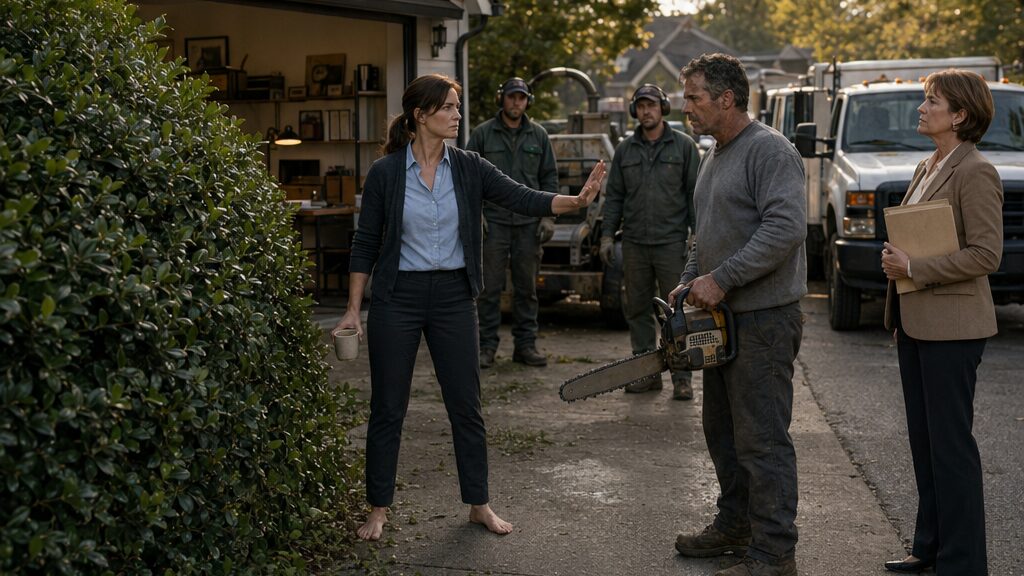
The chainsaw blade stopped inches beneath the first privet branch.
Sarah Walker stepped between it and the hedge before she had time to decide whether that was sensible. Hot coffee sloshed over the rim of her mug and struck her bare wrist, but she did not look down.
“Don’t start that saw.”
The man holding it lowered the bar without releasing the handle. Behind him, two other workers stood beside a chipper and a flatbed truck. Their engines idled along the curb, filling the quiet street with diesel vibration. It was 6:15 in the morning. Porch lights still glowed on two neighboring houses.
At the end of Sarah’s driveway, Margaret Clark watched from beside a white utility vehicle. She wore a tan blazer, pressed slacks, and the expression she used whenever she was about to explain that somebody else had left her no choice.
“The removal was properly noticed,” Margaret said. “Please don’t interfere with contracted work.”
Sarah looked again at the man with the saw.
She knew the scuffed work boots, the gray sweatshirt, and the narrow scar beside his left thumb. James Scott had sat across from her desk three weeks earlier while she explained why taking cash from a business account without recording the owner draw would create a mess at tax time.
“James?”
His eyes shifted toward her. Recognition brought no relief to his face.
“Morning, Sarah.”
The two other men looked between them.
Margaret’s posture stiffened. “You know each other?”
“James is a client.”
Sarah heard how dangerous the sentence sounded as soon as she said it. Not to Margaret. To James.
His grip tightened around the chainsaw handle. “She does my books.”
Margaret recovered quickly. “Then everyone should appreciate the need to keep personal matters separate from association business.”
Sarah set her mug on the driveway. The coffee was already losing steam.
“May I see the work order?”
“You received your notice,” Margaret said.
“I’m asking the contractor.”
James glanced at Margaret, then pulled a folded sheet from the chest pocket of his sweatshirt. He held it out without stepping closer.
The heading named the association. The property address was hers. Under scope, someone had typed complete removal of encroaching hedge line, root extraction, debris hauling, soil leveling, and restoration.
Sarah read it twice.
James had quoted her two weeks earlier on trimming three ornamental trees for a client across town. He had mentioned that his general liability policy had been renewed with exclusions for excavation and structural removal. Root extraction along a paved driveway was not hedge trimming. It was ground disturbance beside utilities and private concrete.
“Where’s the certificate of insurance for this scope?”
James looked at the paper as though the question might be answered in smaller print.
“Property manager said they had it.”
“Do you?”
“I sent my regular certificate.”
“Does it cover root extraction?”
Margaret crossed the driveway. “Sarah, this is not an audit. Your hedge extends eighteen inches into the common easement. You were given ten days.”
“Eleven days,” Sarah said. “The letter arrived on a Monday, and the portal said Friday at five.”
“You missed the deadline.”
“By one afternoon.”
“The duration of noncompliance does not change the violation.”
One of the workers near the chipper looked toward the hedge. It rose seven feet in places, thick enough to hide the windows of Sarah’s converted garage office from the sidewalk. She had planted it when Patricia was six, after a stranger had stood on the curb and photographed client boxes visible through the glass.
Sarah pointed to the work order. “Who confirmed the easement line?”
“The association’s measurements are sufficient.”
“Who measured it?”
Margaret’s polite smile thinned. “I did.”
“With what survey?”
“The plat is on file.”
“That isn’t what I asked.”
James switched the chainsaw off completely. The sudden silence traveled down the street. A bird fluttered out from the hedge and vanished over the roof.
Margaret looked at him. “Mr. Scott, you have authorization.”
“Not if the insurance doesn’t cover what’s written here.”
“It is landscaping.”
“It says root extraction.”
Her gaze sharpened. “You accepted the job.”
“I accepted hedge removal. Nobody said anything about digging along concrete.”
Sarah kept her eyes on the work order. At the bottom were three vendor lines: Scott Landscaping, a tree service, and a hauling company. One authorization number appeared beside all three.
“What are the other crews doing?” she asked.
James rubbed his jaw. “Tree service was supposed to handle the thick trunks. Hauler takes debris.”
“There are no trunks. It’s privet.”
“That’s how they split it.”
Margaret took one step toward the paper. “This discussion is becoming inappropriate.”
Sarah folded the sheet along its existing crease and gave it back to James. “I do not authorize entry beyond the driveway edge. Until you provide the insurance certificate and a verified easement survey, any cutting is at your risk.”
Margaret’s voice remained quiet. “The association has enforcement rights.”
“And I have property rights.”
“You also have an accumulating violation.”
“Then put that in writing.”
“I intend to.”
For a moment, none of them moved. The hedge stood behind Sarah, glossy with morning moisture. She could smell the crushed leaf where the saw’s bar had brushed it.
James handed the machine to one of his workers. “We’re not touching it until this is cleared up.”
Margaret stared at him. “You will be paid for authorized work, not for standing in a driveway.”
“I’d rather lose the morning than buy somebody a new driveway.”
The other men began closing the truck compartments. Their movements were careful and conspicuously slow.
Margaret turned to Sarah. “An emergency compliance fee will be added today. If removal and associated costs remain unpaid, the association may pursue a lien according to the declaration.”
Sarah’s stomach tightened, but she kept her face still.
“How much?”
“You’ll receive the assessment.”
“That wasn’t my question.”
“It will include mobilization for all three vendors.”
All three.
Sarah looked from the flatbed to the chipper, then to the hauling truck farther down the curb. The hedge could have been cut and loaded by two workers in half a day. Yet Margaret had summoned three separate businesses before sunrise.
Margaret returned to her vehicle. “Rules work only when they are enforced consistently.”
She drove away before the crews did.
James stayed behind after his workers climbed into the cab.
“You shouldn’t have said I was your client in front of everybody,” he said.
Sarah picked up her mug. The coffee had gone lukewarm.
“You shouldn’t have been sent here without the right coverage.”
“That’s my problem.”
“It becomes mine when your saw is over my property.”
He looked toward the hedge. “I didn’t know this was your house until we pulled up.”
“I believe you.”
“That doesn’t make what you said okay.”
Sarah wanted to answer with the work order, the missing certificate, the root extraction clause—facts arranged in a clean line. Instead, she said, “I’m sorry.”
James did not say he accepted it.
He climbed into his truck and left with the others.
Inside the garage office, Sarah placed the work order details into a fresh spreadsheet. She entered the authorization number first. Then she searched the association portal for recent landscaping payments.
The same number appeared three times.
Scott Landscaping.
Coleman Tree Service.
Duke Hauling.
Each entry carried a different amount, but all three were categorized beneath a single maintenance authorization issued two days before Sarah’s compliance deadline had supposedly expired.
She stared at the dates until the numbers stopped looking accidental.
The crews had not been hired because she missed the deadline.
They had been arranged before she missed it.
Chapter 2: Every Small Fine Had Taught Her to Stay Quiet
Patricia found the envelope taped over the last visible piece of blue chalk.
She was still wearing her school backpack when she crouched at the edge of the driveway and peeled the paper from the concrete. Beneath it, a faded row of square windows ran through what had once been a crooked chalk city.
“Is this about me again?”
Sarah took the envelope from her before Patricia could unfold it. EMERGENCY COMPLIANCE ASSESSMENT was printed across the top.
“It’s about the hedge.”
Patricia looked toward the privet wall. “Because I drew near it?”
“No.”
“You said that last time.”
Sarah glanced across the street. A curtain moved in an upstairs window, then settled. The chainsaw trucks had been gone for eight hours, but the neighborhood still felt arranged around their absence.
She opened the notice.
Mobilization charges, administrative processing, emergency review, continued noncompliance. Total due within ten days: $1,840.
Failure to pay could result in collection action against the property.
Patricia read her face instead of the page. “Are we in trouble?”
“No.”
The answer came too quickly.
Sarah folded the paper into thirds. “Go inside. I need to make a call.”
Patricia remained crouched beside the chalk mark. “I stopped drawing out here.”
Sarah looked at her.
“After that woman put the other paper down.” Patricia traced a finger along the pale blue line. “I thought maybe you got fined because of me.”
“The chalk had nothing to do with the mailbox fine.”
“It was the same week.”
“That doesn’t mean you caused it.”
“You never told me what happened.”
Sarah had told her that the board was being difficult. She had said grown-ups sometimes confused neatness with importance. She had not told her that Margaret had photographed the chalk from four angles or that the cease-and-desist letter described Patricia’s drawing as an unauthorized alteration of common-view pavement.
“I was trying not to make it bigger,” Sarah said.
Patricia stood. “It got bigger anyway.”
The front door closed softly behind her.
Sarah stayed beside the driveway until the folded assessment began to soften in her hand.
The small fines had trained her well. Forty dollars because the trash container remained visible nine minutes after the pickup window. Two hundred twenty dollars because her mailbox was painted “warm sand” instead of “heritage beige.” A warning for leaving a client’s pickup in the driveway overnight. Each notice had been irritating but cheaper than a fight.
She had paid, repainted, adjusted, and said almost nothing.
The hedge notice had arrived after she requested copies of the quarterly expense summaries.
That connection had felt paranoid yesterday.
Now the crews’ authorization date sat in her spreadsheet.
Inside the office, Sarah logged into the HOA portal. The original hedge notice showed a compliance date of May 17 at five o’clock. She opened the PDF she had downloaded when it first appeared.
May 20.
Her breathing slowed.
She placed both documents side by side. The language was identical except for the deadline. The portal version had been modified three days after Sarah asked the property manager whether the association’s landscaping invoices were available for member inspection.
The metadata listed no editor.
She printed both versions.
Patricia appeared in the office doorway. “Can I stay at Donna’s tonight?”
“Why?”
“She said I could help sort books for the donation table.”
Sarah knew Donna had not invited Patricia. Not yet.
“You don’t have to leave because of this.”
“I know.”
The quickness of the reply sounded too much like Sarah’s own.
Sarah opened her mouth to explain the lien, the altered date, the three vendor lines. She imagined Patricia carrying those details into school, where neighbors’ children would repeat fragments at dinner tables. By morning, Sarah’s investigation would become a rumor before she understood it herself.
“I’ll call her,” she said.
Patricia nodded, relieved.
That relief hurt more than an argument would have.
Donna Lee answered on the fourth ring.
“Sarah, I heard about this morning.”
“I need to ask you something as treasurer.”
A pause. “Then I may need to answer you in writing.”
“Was there a board vote authorizing three contractors to remove my hedge?”
“Margaret handles routine enforcement.”
“This wasn’t routine. The assessment calls it emergency work.”
Donna lowered her voice. “I’m at the grocery store.”
“Was there a vote?”
“Not that I attended.”
“Did you approve the payment?”
“I sign summaries, Sarah. The property manager processes vendors.”
“That is not an answer.”
“It is the answer I have.”
Sarah looked toward the interior door. Patricia was sitting at the kitchen table, erasing something from a notebook with hard, repeated strokes.
“Did Margaret have authority to issue that authorization alone?”
“Under emergency maintenance, the president can act to prevent immediate damage.”
“What immediate damage did my hedge cause?”
“I don’t know.”
“Then why did you sign anything?”
Donna exhaled. “Because last year, every time we delayed a repair, residents accused us of neglect. Because nobody comes to meetings until there’s a bill. Because Margaret reads the governing documents more closely than anyone else.”
“That doesn’t make her right.”
“No. It makes everyone else willing to let her decide.”
Sarah pressed her fingers to her forehead.
“Donna, the deadline in the portal was changed.”
This time the silence lasted longer.
“Changed how?”
“My downloaded notice says May 20. The current portal says May 17. The contractors were authorized on May 18.”
“You’re sure?”
“I keep records.”
“I know you do.”
The words carried neither praise nor comfort.
Donna agreed to let Patricia stay. Before ending the call, she said, “Send me both notices. Don’t send them to the full board yet.”
“Why not?”
“Because if this is a property-manager error, it can be corrected without turning the neighborhood into two camps.”
“And if it isn’t an error?”
Donna did not answer directly. “Let me look first.”
Sarah emailed the documents, then packed Patricia’s overnight bag. She included the purple chalk Patricia usually carried outside, though she found it buried beneath winter gloves at the back of a drawer.
At Donna’s house, Patricia hugged Sarah quickly and went in without looking across the street toward Margaret’s corner lot.
Sarah returned home alone.
At dusk, the hedge cast a dense green shadow across the office windows. Without Patricia in the house, every click of the printer sounded too loud.
An email arrived from Donna at 8:43.
There was no explanation, only one sentence.
No full board vote appears in the minutes, and I did not authorize the contractor mobilization.
Attached beneath it was a payment request bearing Margaret Clark’s electronic approval.
Chapter 3: The Numbers Matched Until She Looked at Who Was Paid
The first invoice claimed James Scott had removed six storm-damaged trees from the south retention area.
Sarah knew he had not.
She knew because James had spent most of that week replacing a commercial client’s failed irrigation lines, and because he had complained in her office that constant rain had kept his mower crews idle. She could still picture the deposit slips clipped inside his April folder.
That memory was not evidence.
She repeated the sentence twice before opening another HOA invoice.
Scott Landscaping: $4,800.
Coleman Tree Service: $4,200.
Duke Hauling: $2,150.
Each description used broad language—storm cleanup, vegetation management, emergency access restoration. The dates overlapped. The authorization numbers repeated in patterns that made the entries appear orderly until she sorted them by vendor and scope.
Over three years, landscaping-related payments totaled $27,860.
Sarah requested the underlying contracts through the association’s member-inspection process. The property manager replied that retrieval could take thirty business days and might require copying fees.
The lien assessment was due in ten.
She searched county business records instead. James’s company was active. Coleman Tree Service had allowed a registration to lapse for six months during the previous year. Duke Hauling appeared under a residential address with no listed workers’ compensation account.
Then Sarah checked the state insurance verification portal.
James had general liability coverage, but the policy effective date began four days after the hedge work order. His previous certificate had expired during a carrier change. Whatever explanation existed, the crew had arrived at her property during the gap.
That was public information. Clean information. Usable information.
She printed it and felt the first solid satisfaction she had experienced since the chainsaw rose toward the hedge.
Then she looked again at the $4,800 invoice.
The amount bothered her because it felt familiar.
At sunset, hedge shadows crossed her monitor in narrow bands. Sarah opened James’s client folder only to confirm the tax classification of his business, she told herself. She would not inspect transactions. She would not use anything confidential.
The digital ledger loaded to the most recent reconciliation.
Her eyes moved automatically to the deposits.
A payment from the association appeared during the same month as the $4,800 invoice.
$1,650.
Sarah’s hand remained on the mouse.
She should have closed the file.
Instead, she searched the association name.
Three payments appeared across eighteen months: $1,650, $900, and $1,200. None matched the invoices carrying James’s company name.
She copied no screenshot. She printed nothing. But she wrote the amounts on a yellow pad beside her keyboard.
The act was small enough to disguise as memory and clear enough that she felt ashamed before the ink dried.
Her phone rang.
James.
She turned the pad face down.
“I heard you requested my insurance history,” he said.
“It’s publicly available.”
“That isn’t what I asked.”
“I needed to establish whether the removal order was valid.”
“And now Margaret’s telling people I showed up uninsured.”
“Were you covered that morning?”
“My renewal was being processed. The agent backdated the binder after I paid.”
“Did you have proof in the truck?”
“No.”
“Then stopping was the right decision.”
“That isn’t the problem.”
Sarah looked at the dark hedge outside. “What is?”
“You’re making me part of your case.”
“You were part of it when you came to cut my property.”
“I was doing a job.”
“With an incomplete work order.”
“I know that now.”
There was anger in his voice, but beneath it Sarah heard something tighter: fear. James employed two men. A rumor about uninsured work could cost him contracts before any paperwork clarified the gap.
“I won’t misstate your coverage,” she said.
“You already said in front of my crew that you knew what I carried.”
“I knew the type of policy.”
“Because you do my books.”
Sarah said nothing.
James’s breathing changed.
“What did you look at?”
“Nothing I intend to use.”
The sentence betrayed her more completely than an admission.
“You opened my file.”
“I was verifying a pattern.”
“My file is not your pattern.”
“The HOA reported paying your company forty-eight hundred dollars for work during a month when—”
She stopped.
James did not.
“When what?”
Sarah closed her eyes.
“When your records may not reflect that amount.”
The silence on the line became absolute.
“You went through my deposits.”
“I saw a discrepancy.”
“You had no permission.”
“I’m trying to find out where association money went.”
“That does not make my bank account yours.”
“I know.”
“No, you know rules. You know what sentence to put in a letter and which box needs checking. If you knew what you just said, you wouldn’t have said it.”
The call ended.
Sarah sat motionless until the monitor dimmed.
At nine the next morning, she went to the clubhouse to collect the first packet of records the property manager had agreed to release. Margaret was in the foyer speaking with Gary Davis. Both stopped when Sarah entered.
Margaret’s gaze dropped to the folder in Sarah’s hand.
“I hope you understand that vendor records contain protected information.”
“I requested association contracts and invoices.”
“Your recent conduct has made several contractors uncomfortable.”
Sarah felt Gary watching her.
“Did James complain to the board?”
Margaret’s expression barely shifted. “I don’t discuss private complaints in hallways.”
The irony was so precise that Sarah almost laughed.
Instead, she signed for the packet and carried it home.
The invoices inside were copies of copies, some missing attachments, some marked paid without check numbers. Yet a pattern emerged. Large amounts were approved under broad maintenance categories. Smaller payments went to the companies whose names appeared on the work descriptions. The remainder moved through administrative charges, bundled authorizations, or invoices from vendors Sarah did not recognize.
She could see the shape of the problem.
She could not prove it without crossing lines she had already crossed once.
Late that afternoon, James pulled into her driveway alone. He did not come to the office. He stood beside the hedge with both hands in his jacket pockets.
Sarah went outside.
“I’m not here as your client,” he said.
“I understand.”
“No, I don’t think you do. I moved my records to somebody else this morning.”
The loss landed quietly. James was not her largest account, but he had referred six clients over four years.
“I’m sorry,” she said.
“You said that yesterday.”
“I was wrong.”
He looked at the hedge. One branch bore a pale scrape from the chainsaw bar.
“They never paid me forty-eight hundred,” he said.
Sarah waited.
“They paid sixteen-fifty for storm debris pickup. Two loads and three labor hours. That was the whole job.”
“Why was your name on the larger invoice?”
“It wasn’t when I signed.”
Her attention sharpened. “What did you sign?”
“A work completion sheet with no amount on it. Margaret said the property manager would attach the approved rate.”
“Do you have a copy?”
“No.”
“Would you tell the board?”
James gave her a hard look. “You still think everybody else exists to complete your spreadsheet.”
The words struck because they were true.
He turned toward his truck, then stopped.
“She left me a voicemail after I questioned the next work order,” he said. “Told me not to worry about the number because I was supposed to invoice the full maintenance amount, not just the work I performed.”
Sarah took one step forward. “Do you still have it?”
James opened the driver’s door.
“Yes,” he said. “But after what you did, I haven’t decided whether you’re the person I should give it to.”
Chapter 4: The Recording Proved Less Than Sarah Wanted It To
Margaret opened the special meeting by accusing Sarah of intimidating local contractors.
She did it before Donna finished confirming the quorum.
The clubhouse conference room held nine residents, three board members, the property manager, and a row of folding chairs that had been placed too close together. Sarah sat at the end of the table with a binder, two printed notices, the landscaping invoices, and her phone beside a small portable speaker.
Margaret did not look at the speaker.
“Over the past week,” she said, “a private business dispute has been turned into an attack on association operations.”
“It isn’t a private business dispute,” Sarah said.
Margaret raised one hand. “You requested the meeting. You will have time.”
The gesture was mild. That made it worse.
Gary Davis sat beside Margaret with his reading glasses low on his nose. Donna occupied the other side, a yellow legal pad in front of her. She had already written the date twice.
Margaret continued. “Several vendors have expressed concern that confidential information may have been used to pressure them into refusing authorized work.”
Sarah felt the heat rise behind her collar.
James had not answered her calls after the driveway conversation. He had sent the voicemail file through a one-line email instead.
Use this carefully.
Nothing else.
Sarah waited until Margaret finished, then stood.
“The hedge removal was authorized before the compliance deadline shown on the notice I downloaded,” she said. “The deadline was later changed in the portal. No full board vote approved the contractor mobilization. The work order required activity outside the contractor’s documented coverage.”
Margaret folded her hands. “You are presenting disputed claims as conclusions.”
Sarah passed copies of the two notices down the table.
Donna held them side by side. “The dates are different.”
“The property manager can address portal corrections,” Margaret said.
The property manager shifted in his chair. “I did not alter the deadline.”
Every head in the room turned.
Margaret’s expression held, but only just. “Then we will determine whether the software updated it during processing.”
Sarah opened her binder.
“Over three years, the association recorded nearly twenty-eight thousand dollars in landscaping and emergency vegetation work. Several invoice amounts do not align with the documented work scopes.”
A resident in the back asked, “Are you saying money was stolen?”
“I’m saying the records do not reconcile.”
Margaret leaned back. “According to whose records?”
“Association records.”
“And information obtained from your clients?”
Sarah’s hand paused on the page.
It lasted less than a second, but Margaret saw it.
“So there it is,” Margaret said. “You are mixing protected business information with neighborhood grievances.”
“I have public records confirming the insurance gap and association invoices showing inconsistent approvals.”
“That was not my question.”
Donna looked at Sarah, not accusingly. That was harder to endure.
Sarah touched the phone.
“There is also a voicemail from Margaret to one of the vendors.”
The room tightened around the sentence.
She connected the speaker and pressed play.
Margaret’s recorded voice filled the conference room, thinner than her real one but unmistakable.
James, don’t break the job into every little task. Invoice the full maintenance amount under the authorization. The board needs one clean number, and the property manager will handle the allocation—
Sarah stopped the recording.
For one breath, the room remained silent.
Then two residents began speaking at once.
Margaret did not.
She looked at Sarah with something almost like disappointment.
“Would you play the sentence before that?”
Sarah’s fingers stayed on the phone.
“The file begins there.”
“No,” Margaret said. “The clip you received begins there.”
Sarah looked at the screen. The audio file was forty-three seconds long. James had trimmed it before sending.
Margaret turned toward the residents. “Mr. Scott was calling about combined work in the south retention area. Multiple vendors performed portions of the same maintenance project.”
“Without a board vote,” Donna said.
Margaret looked at her. “Under emergency authority.”
“You never brought the invoice structure back for ratification.”
“I brought the drainage condition to the board six months earlier.”
“That is not the same thing.”
“No, Donna. It is what happened before everyone refused to fund it.”
Gary removed his glasses.
The movement drew more attention than if he had struck the table.
“There was a drainage proposal,” he said.
Sarah faced him. “What drainage proposal?”
Gary rubbed the bridge of his nose. “The south easement was failing. Water was backing toward three foundations. Margaret requested a special assessment.”
“How much?”
“Eight hundred per home.”
A low complaint moved through the room.
Gary gave a tired nod. “That was the reaction then too.”
Margaret’s voice sharpened for the first time. “Residents demanded another estimate. Then another. They said the reserve fund should cover it. The reserve fund could not. When the first basement took water, those same residents demanded to know why the board had done nothing.”
“So you inflated landscaping invoices?” Sarah asked.
“I consolidated maintenance expenses.”
“Under vendor names for amounts they didn’t receive.”
“I authorized necessary work through available categories.”
“You hid it.”
“I kept water out of people’s homes.”
The room shifted. Not toward Margaret exactly, but away from the simplicity Sarah had brought with her.
Donna tapped one invoice. “You still did this without approval.”
Margaret turned to her. “You signed the monthly summaries.”
“I did not see these supporting invoices.”
“You did not ask.”
Donna went still.
Sarah understood then how Margaret had remained powerful. She did not merely conceal things. She collected everyone’s moments of passivity and kept them ready.
Gary looked at Sarah. “The repairs were real.”
“That does not explain the hedge crew.”
“No,” Margaret said. “The hedge was a separate compliance matter.”
“Authorized before my deadline.”
“You had been noncompliant for months.”
“That was not the notice.”
“No, it was the history.”
The answer chilled Sarah more than a denial would have.
Margaret had not sent the crews because one deadline expired. She had decided Sarah was a resident who needed to be made an example of, then used the process to make it look routine.
Sarah closed the binder.
Margaret reached beneath her own folder and removed a white envelope.
“One more matter,” she said.
She passed it to Donna, who read the first page and looked immediately at Sarah.
“What is it?” Gary asked.
Margaret answered without looking away from Sarah.
“A formal complaint alleging professional misuse of confidential client information.”
The property manager stopped taking notes.
Sarah did not ask who had filed it. She already knew the complaint did not need James’s signature to do damage. Margaret only needed enough truth inside it to make every other truth Sarah presented look contaminated.
Chapter 5: The Woman Who Broke the Rules Had Once Asked Permission
The repaired drainage channel did not appear on any map Sarah had received.
She found it behind the south row of homes, where the common easement dipped toward a retention basin hidden by waist-high grass. Fresh stone lined a shallow trench. A new black pipe disappeared beneath the ground near a concrete outlet stained with an older band of mud.
Three houses stood beyond it.
One foundation still showed a brown water mark above the mulch.
Gary had agreed to meet her there but arrived ten minutes late in work gloves and an old baseball cap.
“You shouldn’t be back here alone,” he said.
“It’s association property.”
“That hasn’t stopped anybody from complaining lately.”
Sarah pointed to the stone. “When was this done?”
“Last fall. Some of it in winter.”
“By which vendor?”
Gary studied the channel instead of answering. “Different people.”
“Under landscaping invoices?”
“Some.”
“Why isn’t it in the capital maintenance report?”
“Because it wasn’t a capital project.”
“It involved excavation and drainage replacement.”
“It started as emergency clearing.”
“And became this.”
Gary pushed a loose stone back into place with his boot. “Margaret warned us for almost a year. She had photographs, engineering notes, estimates. Nobody wanted the assessment.”
“You voted against it?”
He looked at her then.
“Yes.”
The admission was quiet.
“Why?”
“My wife had just retired. Eight hundred dollars was not nothing. And the first estimate looked high.”
“So you let Margaret find another way.”
“I didn’t know what way she found.”
“You signed meeting minutes saying the issue had been deferred.”
“I thought she was arranging temporary work.”
Sarah looked toward the stained foundation. “Temporary work that prevented more water damage.”
Gary nodded.
The fact sat between them without becoming forgiveness.
Margaret’s porch faced the retention area from two streets over. Sarah went there after Gary left.
Margaret opened the door before Sarah knocked twice. She wore no blazer, only a dark sweater and house shoes. Without the board table between them, she looked older and more tired, but not smaller.
“I wondered when you would come.”
“I saw the drainage work.”
Margaret stepped outside and closed the door behind her.
“Then you understand part of it.”
“I understand that the work existed.”
“That is more than most residents cared to understand.”
“You concealed it.”
“I placed necessary maintenance under categories the association could process.”
“You used contractor names for amounts they never received.”
“The full amounts covered materials, coordination, hauling, and administrative work.”
“Administrative work by whom?”
“The property manager. Additional vendors. Reimbursements.”
“Documented where?”
Margaret’s jaw tightened. “Not well enough.”
Sarah waited.
The hedge dispute had taught her that silence could be pressure too. She disliked recognizing the technique in herself.
Margaret looked toward the end of the street.
“The reserve study was already outdated when I became president,” she said. “The previous board kept dues low because people liked them. Roof repairs were postponed. Drainage was postponed. Tree removal was postponed. Everyone praised fiscal restraint until something failed.”
“That does not give you authority to create your own accounting system.”
“No. The declaration gave me emergency authority.”
“Not unlimited authority.”
“Nothing is unlimited until people demand results without agreeing to the cost.”
A lawn mower started two houses away. Neither woman raised her voice.
Sarah said, “Did you benefit personally?”
Margaret looked back at her.
“No.”
“Did a family member?”
A pause.
“My sister’s husband owns a small maintenance company.”
“Was he paid?”
“He performed coordination work.”
“Was that disclosed?”
“No.”
There it was—not theft in the form Sarah had expected, but a conflict Margaret had decided was acceptable because the work needed doing.
“You knew it should have been disclosed.”
“I knew the board would spend three meetings arguing about appearance while water kept moving toward those foundations.”
“And once you decided rules could be bent for that, you kept bending them.”
Margaret’s face changed slightly.
Not guilt. Recognition.
“The hedge was compliant for years,” Sarah said. “Then I asked to inspect expenses.”
“It extended into the easement.”
“Why then?”
Margaret crossed her arms. “Because residents watch what happens when someone openly challenges enforcement. If one person ignores a deadline, others decide deadlines are optional.”
“I missed it by one afternoon.”
“You had ignored three previous notices.”
“A trash can. A paint shade. My daughter’s chalk.”
“You call them trivial because you were the one violating them.”
“You call them necessary because you were the one enforcing them.”
For the first time, Margaret looked tired enough to stop performing authority.
“You think I enjoyed measuring your hedge?”
“I think you enjoyed knowing I could not stop you.”
Margaret’s eyes hardened.
“I chose your property because you were already suggesting the books were improper. If I allowed you to remain visibly noncompliant while making those accusations, every board action would look retaliatory whether it was or not.”
Sarah almost smiled at the logic.
“So you retaliated early to avoid looking retaliatory later.”
Margaret flinched.
Only once.
It was enough.
“You made me an example,” Sarah said.
“I enforced a real encroachment.”
“With three crews and no survey.”
“I made the point clearly.”
The honesty of it was worse than another excuse.
Sarah left without saying goodbye.
Back in her office, she found a new email from the independent accountant Donna had persuaded the board to retain. The preliminary review was marked confidential pending authorization.
Sarah read it once, then again more slowly.
The drainage expenditures accounted for a substantial portion of the landscaping discrepancy. Emergency clearing, gravel, pipe, hauling, and labor could be traced through secondary invoices and bank transfers.
But not all of it.
Duplicate administrative charges appeared on four authorizations. Payments had been made to a maintenance vendor connected to Margaret’s family. Several reimbursements lacked receipts. One transfer had been recorded under two different project descriptions.
The unexplained total was smaller than Sarah had first imagined.
It was still large enough to matter.
Her phone rang before she reached the final page.
Donna.
“Did you get the preliminary report?”
“Yes.”
“Margaret says the reimbursements were for materials.”
“Then she should have receipts.”
“She says some were lost during the property-management change.”
Sarah looked through the garage window. The hedge leaves shivered in the afternoon wind, revealing brief gaps between branches. For years, she had thought of that green wall as protection from strangers seeing inside.
Now she wondered how often protection became concealment simply because the person behind it believed the reason was good.
“There’s something else,” Donna said.
“What?”
“The accountant cannot rely on any contractor payment comparisons that came from your private records.”
“I know.”
“Margaret is asking the board to dismiss the entire review as tainted.”
“The association records exist independently.”
“But the complaint gives her an argument.”
Sarah stared at the yellow pad still turned face down beside her keyboard.
The audit had found real problems.
Her own mistake had given Margaret a way to make those problems disappear.
Chapter 6: She Could Not Demand the Whole Truth While Hiding Her Own
Sarah deleted the comparison sheet from the board packet at 7:12 on Monday morning.
The file contained the cleanest visual proof she had: HOA invoice amounts in one column, contractor deposits in another, differences highlighted between them.
It was also built partly from information she had no right to use.
She removed the printed copies from her binder, fed them into the shredder, and watched the pages become narrow white strips.
Then she called her legal adviser.
“If I disclose what I accessed before anyone asks,” Sarah said, “does that protect me?”
“No.”
The answer came without hesitation.
“It may reduce the appearance that you intended to conceal it. It does not undo the breach.”
“Could I lose clients?”
“Yes.”
“Could James file a complaint?”
“Yes.”
Sarah looked at the damaged branch near the driveway, its bark scraped pale where the chainsaw had touched it.
“What happens if I say nothing?”
“That depends on what other people can prove. It also depends on what kind of person you intend to be after this.”
Sarah disliked questions that could not be reconciled.
After the call, she carried a pair of hand pruners outside. The damaged branch leaned beyond the verified edge shown on the municipal inspector’s preliminary marking. She cut it herself, one clean pressure of the handles, and placed it beside the garage.
The hedge looked no smaller.
Only more honest.
James agreed to meet in a private room at the clubhouse after Donna told him the independent accountant wanted vendor records directly from him. He arrived carrying a thin folder and did not sit.
Margaret was not present. Donna and Gary were.
Sarah stood across the table.
“Before we discuss the invoices, I need to state exactly what I did.”
James’s expression did not change.
Sarah placed no papers in front of her.
“I opened your bookkeeping ledger after I recognized an association invoice using your company name. I searched deposits from the HOA. I wrote down amounts. I did not have your permission, and the information was not necessary to protect my property at that moment.”
Gary shifted in his chair.
Donna kept her pen still.
Sarah continued. “I removed every comparison based on those records from the board packet. I told the independent accountant not to rely on them. You may report me or end our professional relationship. I will cooperate.”
James looked at her for a long time.
“You’re saying this in front of the board?”
“Yes.”
“Why now?”
“Because Margaret hid spending because she believed the result justified the method. I cannot argue that she was wrong while doing a smaller version of the same thing.”
Gary looked down.
James finally sat.
“I already moved my books,” he said.
“I know.”
“I don’t know if I’m filing anything.”
“You do not have to decide today.”
His mouth tightened. “You always sound calm when you’re giving somebody bad news.”
Sarah accepted that without defending herself.
James opened the folder.
“These are every invoice I submitted to the association. Originals from my email account. Work orders too.”
Donna leaned forward. “You are providing them voluntarily?”
“Yes.”
“May the accountant review them?”
“Yes.”
James slid the folder across the table, but not toward Sarah. He gave it to Donna.
The distinction was deliberate.
Sarah felt it and let it remain.
The records changed the audit. They showed blank completion forms later attached to broader invoices. They showed James billing for specific labor while the association recorded bundled maintenance amounts. Similar records arrived from one of the other contractors after Donna contacted him directly.
The final pattern was neither clean theft nor harmless emergency bookkeeping.
Money had paid for real drainage work. Money had also been charged twice through administrative categories. Margaret’s brother-in-law’s company had received coordination fees without competitive bids or disclosure. Several reimbursements lacked support. The property manager had processed authorizations based on Margaret’s electronic approval, assuming the board had ratified them.
Nobody had asked enough questions.
Margaret had counted on that.
At the next closed board session, the accountant presented the findings in a plain voice that made every number harder to dismiss.
Margaret sat at the far end of the table.
“This report exaggerates procedural defects,” she said when he finished. “No resident funds were diverted for personal luxury. The neighborhood received the work.”
“The family-connected vendor was not disclosed,” Donna said.
“The work was performed.”
“The reimbursements were unsupported.”
“Receipts were lost.”
“The hedge mobilization lacked a valid emergency basis,” Gary added.
Margaret turned to him. “You asked me privately to resolve violations faster because residents complained that the board looked weak.”
Gary’s face reddened. “That does not make this right.”
“No. It makes it shared.”
Sarah watched the sentence land. Margaret was still defending herself, but she was not entirely wrong.
The accountant closed his folder. “The board will need an open meeting to authorize corrective actions, vendor controls, and any recovery process.”
Afterward, Margaret asked Sarah to remain.
Donna hesitated, then left the door partly open.
Margaret placed a two-page agreement on the table.
“If you withdraw the complaint regarding your hedge and make no further public allegations about intentional theft, I will recommend cancellation of your fines and authorize trimming rather than removal.”
Sarah read the first paragraph.
The agreement would preserve the hedge. It would eliminate the lien threat. It would prevent Margaret from calling her a liar in public.
It would also keep the audit findings inside closed board records.
“You drafted this before the accountant finished,” Sarah said.
“I anticipated a practical resolution.”
“Practical for whom?”
“For the association. For you. For your daughter.”
Sarah looked up.
Margaret’s voice softened. “Do you really want Patricia hearing neighbors argue about whether her mother violated client privacy? Do you want your business discussed in an open meeting?”
The pressure was precise because it was not invented.
“No,” Sarah said.
Margaret waited.
Sarah placed the agreement back on the table.
“But I want her to know that hiding a mistake does not correct it.”
“You may lose your business over a hedge.”
“This stopped being about the hedge when you changed the deadline.”
“It stopped being about the hedge when you opened your client’s ledger.”
Sarah felt the truth of that too.
“Yes,” she said. “Which is why I will disclose that myself.”
Margaret stared at her.
Sarah stood. “I’m requesting the final meeting be open to all members. The audit, the reimbursement review, the contractor rules, the altered notice, and my conduct should all be included.”
“You think confession will protect you?”
“No.”
The word came more easily than Sarah expected.
“I think it will prevent me from asking for a standard I refuse to meet.”
She left the unsigned agreement on the table.
That evening, Donna posted the meeting notice to every resident.
Within an hour, comments appeared beneath it: demands for arrests, accusations of political revenge, complaints about assessments, defenses of Margaret, questions about Sarah’s clients.
The neighborhood wanted a thief and a hero.
Sarah knew the truth would give them neither.
Chapter 7: The Hedge Stayed, but Nobody Left the Meeting Innocent
Sarah began by admitting what she had done.
The clubhouse was full enough that residents stood along the back wall and beside the vending machines. Margaret sat at the board table with Donna and Gary. The independent accountant occupied a folding chair near the front, his report closed on his lap.
Sarah remained standing.
“Before I discuss the audit,” she said, “I need to disclose that I accessed confidential information in a client’s bookkeeping file without permission.”
The room reacted in small sounds: a chair creaking, someone whispering, a paper cup set down too hard.
Margaret did not move.
Sarah continued before fear could make her precise in the wrong way.
“I recognized a discrepancy between an HOA invoice and a contractor payment. Instead of stopping with public association records, I opened the client ledger and checked deposits. I later removed that information from everything presented to the board. The audit did not rely on it. That does not make the access acceptable.”
A resident near the door said, “Then why should we trust anything you found?”
“You should not trust it because I found it,” Sarah said. “You should trust only what the independent records support.”
She looked toward James.
He stood against the side wall with his arms folded. He did not nod, but he did not look away.
Sarah took her seat.
The accountant opened his report.
He explained the findings without using the words residents had spent the week demanding. No embezzlement charge. No criminal conclusion. No dramatic total beside Margaret’s name.
Instead, there were failures.
Emergency work had been assigned without proper ratification. Vendor scopes had been combined under misleading invoice descriptions. Administrative charges had been duplicated. A maintenance company owned by Margaret’s brother-in-law had received work without disclosure or competitive review. Reimbursements had been approved without receipts. The hedge-removal order had been issued before the compliance deadline then shown in the portal.
The drainage repairs were real.
So were the irregularities.
When he finished, a man in the second row raised his hand without waiting to be recognized.
“Did she steal money or not?”
The accountant closed one section of the report. “That is not a conclusion this review can make.”
“So we paid for work?”
“Much of the money can be connected to work performed.”
“Then what are we doing here?”
A woman across the aisle turned toward him. “We’re here because she lied about where it went.”
Another resident said, “My basement did not flood because those repairs were made.”
“And Sarah’s property almost got cut apart to keep her quiet,” someone answered.
The meeting began to divide exactly as Donna had feared.
Gary struck the gavel once. The sound was weak against the room.
“We are not holding a trial,” he said. “We are deciding corrective action.”
Margaret lifted her hand.
The room quieted more quickly for her than it had for Gary.
“I will respond,” she said.
She stood without gathering her papers.
“I reject the accusation that I stole from this community. I did not use association money for vacations, clothing, or personal expenses. I did not create false repairs. The drainage failure existed. The estimates existed. The board refused the assessment, residents demanded action, and I acted.”
A voice from the back said, “You paid your family.”
“I hired a company capable of coordinating the work on short notice.”
“You did not disclose who owned it.”
“No.”
The single word stopped the next interruption.
Margaret looked toward Donna.
“I should have disclosed it. I should have brought the emergency spending back for approval. I should not have allowed the invoices to be structured the way they were.”
Then she turned to Sarah.
“And I should not have used enforcement against a resident because she questioned the books.”
Sarah felt the entire room wait for something larger: an apology, a collapse, an invitation to forgive.
Margaret offered none.
“The hedge extended into the easement,” she said. “But I accelerated the action because I believed visible defiance would weaken the board. That was retaliation, regardless of whether the underlying violation existed.”
Someone whispered, “At least she admitted it.”
Margaret heard.
“Admission does not erase responsibility,” she said. “It also does not make every decision I made dishonest.”
Sarah understood the line because it could have been her own.
Donna read the proposed motions.
The emergency assessment against Sarah would be withdrawn. Her prior mailbox and chalk-related penalties would be reviewed and refunded where enforcement had exceeded the documents. The hedge would remain, subject to a municipal survey and supervised trimming to the verified easement line.
All future vendors would need current insurance certificates, written scopes, conflict disclosures, and board approval above a defined threshold. Emergency spending would require written ratification within thirty days. An annual independent review would be added to the budget.
The association would pursue recovery of unsupported reimbursements and duplicated charges through civil procedures.
Margaret would resign as president immediately.
The votes were not unanimous.
One resident objected to paying for annual audits. Another called the reforms an overreaction. Two homeowners said Margaret had done more work for the neighborhood than anyone criticizing her.
Gary listened before casting his vote in favor.
“I voted against the drainage assessment,” he said. “Then I expected Margaret to solve the problem anyway. That does not excuse what she did. It does mean I helped create the pressure she used to justify it.”
Donna voted next.
“I signed summaries I did not fully review,” she said. “Neutrality was easier than asking questions. I vote yes.”
Margaret did not vote.
When the motions passed, there was no applause. The room released its breath and returned immediately to consequences.
Afterward, James waited near the exit.
Sarah approached him without carrying her binder.
“I heard what you said,” he told her.
“I meant it.”
“I know.”
He handed her a sealed envelope.
Inside was a final notice ending their bookkeeping agreement.
“I’m not filing a professional complaint right now,” he said. “But I’m not coming back either.”
Sarah folded the notice along the crease.
“I understand.”
“You might.”
The words were not cruel.
He looked toward the board table, where Margaret was placing documents into a cardboard box.
“Everybody thinks the hard part is finding the number that doesn’t match,” James said. “Sometimes the hard part is remembering the number belongs to somebody.”
Then he left.
A month later, a licensed landscaping crew arrived at Sarah’s house at nine in the morning.
No chainsaws were raised without explanation. A municipal right-of-way inspector had marked the verified easement with small flags. The hedge extended into it by less than nine inches at the widest point, not eighteen.
Sarah stood beside Patricia while the crew leader explained the cut line.
“We can keep the height,” he said. “We only need to bring this face back.”
He held a branch between two gloved fingers and waited.
Sarah took the hand pruners from the open toolbox.
“I’ll make the first cut.”
The branch was thinner than the one James’s saw had nearly struck. Sarah positioned the blades beside the survey line and pressed the handles together.
The clipped end dropped onto the driveway.
Nothing collapsed.
The hedge remained dense enough to screen the office windows, but the line was cleaner now. It belonged fully to Sarah’s property without claiming space that did not.
The crew completed the trimming by noon.
Patricia came outside carrying a box of chalk. She knelt near the sidewalk, where the old blue city had faded into pale fragments.
“What are you drawing?” Sarah asked.
“A border.”
Patricia used purple chalk to make a narrow pattern of squares and leaves beside the trimmed hedge. She kept it clear of the common sidewalk and followed the line the inspector had marked.
“You checked first?” Sarah asked.
Patricia pointed to a printed approval email lying under the chalk box.
Sarah almost laughed.
Across the street, Donna was delivering copies of the new vendor policy to board members. Gary had volunteered to lead the reserve-study committee. Margaret’s house remained quiet, the curtains open but no figure visible behind them.
The neighborhood had not become kinder in a month. People still argued about dues. Two residents blamed Sarah for the audit expense. Another left an unsigned note thanking her for stopping the lien process before it reached someone less prepared.
Sarah’s client list was smaller. James’s empty folder remained archived rather than deleted.
Inside the garage, a fresh cup of coffee waited beside her keyboard.
She looked at it, then at Patricia’s chalk border.
For years, Sarah had treated boundaries as things that protected people from being seen. The hedge had hidden her office. Silence had hidden fear. Records had hidden uncertainty beneath neat columns.
But a boundary could also show where responsibility began.
Sarah sat on the driveway beside Patricia before the coffee had time to cool.
When Patricia reached the last square, she looked up.
“Should I erase it when I’m done?”
Sarah studied the purple line beside the living green hedge.
“No,” she said. “Leave it where people can see it.”
The story has ended.