They Put a Repair Bill Beside His Water Glass and Expected Him to Pay Quietly
Chapter 1: The Bill Beside the Water Glass
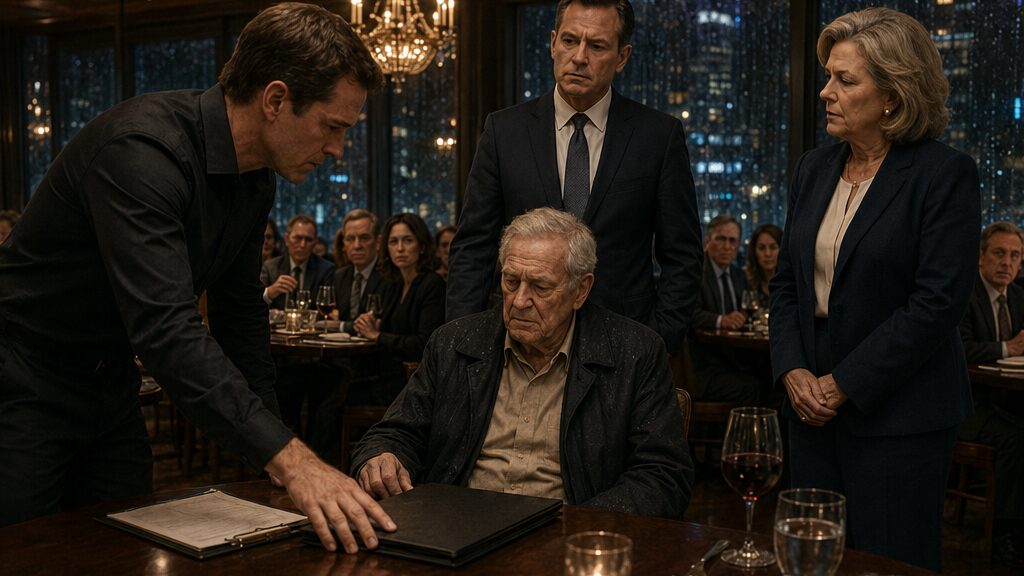
The dark folder landed beside Donald Walker’s water glass before the dessert plates had been cleared.
It did not slam. Jack Harris was too practiced for that. He set it down with just enough weight to make the silverware tremble and the ice in Donald’s glass give a small, brittle click.
Donald looked at the folder first, not at Jack.
Black vinyl. Brass corners. A contractor’s business card tucked under the clip. One white page visible at the edge, folded back so the number could not be missed.
$14,870.00.
Around them, the private dining room of the restaurant had gone quiet in that way rooms did when people wanted to pretend they were not listening. Forks hovered. Conversations thinned into murmurs. Through the tall windows behind the long tables, the city lights blurred in the rain.
Donald sat with his napkin still folded across one knee. His dark overcoat was buttoned to the throat, though the room was warm. He had come because Cynthia Roberts had called it the neighborhood association’s twenty-fifth anniversary dinner, and because staying home every Friday night had begun to feel like admitting something he was not ready to admit.
Jack stood behind Donald’s chair as if he had arrived to check on him kindly.
Paul Carter stood on the other side of the table, leaning forward with both hands flat near Donald’s bread plate. He wore black slacks and a black button-down shirt, the restaurant staff’s color, though he was no waiter. He was the field representative for the contractor Jack had brought in. Young enough to think bending down made him sound patient.
“Mr. Walker,” Paul said, “we’ve gone over the damage twice.”
Donald lifted his eyes to him.
Paul’s voice lowered, but not enough. “The retaining wall behind the Harris property cracked because of pressure from your side. Tree roots, driveway runoff, and improper drainage. The estimate is itemized.”
Donald did not touch the folder.
Jack gave a small sigh for the people watching. “Nobody wants this to be unpleasant.”
That was how Jack said unpleasant. As if the unpleasantness had come from Donald sitting there alone.
Cynthia Roberts stood near the end of the table, one hand resting on the back of an empty chair. Her pearl earrings caught the chandelier light when she turned her head toward the room. “We were hoping to handle this quietly,” she said.
Donald glanced at her. “At dinner?”
A few people shifted.
Jack’s mouth tightened, then relaxed. “You’ve had notices.”
“I had one notice,” Donald said. “Yesterday.”
“And the issue has been developing for months,” Jack replied. “The board can’t ignore damage to shared structures. You know that.”
Donald knew a great many things about shared structures. He knew where the old irrigation sleeves had been buried under the walkway. He knew which side of the hedge held water after a storm. He knew the retaining wall was older than the association’s new paint colors, older than Jack’s stone patio, older than half the people in that dining room understood.
But knowing a thing and being allowed to say it were not the same.
Paul reached for the folder, opened it toward Donald, and slid the top sheet closer. The paper stopped beside the water glass.
“Here,” Paul said. “Retaining wall stabilization, drainage correction, stone replacement, labor. The total is at the bottom. If you initial here tonight, we can schedule before the crack spreads.”
Donald looked at the line where Paul’s finger tapped.
RESPONSIBLE PARTY ACKNOWLEDGMENT.
He read it once. Then he read it again, slower.
His right hand rested near the glass. The knuckles looked larger than they used to. Thin skin, old veins, a faint tremor that came when too many people watched him at once. He curled his fingers lightly around the glass until the cold steadied them.
Jack lowered his voice. “Donald, nobody is saying you did it on purpose.”
That drew the room tighter.
Donald heard the shape of it. Not on purpose. Careless. Forgetful. Old. A man who let a tree go too long, a gutter clog, a driveway slope worsen, a wall break behind someone else’s house. A man who should be grateful they were letting him settle privately.
Paul tapped the page again. “The longer we wait, the more expensive it gets. The HOA can assess late fees if responsibility is disputed without cause.”
Donald looked at him. “Without cause.”
“Yes, sir.”
The sir did not help.
Jack stepped closer behind Donald’s chair. Donald could feel him there, not touching, but near enough that the chair seemed smaller. “I’m trying to keep this from becoming an insurance matter. Once that starts, it gets ugly. Claims, adjusters, maybe a lien if the association has to advance payment.”
The word lien moved through the room like a draft.
Donald’s throat tightened before he could stop it. He thought of the house on Maple Trace, the mortgage paid off two winters before his wife died, the kitchen cabinets she had wanted to repaint but never did, the narrow hallway where her gardening hat still hung because he had not found a good enough reason to move it.
He looked down at the folder.
The first page had photographs printed in color. Close shots of stone and mortar. A jagged line through gray block. Damp soil. A tree root, though not clearly touching anything. In the lower corner of each photo was a faint printed date.
Donald leaned closer.
His glasses were in his coat pocket, but he did not reach for them yet. He wanted to see how the room behaved while he hesitated.
Paul mistook the pause for confusion. “The crack is here.” He rotated the page with one finger. “That section runs along the rear of Mr. Harris’s property. Your oak sits above the grade. When water comes off your driveway, it travels down—”
“No,” Donald said softly.
Paul stopped.
Jack gave a careful smile. “Donald.”
Donald did not look at him. He lifted his napkin from his knee, placed it on the table, and reached inside his overcoat. The motion was slow enough that several people watched his hand disappear beneath the lapel.
From the inside chest pocket, he removed a folded yellow paper, softened at the corners and creased into quarters. It had been folded so long it did not want to lie flat. He placed it beside the contractor’s estimate.
Paul glanced at it, then at Jack.
“What is that?” Jack asked.
Donald smoothed one corner with the side of his thumb. “Old survey.”
Cynthia took a step toward the table.
Donald did not unfold it fully. Not yet. He only opened it enough for the faded blue property lines to show.
“My wife kept telling me to put this in a file box,” he said. “I kept it in my coat because people forget what fences and hedges make them believe.”
Jack’s face changed, not much. A small narrowing of the eyes.
Paul straightened. “A survey doesn’t change the condition of the wall.”
“No,” Donald said. “But dates do.”
The private room was very still now. Even the rain against the windows seemed quieter.
Donald took his glasses from the same pocket, unfolded them, and put them on. He pulled the estimate closer, not the signature page, but the photograph page beneath it. His finger stopped at the lower corner of the first image.
Paul’s breathing became audible.
Donald looked up at him. “This picture says March seventh.”
Paul’s jaw moved once. “That may be when the file was created.”
Donald turned the page slightly so the date faced Cynthia. “The notice says the damage came from the storm on March twelfth.”
Cynthia looked down.
Jack put a hand on the back of Donald’s chair. “These documents can be confusing.”
Donald finally turned his head toward him.
He did not raise his voice. He did not accuse. He only asked the one question that had settled, cold and clear, behind his ribs.
“Then why are you asking me to pay for storm damage photographed five days before the storm?”
Chapter 2: The Crack Behind the Hedge
The next morning, Donald carried the dark folder home under his arm without opening it past the first few pages.
He had left the restaurant after Cynthia said the board would “review the matter.” Jack had not followed him outside. Paul had gathered the papers too quickly, then remembered Donald’s copy and pushed the folder back across the table with the stiff politeness of a man who wanted to take back a gesture but could not.
Now the folder lay on Donald’s kitchen counter while he made coffee he did not want.
The house was quiet. Rainwater ticked from the gutters. The clock above the stove gave its steady, indifferent clicks. Donald stood by the sink and watched the hedge through the window.
Behind that hedge was the retaining wall.
He had avoided looking at it closely since the first notice arrived. Not because he was afraid the wall was his fault, he told himself. Because looking too soon, while angry, made a man see only what he wanted to see.
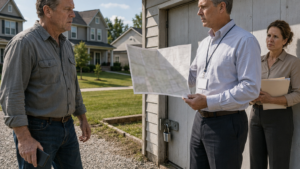
He poured the coffee into a travel mug, buttoned the same dark overcoat, tucked the folded survey inside, and picked up the folder. Outside, the morning smelled of wet mulch and stone. His driveway, narrow and slightly sloped, shone dark from the rain. The old oak beside it lifted its roots under the grass like knuckles beneath a blanket.
Jack was already at the hedge.
Of course he was.
He wore a quilted vest over a pale shirt, clean boots, and the expression of a man who had been inconvenienced by someone else’s stubbornness. He held his phone in one hand.
“Donald,” he said. “I hoped you’d come out. Easier when you see it in daylight.”
Donald stepped carefully across the damp grass. He did not hurry. Jack watched his feet as though waiting for him to slip.
The hedge had been trimmed hard on Jack’s side and left fuller on Donald’s. Beyond it, the retaining wall ran low and gray along the change in grade between the two properties. The crack was real. Donald saw that immediately. A dark uneven line traveled through three blocks and down toward a seam near the corner.
Real damage. Not fake. That mattered.
Jack pointed. “There. You can see how it starts under your oak.”
Donald did not answer. He stopped a few feet from the wall and looked at the ground first.
The soil near his side was damp, but not washed. Old leaves had collected in a shallow line along the hedge roots. His driveway sloped toward the street, not backward. It always had. He had complained about that slope years ago when winter runoff glazed near the mailbox.
On Jack’s side, the stone patio sat higher, newer, and cleaner than everything around it. A narrow drainage channel cut along its edge, half hidden beneath decorative river rock. The rock was darker than the rest, wet in a strip that ran toward the wall.
Donald crouched slowly, one hand braced on his knee.
Jack sighed. “Careful.”
Donald ignored that.
He touched the soil below the crack. It was soft, not just damp. The water stain on the stone did not spread from the oak side. It ran down from behind the patio lip, a faint brown fan beneath the drainage channel.
“You see the root?” Jack pressed. “Paul said roots can push laterally. It doesn’t have to be touching the wall right where the crack appears.”
Donald stood, slower than he wanted. His knee clicked.
“I see the crack,” he said.
Jack looked satisfied, as if that was an admission.
Donald took the folder from under his arm and opened it to the photograph page. He looked from the printed image to the wall itself.
In the photo, the crack was circled in red. A measuring tape lay across the top stone. Someone’s boot appeared in the lower corner. No chalk marks. No patio channel visible. The framing was tight, almost careful.
Donald shifted two steps to the left.
From there, the red-circled crack lined up not with his oak, but with the place where Jack’s patio drainage channel met the wall.
Jack followed him. “Donald, don’t make this harder. The association is being reasonable. You’ve lived here long enough to know repairs don’t get cheaper.”
Donald closed the folder.
“How long has that channel been there?”
Jack glanced toward the patio. “Drainage improvement. Last fall.”
“Approved by the board?”
Jack’s smile flickered. “It’s decorative grading. Nothing structural.”
“Water is structural when it keeps moving downhill.”
Jack’s expression cooled. “You always did enjoy splitting hairs.”
Donald turned back to the wall.
A small wooden stake had been pushed into the soil near the crack. A strip of blue tape clung to it, wet and wrinkled. On the stone itself, just below the top row, was a pale chalk line Donald had not noticed from the kitchen window. It made a bracket around the cracked area, ending near the patio side.
The chalk looked fresh. Too fresh to have survived the last two nights of rain unless it had been drawn that morning or late yesterday.
Donald opened the folder again and checked the first photograph.
No chalk line.
Second photograph. No chalk line.
Third. No chalk line.
Jack said, “Paul marked the repair section.”
“When?”
“Does it matter?”
Donald looked at the wall, then at the photograph.
The chalk line extended beyond the red circle, past the visible crack, toward the drainage channel. It was not measuring the damage as shown in the estimate. It was measuring what someone had decided to include after the photographs were taken.
Jack slipped his phone into his vest pocket. “The board meets next week. I’d rather not have to say you refused to cooperate.”
Donald let the folder rest against his side.
The old instinct rose in him, the one from years of work orders and maintenance logs: do not argue with the conclusion until you know who wrote the first line. Follow the mark. Follow the date. Follow the water.
He looked once more at the chalk.
There, just at the corner where the patio stones met the wall, the line had been drawn over a damp streak that had not dried, turning the chalk gray and thin.
Donald stepped closer, close enough to smell wet stone.
“Jack,” he said.
“What?”
“This mark wasn’t in Paul’s photographs.”
Jack’s eyes moved to the wall before he could stop them.
Donald saw it then—not guilt, not confession, nothing so clean. Just a quick calculation.
And that was enough to keep him looking.
Chapter 3: The Contractor Measured Only One Side
Paul Carter returned two days later with a clipboard, a measuring tape, and a form already clipped to the top.
Donald watched him from the kitchen window before opening the back door. Paul had parked his truck partly in front of Donald’s driveway, though there was open curb in front of Jack’s house. He stood near the retaining wall with Jack, both men looking down at the crack as if it were an object they had purchased and were deciding where to place.
Donald put on his overcoat. The folded survey went into the inside pocket. The dark folder went under his arm.
He did not bring coffee this time.
By the time he reached the hedge, Paul had pulled the measuring tape from the driveway side across the grass toward the wall. The bright yellow strip cut over Donald’s damp lawn, past the oak, and stopped at the cracked stones.
“That angle is wrong,” Donald said.
Paul looked up, his face already arranged into patience. “Morning, Mr. Walker.”
Jack stood behind him with his arms folded. “Paul’s just documenting the source area.”
“The source area,” Donald repeated.
“Your grade,” Paul said. “Your tree. Your runoff path.”
Donald stepped around the measuring tape, careful not to touch it. “You started from my driveway.”
“That’s the water path.”
“No.”
Paul exhaled through his nose. “Sir, with respect, this is what I do.”
Donald looked at the tape. It ran from the driveway edge to the crack in a clean diagonal line, persuasive if a person did not know where water went. But water did not travel by persuasion. It traveled by slope, by channel, by the lowest open path.
Donald pointed with two fingers toward Jack’s patio. “There’s a drain under that river rock.”
Jack’s arms tightened. “We discussed this.”
“No,” Donald said. “You dismissed it.”
Paul flipped a sheet on his clipboard. “The patio drain isn’t part of the damaged area.”
“It points at the damaged area.”
“It disperses along the edge.”
“It is wet now.”
“It rained.”
Donald turned his head slowly and looked at the sky. Pale sun. No rain since dawn.
Paul’s mouth shut for a moment.
Jack stepped in. “Donald, this is exactly why the board asked for a professional. We can’t have every homeowner inventing theories to avoid responsibility.”
A window opened somewhere behind them. A neighbor had begun listening.
Donald felt the heat of embarrassment move up his neck. Not because Jack had spoken loudly. Because Jack knew exactly how loud to speak.
Paul crouched by the wall and hooked the tape against the lower stone. “The repair crew will need access through your side. That’s another reason to get the acknowledgment signed today.”
He stood and held out the clipboard.
Donald did not take it.
Paul lowered it slightly. “This doesn’t mean payment is due this second. It authorizes the association to proceed and confirms responsibility pending final billing.”
Donald read the top line from where he stood.
PROPERTY DAMAGE RESPONSIBILITY AND ACCESS ACKNOWLEDGMENT.
Below it, his name had already been printed.
Donald Walker.
The letters looked too dark against the paper. Too certain.
Jack said, “It prevents delay fees.”
“It lets you bill me directly,” Donald said.
Paul blinked. “It confirms the responsible party.”
“No. It confirms that I agree to be called that.”
Jack gave a short laugh without humor. “That is wordplay.”
Donald looked at him. “Words are what liens are made of.”
For the first time, Paul’s patient expression thinned. He tapped the clipboard with the back of his pen. “Mr. Walker, if you refuse access and refuse acknowledgment, I have to note noncooperation. That goes in the packet.”
“What packet?”
“The inspection packet.”
“I asked for a copy.”
“You have the estimate.”
“I asked for the packet.”
Jack shifted. “The board handles official documents.”
Donald turned to Paul. “Did you photograph the patio drain?”
Paul glanced toward Jack’s patio. “Not relevant.”
“Did you measure from it?”
“No.”
“Did you test water flow?”
Paul’s jaw worked. “We’re not doing a hydrology study for a cracked backyard wall.”
Donald nodded once. “So you measured only from the side you wanted to blame.”
Jack stepped closer. “That is unfair.”
Donald looked at the measuring tape, stretched bright across his grass like a line someone else had drawn through his life. “It is.”
The word settled between them.
Jack’s face colored. “You’re making this personal.”
“It became personal when you put my name on a bill before checking your drain.”
From the open window, a curtain moved.
Paul unclipped the form and held it out again. “Last chance for today. Sign it, and you can write ‘under protest’ if that makes you more comfortable.”
Donald almost reached for the paper.
Not because he believed it. Because the morning was cold, his knee hurt, and the thought of being written up like a troublesome child scraped at something old and tired in him. He imagined Sarah hearing the word noncooperation. He imagined Cynthia repeating it in minutes. He imagined the board deciding he was confused, stubborn, difficult.
He saw himself from outside: old man in an overcoat, standing in wet grass, arguing about water.
Then he looked at the tape again.
It crossed the grass above the root line, but it did not touch the damp fan beneath Jack’s patio channel. It made a story by leaving out the part that mattered.
Donald took the clipboard.
Paul’s shoulders loosened.
Donald read the form fully, every line. Access authorization. Responsibility acknowledgment. Assessment recovery. Administrative fee. Failure to comply.
At the bottom, beside the signature line, Paul’s pen waited in the clip.
Donald handed it back.
“No.”
Paul stared at him. “No?”
“No signature.”
Jack said, “Donald, think carefully.”
“I am.”
Paul clipped the form back with a sharp snap. “Then I’ll report refusal to acknowledge and refusal to cooperate.”
“I’m not refusing access for inspection,” Donald said. “I’m refusing to sign a conclusion.”
Paul wrote something on the form. His handwriting was fast, hard, annoyed.
Donald watched the pen move.
Jack’s voice dropped. “You know how this will look.”
Donald tucked the folder under his arm again. “Yes.”
Paul tore a small pink copy from the bottom of the form and held it out. Donald took it. The paper was thin enough that his fingers bent it.
Across the top, Paul had written: OWNER DECLINED — NONCOOPERATIVE.
Donald folded it once and slid it into the dark folder.
Paul packed the tape with a metallic snap. Jack looked toward the open window, then back at Donald, measuring the damage done not to the wall, but to the room of opinion forming around them.
As Paul walked toward his truck, he turned and said, “The board won’t like this.”
Donald stood by the hedge until the truck door closed.
Then he looked past the crack, past the chalk, toward the narrow strip of river rock along Jack’s patio. A bead of water slipped out from under the stones and ran down the back of the wall, though the sky had been clear all morning.
Chapter 4: Sarah Said Paying Might Be Easier
Sarah Moore arrived that evening with a casserole Donald had not asked for and a face already arranged around worry.
He saw it through the kitchen window before she reached the porch. She got out of her car slowly, balancing the glass dish with both hands, scanning the house as if loose shingles or a sagging gutter might tell her something he had refused to say. The porch light had come on by itself at dusk. Donald had never liked that timer, but his wife had said it made the house look less lonely.
Sarah knocked once, then opened the door with her key.
“Dad?”
“In the kitchen.”
She came in with the smell of baked cheese and rain-damp wool. Her hair was pulled back too tightly, the way she wore it when she had driven over after work and tried not to look tired. She set the dish on the counter and looked at the dark folder on the table.
Donald had left it there on purpose. Not open. Not hidden.
Sarah saw the pink slip beside it.
“What’s that?”
“A note from the contractor.”
She picked it up before he could say more. Her eyes moved across Paul’s words. OWNER DECLINED — NONCOOPERATIVE.
Her mouth tightened. “Dad.”
Donald turned the kettle off before it whistled. “Tea?”
“Did you refuse to let them inspect?”
“No.”
“That’s what this says.”
“That’s what he wrote.”
Sarah held the paper with both hands, as if it might tear if she let one side go. “The HOA called me.”
Donald did not turn around right away. He took two mugs from the cabinet. One had a faded blue flower on it. The other said Grand Canyon, though he had never been there. His wife had bought it at a yard sale because she liked the shape.
“Who called?” he asked.
“Cynthia Roberts.”
Donald poured hot water into the mugs.
Sarah waited, then said, “She said there’s a dispute about damage to Jack Harris’s retaining wall. She said the board is trying to resolve it before legal fees start.”
“Cynthia likes words that make a thing sound already decided.”
“She said you seemed upset at the dinner.”
Donald placed the kettle back on the stove. “I was handed a bill in front of forty people.”
Sarah’s eyes softened, but only for a second. Worry took over again. “I know. That was wrong. I’m not saying it wasn’t.”
He put a tea bag in her mug and slid it toward her.
She did not sit.
“How much is it really?” she asked.
“Fourteen thousand eight hundred seventy.”
The number sat between them. Sarah looked toward the hallway, toward the living room where her mother’s framed photographs still stood on the shelf. Donald knew what she was calculating. His pension. The savings account. The roof he had patched last winter instead of replacing. The medication insurance did not cover the way it used to.
“They can’t just make you pay that,” she said, but her voice did not fully believe it.
“They can try.”
“Could insurance handle it?”
“Not if I sign that I caused it.”
“Then don’t sign. But maybe—” She stopped.
Donald looked at her.
Sarah set the pink slip down carefully. “Maybe there’s a way to settle before it grows. Not because you did anything wrong. Just because fighting them could cost more.”
He heard the care in it. That made it harder.
“Paying fourteen thousand dollars to avoid trouble is still trouble,” he said.
“I know.”
“No,” he said quietly. “You know it as a number. I know it as the new water heater I didn’t buy. The dental work I postponed. Your mother’s hospital bill I finished paying last April.”
Sarah closed her eyes briefly. “Dad.”
He regretted the last part as soon as he said it. Not because it was false. Because grief, when used in an argument, left fingerprints on both people.
He sat at the table. After a moment, Sarah sat across from him.
The dark folder lay between them like a third person.
She opened it and read the first page. Her eyes moved to the photographs. “This is the wall?”
“Yes.”
“It looks bad.”
“It is bad.”
“Could your tree have done some of it?”
Donald looked down at his hands.
That question should not have hurt. It was practical. It was fair, even. But after Jack, after Paul, after the room at the restaurant, hearing it from Sarah made the kitchen feel smaller.
“I don’t know everything yet,” he said. “But the water stain is on Jack’s side. Paul measured from mine.”
Sarah rubbed one hand over her forehead. “I’m not doubting you.”
“You are.”
“I’m trying to understand.”
“No,” he said, softer. “You’re trying to protect me from being embarrassed.”
Her face changed.
He looked toward the window. In the dark glass, he could see the reflection of the kitchen table, the folder, the two mugs untouched.
“When your mother was sick,” he said, “people started speaking to me slowly. Nurses, clerks, the man at the pharmacy. Not cruelly. Just slowly. Like every hard thing had made me less able to hear plain English.”
Sarah’s eyes filled, but she blinked it away. “I don’t do that.”
“Not often.”
She looked down.
Donald wished he could take the sentence back and knew he should not.
“I’m scared,” she said. “That’s all. I’m scared they’ll bury you in paperwork, and you’ll try to handle it alone because you don’t want anyone thinking you can’t.”
He looked at the folder. “I can be scared and still be right.”
Sarah reached across the table, then stopped before touching his hand. She had learned that from him, maybe. Leave a person one inch of dignity.
“What do you need?” she asked.
Donald breathed out slowly.
He almost said nothing. Habit rose faster than truth. Nothing. I’m fine. Don’t worry. Go home.
Instead he opened the folder and removed the folded yellow survey. He spread it partway between them. The old paper crackled under his fingers.
“Your mother kept a box,” he said. “House papers. Receipts. Old letters from the association. I thought most of it was useless.”
Sarah smiled faintly through her worry. “Mom never threw away anything with a staple.”
“She said memory gets expensive when you have to prove it twice.”
The line surprised him. He had not thought of it in years. His wife had said it while filing a receipt for a gutter repair he had insisted nobody would ever ask about.
Sarah touched one corner of the survey. “Where’s the box?”
Donald looked toward the hallway closet, then beyond it in his mind: the garage shelf, the plastic tubs, the cardboard banker’s box with his wife’s square handwriting across the lid.
“Not the box,” he said slowly. “A folder.”
“What folder?”
He saw it suddenly. Tan cardboard, red string tie, her handwriting on the front: DRAINAGE / WALL / MAPLE TRACE.
He had teased her for making a file that sounded like a lawsuit.
Donald stood.
Sarah rose with him. “Dad?”
He went to the hall closet and opened the door. Coats pressed forward. An umbrella fell and clattered against the floor.
Donald did not pick it up.
He was remembering his wife at this very closet, holding a folder in one hand and telling him, Donald, if water is involved, keep the paper.
He looked back at the dark repair folder on the kitchen table.
For the first time since Jack had placed it beside his glass, Donald felt something other than shame when he looked at it.
He felt the beginning of a path.
Chapter 5: The Folder His Wife Would Not Throw Away
The folder was not in the hall closet.
Donald found winter gloves, two old flashlights, a roll of shelf liner, Sarah’s school art in a cracked frame, three umbrellas, and a shoebox full of keys that did not fit any lock he remembered. He found tax envelopes from years when stamps still cost less than a cup of coffee. He found his wife’s gardening gloves, stiff with dried soil at the fingertips.
But not the tan folder.
Sarah offered to help, and Donald let her carry boxes to the kitchen, but he did not let her sort them. That was not pride exactly. It was order. His wife had arranged things according to a private map built from reasons only she and, sometimes, Donald understood. If Sarah began opening everything too quickly, she might move the one scrap that made sense of the rest.
By morning, Sarah had gone home, after leaving the casserole in the refrigerator and making him promise to call if he felt dizzy, cornered, overwhelmed, or stubborn.
“I can promise three of those,” Donald had said.
She did not laugh until she reached the door.
Now, with pale light coming through the kitchen curtains, Donald stood in the garage in his coat and slippers, looking at the high shelf above the pegboard.
There were four banker’s boxes up there.
He brought the step stool over and stared at it.
His balance had changed in the last few years. Not badly, not dramatically, but enough. Enough that he stood longer before climbing. Enough that he hated himself a little for standing longer.
“Slow is not the same as stopped,” his wife used to say when she saw him getting irritated with a jammed drawer or a stiff hinge.
Donald put one hand on the wall, stepped up, and pulled the first box down.
Christmas lights.
The second held instruction manuals for appliances they no longer owned.
The third was heavier. He lowered it carefully to the floor, sat on the stool, and lifted the lid.
House papers.
Not the folder at first. Insurance renewals. Roof patch receipts. A copy of a letter about mailbox height. HOA newsletters with smiling photographs of summer picnics. Donald sorted them into piles on the garage floor, the cold coming up through the concrete into his knees.
The tan folder was near the bottom, under a packet labeled SPRINKLER REPAIR — 2011.
DRAINAGE / WALL / MAPLE TRACE.
His wife’s handwriting was still firm in black marker. No flourish. No decoration. She had believed labels were promises you made to your future self.
Donald sat very still with the folder in his lap.
He had expected triumph, maybe. Relief. Instead, he felt the old ache of seeing her mind still working in a room where she was not.
He untied the red string.
Inside were papers arranged by year. She had paper-clipped some. Others had sticky notes, now pale and curled at the edges. The first page was a copy of the survey, cleaner than the folded one he kept in his coat. Beneath it was a repair receipt from sixteen years earlier.
REAR RETAINING WALL REINFORCEMENT — SOUTHWEST RUN.
Donald read the contractor’s description twice.
Reinforced existing wall along common drainage easement. Work performed on association-maintained boundary structure. Access from Walker lot and Harris lot by permission of prior owner.
Prior owner. Not Jack. The people before him had been quiet, older, gone now to a condo closer to their grandchildren.
Donald turned to the next page. A rough diagram showed the wall’s curve. Not straight along Jack’s current patio edge, as Paul’s estimate implied, but set slightly inside a drainage easement that crossed both lots. Donald traced the line with one finger.
The wall was not simply “behind the Harris property.” It had never been only Jack’s.
He took the folder to the kitchen and laid its contents beside the dark repair folder. The two looked like different languages. Jack’s folder was glossy, clean, aggressive with typed totals and color photographs. His wife’s folder was soft from age, full of receipts, notes, copies, and patience.
Donald made coffee and did not drink it.
He read through the repair receipt again. It did not clear him completely. He knew that. An old association-maintained structure could still be damaged by a homeowner’s tree or runoff. The receipt was not a magic door.
But it changed the room.
It meant Jack’s version had skipped history.
By noon, Donald had made three piles: property line, drainage, wall repair. He used soup cans to hold the corners of the survey flat. He found a note from his wife written on the back of an envelope.
Ask board: water from upper lots? Not just our oak.
He sat with that one a long time.
In the afternoon, he went back to the garage and found a smaller envelope tucked into the folder’s back pocket. It held photographs printed on drugstore paper. The colors had faded greenish, but the wall was visible, along with the hedge when it was younger and thinner. In one photo, Donald stood in the background holding a rake. His wife must have taken it without telling him.
He almost smiled.
Then he noticed the shallow swale behind the wall, open and grassy in the old picture. No patio. No river rock. No hidden channel. Water would have spread there before, slowed by grass and soil.
Jack’s patio had covered that open strip.
Donald placed the photograph beside Paul’s printed image from the estimate. Paul’s photo showed decorative stones where the grassy swale used to be.
Not proof, not yet. But a change.
He called the HOA office. Virginia Lopez answered on the fourth ring.
“Maple Trace Association.”
“This is Donald Walker.”
A pause. Not long enough to be rude, but long enough to mean she knew why he was calling. “Good afternoon, Mr. Walker.”
“I’d like the original inspection packet for the retaining wall complaint.”
“The board is still reviewing that matter.”
“I understand. I’d like the packet.”
“We can provide documents after the board completes its review.”
Donald looked at the tan folder. “The review is about me.”
“Yes, but some materials are internal.”
“Is the estimate internal?”
“No, you were given that.”
“Are the photographs internal?”
“You were given selected photographs.”
Selected. He wrote that word on a notepad.
“Are the minutes from the last board discussion available?”
Another pause. “Draft minutes are not final.”
“Then I’d like to know when final minutes will be approved.”
“Next Thursday, most likely.”
Donald looked at the calendar on the wall. The payment deadline printed in Jack’s folder was the day after that.
“Virginia,” he said, “if my name is already in a responsibility form, I should be allowed to see what made it get there.”
Her voice softened by half a degree. “You can submit a written records request.”
“To whom?”
“To the board.”
“Cynthia?”
“Yes.”
“Thank you.”
He hung up and wrote records request beneath selected photographs.
Then he turned back to his wife’s folder.
Near the bottom was a city notice folded in thirds. He had forgotten it entirely until the seal appeared under his thumb.
CITY STORMWATER MAINTENANCE ADVISORY.
The paper was dated nine years earlier. It referenced neighborhood runoff patterns after complaints from the lower lots. Donald adjusted his glasses.
Affected parcels: Lot 18, Lot 19, Lot 21.
He knew his own lot number. Everybody who had bought in the early years knew theirs from the plat maps and closing papers.
Donald Walker: Lot 17.
Jack Harris: Lot 19.
The notice did not mention his lot at all.
Donald laid it flat on the table, then set one hand over it, as if the paper might leave.
Outside, beyond the kitchen window, the hedge moved in the wind. Somewhere behind it, water still found the path people had made for it.
Donald looked toward the empty chair across from him.
“You kept it,” he said quietly.
The house gave no answer, but the folder did.
Chapter 6: The Offer That Still Called Him Guilty
The HOA office occupied the front room of the old clubhouse, a low brick building beside the neighborhood pool. Donald had voted against turning it into an office fifteen years earlier. He had said then that paperwork expanded to fill any room given to it.
His wife had laughed and voted yes.
Now he sat in one of the blue upholstered chairs facing Cynthia Roberts’s desk while the dark folder rested across his knees.
Cynthia had placed a glass of water near him. He noticed that and did not touch it.
Jack Harris stood by the window. He was not supposed to be part of the meeting, Donald had thought, but no one seemed surprised to see him there. Paul Carter was absent. In his place sat the estimate, printed again and clipped to Cynthia’s copy of the file.
Virginia Lopez sat at a side table with a laptop open, hands poised above the keyboard. She gave Donald a small nod when he entered, then looked down.
Cynthia folded her hands on the desk. “Donald, thank you for coming in. We all want to find a reasonable path forward.”
The word reasonable had begun to sound expensive.
Donald opened the dark folder but did not remove anything yet. Since the restaurant, he had added his own papers behind Jack’s estimate: the survey copy, the old reinforcement receipt, the city drainage advisory, photographs of the damp streak below Jack’s patio, and the pink noncooperation slip.
“I’m here to correct the responsibility claim,” he said.
Jack turned from the window. “We’re not holding a hearing.”
Cynthia gave him a look, then returned to Donald. “This is not a hearing. It’s a conversation. The board understands you have concerns.”
“I have records.”
“And we will consider them,” Cynthia said. “But the repair cannot wait indefinitely.”
Donald nodded. “Then the cause should not wait either.”
Cynthia drew a form from the file in front of her and turned it around.
Donald looked down.
AMENDED PAYMENT AGREEMENT.
His name appeared in the first paragraph.
Donald Walker agrees to contribute $7,435.00, representing fifty percent of the estimated repair cost, without prejudice to future board determination.
He read the sentence twice. The number was lower. That was what she wanted him to see first.
Cynthia’s voice softened. “This cuts the amount in half. No late fee if signed today. No lien process. No insurance escalation for now. It lets everyone move forward.”
Donald kept reading.
Responsible party contribution. Access cooperation. Matter closed upon payment unless further damage occurs.
He looked up. “This still calls me responsible.”
“It says contribution.”
“It says responsible party contribution.”
Jack sighed from the window. “Donald, it is half. Most people would appreciate that.”
Donald turned one page. “Most people might not read the second paragraph.”
Virginia’s fingers paused above the keyboard.
Cynthia’s smile thinned. “The language is standard.”
“For guilty people?”
“For disputed maintenance matters.”
Donald placed the form back on the desk with two fingers. “No.”
Jack stepped away from the window. “This is exactly what we were trying to avoid.”
Donald looked at him. “What were you trying to avoid?”
“Needless escalation.”
“You handed me a bill at dinner.”
Jack’s face tightened. “Because private notices had not gotten your attention.”
“One notice,” Donald said again. “Delivered one day before the dinner.”
Cynthia raised a hand. “Let’s stay focused.”
Donald opened his folder and removed the old repair receipt. He placed it on the desk. “The wall was reinforced sixteen years ago as an association-maintained boundary structure.”
Cynthia glanced at it but did not pick it up. “Historical maintenance doesn’t necessarily determine current responsibility.”
“No. But it means the wall is not simply Jack’s backyard wall damaged by my tree.”
Jack said, “Nobody said simply.”
Donald turned to him. “Paul did.”
Cynthia looked toward Virginia. “Please note that Mr. Walker has provided historical repair documentation.”
Virginia typed.
Donald placed the city drainage advisory beside the receipt. “This notice names Jack’s lot in a stormwater review. Not mine.”
Jack’s eyes sharpened. “That notice is nine years old.”
“So is the slope.”
“That was before my patio work.”
The room went very quiet.
Cynthia looked at Jack.
Donald did not move.
Jack’s mouth closed. He had heard it too.
Donald slid a photograph forward. Not the old one yet. The new one he had taken two mornings before. The narrow strip of river rock along Jack’s patio. The damp streak below it. The wall darkened in a line beneath the drain.
“This was taken the morning after Paul measured from my driveway,” Donald said. “No rain since dawn.”
Jack reached for the photograph, but Cynthia picked it up first.
“It rained the night before,” Jack said.
“Yes,” Donald said. “And water was still coming from under your patio stones the next morning.”
Cynthia set the photo down carefully. “Donald, these are points for review. They do not change the immediate need for repair.”
“I’m not refusing repair.”
“You refused to sign.”
“I refused to sign a conclusion.”
Virginia’s hands stilled again.
Cynthia leaned back. “The board minutes from Monday reflect that you were identified as the responsible party based on the contractor’s preliminary assessment and visible conditions.”
Donald felt the words enter him slowly.
“Minutes,” he said.
“Draft minutes,” Cynthia said.
“May I see them?”
“They are not approved yet.”
“But they already call me responsible.”
Cynthia’s face shifted, just enough to show irritation under the polish. “The board had to document the basis for action.”
Donald looked at the amended agreement, then at his name inside it.
Action. Contribution. Cooperation. Responsible. The words made a net. Not one knot strong enough by itself, but together enough to hold a man still.
He reached into the folder and removed the pink slip Paul had given him. He placed it beside Cynthia’s form.
“Paul wrote that I was noncooperative because I would not sign this same net under a different title.”
Jack made a sound under his breath. “This is getting theatrical.”
Donald turned to him. “No. The restaurant was theatrical.”
Virginia looked down quickly.
Cynthia inhaled. “Donald, what exactly are you asking for today?”
“The original inspection packet. All photographs. All notes. The basis for putting my name in the minutes. And the board to remove responsible party language until a neutral inspection reviews the drainage.”
“We cannot rewrite every document because you object.”
“I’m not asking you to rewrite every document.”
“What are you asking?”
Donald tapped the amended agreement once. “I’m asking you to stop writing the ending before checking the first page.”
No one spoke.
Cynthia looked at Virginia. Something passed between them—not agreement, but procedure waking up and realizing it had been seen.
Virginia cleared her throat. “Homeowners can request supporting records for an assessment affecting their lot.”
Jack turned. “This isn’t an assessment yet.”
“It references one,” Virginia said quietly.
Cynthia’s eyes moved to the form. Then to Donald. “You’ll need to submit the request in writing.”
Donald took a sheet from his folder. He had written it the night before in careful block letters, then copied it cleanly that morning.
He placed it on the desk.
Cynthia did not pick it up at first.
Jack said, “This is unnecessary.”
Donald looked at him, then at the window beyond him, where the pool deck lay empty in the gray afternoon.
“Fourteen thousand dollars is necessary to me,” he said.
Virginia rose and came around the side table. She picked up Donald’s request before Cynthia could stop her. Her eyes moved down the page.
“I can log it today,” she said.
Cynthia’s mouth tightened, but she nodded once. “Log it.”
Donald closed the dark folder. It felt heavier now, but not with accusation.
As he stood, Jack spoke from near the window. “You know, Donald, people are trying to help you avoid making this worse.”
Donald put the folder under his arm.
“That’s what worries me,” he said.
At the door, he looked back. Virginia still held his records request. Cynthia was staring at the amended agreement as if the printed name on it had become less convenient than it had been ten minutes before.
Donald paused with his hand on the knob.
“One more thing,” he said. “Who approved the wording before the inspection packet was complete?”
Virginia looked at Cynthia.
Cynthia looked at Jack.
And Jack, for once, had no ready
Chapter 7: The Date on the Photograph
The city records office smelled faintly of paper, floor wax, and raincoats that had dried too many times on the same wooden rack.
Donald stood at the counter with his dark folder held flat against his chest. Behind the counter, the clerk examined his request form through narrow reading glasses, then looked from the form to Donald as if deciding how much patience the morning could spare.
“Stormwater advisories by lot number?” the clerk asked.
“Yes.”
“For Maple Trace?”
“Yes.”
“Those files may be archived.”
“I expected that.”
The clerk glanced at the folder. “Most people don’t.”
Donald said nothing.
That seemed to help.
The clerk disappeared through a door behind the counter, leaving Donald alone beneath fluorescent lights that hummed softly above him. On a bulletin board beside the permit window, public notices curled at the corners. Road closures. Water restrictions. A diagram showing how to keep leaves out of storm drains. Someone had drawn a smile on the raindrop mascot with blue marker.
Donald lowered himself onto the bench by the wall.
The folder sat on his lap. It no longer felt like Jack’s folder, though Jack’s estimate was still inside. Donald had added his wife’s papers behind it, then his own notes, then photographs he had printed at the pharmacy because he did not trust a phone screen to make a point in a boardroom. The folder was beginning to bulge at the brass corners.
He opened it and removed Paul’s estimate.
The photographs bothered him more each time he looked at them. The first image was dated March seventh. The demand notice blamed a storm on March twelfth. Paul had said the date might be when the file was created. But all three photos carried the same faint marking in the lower corner, and the shadows in them suggested morning light from the east. Donald did not know whether that mattered. He only knew people who worked carefully did not explain dates away before checking them.
The clerk returned with a thin packet and a larger rolled sheet held by a rubber band.
“Not everything is digitized,” the clerk said, as if warning him not to expect miracles.
“I don’t need miracles.”
The clerk looked at him over the glasses. “Good. We’re out.”
Donald almost smiled.
She spread the rolled sheet on the counter and weighted the corners with a tape dispenser and a stapler. It was a drainage map, old enough that some lot numbers had been corrected by hand. Donald leaned close. Lot 17. His. Lot 19. Jack’s. A shallow drainage easement crossed behind both properties before bending toward the lower catch basin near the end of the block.
The clerk tapped a line with one fingernail. “This advisory was issued after complaints from lower parcels. It doesn’t assign blame, but it identifies runoff patterns.”
“It names Lot 19.”
“It names several lots.”
“Not Lot 17.”
“No.”
Donald let the answer settle. Not victory. A peg in the wall. Something to hang the next fact on.
“Can I get a copy?”
“For a fee.”
He paid with cash and waited while the machine warmed, clicked, and breathed out copies with soft mechanical sighs. He asked for the permit history for Lot 19, and the clerk gave him a look that suggested he had finally asked the right question.
The patio work had a landscaping permit. Decorative hardscape, nonstructural. No drainage alteration listed.
Donald read the line twice.
Outside, rain had begun again, light enough to float rather than fall. He sat in his car with the packet on the passenger seat and did not start the engine. His hands rested on the steering wheel. The city documents did not say Jack had caused the damage. They said water crossed Jack’s lot. They said no drainage alteration had been declared. They said the old easement had not disappeared because someone covered it with river rock.
A story was forming, but it had gaps.
At home, Donald spread everything across the kitchen table. The folded survey lay under a glass of water to flatten its stubborn crease. His wife’s repair receipt sat beside the city copy. Paul’s estimate sat at the top, still loud with its total.
He made a timeline on a yellow legal pad.
Sixteen years ago: association wall reinforcement.
Nine years ago: stormwater advisory names Lot 19.
Last fall: Jack installs patio.
March seventh: Paul’s photo of crack.
March twelfth: storm cited in demand notice.
Friday dinner: repair bill presented.
He stared at the list until the lines began to blur.
The final proof was not one thing. That troubled him. People liked one thing. One photograph. One confession. One sentence with a stamp on it. But houses did not fail in one sentence. Water did not move by confession. Paper only told the truth when arranged in the right order.
He put on his coat and went outside again.
The rain was still light. Donald walked along his driveway first, watching where water collected. It ran toward the street, as it always had. A thin stream traveled along the curb, carrying a brown leaf past his mailbox.
He went through the side gate to the hedge. The wall looked darker in the rain. The chalk marks had faded, but a ghost of them remained on the upper stones. Behind Jack’s patio, water slipped from beneath the river rock in three narrow points, not one. It gathered along the back of the wall before dropping down the crack line.
Donald took photographs. Not many. He did not want to look like Paul, building a story by choosing only what helped. He photographed the driveway slope. The oak. The dry soil near the root flare under the branches. The patio channel. The wall. The crack. The old swale line visible only where grass still dipped near the hedge.
A door opened.
Jack stood on his patio under a large black umbrella. “Documenting again?”
Donald lowered his phone. “Yes.”
“You’re trespassing if you cross the hedge.”
“I’m on my side.”
“That camera isn’t.”
Donald looked at the phone in his hand. “It sees what water sees.”
Jack came closer, stopping at the patio edge. The umbrella hid half his face. “You’re turning a maintenance issue into an accusation.”
“No,” Donald said. “You did that.”
Jack’s mouth tightened. Rain tapped against the umbrella.
“I tried to reduce the amount,” Jack said.
“You tried to reduce the price of a lie.”
Jack’s eyes hardened. For a moment the polished neighbor disappeared, and Donald saw a tired, angry man with a wet patio and a cracked wall and a bill he did not want either. It did not make Jack right. It made him more dangerous than a simple bully. A simple bully might get bored. A worried man with status to protect would keep pressing.
“You don’t know what you’re talking about,” Jack said.
Donald put the phone in his pocket. “Then bring all of it to the meeting.”
“All of what?”
“The permit. Paul’s original photos. The inspection notes. The reason the photo is dated before the storm.”
Jack’s face changed at the photo date.
Small. Quick. Enough.
Donald went back inside and printed the new photographs on plain paper. The colors came out dull, but the wet streaks were visible. He placed them beside Paul’s glossy images.
That evening, Virginia called.
“I logged your request,” she said. Her voice was low, as if she were speaking from a room where other people might hear. “You can pick up copies of the inspection packet tomorrow.”
“Thank you.”
“There’s something you should know.” She paused. “The first inspection note doesn’t mention the March twelfth storm. That language appears later.”
Donald sat down slowly.
“Later when?”
“After the estimate was revised.”
He looked at the yellow legal pad.
Revised estimate.
Another peg.
Virginia added, “I’m not saying what it means.”
“I know.”
“I just thought you should compare the dates.”
Donald thanked her and hung up.
For a long while, he sat in the kitchen with his hand resting on the folded survey. The glass of water had flattened most of the paper, but one crease remained raised, a pale ridge across the map.
He moved the estimate, the drainage notice, the permit copy, the old receipt, and the photographs into a single line.
Not proof by thunder. Proof by order.
At the bottom of the legal pad, he wrote one sentence in block letters.
The damage was photographed before the storm, after the patio, along the old drainage path.
Then he crossed out the first two words and rewrote them.
The water was photographed before the storm, after the patio, along the old drainage path.
That was closer.
Donald looked toward the empty chair across from him.
“I won’t say more than I know,” he said.
The house was quiet.
He closed the dark folder, then opened it again and arranged the papers in order, not by which one hurt most, but by which one came first.
Chapter 8: The Folder Opened the Other Way
The special HOA meeting was not held at the restaurant, though Donald heard later that Jack had suggested it.
Instead, they met in the clubhouse room with the blue chairs, the folding tables, and the framed watercolor of Maple Trace before the houses had grown mature trees. The room was smaller than the restaurant’s private dining room. That made the silence different. Less elegant. Harder to hide inside.
Donald arrived early.
He wore the same dark overcoat. The folded survey was in his inside pocket, though a clean copy lay in the folder. He wanted the old one near his heart, not because it proved more, but because his wife’s hands had touched it enough times to soften the paper.
Cynthia sat at the center table with Virginia to her right. Jack sat two chairs down, a neat stack of papers in front of him. Paul Carter stood near the wall with his clipboard held against his thigh. A few residents filled the back rows, curious without wanting to look curious.
Donald took the chair across from Cynthia.
For a moment no one spoke.
Then Donald placed the dark folder on the table.
Not beside his water glass this time. Not near the edge where someone else could turn it toward him. He placed it in the center, opened it toward the board, and rested both hands on either side.
Cynthia looked at the folder, then at Donald. “We’re here to review the disputed retaining-wall repair responsibility.”
Jack leaned back. “And to avoid further delay.”
Donald turned the first page.
“The wall should be repaired,” he said.
That seemed to surprise them.
He continued before Jack could use it. “I am not disputing the crack. I am disputing the story attached to it.”
Virginia began typing.
Paul shifted against the wall. “The estimate was based on visible conditions.”
Donald nodded. “Visible from one side.”
Jack’s chair creaked. “Donald, we’ve been through this.”
“No,” Donald said. “You’ve been around it.”
Cynthia raised a hand. “Let him present.”
Donald was grateful for the sentence and did not show it. He slid the old reinforcement receipt forward.
“Sixteen years ago, the association paid to reinforce this wall as a boundary and drainage structure. Not as Jack’s private wall. Not as mine.”
Cynthia picked it up this time. She read the description, then passed it to Virginia.
Jack said, “Historical work doesn’t prove current cause.”
“Correct,” Donald said.
He did not rush. Rushing had been their tool. He would not borrow it.
He placed the city stormwater advisory beside the receipt. “Nine years ago, the city identified runoff patterns crossing Lot 19. Jack’s lot. My lot is 17. It is not named.”
Jack leaned forward. “That advisory named several lots in a broad area.”
“Yes.”
“Not a specific cause.”
“Correct.”
Paul’s expression flickered, as if Donald’s agreement made it harder to push back.
Donald placed the permit copy next. “Last fall, Jack installed patio hardscape on Lot 19. The permit lists decorative work. It does not list drainage alteration.”
Jack’s voice sharpened. “Because there was no drainage alteration.”
Donald looked at him. “There is a drain under the river rock.”
“It disperses water.”
“Toward the old drainage path.”
Jack looked at Cynthia. “This is speculation.”
Donald removed two photographs. One from his wife’s old folder, showing the grassy swale before Jack’s patio. One from the week before, showing the river rock and damp streak beneath it.
He set them side by side.
The room leaned in without moving.
Donald touched the older photo. “This was the open swale behind the wall.”
Then the newer one. “This is the same area now.”
Cynthia’s eyes moved between the two.
Paul cleared his throat. “Those photos are from different years, different conditions, different—”
“Different surfaces,” Donald said. “Yes.”
Paul stopped.
Donald turned to the next sheet: Paul’s estimate photograph, the crack circled in red. He placed it in front of Cynthia.
“This photo is dated March seventh.”
Cynthia looked at Paul.
Paul stepped away from the wall. “Again, that may be a file date.”
Donald placed the inspection packet Virginia had provided beside it. “The original inspection note also references March seventh.”
Virginia’s typing slowed.
Paul came closer. “Let me see that.”
Donald did not move the paper toward him. “You have your copy.”
Jack said, “The storm on March twelfth worsened preexisting damage. That is what the board understood.”
Donald looked at him. “The first notice I received says the damage resulted from the March twelfth storm and runoff from my property. The first inspection note does not mention that storm. The revised estimate does.”
Cynthia turned a page from the packet. Her face had gone still.
Donald placed the demand notice down last. The paper that had started it. The number. The language. The threat of fees.
“By the time this reached me,” he said, “the story had changed from a crack photographed on March seventh to storm damage blamed on me after March twelfth.”
Jack’s palm flattened on the table. “You are implying someone lied.”
Donald looked at him for a long moment.
In the back row, a chair leg scraped softly against the floor.
“I am saying the paperwork moved faster than the truth,” Donald said.
The sentence left him tired, but steady.
Cynthia looked at Paul. “Why was the March twelfth storm added to the revised estimate?”
Paul’s face colored. “The board asked whether recent weather could have contributed.”
“That isn’t what she asked,” Donald said.
Paul glanced at Jack.
It was brief. Not an answer. But every person at the front table saw it.
Jack sat upright. “I provided context. The storm caused visible worsening. My patio has nothing to do with Donald’s oak roots pressing into that grade.”
Donald removed the survey copy and opened it fully. The old property lines, the drainage easement, the rear wall curve. He had marked nothing in pen. He had used removable tabs, because his wife would have disliked ink on an original copy.
“My oak is here,” he said. “The crack is here. The drainage easement bends here. Jack’s patio covers this section.”
Paul said, “Roots can travel.”
“Water travels where it is sent.”
Jack gave a short, frustrated laugh. “Now you’re an engineer?”
Donald felt the old heat rise. The restaurant came back: the folder by the glass, Jack behind his chair, Paul leaning over him, the room waiting for him to shrink.
He took the folded yellow survey from his coat pocket.
Not the copy. The old one.
He opened it carefully. The worn creases resisted, then gave way. He laid it over the clean copy, aligning the corners with patient fingers.
“No,” he said. “I am a man who has lived beside that wall for thirty-two years.”
No one answered.
Donald continued, “I watched the old swale carry water before the hedge grew thick. I watched the association reinforce the wall when it first bowed. I watched Jack’s patio go in last fall. I watched Paul measure from my driveway and not from the drain. I watched a photo from March seventh become a bill for a storm on March twelfth.”
He looked at Cynthia, not Jack. “I will not sign a form that calls me responsible because I was quiet while other people spoke faster.”
Virginia’s hands were still.
Cynthia lowered her eyes to the documents. The room waited with her.
When she spoke, her voice was careful in a different way than before. Less polished. More official. “The board will withdraw the payment agreement pending a neutral inspection.”
Jack turned sharply. “Cynthia.”
She did not look at him. “The minutes identifying Mr. Walker as responsible will be corrected to say responsibility is disputed and under review.”
Donald let out a breath he had not meant anyone to hear.
Paul shifted his clipboard from one hand to the other. “The wall still needs repair.”
Cynthia nodded. “And the inspection will include drainage from both properties, the patio hardscape, the easement, and the wall history.”
Jack’s face had gone pale with anger. “This is an overreaction to an old man’s paperwork.”
The room froze.
Donald looked at him.
There it was, finally. Not the polite words. Not the neighborly concern. The thing underneath.
An old man’s paperwork.
Donald gathered the pages slowly. The repair receipt. The advisory. The permit. The photographs. Paul’s estimate. The notice. He did not hurry, because no one interrupted him now.
Then he slid the corrected meeting note Cynthia had written by hand across the table toward himself and read it.
Payment demand withdrawn pending neutral inspection. Prior responsible-party language to be amended.
It was not dramatic. It was not an apology. It did not fix the wall. It did not make Jack kind or Paul careful or Cynthia brave.
But it removed Donald’s name from a lie.
He left the corrected notice on the table.
Cynthia looked up. “Mr. Walker, don’t you want a copy?”
“I’ll pick up the official one when Virginia enters it.”
Virginia nodded once.
Donald placed the clean copies back into the dark folder. Last, he lifted the old folded survey. He ran his thumb once across the softened crease, then folded it along the lines it already knew.
Jack stared at him from the end of the table.
Donald put the survey into the inside pocket of his overcoat.
At the door, Sarah stood just outside the room. Donald had not known she was coming. Her eyes were wet, but she did not rush to him. She did not take his arm. She simply stepped aside so he could pass through under his own balance.
That small mercy nearly undid him.
In the hallway, she said, “Dad.”
He stopped.
“I’m sorry I thought paying might be easier.”
Donald looked through the glass door toward the dark outline of the neighborhood, the wet pavement shining under the clubhouse lights.
“It would have been easier,” he said.
Sarah looked at him.
He buttoned his overcoat slowly. “That was the problem.”
Outside, the rain had stopped. Water still moved somewhere under lawns, under stone, under the hidden paths people forgot until something cracked.
Donald walked to his car with the dark folder under his arm, lighter than it had been when Jack first placed it beside his glass.
At home, he would put the folder on the kitchen table. Tomorrow, he would call about the official minutes. Next week, he would meet the neutral inspector at the wall and show only what he knew, not more.
But the folded survey would stay in his coat.
Some papers belonged in files.
Some belonged close enough to remind a man that memory was not weakness, and silence was not surrender.
The story has ended.