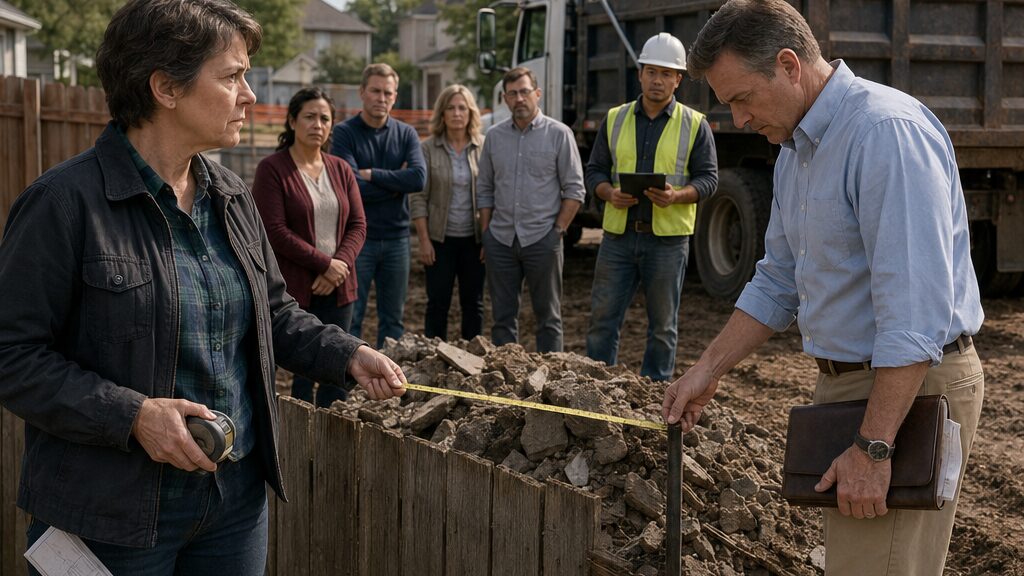
They Called Her Yard “Temporary Storage” Until the HOA Records Exposed Who Had Been Lying
Chapter 1: The First Load Fell Behind Her Fence
The first board struck the cedar fence hard enough to make Debra Wilson turn before the rest of the load came down.
She was ten yards away with a mug in one hand and her back door still open behind her when broken plywood, chunks of drywall, bent metal, and gray construction dust poured from the raised bed of a dump truck. The debris landed on the far side of the fence, but not neatly. A length of splintered lumber bounced over the top rail. Something heavier slammed low against the boards with a hollow crack.
Debra set the mug on the patio without looking where.
“Hey!”
The truck’s reverse alarm kept beeping.
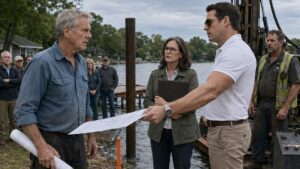
She crossed the yard fast, one hand lifted as if the driver could somehow see through six feet of cedar. Beyond the fence, the narrow strip of rough ground between her property and the clubhouse renovation site had been scraped bare over the previous week. Orange fencing sagged around trenches. A compact excavator idled beside a row of drainage pipe. The dump truck sat at an angle, rear wheels sunk in pale soil.
A man in a white hard hat looked up from a tablet.
“Stop that truck,” Debra called.
He glanced toward the driver, then back at her.
The bed continued to rise.
“Stop it.”
This time her voice cut through the machinery. The man made a small circling motion with one hand. The truck bed paused.
Debra pushed through the side gate and walked around to the project entrance. By then, dust had settled over the weeds behind her fence.
The man met her halfway.
“Ma’am, you can’t be in the work zone.”
“That load just hit my fence.”
He looked past her shoulder, almost casually. “It’s temporary storage.”
“Storage?”
“Staging. Whatever you want to call it.”
Debra stared at him. He was perhaps forty, clean-shaven, high-visibility vest zipped over a dark polo. The name printed on his hard hat read KEVIN.
“You dumped construction waste against my property.”
Kevin Lee shifted the tablet under one arm. “We’re clearing it out as the project moves.”
“That isn’t an answer.”
“It’s not permanent.”
Debra heard herself become quieter. That usually happened when she was angriest.
“You need to move it.”
Kevin exhaled through his nose. “The association approved this area.”
“What area?”
“This strip.”
“This strip belongs to me.”
Now he gave her his full attention, though not in the way she wanted. His expression suggested he had just identified the category of inconvenience she represented.
“No,” he said. “This is maintenance access.”
“My fence is right there.”
“Exactly.”
Debra looked from him to the pile. One broken panel had wedged upright against the cedar boards. A black trash bag hung torn from a nail. Dust coated the lowest slats.
She took out her phone.
Kevin’s mouth tightened. “You can take pictures. That’s fine.”
“I wasn’t asking.”
She photographed the pile, the truck, the position of the rear wheels, the excavator, then stepped sideways until the license plate came into view.
Kevin watched her do it.
“You know,” he said, “we’ve got a schedule.”
“So do I.”
He laughed once, without much humor. “I mean a real project schedule.”
The insult was small enough that another person might have let it pass.
Debra turned toward him.
For seven years she had done medical billing from the desk in her spare bedroom. She corrected denied claims, traced missing authorization numbers, found errors in twenty-page hospital accounts. She spent her days noticing what other people had overlooked and was paid, modestly, for being hard to confuse.
Kevin knew none of that.
He saw a woman in house shoes standing beside a construction site.
“Move it,” she said.
A black SUV rolled slowly along the access lane before Kevin could answer.
Debra recognized it before the driver’s door opened.
Scott Roberts stepped out wearing khakis and a blue button-down shirt with the sleeves rolled once at the wrist. He had been HOA president for three years and her neighbor, in the broad suburban sense, for nearly fourteen. They had exchanged holiday greetings, argued once about mailbox paint colors at a meeting, and stood together at a memorial bench dedication after her husband died.
“Debra,” he said. “I heard there was an issue.”
Kevin gave a short shrug. “She says we’re on her land.”
Scott looked at the pile and then at the fence.
“It hit my fence,” Debra said.
“I can see that.”
“And he says this is storage.”
“Temporary staging.”
The phrase landed differently coming from Scott. Smoother. More official.
Debra folded her arms. “On whose property?”
Scott glanced toward Kevin as though the answer were obvious enough to be tedious.
“The association has maintenance access back here. You know that.”
“No. I know there’s drainage behind these lots.”
“Right.”
“That is not the same thing.”
Scott’s expression shifted. Not anger. Patience.
That bothered her more.
“The board approved the project footprint,” he said. “The contractor is using the access area while the old drainage line is replaced. It’s temporary.”
“You keep saying temporary like that changes ownership.”
“It changes context.”
“No, Scott. It changes duration.”
Kevin looked away, but Debra saw the corner of his mouth move.
Scott lowered his voice.
“This project has been delayed twice. People on the lower side of the development have had water in their basements. We finally got the permits, finally got a contractor, and we’re trying to get major excavation done before the next heavy rain pattern.”
“I’m not stopping drainage work.”
“You’re asking them to clear a work area they were told they could use.”
“I’m asking them to stop dumping against my fence.”
“A fence,” Scott said carefully, “is not always a property line.”
For one second, Debra said nothing.
The words irritated her because they sounded prepared.
Scott continued. “There’s an association-controlled maintenance strip behind these homes. The management company provided the project map. Kevin’s crew is operating within it.”
“Show me.”
“I don’t carry the whole file in my car.”
“Then tell him to stop until you can.”
Scott rubbed a thumb over his jaw.
“That’s not reasonable.”
Debra looked past him at the truck.
The driver had lowered the bed. Another truck waited farther down the access lane.
“You think continuing after I’ve told you this land is disputed is reasonable?”
“I think,” Scott said, “that we should not turn a few feet of unused ground into a crisis before we verify what we already have on record.”
Unused ground.
Debra felt the phrase settle somewhere colder than anger.
That strip had held volunteer black-eyed Susans before the utility crews tore them out years ago. Her husband had once set a folding chair there while replacing three warped fence boards. There had been a bird feeder near the corner until raccoons kept pulling it down.
Unused, because Scott had never used it.
Debra raised her phone again and took a photograph of the truck plate.
Then another of the pile against the cedar.
Then one wide enough to include Scott and Kevin, both standing inside the scraped strip.
Scott noticed.
“Really?”
“Yes.”
“Debra.”
She put the phone down.
“You’ve told me your position. Now I have it with a date.”
Something changed in his face.
Not fear. Not yet.
Annoyance.
Kevin turned toward the waiting truck. “Can I keep moving?”
Scott looked at Debra.
She held his gaze.
After a moment, he said, “Keep it away from the fence.”
“That’s not what I asked.”
“I heard what you asked.”
Kevin gave the driver a signal.
The engine changed pitch.
Debra stepped backward as the next truck began creeping forward.
She did not shout again.
By noon, the first pile had been shifted eighteen inches away from the cedar boards. Nothing had been removed.
That evening, Debra printed four photographs at the kitchen table.
She wrote the time beneath each one.
8:14 a.m.
8:19.
8:27.
8:31.
Then she opened the lower cabinet where she kept closing papers, tax receipts, appliance warranties, and every document she had been unable to throw away since her husband’s death.
The property file was not where she remembered.
She checked a second drawer, then a cardboard bank box in the pantry.
At the bottom lay a thick manila folder faded along one edge.
PROPERTY—LOT 118 had been written across the front in her husband’s square black handwriting.
Debra sat down.
There was a second line beneath it, smaller and added later.
FENCE IS NOT THE LINE.
Chapter 2: Every Morning Brought Another Truck
At 5:47 the next morning, the reverse alarm started before Debra’s coffee maker finished dripping.
She was out of bed and at the back window in seconds.
Red lights blinked through the slats of the cedar fence. A diesel engine growled low enough to vibrate the glass. Then came the metallic bang of a tailgate.
Debra grabbed her phone.
By the time she reached the yard, another load was sliding down.
Not the same debris as Monday.
This was heavier: torn bags of hardened concrete, twisted lengths of metal, mud-caked pipe sections, broken pallets. The pile landed several feet from the fence as Scott had instructed, but its edge spread outward across the scraped ground.
Debra took three photographs before anyone saw her.
The plate was different.
She went inside and wrote it down.
That became the beginning of the ledger.
At first she kept it on the yellow legal pad beside her computer.
Tuesday, 5:49 a.m. — white dump truck — plate ending 42K.
Tuesday, 11:16 a.m. — same truck? Photograph unclear.
Wednesday, 7:03 a.m. — blue cab — full plate visible.
Wednesday, 2:38 p.m. — white truck from Tuesday returns.
By Thursday, she transferred everything to a spreadsheet.
Date.
Time.
Vehicle.
Plate.
Load description.
Photograph number.
She told herself she was only organizing.
She did not tell anyone else.
Katherine Perez called on Thursday afternoon while Debra was reconciling insurance adjustments for a clinic account.
“I saw trucks back there again,” Katherine said.
“Yes.”
“Do you need anything?”
Debra looked through the kitchen window at the top of a bent metal frame now visible above the fence.
“No.”
There was a pause.
“Are you sure?”
“I’m handling it.”
“I heard there’s some confusion about the access strip.”
Debra’s fingers stopped on the keyboard.
“From whom?”
“I don’t know. People talk.”
“People always talk.”
“I just meant—”
“I know what you meant.”
Another pause, longer this time.
Katherine said, “All right.”
Debra regretted the sharpness as soon as the call ended.
She did not call back.
On Friday morning, she phoned the management company.
She was calm.
She gave her address, lot number, and the project name from the sign near the clubhouse.
The representative put her on hold twice.
When he returned, he said, “The contractor is operating under board-approved access.”
“I’m asking whether that access includes storage of construction debris.”
“I can’t interpret project documents for you.”
“Then connect me to someone who can.”
“The board would be the appropriate contact.”
“I have already spoken to the board president.”
“Then I’m not sure what else I can offer.”
Debra looked at the photograph on her kitchen table.
A broken pipe section lay half buried beneath greasy metal.
“You could answer whether your company verified the parcel boundary before giving the contractor a map.”
Silence.
Then the representative said, “You may want to submit your concern in writing.”
“I did. Yesterday.”
“I don’t see it here.”
“I have the delivery confirmation.”
Another silence.
This one gave her more satisfaction than it should have.
“I’ll look into it,” he said.
Nothing changed.
Every morning, more arrived.
By the eighth day, the debris rose high enough that Debra could see it from the breakfast table. One corner of the cedar fence leaned inward where something had struck it. She measured the gap between two boards and photographed that too.
On the tenth day, the smell began.
It was faint at first. Oily, sour, difficult to place.
Debra walked the fence line with her phone held low. Near the far corner, beneath a section of snapped black pipe, something dark had soaked into the soil.
She crouched but did not touch it.
A drop gathered at the broken edge of the pipe and fell.
She photographed the stain.
Then she called the site office.
Kevin answered.
“There’s liquid leaking from material in the pile.”
“What kind?”
“I don’t know. That’s why I’m calling.”
“Probably rainwater.”
“It hasn’t rained in four days.”
“Could be residual.”
“Residual what?”
Kevin sighed.
“Debra, I’m not standing back there looking at it.”
“Then come look.”
“We’re working.”
“You’re storing it behind my fence.”
“We’ve been through this.”
“No. You’ve repeated yourself. That isn’t the same thing.”
His voice hardened.
“If you believe there’s a hazard, call the county.”
The line went dead.
Debra stared at the phone.
Then she said aloud, to an empty kitchen, “Fine.”
She printed the photograph of the dark stain.
She printed the truck from 5:49 Tuesday.
Then the same white truck from Wednesday afternoon.
She placed them side by side.
The plates matched.
So did the scrape along the passenger door.
Debra went back through the folder on her computer.
The blue-cab truck from Wednesday had returned Saturday.
A gray truck had appeared on three separate mornings.
What had looked like a random stream of vehicles was not random.
The same trucks were coming back.
She expanded the ledger.
Load one.
Load two.
Load three.
By Sunday night, she had documented fourteen separate arrivals.
Some were only staging equipment. Some were unmistakable deposits.
She marked the distinction because she did not want anyone later accusing her of exaggeration.
On Monday morning, an email from the HOA arrived.
The subject line read COMMUNITY PROJECT UPDATE.
Debra opened it while standing at the counter.
The first two paragraphs discussed drainage improvements and thanked residents for their patience.
The third paragraph tightened something in her chest.
Recent questions have arisen regarding temporary contractor access near several rear lot areas. The Association is working to address a misunderstanding with an adjacent homeowner while avoiding disruption to improvements intended to reduce flooding risk for the community.
An adjacent homeowner.
A misunderstanding.
Debra read it twice.
Then a third time.
No name.
It did not need one.
The lower-side homes had suffered water damage. Everyone knew the project route. Everyone knew which backyard bordered the disputed strip.
Her phone buzzed ten minutes later.
A neighbor from two streets over had sent a message.
Hope this gets worked out. We really need that drainage fixed.
Debra did not respond.
At noon, Katherine texted.
I’m guessing you saw the email.
Debra turned the phone face down.
That evening, she spread the photographs across the kitchen table.
Fourteen arrivals.
Nine clear deposits.
Six readable plates.
One recurring truck on three different dates.
A dark stain beneath a broken pipe.
A damaged fence.
She opened a new document and titled it CHRONOLOGY.
For the first time since the dumping began, her fear felt useful.
She went back to the manila property folder.
Inside were closing documents, a title policy, a plat copy, tax maps, and a survey dated years earlier.
Debra unfolded the survey across the table.
The print was small. She found Lot 118, then traced the rear boundary with one finger.
The line did not sit where the fence sat.
She leaned closer.
The difference was not inches.
The recorded boundary ran several feet beyond the cedar boards, directly into the strip Scott had called association-controlled ground.
Debra checked the scale twice.
Then she looked toward the dark kitchen window, where the top of the debris pile was visible over the fence.
Her yard, if the survey was right, had been larger all along.
Chapter 3: The Tape Line Crossed Through the Debris
The loaded truck arrived before the residents did.
It stopped behind Debra’s fence at 8:56 on Wednesday morning, engine idling, bed full of broken concrete and timber. Kevin stood near the cab with both hands on his hips. He had not unloaded.
That, Debra understood, was meant to look cooperative.
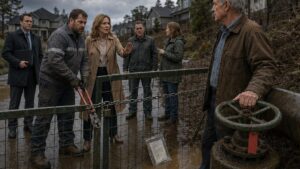
At 9:02, Scott came through the project entrance with a management-company representative, Katherine, and two homeowners Debra knew only by sight.
The “project update walk” had been Scott’s idea.
He had emailed the invitation the previous afternoon.
To clarify recent concerns regarding access and avoid further confusion.
Debra had read the sentence four times before replying with one word.
Confirmed.
Now everyone stood in the narrow rear strip while a truck waited to make the argument feel expensive.
Scott began before she could.
“I appreciate everybody coming. I want to keep this straightforward. We have an active drainage project serving multiple homes, a contractor working under an approved plan, and a disagreement over a few feet of unused ground.”
Debra said nothing.
Scott glanced at her.
“Debra believes the staging area crosses onto her parcel.”
“I don’t believe it,” she said. “I have a recorded survey.”
One of the homeowners shifted his weight.
Scott gave a patient nod. “And as I explained, the existence of a parcel line does not automatically eliminate an access right.”
“Agreed.”
That stopped him.
Debra saw Katherine look at her.
Scott said, “Good. Then maybe we’re getting somewhere.”
“We might be.”
Debra walked to the far corner of the fence and picked up the orange surveyor’s tape she had laid there earlier.
Kevin frowned.
“What’s that?”
“A tape.”
“I can see that.”
“Then we’re making progress.”
The management representative looked down, hiding a smile or a cough.
Debra had spent the previous evening checking the survey bearings until the numbers blurred. She had also visited the county records office that morning to confirm the survey was filed with the parcel documents. She did not know yet whether every legal question favored her.
That frightened her.
It also kept her honest.
She pointed to a patch of ground near the edge of the project lane.
“There should be an iron pin here.”
Scott folded his arms. “Should be?”
“According to the survey.”
Kevin said, “We’re not excavating around for somebody’s old pin.”
“You don’t have to.”
Debra knelt and brushed aside loose soil.
The first pass found nothing.
The second found stone.
The third produced a dull metallic scrape.
She cleared more dirt with the side of her hand until the top of an iron rod showed beneath the soil.
Nobody spoke.
Debra stood.
“That pin.”
Scott stepped closer.
“You verified it?”
“I verified the recorded survey and the location shown on it. I am not claiming I’m a licensed surveyor.”
The distinction mattered.
She needed them to hear it.
Scott looked at the iron pin, then toward the fence.
Debra handed him one end of the tape.
“Hold this.”
He stared at it.
“Debra.”
“You said the problem was a few feet of unused ground. Hold the tape at the recorded corner.”
“This is getting theatrical.”
“No. Theater would be me asking everyone to trust how I feel.”
The truck engine rumbled behind them.
Katherine’s face had tightened.
One of the homeowners said, “Just hold it, Scott.”
A faint flush rose along Scott’s neck.
He took the tape.
Debra walked backward, reading from the survey copy in her other hand.
She had placed a fresh orange stake near the second reference point based on the recorded bearing. She did not pretend the stake itself proved anything. The purpose was visual.
Scott held the metal end at the pin.
Debra pulled the tape taut.
It passed behind the cedar fence.
Not along it.
Behind it.
Across the ground where Scott had repeatedly said the association-controlled strip began.
Then through the edge of the debris pile.
The yellow tape vanished beneath broken lumber and emerged beside a torn concrete bag.
No one spoke for several seconds.
The idling truck seemed suddenly louder.
Debra looked at Scott.
“The fence is not the line.”
Katherine turned toward the cedar boards as if seeing them for the first time.
The management representative stepped closer to the survey copy.
“How far inside?”
“I’m not giving you a legal measurement from this tape,” Debra said. “I’m showing you why I asked for work to stop until the records were checked.”
Kevin pointed toward the fence.
“You built the fence there.”
“I didn’t say I didn’t.”
“That’s your yard.”
“That is my fence.”
He gave a short, incredulous laugh. “Same thing.”
“No.”
This time Katherine answered before Debra could.
“Apparently not.”
Kevin looked at her.
Scott still held the tape.
Debra noticed that his grip had tightened.
She said, “You can let go now.”
He released it.
The tape snapped lightly against the dirt.
It should have felt like victory.
Instead Debra felt something more cautious.
Because Scott was not surprised enough.
He looked annoyed. Cornered, perhaps. But not stunned.
He reached into the leather folio he had brought under one arm.
“I was hoping we wouldn’t need to turn this into a document contest.”
Debra’s stomach dropped.
Scott withdrew a folded sheet.
“Then don’t.”
“I think we should be accurate.”
He opened the page and held it where the others could see.
The management-company logo sat in one corner. Beneath it was a map of the rear lots with a shaded band running behind them.
Scott tapped the band.
“This is the easement exhibit provided for the project.”
Debra took one step closer.
The shaded area crossed behind Lot 118.
Her lot.
“There is recorded access,” Scott said. “Which is what I have been saying.”
The first rush of heat rose into Debra’s face.
Kevin looked toward the waiting truck.
“So can we work now?”
“Not yet,” Debra said.
Scott’s voice remained controlled. “Debra, I understand this is upsetting. But a property line and an easement can both exist. Your survey does not prove the association has no right to access the area.”
She looked at the paper.
He was right about that much.
The thought hurt because she had built two days of certainty around the survey.
Katherine came nearer.
“What kind of easement?”
“Maintenance access,” Scott said.
“For what?”
“Drainage infrastructure.”
Debra looked at him.
“Does it authorize debris storage?”
Scott paused.
Only briefly.
But she saw it.
“The contractor needs reasonable working room.”
“That isn’t what I asked.”
The management representative spoke for the first time.
“We may need counsel to interpret the exact scope.”
Kevin made a frustrated sound.
“You all called me out here with a loaded truck.”
Scott looked toward him. “Hold for now.”
Kevin stared at him.
“Seriously?”
“For now.”
The small payoff landed quietly.
The truck did not unload.
But neither did Debra feel vindicated anymore.
She looked again at the shaded band on the easement exhibit.
The map seemed clean.
Official.
Simple in a way reality rarely was.
Scott folded it.
“I’ll send you a copy.”
“Send the recorded instrument too.”
His eyes met hers.
“This is what the management company provided.”
“I didn’t ask what they provided.”
For the first time that morning, Scott’s confidence slipped by a fraction.
“I’ll see what we have.”
The residents began to disperse.
Katherine lingered near the fence.
“I didn’t know your line was back here,” she said.
“Neither did I.”
The admission came harder than Debra expected.
Katherine looked surprised.
Debra added, “Not until this week.”
Scott, ten feet away, turned at that.
Debra watched him hear it.
She knew immediately what it would cost her.
She had publicly shown that Scott’s repeated fence-based assumption was wrong.
She had also just admitted that her own certainty was new.
By noon, the HOA’s easement exhibit was in her inbox.
At 2:30, Debra called three attorneys.
One did not handle association disputes.
One wanted a consultation fee she could not justify without knowing whether she had a case.
The third was Michael Hill.
His office was small, above a dental practice in a commercial building near the county complex. He listened without interrupting while Debra laid out the survey, the exhibit, photographs, and chronology.
When she finished, he removed his glasses.
“Do you want me to tell you that you’re right?”
“I want you to tell me what the documents mean.”
“That’s a better answer.”
He placed her survey beside the HOA exhibit.
“Your survey may be right.”
Debra waited.
Michael tapped the shaded easement band.
“And Scott still may not be entirely wrong.”
Chapter 4: The Document That Nearly Proved Scott Right
Michael Hill slid the HOA exhibit away from Debra and tapped the old survey with one finger.
“Before we decide anybody lied,” he said, “I need the recorded easement.”
Debra sat very still.
“You think Scott is right.”
“I think you’re asking me to tell you who is right before we know what rights were granted.”
“He kept dumping after I objected.”
“That may matter.”
“May?”
Michael put his glasses back on. “You came here because you wanted accuracy.”
The words irritated her because they were true.
He turned the survey ninety degrees. “Your parcel line appears to extend behind the fence. That does not mean the association cannot have access across part of your parcel. Ownership and use rights can overlap.”
Debra looked at the shaded band on Scott’s exhibit.
“So the tape meant nothing.”
“I didn’t say that.”
“It crossed the debris.”
“That established a serious boundary question in front of people who had been treating the fence as the line. That matters. It just doesn’t finish the argument.”
Debra gathered the papers too quickly. One photograph slipped to the floor.
Michael picked it up.
It showed the first pile against the cedar boards.
He studied it before handing it back.
“Find the recorded instrument,” he said. “Not the project map. The actual easement document.”
The county records office occupied the first floor of a beige government building Debra had driven past for years without entering. By ten the next morning, she was standing at a public terminal while a records clerk showed her how to search older instruments by parcel reference.
The first result was not the easement.
It was a plat amendment.
The second was a utility agreement.
The third referenced drainage maintenance and a book-and-page number from more than twenty years earlier.
Debra opened the scanned image.
The document was six pages long.
She printed all six.
Then she returned home and found the note.
It had been tucked behind the survey in the manila folder, a small sheet of yellow paper folded twice. Her husband’s handwriting ran diagonally across it.
Set fence 6′ inside rear line at west end, 8’+ at east. Easier than another fight over mower access. Pins stay.
Debra read it once.
Then again.
Her chair scraped backward.
“No,” she said.
The kitchen was empty.
She unfolded the survey and laid the note beside it.
Six feet.
Eight feet.
The numbers were close to what she had estimated from the recorded line.
Her husband had known.
Not only known—chosen.
The fence had never been the boundary.
For years Debra had mowed to the cedar boards and stopped. She had corrected delivery drivers who left mulch too close to the side gate. She had once told a tree service that everything beyond the rear fence belonged to the association.
She had been wrong.
The shame came before reason.
Scott’s face at the project walk returned to her: You built the fence there.
Kevin’s laugh.
Her own voice, steady and certain.
My property.
She sat down.
For nearly an hour, she did nothing useful.
Then her phone rang.
Katherine.
Debra watched it until the call ended.
A message appeared.
Just checking in. No need to call back.
Debra turned the phone over.
At noon, she drove back to Michael’s office with the easement and her husband’s note.
Michael read the note first.
“This helps explain the fence.”
“It proves I didn’t know where my own yard ended.”
“It proves your husband placed a fence inside the parcel line.”
“I stood in front of six people with a tape.”
“And you told them you weren’t a surveyor.”
“That is not the point.”
Michael’s gaze stayed on her.
“Then what is?”
Debra opened her mouth and closed it.
The answer was uglier than the documents.
She had wanted Scott wrong in every possible way.
Not mostly wrong. Not careless. Not unjustified after a certain date.
Wrong from the beginning.
Michael unfolded the recorded easement.
“Let’s see whether he was.”
The language was dense but not mysterious once he separated it into pieces. The association held access rights across a defined rear corridor for inspection, maintenance, repair, and replacement of drainage facilities.
Debra felt the room narrow.
“So they can cross.”
“Yes.”
“Across my property.”
“In the described area, for the stated purposes.”
She looked at the shaded project map.
“Then Scott was right.”
“Partly.”
Michael pointed to a paragraph.
“The easement allows entry for drainage work. It allows equipment reasonably necessary to perform that work.”
Debra waited.
“It does not say storage.”
He moved his finger lower.
“It does not grant general construction staging. It does not transfer possession. And nothing I see here gives the association an unlimited right to deposit unrelated demolition material for days at a time.”
“Unrelated?”
“We’d need to know what the material is and where it came from.”
“The clubhouse renovation is part of the same contract.”
“Same contract is not necessarily same easement purpose.”
For the first time that day, Debra breathed fully.
Michael held up one hand.
“Do not turn that into certainty yet.”
She almost laughed.
“You really hate certainty.”
“I hate expensive certainty built on incomplete records.”
He compared the easement description to Scott’s project exhibit.
Then his expression changed.
“What?”
Michael leaned closer.
“The shaded band on this exhibit is wider.”
“How much?”
“I’m not measuring from a photocopy. But enough that I want the source map.”
“The management company gave it to Scott.”
“Maybe.”
That word again.
Debra left with three tasks: request the project mapping correspondence, obtain the board packet approving contractor access, and stop saying the association had no right to enter her property.
The last task was the hardest.
At home, she opened her email and drafted a correction to the management company.
My earlier statement that the Association has no access rights across any portion of my rear parcel was too broad. I have now reviewed a recorded drainage easement. I am requesting clarification of whether that easement authorizes material storage, debris placement, and the mapped staging footprint currently in use.
She stared at the message.
Then sent it.
The act felt like surrender for approximately thirty seconds.
After that, it felt cleaner.
Two days later, the management company responded with a document package.
Most of it was useless.
Meeting minutes.
Contract summaries.
A project schedule.
Then, buried in a chain of forwarded emails, Debra found one sent nine days before the first load.
The original sender was a mapping consultant identified only by title.
The message was addressed to the management representative and copied to Scott.
Attached exhibit should be treated as preliminary. Rear-lot easement depiction has not been reconciled against all recorded parcel documents. Field verification recommended before contractor access outside existing maintained corridor.
Debra stopped reading.
Nine days before the first load.
She checked the date again.
Then the recipients.
Scott Roberts.
Copied.
She opened the next email in the chain.
Scott’s reply was brief.
We cannot move the mobilization date again. Proceed with current exhibit for contractor coordination and flag any actual conflicts as they arise.
Debra sat back.
The kitchen seemed suddenly too quiet.
He had known the map was incomplete.
Not that it was definitely wrong.
Not that Debra definitely owned every disputed foot free of access rights.
But he had known uncertainty existed before Kevin’s truck arrived.
He had known when he stood beside her fence and said the records were already clear.
Her phone chimed.
Another HOA email.
This one was not a community update.
It was a draft notice attached to the upcoming board packet.
Debra opened it.
The first paragraph cited association authority to maintain drainage infrastructure.
The second described interference with contractor access.
The third contained her name.
Debra Wilson has continued to obstruct access to common-area drainage improvements despite notice of the Association’s recorded rights.
At the bottom, a proposed enforcement hearing date had been left blank.
Debra printed the page.
Then she placed it beside Scott’s email authorizing use of the incomplete map.
For the first time since the dumping began, the threat was no longer implied.
The board was preparing to punish her.
Chapter 5: The Board Turned Her Boundary Into a Vote
Debra entered the HOA meeting room and saw her backyard on the wall.
The photograph filled the projection screen before she had even taken off her coat.
Her cedar fence ran across the image. The debris pile sat beyond it. No survey line appeared. No orange tape. No iron pin.
From that angle, the message was obvious.
Fence.
Waste outside fence.
Homeowner complaining about land that did not look like hers.
Scott stood near the projector speaking quietly with the HOA secretary.
He saw Debra.
His sentence stopped.
She set her document box on an empty chair.
“Interesting picture.”
Scott glanced at the screen. “It’s part of the project summary.”
“Who took it?”
“The contractor provided site photos.”
“Of course.”
Residents filled perhaps half the chairs. More than Debra had expected. Katherine sat near the aisle with a folder on her lap.
The board had not yet called the meeting to order when one of the homeowners from the project walk approached Debra.
“I hope this doesn’t get ugly.”
Debra looked at him.
“So do I.”
“We just really need the drainage fixed.”
There it was again.
Not accusation exactly.
A request that she understand what her resistance cost everyone else.
“I know.”
He seemed surprised by the answer.
Scott called the meeting to order.
For twenty minutes, they discussed landscaping bids and reserve expenditures. Debra sat with her hands folded over a legal pad while her own yard waited on the wall.
Then Scott reached the project item.
“We need to address contractor access complications affecting the drainage schedule.”
Not Debra.
Not the boundary.
Complications.
The management representative summarized the easement. He described the contractor’s need for working room. He mentioned a homeowner objection.
Scott then displayed the draft enforcement notice.
Debra heard a quiet shift in the room.
Katherine raised her hand.
“Before we talk enforcement, can we clarify whether the disputed area is actually outside her lot?”
Scott answered, “The issue is not simply ownership. The association holds easement rights.”
“That wasn’t my question.”
Debra turned toward Katherine.
Scott did not.
“The fence location has created confusion,” he said.
Debra almost smiled.
Created confusion.
As though cedar boards had drafted the project map.
Scott continued. “The association must preserve its ability to maintain drainage infrastructure. We cannot allow individual disputes to stop work affecting multiple homes.”
Debra raised her hand.
Scott saw it and waited a beat too long.
“Yes.”
“May I ask that the next photograph be shown?”
“What next photograph?”
“The one from the project walk. With the tape.”
A murmur moved through the chairs.
Scott said, “This is not a trial.”
“No. It’s a meeting where you are considering enforcement against me using a photograph of my property. I’m asking you to show another photograph of the same area.”
The HOA secretary looked at Scott.
Katherine said, “That seems reasonable.”
Scott’s jaw tightened.
“There is no need to relitigate—”
“Then don’t enforce tonight,” Debra said.
The room went still.
It was the first sharp thing she had said.
She regretted the tone immediately, but not the words.
Scott rested both hands on the table.
“We have residents who have had repeated flooding.”
“And I have never asked you to cancel the drainage project.”
“You have blocked access.”
“I challenged storage and dumping on a disputed strip.”
“Which affects access.”
“Because your contractor used the same area for both.”
Kevin sat near the rear wall. He looked down.
Debra saw it.
“So let’s separate them,” she said. “Crossing for legitimate drainage work. Storing debris. Parking trucks. Dumping material. Those are not automatically the same act because they happen under one contract.”
The management representative leaned toward his microphone.
“The association’s counsel has not issued a final interpretation.”
“Then why is my enforcement notice already drafted?”
No one answered immediately.
That silence gave her a small, hard satisfaction.
Then Katherine spoke.
“Debra, can I ask you something?”
“Yes.”
“If the access route has to move, how much delay are we talking about?”
“I don’t know.”
“Because some of us don’t have the luxury of treating this as just a boundary principle.”
The words struck more deeply than Scott’s did.
Katherine’s face had gone pale.
Debra said, “I’m not treating it as just a principle.”
“My basement flooded twice.”
The room quieted.
Katherine’s fingers tightened around her folder.
“Two years ago, I lost the drywall on one side. Last spring, I had six inches of water in the storage room. Insurance covered part of it. Not all.”
Debra had not known.
Katherine continued, “I’ve been pushing this project for eighteen months. So yes, when I heard you were stopping trucks, I thought you were being stubborn.”
Debra looked at her.
“Did you think Scott was definitely right?”
Katherine hesitated.
“No.”
The answer changed the room more than an accusation would have.
“I thought,” Katherine said, “that if everybody started questioning the route, the whole thing would die again.”
Scott looked away.
Debra understood then that Katherine had not betrayed some private certainty. She had chosen her fear.
It did not make the harm disappear.
It made it human.
The board postponed enforcement.
Not dismissed.
Postponed.
Scott proposed reconvening after counsel reviewed the records.
In the parking lot, Katherine caught up with Debra.
“I meant what I said.”
“I know.”
“I’m not switching sides.”
“I didn’t ask you to.”
Katherine stopped beside a row of parked cars.
“You make that difficult.”
“What?”
“Helping you.”
Debra felt the old instinct rise.
I didn’t ask for help.
The words reached the back of her teeth.
She swallowed them.
Katherine looked toward the clubhouse.
“I think Scott believed the route was good enough. I also think once you challenged it, he should have slowed down.”
Debra said nothing.
“And I think,” Katherine added, “you’ve been so determined not to need anybody that half the neighborhood only heard his version.”
That one landed cleanly.
Debra looked at the pavement.
“I didn’t want this turned into gossip.”
“It became gossip anyway.”
“I know.”
Katherine nodded.
Not victory.
Not friendship.
Just acknowledgment.
The next morning, Debra received an email from Michael.
The subject line read: LOGS.
He had requested contractor production records through correspondence tied to the property dispute. Kevin’s company had provided a partial set.
Debra opened the attachment.
Truck entries.
Dates.
Times.
Load numbers.
She compared them with her spreadsheet.
The match was not perfect.
It was better than perfect.
Her photographs filled gaps in their records.
Their records identified loads her photographs could not.
She moved down the page.
Then stopped.
The mapping-warning email had been sent nine days before work began.
Scott’s reply authorizing continued mobilization followed the same day.
And after that warning—
load after load after load.
Debra counted.
Not one mistaken delivery.
Not one hurried morning.
Repeated entries continued after Scott had been told the exhibit was preliminary.
She called Michael.
“I want the full chronology.”
“I assumed you would.”
“Everything.”
“Debra.”
“What?”
“You have a stronger case if you don’t pretend the documents are cleaner than they are.”
She stared at her husband’s note on the table.
Fence six feet inside.
Easement exists.
Access may be legitimate.
Storage may not be.
Her own first claim had been too broad.
“I know.”
“Do you?”
The question angered her.
Then she saw why he asked.
“Yes,” she said. “Include the parts where I was wrong.”
Michael was silent for a moment.
“That will make Scott’s lawyer very happy for about thirty seconds.”
“Good.”
“Then what?”
“Then I show what happened after they knew.”
That evening, Debra assembled the chronology herself.
First photograph.
First plate.
First complaint.
Scott’s statement.
Repeated loads.
Survey discovery.
Public tape measurement.
Easement.
Her correction.
Preliminary-map warning.
Scott’s reply.
Post-warning truck logs.
Draft enforcement notice.
She printed two sets.
At the top of the first page, she wrote one sentence.
I was wrong about one thing, and they used that uncertainty to keep doing another.
The reconvened hearing was three nights away.
Debra had spent years believing that strength meant never handing anyone the part of the story that could be used against her.
Now she placed her own mistake first.
Chapter 6: Sixteen Days of Records and One Missing Warning
“I need to correct something I said.”
Debra’s first sentence at the reconvened hearing made Scott look up.
The room was fuller than before.
No photograph of her yard filled the screen this time. Debra had brought her own presentation on a small flash drive, but she had not asked to begin with evidence.
She stood at the end of the board table with a paper copy in her hand.
“At the project walk,” she said, “and before that in emails, I said the association had no right to enter any part of my rear parcel.”
Scott’s attorney, seated beside the management representative, shifted slightly.
Debra continued.
“That was too broad.”
A faint movement passed through the room.
She saw Scott’s shoulders ease.
For one second, she understood exactly what he thought was happening.
Retreat.
“The recorded drainage easement does give the association limited access rights across part of my parcel for inspection, maintenance, repair, and replacement of drainage facilities.”
Scott’s attorney leaned toward his microphone.
“We appreciate that clarification.”
Debra looked at him.
“I’m not finished.”
The room went quiet.
She inserted the flash drive.
The first image appeared.
Monday morning.
8:14.
Debris against cedar.
“This is the first load I documented.”
The next photograph.
Truck plate.
“This is the vehicle.”
Next slide.
Her email complaint.
“8:46 that morning.”
Next.
Scott’s arrival.
She had no audio recording and said so.
“I am not asking anyone to rely on my memory for exact wording. The undisputed point is that I raised a property objection that morning.”
Scott said, “And I explained the easement.”
“You explained an association-controlled maintenance strip.”
“That is substantially the same issue.”
“No.”
Debra clicked.
The survey appeared.
Then the photograph of the yellow tape crossing behind the fence and through the debris pile.
“This showed that the fence was not the parcel line.”
She changed slides before anyone could settle into the image.
“My husband had intentionally built the fence inside the line.”
The handwritten note filled the screen.
Debra heard someone inhale.
She kept her eyes forward.
“I did not know that when the project began.”
Scott’s attorney said, “Which is significant.”
“Yes.”
Debra turned toward him.
“It is.”
The answer seemed to deprive him of his next sentence.
She clicked again.
The recorded easement.
“This is also significant. It means my first legal assumption was wrong.”
Katherine sat in the second row, watching without expression.
Debra moved to the easement language.
“What it does not clearly say is that the association may use the area as general storage for mixed construction material. It does not erase the parcel. It does not automatically make every contractor activity lawful because some drainage work is lawful.”
The attorney said, “That interpretation is disputed.”
“I know.”
Another slide.
The HOA’s project exhibit.
Then the recorded easement description beside it.
“The project map is wider.”
Scott spoke.
“You’re comparing drawings at different scales.”
“I am not offering my own measurement as a legal conclusion.”
Debra clicked once more.
The preliminary-map warning email appeared.
The date sat near the top.
Nine days before mobilization.
This time the room changed.
Not loudly.
Scott’s face did.
Debra read only the relevant sentence.
“Rear-lot easement depiction has not been reconciled against all recorded parcel documents. Field verification recommended before contractor access outside existing maintained corridor.”
She looked at Scott.
“You received this.”
He leaned toward his microphone.
“Yes.”
No denial.
The simple answer was almost worse.
Debra clicked.
His reply appeared.
We cannot move the mobilization date again. Proceed with current exhibit for contractor coordination and flag any actual conflicts as they arise.
One of the homeowners whispered something to another.
Scott said, “I’d like the full email chain reflected, not excerpts.”
“The full chain is in the packet.”
Debra held up the binder.
“I hope everyone reads it.”
She changed slides.
The first-load photograph returned.
Beside it now appeared a photograph from the sixteenth day.
The difference was brutal.
In the first, the cedar fence remained mostly visible.
In the last, broken material rose above it. The dark stain near the pipe section spread across exposed soil. One board leaned inward.
“Sixteen days,” Debra said.
She began aligning dates.
Not dramatically.
Precisely.
Day one: objection.
Day two: repeat truck.
Day four: written complaint.
Day six: recurring plate.
Day ten: dark liquid documented.
Day twelve: project-update email describing a misunderstanding.
Day fourteen: public measurement.
Day sixteen: continued load entry.
Then the contractor logs.
Kevin sat near the rear again. His jaw tightened when his company records appeared.
Debra did not accuse him of falsifying anything.
She did something more difficult.
She matched.
“Our records overlap here.”
She pointed.
“My photograph at 5:49 a.m. Their truck entry at 5:42.”
Next.
“My plate image Wednesday. Their vehicle record.”
Next.
“My photograph is unclear on this load. Their log supplies the truck identification.”
She turned toward the board.
“I am not asking you to believe only me.”
That sentence settled over the room.
The attorney tried once.
“Photographs can be selectively framed.”
“Yes.”
Debra changed the slide.
A wide image showed the truck, fence, pile, and license plate.
“Which is why I kept plates.”
Next.
The survey.
“Which is why I obtained the parcel record.”
Next.
The easement.
“Which is why I corrected my own claim.”
Next.
The warning email.
“Which is why the timing matters.”
She stopped.
No one spoke.
The silence she had imagined for weeks did not feel like triumph.
It felt heavier.
Scott broke it.
“You want the board to believe I knowingly authorized trespass.”
“No.”
He looked surprised.
Debra said, “I want the board to believe what the records show.”
“And what do you think they show?”
“That you knew the map was uncertain.”
Scott’s mouth hardened.
“You had a project delayed twice.”
He did not answer.
“You had residents with flood damage.”
Still nothing.
“You had contract deadlines.”
His eyes moved briefly toward Katherine.
Then he said, “Yes.”
The room shifted again.
Scott removed his glasses.
“We had a mobilization window. If we missed it, the contractor could reprice. We were already over budget. Another storm season was approaching. I had people calling me every time rain was forecast because they were moving boxes off basement floors.”
Katherine looked down.
Scott continued.
“The map came from management. It was based on prior project files. The consultant said reconcile and field verify. He did not say the route was wrong.”
“No,” Debra said.
“I made a decision.”
“Yes.”
“To proceed unless an actual conflict appeared.”
“I appeared Monday morning.”
That stopped him.
Debra did not raise her voice.
“I stood beside the fence and told you there was a conflict.”
Scott looked at the screen.
The first-load photograph remained there.
“You didn’t have the survey then.”
“No.”
“You did not know the fence location was wrong.”
“No.”
“You were wrong about the easement.”
“Yes.”
Each admission seemed to disturb the room more than denial would have.
Debra took one step toward the table.
“And after I found that out, I corrected it. When did you correct the statement that your map was settled?”
Scott said nothing.
There it was.
Not the entire case.
Not proof of every violation.
The missing act.
Disclosure.
He had not told her the map was preliminary.
He had not told the residents.
He had not included the warning in the board packet before preparing enforcement against her.
The HOA secretary spoke quietly.
“I didn’t see that email.”
Scott turned.
“It was operational correspondence.”
“You were copied,” she said.
“I receive hundreds of project emails.”
The secretary looked at the screen.
“This one recommended verification.”
Scott’s attorney intervened.
“I think we should be careful about assigning intent.”
Debra nodded.
“I agree.”
The attorney looked at her.
“I’m not asking you to decide what Scott felt. I’m asking you to decide what the association knew, when it knew it, and what it did after.”
For the first time, Debra saw Michael smile faintly from his chair near the wall.
Not because she had won.
Because she had stopped trying to win the wrong argument.
The board recessed.
Residents moved into the hallway.
Katherine approached Debra but did not congratulate her.
“Scott wasn’t lying about the flooding.”
“I know.”
“My basement really did flood.”
“I know.”
“And you’re still asking them to stop the project.”
“No.”
Katherine searched her face.
“I’m asking them to stop using one disputed strip until they verify the rights and deal with what they put there.”
“What if that delays everything?”
“Then we find another route.”
“There may not be one.”
“Then we negotiate one.”
The word surprised Debra as she said it.
We.
Katherine seemed to hear it too.
When the board returned, no final ruling came.
Instead, the management representative announced three immediate actions: review by association counsel, preservation of contractor records, and notice to the association’s liability carrier.
Scott looked exhausted.
Not defeated.
Older.
The hearing adjourned after ten.
Debra was packing her binder when her phone buzzed.
Michael had received the same email.
He read it first.
Then handed her the phone.
The sender was the insurance adjuster assigned to the notice.
Pending review of the reported boundary dispute, material placement, and potential property damage, the carrier requests that all contractor activity within the disputed rear-lot strip cease immediately.
Debra read the sentence twice.
Outside, through the meeting-room windows, the clubhouse project lights glowed over idle equipment.
For sixteen days, every new load had made the pile larger.
Now, for the first time, something larger than Debra had told the trucks to stop.
Chapter 7: What They Removed, and What She Chose to Keep
The first machine to return lifted debris away from Debra’s yard instead of dropping more.
She stood behind the cedar fence and watched the excavator bucket close around a knot of broken lumber, concrete bags, and twisted metal. For one irrational second, she expected the operator to swing toward the pile and let it fall again.
Instead, the machine rotated slowly toward a lined truck waiting on the project lane.
The load disappeared into the bed with a dull crash.
Debra did not move.
Six weeks had passed since the insurer ordered activity halted on the disputed strip. In that time, the pile had remained exactly where it was, wrapped in orange temporary fencing and visited by more people than Debra had ever invited into her backyard.
A code-enforcement inspector.
An insurance adjuster.
A soil-testing crew.
Two contractor representatives.
Michael.
The HOA’s attorney.
No one had called the liquid beneath the broken pipe harmless until the tests came back.
No one had called it catastrophic afterward.
The final report was less dramatic than fear and more expensive than reassurance: limited petroleum contamination in one shallow area, consistent with residue from construction material or equipment contact; impacted soil to be removed and disposed of appropriately; no evidence of broader groundwater contamination.
Debra had read the report three times.
She had not felt relief immediately.
She had felt anger that “limited” still meant someone had to dig up part of her land.
Now the excavator removed the first layer under monitored conditions while a worker photographed each section.
Kevin stood near the truck.
He no longer smiled when he saw her.
“Morning,” he said.
Debra nodded.
“Morning.”
That was all.
The removal plan required the debris to be separated, documented, and hauled off before contaminated soil was excavated. The damaged cedar boards would come down last.
Katherine appeared at Debra’s side gate carrying two paper cups.
“I brought coffee.”
Debra looked at her.
“Is this an ambush?”
“Only if you hate medium roast.”
Debra opened the gate.
Katherine handed her a cup and stood beside her without asking permission to stay.
For several minutes, they watched the machine work.
Then Katherine said, “The lower trench starts again Monday.”
“I heard.”
“Different access route.”
“I heard that too.”
The reroute had become the center of the settlement discussions.
Not money.
Not apology.
Access.
The drainage repair still had to be completed before the heaviest autumn storms. The original route was faster. The alternative required equipment to enter from the clubhouse side, cross a narrower maintained corridor, and make additional turns around existing utilities.
More days.
More cost.
Less use of Debra’s disputed rear strip.
Not zero use.
That was the problem waiting for her at Michael’s office that afternoon.
The proposed agreement lay across the conference table in two versions.
Michael tapped the shorter one.
“This is the insurer’s preferred resolution.”
Debra read the first page again.
Property restoration.
Fence repair.
Soil remediation.
Reimbursement of reasonable professional fees.
Confidential settlement amount for loss of use and property impact.
Mutual release.
She looked up.
“What changes for the next homeowner?”
Michael did not answer immediately.
“That isn’t what this document is designed to do.”
“I know.”
“The money is not insignificant.”
“I know.”
“You could sign this and be done.”
Debra leaned back.
For sixteen days she had photographed trucks because she was afraid no one would believe her.
For six weeks after that, she had lived with investigators walking the strip and neighbors lowering their voices when she passed.
She looked again at the confidentiality paragraph.
“What happens to the map?”
“The project map?”
“The process that let Scott use a preliminary exhibit as though it were settled.”
Michael folded his hands.
“That would be a governance issue.”
“So nothing.”
“Not necessarily.”
“In this agreement?”
“No.”
Debra pushed the paper away.
Michael watched her.
“You understand that broader terms will be harder.”
“Yes.”
“They may reduce the cash component.”
“Yes.”
“The HOA will resist anything that reads like an admission of systemic failure.”
“Then don’t call it that.”
“What do you want to call it?”
Debra thought of the first morning.
Temporary storage.
Unused ground.
A misunderstanding.
“Verification.”
Michael’s expression changed slightly.
She continued.
“Written parcel verification before contractor access outside an existing maintained corridor. Notice to the homeowner. Actual recorded documents, not just whatever project exhibit management emails around.”
“That’s specific.”
“It happened specifically.”
“And emergency work?”
Debra paused.
Michael saw it.
“There it is,” he said.
“What?”
“The part where a rule stops being satisfying.”
She looked at him.
He slid the second proposal forward.
The revised drainage plan required a narrow temporary crossing near the eastern edge of Debra’s parcel for a limited period. Not storage. Not staging. Passage only, with protective mats, fixed hours, prior notice, and restoration.
Debra stared at the map.
“You’re asking me to let them back on.”
“I’m telling you the engineer says the reroute still needs this crossing to finish before the high-risk rain period.”
“On my land.”
“Yes.”
“The same association.”
“Yes.”
She hated him for not softening it.
Michael said, “You can refuse and litigate the scope. You may have grounds. But that choice has consequences too.”
Katherine’s flooded basement entered the room without being present.
So did Scott’s face at the hearing.
People moving boxes whenever rain was forecast.
Debra looked at the crossing.
“How many days?”
“Eight scheduled. Ten maximum without written extension.”
“No material stored overnight.”
“Agreed in the draft.”
“No debris.”
“Yes.”
“No access outside the marked path.”
“Yes.”
“Photos before and after.”
Michael smiled faintly.
“I assumed you’d ask.”
She did not smile back.
“Written notice every day they enter.”
“That may be excessive.”
“Then they can use the other route.”
Michael made a note.
The negotiations lasted another week.
The confidential settlement disappeared.
So did part of the cash.
In its place came procedures.
A resident-notice requirement.
Written parcel verification before planned contractor access beyond established common corridors.
Board review for disputed private-land use.
Preservation of project mapping and authorization records.
No unilateral field expansion by the board president.
Scott did not resign.
Debra had not expected him to.
But the revised operating resolution required two board officers to approve changes affecting private parcels. The authority he had exercised alone was gone.
Katherine supported the resolution at the meeting.
She also defended completing the drainage project.
Some residents disliked both of them by the end.
Debra found that oddly reassuring.
The cleanup reached the fence on the third week.
Two cedar boards had split low near the ground. Another had warped inward. When the contractor removed them, the open gap exposed the strip beyond.
For the first time in years, Debra could stand in her yard and see the actual ground that had existed behind the fence all along.
The survey markers remained.
She had insisted on that.
Not decorative posts.
Not a second fence.
Just lawful points left visible and protected.
Katherine stood beside one orange-capped marker while the repair crew prepared new cedar boards.
“You’re moving the fence to the property line?” she asked.
Debra looked at the open space.
She had considered it.
Six feet more here.
More at the eastern end.
Land she owned.
Land her husband had chosen not to enclose.
“No.”
Katherine raised an eyebrow.
“After all this?”
“The fence can stay where I want it.”
“That sounds suspiciously reasonable.”
“Don’t spread it around.”
Katherine laughed.
The sound surprised them both.
Debra let the new cedar line follow the old one, except where minor adjustments protected the repaired ground. The legal markers remained visible beyond it through small access points in the landscaping.
The boundary would no longer depend on what the fence seemed to say.
On the seventh week, protective mats were laid across the narrow temporary route Debra had agreed to.
She stood at the gate when Kevin arrived.
He carried the daily access notice.
“Eight to five,” he said.
“Four-thirty.”
He checked the paper.
“Right. Four-thirty.”
“No parking.”
“I know.”
“No material.”
“I know.”
Debra held out her hand.
Kevin gave her the notice.
He hesitated.
“Look, about the first day—”
“You were warned.”
His mouth closed.
She did not rescue him.
After a moment, he nodded.
“Yeah.”
That was enough.
Not forgiveness.
Not humiliation.
A fact acknowledged by the person who had once laughed at it.
The final drainage section was connected nine days later.
The temporary mats came up.
The soil beneath them was photographed.
The route was restored.
No applause followed.
One neighbor complained about project cost overruns in the next community email. Another thanked the board for finishing before storm season. Someone else objected to the new verification process as bureaucratic.
Life returned in untidy pieces.
Then, late one afternoon, Debra heard the side-gate latch.
She stepped onto the patio.
Scott stood outside the gate alone.
He was not wearing meeting clothes. No blue button-down. No folio.
He carried a cedar board under one arm.
Debra recognized the gray scar across its lower half.
It was one of the original boards struck by the first pile.
She had thought the crew discarded it.
Scott lifted it slightly.
“They were going to throw this away.”
Debra looked at the board, then at him.
Scott did not ask to come in.
Chapter 8: The Boundary Was Never Meant to Be Invisible
Scott held the scarred cedar board between them like something neither of them had agreed to remember.
“I thought you might want it,” he said.
Debra rested one hand on the gate.
“Why?”
He looked at the split near the bottom.
“I don’t know.”
It was the most convincing thing he had said to her in months.
She opened the gate.
Not wide.
Enough.
Scott stepped into the yard and set the board against the patio wall.
The repaired fence stood behind him, new cedar still pale against the older sections. Beyond it, the legal markers remained visible where Debra had insisted they stay.
Scott noticed.
“You left the pins exposed.”
“Yes.”
“I figured you’d move the whole fence back.”
“So did everyone.”
“Why didn’t you?”
Debra looked toward the eastern corner.
“My husband put it there.”
Scott waited.
She had told the board about the note. She had not told them what it meant.
“He knew the line,” she said. “There used to be arguments about mowing and access. Nothing serious. Just the kind that grows because everybody thinks six inches means respect.”
Scott gave a tired half smile.
“That sounds familiar.”
“He moved the fence inward to stop it.”
“And you kept it.”
“I thought I had to.”
The words surprised her once they were outside.
Scott looked at her.
Debra continued before she could retreat.
“For a while, after I found his note, I thought challenging any of this meant undoing what he wanted.”
“What did he want?”
“Peace.”
She looked at the repaired cedar.
“I confused peace with pretending the line wasn’t there.”
Neither spoke.
A truck passed on the neighborhood road beyond the houses. Debra’s shoulders tightened before she could stop them.
Scott heard it too.
He glanced toward the sound.
“I am sorry about the dumping.”
She looked at him.
He did not add if you felt.
Did not say misunderstanding.
“I’m sorry I kept the project moving after you raised the conflict,” he said. “I told myself we had an access right and could sort out the details later.”
“You had some access rights.”
“Yes.”
“That’s what made it easy.”
Scott nodded.
“I was afraid if I stopped again, the project would fall apart. We had already lost one contractor. Costs were climbing. Katherine was not the only person calling about flooding.”
“I know.”
“I also knew the map had not been fully reconciled.”
There it was.
Plain at last.
Debra said nothing.
Scott rubbed a hand over the back of his neck.
“I chose certainty because I needed everybody else to believe I had it.”
“That was the problem.”
“Yes.”
He did not ask her to say more.
She appreciated that.
After a moment, Scott looked toward the fence markers.
“The policy passed last night.”
“I heard the draft passed.”
“Final version too.”
Debra waited.
He recited it without ceremony.
Planned contractor access outside an existing maintained common corridor required written parcel verification against recorded documents. Affected owners had to receive notice before entry. Disputed access could not be expanded in the field by a single board officer. Emergency entry remained possible when necessary to protect life or prevent imminent property damage, but had to be documented and reviewed afterward.
Debra folded her arms.
“Who opposed it?”
“Two board members.”
“Only two?”
“Three, if you count me on the first draft.”
She looked at him.
Scott gave a small shrug.
“The emergency language was bad.”
Despite herself, Debra smiled.
“Was it?”
“It would have required notice before an emergency.”
“That does seem inconvenient.”
“I’m learning nuance.”
“Slowly.”
“Apparently.”
The silence that followed was not reconciliation.
It was better than that.
It was accurate.
Scott left without asking forgiveness.
Debra did not offer it.
Two weeks later, the first hard autumn rain came overnight.
Debra woke at 3:12 to water tapping against the windows.
For a few seconds she lay still, listening.
Then she got up.
Old instinct took her to the rear window.
The repaired fence shone dark under the yard light. Water ran along the drainage grade beyond it, moving steadily toward the completed system instead of spreading across the low ground.
At 7:20, Katherine texted.
Basement dry.
Debra read the message twice.
Then typed:
Good.
She almost stopped there.
Instead she added:
Mine too.
The next spring, the HOA conducted its first contractor-access review under the new policy.
Debra was not on the board.
She had refused when someone suggested it.
But the management company sent residents a verification packet before planned work near three rear parcels.
Recorded documents.
Marked routes.
Dates.
Contacts.
A page explaining how to dispute boundaries before equipment mobilized.
Debra sat at her kitchen table and examined the packet with the same attention she once gave her private ledger.
There were errors.
Minor ones.
She emailed corrections.
The management representative thanked her.
No one called her difficult.
That mattered less than she would have expected.
The old evidence box remained in her workroom.
Photographs.
Plate records.
Survey copies.
The easement.
Scott’s warning email.
Her own correction.
For months, Debra had thought of the box as protection.
Then one afternoon she opened it and found the first photograph.
8:14 a.m.
Broken material pressed against cedar.
The image no longer made her heart race.
She carried it to the window.
Outside, the repaired fence stood where she had chosen to keep it—not on the legal boundary, not pretending to be one.
Beyond it, a small orange-capped marker remained visible between low plantings.
Her husband’s compromise was still there.
So was her correction to it.
Debra placed the first dated photograph in a simple frame and hung it inside the workroom, beside the cabinet where she kept current files.
Not because she wanted to remember winning.
She had not won everything.
The settlement money was smaller than it could have been. The project had cost more. Scott still lived in the neighborhood. Katherine still disagreed with her at meetings. Kevin’s company continued doing work elsewhere.
The soil had still needed removal.
The fence had still been damaged.
Sixteen days had still happened.
But the photograph held the moment before she knew anyone would believe her.
The moment when she had believed she had to do everything alone.
That was the part she did not want to forget.
A month later, a storm damaged a large branch near the rear drainage route. The association needed temporary access across the eastern edge of Debra’s parcel to remove it before it blocked water flow.
This time, the call came first.
Then the written route.
Then the time window.
Debra reviewed the map.
She asked two questions.
One answer required correction.
The board corrected it.
Then she signed.
Permission for limited access under stated conditions.
Not surrender.
Not hostility.
A choice.
On the morning the crew arrived, Debra opened the gate herself.
She stood aside while equipment crossed the marked route.
No one called the ground unused.
No one called it temporary storage.
When the work was done, she checked the soil, photographed the exit condition, and closed the gate.
That evening, she returned to her workroom.
The first-load photograph hung on the wall.
Behind her desk, the curtains were still drawn from the afternoon glare.
Debra reached up and pulled them open.
The repaired cedar fence came into view.
Beyond it, the boundary marker caught the last light.
For years, she had thought belonging required smooth edges. No arguments. No visible lines. No need to ask anyone to stop.
Now she understood something her husband had never written on the yellow note.
A boundary did not have to become a wall.
It only had to remain true.
Debra left the curtains open.
The story has ended.