The HOA Tried to Stop Him From Mowing Her Yard—Then They Learned Why She Had Let It Grow
Chapter 1: He Had Cleared Half the Sidewalk When They Ordered Him to Stop
The first strip of concrete appeared beneath Dennis Hill’s trimmer like something being uncovered from a shallow grave.
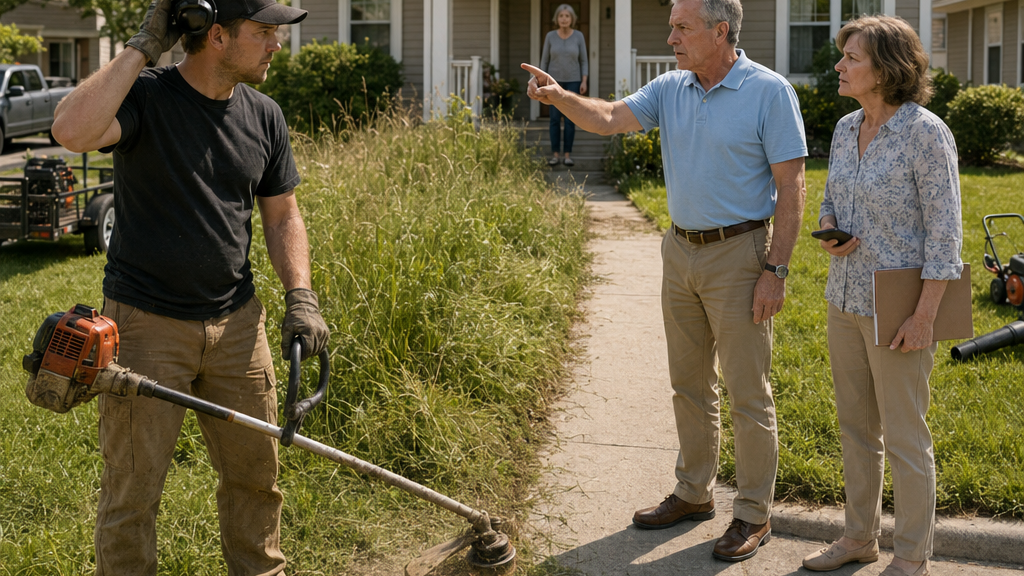
He eased the spinning line along the sidewalk, shaving away six inches of grass that had folded across the edge. Dirt and dry clippings sprayed against his work boots. Behind him, the difference was almost ridiculous: one side of the walk had a clean, straight border; the other disappeared beneath weeds and thick blades that had grown far enough over the concrete to soften its shape.
Dennis lifted the trimmer and studied the line.
“About time,” he muttered.
He had been working less than twenty minutes.
“Turn that off.”
Dennis heard the voice through his hearing protection but kept the trimmer idling.
A man in a pale blue polo was walking toward him from the neighboring driveway. A woman followed several steps behind, holding a phone and a thin folder against her chest.
The man pointed toward the trimmer.
“I said turn it off.”
Dennis squeezed the throttle once to clear the line, then released it. The engine settled into a rough idle.
“Can I help you?”
“You can shut that equipment down.”
Dennis stared at him for a second.
Then he killed the engine.
The sudden quiet made the street feel unnaturally still.
“I’m Patrick Roberts,” the man said. “HOA president.”
The woman beside him introduced herself as Katherine Taylor from the compliance committee.
Dennis pulled off his earmuffs.
“All right.”
Patrick looked past him toward the lawn. Dennis’s mower sat beside the driveway, and his pickup and small utility trailer were parked legally along the curb. Freshly cut grass covered nearly half the front yard. The rest stood high enough to brush Dennis’s calves.
“You weren’t checked in,” Patrick said.
“For what?”
“Contractor approval.”
“I’m mowing a yard.”
“You’re performing exterior work in the community.”
Dennis gave him a flat look. “The homeowner called me.”
“That doesn’t change the process.”
Katherine raised her phone. “We’ve already documented the work.”
Dennis felt something tighten behind his ribs.
Years earlier, a commercial customer had dropped his company after somebody complained that his crew had damaged irrigation lines. Dennis had known they hadn’t. He had photographs. Dates. Equipment logs. None of it had mattered. The property manager had decided avoiding an argument was easier than keeping him.
Since then, phrases like documented the work had a way of changing his temperature.
“I knocked before I started,” Dennis said. “She came to the door. She hired me. I have the text messages.”
Patrick shook his head. “You still didn’t register.”
“So register me.”
“That needs to happen before work begins.”
Dennis glanced down at the half-cleared sidewalk.
“You want the violation fixed or not?”
Patrick’s expression sharpened. “That isn’t your decision.”
“No. It’s hers.”
Dennis pointed toward the house.
Patrick stepped closer. “And continuing after you’ve been told to stop could become another violation attached to the property.”
That got Dennis’s attention.
“Another violation for her because I’m cutting the grass you already fined her for not cutting?”
Katherine spoke before Patrick could answer.
“Nobody said she was fined because of you.”
“You just said you’re documenting me.”
“We’re documenting an unauthorized contractor.”
Dennis laughed once, without humor.
The front door opened.
All three turned.
Mary Wilson stood behind the storm door in a loose gray sweater despite the warm morning. She looked smaller than Dennis remembered from when she had answered earlier. Her silver-streaked hair had been pulled back quickly, and she held the doorframe as though she had hurried there.
“What happened?”
Patrick’s voice softened.
“Mary, we’re handling it.”
Dennis looked at her.
“Did you hire me?”
Mary blinked.
“Yes.”
Patrick raised one hand. “That isn’t the issue.”
Dennis kept his eyes on Mary.
“Did I knock?”
“Yes.”
“Did I tell you what I was going to do?”
“Yes.”
“And you gave me permission?”
Mary looked from Dennis to Patrick.
“Yes. I asked him to come.”
The street seemed to settle around the answer.
Katherine lowered her phone slightly.
Dennis turned back toward Patrick.
“There.”
He expected that to end it.
For half a second, he thought it had.
Patrick’s face lost some of its certainty, but not enough.
“She has the right to hire someone,” he said. “You still have to comply with community contractor requirements.”
Dennis stared at him.
“So we’ve gone from me being unauthorized by the homeowner to me not filling out your paperwork.”
“You were always unauthorized under association procedure.”
“That’s not how you said it.”
Patrick’s jaw shifted.
Mary had stepped onto the porch now.
“Please,” she said quietly. “I just need the yard done.”
Dennis looked at her.
He had noticed the exhaustion in her voice when she called. He had assumed it was embarrassment. Homeowners often apologized for overgrown yards before he ever saw them.
This was different.
Patrick looked toward Mary. “You know there is an active compliance matter.”
“Yes.”
“And you know contractors are supposed to be registered.”
Mary closed her eyes briefly.
“I forgot.”
Katherine said, “There have been multiple notices.”
Dennis looked at Mary again.
She didn’t answer.
That was the first moment he understood he had walked into something that had started long before his trailer came around the corner.
Patrick pointed toward Dennis’s equipment.
“You need to leave until this is cleared through management.”
Dennis’s pride answered before his judgment did.
“I’ll leave if she tells me to leave.”
Patrick’s eyebrows rose.
“That isn’t how this works.”
“It is with my customer.”
Mary looked stricken.
Dennis immediately knew he had made the situation harder, but the knowledge arrived too late to pull the words back.
Patrick took out his own phone.
“All right.”
“What are you doing?”
“Documenting your vehicle and company information.”
Dennis’s shoulders stiffened.
Mary stepped down one porch stair.
“Patrick, don’t.”
“This doesn’t need to be personal.”
“You’re making it personal,” Dennis said.
Patrick ignored him and photographed the pickup, then the trailer, then the license plate.
Dennis almost reached for his own phone.
Almost.
Instead he looked down at the sidewalk.
The clean edge stopped precisely where Patrick had interrupted him. On one side, bare concrete. On the other, grass creeping over it as if the boundary had never existed.
Mary saw him looking.
“Dennis.”
Her voice was barely above normal conversation.
He turned.
“Please go for today.”
The anger left him faster than he expected.
Not because Patrick had won.
Because Mary looked embarrassed to be asking.
Dennis nodded once.
“All right.”
He loaded the trimmer first. Patrick stood near the curb while Katherine remained beside Mary, no longer filming.
When Dennis climbed into his truck, Patrick walked over to the driver’s window.
Dennis lowered it halfway.
Patrick held up his phone.
“This incident will be added to Mary’s violation file.”
Dennis looked past him toward the house.
Mary was standing beside the unfinished sidewalk, staring down at the line he had exposed.
“How many violations does she already have?”
Patrick hesitated.
Then he stepped away from the truck without answering.
Chapter 2: The Yard Was Only the Part Everyone Could See
Mary came back outside carrying enough envelopes to fill both hands.
Dennis had not driven away.
He had moved his truck around the corner, sat there for five minutes with the engine running, then shut it off because leaving felt wrong and staying felt worse. He finally walked back without his equipment.
Mary met him on the porch.
“I thought you left.”
“I did badly.”
That almost made her smile.
Almost.
She placed the envelopes on a small patio table.
Most were unopened.
Dennis recognized the association logo.
“How many?”
Mary sat down.
“I don’t know.”
“That many and you don’t know?”
“I stopped counting.”
Dennis pulled out the chair opposite her but remained standing.
“Mary, he said this morning was going in your violation file.”
“I heard him.”
“Are you already being fined?”
She picked at one corner of an envelope.
“The first ones were warnings.”
“And after that?”
“Fifty dollars.”
“For the grass?”
“The lawn. The weeds by the utility box. The edging. Then they came back.”
Dennis looked toward the sidewalk.
The interruption was even more obvious from the porch. Half of it had been uncovered. The rest still wore a shaggy green border.
“When?”
“Monday.”
“What’s Monday?”
“Another inspection.”
Dennis checked his watch, though the date was not something he could change by looking at it.
“So they tell you to correct the yard, I show up to correct it, and they stop the work two days before the inspection.”
Mary gave him a tired look.
“You’re doing what I did.”
“What?”
“Making it simple.”
Dennis sat.
For a moment neither spoke.
Inside the house, an air conditioner clicked on. A stack of mail sat on a console table visible through the open front door.
Dennis pointed toward the envelopes.
“You tried to get somebody out here before me?”
“Yes.”
“How many?”
“Three.”
That surprised him.
“One never called back. One said the job was too small unless I signed up for weekly service. The other gave me an estimate.”
“What was wrong with the estimate?”
Mary told him.
Dennis leaned back.
“For this yard?”
She nodded.
“That’s ridiculous.”
“I thought so too.”
“Why didn’t you tell me you’d already been dealing with all this?”
She looked at him as though the question itself had exhausted her.
“You asked how tall the grass was.”
Dennis had no answer.
That was exactly what he had asked.
He had been driving between jobs when Mary called. Her voice had been low and apologetic.
It’s gotten away from me.
He had looked at the address on his phone, quoted a basic cleanup price, and told her he could fit her in Saturday morning.
Problem. Price. Schedule.
That was how work operated.
He looked through one of the envelopes after Mary pushed it toward him. The notice was formal but not aggressive. It listed the maintenance condition, previous inspection dates, and a deadline.
Another notice added a fine.
A later one warned of escalation if the condition remained unresolved.
Dennis put them in chronological order.
“You opened these?”
“Some.”
“Not the last three.”
“No.”
“Why?”
Mary folded her hands.
“I knew what they said.”
“You didn’t know Patrick was going to stop me.”
“No.”
“Or about the contractor registration.”
“I knew there was something.”
Dennis looked up.
Mary’s face tightened.
“I forgot, Dennis.”
He heard the shame before the explanation.
“I’m not trying to pile on.”
“I know.”
“Then tell me what you want me to do.”
She looked toward the yard.
“Nothing.”
He waited.
“I want you to forget today happened. I’ll pay you for your time.”
“No.”
Her head turned sharply.
“I’m not taking money for half a yard.”
“You worked.”
“I didn’t finish.”
“That wasn’t your fault.”
Dennis almost said it was Patrick’s.
Instead he remembered himself standing in the street saying he would leave only if Mary told him to.
He rubbed a thumb across the edge of one notice.
“I didn’t help.”
“You came.”
“That’s not the same thing.”
Mary’s eyes settled on him.
“You cleared more of that sidewalk in twenty minutes than I’ve managed in three months.”
There was no gratitude in the sentence.
That made it harder to hear.
Dennis leaned forward.
“What happened?”
Mary’s expression closed immediately.
“With the yard.”
“I know what you mean.”
“You said it got away from you.”
“It did.”
“That doesn’t happen all at once.”
“No.”
Dennis waited.
Mary stood and gathered the envelopes.
“You should go.”
“Mary.”
“If Patrick reports your company, you don’t need this attached to you.”
“I can handle Patrick.”
“That’s exactly what worries me.”
Dennis rose.
She carried the mail inside, then stopped at the doorway.
“I’m serious. Don’t get yourself into trouble because I couldn’t keep up with my own grass.”
The phrase bothered him.
My own grass.
As though mowing it were some kind of test she had failed.
Dennis looked at the exposed strip of concrete.
“What about Monday?”
“I’ll figure it out.”
“You can’t mow this yourself before Monday.”
“I know.”
“You have somebody who can help?”
Mary did not answer.
Dennis thought of the mail inside, the high contractor estimate, the way she held the doorframe that morning.
“Family?”
Her shoulders stiffened.
“My daughter lives a few hours away.”
“Can she come?”
“No.”
“Can she help arrange somebody?”
“No.”
“That sounded pretty quick.”
Mary turned fully toward him.
“Her name is Emily.”
Dennis said nothing.
“And you are not calling her.”
“I don’t have her number.”
“Good.”
“Mary—”
“I mean it.”
Her voice was stronger now than it had been all day.
Whatever exhaustion had hollowed out the rest of her seemed to leave that one boundary intact.
“Do not involve my daughter.”
Dennis studied her face.
There was fear there.
Not fear of Emily.
Fear of Emily finding out.
“All right,” he said.
Mary nodded.
Dennis walked back toward his truck.
At the sidewalk, he stopped where the clean concrete disappeared beneath the grass.
He could have stepped over it without thinking.
Instead he looked back toward the house.
Mary had already closed the door.
Chapter 3: The Rule Patrick Quoted Was Real After All
The property manager slid a printed page across the desk and tapped the paragraph Dennis least wanted to see.
“Exterior service contractors must register before beginning work.”
Dennis read it twice.
Monday morning had already started badly. He had rearranged two customers to make time for the HOA office, arrived prepared to argue, and spent the drive rehearsing exactly how he would explain that a homeowner’s permission ought to be enough to mow a homeowner’s grass.
Now the clause sat beneath his hand in plain English.
“Landscapers too?”
“For work connected to an active compliance correction, yes.”
Dennis looked up.
“That’s unusually specific.”
“It was amended last year.”
“So Patrick wasn’t making it up.”
“No.”
Dennis leaned back.
The office occupied one room beside the HOA clubhouse. Filing cabinets lined one wall. A coffee machine hummed on a counter.
The manager did not look pleased to be proving Patrick right.
Dennis noticed that.
“What?”
“Nothing.”
“You made that face.”
“What face?”
“The one people make right before saying something they don’t want quoted.”
She folded her hands.
“The rule is legitimate.”
“You already said that.”
“And registration normally takes about five minutes.”
Dennis went still.
“What?”
“For a lawn contractor with proof of insurance? Five minutes. Maybe ten.”
“You’re telling me Patrick could’ve registered me Saturday.”
“He could have called me.”
“Was the office open?”
“No. I was reachable.”
Dennis stared at the document.
Something shifted in his understanding of Saturday.
Not enough to make him feel foolish.
Enough to make him uncomfortable.
Patrick had been right about the rule.
Dennis had still made the confrontation worse.
He saw himself again refusing to shut down immediately, telling the HOA president he would leave only if Mary ordered him to.
At the time it had felt like principle.
From the other side of the desk, it looked more like stubbornness.
The manager opened a folder.
“I also need you to understand something.”
She turned it toward him.
On top was a photograph.
Dennis recognized the image instantly.
His string trimmer lay on the grass. The sidewalk ran diagonally through the frame. Half the edge was sharp and exposed. The rest vanished beneath overgrowth.
Patrick had taken it Saturday.
Underneath were older photographs of Mary’s property.
The grass had worsened over several weeks.
“What am I looking at?”
“Her compliance file.”
Dennis scanned the inspection dates.
“This many?”
“She received notice before fines began.”
“I saw the letters.”
“Then you know we didn’t start with penalties.”
Dennis nodded reluctantly.
The manager continued.
“We’ve had complaints about inconsistent enforcement. Some owners believe certain residents get extra time because they know board members.”
“Does Mary?”
“Know board members? Everyone knows everyone after enough years.”
“That’s not what I asked.”
The manager sighed.
“Patrick has been trying to make the process uniform.”
Dennis looked at the folder.
There it was again.
Complication.
He had wanted Patrick to be simply wrong.
That would have been easier.
“Then why stop somebody who was fixing it?”
“That’s a different question.”
“And the answer?”
“He believed the procedure mattered.”
“More than the yard getting fixed?”
“You’ll have to ask him.”
Dennis pushed the photograph aside.
“What happens now?”
The manager hesitated.
“He requested an expedited fine review.”
Dennis looked up sharply.
“After Saturday?”
“Yes.”
“For what?”
“Failure to cure the lawn condition before the next inspection, plus the contractor issue.”
“The next inspection was supposed to be today.”
“It was.”
“And I could’ve finished Saturday.”
“Yes.”
Dennis let out a slow breath.
“Does that seem reasonable to you?”
“I administer the rules. I don’t vote on enforcement.”
“That wasn’t my question either.”
For the first time, the manager smiled faintly.
“No. It does not seem especially productive.”
Dennis sat back.
He thought about Mary’s unopened envelopes.
“How do I register?”
The manager handed him a form.
Dennis filled it out.
Business name. Insurance carrier. Phone number. Vehicle description.
Nothing dramatic.
Nothing difficult.
He signed at the bottom.
The manager stamped it.
“That’s it?”
“That’s it.”
Dennis almost laughed.
Instead he put the approved copy in his folder.
He had spent most of the weekend convinced that paperwork was being used as an excuse to push him around.
The paperwork had taken less than six minutes.
His anger did not disappear.
It became more precise.
On the way back to his truck, Dennis heard someone call his name.
Katherine Taylor stood near the clubhouse entrance.
He stopped.
She was alone.
No phone in her hand this time.
“If you’re looking for Patrick, he’s not here,” she said.
“I’m not.”
“I heard you registered.”
“Apparently I’m officially safe to operate a lawn mower.”
Katherine accepted the jab without reacting.
Dennis started toward his truck.
“Dennis.”
He turned.
Katherine looked toward the parking lot rather than at him.
“Has Mary seemed like herself to you?”
Dennis frowned.
“I’ve met her twice.”
“That’s not what I mean.”
“Then what do you mean?”
Katherine crossed her arms.
“She used to edge that sidewalk herself every Thursday.”
Dennis said nothing.
“She’d complain if the mower left clippings in the gutter. She planted annuals twice a year. She was the person who noticed everybody else’s yard before they noticed hers.”
Dennis thought of the grass swallowing the concrete.
“You reported her.”
Katherine looked at him then.
“Yes.”
“Why?”
“Because I thought she’d stopped caring.”
The answer came without defensiveness.
That made Dennis listen.
Katherine glanced back at the clubhouse.
“I’m starting to think I was wrong.”
Dennis reached for his truck door.
“What changed your mind?”
She hesitated.
Then she asked the question again, more quietly.
“Has Mary been herself lately?”
Chapter 4: The Neighbor Who Complained First Remembered What Mary Had Done for Her
“I was the one who reported her.”
Katherine said it Tuesday evening before Dennis had even shut his truck door.
He had stopped near her driveway because she had waved him down on his way through the neighborhood. His approved contractor form lay in the passenger seat, clipped neatly to the insurance certificate he had brought to management the day before.
Dennis rested one forearm on the open door.
“You already told me you thought she’d stopped caring.”
“I didn’t tell you I filed the first complaint.”
Across the street, Mary’s lawn looked worse because half of it looked better. The mowed section had begun to dry evenly beneath the sun, while the untouched side still leaned across the sidewalk.
Dennis looked at Katherine.
“Why are you telling me now?”
She folded her arms.
“Because I keep looking at that sidewalk.”
Dennis followed her gaze.
“What about it?”
“She used to edge it herself.”
“You said that yesterday.”
“No. I mean every week. Thursday afternoons, usually.”
Katherine leaned against the brick column beside her driveway.
“She had one of those old electric edgers with the orange extension cord. She’d drag the cord around like it was trying to trip her. I used to tease her about buying a battery one.”
Dennis waited.
Katherine seemed irritated by the memory.
Not at Mary.
At herself.
“Three years ago, my husband had surgery,” she said. “Nothing dramatic. But he couldn’t drive for a while, and I was going back and forth to appointments and trying to work from home.”
Dennis said nothing.
“Mary brought our trash bins back every collection day. She watered two planters I kept forgetting. One afternoon she edged our side of the walk because she said it looked silly for hers to be straight and ours not.”
Dennis glanced at the grass covering Mary’s concrete now.
“So when her yard started getting bad…”
“I noticed.”
“And reported it.”
“Yes.”
“Did you knock on her door?”
Katherine’s face changed.
“No.”
“Call her?”
“No.”
Dennis nodded slowly.
“Why?”
“Because I thought I knew what was happening.”
“What did you think?”
“That she was letting things go because nobody was making her deal with them.”
The admission landed harder because Katherine did not soften it.
Dennis looked toward Mary’s windows.
“People decide a lot from grass.”
Katherine gave him a brief, humorless smile.
“I’m beginning to understand that.”
A car passed at the end of the street. Katherine waited until it was gone.
“The first notice didn’t bother me,” she said. “Honestly, I thought it might wake her up.”
“And when it didn’t?”
“I filed another complaint.”
Dennis turned toward her.
“You did it twice?”
“The second one was about the weeds around the utility box.”
He rubbed his jaw.
“You really were watching.”
“I’m on the compliance committee. Watching is part of what I agreed to do.”
“That doesn’t mean you have to enjoy it.”
“I didn’t.”
Dennis raised an eyebrow.
Katherine let out a breath.
“Fine. At first, maybe I did a little.”
That was the first thing she had said that sounded completely unprotected.
“She’d always been the person with the neat yard,” Katherine continued. “Not showy. Just taken care of. Then suddenly it wasn’t. And when she didn’t respond to me, I decided she was being stubborn.”
“She didn’t respond to you?”
“I said something at the mailbox one afternoon. She changed the subject.”
Dennis remembered Mary saying, Don’t involve my daughter.
A pattern was beginning to take shape.
“Did she ever ask the HOA for help?”
Katherine hesitated.
“I don’t know about help.”
“What do you know?”
“She asked Patrick for time.”
Dennis straightened.
“When?”
“A couple of weeks ago.”
“You’re sure?”
“I was outside the clubhouse after a committee meeting. Mary stopped him in the parking lot.”
“What did she say?”
“I didn’t hear everything. I heard her ask whether the next inspection could be pushed back.”
“And Patrick?”
“He said she needed to put something in writing.”
“That’s it?”
Katherine’s lips tightened.
“He told her the board had been getting complaints about exceptions.”
Dennis felt his irritation return, but it no longer had the clean shape it had Saturday.
Patrick had not invented the rule.
Mary had not followed the formal process.
But Patrick had known she was struggling enough to ask for time.
“What happened after that?”
“She walked away.”
“Did she submit anything?”
“Not that I know.”
Dennis looked at Katherine.
“And you still reported her again?”
The question hit.
Katherine dropped her eyes.
“Yes.”
“Why?”
“Because the weeds were still there.”
Dennis almost laughed, but there was nothing funny in it.
Katherine looked sharply at him.
“I know how that sounds.”
“No, I think you know how it looks.”
“That’s worse.”
For a moment they stood without speaking.
Then Katherine said, “I thought rules were better than deciding whose story deserved sympathy.”
Dennis considered that.
“That part isn’t wrong.”
“I know.”
“But?”
“But I never asked whether there was a story.”
Dennis leaned against the truck.
He had spent the last three days wanting someone on the HOA side to admit exactly that. Now that Katherine had, the satisfaction never came.
Instead he remembered his own behavior.
Mary had asked him for one thing besides cutting the lawn.
Do not call Emily.
He had agreed.
He had even meant it when he said yes.
Katherine looked toward Mary’s house again.
“She used to notice everyone else needed help,” she said. “Before they asked.”
Dennis felt something shift.
Not proof.
Not an explanation.
Just contrast.
The Mary who once hauled someone else’s trash cans up a driveway and edged a neighbor’s concrete every Thursday did not match the woman hiding unopened violation notices in her house.
Something had happened between those two versions.
Dennis opened his truck door.
Katherine frowned.
“Where are you going?”
“To work.”
“I thought you were going to Mary’s.”
“She told me not to.”
Katherine seemed relieved.
Then Dennis reached for his phone.
Her expression changed.
“Who are you calling?”
Dennis looked at the dark screen.
He knew exactly why he shouldn’t.
Mary had been clear.
She had trusted him enough to hire him and tell him a little, and he was about to cross the one line she had drawn.
But Monday’s inspection had passed. Patrick had requested an expedited review. Thursday’s hearing was coming.
And Mary was still pretending she could solve everything alone.
Dennis found the number she had once texted from when arranging access to the house—a contact labeled Emily for emergencies.
His thumb hovered over it.
“This might be a mistake,” he said.
Katherine did not answer.
Dennis pressed Call.
Chapter 5: Her Daughter Thought the Grass Was the Smallest Problem
Emily Allen’s car was already in Mary’s driveway when Dennis arrived Wednesday morning.
He knew he had made a mistake before he reached the porch.
Mary stood behind the storm door with one hand on the frame, staring at him as if he had brought the car there himself.
In a way, he had.
“You called her.”
Dennis stopped at the bottom step.
“Yes.”
Mary opened the door.
“You told me you wouldn’t.”
“I know.”
“You said all right.”
“I know what I said.”
Emily appeared behind her.
She looked to be in her forties, travel bag still sitting near the hallway wall. Her expression moved quickly between concern and suspicion when she saw Dennis.
“You’re the lawn guy?”
Dennis almost corrected the phrase.
He didn’t.
“Yes.”
“The one who called me?”
“Yes.”
Mary turned away from both of them.
“This is unbelievable.”
Dennis stayed outside.
“I’m not going to pretend I didn’t cross a line.”
“Good, because you did.”
Emily stepped onto the porch.
“Mom, he said you had an HOA hearing tomorrow and fines you weren’t dealing with.”
“I am dealing with them.”
“You have unopened notices.”
Mary’s head snapped toward her.
“You went through my mail?”
“They were on the table.”
“That doesn’t make them yours.”
Emily stopped.
Dennis recognized the look.
He had seen adult children use it with aging parents and parents use it right back: anger covering fear, fear covering an older argument neither person wanted to name.
Emily lowered her voice.
“You told me everything was fine.”
“It is.”
“Your yard looks like this.”
Mary looked toward the lawn.
“That is not everything.”
“No. Apparently it’s the part I’m allowed to see.”
Dennis shifted his weight.
He should leave.
This was family territory now.
Then Mary looked at him.
“And you.”
He stayed.
“You decided I couldn’t handle my own life, so you called my daughter.”
“I decided you were about to get more fines while telling everybody you’d figure it out.”
“That was my decision.”
“Yes.”
The word came out softer than she expected.
Mary’s anger faltered.
Dennis continued.
“And I took it away from you.”
Emily looked between them.
Dennis put his hands into his pockets.
“I thought helping meant fixing the part somebody else wasn’t fixing. That’s how my job works most days.”
Mary said nothing.
“I was wrong about this part.”
For several seconds the only sound came from a mower somewhere on the next street.
Emily broke the silence.
“Can somebody please tell me what is actually going on?”
Mary sank into the porch chair.
Dennis stayed by the steps.
Emily sat opposite her mother.
Mary stared at the unfinished sidewalk.
“My sister got sick last fall.”
Emily’s face tightened.
“I know.”
“No. You know the part I told you.”
Mary clasped her hands together.
“I was driving over there four days a week by Christmas. Then five. Appointments. Groceries. Laundry. Making sure she took what she was supposed to take. Sitting there when she didn’t want to be alone.”
Emily’s anger had vanished.
“You said you were only helping with errands.”
“I didn’t want you taking off work.”
“You should have told me.”
“And then what?”
“I would have come.”
“That’s exactly why I didn’t.”
Emily looked wounded.
Mary kept going before she could answer.
“By the time things settled down, I came home and had three months of my own life waiting for me.”
Dennis watched Mary’s fingers press into each other.
“Bills. The yard. Things around the house. I was behind before I understood I was behind.”
“What about money?” Emily asked.
“I’m managing.”
“That’s not an answer.”
“It’s the answer you’re getting.”
Emily stood.
“I can pay the HOA balance today.”
“No.”
“Mom.”
“No.”
“I can set up the lawn service. I can cover whatever this costs.”
“I said no.”
Emily stared at her.
“Why?”
Mary’s voice sharpened.
“Because I don’t need you paying my life for me.”
“This isn’t about pride.”
“It’s exactly about pride.”
The honesty silenced them.
Mary looked toward the walkway.
“You know what I saw every time I opened that door?”
Neither answered.
“That.”
She pointed at the grass covering the concrete.
“I used to keep that line clean enough you could see it from the street. Then one week I missed it. Then another. Then the grass got taller, and every time I looked at it, it reminded me of everything else I hadn’t done.”
Emily sat again.
Mary continued more quietly.
“The first HOA letter came, and I thought I’d fix it before the next one. Then another came. And after a while, opening them felt like opening a report card for a class I already knew I was failing.”
Dennis looked down.
The word failing landed differently from neglected.
“Why didn’t you tell me?” Emily asked.
Mary’s answer took time.
“Because you would have arrived exactly like this.”
Emily flinched.
“With a bag in the hallway and a plan for everything.”
“I’m trying to help.”
“I know.”
“That’s bad now?”
“No. But sometimes you help until there’s nothing left for me to decide.”
Emily looked toward Dennis as if expecting support.
He looked away.
He had done the same thing.
Different method.
Same mistake.
Mary noticed.
“You called her because you thought you knew better.”
Dennis nodded.
“Yes.”
“Patrick gives me deadlines because he thinks he knows better. Katherine reports the weeds because she thinks she knows better. Emily wants to pay everything because she thinks she knows better.”
Emily started to object.
Mary lifted a hand.
“I know all of you mean different things by it.”
That stopped her.
Dennis stepped onto the porch.
“What do you want?”
Mary looked at him.
“Right now?”
“Right now.”
“I want the yard finished.”
“Okay.”
“I want to pay you.”
“Okay.”
“I want whatever registration you need handled before you touch it.”
Dennis held up the approved paperwork.
“Done.”
For the first time that morning, Mary’s mouth shifted toward a smile.
Then she looked at Emily.
“I want help setting up something I can keep paying for. Not something you pay for behind my back.”
Emily swallowed.
“All right.”
“And tomorrow, I’m going to the hearing.”
Dennis frowned.
“Patrick requested an expedited review.”
“I know.”
“You don’t have to go alone.”
“I didn’t say alone.”
Mary looked from Dennis to Emily.
“I said nobody speaks for me.”
The sentence settled over the porch.
Dennis understood immediately that it included him.
Maybe especially him.
Mary stood.
“If they want to talk about my lawn, they can talk to me.”
She looked at the buried edge of the sidewalk once more.
“And if they want to talk about why it got that way, they’re going to hear only as much as I choose to tell them.”
Chapter 6: At the Hearing, Mary Refused to Ask Them to Feel Sorry for Her
“Every violation in that folder is accurate.”
Mary’s opening sentence stopped Dennis from shifting in his chair.
The HOA clubhouse meeting room held twelve folding chairs, a rectangular board table, a pitcher of water, and far too much fluorescent light. Patrick sat at the center with the property manager at one end. Katherine occupied a chair along the side.
Dennis and Emily sat behind Mary.
Mary sat alone at the small table facing the board.
Patrick glanced at the file in front of him.
“Mrs. Wilson, you understand you can dispute the inspection findings.”
“I’m not disputing them.”
Patrick looked faintly surprised.
“The grass was too high. The edging was overdue. The weeds around the utility box were out of compliance. I missed deadlines.”
Emily shifted behind her.
Mary did not turn.
Patrick folded his hands.
“Then what are you asking the board to consider?”
“Whether someone actively correcting a violation should keep accumulating penalties because the correction wasn’t performed according to a process nobody helped her complete.”
The room went still.
Dennis felt the old impulse rise in him—the desire to lean forward, explain the contractor rule, explain how quickly the manager had registered him, explain exactly what Patrick could have done Saturday.
He stayed silent.
Mary continued.
“I hired Dennis because I knew the property had gotten away from me. He came Saturday. He knocked. I gave him permission. He started fixing it.”
Patrick nodded.
“But he had not registered.”
“That’s true.”
Dennis looked down.
Mary did not rescue him from that fact.
Neither should she.
“I also should have remembered that requirement,” Mary said. “I didn’t.”
Patrick’s shoulders relaxed slightly, as if the hearing had moved back onto ground he understood.
Then Mary asked, “What was supposed to happen when I asked you for more time two weeks ago?”
Patrick’s face changed.
Dennis saw Katherine look toward him.
Patrick said, “You were advised to submit a written hardship request.”
“I asked whether the inspection could be moved.”
“You did.”
“And you said the board was trying to be consistent.”
“Yes.”
“Did you have the authority to give me a few extra days while I arranged the yard work?”
Patrick did not answer immediately.
The property manager lowered her eyes to the papers in front of her.
Mary waited.
Patrick finally said, “There is limited administrative discretion.”
Emily leaned forward.
Dennis put one hand lightly against the side of her chair.
She looked at him.
He shook his head.
Mary had asked them not to speak.
Patrick continued.
“We had received several complaints regarding enforcement consistency.”
“From me?”
“No.”
“About my property?”
“No.”
Mary nodded.
“So somebody else complained that another resident got more time.”
“That is essentially correct.”
“And because you didn’t want to look inconsistent, you didn’t give me any.”
Patrick’s expression tightened.
“That reduces the issue too far.”
“Then don’t reduce it. Explain it.”
No challenge in her voice.
That made the question harder.
Patrick glanced at the other board members.
“We had homeowners arguing that informal exceptions were being granted based on relationships. People were asking why one property received seven extra days while another received a fine. We were trying to stop making decisions in parking lots.”
Dennis understood.
For the first time, he could see the problem from Patrick’s chair.
A rule applied casually became favoritism.
A favor to one resident became evidence for another.
Patrick had chosen rigidity because rigidity was easier to defend.
But Mary was not finished.
“Then you should have told me where to get the form.”
Patrick’s gaze returned to her.
“You had received instructions previously.”
“In one of the letters?”
“Yes.”
“I didn’t open that one.”
“That isn’t the association’s responsibility.”
“No.”
Mary said it so quickly that Patrick stopped.
“That part is mine.”
She folded her hands.
“I’m not asking you to turn my mistakes into yours.”
Dennis watched Patrick’s posture change.
Just slightly.
Mary continued.
“I’m asking why, once you saw a contractor standing in my yard fixing the exact problem I was being fined for, your first solution was to stop the work.”
Patrick looked toward Dennis.
“The contractor became confrontational.”
Dennis felt heat rise in his neck.
Mary glanced back at him.
He nodded once.
“That’s also true,” she said.
Dennis almost smiled despite himself.
Patrick seemed wrong-footed.
Mary said, “Dennis should have shut the equipment down sooner. I should have remembered the registration. You should have made the registration happen instead of turning the correction into another violation.”
Nobody spoke.
Katherine shifted in her chair.
“I need to say something.”
Patrick looked over.
“Katherine—”
“I filed the first complaint.”
Mary turned toward her.
Katherine’s voice was steady, but her hands were clasped tightly.
“I filed the second one too.”
Mary’s face showed no surprise.
That seemed to hurt Katherine more.
“I thought you’d stopped caring,” Katherine said. “I didn’t ask.”
Mary waited.
Katherine swallowed.
“You helped me when my husband was recovering. For weeks. You did things I didn’t even ask you to do.”
Patrick glanced toward her, then toward Mary.
Katherine continued.
“And when your yard changed, I decided it meant something about you instead of asking what had changed for you.”
Mary looked down at the table.
“I’m sorry.”
No applause followed.
No dramatic reaction.
Just a room in which several people suddenly seemed less certain of their own positions.
Patrick cleared his throat.
“The board still has to deal with the violation record.”
“I know,” Mary said.
Emily’s hand tightened around the strap of her bag.
Patrick opened the folder.
The top photograph showed Mary’s property before Dennis arrived. Grass covered the sidewalk edge almost completely.
Beneath it was the photograph from Saturday.
Half buried.
Half exposed.
Dennis recognized his trimmer lying beside the line.
Mary looked at the photograph.
“That one,” she said.
Patrick glanced up.
“What about it?”
“That is what I was trying to do.”
Dennis leaned forward despite himself.
Mary pointed at the image.
“Not erase the fact that I let it get bad. Fix it.”
The property manager slid another photograph across the table.
Dennis had emailed it that afternoon after completing the remaining mowing under his newly approved registration. It showed most of the walkway exposed again.
Patrick placed the images beside each other.
For a moment the hearing stopped being about abstract compliance.
The progress was visible in inches of concrete.
Patrick looked at Mary.
“What are you asking the board for?”
“Not forgiveness.”
Emily’s eyes lifted.
Mary continued.
“Pause the new penalties. Give me enough time to finish the remaining work. I’ll pay the existing amount under a schedule if that’s what the rules require.”
“You don’t want the fines waived?”
“I want to be treated like someone correcting a problem, not someone refusing to correct it.”
Patrick leaned back.
Dennis could see him calculating—not money exactly, but precedent.
“If we make an exception—”
“Then write down what the exception is.”
The property manager looked up.
Mary said, “If there’s supposed to be a hardship process, make one people can actually use before everything becomes a hearing.”
One of the board members murmured agreement.
Patrick’s expression tightened again, but this time the resistance seemed aimed inward.
He looked at the before-and-after photographs.
“We can pause further escalation on this property pending completion of the corrective work.”
Emily exhaled.
Mary remained still.
Patrick raised a hand.
“That does not resolve the existing balance.”
“I understand.”
“And I’m not prepared tonight to rewrite policy.”
“I didn’t ask you to.”
Katherine spoke.
“But we should.”
Patrick looked toward her.
She did not look away.
The property manager said, “The board could put a hardship-extension procedure on the next agenda.”
Patrick rubbed two fingers against the edge of Mary’s file.
Dennis knew the moment when his old instincts would have pushed him into the conversation.
He had the registration timeline.
He had photographs.
He could point out that Patrick had turned a five-minute form into a public confrontation.
He could win that argument.
Instead, Dennis stayed in his chair.
Mary had not come here to be represented.
Patrick finally nodded.
“We’ll suspend additional penalties while the property is actively being corrected. Management will confirm the completion date with Mrs. Wilson.”
Mary said, “Thank you.”
Patrick looked almost relieved.
Then he continued.
“The policy issue is separate. We will vote on whether to establish a formal hardship extension and same-day contractor registration procedure at the next board meeting.”
Katherine nodded.
Mary gathered her papers.
The hearing was ending.
Emily leaned toward Dennis.
“So that’s it?”
“For tonight.”
Mary stood and turned toward them.
Her face showed no triumph.
Only fatigue.
And something Dennis had not seen on Saturday.
Room.
A little room around the problem.
Patrick closed the folder, then paused.
“Mrs. Wilson.”
Mary turned back.
“I should have directed you to the written request when you spoke to me.”
Mary studied him.
“Yes,” she said.
Patrick accepted that without defending himself.
Dennis followed Mary and Emily toward the door.
Behind them, the board had already moved to its next procedural item.
At the doorway, Dennis looked once more at the two photographs left on the table.
The buried sidewalk.
The exposed line.
The difference was obvious.
What happened next was not.
Because Mary’s fines had stopped growing, but the rule that had allowed the situation to grow with them had not yet changed.
Chapter 7: When the Concrete Edge Reappeared, Nobody Called the Yard Neglected Anymore
Dennis stopped the trimmer at exactly the same place where Patrick Roberts had ordered him to shut it down two weeks earlier.
He knew the spot because the concrete changed color there.
The section Dennis had uncovered that first Saturday had been exposed to sun and rain ever since, while the last stubborn strip still carried a thin crust of soil where grass had grown over the walk for months.
He looked down at the line.
Then he pulled the trigger.
The trimmer came alive.
Grass snapped away from the concrete in quick green bursts, and the buried edge emerged beneath it—straight, ordinary, almost disappointingly simple after everything that had happened around it.
Mary stood on the porch with a glass of water.
“Don’t take too much off near the flower bed.”
Dennis glanced up.
“You planning to supervise the whole job?”
“Yes.”
“Good. I was worried you’d gotten easier to work for.”
She smiled.
It was the first time he had seen her do it without effort.
The yard was already different.
Not perfect.
Dennis disliked that word anyway.
Perfect lawns were temporary things. They lasted until heat, rain, insects, vacations, broken sprinklers, sick relatives, or ordinary life interfered.
Mary’s grass was simply manageable again.
The tall growth was gone. The weeds around the utility box had been cleared. Freshly cut lines ran across the front yard, and the sidewalk was visible nearly all the way to the driveway.
Nearly.
Dennis worked toward the final covered section.
A car pulled up behind his trailer.
He killed the trimmer.
Mary noticed.
“So much for peace.”
Emily stepped out carrying two coffees and a small paper bag.
Dennis relaxed.
“False alarm.”
Emily handed one coffee to her mother.
“I brought the paperwork.”
Mary’s smile disappeared.
Dennis raised an eyebrow.
“What paperwork?”
Emily pulled several pages from her bag.
“The maintenance arrangement.”
Mary immediately looked suspicious.
“You turned mowing my yard into a contract?”
“You told me you wanted something you could afford and control.”
“I did.”
“So I wrote down what we agreed.”
Dennis laughed.
Mary pointed at him.
“You stay out of this.”
“Gladly.”
Emily spread the pages across the porch table.
The arrangement was simple.
Dennis would come every other week during the growing season, with additional visits only if Mary approved them. Mary would pay a set portion of the cost. Emily would cover the rest directly to Dennis for six months, after which they would review it together.
No hidden payments.
No automatic changes.
No daughter quietly taking control of the household.
Mary read every line.
Twice.
“You put a cancellation clause in here.”
“You said you wanted one.”
“Thirty days.”
“You said thirty days.”
Mary looked at her daughter.
Emily lifted both hands.
“I listened.”
Mary lowered her eyes to the paper again.
Dennis watched from the lawn.
Something about the scene reminded him of the HOA registration form.
The paperwork itself had never been the enemy.
Sometimes the problem was whether a form gave a person control or quietly took it away.
Mary signed.
Then she took a pen and crossed out one sentence.
Emily frowned.
“What was that?”
“Automatic renewal.”
“You don’t want it?”
“I want you to ask me.”
Emily considered it.
Then nodded.
“Fair.”
Mary signed again.
Dennis turned back to the sidewalk before either of them noticed him smiling.
He had cleared another three feet when a familiar voice came from behind him.
“Dennis.”
This time he shut the equipment off before anyone asked.
Patrick stood at the curb.
No Katherine.
No phone raised for photographs.
No folder tucked beneath his arm.
Dennis removed his hearing protection.
“Am I registered enough today?”
Patrick accepted the remark.
“Yes.”
Mary came down from the porch.
“What happened?”
Patrick looked toward the lawn.
“Nothing happened.”
“That’s new.”
He almost smiled.
“I’m here because management completed the follow-up inspection this morning.”
Dennis looked around.
“They inspected while I was working?”
“They inspected the corrected items from the last visit.”
“And?”
Patrick turned to Mary.
“The violation is closed.”
Mary stared at him.
“All of it?”
“The active compliance matter, yes. Your existing payment arrangement remains with management, but there will be no additional penalties.”
Mary’s shoulders dropped slightly.
Not dramatically.
Just enough for Dennis to notice.
“Thank you.”
Patrick nodded.
“There’s something else.”
Dennis waited.
Patrick seemed less comfortable with this part.
“The board voted last night.”
Mary glanced at Emily.
“On the hardship procedure?”
“Yes.”
Patrick put his hands in his pockets.
“There will be a documented thirty-day hardship extension available for owners dealing with medical, caregiving, financial, or similar temporary circumstances. Management can approve the first extension without a full board hearing.”
Mary said nothing.
“And contractor registration?”
“Same-day registration for routine corrective maintenance. Insurance still has to be verified.”
Dennis looked at him.
“So five minutes.”
Patrick gave him a tired expression.
“Apparently.”
Dennis let the silence sit between them for a moment.
Two weeks earlier, he would have wanted more.
An admission.
A clean apology.
Some sentence proving that Patrick understood exactly how badly Saturday had been handled.
Now the need felt smaller.
Patrick looked at the remaining strip of grass covering the sidewalk.
“You’re almost done.”
“Almost.”
Patrick nodded toward Mary.
“For what it’s worth, the board should have had that procedure before your case reached us.”
Mary studied him.
“Yes.”
He nodded once.
It was not an apology polished enough to display.
It was better than one made for display.
Patrick started toward his car.
“Patrick.”
He turned.
Mary pointed toward Dennis.
“If you see him here again, he has permission.”
Patrick looked at Dennis.
“I’ll try to contain myself.”
Dennis said, “That would help.”
Patrick left.
Emily watched his car disappear around the corner.
“That was surprisingly normal.”
Mary took a sip of coffee.
“I could get used to normal.”
Dennis restarted the trimmer.
The last covered section of sidewalk took less than four minutes.
When he finished, the concrete edge ran continuously from Mary’s driveway to the neighboring property.
No dramatic reveal.
No hidden damage.
Just a clean line that had been there all along.
Dennis switched to the blower and pushed the loose clippings from the walk into the yard. When he finished, he packed the tools onto his trailer and walked back to the porch with the invoice.
Mary examined it.
“This is less than the original cleanup estimate.”
“I didn’t have to do all the cleanup today.”
“You did extra work the first Saturday.”
“I also stood in your yard arguing instead of filling out a five-minute form.”
Mary looked at him over the invoice.
“You’re still bothered by that.”
“A little.”
“Good.”
Dennis laughed.
Mary handed him payment for her portion.
Emily reached for her purse.
Mary stopped her.
“We already agreed how this works.”
Emily froze.
Then put the purse away.
“Right.”
Dennis accepted the payment.
He had expected the moment to feel satisfying.
It did.
Just not for the reasons he would have guessed two weeks earlier.
He had not defeated the HOA.
Mary had not been rescued.
Patrick had not been publicly humiliated.
Emily had not taken control of her mother’s life.
Nobody had become a different person.
They had simply changed enough of what they were doing.
Dennis clipped the invoice into his folder.
“I’ll be back in two weeks.”
Mary nodded.
“Not before.”
“Wouldn’t dream of it.”
Emily walked him toward the driveway.
“Thank you.”
Dennis looked back at Mary.
“She did most of the hard part.”
Emily followed his gaze.
“You called me.”
“Against direct instructions.”
“Yes.”
“I’m trying not to make a habit of that.”
Emily smiled.
“So am I.”
Dennis climbed into his truck.
As he pulled away, he saw Mary step off the porch.
She was carrying an old push broom.
Dennis slowed slightly.
Loose grass remained along one corner of the sidewalk where the blower had missed it.
Mary walked down the concrete, stopped at the place where the edge had once disappeared under weeks of growth, and began sweeping.
Short strokes.
Nothing hurried.
Nothing perfect.
She pushed the clippings back onto the lawn, moved another few feet, and swept again.
Dennis drove on before she could notice him watching.
Behind him, the sidewalk remained visible from one end of Mary Wilson’s property to the other.
Not because somebody had finally forced her to care.
Because she had finally found a way to begin again without surrendering the right to do it herself.
The story has ended.