The Trembling Archer Who Pierced The Heart Of Cruel Pride
CHAPTER 1: THE WIND THROUGH THE PONDEROSA PINES
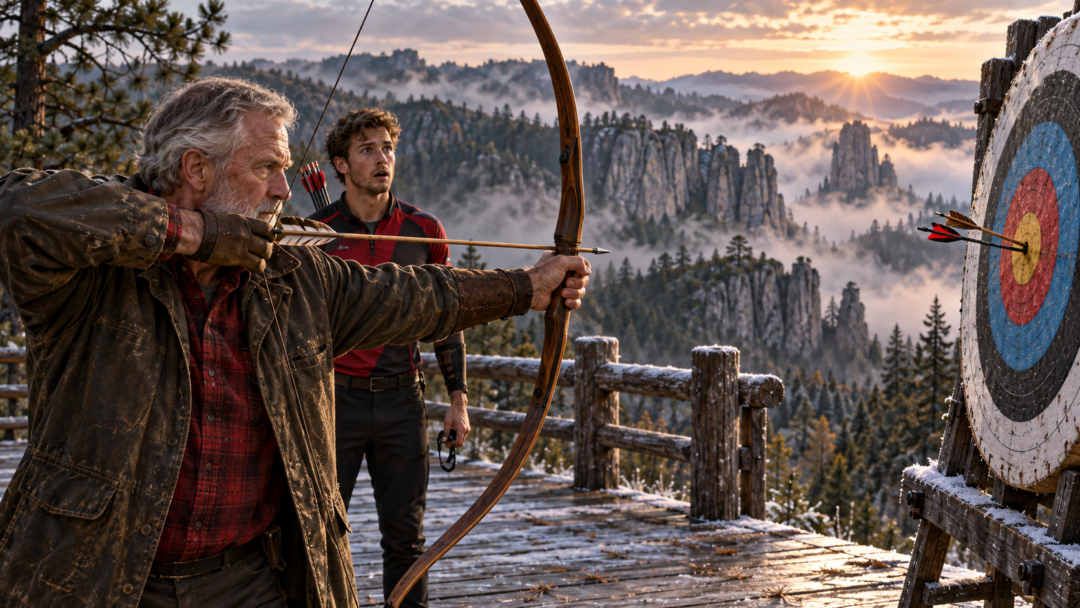
The wind blowing through Spearfish Canyon carried the sharp, bitter scent of crushed pine needles, cured limestone dust, and early November frost. Up on the high timber shooting deck of the Black Hills Archery Range, thirty miles north of Deadwood, the morning fog hung low over the target meadow like a shroud of damp wool. Down in the valley, seventy meters away, the heavy round target butts—woven from dense compressed rye straw and wrapped in weatherproof green burlap—stood like silent round sentinels against the granite cliffs. The orange wind flags mounted on the timber posts hung limp, heavy with frozen mist that dripped from the spruce crossbeams onto the frozen ground below.
Bran Keller adjusted the four-foot carbon-fiber stabilizer rod extending from the machined aluminum riser of his custom four-thousand-dollar target bow. He was twenty-seven years old, broad-shouldered and lean, dressed in a sleek red-and-black sponsorship jersey emblazoned with the silver raptor logo of Apex Precision Archery. His black composite sight bracket bristled with fiber-optic pins, micro-adjustable elevation clicks, and a magnifying lens that could pick out a fly on a target face at eighty yards. Between his right index finger and thumb, he held an anodized aluminum mechanical release aid worth more than a working man’s monthly grocery bill, its hardened steel jaws polished to a frictionless mirror shine.
Bran drew the bow back to his jaw with effortless, mechanical smooth motion, checked the illuminated bubble level mounted in the sight housing to eliminate any cant, and triggered the caliper with a micro-pressure twitch of his thumb.
SNAP-THUNK.
Seventy meters downrange, the ultra-thin carbon-fiber arrow buried itself in the center gold ring with an aggressive, hollow crack that echoed off the limestone cliffs. It was a nine-point shot, half an inch from the dead center X.
Bran lowered the bow with a self-satisfied smirk, blowing a puff of warm breath across the anodized cam pulleys. He turned around toward the covered cedar bench behind the shooting lane, shaking his head with a condescending chuckle that whistled through his teeth.
Sitting on the rough cedar bench was sixty-eight-year-old Soren Lind.
Soren wore a faded, oilskin hunting jacket with frayed corduroy cuffs over a heavy red wool flannel shirt that had seen thirty South Dakota winters. His grey beard was trimmed close to a jawline carved from mountain stone, and his steel-grey eyes looked out from beneath thick, grizzled eyebrows. He was lean, tall, and sinewy, with shoulders that had once pulled seventy-pound hunting recurves through the high Montana timber in sub-zero snowstorms.
Across his knees lay a traditional, one-piece recurve bow hand-carved from Pacific yew wood and backed with clear fiberglass laminate. It had no sights, no stabilizer rods, no mechanical release aids, and no dampening weights. It was a weapon of pure, distilled physics—wood, glue, string, and muscle.
Beside Soren’s knee, his right hand rested against his canvas thigh. The fingers were twitching.
It was a slow, involuntary rhythmic tremor—a neurological resting tic that had developed after forty years of working freezing timber lines and high-altitude hunting camps. The index and middle fingers tapped against the heavy fabric of his trousers every two seconds like a quiet, restless telegraph key.
Bran unclipped his release aid and tossed it lightly onto the wooden equipment shelf, smirking down at the old man’s twitching fingers.
“You’ve been sitting on that bench for forty-five minutes, old-timer,” Bran said, his voice carrying the sharp, abrasive arrogance of an athlete who had never known hardship. “The Lawrence County Archery Association reserved the championship lanes for Apex team training this morning. I’ve got six dozen competition arrows to log before the noon press conference. You’re taking up bench space, and to be honest, that shaking hand is making my sight picture twitch.”
Soren did not lift his head immediately. His eyes remained fixed on the limp orange wind flags down in the meadow.
“The public range guidelines give any county resident thirty minutes on an open lane between tournament sessions, son,” Soren said softly. His voice had the dry, quiet scrape of river gravel sliding under boot soles. “The clock on the clubhouse wall says you’ve been on this deck since dawn. There are three lanes here. I only need one.”
Bran laughed—a loud, nasal snort of pure contempt that drew the attention of two teenage archers practicing on the junior fifteen-meter range.
“You need a lane?” Bran scoffed, gesturing at Soren’s wooden bow with the tip of his stabilizer rod. “With that stick? Old man, this is seventy meters. This isn’t shooting tin cans behind a barn in Sturgis. At seventy meters, with your hand jumping like a hooked trout, you won’t even hit the dirt berm. You’ll put a cedar shaft into the pine trees and break a window in the clubhouse. Take that antique home and hang it over your fireplace before you hurt yourself.”
From the gravel walkway leading up to the range pavilion came the heavy, measured crunch of size-twelve service boots.
Stepping onto the cedar shooting deck was Lawrence County Sheriff Wyatt Miller, sixty-two years old, wearing his khaki winter service coat, a silver star pinned over his heart, and a Stetson hat pulled low against the canyon wind. In his left hand, the sheriff carried two steaming paper cups of black coffee from the Deadwood diner.
“You ought to watch your mouth around that stick, Bran,” Sheriff Miller said, his deep, gravelly voice cutting through Bran’s smirk like a cold blade. “You’re a national target champion, and your daddy owns the biggest archery factory in the state. But you take a long, hard look at the burnt maker’s mark stamped into the belly of that yew riser. That bow won an Olympic bronze medal in Los Angeles in 1984, before your father ever bought his first patent or figured out how to glue a carbon fiber to a limb.”
CHAPTER 2: THE SPLINTERED CARBON AT SEVENTY METERS
Bran Keller’s head whipped around toward the sheriff, his face darkening with offended vanity and sudden embarrassment before the junior shooters. He looked from the sheriff’s polished gold star down to the weathered wooden recurve resting across Soren’s knees, his lips twisting into an ugly sneer.
“I don’t care if Robin Hood shot it, Wyatt,” Bran snapped, crossing his arms tightly over his sponsor logos. “That was forty years ago. Archery isn’t about mountain lore or folklore anymore. It’s about kinetic velocity, computer-modeled limb deflection, dynamic spine alignment, and micro-radian stability. My Apex compound delivers three hundred and forty feet per second with zero hand shock. His wooden relic drops twelve feet over seventy meters in cold air. And look at his hand! The man can’t even hold a paper coffee cup without spilling it on his boots!”
Soren set his mug down on the rough cedar planking. He did not look at Bran. He stood up slowly, his six-foot-two frame straightening with the deliberate, unhurried power of an old spruce tree resisting a mountain gale.
He reached into the worn leather hip quiver at his side and pulled out a single twenty-nine-inch cedar arrow. The shaft was hand-planed from virgin Port Orford cedar, crested in pale yellow lacquer, and fletched with three five-inch shield-cut turkey feathers bound with dark silk thread. At the tip was a simple one-hundred-grain field point made of turned carbon steel.
Soren stepped past Bran, walking to the red painted shooting line on lane three.
His right hand was still twitching—the fingers tapping involuntarily against his palm as he approached the mark. Bran leaned against the timber rail, shaking his head and rolling his eyes toward the two junior shooters who were now watching from the pavilion with wide eyes.
“This is going to be embarrassing,” Bran muttered under his breath. “Fifty dollars says he misses the entire bale.”
Soren planted his heavy leather hunting boots perpendicular to the target, exactly shoulder-width apart. He took one deep, diaphragmatic breath of the cold canyon air, feeling the mountain chill settle into his lungs. He focused his vision entirely on the tiny white center spot pinned seventy meters away.
Then, he touched the bowstring.
The instant Soren’s three calloused middle fingers hooked around the Dacron serving, a miraculous transformation took place.
The tremor stopped.
It didn’t merely subside; it vanished into thin air. Soren’s wrist locked into alignment with his forearm, turning into an unyielding spar of solid bone and sinew. His right fingers froze around the nock with the absolute, dead stillness of a granite statue.
Bran’s smirk died on his face. He blinked, leaning forward over the rail, staring at Soren’s hand in sudden, uneasy disbelief.
Soren raised the bow.
He didn’t use a mechanical release. He didn’t look through an illuminated scope or check a spirit level. He brought the cedar shaft up in one continuous, sweeping, fluid motion, drawing the string back until his right index finger touched the corner of his mouth—the classic instinctive anchor point used by hunters for ten thousand years. The thick yew limbs bent into a deep, graceful crescent, groaning softly under fifty-five pounds of pure hand-drawn tension.
For one half-second, the entire canyon seemed to hold its breath. The orange flags remained dead limp.
Soren released.
THWACK-THUMP.
The sound of the bowstring striking the leather limb pads was a deep, resonant acoustic punch that rattled the cedar planks beneath Bran’s feet. The cedar arrow vanished from the shelf in a whistling blur of yellow feathers.
Seventy meters downrange, at the very center of lane two where Bran’s carbon arrow was lodged, a violent, splintering crack echoed off the rock wall.
CRACK-SHATTER.
Soren’s heavy steel point struck the plastic nock of Bran’s four-hundred-dollar carbon arrow dead center. The carbon fiber didn’t deflect; it exploded outward in a cloud of black composite dust and shredded graphite needles. Soren’s cedar shaft drove directly down the core of Bran’s split arrow, driving the fractured halves apart and burying itself six inches deep into the compressed straw gold-ring X.
The silence that followed was absolute, broken only by the distant caw of a raven circling over the pine ridge.
Bran’s jaw hung slack. His eyes bulged as he stared down the lane through his spotting scope. His four-hundred-dollar custom arrow was ruined—split like a dry kindling twig from nock to point, with a wooden hunting shaft standing proudly in its place.
“He… he Robin-Hooded my tournament arrow,” Bran choked out, his voice cracking into a high, humiliated squeak.
“That wasn’t a lucky shot, boy,” Sheriff Miller said quietly, taking a slow sip from his paper cup. “That was a message.”
Bran’s face flooded with dark, venomous crimson. He turned on Soren, his hands trembling with hysterical fury as he reached toward his phone on the bench.
“You did that on purpose!” Bran screamed, saliva flecking his lower lip. “That arrow was precision-tuned for the national finals! You used an illegal, overweight hunting point on a target range! That is destruction of private property and a direct violation of range safety codes! I’m calling my father’s corporate security right now! You’re banned from this facility for life!”
CHAPTER 3: THE BLUEPRINT IN THE CEDAR WORKSHOP
The front door of Soren Lind’s cabin, perched on a pine-crested spur four miles above Spearfish Creek, opened with the soft creak of hand-forged iron hinges.
The cabin was built from rough-hewn ponderosa pine logs chinked with lime mortar, their dark resin scented by woodsmoke and mountain pitch. The air inside was rich with the fragrance of drying cedar wood, beeswax, boiled linseed oil, and tobacco from an old ceramic jar on the mantle. In the corner, a heavy soapstone stove radiated steady, bone-deep warmth that thawed the November chill. Along the western wall stretched a sixteen-foot workbench cluttered with antique drawknives, spokeshaves, cabinet scrapers, and wooden clamping jigs holding curved laminates of yew, osage orange, and hard rock maple. Racks of hand-fletched hunting arrows lined the pine logs, their steel broadheads gleaming in the lamplight.
Sheriff Wyatt Miller wiped his boots on the braided rag rug inside the door and set his hat on the timber coat rack, shaking off the crust of fresh sleet that had begun falling as they left the canyon floor.
“Garrett Keller is beside himself, Soren,” Wyatt said, walking over to the stove to warm his hands. “He called the county board president before we even made it off the range access road. He’s threatening to pull Apex Precision’s entire five-million-dollar manufacturing expansion out of Lawrence County unless the board terminates the public lease on the bluff and signs the land over to Apex as a private corporate proving ground.”
Soren stood by his workbench, running a strip of fine garnet sandpaper along the belly of an unfinished longbow. His fingers were calm now, working with a rhythmic, hypnotic stroke that smoothed the golden grain to the texture of silk.
“Garrett’s been trying to steal that bluff for thirty years, Wyatt,” Soren said quietly. “He doesn’t want an archery proving ground. He wants to bulldoze the shooting deck and dig a gravel quarry to supply the interstate extension. That limestone ridge has sixty feet of high-grade aggregate underneath the topsoil. It’s worth twenty million dollars to a road-surfacing syndicate.”
Wyatt nodded grimly, leaning against the timber frame. “The county commissioners are scared, Soren. The tax revenue from Apex Precision keeps the road department running and funds the local school district. If Garrett threatens to move his factory across the state line to Wyoming, three of those commissioners will vote to privatize the range at tomorrow morning’s emergency hearing. They don’t care about thirty archers who shoot wooden bows on Saturday mornings.”
Soren set down his sandpaper and walked to a heavy, iron-strapped cedar sea chest resting beneath the front window. He knelt on one knee, produced a brass skeleton key from his pocket, and unlocked the heavy iron hasp.
From inside the chest, wrapped in yellowed oilcloth, Soren lifted out a thick roll of drafting vellum and a legal folder tied with faded blue silk ribbon.
He carried the documents to the workbench, unrolling the vellum flat under a brass gooseneck lamp, weighting the corners with two heavy iron broadhead anvils.
Across the top of the drafting paper, rendered in crisp black India ink, were detailed engineering cross-sections of an archery limb. The schematics showed a multi-layered core of cross-grain carbon fibers sandwiched between tapered laths of hard maple, bonded with aerospace-grade epoxy under twenty tons of hydraulic pressure.
Stamped in red ink in the lower right corner was the official seal of the United States Patent and Trademark Office, dated March 14, 1986. Below the seal were two signatures: Garrett Keller, Managing Partner and Soren Lind, Lead Designer and Co-Inventor.
“Look at Section Eight of the original partnership covenant, Wyatt,” Soren said, tapping the parchment with his calloused finger.
Wyatt leaned over the blueprint, reading the faded typewriter text aloud: “The proprietary rights to the carbon-core multi-laminate limb design shall remain indivisible between the partners. In the event that either partner attempts to commercialize, license, or assign the technology without unanimous written consent, or denies the co-inventor’s public credit, all corporate patents derived from this foundational prototype shall become null and void, reverting in full to the public domain.”
Wyatt let out a low whistle through his teeth. “Soren… Garrett Keller built his entire compound bow line on this patent. Every bow Apex sells uses this cross-grain carbon core.”
“Every single one,” Soren said. “Garrett locked me out of the machine shop in 1988 while I was competing in Europe. He filed a secondary patent under an alter-ego shell company in Delaware, altered the limb tip angles by three degrees, and claimed he invented the technology alone. I was too broke to fight three corporate law firms in federal court. I took my tools, built this cabin, and let it go. But I kept the original signed vellum.”
Before Wyatt could reply, the gravel driveway outside the cabin crunched violently beneath heavy truck tires.
Two black heavy-duty pickup trucks with tinted windows and chrome brush guards slid to a stop in front of the porch, their high-beam headlights blazing through the cabin windows. Four men in dark tactical parkas stepped out into the freezing dusk, led by a tall, silver-haired man in a tailored sheepskin coat: Garrett Keller.
CHAPTER 4: THE MIDNIGHT BARRICADE ON SPEARFISH BLUFF
Garrett Keller kicked the snow off his designer leather boots and stepped onto the cabin porch, his face lined with the sharp, ruthless authority of a man accustomed to buying whatever he couldn’t bully. Behind him stood two private security contractors carrying clipboards and leather folders, their breath pluming in the freezing mountain air like white smoke against the dark pines.
“Wyatt,” Garrett said, his voice flat and cold as he nodded toward the sheriff standing in the doorway. “I figured you’d be up here running interference for your old hunting buddy. You’re out of your jurisdiction on private corporate matters, Sheriff.”
“This cabin sits in Lawrence County, Garrett,” Wyatt said, resting his hand casually on his gun belt. “Which makes everything that happens on this porch my jurisdiction. What do you want?”
Garrett pushed past Wyatt into the cabin without an invitation, stopping in the center of the warm room. His cold, pale blue eyes locked onto Soren, who remained standing behind his workbench, his hand resting flat over the rolled vellum blueprints.
“I hear you humiliated my boy on the range this morning, Soren,” Garrett said, his tone deceptively smooth, masking a vicious, simmering fury that tightened the corners of his eyes. “Bran is a fragile thoroughbred. He shoots on nerves, focus, and corporate image. You cost him forty thousand dollars in lost endorsement shoots today with that circus stunt in front of the junior league.”
“Your boy has no respect for the weapon, Garrett,” Soren said, his voice steady as iron. “And he has no respect for the ground he stands on. He shoots like a machine because you raised him to be one. You taught him that winning is a transaction, not an art.”
Garrett let out a harsh, dry bark of laughter. He reached into his sheepskin coat and pulled out a legal document with an official blue backer from the Seventh Judicial District Court.
“I didn’t drive up this canyon to talk about marksmanship philosophy, Soren,” Garrett said, tossing the document onto the corner of the workbench. “That is an emergency temporary restraining order and notice of commercial trespass. As of four o’clock this afternoon, the Lawrence County Commissioners granted Apex Precision an exclusive, unencumbered utility license over the entire Spearfish Bluff parcel to conduct immediate soil and geological survey work. You are barred from coming within five hundred yards of that property. If you step foot on that shooting deck tomorrow morning, Wyatt will have no choice but to put you in a county cell.”
Soren didn’t pick up the court order. He looked down at the paper, then directly into Garrett’s eyes.
“You’re not doing soil surveys, Garrett,” Soren said. “You’re bringing in drill rigs to bore test core holes for the limestone aggregate. You want to destroy the bluff before the public finds out what you’re doing. You’ve already got twenty dump trucks lined up at the quarry exit.”
“What I do with that land is between me and the county commission, Soren,” Garrett hissed, leaning across the table until his face was six inches from Soren’s. “I pay three million dollars a year in payroll taxes to this county. You pay forty dollars in property tax on five acres of pine scrub. The commissioners know where their bread is buttered. You lost forty years ago when you walked away from the shop, and you’re losing tomorrow morning at City Hall.”
Sheriff Miller stepped up beside Garrett, tapping the red-sealed blueprint unrolled on the bench.
“You might want to take a look at what Soren was showing me before you start celebrating your lease, Garrett,” Wyatt said.
Garrett’s eyes flickered down to the drafting vellum. The moment his gaze caught the 1986 India ink schematics and the signature in the lower right corner, the smug arrogance on his face vanished, replaced by an expression of pure, suffocating shock. His knuckles turned white against his gloves.
“Where… where did you get this?” Garrett stammered, his voice losing its polished baritone. “The partnership records were destroyed in the shop fire in 1989.”
“You burned the shop, Garrett,” Soren said quietly. “You didn’t burn my sea chest. The covenant is intact. If you privatize that public bluff, I file this original vellum with the Federal District Court in Pierre by noon tomorrow. Every patent Apex Precision holds on multi-laminate limbs will be revoked under Section Eight. You won’t have an expansion to threaten the county with. You won’t even have a company.”
Garrett stared at the parchment, his jaw working silently, his throat bobbing in a desperate, strangled swallow.
“You wouldn’t dare,” Garrett whispered, though his trembling voice betrayed that he knew every word was true. “A federal patent challenge takes three years to litigate. Apex has twenty million dollars in legal reserves. You’ll die in poverty before the first judge hears oral arguments.”
“I was born with nothing, Garrett,” Soren said softly. “I can die with nothing. But you? You can’t live thirty seconds without your empire. Now get off my mountain.”
CHAPTER 5: THE COUNTY HEARING IN DEADWOOD
The historic Lawrence County Courthouse in Deadwood was packed to the oak rafters at nine o’clock the following morning.
The high-ceilinged room smelled of damp winter wool coats, roasted coffee, floor wax, and the stale tobacco smoke lingering in the heavy velvet drapes. Outside, sleet tapped against the tall arched windows overlooking Main Street. Inside, three county commissioners sat behind an elevated mahogany bench, flanked by county attorneys and municipal planning directors.
In the front row of the gallery sat Garrett Keller and his son Bran, surrounded by four corporate lawyers in dark charcoal suits holding thick leather presentation binders. Bran wore his sponsorship jersey under a tailored blazer, but his eyes were bloodshot and his fingers repeatedly twitched against his knees.
At the public podium stood Garrett’s lead counsel, an oily, fast-talking attorney from Sioux Falls named Arthur Vance.
“Commissioners,” Vance declared, projecting his voice toward the three board members. “Apex Precision Archery has offered to invest four point eight million dollars into a world-class training center that will put Deadwood on the national sporting map. The current public facility on Spearfish Bluff is obsolete, unmanaged, and presents severe municipal liability risks due to uncontrolled public use. The proposed long-term commercial lease ensures twenty-four-hour security, regular maintenance, and guaranteed local tax revenues. We urge the immediate passage of Resolution 404 approving the private lease transfer.”
The commission president, a portly rancher named Donald Hayes, adjusted his spectacles and cleared his throat. “Thank you, counselor. The board has reviewed the economic impact projections and the proposed infrastructure grants. Unless there is formal objection under municipal standing, the chair will call for the vote.”
“Lawrence County has a standing objection,” Sheriff Wyatt Miller announced, walking through the heavy double oak doors of the courtroom.
Behind the sheriff walked Soren Lind, dressed in a clean wool coat, carrying a battered leather dispatch case under his arm.
A low buzz of murmurs broke out across the gallery. Garrett Keller’s lawyers immediately stood up, waving their hands frantically.
“Mr. Chairman!” Arthur Vance shouted. “Soren Lind is under an active temporary restraining order regarding the bluff property! He has no legal standing in this municipal land transfer!”
“The restraining order was quashed by District Judge Albright at seven o’clock this morning,” Sheriff Miller said calmly, walking to the clerk’s desk and handing down a stamped judicial order. “Judge Albright determined that Mr. Lind is not a trespasser. In fact, Mr. Lind holds a superior proprietary covenant that predates this entire county charter.”
Sheriff Miller turned to Soren, who stepped up to the public microphone.
Soren opened his leather case and placed two documents on the podium.
“Commissioners,” Soren said, his gravelly voice filling the silent chamber with quiet, granite authority. “In 1968, my father, Peter Lind, conveyed forty-eight acres of Spearfish Bluff to Lawrence County for the sum of one dollar. The conveyance deed contains an unbreakable municipal trust covenant: the land must remain open to all citizens for traditional unpowered recreation in perpetuity. Furthermore, Section Three of the deed specifies that no commercial lease may ever be granted on the property unless a certified challenge is conducted under open public marksmanship rules.”
Commissioner Hayes frowned, leaning forward over the elevated mahogany bench to inspect the yellowed parchment deed with his reading glasses. “What kind of challenge, Mr. Lind? The county legal department has not cited a sporting covenant in forty years.”
“The traditional Founders’ Shoot,” Soren said, turning his steady grey gaze directly onto Bran Keller, who sat frozen on the gallery bench. “Three arrows at three distances: fifty meters, seventy meters, and ninety meters. If the commercial applicant’s designated archer wins, the lease proceeds to an open referendum before the county voters. If the public challenger wins, the commercial application is rejected with prejudice, and the property remains protected public parkland forever.”
The historical significance of the Founders’ Shoot was not lost on the citizens of Deadwood. For nearly a century, the high pine bluff overlooking Spearfish Canyon had served as common ground—first for Lakota hunters practicing traditional archery on the rim, then for the early territorial settlers who gathered on weekends to test their hand-carved longbows against the harsh mountain winds. The 1968 deed was signed during the height of the town’s centennial, created specifically to preserve the bluff from predatory mining syndicates that had already scarred the lower valley with cyanide leach pits.
“The charter language is completely unequivocal, Mr. Keller,” Commissioner Hayes stated, his voice echoing off the courtroom’s high pressed-tin ceiling. “Section Three does not grant this board the discretionary power to waive the public trial. If an open challenge is issued by a lawful trustee of the Lind family estate, the matter must be resolved on the shooting line under traditional rules before any lease can even be considered by the zoning clerk. That is the law of Lawrence County.”
Bran Keller stood up from his bench, his face bright red, his fists clenched at his sides.
“I accept!” Bran shouted, cutting off his father’s lawyers who were frantically trying to wave him down. “I’ll shoot against you right now, old man! At ninety meters, you won’t even hit the dirt! I’ll crush you in front of the whole town and put an end to this peasant nonsense once and for all!”
Garrett Keller grabbed his son’s arm, his face pale with fury. “Sit down, you reckless fool! You don’t know what you’re doing!”
“No, Dad!” Bran yelled, ripping his arm free with violent petulance. “He got lucky with one fluke shot yesterday morning! Let’s do it on live television! Let the whole state see what modern equipment and real training do to an old fossil who thinks he’s Robin Hood!”
Commissioner Hayes brought his heavy walnut gavel down with a sharp, resounding bang that silenced the room.
“The challenge is accepted under the provisions of the 1968 charter,” Hayes ruled. “The contest will take place at Spearfish Bluff at one o’clock this afternoon. Frank Cooper will preside as range marshal. The commission is adjourned until the results are certified.”
CHAPTER 6: THE DUEL AT NINETY METERS
By one o’clock that afternoon, more than five hundred spectators lined the timber barricades overlooking the Black Hills Archery Range.
Local television news crews from Rapid City had set up broadcast cameras on the timber pavilion deck. The weather was brutal: an Arctic front was tearing through Spearfish Canyon, driving temperatures down to twenty-two degrees Fahrenheit. Gale-force wind gusts of thirty to thirty-five knots whipped through the ponderosa pines, sending frozen pine needles and ice pellets scudding across the shooting deck. The target butts at ninety meters down in the meadow looked like tiny white coins obscured by drifting winter haze.
At the red shooting line stood Bran Keller, wearing a high-tech heated battery-powered vest beneath his jersey. His compound bow was mounted with an electronic sight housing featuring an active laser rangefinder and dynamic wind-drift calculation software.
Beside him on lane three stood Soren Lind, wearing only his red flannel shirt and wool hunting coat, holding his bare yew recurve.
The range master, an elderly veteran named Frank Cooper, raised an air horn.
“Round one! Fifty meters! One arrow each!”
Bran drew back his bow with mechanical precision. He centered his digital crosshair, checked the green digital wind indicator on his sight, and touched his electronic release.
SNAP-THUD.
The carbon arrow struck the outer gold ring for a nine. The crowd clapped politely.
Soren stepped to the line. His resting hand gave one small, final twitch before his fingers locked onto the string. He drew, anchored for a fraction of a second, reading the sway of the pine branches with instinct born of fifty winters, and released.
THWACK-CRACK.
His cedar arrow buried itself half an inch closer to the center X than Bran’s. Ten points.
A roar of cheers erupted from the local hunters and timber workers in the gallery.
“Round two! Seventy meters!” Frank called out.
The wind suddenly shifted, howling violently from the northwest in a swirling downdraft off the canyon wall. Bran’s digital sight began flashing an error code—the sub-zero cold was draining his lithium battery pack, causing the electronic crosshair to flicker and dim.
Bran’s breathing grew ragged. Sweat froze on his temples. He rushed his draw, fighting the buffeting wind against his four-foot stabilizer rod. When his release fired, the sudden wind gust caught his light carbon shaft, drifting it into the red eight-ring.
Soren didn’t fight the wind. He waited. He held his draw for three long, agonizing seconds, feeling the gust peak against his knuckles, then released into the lull immediately following the surge.
THWACK.
Another dead-center nine, piercing the inner gold circle. Soren led by two points.
“Round three! Ninety meters!” Frank Cooper’s voice echoed across the frozen valley, sounding like a gunshot against the canyon walls.
Ninety meters in a freezing mountain gale was an almost impossible distance for barebow archery. The arrow would need over three seconds of flight time, curving through multiple turbulent wind shears, thermal updrafts from the creek bed, and cross-canyon downdrafts before reaching the distant straw butt. It was a distance where mechanical calculations collapsed under the raw, unpredictable chaos of mountain nature. A single degree of lateral torque on the handle would translate to twenty feet of drift at the target face.
Bran stepped to the shooting line, his legs shivering inside his high-tech trousers. As he raised his heavy aluminum compound bow, the digital heads-up display inside his scope housing flickered violently twice, then went completely black—the lithium-ion battery pack had frozen solid in the sub-zero mountain gale.
“My sight died!” Bran yelled frantically toward his father, holding up his dead compound bow with shaking hands. “The equipment failed! The battery froze in the draft! I need a ten-minute technical timeout to replace the power pack from my truck!”
“There are no timeouts in a Founders’ Shoot, Bran,” Sheriff Miller called out sternly from the scorer’s table, leaning over the timber rail with unyielding authority. “The 1968 charter does not recognize equipment failure as an act of God. You shoot what you brought to the line, son. Shoot your arrow or forfeit the round right now.”
Panicked, shivering with cold, exhaustion, and rising terror, Bran was forced to aim with naked eye through his dead scope housing. Without his computerized elevation lines or illuminated pins, the distant ninety-meter target looked no larger than the head of a pencil. He drew back frantically, his fingers trembling violently against his release aid, fighting the buffeting thirty-knot crosswind against his long carbon stabilizer rod. His breath came in ragged, wheezing gasps.
He fired blindly into the wind.
The lightweight carbon arrow flew wide. The howling canyon gale seized the fragile graphite shaft like a dry leaf, hurling it thirty feet off course. It struck the frozen dirt berm forty yards short of the target butt, skipping off a granite boulder and shattering into useless carbon splinters that vanished into the snowdrifts.
A score of zero.
The entire crowd went dead silent. The wind roared through the pines. All eyes turned to Soren Lind.
CHAPTER 7: THE FINAL ARROW ON THE LIMESTONE RIDGE
Soren needed only to hit the target bale anywhere—even a single point on the outer white ring—to win the contest and save the bluff forever.
He stepped to the line. The gale was shrieking now, roaring through the pine canopy with the sound of a freight train. Ice pellets stung his weathered cheeks, but Soren’s eyes were wide, clear, and serene.
He pulled his final cedar shaft from his leather quiver. He ran his thumb over the turkey feathers, feeling the stiff, oily barbs that had been shed by a wild tom in these very hills three springs ago.
Soren lifted the yew bow.
He didn’t aim at the target butt. He aimed forty feet to the left, angling the tip of his arrow high into the empty grey sky above the canyon rim, calculating the massive ballistic arc that gravity and sixty miles of wind would carve through the air.
His hand touched the corner of his smile.
He released.
The bowstring sang—a pure, golden tone that cut through the howling gale like a cathedral bell.
The cedar arrow soared into the sky, climbing high above the treetops, disappearing for a heartbeat into the low winter clouds. For two seconds, five hundred people held their breath, their heads tilted back toward the freezing sky.
Then, the arrow descended.
Curving gracefully through the turbulent wind shears, the heavy cedar shaft rode the mountain downdraft like a living bird. It dropped down out of the grey mist, locked onto the target face, and struck the very center of the gold ten-ring with an explosive, muffled thud.
THUNK.
Dead center X.
For three seconds, the entire Black Hills range stood in paralyzed, breathless awe.
Then, the mountain erupted.
Ranchers, timber cutters, townspeople, local business owners, and teenagers leaped over the wooden barricades, swarming the shooting deck in a roaring, cheering wave of genuine mountain triumph. Hats were thrown high into the freezing air, tumbling across the snowbanks. Sheriff Wyatt Miller grabbed Soren in a massive bear hug, his booming laughter carrying over the howling wind. Men who had worked the timber mills alongside Soren’s father pounded him on the back, their eyes shining with pride as the news cameras broadcast the historic victory across the state.
Down on lane one, Bran Keller dropped to his knees on the snow-covered planks, his four-thousand-dollar bow tumbling into the slush from his numb, shaking fingers, his head buried in his hands as he wept in total, humiliating defeat. His high-tech sponsors had watched his collapse on live regional television. Behind him, Garrett Keller turned his heavy sheepskin collar up against the biting wind, clutching his useless corporate lease dossiers to his chest, and fled down the gravel road toward his idling pickup truck before the angry townspeople could turn their eyes on him.
Three days later, the Lawrence County Commissioners met in a standing-room-only session at the Deadwood courthouse.
By unanimous, recorded roll-call vote, Resolution 404 was struck from the register forever with extreme prejudice. The Spearfish Bluff range was declared a protected historical landmark and deeded into the Soren Lind Traditional Archery Trust, ensuring that no commercial mining, private corporate leases, or commercial developments could ever touch the sacred timber ground. Furthermore, the county attorney initiated a formal review of Apex Precision’s corporate tax credits, uncovering decades of fraudulent municipal claims that resulted in a two-million-dollar restitution order to the county school fund.
The following Saturday, the Arctic storm had finally passed over the Black Hills, leaving behind clear blue mountain skies, crisp clean air, and bright, warm sunshine that melted the frost from the ponderosa pine needles.
On the high shooting deck stood eight young boys and girls from Deadwood, each holding a simple wooden recurve bow hand-carved by Soren’s own hands from seasoned South Dakota ash and yew. The range smelled of sawdust, fresh beeswax, and pine pitch, alive with the bright chatter of youth.
Soren walked slowly behind the line, his fingers resting gently on the shoulder of a twelve-year-old girl whose hand was trembling nervously as she tried to draw the Dacron string to her cheek.
Soren knelt beside her in the warm sunlight, his voice warm, gentle, and patient as the mountain pine.
“Don’t fight the tremor, child,” Soren whispered, guiding her small fingers onto the Dacron serving. “The shake is just the body reminding you that you’re alive. It’s the mountain wind talking to your blood. When you touch the string, let your mind become the arrow. Trust the wood. Trust the wind. And the target will find you.”
The girl drew. Her hand steadied into solid, unshakeable stone.
She released, and the cedar arrow flew true into the morning light.