The Cold Frozen Blades That Shattered His Cruel Ice Empire
CHAPTER 1: THE FROST ON THE STEEL DASHER BOARDS
The ammonia chill of Superior Municipal Ice Arena hit like a fist to the teeth. It was twenty minutes past four in the morning, and November gales howling off Lake Superior rattled the heavy iron corrugated roof thirty feet above the ice. Outside, sleet iced the telephone poles along Tower Avenue and turned the docks of Duluth Harbor into a treacherous maze of black slush. Inside, the only illumination was a row of pale industrial mercury-vapor lamps hanging over the rink, humming with a sickly blue frequency that made the frost on the green dasher boards glow like bone. The vast concrete cavern smelled of brine, rusted iron pipes, damp wool, and the bitter exhaust of the Zamboni compressor idling in the rear bay.
Coach Gregory Renner stood at the gate of the home team players’ bench, his hands buried deep inside the fleece-lined pockets of his three-hundred-dollar academy team parka. His neck was pulled tight against the woolen collar, his breath venting in rapid, impatient plumes of white steam that drifted upward into the shadowed rafters. Behind him on the wooden bench sat his star junior pupil, a sixteen-year-old girl named Chloe whose wealthy timber-syndicate parents paid Renner eight hundred dollars a week for private dawn ice time. Renner checked his stainless-steel stopwatch with an aggressive flick of his wrist, then glared toward the rubber-matted walkway leading to the public locker rooms.
Walking along the rubber mat, carrying a scuffed leather skate bag over her thin shoulder, was ten-year-old Mila Rostov.
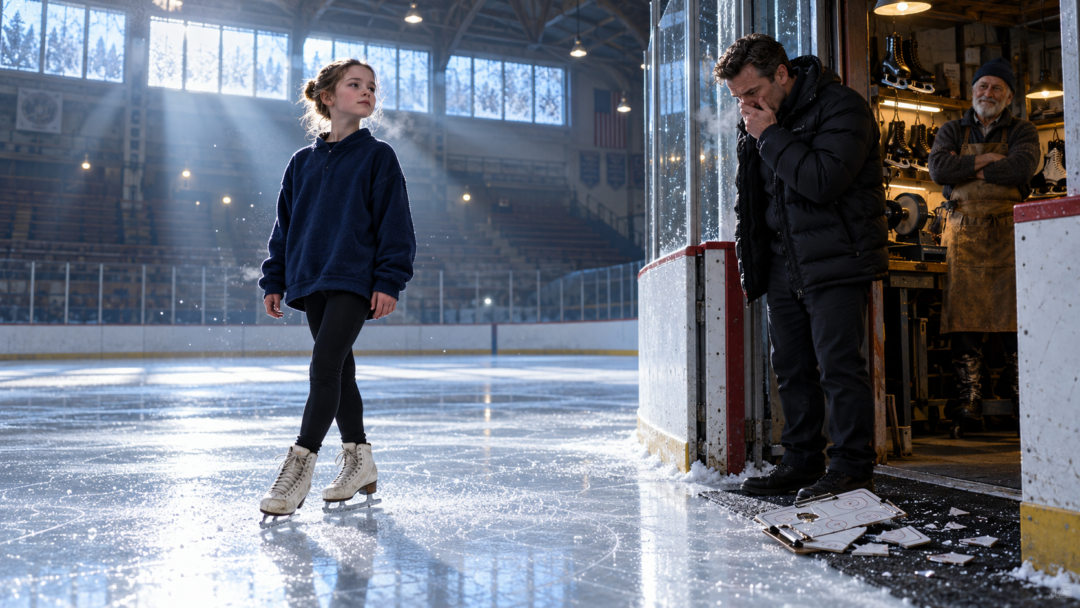
Mila wore an oversized navy-blue fleece pullover that had belonged to an older cousin, faded dark corduroy leggings, and thick wool knit gloves with patched fingertips. Her dark brown hair was pulled back into a severe, disciplined competition bun secured with wire bobby pins that dug into her scalp. She was small for ten, with thin wrists and sharp, prominent collarbones, but she walked with an eerie, centered equilibrium—every step landing squarely on the balls of her feet, her spine perfectly straight, her dark eyes looking forward without blinking.
On her feet were an old pair of white Riedell figure skates. The leather was scuffed down to the raw grey suede along the inner counters, and the brass lace hooks were tarnished black with age. But the blades mounted beneath the soles were John Wilson Gold Seals—hand-forged Sheffield steel with deep, hollow-ground parabolic edges and cross-cut toe picks that caught the light with cold, surgical brilliance.
Renner stepped directly into the open doorway of the ice gate, crossing his arms over his chest. A thin, mocking smirk tugged at the corner of his clean-shaven jaw.
“Where do you think you’re going, Rostov?” Renner’s voice echoed across the empty, freezing sheet of ice, flat and harsh.
Mila stopped two feet from the rubber threshold. Her eyes rose to meet his, completely steady, carrying a quiet stillness that made Renner’s left hand twitch involuntarily inside his pocket.
“The municipal public session schedule lists open ice at four-thirty, Coach Renner,” Mila said. Her voice was calm, clear, and quiet, without a tremor of cold or hesitation. “I paid my twelve-dollar municipal pass at the ticket window.”
Renner let out a dry, barking laugh that bounced off the steel roof trusses.
“Open ice?” Renner said, tapping his clipboard against the wooden rail with sharp, rhythmic cracks. “The North Shore Elite Academy has an exclusive morning charter with the city parks department. Chloe is preparing for the Midwest Sectional Qualifier next Saturday. We don’t share our ice with walk-in public park skaters in clearance-rack hand-me-downs. This sheet was resurfaced ten minutes ago with boiling municipal water to create an Olympic-grade competition plane. Your twelve dollars gets you the afternoon public session when the ice is chopped to hamburger by amateur hockey leagues.”
“The city charter says the four-thirty morning slot is open development ice for all registered St. Louis County youth skaters,” Mila said, her tone unyielding. “My mother checked the registry with the recreation clerk yesterday afternoon. The public window is posted on the bulletin board.”
Renner’s smirk dropped, replaced by an ugly, tightening snarl around his mouth. He stepped down onto the rubber threshold, towering over the child with the full bulk of his heavy athletic frame.
“Your mother works the graveyard shift at the packaging warehouse on the harbor docks,” Renner hissed, leaning in close so only Mila could hear his bitter, gravelly whisper. “She hasn’t had any say in this arena since 2002, and she knows it. You don’t have private coaching. You don’t have club affiliation. You don’t belong on this ice, Mila. You’re cluttering my sightlines, and your presence is a distraction to paying athletes.”
From the dark corridor behind the Zamboni garage, the heavy scrape of an industrial grinding wheel suddenly stopped.
The wooden half-door of the skate technician’s booth swung open with a screech of rusted hinges. Out stepped Karl Lindqvist, seventy-four years old, wearing a grease-stained canvas apron over an old flannel work shirt, his steel-toed boots scuffing heavily across the rubber matting. His hands were covered in fine steel dust, his fingernails split from half a century of mounting competition blades. In his right hand, he held an eight-inch diamond-grit honing stone.
“Gregory,” Karl said, his gravelly Scandinavian accent cutting clean through the ammonia air like a dull saw. “The girl’s ice fee was punched on the registry clock by my own hand at four-fifteen. She has the ice.”
Renner spun around, his face flushing dark red in the blue vapor light. “Stay out of this, Karl! You’re an hourly municipal employee. I manage the competitive program for this city. If I say she’s a safety hazard to my private students, she doesn’t step on that sheet. Look at those boots! The ankles are broken down. She couldn’t hold a clean outside edge to save her life. If she steps out there and crashes into the boards, the liability falls on the city.”
Karl Lindqvist took two slow, heavy steps forward, stopping right beside Mila. He looked down at the child’s feet, then fixed his pale blue eyes on Renner’s throat.
“Call the city attorney if you want to talk about liability, Gregory,” Karl said, his voice dropping into a dangerous, low rumble. “Call the mayor. Call the district commissioner. And while you have them on the phone, I’ll show them the serial numbers stamped into the mounting plates of those blades. I’ll make sure they remember who owns the deed to the ground under this ice.”
CHAPTER 2: THE EDGE IN THE COLD ICE
Gregory Renner’s jaw clenched so hard the muscles along his cheek pulsed like an exposed nerve. His eyes flickered down to the polished steel runners beneath Mila’s boots, then darted back to Karl Lindqvist’s weathered, uncompromising face. The arena suddenly felt two degrees colder, the wind outside thumping against the corrugated metal siding like a trapped beast.
“You’re bluffing, old man,” Renner said, though the confidence in his tone was suddenly hollow, brittle as thin pond ice. He shifted his weight, his fingers curling into tight balls inside his parka. “Anya Rostov sold off her equipment twenty years ago to pay her hospital bills after the Olympic trials. These are just salvage blades picked up from a second-hand pawnshop on Michigan Street.”
“Then let the girl skate,” Karl said, crossing his thick, soot-stained arms over his apron. “If she’s a danger to your student, you can throw her off. But if she can skate, you step back into your coach’s box and keep your mouth shut until the five-fifteen bell rings.”
Renner scoffed, turning back to the ice with a sneer of pure contempt. He looked down at Mila, gesturing toward the vast, empty expanse of seventy-by-two-hundred-foot glistening ice.
“Fine,” Renner barked. “Let’s see it, Rostov. Let’s see the glorious technique you learned from your crippled mother in the garage. Show me a clean double salchow. If your toe pick slips, if your knee buckles, or if you under-rotate by forty-five degrees, you pack your skates and get out of this facility for good. You have sixty seconds.”
Mila did not glance at Karl. She did not say a single word of defiance. She stepped across the threshold, her blades meeting the freshly shaved ice with a sound as crisp and sharp as an axe biting frozen birch.
She glided ten feet onto the ice, then paused at the blue line.
The arena was dead silent except for the low rumble of the ventilation fans and the distant drip of condensation from the high ceiling rafters. Mila stood motionless, her arms curved softly at her sides, drawing three slow, measured breaths through her nose. Her posture was completely serene, centered over her hips, her weight settled deeply into the hollow of her left blade. She felt the temperature of the ice through her leather soles—hard, fast, twenty-four degrees Fahrenheit.
Then she pushed.
With two powerful forward crossovers that carved clean, razor-thin white arcs through the frost, Mila gathered immense speed with shocking efficiency. She didn’t flail; her upper body remained quiet as a stone statue while her legs generated raw kinetic torque. She transitioned effortlessly onto a deep back outside edge, curving in a wide parabolic circle toward the center red dot.
Renner watched from the boards, his smirk frozen. His eyes narrowed. “What is she doing? That’s not a salchow entry…”
Mila drove her left toe pick hard into the ice behind her right heel.
CRACK.
The sound of the pick strike wasn’t a dull scrape; it was a thunderous, explosive pop that echoed through the empty steel rafters like a small-caliber gunshot. Mila launched upward, catapulting four feet into the air with astonishing vertical height. In mid-air, her arms snapped tightly across her chest like a closing steel trap, her rotational axis pulling into a tight, frictionless pencil that blurred in the blue light.
One rotation. Two rotations. Three rotations.
A full, soaring, textbook Triple Lutz.
At the peak of her trajectory, she hung suspended against the dark steel roof beams, her body turning with dizzying, mathematical precision. The delay at the apex was breathtaking—she held the ascent for half a beat before snapping the third revolution with ferocious rotational velocity. Then, as gravity took hold, her right leg extended back in a wide, sweeping arc, checking the centrifugal force instantly.
SHHH-T.
Her right back outside edge carved a clean, whispering groove across the ice. She held the landing position for four full seconds—chest high, fingers extended in classical Russian alignment, her free leg straight and locked behind her, gliding twenty feet across the ice with zero wobble, zero blade chatter, and absolute, regal stillness.
At the boards, Chloe let out an audible gasp, her hand flying to her mouth, her eyes wide with undisguised shock.
Gregory Renner stood paralyzed. His clipboard slipped through his fingers, clattering onto the rubber floor mat with a hollow slap. His right hand came out of his parka pocket, visibly trembling—the fingers twitching in an uncontrollable spasm of pure, unadulterated shock.
It was the exact jump that had ended his competitive career in 1998—the jump he had spent ten years trying and failing to teach any student in his private academy. And here, in front of him, a ten-year-old girl in second-hand skates had executed it with the ease of drawing breath.
Mila curved into a gentle three-turn, gliding back toward the player’s gate, coming to a soft stop six inches from where Renner stood.
“Was that clean enough, Coach Renner?” Mila asked quietly.
Renner’s face was white as the ice beneath his boots. His chest rose and fell in ragged bursts. But instead of conceding, his eyes flared with a desperate, venomous panic. He dropped to one knee on the rubber mat, frantically inspecting the ice where Mila had landed, searching for any imperfection.
“You had steel screws in those soles!” Renner yelled, his voice cracking with hysterical rage as he pointed at the clean groove in the ice. “You altered the edge! That’s an illegal radius grind! You intentionally damaged the municipal surface to sabotage Chloe’s training session! Get off my ice! You have ten minutes to clear your locker or I’m calling the police!”
CHAPTER 3: THE LOGBOOK UNDER THE GRINDING WHEEL
The door to Karl Lindqvist’s skate shop slammed shut, cutting off the drafty roar of the arena concourse.
Inside the small, ten-by-twelve-foot workshop, the air was warm, smelling of motor oil, fine leather dressing, and the bitter tang of ground carbon steel. Two industrial skate-sharpening machines stood mounted on heavy cast-iron pedestals, their abrasive wheels surrounded by copper dust shrouds that glowed dull orange in the light of an overhead swing-arm lamp. Along the rear wall hung hundreds of brass templates, boot stretchers, calipers, and pitch-gauges dating back to the 1960s.
Mila sat on a low wooden stool by the workbench, unlacing her right boot with steady, patient fingers. Her face showed no sign of tears, but her cheeks were flushed pink from the cold ice and the adrenaline still humming through her veins.
Karl locked the heavy deadbolt on the workshop door, pulled down the yellowed window shade, and walked over to the corner behind the oil heater. He reached on top of a steel fireproof filing cabinet, lifting down a thick, heavy three-ring binder bound in black oilcloth, its edges cracked and taped with duct tape. Stenciled across the front in faded white paint was: SUPERIOR MUNICIPAL RINK – EQUIPMENT LOG – 2000-2005.
Karl dropped the binder onto the workbench with a heavy, dust-raising thud.
“Drink your cocoa, Mila,” Karl said, nodding toward a steaming ceramic mug on the corner of the desk. “Renner is out there on his cellphone crying to the city recreation director. He’ll have three security guards at that gate by five o’clock. But they won’t touch you while you’re in this shop. Not while my name is still on the union seniority roster.”
Mila took a sip of the warm cocoa, wrapping both hands around the mug to thaw her chilled fingertips. “Why does he hate my mother, Karl? He was her partner once. She had pictures of them in her scrapbook from when they were juniors.”
Karl sat down heavily in his swivel chair, his knees cracking. He flipped open the binder to a section marked JANUARY 2002 – U.S. OLYMPIC TEAM TRIALS.
“They weren’t partners, child,” Karl said, his voice grim as granite. “They were rivals training under the same master coach, Viktor Stanislav. Your mother was sixteen years old, the fastest jumper this state ever produced. She could land the triple lutz blindfolded in a blizzard on natural river ice. Renner was twenty-two, funded by a syndicate of Duluth grain-shipping heirs who poured fifty thousand dollars into his training. The sponsors told Renner that if he didn’t win the Midwestern gold and qualify for Salt Lake City, the money was gone. His family was drowning in mortgage debt, and his coaching career depended entirely on making that national team.”
Karl turned the yellowed page. Pasted into the lined ledger was a carbon-copy work order from January 14, 2002.
“The night before the short program, your mother brought her skates in for a final edge check,” Karl continued, his voice dropping to a harsh whisper. “I had gone home with pneumonia. My apprentice at the time was an eighteen-year-old kid named Danny, who needed five hundred dollars to fix his truck transmission. Look at this line right here.”
Karl’s soot-stained index finger pointed to a handwritten entry at the bottom of the slip: Special hollow grind: 5/16-inch radius on landing foot. Authorized by G. Renner, Assistant Coach.
“A five-sixteenths hollow is too deep for a competitive free skate,” Mila said, her brow furrowing as she recognized the technical measurement. “The edges bite too hard into the ice. If you land with any lateral tilt, the blade locks.”
“It doesn’t just lock,” Karl said grimly. “It snaps the bone. When your mother landed her triple lutz in the second minute of her program, the blade caught the ice like an iron wedge driven into frozen oak. Her fibula snapped in three places. She was in a cast for six months, and the ligament damage was permanent. Renner took the silver medal, qualified for the international team, and used the publicity to secure the municipal lease on this entire facility.”
Mila looked down at the signature on the yellowed paper. Even twenty years later, the hurried, arrogant slant of Gregory Renner’s handwriting was unmistakable.
“Does my mother know?” Mila asked softly.
“She suspected,” Karl said. “Viktor Stanislav tried to get the state skating federation to investigate, but Renner’s grain-shipping backers threatened a three-million-dollar defamation suit that would have ruined the club. Viktor resigned, left the country in disgust, and your mother never skated competitively again. She took a job on the docks and buried the boots in the back of the closet.”
Karl reached into the top drawer of his desk and pulled out a small black velvet pouch. He untied the drawstring and tipped the contents onto the green blotter.
Out rolled four stainless-steel mounting screws, their threads blackened with dried red thread-locker.
“These came out of your mother’s landing boot that night in the emergency room at St. Mary’s,” Karl said, his eyes burning with quiet fury. “The screws weren’t just standard mounting hardware. The heads had been notched with a hacksaw file so they would shear under twenty foot-pounds of landing torque. Renner paid Danny fifty dollars to notch them. Danny gave them to me on his deathbed five years ago, along with a sworn affidavit.”
A violent knock rattled the frosted glass of the workshop door.
“Karl! Open this door right now!” Gregory Renner’s muffled shout carried through the wood. “I have Officer Henderson from the Duluth harbor patrol with me! We have an immediate facility exclusion order signed by the parks commissioner! Unlock this door or we take it off the hinges!”
CHAPTER 4: THE MIDNIGHT ICE ON THE BAY
Karl Lindqvist didn’t rush. He slipped the four notched screws back into the velvet pouch, tucked the 2002 logbook into a heavy canvas tool bag, and handed it to Mila.
“Take the rear compressor exit,” Karl whispered, pointing toward a small steel fire door behind the insulated boiler pipes. “It leads out to the loading dock on Railroad Street. My truck is parked behind the lumber yard. Go straight home to your mother. Do not stop for anyone.”
“What about you?” Mila asked, clutching the canvas bag to her chest.
“I’m seventy-four years old, child,” Karl said, picking up his diamond sharpening stone and slipping it into his apron pocket with a calm smile. “I’ve worked for the city longer than Renner’s father has been drawing a municipal pension. Let them try to fire me.”
Twenty minutes later, Mila was running down the snow-covered alleyway toward the harbor docks, the icy wind off Lake Superior biting her cheeks through her wool scarf. The sleet had turned into heavy, wet snow that plastered her coat and obscured the streetlamps.
When she pushed open the back door of the small clapboard house on 12th Avenue East, her mother was standing by the cast-iron stove in her stained warehouse work uniform, stirring a pot of barley soup. Anya Rostov turned, wiping her hands on an apron, her face pale with exhaustion from sixteen hours on her feet.
“Mila?” Anya’s eyes darted to the canvas tool bag in her daughter’s arms, then down to the skates tied around her neck. “What happened? You weren’t supposed to finish until six.”
Mila set the canvas bag on the kitchen table and pulled out the 2002 black oilcloth logbook, opening it to the yellowed carbon slip.
Anya froze. The color drained from her face so completely that the faint white scar along her left cheek stood out like chalk under the dim overhead bulb.
For two hours, as the gale rattled the storm windows of the little kitchen, Anya turned the yellowed pages of the logbook, reading Danny’s handwritten confession, running her trembling fingers over the four notched steel screws. She didn’t cry. Her jaw, carved from the same stubborn Slavic granite as her daughter’s, set into an expression of unyielding, lethal cold.
“Renner thinks he won,” Anya said, her voice dropping into a register Mila had never heard before. “He thinks because we have no money, we have no teeth. He thinks time washes out blood.”
“He locked the rink doors, Mom,” Mila said quietly. “He told the harbor patrol to arrest us if we step foot on municipal property before the regional qualifier on Saturday.”
Anya stood up, limping slightly on her scarred left ankle as she walked to the back door. She looked out through the frosted glass toward the dark expanse of St. Louis Bay, where the river mouth emptied into Lake Superior. The sub-zero temperatures over the past forty-eight hours had flash-frozen the sheltered bay into five square miles of natural black ice—flat, glass-smooth, and hard as tempered steel, swept clear of snow by the gale.
“Then we don’t need his rink,” Anya said, turning to her daughter. “Get your coat, Mila. And put on your heavy wool tights.”
By midnight, they were standing on the frozen shore of St. Louis Bay beneath the rusted iron piers of the old ore docks.
Anya parked their beat-up 2004 Ford Taurus on the gravel boat ramp, turning the high-beam headlights out over the bay. The two parallel cones of yellow halogen light illuminated an eighty-foot oval of pure, pristine black ice, protected from the wind by the towering steel walls of an abandoned grain elevator.
Mila laced her skates on the tailgate of the car.
“Show me the triple lutz, Mila,” Anya said, standing at the edge of the ice with an old stopwatch around her neck, her breath venting like white smoke in the car’s headlights. “Not for Renner. Not for the judges. For yourself. Feel the edge bite the lake. Lake Superior doesn’t care about academy politics. The lake only knows gravity and speed.”
Mila stepped onto the black ice. The natural ice was harder, colder, and faster than any artificial rink surface. Her blades sang against the frozen bay—a clean, resonant shriek of steel carving crystal that echoed under the massive concrete grain silos. She circled into the beam of the headlights, set her back outside edge, and struck the pick.
She flew.
Under the harsh yellow light of the Ford Taurus, suspended between the dark Minnesota sky and the frozen lake, Mila executed jump after jump: triple lutz, triple flip, double axel. Anya stood at the edge of the ice, calling out corrections with the surgical precision of an elite Olympic technician: Hips square! Drop the right shoulder! Snap the arms at the peak!
Suddenly, the roar of twin diesel engines echoed from the access road above the boat ramp.
Two heavy-duty municipal flatbed tow trucks, their orange strobe lights flashing violently against the snowbanks, rumbled down the ramp. Out of the lead cab stepped Gregory Renner, wearing a fur-trimmed winter parka, accompanied by two private security contractors in high-visibility vests.
“Shut off those headlights!” Renner bellowed through a battery-powered megaphone, pointing down at the Taurus. “This bay access is private municipal port authority property! You are operating an unlicensed vehicle in an industrial shipping zone! Tow these cars immediately!”
CHAPTER 5: THE AUDIT AT ST. LOUIS COUNTY COURT
The two tow truck operators hesitated, their hydraulic booms lowering toward the rear bumper of Anya’s car, their breath pluming in the freezing orange strobe light.
Anya did not move an inch. She stepped directly in front of the winch hook, resting her gloved hand flat on the steel cable.
“Touch this car,” Anya said, her voice cold as the ice beneath her boots, “and I’ll file an immediate criminal conversion charge with the county sheriff before your winch turns a single gear. This vehicle is on a public boat launch maintained under federal waterways easements.”
Renner marched down the icy gravel, his face twisted in venomous triumph. “You think you’re above the law, Anya? The Duluth Port Authority signed an exclusive waterfront security easement with the North Shore Academy board last month! We have full jurisdiction over this shoreline! Your daughter is barred from regional qualifying for code-of-conduct violations, and your car is being impounded for trespassing!”
“What code of conduct?” a booming voice demanded from the darkness behind the ore piers.
Out of the shadows walked Karl Lindqvist, accompanied by a tall, broad-shouldered man in a heavy charcoal overcoat with an official gold star pinned to his lapel: St. Louis County Sheriff David Vance. Beside them walked an elderly woman carrying a thick leather dispatch case—County Archivist Martha Higgins.
Renner stopped dead in his tracks. The tow truck drivers immediately killed their hydraulic pumps, recognizing the sheriff’s cruiser idling at the top of the ramp.
“Sheriff Vance,” Renner stammered, pulling off his leather glove to offer a handshake that the sheriff completely ignored. “I… I was just assisting the port authority with an unauthorized trespasser operating heavy equipment on the frozen bay…”
“Save it, Gregory,” Sheriff Vance said, his eyes hard as flint. “Karl called me at home an hour ago. He showed me the 2002 equipment log from the municipal arena. And more importantly, he had Martha pull the original land records from the county courthouse basement.”
Martha Higgins stepped forward, opening her dispatch case and pulling out a thick, red-bound legal dossier stamped with the gold seal of the Minnesota Secretary of State.
“What is that?” Renner muttered, taking a nervous half-step backward toward his truck.
“This is the 1974 Rostov Municipal Trust Deed,” Sheriff Vance said, opening the document under the flashing orange lights. “Fifty years ago, Mila’s great-grandfather, Nikolai Rostov, donated forty acres of prime Duluth waterfront to the city—including the land where your arena and these ore docks sit. The deed contains an ironclad reverter clause: if the facility ever bars a direct descendant of Nikolai Rostov from using the recreational facilities, or if the managing tenant is found guilty of commercial fraud, the entire parcel reverts immediately to the Rostov family estate.”
Renner’s mouth fell open. His eyes darted frantically to Anya, then to Mila standing motionless on her skates on the black ice.
“That… that deed is fifty years old!” Renner sputtered, his voice rising to an indignant pitch. “It’s obsolete! The city council signed a twenty-year commercial lease with my academy! My board has invested hundreds of thousands of dollars in facility improvements!”
“The city council signed a lease based on your fraudulent representation that the arena was unencumbered by private covenants,” Sheriff Vance said. “Karl brought the original county archives out of the courthouse vault tonight. Furthermore, Karl’s logbook and Danny’s deathbed affidavit regarding the tampering with Anya’s skates in 2002 have been entered into the county investigative docket as evidence of criminal reckless endangerment.”
The sheriff turned to the tow truck drivers, his voice carrying the full weight of thirty years of law enforcement on the Great Lakes. “Get your rigs out of here. If I see either of these trucks down here again tonight, or anywhere near this public waterfront before sunrise, I’m revoking your municipal towing permits on the spot and impounding both rigs at the county yard.”
The drivers scrambled back into their cabs, killed the strobe lights, slammed their heavy doors, and backed up the gravel ramp into the darkness of the snowstorm.
Renner stood alone on the gravel in the biting sub-zero wind, his face pale, his breath catching in his throat as the reality of the unsealed county deed settled into his bones. His multimillion-dollar academy empire was crumbling beneath the weight of fifty-year-old parchment.
Anya walked up to him, stopping three inches from his face. The white scar on her cheek gleamed in the halogen headlights. She looked down at his trembling right hand, then directly into his panicked, hollow eyes.
“We’ll see you at the regional qualifier on Saturday, Gregory,” Anya whispered, her words cutting through the howling gale with icy clarity. “Have your student ready. Because my daughter is going to skate the program you tried to kill twenty years ago. And every judge in the arena will see what stolen glory looks like when the truth takes the ice.”
CHAPTER 6: THE CHALLENGE AT THE REGIONAL QUALIFIER
The Duluth Civic Center was packed with twelve hundred spectators for the Saturday afternoon session of the Midwestern Regional Figure Skating Championships.
Banners from elite clubs across Minnesota, Wisconsin, Michigan, and Illinois hung from the steel balconies. The air smelled of hot popcorn, zamboni exhaust, and high-strung competitive tension. Down on the ice, six young women were finishing their six-minute warmup for the Junior Ladies Short Program.
In the center of the warm-up group, wearing a glittering, thousand-dollar custom crystal dress, was Renner’s star pupil, Chloe. She landed a double axel, landing cleanly to polite applause from the VIP box where Renner sat alongside the regional technical committee. Renner wore a charcoal designer suit, his hair slicked back, but those sitting near him noticed that his right hand remained tucked firmly beneath his program to conceal a violent tremor.
At the edge of the rink, standing at the player’s gate, was Mila.
She wore a simple, deep-navy velvet dress sewn by her mother’s hands, with high-collared lace and long sleeves that made her look like an athlete from a classical era. Her white skates were immaculately polished, the Sheffield steel blades gleaming under the arena spotlights.
Gregory Renner walked down from the judges’ platform, leaning over the dasher boards with a paper registration slip in his hand.
“She can’t skate, Anya,” Renner said, presenting the paper to the chief technical controller, a silver-haired woman named Madame Elizabeth Thorne. “Mila Rostov has no official club sponsorship. Rule 402 of the Midwestern Association requires an active letter of endorsement from a certified US Figure Skating master coach. I am the only master coach registered in this district, and I have officially withheld my endorsement based on safety concerns.”
Madame Thorne frowned, looking over her half-moon spectacles at the registration slip. “Gregory, the girl made the technical qualifying score in the open trials last month. Her elements were verified by three regional judges.”
“The score is irrelevant without a certified coach of record, Elizabeth,” Renner said, his voice loud enough for the nearby skaters to hear. “Rules are rules. Unless a recognized master coach signs this card before the five-minute bell, she is disqualified from the start order.”
A low murmur ran through the crowd behind the boards. Chloe smirked from the ice, gliding past the gate with haughty confidence.
“I will sign the card,” a calm, resonant voice announced.
The double doors leading from the judges’ lounge opened. Walking down the rubber aisle, leaning lightly on a polished rosewood walking cane, was seventy-eight-year-old Viktor Stanislav—the legendary former Olympic head coach who had trained three world champions before retiring to his estate in northern Michigan.
Renner froze as if he had been struck by lightning.
“Viktor…” Renner choked out, his throat constricting. “You… you haven’t attended a regional qualifier in ten years…”
“I don’t attend tournaments run by thieves, Gregory,” Viktor Stanislav said, his gravelly voice carrying across the entire technical box. He took the registration pen from Madame Thorne’s desk and signed the card with a single, sweeping flourish. “I am Viktor Stanislav, Master Coach of Honor, Life Member of the United States Figure Skating Association. Mila Rostov is my direct student of record.”
Viktor turned his sharp, eagle-like gaze onto Renner.
“And while we are discussing qualifications, Madame Thorne,” Viktor added, reaching into his wool coat and producing a certified copy of the St. Louis County Sheriff’s indictment notice, “you may wish to inspect this formal notification from the district attorney. Coach Renner’s professional credentials have been suspended pending the grand jury review of the 2002 Olympic trial sabotage.”
Madame Thorne looked at the document, then stared at Renner in horrified disbelief. “Gregory… step away from the technical box immediately.”
Renner’s face went purple. He tried to speak, but only a dry, whistling gasp escaped his lips. Under the stunned gaze of twelve hundred spectators, two county deputies stepped up behind Renner, taking him by the elbows and escorting him off the arena floor.
The arena announcer’s voice crackled over the public address system:
“Representing the Duluth Municipal Youth Skating Foundation… skating to Tchaikovsky’s Violin Concerto in D Major… Mila Rostov.”
CHAPTER 7: THE FINAL EDGE ON LAKE SUPERIOR
Mila glided to center ice under the blinding white beam of the main spotlight.
The arena was completely silent. Twelve hundred people leaned forward in their seats. Up in the stands, Karl Lindqvist stood beside Sheriff Vance and Martha Higgins, his calloused hands resting on the brass railing. At the boards, Anya and Viktor Stanislav stood shoulder to shoulder, their eyes fixed on the child in the center circle.
The first crystalline notes of the solo violin soared through the high rafters.
Mila moved.
She didn’t merely skate; she owned the ice with an effortless, breathless majesty that silenced every whisper in the building. Her edges were deep, noiseless, and mathematically pure. She floated into her opening footwork sequence, her upper body expressing the sweeping, tragic drama of the music while her feet carved intricate twizzles, rockers, and counter-turns across the sheet. Every movement was connected, every line extended to its absolute classical limit.
Then came the climax.
Mila gathered speed with four massive backward crossovers that took her all the way to the far end of the rink. She transitioned onto a deep, running right back outside edge, curving with terrifying velocity toward the center spotlight.
She struck her toe pick.
BANG.
The takeoff was colossal. Mila launched five feet above the ice, executing a soaring, delayed-rotation Triple Lutz. In mid-air, she pulled in with such razor-sharp alignment that the air around her seemed to whistle.
One. Two. Three.
She landed like a feather landing on fresh snow—deep on the back outside edge, checking her arms in an exquisite, textbook extension that held for five long seconds across the red line.
The entire arena exploded into an immediate, deafening roar.
Spectators leaped to their feet. Programs and flowers rained down onto the ice. Madame Thorne and the technical panel sat with tears in their eyes, their fingers furiously keying in maximum technical execution scores of plus-five across the board. When the final score flashed on the digital scoreboard, it broke the state regional record that had stood untouched for twenty-two years.
Mila finished her final spin in the center of the rink, her hands rising toward the high iron rafters, her breath catching as the music ended on a triumphant, resounding chord.
She didn’t look at the scoreboard. She looked toward the boards, where her mother stood weeping with pride, her hands clapping with unmasked joy.
Twenty-four hours later, the St. Louis County Commission convened an emergency public session in the municipal arena concourse, attended by over three hundred local residents, former skaters, and civic leaders.
By unanimous vote, the city council terminated the North Shore Elite Academy’s commercial lease with cause, citing criminal fraud, illegal conversion of municipal assets, and multiple severe violations of the 1974 Rostov Trust. The arena was formally renamed the Anya Rostov Memorial Community Ice Center, with free morning training hours established in perpetuity for all local youth skaters, funded by a dedicated endowment established from the forfeiture and civil seizure of Renner’s corporate assets. A bronze plaque was ordered for the front concourse, honoring the enduring athletic legacy of the Rostov family.
That evening, the arena was warm, filled with the golden hum of restored heating and the lively laughter of twenty children skating on the freshly shaved ice under Karl Lindqvist’s watchful, smiling eyes. The smell of hot cocoa and freshly sharpened steel filled the air, replacing the cold bitterness of the past twenty years.
Mila stood at the boards beside her mother, watching a seven-year-old girl in scuffed rental skates clumsily practice her first forward glides, catching herself against the boards with a triumphant giggle.
Anya placed a gentle, loving hand on Mila’s shoulder, her eyes shining with quiet, unshakeable peace. “What are you thinking, Mila?”
Mila looked down at her mother’s vintage Sheffield steel blades, gleaming without a scratch, then out at the children filling the rink with life and laughter.
“I’m thinking the ice is finally free,” Mila said softly.
She pushed off the boards with a smooth, silent stroke, gliding out into the center of the light to show the little girl how to find her edge.