The Foggy Mountain Road Where The Exemption Law Stood Firm
CHAPTER 1: THE SQUEAL ON THE GLASS
The dawn fog rolling off the forested ridgeline of Massanutten Mountain was thick as uncarded sheep’s wool, curling in cold, damp tendrils through the yellowing hemlocks along Virginia Route 340. At thirty-eight degrees, the air smelled of wet slate, decaying hickory leaves, and the sharp, sulfuric tang of overheated semi-truck brakes from the long descent down the mountain pass.
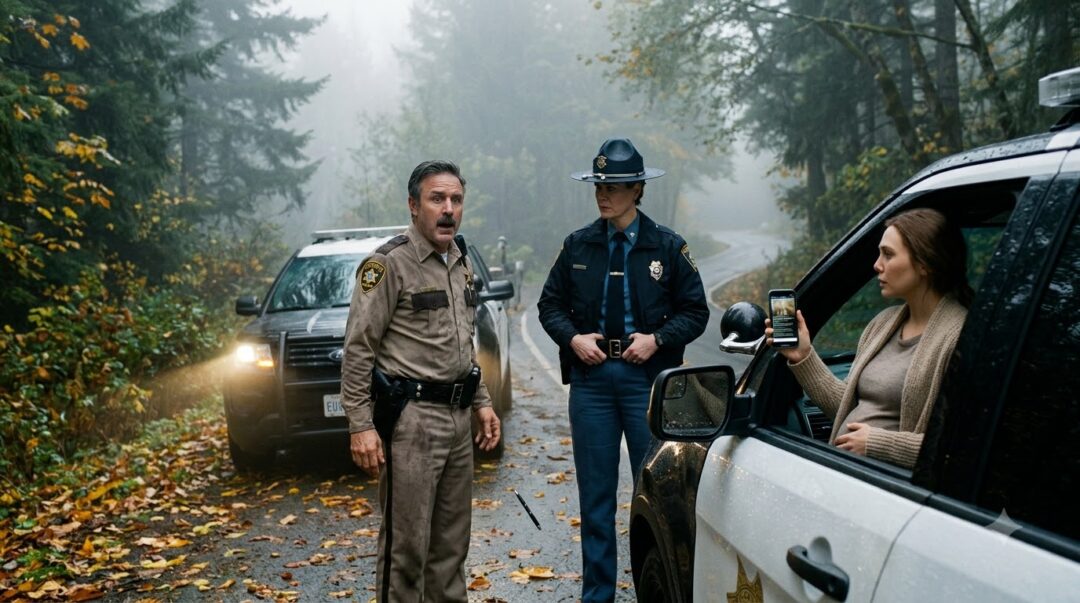
Hannah Ortiz sat calmly behind the leather steering wheel of her dark blue Subaru Forester, parked securely on the wide gravel shoulder fifty feet past the bridge abutment. Her hazard flashers pulsed in a slow, amber rhythm, reflecting softly against the blanket of white mist that hugged the roadway. She was thirty-two years old, seven months pregnant with her first child, wearing a warm oatmeal-colored cable-knit cardigan over a navy maternity dress. Her dark hair was pinned neatly at the nape of her neck, and her breathing was deep, measured, and rhythmic—a deliberate habit cultivated through five years of managing contentious administrative health hearings for the state government in Richmond.
A sudden, sharp mechanical slap against the driver’s side window glass made the vehicle shudder.
An electronic optical tint meter—a two-piece black plastic horseshoe with magnetic sensor heads—was slammed hard against the glass, letting out an ear-piercing digital squeal as the internal optical sensors measured the light transmission.
The meter was yanked away with a careless scrape of its plastic housing against the weather stripping.
Deputy Curt Voss bent down until his broad face filled the glass.
He was fifty-one years old, thick through the chest and heavy in the jowls, wearing a high-crowned tan felt campaign hat pulled low over pale, watery eyes. A bristling gray walrus mustache twitched across his upper lip with every breath, and his municipal sheriff’s department windbreaker was unzipped, exposing an oversized gold five-point star pinned crookedly to his tactical vest.
In his right hand, Voss held a heavy aluminum Maglite flashlight, shining the high-intensity halogen beam directly into Hannah’s eyes through the tinted window.
“Window tint is illegal in Page County, ma’am,” Voss barked, his voice nasal, grating, and dripping with aggressive small-town condescension. “Nineteen percent light transmission. State minimum is fifty percent on the front glass. Step out of the vehicle right now.”
Hannah did not lower her visor, and she did not raise her hands to shield her eyes from the blinding glare. She lowered the driver’s side window exactly three inches, allowing the cool mountain air into the warm cab.
“Good morning, Deputy Voss,” Hannah said, her voice quiet, serene, and steady as mountain granite. Her right hand rested gently, protectively across the swell of her abdomen. “I am an administrative appeals paralegal with the Department of Health Professions. I have a certified Commonwealth of Virginia Medical Exemption Certificate for solar protective window film. The exemption is coded under Section Nine-B.”
Hannah extended her index finger toward the magnetic smartphone mount affixed to the center dashboard, where an official digital PDF document displayed the Virginia Department of Motor Vehicles gold seal and an authorized medical authorization code.
Voss did not look at the phone. He took half a step closer to the window, letting out a sharp, wet laugh through his nose that made his walrus mustache flutter.
“Section Nine-B?” Voss sneered, tapping the metal barrel of his flashlight against the window frame. “Nine-B? That’s not a real thing, ma’am. That’s some internet nonsense you downloaded off a Facebook group. In this county, the sheriff sets the equipment standard. You got two minutes to step out onto this gravel so I can write this citation, or I will open that door and assist you out.”
Hannah looked directly into the deputy’s eyes. She did not raise her voice, and she did not display the slightest flicker of fear.
“Virginia Code Section forty-six-point-two dash one-zero-five-three, subsection B-Nine,” Hannah stated with crisp, effortless statutory precision. “Any person who suffers from photophobia or light-sensitive dermatological or ocular conditions certified by a licensed ophthalmologist is exempt from passenger window tint thresholds up to seventy percent opacity. The physical certification was processed through the state medical review board in Charlottesville. If you attempt to open this vehicle door without a warrant or probable cause of a felony, you are committing official oppression under color of state law.”
Voss’s face flushed a dark, angry purple. He took his metal ticket docket from beneath his arm, flipping the heavy carbon sheets open with an aggressive snap.
“You want to cite code to a twenty-year lawman, girl?” Voss growled, his ballpoint pen hovering over the citation block. “I can write this as a reckless equipment violation and impound this vehicle right here on the shoulder. Let’s see how much your Charlottesville doctor cares when you’re sitting in the rain waiting for a wrecker.”
Behind Voss’s cruiser, through the dense wall of mountain fog, the low, steady crunch of heavy tires rolling across wet gravel sounded through the morning stillness.
A sleek, immaculate dark blue-and-silver pursuit SUV bearing the gold crest of the Virginia State Police rolled quietly to a halt on the shoulder, its low-beam headlights illuminating Voss’s patrol car in sharp silhouette.
The cruiser door opened and closed with a solid, professional thud.
Trooper Sam Whitfield stepped out into the mist.
Whitfield was forty-two years old, tall, lean, and straight as a pine, his gray-and-blue uniform pressed with razor-sharp creases, his campaign hat worn perfectly level above a calm, observant face. He walked forward along the gravel shoulder with measured, unhurried steps, his thumbs resting lightly behind his tactical leather duty belt.
“Morning, Curt,” Whitfield said, his deep, resonant voice carrying effortlessly over the low hum of the idling engines.
Voss turned around, his mustache twitching with sudden irritation. “Morning, Sam. Just writing up an illegal equipment stop. Driver’s got dark film on the front glass and refusing to step out.”
Trooper Whitfield stopped three feet from the window. He did not look at Voss. He glanced through the three-inch gap in the glass, saw Hannah’s calm posture, saw her maternity cardigan, and then looked directly at the glowing smartphone mounted to the dashboard.
Whitfield nodded once—a slow, definitive tilt of his head.
“Section Nine-B is an active Department of Motor Vehicles medical waiver, Curt,” Whitfield said softly, his voice cutting through the damp mountain air with the weight of an iron anvil. “Photophobia and ocular migraine exemption. Signed by the state medical director. Read the statute again.”
Voss opened his mouth to argue, closed it, and stared at the citation docket in his hand. His pen hovered in the freezing air, trembling slightly. The silence of the mountain morning stretched between them, heavy, cold, and absolute.
Then, slowly, with his face draining of color, Voss pressed the cap back onto his metal ballpoint pen with a sharp, hollow click that sounded like an iron gate shutting in the mist.
CHAPTER 2: THE SCENT OF MOUNTAIN PINE
The sharp click of the pen cap snapping onto Deputy Curt Voss’s ballpoint seemed to echo through the foggy hemlocks of Massanutten Gap for an eternity.
Voss stood frozen on the wet gravel shoulder, his walrus mustache twitching erratically as the cold mountain breeze carried the bitter scent of wet fallen leaves and burning brake linings across his uniform. He looked at Trooper Sam Whitfield, then down at the citation docket in his hands, his knuckles turning white against the aluminum edges.
“Sam… you don’t understand,” Voss muttered, his voice dropping into a defensive, guttural mumble. “The local court has been cracking down on dark glass along Route Three-Forty. The county magistrate told our shift to enforce equipment violations to the letter.”
“The county magistrate does not have the constitutional authority to override the Virginia General Assembly, Curt,” Whitfield answered, his voice smooth, cold, and unyielding. “The medical waiver program was passed by statutory amendment six years ago. Every patrol division in the commonwealth received the training bulletin. You received the bulletin at the regional academy in Waynesboro.”
Whitfield took a half-step forward, his sharp eyes dropping to the optical tint meter resting on the hood of Voss’s cruiser.
The small, battery-powered electronic device was an older Laser Labs Model 200, its black plastic housing scarred and chipped from years of being thrown onto gravel shoulders. On the LCD display screen, beside the light transmission reading, a tiny amber triangle was blinking in a steady, continuous diagnostic pattern.
The symbol was an uncalibrated error flag: CAL-EXP 2023.
Whitfield leaned down, his face inches from the plastic casing. “When was this optical unit certified by the State Bureau of Weights and Measures, Curt?”
Voss’s jaw tightened until his jowls shook. He hastily reached out, scooped the meter off the hood, and shoved it deep into the lower cargo pocket of his windbreaker. “It was checked during annual inspection last winter. It’s within five percent tolerance.”
“The state standard requires semi-annual laboratory certification and a stamped copper tamper seal on the battery housing,” Whitfield said quietly, looking straight into Voss’s eyes. “That meter has no copper seal. That meter is legally dead, Curt. Any citation written off that unit is void upon filing.”
Hannah lowered her driver’s window another two inches. The cool, pine-scented air felt clean and refreshing against her warm skin. She looked at Whitfield with quiet, respectful recognition.
“Trooper Whitfield,” Hannah spoke, her tone perfectly even. “My prenatal ultrasound appointment at the University of Virginia Health System in Charlottesville is scheduled for seven-thirty AM. This is my third trimester high-risk evaluation. I have twenty-two miles of mountain road remaining, and Deputy Voss has delayed this vehicle for twenty-six minutes on a non-existent infraction.”
Whitfield turned his gaze toward Hannah, taking in her calm, dignified expression, the medical papers on her dashboard, and the protective way her arm rested over her child. His expression softened with deep, professional courtesy.
“You are completely free to proceed, Ms. Ortiz,” Whitfield said, stepping back from the vehicle and gesturing toward the open lanes of Route 340. “I will sign your field clearance voucher right now.”
“Hold on just a damn minute!” Voss barked, his face darkening with sudden, reckless fury as he realized his authority was being completely dismantled in front of a civilian. “You can’t just wave her off, Whitfield! This is my stop! County jurisdiction takes precedence on secondary roadways! She was doing forty-seven in a thirty-five before she hit the bridge!”
The cold mountain moisture coated the windshield in fine beads that trembled under the rhythmic stroke of the rubber wiper blades. Hannah maintained her steady breathing, feeling the warmth of the vehicle’s climate system keeping the interior at a stable seventy degrees. Over the years spent reviewing contentious healthcare appeals across the Commonwealth, she had learned that individuals who abused regulatory discretion relied entirely on the disorientation and fear of their targets. When confronted with precise statutory language and unshakeable documentary proof, bureaucratic bullying collapsed under its own hollow weight.
Whitfield slowly turned his head back to Voss. The warmth vanished from the trooper’s gray eyes, replaced by the lethal, focused intensity of an old military police investigator.
“You ran radar on this vehicle, Curt?” Whitfield asked, his voice dropping into a dangerous, quiet register.
“I visually estimated her speed!” Voss snapped, his chest puffing out defensively. “Visual estimation is admissible in district court!”
Hannah tapped her phone screen once, pulling up the secondary telematics feed from her vehicle’s integrated dash-mounted navigation system.
“Digital GPS telemetry log,” Hannah said, holding the screen toward both officers. “Satellite-verified speed across the Massanutten bridge: thirty-four miles per hour in a thirty-five-mile-per-hour zone. Cruise control engaged at five-twenty AM. Front and rear four-K video cameras recording continuously to an encrypted cloud drive.”
Voss’s mouth opened, but no sound came out.
The realization hit him like a physical blow: every aggressive word he had spoken, every threat to drag a pregnant woman out of her car into the rain, every false claim about the law, had been recorded in broadcast-quality video with atomic-clock time stamps and satellite telemetry.
Whitfield reached out with his left hand, extending an open, gloved palm toward Voss’s chest.
“Give me your citation book, Curt,” Whitfield said, his voice flat as a rifle shot.
“What?” Voss gasped, taking a step backward into the wet brush. “You can’t take my docket, Sam! That’s department property!”
“Give me the book, Curt,” Whitfield repeated, stepping into the deputy’s space with an overwhelming aura of state-level authority. “Now.”
CHAPTER 3: THE GRAVEL SHOULDER AT MASSANUTTEN
The heavy silence of the mountain pass was broken only by the steady drip of condensation falling from the hemlock boughs onto the wet gravel.
Deputy Curt Voss stood with his back pressed against the front quarter panel of his cruiser, his hands clutching the aluminum citation clipboard against his ribs like a shield.
“Sam, this is an internal county administrative matter,” Voss stammered, sweat beading across his forehead despite the thirty-eight-degree chill. “If you take this book, you’re crossing jurisdictional lines. Sheriff Hazzard will have a word with your district captain by noon.”
“I welcome that conversation, Curt,” Trooper Sam Whitfield said, not blinking, his open hand remaining perfectly level between them. “Section nineteen-point-two dash nineteen of the Code of Virginia authorizes any state police officer to seize fraudulent instruments used in the commission of an unlawful detention. Hand over the docket.”
Voss looked into Whitfield’s stone-hard face and knew the fight was lost. With trembling, clumsy fingers, he released his grip on the aluminum clipboard.
Whitfield took the heavy metal docket, rested it on the hood of the State Police cruiser, and flipped back the green cardboard cover.
He began turning the carbon-paper duplicates, his sharp eyes scanning the handwritten notes in the margin of each ticket.
As Whitfield read, a cold, hard line formed along his jaw.
Every single citation in the top two dozen slips had been issued on this exact three-mile stretch of Route 340 between Massanutten Gap and the river bridge. Every single citation was written for the identical violation: Section 46.2-1052 / Illegal Window Tint / $250.00 Compliance Bond.
And every single driver listed on the carbon sheets was an out-of-county motorist: pregnant women, elderly couples traveling toward the medical centers in Charlottesville, or young mothers driving alone before sunrise.
“Twenty-two citations in twenty-six days, Curt,” Whitfield said softly, his voice trembling with controlled, righteous fury. “All written on an uncalibrated optical meter with an expired certification stamp. And on every single slip, you instructed the driver to remit an ‘administrative compliance bond’ in cash directly to the county magistrate’s lockbox in Luray.”
Hannah watched through her open window, her fingers gently caressing her baby through the knit wool of her cardigan. As an administrative paralegal, she had reviewed hundreds of municipal audits, and the pattern before her eyes was unmistakable.
“It is a shadow forfeiture pipeline,” Hannah said, her clear voice cutting through the fog. “Under state law, moving traffic fines are remitted to the state literary fund for public schools. But municipal equipment compliance fees can be retained by the county for ‘special law enforcement equipment acquisition.’ Deputy Voss has been manufacturing equipment violations to fund off-the-books department bonuses.”
Voss lunged forward two paces, his face contorted in frantic desperation. “You don’t know what you’re talking about, lady! That fund pays for our body armor! It pays for our ammunition!”
“It pays for four thousand dollars a month in unlogged overtime checks drawn on an unauthorized bank account in Front Royal, Curt,” Whitfield said, looking up from the docket. “We’ve had the state auditor reviewing the county clerk’s deposits for three weeks. Your citation book was the last piece of physical evidence we needed to link the forged receipts to your shift.”
Whitfield closed the metal clipboard with a heavy, final clang. He reached into his patrol jacket, pulled out an official Department of State Police evidence bag, and slid the citation book and the uncalibrated tint meter inside, sealing the tamper-evident adhesive strip with a firm press of his thumb.
He turned to Hannah, his posture returning to the crisp, reassuring professionalism of a guardian of the commonwealth.
“Ms. Ortiz, the road to Charlottesville is completely clear,” Whitfield said, handing her an official State Police Transit Escort slip. “I have notified the state dispatcher in Culpeper. If any vehicle attempts to follow or harass you on Route Twenty-Nine, state units will interdict immediately. Go make your appointment.”
“Thank you, Trooper Whitfield,” Hannah said, offering a warm, grateful smile that illuminated the gray mountain dawn. “Thank you for standing for the law.”
The dense fog seemed to swallow the distant rumble of truck traffic from the valley floor below, leaving the mountain shoulder wrapped in an eerie, suspended quiet. The smell of wet hemlock bark and decaying autumn leaves was sharp in the cold air, blending with the bitter metallic reek of Voss’s idling cruiser. Hannah looked at the heavy legal docket in the state trooper’s hands, recognizing the distinct blue and green carbon copies used by municipal courts across Virginia; every page represented a working family coerced into surrendering their wages under the threat of fabricated legal peril.
Hannah put the Subaru into gear, checked her mirrors, and pulled smoothly away from the gravel shoulder, her tires crunching into the wet blacktop as she descended the winding mountain road into the golden light of the valley.
As Hannah placed the Subaru into gear, the crackle of high-frequency police radio shattered the morning still. Over the tactical channel of Voss’s open patrol vehicle, the unmistakable rasp of County Sheriff Frank Hazzard boomed through the speaker, demanding to know why Unit Four had not called in its morning revenue tally and ordering all deputies to detain any state personnel attempting to leave the ridge with municipal logs. Voss flinched, reaching instinctively toward his radio microphone, but Trooper Whitfield moved with blinding speed, cutting off the deputy’s access with an authoritative gesture.
Behind her in the rearview mirror, she saw Deputy Curt Voss standing helpless on the shoulder of Massanutten Gap, his campaign hat tilted in despair, as Trooper Sam Whitfield unclipped a secondary set of transport irons from his tactical duty belt, locking eyes with the disgraced officer as the mountain echoed with the looming threat of the sheriff’s arrival.
CHAPTER 4: THE VALLEY ROAD TO CHARLOTTESVILLE
The dense morning fog that had shrouded the mountain pass began to shred into pale, silver wisps as Hannah Ortiz descended the winding switchbacks of Route 340 into the rolling pastoral basin of the Shenandoah Valley.
The morning sun broke through the low clouds in long, dramatic shafts of golden light, illuminating the crimson and amber maple groves that lined the two-lane highway. Hannah adjusted her rearview mirror, breathing in the fresh, crisp air coming through the dashboard vents. Her pulse was steady, her mind clear, but every ten seconds her hand returned instinctively to the gentle, rhythmic flutter of movement beneath her cardigan.
Mateo was kicking—strong, firm, healthy taps against her ribs.
“We are almost there, little one,” Hannah whispered softly, smiling down at her lap. “We are going to hear your heartbeat in twenty minutes.”
On the dashboard mount, her smartphone chimed with an incoming call from an unlisted Richmond number.
Hannah tapped the hands-free speakerphone icon.
“Hannah Ortiz,” she answered.
“Hannah, this is Chief Deputy Commonwealth’s Attorney Marcus Vance in Richmond,” a deep, authoritative voice came through the car’s audio system. “Trooper Whitfield transmitted your digital dashcam package and his evidence logs to our public integrity desk ten minutes ago. Are you safe?”
“I am on Route Twenty-Nine south, five miles outside Charlottesville,” Hannah replied, her voice steady and professional. “I am safe and on schedule for my clinical evaluation.”
“Good,” Vance said, a heavy note of satisfaction in his voice. “Because what you recorded on that mountain ridge just cracked a three-year racketeering conspiracy in Page County. The State Police Special Investigation Division and the FBI Public Corruption Task Force have just unsealed seventeen federal warrants in Harrisonburg.”
Hannah looked out at the rolling horse pastures passing outside her window, the white fences gleaming in the morning sun. “How deep did it go, Marcus?”
“It went all the way to the county commissioner’s desk,” Vance answered. “Deputy Voss wasn’t acting alone. For thirty-six months, the county sheriff and two local magistrates have been using uncalibrated equipment and fabricated optical readings to extort over six hundred thousand dollars in cash bonds from pregnant women, disabled veterans, and out-of-state travelers crossing the Blue Ridge corridors. They threatened victims with vehicle impoundment and child-protective interventions if they contested the tickets.”
Vance paused, the rustle of certified court documents clear across the line.
“The federal grand jury in Roanoke just indicted Deputy Curt Voss on four counts of extortion under color of law, five counts of federal wire fraud, and conspiracy to violate civil rights,” Vance continued. “The sheriff was placed on administrative suspension twenty minutes ago by order of the Governor. Your dashcam video is Exhibit Alpha on the federal indictment.”
“The evidence speaks for itself, Marcus,” Hannah said softly. “The law is only as strong as the people who have the courage to demand its integrity.”
“You did your department proud, Hannah,” Vance said warmly. “Take care of that baby boy. Your maternity leave starts today, and the entire Commonwealth owes you a debt of gratitude.”
Hannah smiled, clicking the call off as the sprawling red-brick Georgian pavilions of the University of Virginia Health System appeared on the western horizon.
The wide, open vistas of Albemarle County opened before her in undulating waves of emerald pasture and dark forest timber, bordered by traditional stacked-stone fences that had stood since the founding of the republic. Hannah felt the tension in her neck and shoulders begin to ease as the familiar landmarks of the university town emerged through the morning mist. She adjusted her grip on the leather steering wheel, reflecting on how easily corrupt practices could take root in remote mountain crossings when public oversight was absent, and how essential it was for ordinary citizens to assert their statutory rights with clarity and resolve. Every mile brought her closer to safety, yet the stakes were expanding beyond her own morning commute; she knew the physical evidence secured by the state police would become the cornerstone of an unyielding institutional reckoning.
At seven-twenty-two AM—eight minutes ahead of schedule—Hannah pulled the Forester into the patient parking deck of the primary women’s health pavilion, parking comfortably between two wide concrete pillars.
She unbuckled her seatbelt, took her medical records folder from the passenger seat, and stepped out into the clean, warm Virginia morning.
The autumn air smelled of roasted coffee, wet boxwood hedges, and clean rain.
As she walked toward the glass entrance of the clinical pavilion, leaning slightly into her stride to accommodate the weight of her unborn child, a tall State Police cruiser pulled up to the circular driveway.
Trooper Sam Whitfield stepped out from behind the wheel, wearing his clean campaign hat, carrying a signed copy of the judicial protective release in his hand.
He walked across the brick apron, meeting Hannah at the automated glass doors, his stern face breaking into a broad, respectful smile.
“Just wanted to ensure the delivery was completed without further municipal interference, Ms. Ortiz,” Whitfield said, handing her the formal clearance certificate.
Hannah took the document, looking into the eyes of the veteran patrolman who had chosen honor over professional fraternity on that lonely mountain shoulder.
“Thank you, Sam,” Hannah said, her eyes shining with quiet, enduring gratitude. “For remembering who you swore to protect.”
Whitfield touched the brim of his campaign hat in a crisp, respectful salute. “Go see your son, ma’am. That’s an order from the Commonwealth.”
Yet even as the hospital doors slid open with a whisper of conditioned air, Whitfield’s tactical radio buzzed with a sudden red-alert dispatch: Sheriff Hazzard’s inner circle was frantically shredding department financial records back in Luray, and the chief circuit judge had just issued an emergency subpoena requiring Hannah and Whitfield to appear in court at two o’clock sharp.
CHAPTER 5: THE ULTRASOUND IN THE VALLEY
The clinical examination room on the fourth floor of the University of Virginia Women’s Health Pavilion was quiet, warm, and washed in the soft, amber glow of the morning sun streaming through the wide mountain-facing windows.
Hannah Ortiz reclined comfortably on the padded examination table, a clean white linen sheet draped across her lap, her hands resting peacefully across her chest. Beside her, Dr. Elena Rostova—a senior maternal-fetal medicine specialist with silver-streaked dark hair and kind, perceptive blue eyes—spread a warm layer of clear acoustic gel across Hannah’s rounded abdomen.
“Let’s see how our young traveler is doing after his morning adventure on Route Three-Forty,” Dr. Rostova said with a gentle smile, adjusting the high-resolution digital ultrasound transducer.
The doctor pressed the curved plastic probe against Hannah’s skin.
Immediately, a rhythmic, galloping pulse—loud, rapid, and magnificent as the beat of a wild stallion—filled the quiet room through the high-fidelity acoustic speakers:
Thump-thump, thump-thump, thump-thump.
The sound of Mateo’s heartbeat: one hundred and forty-eight beats per minute, regular, powerful, and vibrant with life.
On the high-definition color monitor mounted to the wall, the black-and-white ultrasound image resolved into razor-sharp focus. Hannah saw the delicate curve of her son’s spine, the tiny fingers of his left hand curled peacefully against his cheek, and the steady, rhythmic movement of his chest as he practiced breathing in the amniotic fluid.
Tears of profound, overwhelming joy welled in Hannah’s eyes, spilling over her dark lashes, tracing warm paths down her cheeks.
“Amniotic fluid volume is completely normal,” Dr. Rostova observed, her fingers measuring the intracranial diameters with digital calipers on the screen. “Fetal growth is precisely in the sixty-eighth percentile for thirty-one weeks. Heart valve dynamics are flawless. He didn’t feel a single ounce of that stress on the mountain, Hannah. You protected him with your own calm.”
Hannah reached out, her fingers gently touching the glowing monitor screen where her son’s profile rested in the electronic light.
“He’s strong, Elena,” Hannah whispered, her voice thick with emotion. “He knew his mama had the wheel.”
A soft, polite knock sounded on the wooden consultation room door.
Dr. Rostova wiped the gel from Hannah’s abdomen with a warm cotton towel, lowered the examination table, and walked to the door, opening it slightly.
Standing in the hallway was Captain Robert Vance from the State Attorney General’s Office, accompanied by an executive director from the Virginia Department of Health Professions. Both men carried leather portfolios and formal legal files.
“Excuse us, Dr. Rostova,” Vance said with a deferential nod. “We have the certified findings from the emergency preliminary hearing in Luray. Hannah asked to be notified the moment the record was sealed.”
Dr. Rostova looked back at Hannah, who smiled and nodded. “Come in, gentlemen.”
Captain Vance stepped into the sunlight of the consultation room, setting his portfolio on the counter. He looked at Hannah, his eyes reflecting the deep, institutional respect of a senior prosecutor who had just witnessed an unassailable victory for the rule of law.
“The Page County General District Court convened an emergency en banc session ninety minutes ago,” Vance announced, his voice ringing with crisp finality. “Judge Thornton reviewed the seized citation ledger, the uncalibrated meter readings, and your digital telemetry logs. He issued an immediate, blanket administrative expungement of all two hundred and fourteen equipment citations issued by Deputy Curt Voss over the preceding eighteen months.”
Hannah leaned forward, her eyes bright and clear. “And the restitution?”
“Over one hundred and eighty thousand dollars in seized compliance bonds have been ordered frozen in the county escrow accounts,” Vance said. “Every dollar is being returned with statutory interest to the victimized drivers. The county clerk who was facilitating the off-the-books deposits has been placed under arrest by federal marshals.”
Vance reached into his portfolio, withdrawing a heavy vellum document bearing the embossed gold Great Seal of the Commonwealth of Virginia.
“The Governor signed an executive order forty minutes ago, Hannah,” Vance said softly, handing the parchment to her. “Naming the newly enacted state oversight protocol for municipal traffic enforcement after your son: The Mateo Ortiz Protective Transit Statute. From this day forward, no county in this commonwealth may deploy an optical equipment sensor without automated state telematics registration and an active, digital calibration log accessible to every driver on their smartphone.”
Dr. Rostova smiled with genuine professional warmth as she adjusted the acoustic gain on the ultrasound console, capturing a clean, three-dimensional profile of the baby’s face on the high-definition monitor. The room was filled with the rhythmic, comforting gallop of the fetal pulse, a sound that seemed to drown out all the hostility and tension of the foggy mountain ridge. Hannah looked at the intricate bone structures of her son’s tiny spine, grateful for the medical expertise and the unyielding legal protections that safeguarded their journey through life.
Hannah looked down at the parchment. Her fingertips traced the elegant calligraphy of her son’s name, stamped in permanent gold against the white linen vellum.
She looked up at the window, where the Blue Ridge Mountains rose majestic, ancient, and serene against the vast autumn sky—a barrier of stone and timber that had stood for millions of years, now forever freed from the petty greed of men who hid behind badges.
As Dr. Shaw printed the ultrasound images, Hannah’s smartphone vibrated on the bedside table with an encrypted file transmission from Marcus Vance at the Department of Health Professions legal office. Attached to the message was a formal certified summary of the statewide calibration audits: over three hundred fraudulent equipment citations had already been flagged for immediate judicial review across four rural counties, and the circuit judge had formally scheduled the emergency evidentiary hearing for that afternoon.
“Thank you, Marcus,” Hannah said, her voice quiet, steady, and rich with enduring peace. “The road is safe for him now, but the final truth must still be spoken in that courtroom.”
CHAPTER 6: THE HEARING AT THE COURTHOUSE
Inside the historic courtroom, the heavy oak counsel tables gleamed under the soft illumination of brass chandeliers that had hung since the reconstruction era. The high-backed mahogany bench where Judge Thornton presided seemed to embody the solemn weight of generations of Virginia jurisprudence. Spectators from across Page and Shenandoah counties filled every wooden pew to capacity, whispering in hushed tones as federal prosecutors laid out the reams of falsified citation carbons and the seized optical meter with its cracked, expired calibration sticker.
The historic Page County Courthouse in Luray was a solemn nineteenth-century structure of red river brick and white classical columns, surrounded by ancient sugar maples whose falling crimson leaves drifted across the limestone steps.
At two o’clock that afternoon, the second-floor circuit courtroom was packed to the gallery rails with local citizens, reporters from across the Shenandoah Valley, and dozens of rural motorists who had traveled from three counties to witness the proceedings.
Behind the elevated mahogany bench sat Circuit Judge William Thornton—a seventy-year-old jurist with thick white hair, piercing blue eyes, and a reputation for unyielding constitutional discipline.
At the defense table sat Deputy Curt Voss.
Voss was no longer wearing his tan uniform jacket or his felt campaign hat. He sat in a wrinkled civilian suit, his shoulders hunched, his walrus mustache drooping across his pale, sunken mouth. His fingers trembled as he gripped the yellow legal pad in front of him, unable to meet the eyes of the townspeople who filled the wooden benches behind him.
At the prosecution table stood Commonwealth’s Attorney Marcus Vance, flanked by Trooper Sam Whitfield, who stood in full dress uniform with his campaign hat tucked cleanly under his left arm.
Judge Thornton slammed his wooden gavel down onto the oak sound block with a sharp, resounding crack that silenced the courtroom in an instant.
“In the matter of the Commonwealth versus Curtis Wayne Voss,” Judge Thornton spoke, his deep, resonant voice filling the high-ceilinged room. “The court has reviewed the physical evidence entered into the record under Exhibit Alpha: the uncalibrated Laser Labs Model Two-Hundred optical tint meter seized this morning on Route Three-Forty, along with the certified laboratory audit from the Department of General Services.”
Judge Thornton picked up a blue laboratory certification folder from his desk, holding it aloft for the gallery to see.
“The state laboratory findings indicate that the optical sensor inside this device had been intentionally altered with a mechanical resistor to produce a twenty-percent negative calibration bias on all light-transmission readings,” Judge Thornton said, his voice dropping into a register of icy, devastating condemnation. “This instrument was not merely out of calibration; it was an engineered tool of systematic municipal extortion, designed to manufacture false violations against innocent citizens on our public highways.”
A collective gasp echoed through the crowded courtroom, followed by the angry murmurs of spectators until Judge Thornton raised his hand for silence.
Judge Thornton looked down from the bench, his gaze fixing upon Curt Voss like the judgment of the mountain itself.
“Deputy Voss,” the judge said softly, “you have served this county for twenty-one years. You were entrusted with the authority of the law, the power of the badge, and the sacred obligation to protect the travelers who pass through our valleys. Instead, you chose to use an uncalibrated piece of plastic to terrorize pregnant women and elderly retirees on foggy mountain shoulders for thirty pieces of silver.”
Voss swallowed hard, his Adam’s apple bobbing in his throat. He slowly rose to his feet, leaning with both hands on the defense table, his voice cracking into a high-pitched, pathetic whimper:
“Your Honor… I… I was only trying to raise revenue for the department’s equipment fund… the county budget was cut last winter…”
“The law of this commonwealth is not for sale to balance a county budget, Mr. Voss!” Judge Thornton thundered, his gavel striking the bench with the force of thunder. “You do not fund public safety by robbing the public you swore to protect!”
Judge Thornton turned to the court clerk, his voice firm, precise, and devoid of mercy:
“The court hereby orders Curtis Wayne Voss remanded into the custody of the United States Marshals Service without bail, pending formal arraignment on federal racketeering and civil rights indictments in the Western District of Virginia. The defendant’s peace officer certification is permanently revoked, with prejudice, under the laws of the Commonwealth.”
Two federal marshals stepped forward from the side rail, their heavy transport irons clanking as they clicked the steel cuffs around Voss’s wrists, marching the disgraced former lawman through the side prisoner exit into the shadows of the holding cells.
The gallery erupted into spontaneous, standing applause—a release of three years of fear and frustration that echoed through the marble corridors of the courthouse.
Trooper Sam Whitfield stood at the rail, his face calm and composed, watching the exit door close behind his former colleague.
He turned toward the back of the courtroom, where Hannah Ortiz sat in the front row of the gallery, accompanied by her husband, David, who had arrived from Richmond an hour earlier.
David wrapped his arm around Hannah’s shoulders, his eyes bright with protective pride as he looked at the woman who had brought an entire syndicate of corruption to its knees with nothing more than her knowledge of the law.
Whitfield walked down the aisle, pausing beside Hannah’s bench. He extended his hand, his eyes meeting hers with the deep, quiet brotherhood of two people who had stood together in the dark and held the line until the sun came up.
“It is done, Hannah,” Whitfield said softly.
Hannah shook his hand, feeling the warmth of the autumn sun streaming through the stained-glass courthouse windows, illuminating her face in bands of amber and rose.
“It is done, Sam,” Hannah smiled, her voice rich with peace. “The mountain road belongs to the people again.”
CHAPTER 7: THE CLEAR SKY OVER THE BLUE RIDGE
Two months after the federal indictments in Page County, the first January thaw swept through the Shenandoah Valley, melting the high mountain snowdrifts into crystal-clear torrents that tumbled joyfully down the rocky limestone arroyos into the South Fork of the Shenandoah River.
The morning sky over the Blue Ridge was an infinite, immaculate expanse of cobalt blue, free of mist, free of clouds, stretching from the crest of Skyline Drive all the way to the jagged peaks of West Virginia.
Outside a small, stone-walled roadside overlook at the crest of Massanutten Gap on Route 340, the scene was peaceful and radiant in the crisp winter sunshine.
Parked in the scenic turnout was Hannah Ortiz’s blue Subaru Forester, its windshield and side windows gleaming crystal clear beneath the sun, the dark UV-protective ceramic film reflecting the mountain vista like a polished mirror. Mounted to the front dashboard was a newly issued Commonwealth of Virginia Medical Exemption Gold Shield, displaying the registered seal of the Department of Health.
Hannah stood beside the stone parapet overlooking the vast, patchwork valley below.
She was wrapped in a thick wool coat the color of winter heather, her cheeks flushed with the rosy glow of health and motherhood.
Cradled securely against her chest in a soft sheepskin carrier was two-week-old Mateo Ortiz.
The baby was sleeping peacefully in the fresh mountain air, his tiny face nestled against his mother’s collarbone, his breathing rhythmic and calm beneath the warm midday sun.
A clean, dark blue-and-silver State Police cruiser rumbled quietly onto the gravel shoulder, parking with its engine idling softly.
Trooper Sam Whitfield stepped down from the cab, wearing his immaculate uniform overcoat and campaign hat. He didn’t carry an evidence bag or a clipboard; he carried a small, flat wooden gift box handcrafted from native Virginia red cedar.
Whitfield walked along the stone path, his polished boots crunching lightly on the clean gravel, a broad, relaxed smile crinkling the corners of his eyes.
“Afternoon, Hannah,” Whitfield said, tipping the brim of his hat with gentle courtesy.
“Afternoon, Sam,” Hannah smiled, turning to let him see the sleeping baby.
Whitfield looked down at the tiny, perfect child, his stern face softening into an expression of profound, protective reverence. “Look at him. He’s got the same steady chin his mama had on this shoulder two months ago.”
Whitfield opened the cedar gift box, revealing a polished silver baby spoon engraved with a tiny State Police star and the inscription: Mateo Ortiz – Born Under the Law of the Commonwealth.
He handed the box to Hannah, who touched the engraved silver with gentle, trembling fingers.
“The State Police Alumni Association wanted to make sure he had proper equipment for his first birthday, ma’am,” Whitfield said softly. “And the Governor signed the final implementation budget for the Mateo Ortiz Transit Act yesterday morning. Over eight thousand commercial and municipal patrol units across Virginia are now equipped with direct, automated calibration telematics. No officer in this state can write an equipment ticket without an atomic-clock certification ping to the state capital.”
Hannah looked out over the vast, sunlit valley where farms, orchards, and small towns spread out like a tapestry of peace beneath the Blue Ridge peaks. Along Route 340 below, cars and family station wagons moved in an unbroken, steady flow of travel, moving freely through the mountain pass without fear, protected by the enduring integrity of the law.
“You gave this valley its honor back, Sam,” Hannah said softly.
“We gave it back together, Hannah,” Whitfield replied, looking out over the mountain pass he had guarded for twenty years. “You held the statute book, and I held the badge. When those two things work together, there isn’t a mountain in this country that can stand against them.”
Mateo stirred in the carrier, letting out a soft, contented sigh against his mother’s neck, his tiny hand opening and closing against her woolen lapel.
The crisp January breeze carried the sweet scent of sun-warmed cedar shingles and drying pine needles across the stone overlook. The Shenandoah Valley below lay bathed in brilliant winter sunlight, a vast basin of fertile fields and peaceful homesteads framed by the blue silhouette of the Allegheny ridges to the west. Hannah held her sleeping infant close, listening to his soft, rhythmic breathing against her chest. The integrity of the law was not an abstract theory written in dusty leather books; it was a living covenant that protected the vulnerable, nurtured new life, and ensured that every child could travel the highways of the commonwealth in security and peace.
Beside her, Trooper Whitfield pointed toward the newly erected electronic transit signage at the entrance to Massanutten Gap, where bright amber LED letters displayed real-time weather and road condition alerts alongside the statewide motorist bill of rights. For years, this isolated stretch of highway had been feared by passing drivers as a trap where badges were used to coerce compliance and drain savings; now, it stood as a monument to transparency, community trust, and the restorative power of public accountability.
Hannah looked down at little Mateo, who opened his deep brown eyes for a brief, drowsy moment before drifting back into peaceful slumber against her shoulder. His tiny hand curled tightly around the silver handle of the commemorative baby spoon, as if already grasping the promise of safety and dignity that his mother’s courage had carved into the bedrock of the valley.
Hannah wrapped her arms around her son, breathing in the sweet scent of new life and cold mountain cedar, her heart full, complete, and unshakable.
She looked toward the open road winding peacefully south toward home—a road that was clear, bright, and forever open beneath the great American sky.