They Called My Family Dock a Shared Amenity Until I Found the Amendment They Never Wanted Read
Chapter 1: The Saturday They Told Me My Dock Wasn’t Mine
The first thing I saw was smoke rising beside my father’s fishing bench.
Not lake mist. Not somebody’s outboard coughing at the marina.
Charcoal smoke.
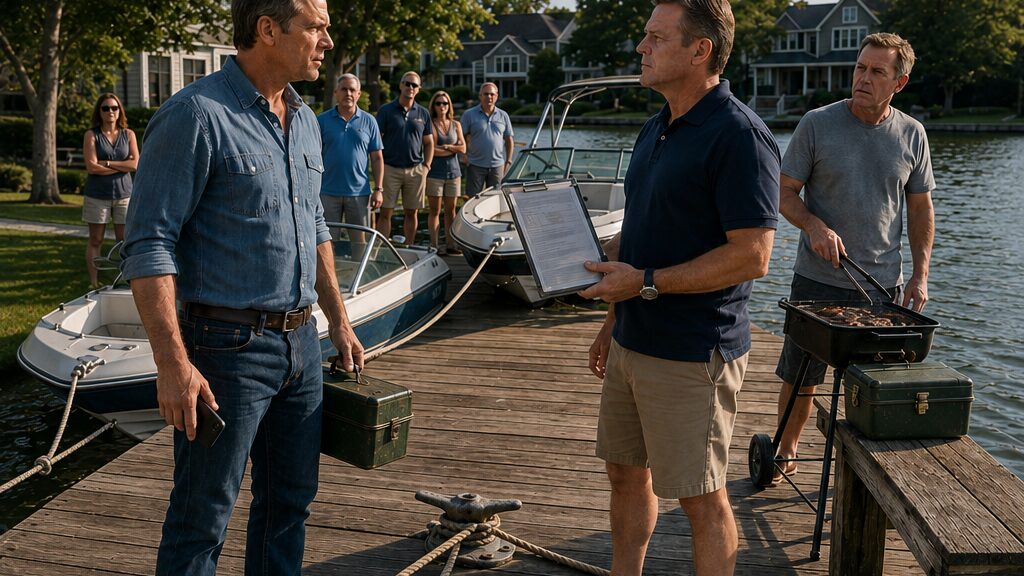
A man I barely recognized stood on my dock with metal tongs in one hand, turning burgers over a portable grill set three feet from the bench Samuel Davis had built when Emma was still small enough to swing her legs without touching the deck boards.
Two boats were tied alongside him.
Neither belonged to me.
I stopped halfway down the slope from the house.
“Can I help you?”
The man looked up as though I had walked into his backyard.
“Oh. Hey, Michael.”
I knew him then. A neighbor from farther around the cove. We had spoken twice in ten years.
“You need to move the grill,” I said. “And the boats.”
His smile faded.
“Jeffrey said we could use the dock.”
Behind him, a woman lifted a cooler onto the planks. Somebody in one of the boats laughed. A radio played low enough that I could hear ice rattling in plastic cups.
I stepped onto the dock.
The old cleat at the near corner was half hidden beneath a thick white rope. My father had installed it himself. The bolts had rusted brown around the edges, but the cleat had survived thirty years of storms, teenage fishing lines, overloaded coolers, and Samuel insisting that stainless steel hardware was “a waste of good money.”
I put my hand on the rope.
Then stopped.
Pulling it loose would feel good.
It would also turn a property dispute into something messier.
“Who told you this was shared?”
The man pointed toward the path.
Jeffrey Hall was coming down from the road.
He wore khaki shorts and a navy polo with the neighborhood association logo stitched over the chest. Two other residents followed him. Jeffrey carried a laminated sheet clipped to a board.
He did not look surprised to see me.
“Michael,” he said. “I was hoping we could avoid a scene.”
I looked at the grill.
“You brought one.”
His mouth tightened.
Jeffrey stepped onto the dock and held up the paper.
“The board clarified the waterfront-use provision this week. The dock falls under the shared-amenity language.”
“My dock.”
“The community dock access attached to your parcel.”
“There is no community dock access attached to my parcel.”
He tapped the paper.
“Section 4.7. Recorded covenants, 1987.”
I took the sheet from him.
It was a one-page interpretation, not the covenant itself. It quoted three sentences about shoreline access and identified my lot by number. At the bottom were Jeffrey’s signature and the association management company’s mailing address.
“You wrote this.”
“The board approved it.”
“That isn’t what I asked.”
Jeffrey lowered his voice.
“This lake was never meant to become a row of private fortresses.”
I looked past him. More people were walking down the slope.
“Get them off my dock.”
“No.”
For a moment, neither of us moved.
The neighbor at the grill stared very carefully at the burgers.
Jeffrey pointed toward the laminated notice now clipped to the railing.
“If you obstruct access to an association-designated shared amenity, you can be fined.”
I almost laughed.
Instead, I took out my phone.
Jeffrey’s expression changed.
“What are you doing?”
“Documenting.”
I photographed the notice.
Then the grill.
Then each boat.
I took clear pictures of the registration numbers and the lines tied to the cleats. I opened the timestamp function I used for claims work and logged the time.
Jeffrey shook his head.
“This is exactly the problem. Everything with you has to become a case file.”
Maybe he meant it as an insult.
He was not entirely wrong.
For twenty-three years, I had investigated insurance fraud, staged losses, inflated claims, and people who believed confidence could substitute for facts. Even after leaving full-time investigation work, I still handled private claims consulting.
My first instinct when somebody challenged me was never to argue.
It was to preserve evidence.
Emma hated that about me.
My father had hated it too.
I walked to the old bench and lifted the battered green tackle box sitting beside the stranger’s cooler.
“Please don’t put anything on this bench,” I said.
The man at the grill finally turned off the flame.
“Look, I don’t want trouble.”
“Then move your boat.”
Jeffrey stepped between us.
“He doesn’t have to.”
I looked at him.
“How old is the clause?”
“I told you. Nineteen eighty-seven.”
“No. When was it last amended?”
Jeffrey paused.
Only a second.
But I spent half my working life watching people answer questions they had not prepared for. A second could be a long time.
“The governing documents have been updated periodically.”
“When was Section 4.7 last amended?”
“You can review the association records.”
“That means you don’t know.”
His jaw tightened.
“I know the board had counsel review the current rules.”
“Did counsel review my deed?”
“This is not solely about ownership.”
That sentence stayed with me.
Not because it frightened me.
Because it was the first thing Jeffrey had said that suggested the board knew ownership might favor me.
I looked around the dock again.
The woman with the cooler avoided my eyes. Another boat had slowed offshore, apparently waiting for room.
“Listen carefully,” I said. “I dispute the designation. I am not giving permission for any of these boats, people, or equipment to be here. I’m not touching anyone’s property. I’m documenting every use.”
Jeffrey folded his arms.
“You’re free to document whatever you like.”
“And you’re telling them they can stay?”
“Yes.”
I nodded.
“All right.”
He seemed disappointed by the answer.
Maybe he expected shouting. Maybe he wanted it.
I carried my father’s tackle box uphill.
From the porch, I could still see the gathering below. The grill came back on ten minutes later. Someone pulled another chair onto the dock.
By four o’clock, there were five boats.
I photographed each one.
By six, the crowd had thinned, but one boat remained.
I started a spreadsheet.
Date. Time. Vessel. Registration. Person observed. Activity.
It felt absurd until I typed the seventh entry.
Then it felt like work.
At dusk, I walked down after everyone had gone. Grease marked one deck board near the bench. An empty plastic cup had been left beside the railing.
I picked it up.
My hand rested on Samuel’s old cleat.
I remembered kneeling beside him as a teenager while he drilled the holes. I had complained that he measured everything twice.
He had said, “Wood forgives mistakes. Water doesn’t.”
I had not thought about that afternoon in years.
The next morning, I drove out for coffee.
When I came back, a white envelope was taped inside my mailbox.
I opened it standing at the curb.
The association had fined me two hundred dollars for interfering with authorized use of a shared community amenity.
At the bottom, in smaller print, was a notice that repeated violations could result in additional daily penalties.
I read it twice.
Then I looked down the hill toward the dock.
A boat I did not recognize was already tied to my father’s cleat.
Chapter 2: The Deed Line Under the Water
The county recorder slid the plat across the counter and placed one finger on a line extending farther into the lake than I expected.
“Your parcel ends here.”
I leaned closer.
The boundary did not stop at the shoreline.
It passed beneath the dock.
Then continued into the water.
“Can I get a certified copy?”
The clerk nodded.
“You’ll want the deed too.”
“I do.”
She pulled up the parcel record on her terminal while I photographed the plat for reference.
Monday morning had started with Jeffrey’s fine on my kitchen table and three more unauthorized boats in my spreadsheet.
Now, less than an hour later, I had confirmation of something I had always assumed but never needed to prove.
The dock was not sitting beside my property.
It was inside it.
The recorded deed described the parcel by metes and bounds and referenced the waterfront plat. Nothing in the legal description identified the dock itself as association property.
That should have made me feel better.
Instead, the clerk frowned at the screen.
“There are covenant references attached.”
“How many?”
“Several.”
She turned the monitor slightly.
The original subdivision restrictions were recorded in 1987. Then came amendments, corrections, releases, and restatements scattered across later years.
I wrote down every recording number.
“Does an easement show separately?”
“If it was recorded against the parcel, it should appear in the chain. But I can’t interpret it for you.”
“I’m not asking you to.”
She gave me the patient look of someone who had said the same sentence a thousand times.
I smiled.
“Sorry. Occupational habit.”
While I waited for copies, I studied the original plat.
Lot lines. Shoreline. Utility easement near the road. Drainage strip near the north edge.
Nothing labeled community dock.
Nothing labeled shared waterfront.
The first small satisfaction I had felt since Saturday lasted exactly four minutes.
Then the clerk returned with a stack of pages.
“The 1987 restrictions contain the section you mentioned.”
Section 4.7 was longer than the quotation Jeffrey had put on his notice.
The first paragraph described association-maintained common shoreline facilities. The second dealt with access corridors. The third contained language about “designated waterfront structures historically available for neighborhood use.”
Historically available.
Not owned by the association.
Not automatically public.
But not meaningless either.
In the margin of the recorded copy was a reference to subsequent amendments.
I tapped it.
“What does that number point to?”
“Another recorded instrument.”
“Can you pull it?”
She entered the number.
Then another.
The chain jumped forward across the years.
My eyes stopped there.
“What’s that one?”
“Amendment to restrictive covenants.”
“Print it.”
The clerk clicked through the pages, then frowned.
“It’s twelve pages.”
“I’ll take all twelve.”
Driving home, I kept thinking about Jeffrey’s answer from Saturday.
This is not solely about ownership.
For once, he might have been correct.
My deed could prove the dock belonged to my parcel and still leave open the question of whether some enforceable access right crossed it.
At home, I covered the kitchen table with documents.
The fine went in the upper left.
Deed beneath it.
Plat beside that.
1987 restrictions in the center.
I arranged the amendments chronologically.
My old investigative habits returned without invitation.
Never start by proving what you want.
Build the timeline first.
I opened a cardboard folder from the cabinet where I kept old house records. Most of it was ordinary: tax receipts, dock repair invoices, shoreline-permit copies, insurance renewals.
Near the bottom was a yellowed receipt for treated lumber.
Samuel’s handwriting crossed the top.
Dock repair—west side.
The date was years after the original 1987 covenants.
He had paid for the material himself.
I placed it beside the deed.
A private repair receipt did not extinguish an easement. I knew that.
But it was another piece that did not fit Jeffrey’s version of a community structure managed by the association.
My phone rang.
Jeffrey.
I let it go once before answering.
“Michael.”
“I heard you went to county records.”
News traveled quickly around the lake.
“I did.”
“So you found the deed.”
“I did.”
“I assume that settles your concern about ownership.”
“Actually, it confirms my concern.”
Jeffrey exhaled.
“You keep treating this as though title ownership defeats access rights.”
“What access right?”
“The historical easement.”
“Recording number?”
Silence.
Then: “It’s incorporated through the covenants.”
“Which instrument creates it?”
“You’re splitting hairs.”
“No. I’m asking for the document that lets strangers tie boats to my property.”
His voice hardened.
“Samuel understood this arrangement.”
The use of my father’s first name irritated me more than it should have.
“What arrangement?”
“You should ask people who were here before you started treating the place like a file cabinet.”
I stood very still.
“You called to discuss the deed?”
“I called because the board is considering a formal dock-use policy. If you keep resisting, this becomes more expensive for everyone.”
“When?”
“The vote?”
“Yes.”
“Next Monday.”
A week.
“You’re voting on permanent rules before verifying the easement?”
“We’re formalizing existing practice.”
I looked at the 2003 amendment lying unopened on the table.
“Send me the proposal.”
“I will.”
Jeffrey paused.
“Michael, your father didn’t act like this.”
The call ended before I answered.
I opened the 2003 document.
The first several pages dealt with insurance, common-area maintenance, and liability limits. I read every line.
On page seven, a paragraph referenced waterfront-use provisions.
My pulse quickened.
But the wording pointed backward to another section, another definition, another recorded instrument.
Not an answer.
A trail.
I made notes until the afternoon light shifted across the kitchen floor.
Then my email chimed.
The HOA proposal had arrived.
The subject line read: Waterfront Access Clarification.
The attached policy would authorize resident use of designated private-parcel dock structures during daylight hours, subject to board rules.
My dock was listed first.
The vote was scheduled for Monday night.
I stared at the screen.
The question was no longer whether Jeffrey believed an old right existed.
He was preparing to turn that belief into a permanent rule before I could prove what the old records actually said.
Chapter 3: What My Father Let Them Believe
Emma picked up the photograph and said, “That’s Barbara.”
I was halfway through sorting the old tackle box.
“Barbara who?”
“Barbara Wilson. The treasurer.”
She held the picture closer.
The photograph had faded around the edges. My father stood on the dock wearing cutoffs and an old work shirt, one hand resting on the railing. Around him were six adults, three children, fishing rods, a cooler, and enough food to cover the bench.
A younger Barbara Wilson stood two people away from Samuel.
I took the photograph.
“You’re sure?”
“She looks exactly the same. Just with bigger glasses now.”
“That was probably twenty-five years ago.”
“Dad.”
“What?”
“She still has the same haircut.”
Despite myself, I laughed.
Emma sat cross-legged on the living-room floor surrounded by the contents of Samuel’s green tackle box.
We had emptied it after dinner.
There were hooks in film canisters, old sinkers, a rusted pocketknife, fishing licenses, photographs, folded receipts, and a small notebook swollen from years of damp air.
I had expected useful records.
I had not expected people.
In photograph after photograph, neighbors appeared on the dock.
Children holding bluegill.
Adults sitting along the railing.
A family pulling a canoe onto the planks.
Samuel smiling beside people I barely remembered.
Emma laid out another picture.
“That’s Jeffrey, isn’t it?”
He was much younger, but it was him.
Jeffrey stood at the far end of the dock beside my father, holding a fishing rod and grinning toward the camera.
I felt something inside me shift.
Not surrender.
Something less comfortable.
“You knew Grandpa let people come down here,” Emma said.
“Sometimes.”
“This doesn’t look like sometimes.”
“He invited people.”
“Isn’t that what Jeffrey’s saying?”
“No.”
The answer came too fast.
Emma noticed.
I returned to the notebook.
“There’s a difference between inviting your neighbors over and giving an HOA permanent access.”
“I know there’s a difference legally.”
“That’s the only difference that matters in the hearing.”
Emma leaned back against the couch.
“No. It’s the only difference you want to talk about.”
I closed the notebook.
“This is exactly why I didn’t want you involved.”
Her face changed.
There it was again.
My instinct to shut a door before somebody could reach the part of the room I did not want examined.
Emma stood.
“I found a man cooking hamburgers where Grandpa taught me to fish. I’m already involved.”
“I’m handling it.”
“You handle everything.”
“Yes.”
“That’s not always a compliment.”
She walked into the kitchen.
I almost followed her.
Instead, I looked again at the photographs.
My father had not merely tolerated neighbors on the dock.
He had welcomed them.
That did not give Jeffrey ownership.
It did make his certainty harder to dismiss.
The next afternoon, Barbara Wilson came by after I emailed the board requesting copies of every record mentioning waterfront access.
She stayed at the top of the driveway at first.
“I’m not here officially.”
“That usually means someone is about to tell me something important.”
Barbara glanced toward the neighboring houses.
“I told Jeffrey we should slow this down.”
“But you voted for the designation.”
“I voted for an interpretation based on the binder we had.”
“You didn’t check county records.”
Her lips pressed together.
“No.”
“At least you answered the question.”
“That’s more than Jeffrey would say?”
I did not respond.
Barbara looked downhill toward the water.
“Samuel used to call that dock ‘for everybody who needs the water.’”
I felt a small flash of anger.
“He said that exact phrase?”
“More than once.”
“When?”
“After the marina closed for repairs one summer. People needed somewhere to put in small boats. Samuel told them to use his place.”
“For how long?”
“A season, maybe two.”
“And after that?”
“People kept coming.”
“Because he invited them?”
Barbara hesitated.
“Mostly.”
Mostly.
One word could carry a lot of weight.
“He ever tell you the association owned the dock?”
“No.”
“Tell you there was an easement?”
“No.”
“Tell you residents had a permanent right?”
“No.”
She folded her arms.
“But Michael, that’s not how people remember it.”
I looked at her.
“How people remember something doesn’t change a recorded property right.”
“No. But it explains why this turned ugly so fast.”
That landed harder than I expected.
Barbara had known my father for decades. Jeffrey had known him too.
I had spent much of the last fifteen years living forty minutes away, visiting when obligation overcame irritation.
My father and I had not stopped speaking.
That would have been simpler.
We spoke just enough to avoid admitting how little we understood each other.
When he died, the house came to me because there was nobody else.
I had treated the dock like an inherited asset.
Jeffrey had treated it like a neighborhood tradition.
Maybe both of us had reduced Samuel to whatever argument we needed.
Barbara started toward her car.
“Tell Jeffrey I still want the records.”
She nodded.
Then turned back.
“He really does believe he’s protecting something.”
“So did the people I spent twenty years investigating.”
“That’s not fair.”
“No.”
I looked toward the lake.
“It probably isn’t.”
That evening, Emma came back.
She did not mention our argument.
Instead she carried the tackle box to the dining table and began sorting receipts by date.
We worked in silence.
Every few minutes, she slid one toward me.
Lumber.
Marine sealant.
Replacement boards.
Dock brackets.
All paid by Samuel.
No HOA reimbursement.
No association work orders.
Then Emma stopped.
“Dad.”
She held up a narrow receipt with faded blue printing.
“What?”
“Look at the date.”
The receipt was for replacement hardware and two galvanized cleats.
I checked the year.
It was well after the period Barbara described as the beginning of neighborhood use.
At the top, in Samuel’s handwriting, were four words:
Private dock maintenance—Davis property.
I read it again.
Emma watched me.
“If Grandpa thought it was for everybody,” she said, “why was he still writing that?”
I placed the receipt beside the old photographs.
In one pile, Samuel had invited half the neighborhood onto the dock.
In the other, he had continued documenting the structure as private property years later.
Jeffrey’s version was not entirely false.
Neither was mine.
And suddenly the question I needed answered was no longer whether my father had shared the dock.
It was why he had shared it while still making sure nobody could mistake who owned it.
Chapter 4: Sixty-Eight Visits and One Missing Page
At 5:42 the next morning, the porch camera recorded a board member stepping from a fishing boat onto my dock and tying his bow line to Samuel’s old cleat.
I watched the clip twice before breakfast.
The man moved with the confidence of someone using his own garage. He carried a coffee mug, checked his phone, then disappeared up the shoreline path for twenty-three minutes while his boat knocked softly against my bumpers.
He never looked toward the house.
I added the entry to the spreadsheet.
Visit 19.
The camera had gone up three days earlier, mounted under the porch roof where it could see the entire dock without pointing into anyone else’s property. I had resisted installing it at first. Not because I objected to cameras. I had used them in investigations for years.
I objected to needing one at home.
By noon, there were two more entries.
By Friday, twenty-seven.
The pattern mattered more than the number.
Several residents came once or twice, clearly acting on Jeffrey’s notice. Four people came repeatedly.
All four served on the HOA board.
One arrived before work and left his boat for an hour while he jogged. Another used the dock to pick up visiting relatives. One woman brought folding chairs down one afternoon and sat with friends until sunset.
The fourth was the man from the 5:42 recording.
He came six times in eight days.
I printed still frames and arranged them by date.
Emma stood over my shoulder at the kitchen table.
“This looks like one of your old fraud boards.”
“That’s because people repeat themselves.”
“You sound pleased.”
“I’m not.”
She pointed at the row of photographs.
“You kind of do.”
I capped my pen.
She was right enough to irritate me.
There was comfort in a pattern. Patterns stayed where you put them. They did not ask why you had ignored your father’s calls during the last year of his life or why an old photograph could make a stranger’s argument feel less absurd.
Emma picked up the maintenance receipt we had found in the tackle box.
“Any answer on this?”
“Not yet.”
“And Barbara?”
“I emailed her.”
“Did you ask about Grandpa?”
“I asked for records.”
Emma gave me a look and went outside.
By the end of the second week, the spreadsheet reached sixty-eight unauthorized uses.
I stopped thinking of them as isolated neighbor misunderstandings.
The board had created a rule, and board members were benefiting from it.
That evening, the HOA meeting room was full before Jeffrey called the meeting to order.
Residents stood along the back wall. Two people I had never met nodded at me as if we were on opposing teams.
Jeffrey sat at the center table with Barbara on his left and two other board members beside her. A thick black binder rested in front of him.
I recognized it from previous meetings.
The association’s working copy of the governing documents.
Jeffrey opened with insurance updates and landscaping bids.
Then he reached waterfront access.
“We have received objections from one property owner,” he said.
One property owner.
Not Michael.
Not the Davis parcel.
Just resistance reduced to a category.
“The board’s position remains that longstanding neighborhood access is protected under Section 4.7 and related historical practice.”
I raised my hand.
Jeffrey glanced at me.
“This isn’t a hearing.”
“You’re discussing my dock.”
“You’ll have an opportunity during owner comments.”
I waited.
That cost me more effort than it should have.
When owner comments finally opened, I carried a thin folder to the front.
“I have sixty-eight documented visits to my dock since the designation was issued.”
A murmur moved through the room.
Jeffrey leaned back.
“You’ve been surveilling neighbors?”
“I’ve been recording activity on my property.”
I placed a summary sheet on the table.
“Four board members account for a significant portion.”
One of the board members stared at the page without touching it.
Jeffrey did not look down.
“You’re trying to imply a conflict of interest.”
“I’m saying the people interpreting the rule are using the property affected by the interpretation.”
“That doesn’t make the interpretation wrong.”
“No. The documents might.”
That got Barbara’s attention.
I set down copies of the deed and recorded plat.
“The parcel includes the dock and extends into the water. I understand you claim a surviving access right. I’ve asked repeatedly for the instrument that creates it.”
Jeffrey opened the black binder.
“Section 4.7.”
“That’s the original language.”
“It remains part of the association records.”
“What amendments follow it?”
He turned several pages.
“Various amendments.”
“Show me the waterfront amendments after 1987.”
Jeffrey’s hand stopped.
Barbara reached toward the binder.
“Let me see.”
He shifted it toward her reluctantly.
She flipped through the tabbed sections.
The room grew quiet.
I had spent enough time in claim examinations to know that silence became heavier when everybody recognized that the person looking for something should already know where it was.
Barbara checked the index.
Then the back pocket.
“There’s a jump,” she said.
Jeffrey looked at her.
“What?”
“Here.”
She traced the page numbers.
“The amendments go from the late nineties to a restatement later in the decade. There should be something between them.”
Jeffrey’s voice hardened.
“That doesn’t mean anything is missing.”
“No,” Barbara said. “But the numbering does.”
For the first time, she sounded less like the treasurer defending the board and more like someone balancing accounts that would not reconcile.
I asked, “Does the binder include the 2003 amendment?”
Barbara looked up.
“I don’t know.”
Jeffrey closed the binder.
“This is becoming procedural theater. The neighborhood has used that dock for decades. Michael’s own father allowed it.”
Several residents nodded.
There it was.
The stronger argument.
Not the law.
Memory.
Jeffrey continued.
“The board cannot erase long-established community expectations because one owner has decided to reinterpret history.”
I felt the room turn slightly toward me.
Two weeks earlier, I would have answered that history was irrelevant.
Now I could see Samuel in the old photographs.
That made my silence look like concession.
Jeffrey proposed a temporary motion affirming shared access until legal review was complete.
Barbara hesitated.
Then voted yes.
The other members followed.
The motion passed.
People relaxed visibly.
As though uncertainty itself had been the problem and any answer was better than none.
Outside, I was halfway to my truck when Barbara called my name.
She hurried across the parking lot carrying her purse and a folded piece of paper.
“I should have checked before tonight.”
“You still voted for it.”
“I know.”
“Why?”
She looked back at the meeting room.
“Because if the board admits we don’t know what governs the waterfront, the association has to hire counsel, probably survey again, maybe notify insurers. We just raised dues. People are already angry.”
“That makes the records less important?”
“No.”
She rubbed one thumb over the edge of the paper.
“It made me want the easy answer.”
I understood that more than I wanted to.
Barbara handed me the paper.
A recording number was written on it.
“Where did you get this?”
“Old treasurer files. Not the binder. A ledger.”
“What is it?”
“I’m not sure. It says amendment—shoreline liability.”
My pulse changed.
“Why isn’t it in the binder?”
“I don’t know.”
“Did Jeffrey know?”
Barbara looked toward the building again.
“I don’t know that either.”
She started to leave, then stopped.
“Michael.”
“Yes?”
“If you find something, don’t assume everyone who got this wrong was trying to steal from you.”
I folded the number into my pocket.
“I won’t.”
She gave me a tired look.
“You say that like an investigator.”
It was not a compliment.
The next morning, I was at the county recorder’s office before the doors opened.
Chapter 5: The Amendment Nobody Put Back in the Binder
My father’s signature was on page nine.
I knew it before I read the name.
Samuel Davis had signed with a hard downward stroke on the D and a cramped tail on the final s, the same way he had signed birthday checks, insurance forms, and every note he ever left on the refrigerator.
For several seconds, I forgot the clerk was standing across the counter.
“That what you were looking for?” she asked.
“I think so.”
The 2003 document was titled Amendment to Restrictive Covenants and Waterfront Liability Provisions.
Twelve pages.
Recorded.
Indexed.
Legally attached to the subdivision’s governing chain.
I read the operative section twice.
Then a third time.
The old language concerning designated waterfront structures had been replaced.
Not clarified.
Not expanded.
Replaced.
The amendment eliminated mandatory neighborhood access over privately titled waterfront improvements unless a separate recorded easement existed.
I looked for one.
There was none attached to my parcel.
The amendment also stated why.
Liability.
An accident at a privately maintained structure had created an insurance dispute. The association’s carrier had objected to community rules that implied control over docks it neither owned nor maintained.
The solution had been straightforward.
Private structures remained private.
Owners could grant permission voluntarily.
The association could not compel access without a separate agreement.
I sat at a small records table with the pages spread in front of me.
For two weeks, I had imagined this moment.
Proof.
A clean line through the noise.
Instead, my eyes kept returning to Samuel’s signature.
He had voted for it.
The man in Jeffrey’s story—the neighbor who wanted everybody to have the water—had signed the amendment that ended compulsory access.
I ordered certified copies.
Then I requested the meeting record associated with the amendment.
The minutes were brief.
Insurance concern.
Ownership clarification.
Vote carried.
No speech from Samuel. No explanation.
Just his vote.
On the drive back, I called Emma.
“I found it.”
“The amendment?”
“Yes.”
“And?”
“The old access provision was superseded.”
She was silent for a beat.
“So Jeffrey’s wrong.”
“Legally, unless there’s some separate easement nobody has found.”
“That sounds like good news.”
“It is.”
“You don’t sound like it.”
I looked at the certified copy on the passenger seat.
“Grandpa voted for it.”
This time her silence lasted longer.
When I pulled into the lakeside parking area near the community mailboxes, Jeffrey was waiting beside his SUV.
I almost kept driving.
Instead, I parked.
He walked over before I had closed the door.
“Barbara told me you found the amendment.”
“That traveled fast.”
“She should have brought it to the board first.”
“She brought me a recording number. County records brought me the amendment.”
Jeffrey glanced at the folder in my hand.
“So this is your victory lap?”
“No.”
I held out a copy.
He did not take it.
“It replaced Section 4.7’s shared-structure language in 2003.”
Jeffrey’s face barely moved.
“You’re reading one provision in isolation.”
“I read the whole amendment.”
“There are decades of practice behind this.”
“Practice doesn’t recreate language the association voted to remove.”
“You’re not an attorney.”
“No.”
“Neither am I.”
“Then maybe we should stop pretending the board’s one-page notice settled it.”
That landed.
Jeffrey took the copy.
His eyes moved down the page.
I watched him reach the paragraph.
Then Samuel’s signature.
Something shifted in his expression.
“You see that?”
“Yes.”
“My father voted for it.”
“I see it.”
“So your claim that I’m betraying what he wanted needs some work.”
Jeffrey looked up sharply.
“Don’t do that.”
“Do what?”
“Turn Samuel into evidence.”
The sentence hit harder than it should have.
Jeffrey folded the document once.
“He gave half this neighborhood their first access to the lake. When the public marina shut down, he let families use that dock. When people couldn’t afford slips, he told them to tie up. When somebody’s motor died, he let them leave a boat overnight.”
“I know.”
“No, Michael. You found photographs. That’s not the same as knowing.”
My grip tightened around the folder.
“You think you knew my father better than I did?”
“I think I saw him more than you did near the end.”
There was no raised voice.
No audience.
That made it worse.
I stepped closer.
Jeffrey did not move.
I wanted to tell him he had no right.
Instead, I heard my own question.
“When was the last time you checked the amendment before issuing the designation?”
His face closed again.
“We relied on the association binder.”
“That wasn’t my question.”
“Barbara’s already told you the binder was incomplete.”
“Did you know it was incomplete?”
“No.”
“Did you check?”
“No.”
There it was.
Not corruption.
Not conspiracy.
Something more ordinary.
Certainty built on convenience.
Jeffrey looked at the amendment in his hand.
“I was trying to restore something.”
“For whom?”
“For everyone who watched this place turn into locked gates and private signs.”
“You promised access without verifying that you could give it.”
His jaw tightened.
“I promised we would stop losing every common thing one parcel at a time.”
“This was never common property.”
“That’s your paperwork talking.”
“And your argument is memory.”
“Memory matters.”
“So does consent.”
Jeffrey stared at me.
“Samuel understood community better than you do.”
I could have answered with the amendment.
Instead, I remembered the unanswered calls on my phone after my father’s last surgery.
I had always had reasons.
Work.
Traffic.
A meeting.
Next weekend.
Jeffrey handed the document back.
“You found a legal point. Congratulations.”
“It’s more than a point.”
“Maybe.”
He opened his SUV door.
“But if you stand in that meeting and use Samuel’s signature to pretend he wanted that dock closed to everyone, you’ll be lying too.”
He drove away.
I remained beside my truck with the certified amendment in my hand.
For the first time since the grill appeared beside the fishing bench, I had the document I needed.
And I felt ashamed.
Emma was waiting at the house.
I laid the amendment on the kitchen table.
She read the paragraph.
Then Samuel’s signature.
“So he ended the shared access.”
“Mandatory access.”
She looked up.
“That’s different.”
“Yes.”
“Did he stop letting people use the dock afterward?”
I thought of the photographs.
The maintenance receipts.
Barbara’s memories.
“I don’t know.”
Emma sat down.
“If he voted to make it private but kept inviting people, then what was he trying to protect?”
I had no answer.
The certified amendment proved what the HOA could not force me to do.
It did not explain why Samuel had fought to preserve that choice.
Chapter 6: The Difference Between Permission and Entitlement
Emma found the note folded inside the back cover of Samuel’s swollen fishing notebook.
She read it once without speaking.
Then pushed it across the workbench toward me.
The paper was stained along one edge, and my father’s handwriting slanted downhill.
Ask first. That’s all I ever wanted.
Below it were dates and abbreviated names beside short entries.
Saturday—boat overnight, asked.
July 4—three families, okay.
Storm warning—move Wilson boat.
Jeffrey—borrow west side until Friday.
I sat on the old garage stool.
Emma turned another page.
There were years of them.
Not rules.
Permissions.
Individual decisions.
Sometimes Samuel wrote yes.
Sometimes no.
Sometimes he added conditions.
No fuel cans.
Kids only with adult.
Not during repairs.
Move by Sunday.
The notes made no sense if the dock had belonged to everybody.
They made perfect sense if Samuel had wanted it to remain his to share.
Emma touched the first line.
“He kept track.”
“Apparently.”
“You do that too.”
I looked at her.
She smiled faintly.
“Just with spreadsheets instead of terrible handwriting.”
I almost argued.
Then did not.
On a lower shelf of the workbench, we found more maintenance papers bundled with a rubber band that had dried hard with age. One invoice from 2004 included a handwritten note on the back.
Association rule changed. Good. Liability stays with owner. Neighbors still welcome if they ask.
I read it slowly.
No legal ambiguity.
No grand statement.
Just Samuel reducing the entire problem to three sentences.
Emma leaned against the bench.
“So Jeffrey was right about one thing.”
“Yes.”
“Grandpa wanted people there.”
“Yes.”
“And you were right too.”
“Yes.”
She waited.
I knew what she wanted me to say.
Neither one of us had been right enough.
I gathered the papers into a stack.
“My plan for Monday was to ask the board to issue trespass notices against everyone who used the dock after my objection.”
Emma’s eyebrows rose.
“All sixty-eight visits?”
“Yes.”
“That sounds like you.”
“I’m starting to understand that isn’t always a compliment.”
She smiled, but only briefly.
“What are you going to do?”
“Change the request.”
“To what?”
“Rescind the designation. Cancel the fine. Stop compulsory access. Leave individual neighbors out of it unless they refuse after notice.”
Emma nodded.
“That sounds more like Grandpa.”
The words should have comforted me.
Instead, they brought back the last time Samuel had asked me to repair the dock with him.
It had been late summer.
I had stopped by for less than an hour, still wearing work clothes. He had three new boards stacked beside the porch.
“Help me swap those Saturday?” he had asked.
I told him I had a claims review.
He said Sunday.
I said Emma had plans.
He stared at the boards for a moment and said, “Another time.”
There was never another time.
A contractor replaced them that fall.
Samuel died the following spring.
I had remembered the conversation as ordinary until that afternoon in the garage.
Now I could hear the invitation inside it.
Not repair the dock.
Come spend a day with me.
Emma must have seen something change in my face.
“What?”
“He asked me to fix boards with him.”
“When?”
“Last year.”
She understood which last year I meant.
I looked toward the open garage door. From there I could see a narrow slice of lake between the houses.
“I said I was busy.”
Emma did not tell me I could not have known.
She did not excuse me.
That was one of the reasons I trusted her.
After a while, she said, “You can’t redo that.”
“No.”
“But you can stop turning this into a case he has to win for you.”
I looked at Samuel’s note again.
Ask first.
All this time, I had treated the dock as a boundary.
Jeffrey had treated it as a community entitlement.
Samuel had apparently treated it as a door.
A door could be opened.
A door could also be closed.
The fact that someone had been welcomed yesterday did not mean they owned the threshold today.
That evening, I walked down to the dock alone.
A pontoon boat was tied at the far side.
The owner was nowhere in sight.
Its stern line ran to Samuel’s cleat.
For two weeks, seeing a rope there had made my chest tighten.
This time, I crouched and examined the knot.
Samuel had taught me that knot.
I did not untie it.
Instead, I photographed the boat and left a written notice under the windshield telling the owner the HOA designation was formally disputed and asking that the vessel be removed by the following day.
Not threatening.
Not apologizing.
Clear.
When I returned to the house, my phone showed three missed calls.
One from Barbara.
Two from the association management office.
There was also an email marked urgent.
I opened it.
Jeffrey had filed a request for emergency enforcement before Monday’s regular meeting.
The board would consider whether my attempts to restrict dock access constituted continuing interference with an association amenity.
If approved, additional fines could begin immediately.
Attached was Jeffrey’s statement.
The final paragraph accused me of trying to “unilaterally erase a longstanding neighborhood custom before the board can fully review the issue.”
A week earlier, that sentence would have made me furious.
Now it bothered me for a different reason.
Part of it was true.
I had wanted to erase the custom because Jeffrey had used it against me.
That was not the same as defending the boundary.
Emma read the email over my shoulder.
“He’s forcing the vote.”
“Yes.”
“Before you present the amendment?”
“Yes.”
“What are you going to do?”
I closed the laptop.
“Present everything.”
“The amendment?”
“And the photographs.”
She stared at me.
“The ones showing Grandpa sharing the dock?”
“Yes.”
“That helps Jeffrey.”
“It helps the truth.”
The words felt unfamiliar coming from me.
Emma looked toward the garage where Samuel’s papers were still spread across the bench.
“And the note?”
I thought about it.
“No.”
“Why?”
“Because the board doesn’t get to turn every private thing he wrote into an exhibit.”
Emma studied my face.
Then nodded.
Monday would not be a hearing about whether Samuel had been generous.
It would be about whether generosity had ever given the board the right to command what he had chosen to offer.
At 8:16 that night, Barbara forwarded the emergency meeting notice to every homeowner.
The vote would begin at seven on Monday.
Jeffrey had requested immediate enforcement.
And for the first time since this started, I knew exactly what I was willing to defend—and what I was not.
Chapter 7: The Hearing Where the Old Rule Finally Broke
Jeffrey called for the vote before the copies of my evidence packet reached the second row.
“Motion to authorize immediate enforcement of the waterfront-access policy,” he said.
A few people looked down at the papers still being passed from hand to hand.
Barbara leaned toward him.
“Jeffrey, they haven’t read anything yet.”
“They’ve had the issue for weeks.”
“They haven’t had this.”
She held up the certified 2003 amendment.
Jeffrey’s expression barely changed.
“The motion is on the floor.”
I stood at the back of the HOA meeting room with Emma beside me and watched the same people who had used my dock look from Jeffrey to the amendment as though they were deciding which version of the neighborhood they preferred.
The room was hotter than usual.
Every chair was taken.
My packet contained the deed, the recorded plat, the 1987 language, the amendment chain, the 2003 replacement provision, the maintenance receipts, and a short summary of the camera log.
I had left Samuel’s handwritten note at home.
Some things could explain a truth without belonging to the board.
Jeffrey began.
“For years, residents have understood that the Davis dock was available for neighborhood lake access. That practice existed under Samuel Davis and long before this dispute.”
He looked directly at me.
“Michael has chosen to reinterpret that history in the most restrictive possible way.”
Two weeks earlier, I would have interrupted.
This time, I waited.
Jeffrey continued.
“The board’s obligation is not only to individual owners. It is to the community as a whole.”
When he finished, Barbara looked at me.
“You requested time to respond.”
I walked to the front table.
The old photograph of Samuel’s dock was on top of my packet.
Jeffrey noticed it immediately.
“So we’re doing family history now?”
“Yes.”
That surprised him.
I placed the photograph beside the certified amendment.
“This is my father on the dock. Barbara is in the picture. Jeffrey is too.”
A few people leaned closer.
“My father let people use that dock.”
The room went still.
Jeffrey’s posture changed.
He had expected denial.
I had given him agreement.
“He let neighbors fish there. He let boats tie up. When the marina closed, he helped people. Some of you in this room probably used it because he invited you.”
I looked at the photograph.
“For the last few weeks, I’ve been acting like acknowledging that would weaken my position.”
Emma stood against the wall, watching me.
“It doesn’t.”
I turned the amendment around so the board could read the highlighted section.
“In 2003, the association changed the covenant. Mandatory access to privately owned waterfront structures was removed. Unless there is a separately recorded easement, the association cannot compel access.”
One board member asked, “Is there an easement?”
“I found none. The county recorder found none in the parcel chain. If the board has one, produce it.”
Nobody spoke.
Jeffrey tapped the table.
“This still ignores established practice.”
“No. It explains it.”
I placed Samuel’s maintenance receipt beside the photograph.
“My father kept inviting people after 2003. He also kept paying for the dock himself and documenting it as private property.”
Barbara studied the receipt.
“So he supported the amendment but kept sharing the dock?”
“Yes.”
The room changed with that sentence.
Not dramatically.
People did not gasp.
But the argument that had seemed like a choice between two incompatible stories suddenly had a third shape.
Samuel had not been inconsistent.
He had distinguished permission from entitlement.
I said, “I’m not asking this board to declare that my father never welcomed anyone. He did. I’m asking the board to stop turning his generosity into a permanent right he never granted.”
Jeffrey leaned forward.
“You’re putting words in his mouth.”
“No. I’m putting boundaries around what the recorded documents actually say.”
“And everything beyond that conveniently belongs to your interpretation.”
I looked at him.
“You were right about something.”
That stopped him.
“You knew my father shared the dock more than I did.”
The admission cost me.
I let it stand.
“You were around. You remember those summers. I wasn’t here enough near the end.”
Jeffrey’s eyes shifted away for the first time that evening.
“But remembering what he did doesn’t give you authority to make it compulsory.”
I pointed to the black governing binder.
“You relied on Section 4.7. The working binder never included the amendment that replaced it.”
Barbara opened the binder.
She had marked the gap with a yellow tab.
“I checked the index against the county records,” she said. “Michael is correct. The 2003 instrument was not incorporated into this copy.”
One of the other board members frowned.
“How long have we been using the wrong binder?”
Barbara looked uncomfortable.
“I can’t answer that yet.”
Jeffrey said, “A clerical omission does not erase historical practice.”
“No,” Barbara replied. “But it matters if we’ve been enforcing language that was formally replaced.”
He turned toward her.
“We can get counsel.”
“We should have done that before issuing fines.”
The room became very quiet.
Barbara looked at me.
“I voted for the temporary access rule.”
“Yes.”
“I shouldn’t have.”
Jeffrey sat back.
“Barbara.”
She raised one hand.
“I wanted continuity. I wanted to avoid legal expense. I told myself the old practice was enough.”
She glanced around the room.
“It wasn’t enough to justify telling an owner that he had no right to control his own structure.”
The vote that followed was not cinematic.
Nobody cheered.
Nobody stood up.
One board member voted to rescind the shared-access designation.
Barbara voted yes.
The next member hesitated, then joined her.
Jeffrey voted no.
The policy failed.
The emergency enforcement request failed with it.
For the first time in weeks, the dock was formally recognized by the association as private property unless some valid separate easement could be produced.
I expected relief.
What I felt was exhaustion.
Then Jeffrey spoke again.
“The fine remains.”
Barbara looked at him.
“On what basis?”
“It was issued under board policy in effect at the time.”
“A policy we now acknowledge relied on incomplete governing documents.”
“That can be reviewed separately.”
I stared at him.
There it was.
Not some grand final act of tyranny.
Pride.
He had lost the central argument and was holding onto the smallest piece still within reach.
I could have pushed.
I had enough support in the room.
Instead, I gathered my papers.
“The board can review it.”
Jeffrey looked almost irritated that I would not fight him.
Outside, Emma caught up with me.
“You let the fine go?”
“No.”
“You didn’t exactly attack it.”
“I don’t need to win everything in one night.”
She smiled.
“That’s new.”
We drove home separately.
When I reached the house, my headlights swept across the water.
Something white moved near the dock.
I parked and walked down the slope.
The same pontoon boat that had been there for eleven days rocked against the bumpers.
Its owner had ignored my written notice.
A fresh stern line had been tied around Samuel’s cleat.
The association had lost its claim less than an hour earlier.
But the boat was still there.
Chapter 8: The Last Boat Tied to My Father’s Cleat
The next morning, two red fuel cans sat beside the pontoon boat.
That was how I knew the owner had no intention of leaving.
He had not forgotten.
He was preparing to stay.
I stood on the dock with my coffee while the boat shifted against the bumpers.
The rope around Samuel’s cleat was newer than the one from the day before.
Someone had retied it during the night.
Emma came down the path behind me.
“He’s still here?”
“Yes.”
She saw the fuel cans.
“You’ve got to be kidding.”
I photographed them.
Emma looked at me.
“You’re doing the evidence thing again.”
“One last time.”
I called the boat owner.
He answered on the fourth ring.
“I left you a notice yesterday.”
“I saw it.”
“The board rescinded the designation.”
“Jeffrey told me not to move.”
I looked at Emma.
“When?”
“Last night.”
“After the meeting?”
“Yes. He said the association would sort it out and nobody could force me off before then.”
There was the final piece.
Jeffrey had lost the vote and continued acting as though his authority survived it.
“I’m asking you directly,” I said. “Move the boat today.”
“I’m not getting trapped in your fight with the HOA.”
“You’re already in it.”
“I’ve had permission.”
“From someone who doesn’t own the dock.”
Silence.
Then: “If law enforcement tells me that, I’ll move.”
I ended the call.
Emma raised an eyebrow.
“Well?”
“He wants official confirmation.”
“So give him official confirmation.”
By late morning, a sheriff’s deputy stood beside the old fishing bench reviewing the certified plat and the association’s written notice rescinding the shared-use policy.
He was younger than I expected and far less interested in neighborhood politics than everyone else had been.
He traced the parcel line.
“This dock is inside your recorded boundary?”
“Yes.”
“And the association no longer claims current authority for common access?”
I handed him the meeting notice Barbara had emailed that morning.
“That’s their written correction.”
He read it.
“This is still mostly a civil matter.”
“I understand.”
“If someone refuses to remove property after the ownership and access issue have been clarified, that can become a different issue. But I’m not here to decide old covenant law.”
“I’m not asking you to.”
That answer seemed to help.
The boat owner arrived twenty minutes later.
He came down the slope looking more annoyed than defiant.
The deputy spoke to him privately.
I stayed near the house side of the dock.
I could hear pieces.
Recorded boundary.
No current HOA authorization.
Owner requesting removal.
Civil towing if not removed voluntarily.
The conversation lasted less than five minutes.
The boat owner walked toward me.
“Jeffrey told me I was covered.”
“I know.”
“He said you were bluffing.”
“I wasn’t.”
He looked at the cleat.
“I’m not trying to steal your dock.”
“I know.”
That surprised him.
I continued.
“You relied on the board. The board was wrong. I’m asking you to move now that you know.”
He nodded once.
“Give me an hour.”
“You have it.”
No impound.
No shouting.
No crowd watching from shore.
An hour later, the pontoon engine started.
Emma and I stood on the porch as the boat backed away.
The stern rope slipped free from Samuel’s cleat.
For the first time in almost three weeks, nothing was tied there.
The empty metal looked smaller than I remembered.
By afternoon, Barbara emailed confirmation that the board had also rescinded my fine.
The message was brief.
No apology drafted by counsel.
No declaration.
Just correction.
That was enough.
Near five, Jeffrey came down the path.
He stopped at the edge of the dock.
“You got what you wanted.”
I was replacing one loose bumper strap.
“Mostly.”
“I heard the deputy came.”
“The boat owner asked for official confirmation.”
Jeffrey stared across the water.
“So that’s it? Nobody uses it now?”
I tightened the strap.
“I didn’t say that.”
He looked at me.
“You spent three weeks proving we have no right to be here.”
“Yes.”
“And now you’re going to invite people back?”
“Some.”
He gave a short, humorless laugh.
“That makes sense.”
“It does to me.”
“Because you get to choose.”
“Yes.”
The word hung between us.
Jeffrey looked toward Samuel’s cleat.
“That was always your point?”
“No.”
I stood.
“That was my father’s point. It took me longer to understand it.”
Jeffrey said nothing.
I could have shown him Samuel’s note.
Ask first.
I did not.
Instead, I said, “You remembered him being generous. You turned that into a rule.”
“And you remembered the property line and forgot everything else.”
“Yes.”
He looked at me then.
Not as board president.
Not as the man who had lost.
Just as someone who had known my father.
“I really thought I was preserving something.”
“I know.”
“That doesn’t make what I did right.”
“No.”
He nodded.
It was not an apology.
It was closer than we had been three weeks earlier.
Jeffrey walked back up the hill.
Emma came outside carrying a small plastic tag with a hole punched through one corner.
“What’s that?”
“Something for the cleat.”
“There’s no writing on it.”
“Does it need any?”
She looped a short cord through the hole and handed it to me.
I tied it beside the weathered metal.
A guest marker.
Nothing official.
Nothing recorded.
Nothing the HOA could turn into an entitlement.
Just a quiet sign that the dock had not become a fortress.
Emma sat on Samuel’s fishing bench.
“So who gets to use it?”
“People we invite.”
“And if Barbara asks?”
“She can ask.”
“And Jeffrey?”
I looked up the hill where he had disappeared between the houses.
“He can ask too.”
Emma smiled.
I rested one hand on the cleat.
For most of my life, I had thought boundaries were lines meant to keep things separate.
The deed line beneath the water had protected the dock.
The amendment had protected the choice.
But Samuel had understood something I had missed.
A boundary did not mean the door stayed closed.
It meant you were allowed to decide when to open it.
Emma nudged the tackle box under the bench with her foot.
“Fishing Saturday?”
I almost said I had work.
The answer rose automatically.
Then stopped.
I looked at the empty water beside the dock.
“Saturday.”
She nodded.
No ceremony.
No promise beyond that.
The little guest tag moved in the breeze beside Samuel’s old cleat.
This time, nothing was tied there without permission.
And that was exactly why I could imagine welcoming someone back.
The story has ended.