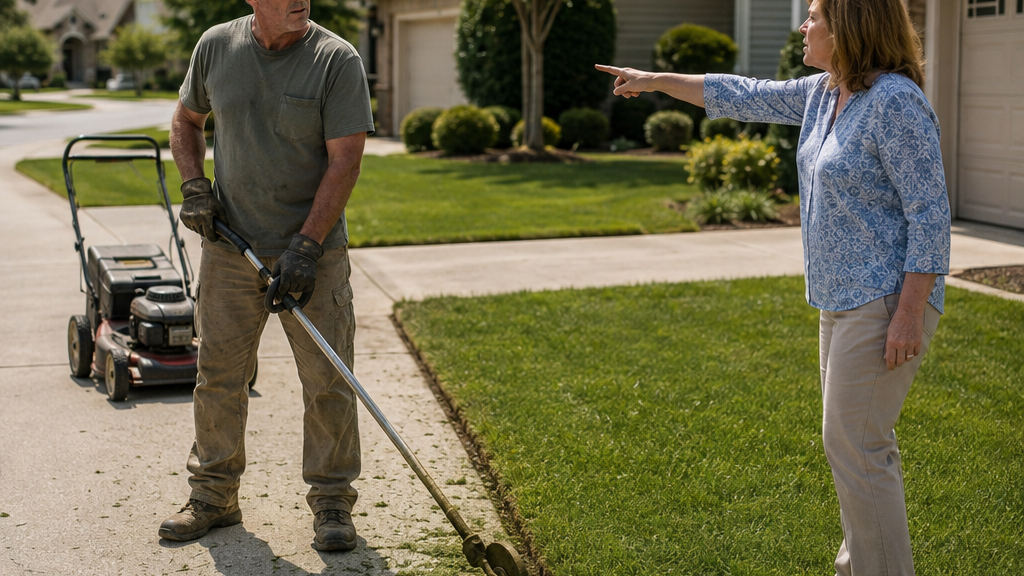
The HOA President’s Wife Tried to Stop His Lawn Job—Then One Property Line Changed the Whole Dispute
Chapter 1: The Woman Who Ordered the Mower Off
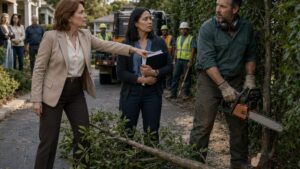
“Stop right there.”
Jack Carter released the trigger on the edger.
The engine dropped from a hard mechanical whine to silence, leaving only the ticking of hot metal and the faint hiss of a sprinkler somewhere farther down the street.
A woman stood three yards in front of him with one hand raised.
Jack had seen her ten minutes earlier on the neighboring porch. She had watched him unload the mower, watched him make the first pass across George Hill’s front lawn, and watched him trim around the mailbox without once looking away.
Now she pointed at the narrow strip of grass beside the driveway.
“Don’t throw that onto my side.”
Jack looked down.
A few green clippings dotted the concrete. Nothing unusual. He had not even reached the cleanup pass.
“I’ll blow everything clean when I’m finished, ma’am.”
“That isn’t the point.”
Jack kept one hand on the edger handle. His gloves were damp around the palms. It was already warming up, and he still had three properties after George’s.
He glanced toward George’s front door.
Closed.
The woman took another step closer.
“You need to stop working over here.”
Jack looked from her to the grass.
The edge he had cut was clean and straight, a dark line of soil between the sidewalk and the freshly trimmed turf.
“This is the property I was hired to service.”
“You’re crossing over.”
“Where?”
She pointed again, this time toward a narrow green strip running between George’s driveway and the side of her yard.
“There.”
Jack studied it.
Nothing marked the ground. No fence. No pins. No stones. Just grass, with a slight difference in height where somebody else had apparently been cutting it.
Before he had started, George had given him a quick walk-around. Front. Side. Back. Trim around the beds. Edge the driveway. Blow everything clean.
Normal instructions.
George had also said one other thing.
If Linda comes over, don’t get into it with her. She’s been giving everybody trouble.
At the time Jack had nodded and moved on.
He had spent enough years doing residential work to know that every neighborhood had one person who cared a little too much about where a mower wheel landed.
“I haven’t damaged anything,” Jack said.
Linda folded her arms.
“You’re not listening.”
Jack felt the first spark of irritation.
He hated being spoken to as if his work made him incapable of understanding ordinary English. Still, irritation did not pay invoices.
So he bent, shut the fuel valve on the edger, and pulled off his right glove.
“Okay. Tell me what you want me to understand.”
Linda seemed almost surprised that he had stopped.
“That area is not his to mess with.”
“Whose is it?”
“It’s maintained under the HOA.”
That changed the shape of the conversation.
Jack looked at the strip again.
It did not look like common landscaping. It looked like part of one lawn fading into another.
“Is there a marker?”
“There doesn’t need to be.”
“There does if you want me to know where not to work.”
Her mouth tightened.
“My husband is president of the HOA.”
There it was.
Jack had heard variations before. Board member. Committee chair. Neighborhood captain. Sometimes the title mattered. Most times it mattered less than the person saying it hoped.
Linda stepped closer to the cut edge.
“If you keep going after I’ve told you to stop, my husband can have you removed from this neighborhood.”
Jack stared at her.
For a moment he genuinely wondered whether he had misunderstood.
“Removed?”
“Yes.”
“I don’t live here.”
“That’s not what I mean.”
“What do you mean?”
“He can make sure you don’t work in here again.”
A curtain shifted in the house across the street.
Jack noticed it and immediately disliked the feeling. A simple Saturday lawn job had become something people might watch from windows.
He set the edger down.
“Do you have a work-stop notice from the association?”
Linda blinked.
“A what?”
“Something from the HOA telling me I’m not allowed to work on this property.”
“I just told you.”
“You told me your husband is president.”
“He is.”
“I’m asking whether the association issued something.”
Her cheeks flushed.
“You think you can stand there and argue with me?”
“No. I’m trying not to argue.”
Jack heard how flat his own voice had become.
That was usually the point when he knew he was angry.
Years earlier, a client had told him to remove a dying shrub beside a garage. After Jack did it, the client claimed she had meant the smaller shrub beside it. There had been no text message, no marked photo, nothing except two people remembering the same conversation differently.
Jack had paid for the replacement himself.
For three months afterward, he photographed every questionable instruction.
Then he stopped.
It felt insulting. Like beginning each job by saying, I expect you to lie later.
Now he looked at the unmarked strip and felt that old lesson returning.
Linda pointed toward George’s house.
“He knows better.”
“Then that’s between you and George.”
“You are the one cutting it.”
“Because George hired me.”
“And I’m telling you to stop.”
Jack picked up his glove but did not put it back on.
“If George tells me not to cut something on his property, I won’t cut it. If the HOA has authority over something, have the manager tell me. But I’m not taking work instructions from somebody who didn’t hire me because her husband has a title.”
Linda’s expression changed.
Not dramatically. Just enough.
Her eyes moved toward George’s front door, then back to Jack.
For the first time, she did not answer immediately.
Jack noticed that too.
Then the hesitation hardened.
“You just wait until Edward hears about this.”
“Fine.”
“He runs this association.”
Jack looked at the edger beside the clean grass line.
“Then he’ll know how to send an official notice.”
Linda turned and walked back toward her property.
Jack watched until she crossed the driveway.
He did not restart the machine.
Instead, he took out his phone and photographed the strip from three angles.
Only then did George’s front door open.
George Hill came outside carrying a glass of iced tea, looking like a man who had waited until the argument was safely over.
“You handled that better than I would have,” he said.
Jack stared at him.
“You knew she was going to do that.”
“I knew she might come over.”
“You told me she caused problems. You didn’t tell me she thought part of your yard belonged to the HOA.”
George looked toward Linda’s house.
“It doesn’t belong to the HOA.”
“Then why did she say it did?”
George’s grip shifted around the glass.
Jack saw the answer before he heard it.
Not guilt exactly.
Avoidance.
“George.”
George let out a breath.
“She’s wrong about the HOA.”
Jack waited.
George looked down at the narrow strip where the two mowing patterns met.
“But not everything about that strip is simple.”
Chapter 2: The Strip George Never Explained
“You never told me where you normally stop mowing.”
George did not answer right away.
They stood in his kitchen with the back door open, the smell of cut grass drifting in through the screen. Jack’s mower remained parked halfway through the front yard.
George set his iced tea beside the sink.
“I figured you’d follow the lot.”
“What lot line?”
“The property line.”
“Which is where?”
George pointed vaguely toward the side yard.
Jack gave him a long look.
“That’s the problem.”
George rubbed the back of his neck.
For the first time that morning, Jack seriously considered loading everything back into the trailer.
He could lose an hour arguing over a twenty-inch strip of grass and still be the person blamed if somebody decided the line was wrong.
“I can finish the front and back,” Jack said. “I’m not touching that side until somebody tells me exactly what it is.”
George frowned.
“You don’t need to make this bigger than Linda already did.”
“I’m not the one making it bigger.”
“She does this.”
“You knew she did this.”
George glanced away.
That annoyed Jack more than Linda’s threat had.
Linda had confronted him openly. George had hired him knowing there was a disagreement and reduced it to a warning about a difficult neighbor.
Jack picked up his phone.
“I took pictures before I stopped. I’m documenting where I left it.”
“You think I’m going to blame you?”
“I think nobody intends to blame anybody until something goes wrong.”
George seemed to hear more in that sentence than Jack had meant to say.
He lowered his voice.
“There was some confusion years ago.”
“What kind?”
George opened a drawer beneath the kitchen counter and dug through appliance manuals, takeout menus, and folded neighborhood notices.
Eventually he pulled out a faded photocopy.
It showed several lots, driveways, planting beds, and a thin shaded band running behind part of the block.
George laid it on the counter.
“This came with some HOA landscaping paperwork.”
Jack leaned over it.
The reproduction was poor. Lines overlapped. Some labels were barely legible.
George tapped the side of his lot.
“That’s us.”
“And this?”
“The strip.”
On the paper, the shaded area did not line up neatly with what Jack had seen outside.
It seemed to angle toward the rear corner of George’s property.
Jack traced it with one finger without touching the paper.
“This doesn’t show what Linda was pointing at.”
“I know.”
“Then why does she think it does?”
George gave a small, humorless laugh.
“You’d have to ask Linda.”
“No. I’m asking you.”
The kitchen went quiet.
George finally said, “She’s been cutting part of it.”
“How long?”
“Years.”
Jack straightened.
There it was.
Not authority. Habit.
“How many years?”
“I don’t know. Six, maybe seven.”
“And you let her?”
“It was grass.”
“So today when you told me to mow the side, did you mean the side you own or the side she usually cuts?”
George hesitated.
Jack shook his head.
“That’s exactly what I’m talking about.”
Outside, the two lawns told the story better than the photocopy did.
George walked with Jack to the driveway.
Jack pointed to the fresh edge he had made near the sidewalk.
“Here’s where I followed the line of your driveway.”
Then he pointed farther back.
“And there’s where somebody else has been mowing.”
The difference was subtle but visible. George’s turf had been cut in broad passes parallel to the street. The narrow strip carried a different direction, its mower lines running lengthwise toward Linda’s backyard.
Two habits. Two assumptions.
One piece of grass.
George shoved his hands into his pockets.
“My deed says the lot goes farther over.”
“Have you seen the pins?”
“Not in years.”
“Survey?”
“Somewhere.”
Jack looked toward Linda’s house.
She was no longer on the porch.
That somehow made the situation feel less settled.
George said, “Just cut to where the property line should be. If she comes out again, I’ll deal with her.”
Jack looked at him.
“You didn’t deal with her the first time.”
George’s jaw tightened.
“I hired you to mow my lawn.”
“And I came to mow it. Not decide a boundary dispute for you.”
George’s face reddened.
For a few seconds Jack thought the job was over.
Then George looked away.
“She started maintaining it after we had drainage trouble.”
Jack said nothing.
George seemed to realize he had given away more than intended.
“What drainage trouble?”
“It was a long time ago.”
“How long?”
“Maybe seven years.”
Exactly as long as Linda had been cutting the strip.
Jack looked down at the two mowing patterns.
The argument was changing.
Linda’s threat still sounded ridiculous. But the grass itself was no longer ridiculous.
“Show me.”
George shook his head.
“There’s not much to show now.”
“Then tell me what happened.”
Before George could answer, his phone rang.
He looked at the screen.
His expression shifted.
“Rachel.”
“Who?”
“The property manager.”
George answered.
“Hello?”
Jack could hear only fragments from the other end.
George turned toward the yard while listening.
“No, he’s still here.”
Pause.
“No. Nobody’s doing anything right now.”
Another pause.
George’s shoulders dropped slightly.
“All right.”
He ended the call.
Jack waited.
“Well?”
George looked irritated, but not at Jack.
“Rachel says there is no HOA stop-work order. Linda had no authority to tell you the association was removing you.”
Jack felt a brief, clean relief.
There.
That part, at least, was settled.
“So I can finish.”
George did not answer.
Jack’s relief disappeared.
“What else did she say?”
George glanced toward the strip.
“She wants nobody touching that section until Monday.”
“Why?”
“She found something in the association files.”
“What?”
“She didn’t say.”
Jack looked at the half-cut yard, the narrow band of taller grass, and the sharp edge where his machine had stopped.
An hour earlier, the line had been nothing more than evidence of unfinished work.
Now it looked like the only part of the lawn anybody cared about.
Chapter 3: No Rule Said What Linda Claimed
Rachel White placed two maps side by side on the conference table.
The lines did not match.
Jack saw it before she said anything.
On the first map, George Hill’s lot extended in a clean rectangle along the side of his driveway. On the second, a narrow shaded band cut diagonally through the same area and continued toward the rear drainage corridor.
Rachel tapped the first page.
“This is from the community’s original landscape-maintenance packet.”
Then the second.
“This was attached to a drainage discussion several years later.”
George leaned forward.
“So which one counts?”
Rachel looked at him.
“That depends what you mean by counts.”
It was Monday morning, and Jack already regretted agreeing to the meeting.
He had two lawns waiting across town and a commercial cleanup scheduled after lunch. Instead, he was sitting in the small HOA management office beneath a wall-mounted clock that seemed louder every minute.
He had come for one answer.
Could Linda Roberts order him off George’s property?
Rachel had given him that answer in the first five minutes.
No.
There was no work-stop notice, no contractor restriction, no board instruction, and no rule allowing the HOA president’s wife to remove a hired landscaper from a private lot because she objected to grass clippings.
That should have been enough.
Instead Rachel had opened the old files.
Now there were two maps.
Jack folded his arms.
“So I didn’t violate anything.”
“Not that I can find,” Rachel said.
“Then why did you tell us not to touch the strip?”
“Because I’m not going to solve one bad assumption by making another one.”
George exhaled impatiently.
“It’s my property.”
“Maybe. Probably. But this document suggests the association once considered that area part of a drainage-access plan.”
“Considered isn’t the same as approved.”
“No.”
“Then we’re done.”
Rachel did not move.
Jack watched her.
She had the manner of someone who disliked giving an answer before she knew how many questions were hiding behind it.
“What’s missing?” he asked.
Rachel looked at him rather than George.
“A final record.”
“What kind?”
“A vote. Recorded approval. Recorded rejection. Something showing what the board actually decided.”
George sat back.
“There was never an easement.”
“I haven’t found one.”
“So Linda made it up.”
Rachel’s expression tightened.
“I didn’t say that either.”
Jack almost laughed, but there was nothing funny about how quickly every simple answer acquired another condition.
Rachel slid the second map toward them.
The shaded band was marked as a proposed maintenance path for runoff access. It reached across part of George’s lot before bending toward the rear of the subdivision.
“This is not a recorded property survey,” she said. “It’s an internal working diagram.”
Jack pointed toward the shaded strip.
“But it’s close to where Linda told me to stop.”
“Yes.”
George shook his head.
“She’s been acting like that land belongs to the association.”
“That’s different from saying the association once discussed needing access there.”
Jack looked from one of them to the other.
The distinction mattered.
He did not like Linda’s behavior any better than he had Saturday. But he also disliked the idea that his clean edge had landed in the middle of something everyone else had spent years refusing to define.
“Can she tell contractors what to do?” he asked.
Rachel answered immediately.
“No.”
“Can Edward?”
“As president, he can act only within the board’s authority. He cannot personally rewrite a private property boundary either.”
“So the threat was empty.”
“As an HOA enforcement threat? Yes.”
That was the small victory Jack had wanted.
He should have felt better.
Instead he remembered Linda pointing toward the strip with absolute certainty.
Not bluffing.
Certain.
Rachel closed one folder and opened another.
“I called the association maintenance contractor this morning. They don’t routinely service that strip.”
George nodded sharply, as if that proved his case.
“But,” Rachel continued, “they have cleared debris through that area after heavy storms.”
George stopped nodding.
“How many times?”
“At least twice in the records I found.”
Jack looked at him.
George avoided his eyes.
Rachel noticed.
“Is there something you want to tell me?”
“No.”
“George.”
He sighed.
“It flooded once.”
Rachel waited.
“More than once?”
George rubbed both hands over his face.
“It wasn’t flooding exactly.”
Jack leaned back.
Here we go.
George stared at the maps.
“Water used to come down between the houses when we had those heavy summer storms. Before some of the rear drains were cleaned out.”
Rachel asked, “And?”
“And Linda kept complaining about it.”
“What did you do?”
“Nothing at first.”
Jack thought of George standing safely behind his front door on Saturday.
That part sounded consistent.
George continued.
“Then we had one storm where water cut through the side and washed mulch into her backyard. She came over furious.”
“Did she contact the HOA?” Rachel asked.
“Yes.”
“And did the board tell you the strip was association-controlled?”
“No.”
Rachel’s eyes narrowed slightly.
“What happened instead?”
George stared toward the window.
“The two of us talked.”
Jack felt the conversation move again.
Not a document this time.
A choice.
George said, “I told her if keeping that side clear helped the runoff, she could keep it trimmed. I said I wasn’t going to fight over a strip of grass.”
Rachel was very still.
“You gave her permission to maintain it?”
“Verbally.”
“For how long?”
“I didn’t put a date on it.”
Jack looked at him.
“And then she kept doing it for seven years.”
George’s jaw tightened.
“I didn’t care.”
“Until Saturday.”
“I still don’t care who cuts it.”
“That’s not what she thinks.”
George looked at Jack with irritation.
“What was I supposed to do? Start a neighborhood war over twenty inches of grass?”
Jack almost answered immediately.
Then he stopped.
Because he understood the temptation.
He had done his own version of the same thing for years.
Do the job. Avoid the argument. Trust that reasonable people know what was meant.
A handshake instead of a message.
A verbal instruction instead of a marked photograph.
Keep moving.
Until someone remembered it differently.
Rachel turned the drainage map around.
“So Linda’s claim that the HOA controls the strip is unsupported. But her belief that the strip has been treated differently didn’t come from nowhere.”
George said nothing.
Jack looked down at the paper.
The sharp edge he had cut Saturday suddenly seemed less like a boundary than a question mark.
Rachel gathered the documents into a neat stack.
“I’m going to review the old board minutes. Until I do, nobody representing the association should give instructions about that strip.”
“What about me?” George asked.
“It’s your property dispute. I’m not telling you what you can do with your land.”
“That sounds like you are.”
“I’m telling you what I need before I say the HOA has any role in it.”
Jack stood.
He had his answer about Linda.
But it no longer solved the job.
As George followed him toward the door, he lowered his voice.
“There’s one more thing.”
Jack stopped.
George looked embarrassed.
“The storm arrangement wasn’t just her idea.”
Jack waited.
George glanced back toward Rachel’s office.
“I was the one who told Linda she could keep that strip clear.”
Jack said nothing.
George added quietly, “And I never told her when that permission ended.”
Chapter 4: The Agreement Nobody Put in Writing
“The water used to run right through here.”
George stood in the side yard Monday evening with one shoe pressed into a shallow dip Jack had barely noticed before.
Without the mower running, the strip looked different.
The grass between the houses sloped gently toward the back. Near the foundation, the ground sat higher. Closer to Linda’s property, it dropped just enough to form a natural channel.
George dragged the toe of his shoe along it.
“Big storms, it would come down from the street, cross here, and keep going toward the rear drain.”
Jack crouched and pressed his fingers into the soil.
Dry now.
Nothing about it suggested trouble.
“That’s why Linda started cutting this?”
“Part of why.”
Jack stood.
“You said you told her she could keep it clear.”
“I did.”
“That sounds different from what you told me Saturday.”
George looked toward the neighboring house.
Linda’s porch was empty.
“I told you she didn’t own it.”
“You also told me to mow your side.”
“It is my side.”
Jack pulled off one glove.
George noticed.
Jack had started to notice too. Whenever a conversation stopped being about work and started being about responsibility, the glove came off.
“George, I need you to understand something. I put a blade next to somebody’s fence, flower bed, irrigation line, whatever—you tell me where to go. I trust you. That’s how most jobs work.”
“I know.”
“No. You knew there was a disagreement here.”
“I knew Linda had opinions.”
“You knew she’d been maintaining part of your yard for seven years.”
George’s mouth tightened.
Jack waited.
Eventually George said, “I didn’t think it mattered.”
“That’s what everybody keeps saying right before something matters.”
The words came out sharper than Jack intended.
George looked at him.
Jack thought of the dead shrub from years before. Wrong plant, wrong memory, his money.
He had promised himself then he would never again work from unclear instructions.
The promise had lasted three months.
Maybe because asking customers to initial photographs felt ridiculous. Maybe because most people were decent. Maybe because Jack preferred believing a handshake still meant something.
Whatever the reason, here he was again.
George walked farther toward the rear corner.
“Come here.”
Jack followed.
Behind the houses, the lawns opened toward a shallow drainage corridor. A grated inlet sat beyond the property line near common landscaping. The ground around it was darker and lower.
George pointed.
“The bad storm came before they cleaned that inlet.”
“How bad?”
“Water got almost to Linda’s patio.”
Jack looked back toward the street.
He could imagine it now. Water coming downhill, carrying mulch and leaves, searching for the lowest place.
“She blamed you?”
“She blamed everybody.”
That sounded more like the Linda Jack knew.
George gave a faint smile, but it vanished quickly.
“She complained to the board. The board talked about making sure nothing blocked this path. I told her she could keep the strip cut if she was that worried about it.”
“You agreed because it worked.”
“I agreed because I wanted her to stop knocking on my door.”
There it was.
The real agreement.
Not property. Not policy.
Exhaustion.
A screen door opened next door.
Linda stepped into her yard.
She stopped when she saw them standing near the drainage channel.
For a moment nobody spoke.
Then she walked over.
This time she did not point.
“What are you doing?”
“Trying to understand what happened,” Jack said.
Linda looked at George.
“He finally tell you?”
“Some of it.”
George folded his arms.
“Linda, I never gave the HOA control of my property.”
“I never said you gave it to the HOA.”
Jack turned toward her.
“You told me Saturday it was maintained under the HOA.”
“It was.”
“By you.”
“And by maintenance after storms.”
“That’s not the same thing.”
Linda’s shoulders stiffened.
“You weren’t here when the water came through.”
“No.”
“It washed mulch into my backyard. It covered part of the patio. We had standing water against the fence for two days.”
Jack said nothing.
She pointed toward the low ground, but the gesture was different now. Less accusatory. More specific.
“George stopped keeping that side low. The grass got tall, leaves collected, and every storm it held water.”
George shook his head.
“That is not what caused the drainage problem.”
“I didn’t say it caused all of it.”
“You’ve spent years acting like you control it.”
“Because somebody had to keep it clear.”
Jack looked between them.
There were pieces of truth on both sides, and each person seemed offended that the other piece existed.
“Who told you the HOA gave you authority over it?” he asked.
Linda looked at him.
“The board discussed making it a drainage-access area.”
“Discussed?”
“It was understood.”
“By who?”
“The people who were involved.”
“Was George involved?”
Linda did not answer.
George let out a humorless breath.
“No.”
Linda turned on him.
“You were at one meeting.”
“I left before they got to that item.”
“You knew what they were talking about.”
“I knew they were talking. I never agreed to an easement.”
Jack watched Linda’s face.
For the first time since Saturday, the anger slipped enough to expose something underneath.
Worry.
“If that strip gets filled in, landscaped, or blocked,” she said, “the water problem can come back.”
“I’m not filling anything in,” George said.
“You say that now.”
Jack stepped between the argument before it gathered speed.
“All I did was cut grass.”
Linda looked at him.
“Exactly.”
Jack frowned.
She continued, “You cut past the line we’ve kept for years.”
“We?”
“Me. Maintenance when necessary. George when he remembered.”
George started to object, but Jack raised a hand.
“So the mowing line became the boundary in your mind.”
Linda’s expression changed.
“It became the safe line.”
That was different.
Not necessarily correct.
But different.
Jack looked down at the grass. One mowing pattern ran north-south. Another ran east-west. For years those machine marks had quietly told everybody where to stop.
No stakes.
No agreement.
Just repetition.
Linda lowered her voice.
“Edward was president when the drainage issue came up. I thought if the board discussed it and maintenance used it, that meant it was association access.”
“You thought,” Jack said.
“Yes.”
“And Saturday you told me your husband could have me removed.”
Her face tightened again.
“He could have addressed it.”
“That isn’t what you said.”
Linda looked toward her house.
When she answered, the certainty was gone.
“I assumed his position meant the association would back it.”
Jack slipped the glove back onto his hand.
That admission did not excuse the threat.
But it changed it.
Linda had not invented the strip from nothing. She had taken years of habit, partial board discussions, storm cleanup, and her husband’s position and stacked them together until they felt like authority.
George had helped by saying nothing.
Jack had helped, in his own smaller way, by arriving and trusting another vague instruction.
His phone rang.
Rachel.
Jack answered.
“I’ve been going through archived minutes,” she said. “I found the drainage discussion.”
George and Linda both looked at him.
“Was it approved?” Jack asked.
A pause.
“That’s the problem.”
“What problem?”
“There’s a motion recorded to investigate formal access. There’s discussion about maintenance. There’s even a draft diagram.”
“And the vote?”
“I can’t find one.”
Jack looked at Linda.
She was no longer angry.
She looked tired.
Rachel continued, “No recorded approval. No recorded rejection. Nothing closing it out.”
George muttered, “Unbelievable.”
Jack stared at the two mowing lines.
Seven years of certainty had grown out of a meeting that apparently never finished.
Rachel said, “I’m putting this on Wednesday’s board agenda.”
Jack asked, “Who was president when this happened?”
Another pause.
“Edward.”
Chapter 5: The President Who Preferred Silence
“Linda was trying to protect the neighborhood.”
Edward Roberts had barely finished the sentence when Rachel White looked up from the folder in front of her.
“Under which recorded rule?”
The board meeting room went still.
Jack sat two chairs away from George at the back of the room. Linda was along the side wall, arms folded, while Edward sat behind the long table with the board treasurer and two empty chairs beside him.
A projected diagram filled the wall.
George’s house.
Linda’s house.
The narrow strip.
Three different lines appeared on three different documents.
Edward glanced toward the projection.
“We all know there was a drainage concern.”
“That wasn’t my question,” Rachel said.
Her tone remained professional, which somehow made the question harder.
Edward adjusted the papers in front of him.
“There was an understanding.”
George leaned toward Jack.
“That word again.”
Jack did not answer.
He had heard enough versions of understanding that week to distrust every one of them.
Rachel clicked to the next document.
“This is the meeting record from seven years ago. The board discussed evaluating access for stormwater maintenance. A motion was made to obtain more information.”
She clicked again.
“This is a draft diagram prepared afterward.”
Another click.
“This is a maintenance invoice after a major storm.”
Edward nodded.
“Exactly.”
Rachel looked at him.
“None of those creates an easement.”
“No one said it did.”
Linda shifted against the wall.
Jack noticed.
Rachel did too.
“Linda did,” she said.
Edward’s face hardened.
“My wife is not on trial here.”
“No one said she was.”
“That’s what this is turning into.”
Jack felt George tense beside him.
This was the moment he had expected Edward to become the man Linda had threatened him with: powerful, defensive, ready to turn a private argument into board business.
Instead Edward looked uncomfortable.
Not furious.
Cornered.
Jack had dealt with men like that before—customers who talked loudly until someone asked them to make a decision they could be held to.
Rachel kept her voice level.
“The contractor was told he could be removed from the neighborhood because you were HOA president. I need to know whether you authorized that statement.”
“No.”
Linda looked at him sharply.
Edward did not meet her eyes.
Rachel asked, “Did you ever tell Linda the association controlled that strip?”
“No.”
“Did you tell her it did not?”
Silence.
Jack looked at Edward.
There it was.
A much smaller failure than corruption.
And maybe a more familiar one.
Edward rubbed one thumb along the edge of his papers.
“The drainage issue was complicated.”
“That’s not an answer,” Rachel said.
“I didn’t want to create an argument over a strip that was functioning.”
George spoke from the back.
“So you let her think she was right.”
Edward turned.
“I let everyone keep doing what had worked.”
“For you,” George said.
“For the neighborhood.”
Linda pushed away from the wall.
“Edward.”
He finally looked at her.
Her face had changed.
Not the anger Jack had seen in the yard.
Something closer to disbelief.
“You told me the board had handled it.”
Edward frowned.
“I told you they had discussed it.”
“You said it was taken care of.”
“I meant the drainage.”
“You knew what I thought.”
Edward did not answer.
The room changed then.
Until that moment, Linda had been the person who exaggerated her connection to authority. Now Jack saw another truth taking shape: Edward had benefited from the exaggeration.
Every time Linda protected the strip, he avoided reopening the old records.
Every time George stayed quiet, Edward avoided forcing a vote.
Every year the water drained without another major incident, the unfinished decision looked more like a successful policy.
No one had to admit there was no policy at all.
Rachel turned off the projector.
“The association has two separate issues.”
She raised one finger.
“First: there is no recorded authority for private residents, including spouses of board members, to direct contractors working on another owner’s lot.”
A second finger.
“Second: there is still a drainage concern that the board failed to resolve formally.”
Edward leaned back.
“So what do you recommend?”
“Stop pretending those are the same issue.”
The treasurer shifted in his chair.
Jack almost smiled.
Almost.
Rachel continued, “The contractor-contact rule is straightforward. If the HOA believes work on a private lot violates association requirements, management or an authorized board representative contacts the property owner. Neighbors do not issue stop-work orders.”
Linda looked down.
Edward asked, “And the strip?”
“Survey ownership first. Then decide whether the association needs actual drainage access. If it does, handle it properly.”
George said, “At whose expense?”
Rachel looked at him.
“That depends on what the association is requesting.”
The meeting threatened to slide into costs and procedure.
Jack stood.
Rachel glanced at him.
Edward did too.
Jack had not planned to speak. He had come because George asked him to, and because Rachel said the board might want his account of Saturday.
But he suddenly heard the entire week being reduced to documents again.
“I need one thing clear.”
Edward’s expression guarded.
“What?”
“This started because I was mowing a lawn.”
Linda looked toward him.
Jack continued.
“I don’t care who wins an argument from seven years ago. I care that I was told to work an area by the man paying me, then told to stop by someone claiming HOA authority.”
George shifted.
Jack faced him too.
“And both of you expected me to figure out which one of you actually knew where the line was.”
George looked down.
Jack pulled off his work glove. He had come straight from a job and had forgotten he was still wearing them.
“I should’ve asked before I cut it. That part’s on me. I saw grass, George said mow the side, and I assumed.”
Linda watched him carefully.
“But I’m not doing that again.”
Edward asked, “Meaning?”
“Meaning I’m not going back to finish that strip until George gives me a written work boundary.”
George stared at him.
“Jack.”
“And if the HOA has instructions that affect the work, they come through management or somebody authorized to give them.”
George lowered his voice.
“I need the yard finished.”
“I know.”
“I hired you.”
“And I want to finish it.”
“Then finish it.”
Jack shook his head.
“That’s what got us here.”
George’s irritation rose.
“So now I need paperwork to get my grass cut?”
“For that strip? Yes.”
The treasurer looked as if he wanted to disappear.
Edward frowned.
“This is getting excessive.”
Jack turned toward him.
“No. Saturday was excessive.”
Edward said nothing.
Jack placed both gloves on the chair beside him.
“I’ve spent years thinking professionalism meant not making customers uncomfortable. Somebody points, I cut. Somebody says stop, I try to keep everybody happy.”
He thought of the wrong shrub and the replacement money.
“I’m done guessing when other people refuse to decide.”
Rachel closed the folder.
“Then we’ll get the boundary confirmed.”
Linda spoke for the first time in several minutes.
“And the drainage?”
Rachel looked at her.
“That gets addressed too.”
Linda nodded once.
No apology.
No argument.
Just a reluctant acceptance that they were no longer discussing the same thing.
As the meeting ended, Edward stayed seated.
Jack gathered his gloves.
George came beside him.
“You really won’t finish?”
“Not that section.”
“You’re willing to lose the account over this?”
Jack looked at him.
“I’m willing to lose the account before I take responsibility for another line nobody wants to own.”
George stared at him for a long second.
Then he walked away.
Jack slipped the gloves into his back pocket.
He had arrived expecting Edward Roberts to be the most powerful person in the room.
Instead Jack left understanding that the entire mess had survived because Edward had spent seven years avoiding one uncomfortable sentence.
And now Jack had said his own.
No written line, no mower.
Chapter 6: Jack Refused to Cross Another Unwritten Line
“I’ll pay you extra.”
George stood beside Jack’s trailer Thursday morning holding folded cash.
Jack did not reach for it.
“Put that away.”
“I’m not trying to bribe you.”
“I know.”
“I just need the place cleaned up.”
Jack latched the trailer gate.
He had stopped at George’s house only because George had called three times since the board meeting.
The uncut strip had become obvious now. The rest of the yard had grown evenly while the disputed section still carried the interrupted edge from Saturday.
“I can do the front and back again,” Jack said. “Not that strip.”
“Rachel already said Linda can’t order you around.”
“This isn’t about Linda anymore.”
George stared at him.
Jack surprised himself by realizing he meant it.
Saturday, the threat had been the whole problem.
Now it was almost the easiest part.
George shoved the cash into his pocket.
“You know where I think the line is.”
“Thinking is what we’re done with.”
George made a frustrated sound.
“The survey technician is coming tomorrow.”
“Good.”
“And if he says I own it?”
“Then you tell me in writing what you want cut.”
George looked almost offended by the phrase.
“In writing.”
“Yes.”
“You think I’m going to turn around and blame you?”
Jack met his eyes.
“I think you spent seven years letting Linda maintain your property because saying something felt harder than letting it happen.”
George’s face changed.
Jack continued before he could stop himself.
“So no. I don’t know what you’ll do when this gets uncomfortable again.”
The words landed harder than he intended.
George looked toward the strip.
After a moment he nodded.
“Fair.”
It was the first time all week he had said that.
The survey technician arrived Friday afternoon.
Jack did not need to be there, but George asked him to come after his last job.
By the time Jack pulled up, bright temporary stakes marked the side of the property.
One stood several inches beyond the mowing line Linda had defended.
Another sat farther back near the drainage slope.
George was holding a copy of the survey.
Linda stood on her side of the yard.
Rachel was there too.
Jack walked toward them.
George handed him the paper.
“The strip is mine.”
Jack studied the marked boundary.
The survey confirmed George’s lot extended beyond the habitual mowing line.
There was no recorded HOA easement across that section.
For a few seconds, nobody spoke.
Then Linda asked, “What about drainage access?”
The technician pointed toward the lower ground.
“The survey tells you ownership. It doesn’t tell you what drainage arrangement you should maintain.”
Linda looked at Rachel.
“So this fixes nothing.”
“It fixes ownership,” Rachel said.
“That’s not nothing.”
“But if he lets it grow in and the water backs up—”
George interrupted.
“I never said I was going to block it.”
“You said it’s yours.”
“It is mine.”
“And that means what?”
Jack watched them move toward the old argument again.
Mine.
Control.
Permission.
Words pulling in opposite directions.
George stopped himself.
He looked down at the stakes.
Then at the low channel.
“I’ll keep a drainage margin.”
Linda frowned.
“What does that mean?”
“It means I’m willing to keep a narrow section clear so water can move through.”
“As HOA access?”
“No.”
Her expression tightened.
“As a neighbor.”
That silenced her.
George continued, “If the association eventually needs formal access, it can bring me something formal. Until then, I’ll keep the area maintained because the drainage matters.”
Linda looked at the ground.
“And you won’t landscape over it?”
“I’m not planning to.”
“That’s not the same as agreeing.”
George almost snapped back.
Jack saw it.
Then George exhaled.
“No, Linda. It’s not the same. That’s the point.”
Rachel nodded.
“We can document the voluntary maintenance plan separately from any future HOA proposal.”
Jack looked at George.
For the first time, George was not asking someone else to carry the uncomfortable part for him.
That mattered more than the survey stake.
Later that evening Jack sat at his kitchen table with a blank sheet of paper.
At the top he wrote:
WORK AREA CONFIRMATION.
He stared at the words.
They looked absurdly formal for lawn care.
Then he remembered the shrub.
Linda pointing.
George saying just cut where the property line should be.
Jack drew a simple rectangle representing a property. He added spaces for areas excluded from service, customer instructions, and unusual boundary conditions.
Nothing legalistic.
Nothing threatening.
Just enough that two people could look at the same page and agree on what the job actually was.
The next morning he brought a copy to George.
George read it on the hood of Jack’s truck.
“You’re doing this for everybody now?”
“Anything with a questionable boundary.”
“You really got changed by twenty inches of grass.”
Jack smiled faintly.
“No. I got reminded.”
George signed.
Under special instructions, he wrote that Jack should mow to the confirmed property boundary except for a narrow maintained drainage margin following the agreed ground contour.
Rachel emailed confirmation that the HOA had no claim of maintenance authority over the strip and that any future association instruction regarding private-lot contractors would come through management or an authorized representative.
Jack printed that too.
It felt ridiculous carrying more paper to a lawn job than he had brought to some commercial contracts.
It also felt clean.
By Saturday morning the temporary survey stakes were still standing.
Jack unloaded the mower.
The neighborhood looked almost exactly as it had one week earlier.
Same driveways.
Same trimmed shrubs.
Same quiet street.
But the line beside George’s driveway no longer existed only because somebody had always mowed there.
It had a location.
And beside it, by choice rather than assumption, was the drainage margin.
Jack was checking the mower height when he heard footsteps.
He looked up.
Linda was walking toward him.
She stopped beside the nearest survey stake.
Her eyes moved from the marker to the mower, then to Jack.
A week earlier she had approached with her finger already raised.
This time her hands stayed at her sides.
“Are you planning to mow all the way to those stakes?”
Chapter 7: The Line Stayed After the Argument Ended
Linda watched from the same porch where the first argument had started.
Jack saw her before he started the mower.
A week earlier, her stare had felt like a warning. Now he simply noted where she was, checked the signed work sheet clipped inside his truck, and walked toward the side yard.
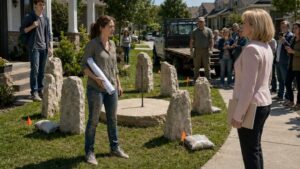
The survey stakes remained bright against the grass.
George’s property line sat several inches beyond the old mowing pattern. Inside that line, closer to the shallow drainage path, George had chosen to leave a narrow maintained margin.
Not because Linda owned it.
Not because the HOA controlled it.
Because water still needed somewhere to go.
Jack started the mower.
The engine settled into its familiar rhythm, and he made the first pass across George’s front lawn.
He did not hurry near the side.
For years he had treated a clean stripe as evidence enough that he knew what he was doing. This time every pass had a defined endpoint.
At the disputed strip, he stopped.
The mower wheels lined up several inches short of the survey stake.
Jack looked down at the written instructions once more.
Confirmed property boundary.
Voluntary drainage margin to remain maintained.
He adjusted his path and continued.
Behind him, the fresh-cut grass formed a new line.
It was not where Linda had ordered him to stop.
It was not all the way to George’s legal boundary either.
It existed because George had finally chosen it.
Jack was halfway through the second pass when the porch door opened.
He released the drive handle.
Linda crossed her yard.
Jack left the mower running at idle.
She stopped near the nearest stake.
For a few seconds they stood almost exactly where they had stood the previous Saturday.
But she did not raise a finger.
“Where is George keeping the drainage margin?”
Jack shut off the mower.
The question surprised him more than an accusation would have.
He pulled off one glove.
“From that low point back toward the rear drain.”
Linda looked at the cut line.
“You’re not mowing to the property stake?”
“Not through the drainage section.”
“Because the HOA told you not to?”
“No.”
Her mouth tightened slightly, but she nodded.
“Because George asked me not to.”
Jack reached into his back pocket and unfolded the work sheet.
“He marked the area.”
Linda did not reach for it.
She looked instead toward the grass.
“So that’s the line?”
“For this job.”
She frowned.
“What does that mean?”
“It means the property line is over there.”
Jack pointed toward the stake.
“The mowing line is here because that’s what George chose.”
Linda was quiet.
A week earlier, she would have treated the distinction as an invitation to argue.
Now she followed the drainage slope with her eyes.
“The board approved the contractor rule yesterday,” she said.
Jack looked at her.
“What rule?”
“If there’s an association issue with work on somebody’s private lot, management contacts the homeowner. Or an authorized board representative does.”
She gave a small, uncomfortable shrug.
“Neighbors don’t stop contractors.”
Jack understood what she was not saying.
Neither do presidents’ wives.
“Rachel told me they were working on it.”
“Edward voted for it.”
That surprised him.
Linda noticed.
“He should have done it years ago.”
Jack said nothing.
She looked toward her house.
“So should I.”
It was not quite an apology.
He decided not to make her turn it into one.
“You were worried about the drainage.”
“I was.”
“You still are.”
“Yes.”
Jack nodded toward the narrow strip.
“Then watch that instead of who’s holding the mower.”
Linda looked at him sharply.
For half a second, he thought he had pushed too far.
Then one corner of her mouth moved.
Not a smile exactly.
“George should’ve dealt with it seven years ago.”
“He probably should have.”
“And the board should have finished what it started.”
“Yes.”
“And Edward should’ve told me what the documents actually said.”
Jack nodded.
“Yes.”
Linda folded her arms, but without the old aggression.
“And I shouldn’t have told you he could throw you out.”
“No.”
She looked at him.
“You could at least pretend to make that easier.”
“I’m cutting grass, not running a counseling service.”
This time she did smile.
Briefly.
Then it disappeared.
“I still think George’s going to regret not formalizing the drainage.”
“That’s between you, George, and the board.”
“You really learned that sentence.”
“I paid for it.”
Linda looked puzzled, but Jack did not explain.
He thought of the old shrub, the replacement bill, and every job where he had decided that asking one more question was more trouble than it was worth.
The lesson had taken years to come back.
Linda stepped away from the mower path.
“I’ll let you work.”
She turned toward her yard, then stopped.
“Jack.”
He looked up.
“If you notice leaves building up in that channel when you’re here…”
She hesitated.
Then corrected herself.
“Would you tell George?”
The change was small enough that someone else might have missed it.
She had almost given him another instruction.
Instead she had asked.
“Yeah,” Jack said. “I can do that.”
She went back inside.
Jack restarted the mower.
Near noon, George came outside carrying two bottles of water.
He set one on the truck bumper.
“Looks good.”
Jack finished the pass before answering.
George stared at the new edge.
“Funny.”
“What?”
“All that fighting, and we ended up leaving almost the same strip she wanted.”
“Almost.”
George nodded.
“But now it’s mine to leave.”
Jack looked at him.
“That’s the difference.”
George handed him the water.
“I thought you were being difficult when you made me sign that paper.”
“You weren’t alone.”
“I still think it’s a little much for mowing.”
Jack took a drink.
“Maybe.”
George laughed.
“Not giving that one up, are you?”
“Nope.”
They walked toward the side yard.
The difference between the legal boundary and the maintained drainage line was visible now. One was marked temporarily by stakes. The other was marked by Jack’s work.
George stood with his hands on his hips.
“If the board wants formal access later, I’ll deal with it.”
“You should.”
“No letting it sit seven years?”
“Probably not the best system.”
George gave him a sideways look.
“You’ve become annoying.”
“Costs extra.”
George laughed again.
When Jack finished, he blew the sidewalk and driveway clean.
No clippings remained on Linda’s side.
Not because she had ordered it.
Because that was how Jack finished a job.
He loaded the mower, then returned to the side yard one last time.
The survey stakes would eventually disappear. The grass would grow again. A different mower might make a slightly different pass next month.
The real boundary was not the stripe.
Jack understood that now.
He took out his phone.
First he photographed the completed yard.
Then the drainage margin.
Then the survey stakes.
Finally he placed George’s signed work sheet on the hood of the truck and took one clear picture of it beside the finished lawn.
George watched from the driveway.
“You keeping that forever?”
“Long enough.”
Jack slid the paper into his folder.
Across the property line, Linda stepped onto her porch.
She glanced toward him.
Jack gave her a small nod.
After a moment, she returned it.
No friendship.
No grand apology.
No victory speech.
Just two people standing on different properties who finally understood that neither one got to invent the line between them.
Jack climbed into his truck.
Before pulling away, he looked once more at the fresh-cut edge running beside the drainage strip.
The first time he had made that line, it had started an argument because everyone believed it meant something different.
Now it meant exactly what had been agreed.
That was enough.
He drove to his next job with the signed boundary sheet filed behind the seat and both work gloves resting on the passenger-side floor.
The story has ended.