The HOA Fined Him Through His Wife’s Treatment—Then His Son Returned the Envelope Nobody Expected
Chapter 1: The Envelope Beside the Game Console
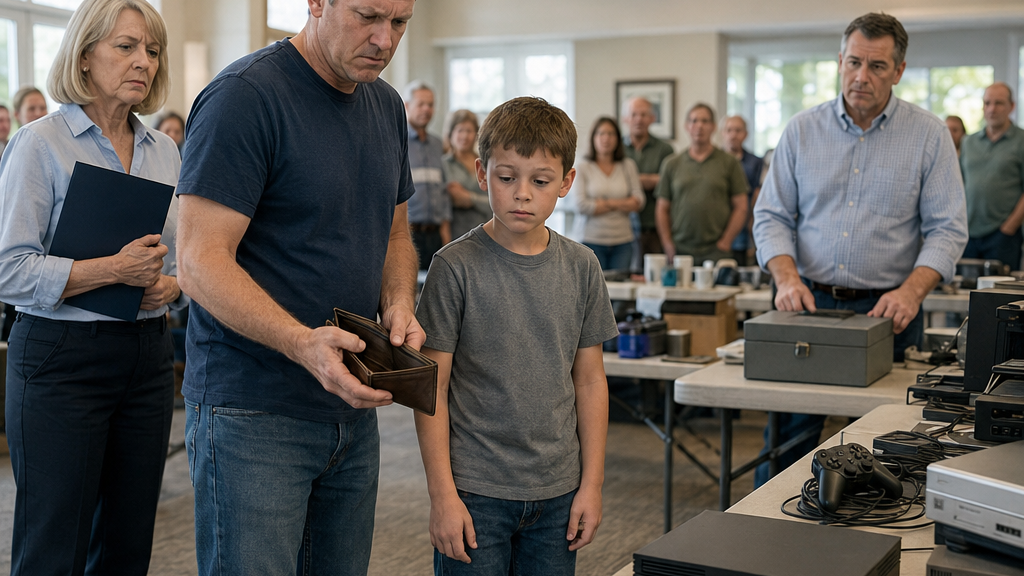
William Harris saw his son point at the game console at the exact moment Donna Martin called his name from behind them.
“William. Before you leave, I need a word.”
His son’s hand stayed in the air.
The console sat on a folding table in the HOA clubhouse between two old computer monitors and a box of tangled charging cables. A handwritten price card leaned against it: seventy-five dollars.
“Dad,” the boy said quietly. “That’s the one I showed you.”
William knew.
His son’s birthday was the next day. For three weeks, he had talked about that particular model as if seventy-five dollars were the distance between childhood and happiness.
William reached automatically for his wallet.
Inside were two twenties, a ten, three singles, and a pharmacy receipt folded so many times the paper had gone soft at the creases.
Fifty-three dollars.
He had twelve more in checking until Monday.
“I know,” William said.
His son looked from the console to his face and understood faster than William wanted him to.
“That’s okay.”
The words hurt more than disappointment would have.
Behind them, Donna waited with a blue association folder pressed against her side. She was in her late fifties, neat gray-blond hair, white sneakers, HOA volunteer badge clipped to her shirt. She had the composed expression she used when she wanted everyone within earshot to know that she was being reasonable.
“We’ve sent you several notices,” she said.
William glanced toward his son.
“Can we do this later?”
“I’ve tried later.”
A neighbor arranging used speakers at the next table looked down too quickly.
Donna lowered her voice, but not enough.
“Your quarterly assessments are overdue. There are late charges now, and the exterior maintenance fine hasn’t been addressed either.”
The maintenance fine was for peeling paint around two upstairs window frames. William had bought the paint. The unopened gallon was still sitting in his garage.
“I know what the account says.”
“Then you know we can’t keep carrying it.”
His son had stopped looking at the console.
That was what finally made William straighten.
“I’ll deal with it.”
Donna’s mouth tightened. “You’ve said that before.”
Across the room, Jeffrey Adams stood behind the cash table counting proceeds from the neighborhood sale. As association treasurer, he had seen William’s balance often enough that William recognized the look he gave him now: not cruelty, exactly. Calculation.
The same way William looked at a broken air handler at work.
Problem. Cost. Deadline.
William took his son lightly by the shoulder.
“Come on.”
They crossed the room toward the exit.
His son glanced back once at the console.
William pretended not to see.
Near the cash table, someone called Jeffrey’s name. Jeffrey turned, lifting a cardboard donation box from the floor. A white envelope slipped from underneath his clipboard and landed beside the leg of the table.
Nobody noticed except William’s son.
The boy stopped.
“Dad.”
William followed his gaze.
The envelope was thick enough to hold more than paper.
His son bent down and picked it up.
For one tiny second, William saw the boy look toward the console.
Then toward the envelope.
Then back toward William.
William said nothing.
The boy walked directly to Jeffrey.
“Sir?”
Jeffrey turned.
“I think you dropped this.”
Jeffrey looked at the envelope, then at the cash box. His expression sharpened. He took it and opened the flap.
Inside were several bills.
He counted quickly.
“Two hundred.”
A woman beside the table exhaled. “Good catch.”
Jeffrey looked at the boy. “You found this on the floor?”
“Yes, sir.”
“You knew there was money in it?”
The boy shrugged. “I could feel it.”
Jeffrey glanced toward the used console.
William saw the connection form in his face.
“So you didn’t think about keeping it?”
The boy’s eyebrows pulled together.
“It wasn’t mine.”
Nothing about the answer was dramatic. That was what silenced the people closest to them.
Jeffrey held the envelope for another moment. “You sure?”
The boy looked confused now. “Yeah.”
William stepped closer.
Jeffrey said, “I mean, somebody might not have known.”
William felt heat rise into his face.
His son looked at him.
William could have turned it into a lesson. Could have said something loud enough for Donna to hear. Could have made sure every person in that clubhouse understood that an overdue HOA account had nothing to do with character.
Instead he said, “Money that belongs to somebody else doesn’t fix our problem.”
The boy nodded as if this were obvious.
Jeffrey’s eyes shifted to William.
The judgment in them had changed.
Not disappeared.
Changed.
Donna stood several feet away, still holding her folder.
William’s phone rang.
He almost ignored it.
Then he saw the treatment center number.
His stomach tightened.
“I need to take this.”
He walked toward the side hallway.
“Mr. Harris?” a woman said when he answered. “This is oncology billing. I’m calling regarding Monday’s treatment appointment.”
William turned his back to the room.
“Yes.”
“We received another response from the insurer. The authorization issue still hasn’t been resolved.”
He closed his eyes.
“What does that mean for Monday?”
A pause.
“It means there’s an additional patient responsibility that has to be addressed before the appointment can proceed as scheduled.”
“How much?”
She told him.
William stared through the glass clubhouse doors at his son, who had wandered back toward the console but wasn’t touching it.
“That’s in two days.”
“I understand.”
“No, I mean—” He lowered his voice. “We were told the appeal was being reviewed.”
“It still is. But the appointment is on the calendar, and the balance requirement hasn’t changed.”
William rubbed his forehead.
Behind him, someone laughed near the bake-sale table. Folding chairs scraped. A child asked for a cookie.
Ordinary Saturday sounds.
“How long do I have?”
“Before Monday morning.”
William swallowed.
“I’ll figure something out.”
When he ended the call, Jeffrey was standing at the far end of the hallway.
He had not come close enough to hear everything.
But he had heard enough.
“You all right?” Jeffrey asked.
William put the phone in his pocket.
“Fine.”
Jeffrey looked past him toward the boy.
“That kid of yours could’ve walked out of here with two hundred dollars.”
“He wouldn’t.”
“I know that now.”
William nodded once.
Jeffrey seemed about to ask another question.
William did not give him the chance.
He returned to his son, took his hand, and walked toward the exit.
At the door, the boy looked back at the console.
“Maybe next year,” he said.
William squeezed his hand.
Outside, he opened his banking app.
Twelve dollars and forty-eight cents.
Then he opened the email from oncology billing and looked again at the amount due before Michelle’s next treatment.
He would need almost nine hundred dollars by Monday morning.
Chapter 2: The Bills He Could Not Explain
“Did you get the association account caught up?”
Michelle asked the question before William had both feet through the kitchen doorway.
He stopped with the grocery bag still hanging from one hand.
She was sitting at the table in a cardigan despite the warm afternoon, a glass of water beside her and a pharmacy bag near her elbow. Treatment had thinned her face over the past two months. On better days she complained about the metallic taste in her mouth. On worse days she stopped complaining entirely.
William set the groceries down.
“I’m handling it.”
Michelle studied him.
“That isn’t what I asked.”
Their son came in behind him carrying a small paper bag from the clubhouse sale. A neighbor had given him two used comic books for free after hearing his birthday was tomorrow.
He put them on the counter.
“Mom, somebody dropped two hundred dollars.”
Michelle blinked. “What?”
“I found it.”
William began unpacking groceries.
His son told the story with the plain confidence of someone describing a lost glove. The envelope. Jeffrey. The money. Returning it.
Michelle smiled at him.
“You did the right thing.”
“I know.”
William nearly laughed.
Then his son added, “Dad said money that belongs to somebody else doesn’t fix our problem.”
The refrigerator hummed in the silence.
Michelle looked at William.
He took a carton of eggs from the bag.
“What problem?”
“Nothing.”
“William.”
“The usual.”
She waited.
He hated that she had become so good at waiting him out.
Finally he said, “Donna talked to me at the clubhouse.”
“About the dues?”
“And the paint.”
Michelle leaned back.
“How far behind?”
“I said I’m handling it.”
Her mouth tightened, but she let the answer go.
That made him feel worse.
At three, William drove her to the treatment center for laboratory work. The building had become familiar in ways he resented: the squeak of the sliding entrance door, the smell of hand sanitizer, the beige chairs lined against the walls, the machine that dispensed parking validation slips.
Michelle checked in.
William stayed near the billing desk.
When she was called back, he asked the representative to explain the insurance issue again.
“The insurer approved the treatment category,” she said, turning her monitor slightly, “but they disputed part of the facility billing associated with this phase. The appeal is pending.”
“So Monday can still happen?”
“Yes, if the patient responsibility is addressed.”
William pulled out his wallet.
The same fifty-three dollars was inside, minus nine he had spent on groceries.
The representative did not look at it.
“We can accept partial payment today, but the remaining amount would still have to be resolved.”
“What if the appeal gets approved afterward?”
“Then the account would be adjusted.”
William almost smiled.
Pay money he did not have now, possibly get some of it back later.
Every system in his life seemed to work that way.
“Can I put four hundred down Monday morning?”
“I can’t promise that would be enough to clear the appointment.”
He nodded.
“Okay.”
“You can also speak with financial counseling.”
“We already did.”
“Then I’m sorry. I wish I had a different answer.”
He believed her.
That somehow made it harder.
On the drive home, Michelle rested her head against the window.
“You were at billing a long time.”
“Insurance stuff.”
“Still the appeal?”
“Yeah.”
“Do we need to worry?”
William kept his eyes on the road.
“No.”
The lie was small enough to sound like comfort.
He hated himself for how practiced it had become.
At home, he spread the bills across the kitchen table after Michelle went upstairs.
Medical statements on the left.
Household bills in the center.
HOA mail on the right.
He kept the piles separate as if they belonged to different lives.
Electricity.
Mortgage.
Prescription copay.
Lab balance.
Quarterly assessment.
Late fee.
Another late fee.
Exterior-maintenance fine.
He opened his banking app again.
Then his credit card.
Then the retirement-account loan page he had already visited twice that week.
Nothing changed.
His son appeared at the kitchen doorway.
“Dad?”
William stacked the papers.
“Yeah?”
“Are we doing anything tomorrow?”
“For your birthday?”
The boy nodded.
William looked toward the stairs.
“What do you want to do?”
His son considered it.
“Maybe pizza?”
“That we can do.”
“And Mom can come?”
“If she feels up to it.”
The boy smiled.
William thought of the console.
Seventy-five dollars.
Yesterday, that price had felt impossible.
Now it felt almost insulting in its smallness.
The doorbell rang.
William expected a neighbor.
Instead, a postal carrier stood outside holding a stiff envelope and an electronic signature pad.
“Certified mail for William Harris.”
William’s stomach dropped.
He signed.
The envelope carried the association management company’s return address.
He did not open it.
He placed it on the counter beneath a grocery circular.
At dinner, Michelle ate half a bowl of soup.
Their son talked about the comics.
William listened and nodded at the right places.
Afterward, Michelle went upstairs early.
William returned to the kitchen.
The certified envelope waited beneath the circular.
He pulled it out.
His thumb slid beneath the flap.
Then stopped.
He knew what it would say.
He had been telling himself that for weeks: there was no reason to open a letter when he already knew what was inside.
Another balance.
Another deadline.
Another reminder that he had failed to make money stretch far enough.
He set it down unopened.
Then his phone buzzed with an automated reminder from the treatment center.
MONDAY APPOINTMENT — PAYMENT REQUIREMENTS MAY APPLY.
He deleted the notification.
A second envelope protruded from a drawer beside the refrigerator.
Then he noticed a third underneath it.
Association mail.
Both still sealed.
William stared at them.
He could not remember exactly when he had put them there.
Upstairs, Michelle coughed.
William shoved the envelopes farther into the drawer.
The next morning, he woke early and returned to the kitchen before anyone else came down.
The certified letter still sat on the counter.
This time he opened it.
The first lines were ordinary.
Account balance.
Delinquency.
Prior notices.
Then the language changed.
Failure to resolve the account, it said, had resulted in authorization for further collection action, including referral for lien preparation if permitted under the association’s governing procedures.
William read the sentence twice.
Then once more.
The medical payment was due Monday.
Now the house had a clock on it too.
Chapter 3: Three Letters Still Sealed Shut
Michelle found the three envelopes Sunday evening while looking for a receipt from the pharmacy.
William knew exactly what she had discovered from the sound she made in the kitchen.
Not a gasp.
Not anger.
Just his name.
“William.”
He had been tightening a loose cabinet hinge in the laundry room. He set the screwdriver down and walked in.
Three association envelopes lay on the table.
All opened now.
Michelle sat beneath the pendant light with one hand resting on the papers.
Their son was upstairs.
“How long have these been here?”
William pulled out a chair but did not sit.
“A few weeks.”
“A few?”
He looked at the dates.
Five weeks.
Three weeks.
Nine days.
“I lost track.”
Michelle’s eyes lifted to his.
“No, you didn’t.”
He had no answer.
She picked up the oldest letter.
“This one says there was a payment-plan option.”
“I know.”
“You opened it tonight?”
“Yes.”
She touched the second.
“This one says there was a hardship review.”
William looked away.
The phrase had been buried midway down the page, under the balance and above instructions for requesting consideration.
He had seen it an hour earlier.
Michelle read from it.
“Owners experiencing documented financial hardship may request review before further collection remedies are pursued.”
She stopped.
“Why didn’t you do this?”
“I didn’t see it.”
“You didn’t open the letter.”
“No.”
“Why?”
Because he had already been negotiating with billing departments.
Because every envelope felt like another person standing at the door with an open hand.
Because asking the HOA for hardship consideration meant writing down what was happening to Michelle and giving strangers permission to measure whether their suffering qualified.
Because he had spent his adult life believing that a man who paid his bills late should at least have the decency not to explain himself.
Instead he said, “I thought I could catch up.”
“With what?”
He stared at her.
Her voice softened.
“With what money, William?”
He sat down.
“The overtime was supposed to start again.”
“And it didn’t.”
“No.”
“And the insurance appeal?”
“Still pending.”
Michelle looked at the three letters.
“How much do we owe the HOA?”
He told her.
Her face changed.
Not dramatically.
Just enough.
“And Monday?”
He knew what she meant.
He told her that number too.
For several seconds she said nothing.
Then: “You told me not to worry.”
“I didn’t want you dealing with this.”
“I am dealing with it.”
“You’re dealing with treatment.”
“I live here.”
“That isn’t what I meant.”
“It’s exactly what you meant.”
William stood.
“I’m trying to keep everything from landing on you at once.”
Michelle’s voice remained quiet.
“And where did you think it was landing instead?”
He looked at the table.
She pushed the oldest notice toward him.
“There was a deadline.”
“I see that.”
“It passed.”
“I see it.”
“Did Donna ever mention this to you?”
“She mentioned the account.”
“That’s not what I asked.”
William thought of the clubhouse.
Donna’s folder.
You’ve said that before.
“No. Not specifically.”
Michelle leaned back, exhausted.
For the first time since the argument began, William noticed how pale she looked.
He lowered his voice.
“I’ll call tomorrow.”
“Tomorrow is Monday.”
“I know.”
“The treatment is Monday.”
“I know.”
She closed her eyes.
William reached for the papers.
“I can deal with both.”
Michelle opened her eyes again.
“That sentence is how we got here.”
He stopped.
The words landed harder because she did not say them cruelly.
His phone rang.
He recognized the property management company’s number.
On a Sunday evening, that could not be good.
He answered.
“William Harris.”
The property manager identified herself and apologized for calling outside normal hours.
“I wanted to make sure you received the certified notice.”
“I did.”
“There’s a board packet going out tomorrow morning. Your account is listed for collection referral.”
William looked at Michelle.
“What does referral mean exactly?”
“The association’s attorney receives the account for lien preparation review. It doesn’t mean a lien is recorded tomorrow.”
“But the legal fees start?”
“There can be additional charges once counsel becomes involved.”
William rubbed the bridge of his nose.
“I want to request hardship review.”
There was a pause.
“All right.”
“I have the letter here. It says I can request one.”
“Yes, but the standard request period has passed.”
“I didn’t open the notice.”
He heard himself say it.
No excuse wrapped around it.
Just the fact.
The property manager paused again.
“I understand.”
“No, you don’t need to. That part is on me. I’m asking whether the board can still review it before sending this to counsel.”
“I can ask.”
“Can they stop the referral until they do?”
“I can’t promise that.”
William looked at the certified notice.
“What exactly happens before something goes to the attorney?”
“There’s usually an internal account review.”
“Usually?”
“Yes.”
“What kind?”
The property manager hesitated.
“Payment history, notices, owner communication, any documented hardship request if there is one.”
William’s eyes went to the sentence Michelle had read.
“What if there isn’t one?”
“Then the file generally proceeds based on the delinquency.”
“That’s not what this letter says.”
Michelle looked up sharply.
William read the hardship language aloud.
The property manager was silent long enough for him to hear papers moving on her end.
“That language is from the board’s collection policy.”
“So does the board review hardship before referral or only if the homeowner fills out the form?”
“The owner normally has to request it.”
“Normally.”
“Yes.”
William stood beside the table now, his embarrassment giving way to something more useful.
“Send me the current policy.”
“I can email it.”
“And the history of my account.”
“You can request that through the office tomorrow.”
“I’m requesting it now.”
Another pause.
“All right.”
When the call ended, Michelle was watching him.
“That sounded different.”
“What?”
“You.”
William picked up the three envelopes and arranged them by date.
For once he did not shove them back into a drawer.
“I missed the deadline.”
“Yes.”
“I ignored the letters.”
“Yes.”
He flinched slightly.
Michelle reached across the table.
“But?”
William pointed to the hardship paragraph.
“But if they have a step they’re supposed to take before they put somebody into lien preparation, I want to know whether they took it.”
Michelle looked at the papers.
“That doesn’t erase what you did.”
“I know.”
“And even if they made a mistake, we still owe the assessments.”
“I know.”
She nodded slowly.
It was not forgiveness.
But it was the first conversation in weeks in which William did not feel himself constructing a wall one sentence at a time.
Their son came downstairs.
“Can I have some water?”
William got up.
While he filled a glass, the boy noticed the envelopes.
“Is that HOA stuff?”
“Yes.”
“Are we in trouble?”
William almost said no.
The word rose automatically.
He stopped it.
“We have some bills I should’ve handled sooner.”
His son frowned. “Are we gonna move?”
Michelle looked at William.
“No,” William said. “Not if I do what I’m supposed to do now.”
The boy accepted that and carried his water upstairs.
William watched him go.
On the table, the white envelopes sat open beneath the kitchen light.
Michelle touched the oldest one.
“Yesterday,” she said, “you told him money that wasn’t his couldn’t fix your problem.”
William said nothing.
“You taught him to hand back an envelope because it belonged to somebody else.”
Her eyes met his.
“Why was it so easy to teach him that, and so hard to show me the envelopes that belonged to both of us?”
Chapter 4: The Rule Donna Chose to Skip
The property manager frowned at her monitor.
“I don’t see it.”
William stood on the other side of her desk with the three opened HOA envelopes arranged by date in front of him.
“What don’t you see?”
“The hardship-review notation.”
He felt something inside him tighten.
“You said there was usually an internal review before an account went to the attorney.”
“There is.”
“And mine?”
She clicked through another screen.
“I see the delinquency notices. The exterior-maintenance fine. The certified letter. Board discussion notation.”
William leaned forward.
“But no hardship review.”
She did not answer immediately.
“That’s what I’m trying to confirm.”
He had dropped Michelle at the treatment center less than an hour earlier. The payment issue had been temporarily handled with a partial payment and another promise from financial counseling to keep working on the insurance appeal.
Nothing was fixed.
But Michelle was in the chair.
That had been enough to get William through the front door of the management office.
Now the letters that had embarrassed him the night before were spread openly across someone else’s desk.
He no longer wanted them hidden.
“What does the policy actually require?” he asked.
The manager pulled up a PDF.
William waited while she scrolled.
“There.”
She turned the monitor slightly.
The language was formal and dry. Delinquent accounts. Notice period. Collection remedies. Owner communication.
Then a paragraph about hardship.
William read it twice.
Before referral for lien-related collection activity, documented hardship circumstances known to the association were to be reviewed by the board or designated committee.
He tapped the screen lightly.
“That says ‘known to the association.’”
“Yes.”
“Not ‘only if the owner submits the form before the deadline.’”
The manager looked uncomfortable.
“The form is how we normally document it.”
“But Donna knew my wife was in treatment.”
“She knew your family had medical issues.”
“And she knew I was asking for time.”
“You didn’t formally request hardship.”
“I know.”
He said it without defensiveness now.
“I should have. I should have opened the letters too. But if you knew there was a hardship issue, was someone supposed to review it before referral?”
The manager folded her hands.
“I need to be careful about interpreting policy.”
“I’m not asking you to interpret it for me. I’m asking whether there’s anything in my file showing that review happened.”
She looked again.
“No.”
The answer was quiet.
It still changed the room.
William sat back.
For weeks he had imagined the HOA as a wall moving toward him one letter at a time.
Now, for the first time, he could see a seam in it.
Not an escape.
A seam.
“What happens now?”
“I can hold the attorney referral until the board confirms the file.”
“For how long?”
“Until tonight, most likely.”
“That’s not much.”
“It’s more than you had yesterday.”
William almost smiled.
She was right.
By late afternoon, he had a printed chronology of his account.
He took it to the clubhouse.
Jeffrey Adams was already there.
The treasurer sat at the end of the conference table with a calculator, laptop, and a stack of budget worksheets. He looked up when William entered.
“I heard you requested the file.”
“I did.”
Jeffrey nodded toward the chair across from him.
William sat.
The clubhouse looked different without the Saturday sale. No folding tables. No used electronics. No birthday console. Just fluorescent light and the hum of the vending machine in the hallway.
William placed the chronology between them.
“Was my account discussed by the board?”
“Yes.”
“How many times?”
Jeffrey thought.
“Twice formally. Probably more than that in passing.”
“Was hardship discussed?”
Jeffrey looked at the page.
“Not as an agenda item.”
“That’s not what I asked.”
Jeffrey exhaled.
“I remember Donna saying you’d had some family medical expenses.”
“And?”
“And that you still hadn’t submitted anything.”
“So the board knew.”
Jeffrey rubbed his thumb along the edge of the calculator.
“We knew there might be something going on.”
“But nobody reviewed it.”
“Not formally.”
William looked down at the dates.
The first late notice had gone out before Michelle’s treatment intensified.
The second after the insurance dispute began.
The third after he had stopped answering Donna’s emails.
He could see his own failures in black and white.
That bothered him more than he expected.
“You thought I just wasn’t paying.”
Jeffrey did not deny it.
“I thought you were making choices.”
“I was.”
Jeffrey looked up.
William continued.
“I chose treatment. I chose prescriptions. I chose not to tell my wife how far behind this got. I chose not to open mail.”
“That’s not what I meant.”
“I know.”
Jeffrey leaned back.
“Saturday changed my mind about some things.”
“The envelope.”
“Your son.”
William said nothing.
Jeffrey glanced toward the empty corner where the sale tables had been.
“I had two hundred dollars in there. Cash deposits from the morning. If he’d kept it, I might never have known.”
“He knew.”
“That’s my point.”
William looked at him.
Jeffrey’s voice softened.
“I had you reduced to a line on the delinquency report.”
“And now?”
“Now I think I should have asked more questions.”
Before William could answer, the clubhouse door opened.
Donna Martin entered with the same blue folder from Saturday.
She stopped when she saw them.
“I figured you’d both be here.”
William slid the policy across the table.
“I want to know why the hardship review wasn’t done.”
Donna did not sit immediately.
“You didn’t submit the request.”
“The policy doesn’t say that matters if the hardship is already known.”
“It matters administratively.”
“Does it matter enough to skip the review?”
She looked toward Jeffrey.
He did not rescue her.
Finally, Donna pulled out a chair.
“The association is carrying more delinquent accounts than it did last year.”
William waited.
“Our insurance premium increased. Landscaping went up. Reserve contributions are short of what the engineer recommended. Every owner who doesn’t pay on time shifts pressure onto everyone who does.”
“I understand that.”
“Do you?”
“Yes.”
She looked almost irritated by the answer.
William pointed to the chronology.
“I’m not asking you to erase the assessments.”
Donna’s expression changed slightly.
“I’m asking why the account went toward lien preparation without the step your own policy says should happen first.”
Silence settled over the table.
Donna opened the folder.
There were budget pages inside, marked with yellow tabs.
“The annual budget meeting is next week,” she said. “Delinquency is already going to be a problem.”
Jeffrey looked at her.
“Donna.”
She kept speaking.
“I pushed several accounts forward so we could show that collections were being actively addressed.”
William stared at her.
“Mine included.”
“Yes.”
“Before hardship review.”
“Yes.”
The admission did not feel like victory.
It felt stranger than that.
Donna looked tired.
“I believed the notices were sufficient. You weren’t responding. I believed delaying again would reward someone who had ignored every opportunity.”
William thought of the unopened envelopes.
She was not wrong about that part.
“I did ignore them.”
Donna nodded once.
“But?”
“But you still skipped the step.”
Her jaw tightened.
“Yes.”
Jeffrey looked from one of them to the other.
William expected Donna to defend herself again.
Instead she reached into the back of the blue folder and removed an older sheet of paper, yellowed slightly at the edges.
She laid it on the table.
“I helped write that hardship language.”
William stared at her.
Donna tapped the page with one finger.
“Five years ago.”
He looked at the policy, then at her.
“You wrote the rule you skipped?”
Donna’s eyes stayed on the paper.
“Not alone.”
“Why?”
Her answer came quietly.
“Because I once watched this association do something worse.”
Chapter 5: Why Donna Feared Making Exceptions
“I know exactly why that hardship rule exists,” Donna said.
The clubhouse conference room had emptied except for William, Donna, and Jeffrey.
Outside the glass doors, porch lights had begun coming on along the street.
William remained seated.
“Then explain it.”
Donna looked at the old policy page between them.
“A homeowner here fell behind after his wife died.”
William said nothing.
“He kept saying he would catch up. The board kept sending notices. Nobody wanted to be the person who gave him special treatment.”
“That sounds familiar.”
Donna accepted the remark without flinching.
“He lost his job a few months later. By then legal fees had been added. The account became harder to cure because we had turned a manageable debt into something bigger.”
“What happened?”
“He sold.”
Jeffrey shifted in his chair.
Donna continued.
“I was new to the board then. I argued that we needed a way to separate unwillingness to pay from temporary hardship. So we added review language.”
William looked at the paper.
“And now you ignored it.”
“Yes.”
There was no excuse attached.
That made him less angry than he wanted to be.
Donna folded her hands.
“You want to know why?”
“I do.”
“Because the last two years changed the board.”
She pulled one of the budget sheets toward her.
“Insurance went up almost thirty percent. Pool maintenance went up. Tree work doubled. We’ve delayed reserve work twice.”
William glanced at the numbers.
“You think I caused that?”
“No.”
“Then what?”
“I think five delinquent owners become ten when people believe enforcement depends on who tells the saddest story.”
William’s eyes hardened.
“You think that’s what I’m doing?”
“No.”
The answer came faster than he expected.
Donna looked toward the hallway where his son had returned the envelope two days earlier.
“I don’t think that now.”
William let the silence sit.
Donna continued.
“But as president, I get emails from people asking why their neighbor got extra time when they paid on schedule. I get accused of favoritism if one lawn gets an extra week. I get accused of being heartless if I enforce the deadline.”
“So you stopped making distinctions.”
“I tried to make the rules make them for me.”
“And when the rule told you to review hardship?”
She looked down.
“I treated the missing form as permission not to.”
William leaned back.
That was the part he understood.
Not approved.
Understood.
He had treated unopened envelopes the same way.
If he did not read them, he did not have to make the choice they demanded.
Donna had treated his missing form as if it erased what she already knew.
Different actions.
Same instinct.
Avoid the part that required judgment.
Jeffrey closed his laptop.
“There’s another issue.”
Donna looked at him.
“The legal fees.”
“What about them?”
“If the referral should have been paused pending review, I don’t think we can fairly charge William for work that shouldn’t have started.”
Donna frowned.
“No invoice has been finalized.”
“Good.”
William looked at Jeffrey.
“I’m still responsible for the assessments.”
“Yes.”
“And the late fees that accrued before this?”
Jeffrey hesitated.
“Probably.”
“Then separate them.”
Donna studied him.
“What?”
“Separate what I actually owe from whatever happened because the procedure wasn’t followed.”
“You’re not asking for everything to disappear?”
“No.”
Her expression held something close to surprise.
William almost resented it.
“I’m not trying to get free housing, Donna.”
“I didn’t say you were.”
“You thought it.”
She did not answer.
That was answer enough.
The room went quiet again.
Then Jeffrey reached into the inside pocket of his jacket and removed his checkbook.
William watched him.
“What are you doing?”
Jeffrey clicked a pen.
“You said Monday treatment cost almost nine hundred.”
William’s shoulders tightened.
“I didn’t tell you the number.”
“I heard enough at the clubhouse, and I asked you today whether you were okay.”
“That doesn’t answer me.”
Jeffrey wrote something.
Donna looked at him.
“Jeffrey.”
He tore out the check.
“I can cover the HOA balance.”
William stared at it.
The amount was enough to wipe out the delinquent assessments and late charges.
For half a second, the room disappeared.
He saw Michelle in the treatment chair.
The pharmacy bag.
The twelve dollars in checking.
His son looking at the used console and saying maybe next year.
One check.
One signature.
One problem gone.
Jeffrey slid it across the table.
“No strings.”
William did not touch it.
“You don’t have to make this complicated,” Jeffrey said.
“It already is.”
“I mean for you.”
William looked at the check.
“I appreciate it.”
“Then take it.”
Donna remained silent.
Jeffrey pushed it another inch.
“You need breathing room.”
William almost reached for it.
That was the hardest part.
Not refusing.
Wanting it.
He imagined walking home and telling Michelle the HOA debt was gone.
He imagined not having to explain the late fees.
He imagined opening the next bill without calculating which other bill it would kill.
Then he saw the white cash envelope on the clubhouse floor.
His son holding it with both hands.
It wasn’t mine.
William pushed Jeffrey’s check back.
“I can’t.”
Jeffrey frowned.
“This isn’t lost money.”
“I know.”
“I’m offering it.”
“I know.”
“Then why?”
William looked at Donna.
“Because if he pays it, everybody gets to pretend the problem was just that I didn’t have enough money.”
Jeffrey stopped moving.
William pointed toward the policy.
“I ignored my mail. I missed deadlines. That’s mine.”
Then he pointed to the chronology.
“But the board skipped its own review. That’s theirs.”
Donna’s face changed.
“If Jeffrey pays my balance tonight, neither one gets fixed.”
Jeffrey leaned back.
“I was trying to help.”
“You are helping.”
“How?”
“By not reducing me to a line anymore.”
William pushed the check fully back to him.
“But I need a process I can live with, not somebody else’s money.”
Donna looked at the check, then at William.
“What are you asking for?”
“A real hardship review. Remove anything that came from sending the account forward too early. Give me a payment schedule for the rest.”
“And if the board says no?”
William folded the old policy page once, then stopped himself and flattened it again.
“Then I’ll know I asked.”
Jeffrey picked up the check.
He did not look offended.
Mostly he looked thoughtful.
Donna gathered the budget sheets.
“The board meets tomorrow.”
“I know.”
“You’ll have to disclose enough to support the hardship request.”
William’s stomach tightened.
Medical statements.
Insurance letters.
Income.
The parts he had spent months hiding.
“I know.”
Donna stood.
William remained seated for another second.
On the table lay the old hardship policy, his account chronology, and the check that could have made the immediate problem disappear.
He left the check where it belonged.
With Jeffrey.
Chapter 6: He Refused the Easy Rescue
Jeffrey’s check sat untouched beside William’s chair when the Tuesday board meeting began.
He had brought it with him because Jeffrey had pressed it into his hand again in the parking lot.
“Just in case you change your mind.”
William had placed it face down on the table.
Beside it sat a sealed envelope containing his hardship packet.
For once, the envelope was sealed because he had chosen what belonged inside it, not because he was afraid to open it.
Donna sat at the front beside the property manager and board secretary.
Three other board members occupied the long table.
No audience had gathered.
No neighbors waited for a spectacle.
William was grateful for that.
Donna called the meeting to order.
Routine items came first.
Pool repair.
Landscaping contract.
A complaint about trash cans visible from the street.
William listened while his pulse beat against the collar of his shirt.
Then Donna said, “Next is the Harris account.”
Every face turned toward him.
William stood.
He carried the sealed hardship packet to the board secretary and handed it over.
Then he returned to his seat with the account chronology.
Donna spoke first.
“The purpose of tonight’s review is to determine the appropriate status of the delinquent assessments, late charges, collection-related charges, and hardship request.”
One board member looked at William.
“Are you disputing the underlying assessments?”
“No.”
The answer seemed to catch several people off guard.
William opened the chronology.
“I owe the quarterly assessments.”
He pointed to the first date.
“I received this notice.”
The second.
“I received this one too.”
The third.
“I didn’t open them when I should have.”
The room remained quiet.
“I also failed to submit the hardship form before the stated deadline.”
Donna watched him without expression.
William continued.
“That part is mine.”
A board member asked, “Then what are you challenging?”
“The escalation.”
He turned the chronology around.
“The policy says known hardship circumstances are supposed to be reviewed before lien-related collection activity moves forward.”
The property manager nodded.
“No review notation was found.”
William looked at Donna.
“She has already acknowledged that.”
Donna spoke.
“I have.”
No resistance.
No attempt to soften the admission.
The board member beside her leaned forward.
“Why was it skipped?”
Donna answered before William could.
“Because I treated the absence of a formal request as sufficient reason to proceed.”
“And you knew there were medical circumstances?”
“I knew his wife was undergoing treatment.”
William felt the room shift.
Not toward him.
Toward complexity.
That mattered.
Another board member looked at William.
“What exactly are you asking us to do?”
William had practiced the answer in his truck.
He almost lost it anyway.
“I’m asking you to remove charges that resulted from the premature referral and stop lien preparation.”
“And the assessments?”
“I pay them.”
“The late fees?”
William paused.
“If they accrued before the point where the process went wrong, I’m not asking you to pretend they didn’t.”
Jeffrey looked at him from the treasurer’s seat.
That was the moment William understood why refusing the check mattered.
If Jeffrey had paid everything, William could have entered this room as a rescued man demanding principle after the danger had passed.
Instead he was still exposed.
Still owing money.
Still asking the board to separate fairness from generosity.
A board member picked up the hardship packet.
“What does repayment look like?”
William took out a single page.
“If the insurance adjustment goes through, this is manageable within four months.”
“And if it doesn’t?”
“Six.”
“That’s assuming no other medical expenses.”
“Yes.”
“Can you guarantee that?”
“No.”
The word sat heavily in the room.
William forced himself not to fill the silence.
“No,” he repeated. “I can’t guarantee my wife won’t have another medical expense.”
Donna looked down.
William continued.
“I can guarantee the payment amount on this schedule from my regular income. If the appeal is resolved in our favor, I can accelerate it.”
The property manager reviewed the figures.
“This is workable from an administrative standpoint.”
Another board member asked, “Why didn’t you come to us sooner?”
There it was.
The question William had been avoiding since Saturday.
He looked at the sealed packet.
“Because I was embarrassed.”
Nobody moved.
“I thought asking for hardship consideration meant asking my neighbors to decide whether my family was struggling enough to deserve an exception.”
His voice stayed level.
“So I kept telling myself I’d catch up before anyone knew.”
He glanced toward Jeffrey.
“My son found two hundred dollars at the clubhouse Saturday.”
Donna lowered her eyes.
“He returned it because it wasn’t his. I told him money that belonged to somebody else couldn’t fix our problem.”
William looked back at the board.
“Then I went home and kept hiding letters from my wife because I thought the problem belonged to me.”
No one interrupted.
“That was wrong too.”
He sat down.
There was no applause.
He was relieved.
The board entered discussion.
The valid assessments were straightforward.
The early late fees were debated.
The attorney-related charges drew the longest argument.
One board member worried that removing them would create precedent.
Donna responded.
“The precedent should be that we follow our policy.”
William looked at her.
She did not look back.
Jeffrey added, “And that we distinguish between waiving a valid debt and correcting a charge caused by our own procedural error.”
The vote came in pieces.
First: suspend lien preparation.
Approved.
Second: remove collection charges generated after the point at which hardship review should have occurred.
Approved.
Third: approve William’s payment plan.
Approved.
Then came the underlying balance.
Donna addressed him directly.
“The assessments remain due.”
“I understand.”
“Some late charges remain as well.”
“I understand.”
Her expression softened only slightly.
“This is not a clean slate.”
“I’m not asking for one.”
The board secretary recorded the vote.
William felt no rush of triumph.
No sudden release.
The mortgage still existed.
Michelle’s treatment still existed.
The insurance appeal still existed.
The HOA debt still existed.
But the shape of the problem had changed.
It was no longer a wall.
It was a schedule.
Before the meeting adjourned, Donna added one final motion.
“All future collection referrals should include written confirmation that hardship review was considered where circumstances are known to the association, whether or not the owner completed the standard form.”
Jeffrey seconded it.
The board approved.
Afterward, William gathered his papers.
Jeffrey picked up the check.
“You sure?”
William smiled faintly.
“Very.”
Jeffrey tore it in half.
Donna approached.
“I voted to remove the premature charges.”
“I saw.”
“I also voted to keep the assessments.”
“I saw that too.”
She nodded.
“I thought you might be angry.”
“I’m still angry.”
That almost made her smile.
“But not about owing what I owe.”
Donna looked toward the empty board table.
“I should’ve done the review.”
“Yes.”
“You should’ve opened your mail.”
“Yes.”
Neither of them apologized again.
There was something cleaner about that.
William left the clubhouse carrying a copy of the approved payment plan.
When he reached his truck, he did not put it in the glove compartment.
He placed it on the passenger seat where he could see it.
Then he called Michelle.
She answered on the second ring.
“How bad?”
William looked at the payment schedule.
“They stopped the lien process.”
She exhaled.
“And?”
“We still owe the assessments.”
“Okay.”
“And some late fees.”
“Okay.”
“They approved six months if we need it.”
Silence.
Then Michelle said, “You told them?”
“Yes.”
“All of it?”
“Enough.”
Another pause.
“Did it kill you?”
William looked back at the clubhouse.
“No.”
“Good.”
He smiled despite himself.
Then she asked the question that mattered more than the vote.
“Are you going to keep telling me enough too?”
William’s smile disappeared.
He looked at the papers beside him.
The board had corrected its process.
That part was finished.
What waited at home was harder.
“I’m going to try.”
Michelle was quiet.
“Try differently,” she said.
William started the truck.
For the first time in weeks, he drove home with every envelope open.
Chapter 7: What His Son Wanted Instead
William opened the newest HOA envelope at the kitchen table before he even took off his work shoes.
Michelle looked up from the couch.
“You just got home.”
“I know.”
He slid one finger under the flap.
No delay. No setting it beside the refrigerator. No telling himself he already knew what it said.
Their son watched from the other side of the table, where he was finishing homework.
William unfolded the statement.
Payment received.
Remaining balance.
Next installment due.
No legal charges.
No collection warning.
He read the whole page anyway.
Michelle noticed.
“What is it?”
William handed it to her.
She took it without asking twice.
“Payment posted,” he said. “Everything matches the plan.”
Michelle checked the figures.
“Good.”
William sat across from her.
It had been several weeks since the board meeting.
The word good no longer meant solved.
Michelle still had appointments taped to the refrigerator. There were still pharmacy receipts in the kitchen drawer. William still checked the checking account before buying gas.
But the bills had stopped surprising them separately.
That was different.
A few days after the board vote, the insurer had partially reversed its position. Some disputed facility charges were reprocessed. Others remained under review. The treatment center had placed the remaining balance on its own payment arrangement.
Nothing had disappeared.
The numbers had simply become numbers they could see.
William had discovered that visible problems could still be frightening without becoming monsters.
Their son pushed his pencil aside.
“Is that the HOA?”
“Yeah.”
“Are we still in trouble?”
William considered the question.
“We still owe money.”
The boy frowned.
“Is that yes?”
Michelle smiled faintly.
“It means we’re taking care of it.”
The boy accepted that.
Then he looked at William.
“Are they gonna take the house?”
William felt the old reflex rise again.
Say no fast enough that fear never has time to settle.
Instead he said, “That was never happening right away. But I should’ve handled things sooner so you didn’t have to wonder about it.”
The boy nodded.
“Okay.”
He went back to his homework.
Michelle looked at William over the top of the statement.
“You’re getting better.”
“At terrifying children?”
“At answering questions.”
William took off his shoes.
“I preferred the old system.”
“I know.”
That Friday, Michelle had treatment again.
William sat beside her in the clinic while medication moved slowly through the line attached to her arm.
The room was quiet except for the low mechanical sounds of infusion pumps and the occasional squeak of a nurse’s shoes.
Michelle held out her phone.
“The insurance portal updated.”
William’s stomach tightened automatically.
She noticed.
“You want me to read it or you?”
He held out his hand.
She gave him the phone.
He read the message once.
Then again.
A portion of the disputed charges had been approved after review.
Not all.
Enough.
The next months would still be tight, but the repayment schedule he had given the HOA no longer depended on a best-case scenario.
William handed the phone back.
Michelle watched him.
“Well?”
“We can do it.”
“Do what?”
“All of it.”
She waited.
He corrected himself.
“We can do what’s on the schedule.”
“That sounds more believable.”
“It’s less satisfying.”
“That’s why it sounds believable.”
William smiled.
He looked around the treatment room.
Months earlier, he had believed being useful meant always having an answer.
Now he understood usefulness could also mean sitting in the chair beside her and reading the same bad-looking number together.
On the way home, they stopped at the clubhouse to drop off William’s second HOA payment.
He could have paid online.
He went inside anyway.
Donna was leaving as they arrived.
She noticed the envelope in his hand.
“Payment?”
“Second one.”
“On time?”
“Don’t sound disappointed.”
She gave him a dry look.
“I’m trying very hard not to enjoy this.”
Michelle laughed softly.
Donna glanced at her.
“How are you doing?”
“Still here.”
Donna nodded.
There was no awkward speech. No sudden friendship.
She simply held the clubhouse door open while Michelle walked through.
William followed.
Inside, the property manager stamped the payment copy and handed it back.
On a bulletin board near the meeting room was a new collection-process checklist for board use.
William recognized one line immediately.
Hardship review documented before referral.
He did not point it out.
He did not need to.
Outside, Donna was still beside her car.
“The board used the new checklist this week,” she said.
William stopped.
“Different account?”
“Yes.”
“How’d it go?”
“We gave the owner ten days to submit documentation before referral.”
William nodded.
Donna added, “They may still end up in collections.”
“I figured.”
“The rule doesn’t guarantee the answer somebody wants.”
“No.”
“It guarantees we ask the question.”
William looked toward the clubhouse.
“That’s enough to matter.”
Donna seemed to consider saying something else.
Instead she said, “Have a good weekend.”
“You too.”
At home the next afternoon, their son placed a small birthday card on the kitchen table.
His actual birthday had passed during the worst week of the dispute. They had eaten pizza, watched a movie at home, and promised to celebrate properly once Michelle had a stronger weekend.
Now she did.
William had managed to set aside enough money that the used game console was possible.
Not comfortable.
Possible.
He had even checked the neighborhood sale page and found another one.
He showed the listing to his son.
“Still want it?”
The boy studied the picture.
William expected the answer immediately.
Instead his son shrugged.
“Not really.”
William lowered the phone.
“What do you mean, not really?”
“I mean I kinda do.”
Michelle looked over from the counter.
“That sounds like really.”
“No.” The boy thought about it. “I just don’t want it that much anymore.”
William sat beside him.
Three weeks ago, the console had been the center of the boy’s universe.
“What do you want instead?”
The boy glanced at Michelle.
“Can we go somewhere?”
“Where?”
“I don’t know. Get burgers. Maybe the park.”
“That’s it?”
“And Mom comes.”
Michelle turned away for a second, pretending to rearrange something on the counter.
William saw her wipe beneath one eye.
His son did not.
“Mom can come,” William said.
“If I get fries,” Michelle said.
“You always get fries.”
“Then we have a deal.”
The boy smiled.
On the table, beside the birthday card, lay the HOA statement William had opened the moment he came home.
The white paper reminded him suddenly of another white envelope on the clubhouse floor.
Two hundred dollars inside.
His son could have taken it.
He had been standing only a few feet from something he wanted badly enough to talk about for weeks.
Yet the decision had apparently been simple.
It wasn’t mine.
William had spent months thinking integrity meant paying every bill without anyone seeing him struggle.
His son had understood something cleaner.
Integrity was knowing what belonged to you.
The money in Jeffrey’s envelope had not belonged to them.
The legitimate HOA assessments did.
The board’s procedural mistake belonged to the board.
The unopened letters had belonged to William and Michelle together.
Even fear, he was beginning to understand, did not become noble simply because a person carried it alone.
That evening they went out for burgers.
Michelle tired halfway through the meal, so they skipped the park and drove home slowly.
Nobody complained.
At the next HOA meeting, William did not attend.
He did not need to watch the new hardship procedure work to believe the correction mattered.
Instead he was home helping his son repaint the peeling trim beneath the downstairs window.
The upstairs frames would have to wait until the following weekend.
For once, waiting did not mean avoiding.
It meant there was a plan.
A month later, another envelope arrived from the treatment center.
William carried it into the kitchen.
Michelle was sorting medication into a weekly organizer.
He could feel from the thickness that the envelope contained more than a routine statement.
For a moment, his old habit returned completely.
He wanted to place it on the counter.
Make dinner.
Ask about her day.
Open it when she went upstairs.
The urge was so familiar it almost felt sensible.
Instead William sat down.
He opened the envelope.
The insurance adjustment had reduced part of the balance, but a new amount remained after Michelle’s latest round of treatment.
It was not catastrophic.
It was not small.
William read the number.
Michelle looked over.
“What is it?”
He did not say, “Nothing.”
He did not say, “I’ll handle it.”
He slid the page across the table before she had to ask again.
Michelle read it.
Then she reached for a pen.
“Okay,” she said. “What do we move around?”
William pulled his chair closer.
Their son was in the next room, laughing at something on television.
There was no miracle waiting in the mailbox.
No stranger arriving with a check.
No erased balance.
Just two people at a kitchen table, an opened envelope between them, deciding together what happened next.
The story has ended.