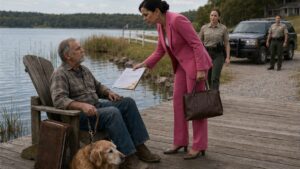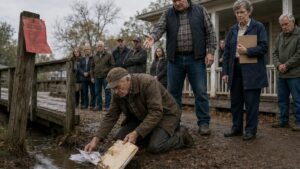
The HOA Blocked the Road to His Home—Then Learned Their Entire Cul-de-Sac Needed What Ran Beneath It
Chapter 1: The Excavator Was Sitting Across His Only Road
Benjamin Carter turned off the county road and hit the brakes so hard that a socket wrench slid off the passenger seat and struck the floor.
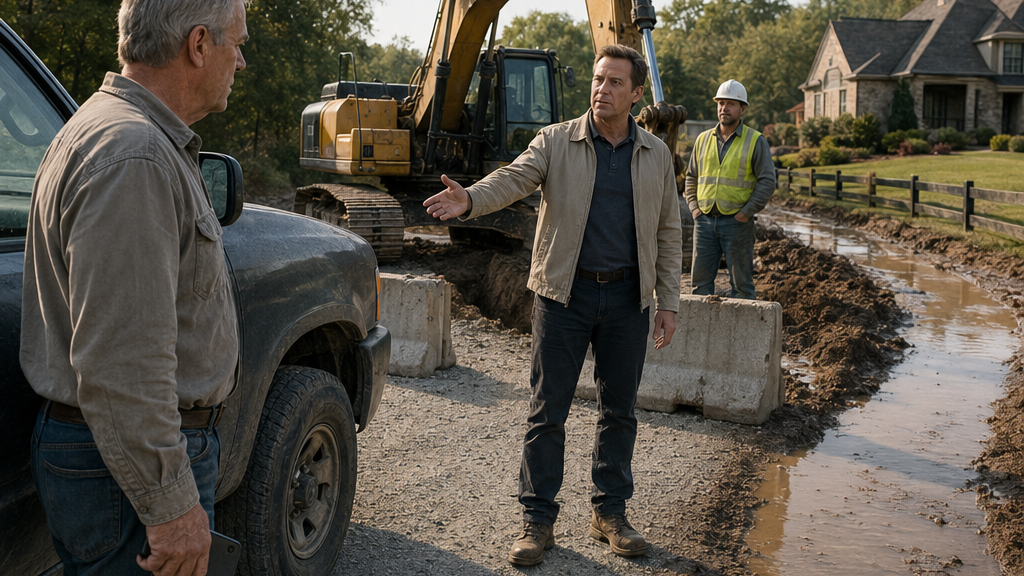
An excavator was sitting across his gravel lane.
Not beside it. Not working along the shoulder.
Across it.
Its steel tracks straddled the pale strip of crushed stone Benjamin had driven for twelve years, and its bucket rested over a fresh trench where the lane narrowed between his property and the first landscaped lot of the newer subdivision.
Two concrete barriers stood behind the machine.
Benjamin lowered his window.
The diesel engine idled heavily in the morning air.
A grading foreman in a reflective vest walked toward him, one palm raised.
“You can’t come through here.”
Benjamin looked past him toward his workshop roof, visible through the trees less than four hundred feet away.
“I live through there.”
“I know.”
That answer bothered him more than if the man had not known.
Benjamin shut off his pickup and stepped out. He was sixty-one, broad through the shoulders from decades of moving equipment that should have been lifted by two people, and he had learned long ago that anger was expensive when other men were paid by the hour.
He took out his phone.
The foreman’s expression tightened.
“You don’t need to photograph my guys.”
“I’m photographing my road.”
“It’s an HOA project.”
Benjamin took three pictures: excavator, trench, barriers.
Beyond the machine, fresh dirt had been pushed into a low ridge along the ditch. Orange stakes marked a curve that had never existed before.
A dark SUV came slowly around the cul-de-sac.
Ryan Adams got out wearing work boots that still looked new.
Ryan had been president of the homeowners association for less than two years. He lived three houses down in the newer section, where the lawns were irrigated and the mailboxes matched.
“Benjamin,” he said. “Jennifer sent notices.”
“She sent a notice about drainage work.”
“That’s what this is.”
Benjamin looked at the excavator.
“This is also my access.”
“For a few days.”
“You blocked it.”
“We’ve provided temporary access.”
Ryan pointed toward the right side of the construction area.
Benjamin followed his hand.
A strip of scraped earth curved behind a row of young maples. Tire ruts had already filled with brown water. At the far end, the temporary path dropped into a shallow swale before reconnecting with Benjamin’s lane near his workshop.
Benjamin walked three steps closer.
His boot sank nearly an inch.
He looked back at Ryan.
“You want me driving my truck through that?”
“It passed inspection for construction access.”
“My truck weighs seven thousand pounds with equipment in it.”
“The contractor says it’s usable.”
Benjamin looked at the foreman.
The foreman looked at the mud instead.
Ryan exhaled. “This drainage project has been approved for months.”
“Approved by who?”
“The board.”
“That wasn’t my question.”
Ryan’s jaw shifted.
The excavator continued idling behind them.
Benjamin pointed toward the original gravel lane.
“Did the board review the recorded easement before it approved putting a trench through here?”
For the first time, Ryan did not answer immediately.
“The subdivision plan shows this as an association maintenance corridor.”
“That’s not what I asked.”
“We have an engineer. We have a contractor. We have the approvals.”
“Did you review the easement?”
Ryan glanced toward the workers.
Benjamin understood the answer.
He had seen this kind of certainty before—not exactly in HOAs, but in shops, job sites, suppliers’ offices. A man presented a stack of paperwork, and everyone nearby began acting as though the thickness of the stack settled what was written inside it.
Ryan lowered his voice.
“Benjamin, nobody is trying to take your property.”
“You put a machine across the road to my house.”
“For drainage work.”
“Then move it long enough for me to get through.”
“We can’t keep stopping excavation every time you come and go.”
Benjamin stared at him.
The words were calm. That was what made them land badly.
Every time you come and go.
As if entering his own property had become a disruption to someone else’s schedule.
He raised his phone again and photographed the trench from another angle.
Ryan rubbed one hand along his jaw.
“What are you planning to do with those?”
“Keep them.”
“Benjamin.”
He put the phone into his shirt pocket.
“You said the temporary route is usable. I say it isn’t. You say the board can close this lane. I say there’s a recorded twenty-foot easement here. One of us should probably check before that bucket goes any deeper.”
Ryan’s face sharpened at the number.
“Twenty feet?”
Benjamin noticed.
“You didn’t know?”
“I know what’s in the subdivision documents.”
“That’s not the same thing.”
Ryan stepped closer, though not threateningly.
“We have houses that flooded twice last year. One family had water against their foundation. The association has already delayed this work once. I’m not stopping the whole project because you remember an old document differently.”
Benjamin felt his temper rise, but the mention of flooded houses slowed it.
He knew about the water. Everybody did. After hard rain, brown runoff collected along the lower end of the cul-de-sac.
That did not give Ryan the right to erase a road.
But it explained the urgency in his voice.
Benjamin looked once more at the mud.
Then he climbed back into his truck.
Ryan seemed surprised.
“You’re turning around?”
“For now.”
“We can figure this out.”
Benjamin started the engine.
“That’s what should’ve happened before the excavator got here.”
He reversed slowly until he could turn around at the county road.
By ten-thirty he had parked on the far side of his property and walked nearly half a mile around the tree line to reach his house. His boots were damp. A customer had left two welding regulators at the workshop door, and Benjamin carried them inside without opening them.
He went instead to the small office behind the workbench.
The filing cabinet stuck halfway out, as it always did.
He pulled open the bottom drawer.
Warranty papers. Tax maps. Closing documents.
He found the old deed packet inside a cracked blue folder his closing attorney had handed him twelve years earlier.
Benjamin had not opened it in years.
He spread the papers across his desk and read slowly.
The first legal description covered the parcel itself.
The second referred to ingress and egress.
Then he saw the line he remembered.
A strip twenty feet in width.
Running from the county road.
Continuing along the western boundary.
Benjamin traced the words with one grease-darkened finger until the measurements reached the back portion of his property.
Four hundred thirty feet.
He sat motionless.
Ryan had not been arguing about an informal farm track.
The association had put an excavator directly across a recorded twenty-foot easement.
And judging from Ryan’s face when Benjamin had said the number aloud, he had not known it existed.
Chapter 2: The Twenty Feet Nobody Put on the Board Map
The measurements on the old deed matched the blocked lane so precisely that Benjamin checked them twice.
Twenty feet wide.
Four hundred thirty feet long.
The description began at the same corner where the county pavement narrowed and followed almost exactly the gravel track now cut open by the HOA contractor.
Benjamin carried the folder into the workshop and laid it beside a newer neighborhood map he had received with an association notice.
The difference was obvious.
The old document showed a defined access strip.
The HOA exhibit showed a pale band labeled only as part of a broader maintenance area, with a proposed drainage line curving across it.
He photographed both.
Then he drove to the county records office.
The clerk behind the counter took the recording number Benjamin had copied from his deed packet and disappeared into a back room.
When she returned, she brought up scanned pages on a monitor.
Benjamin leaned forward.
There it was again.
The easement had not vanished.
It had been referenced in later transfers, including the sale of the land that eventually became the subdivision.
“So this is still in the chain?” he asked.
The clerk kept her voice careful.
“I can tell you it appears in the recorded instruments. I can’t give you a legal opinion about what rights it creates today.”
“I’m not asking you to.”
She printed the relevant pages.
Benjamin paid the copy fee and folded the receipt into the blue folder.
Outside, he stood beside his pickup for a moment.
He should have felt relieved.
Instead, the confirmation made him angrier.
The association had not merely interpreted an unclear line differently. Someone had built a project packet without including a document recorded against the land beneath it.
By early afternoon he was in the property-management office.
Jennifer Harris met him in a small conference room with a glass wall and a table too polished for the stack of dusty county copies Benjamin placed on it.
She had emailed the original project notice three weeks earlier.
At the time, Benjamin had skimmed it, seen “drainage improvements,” and deleted it.
Jennifer adjusted her glasses and read the first page.
Then the second.
Her expression changed.
“Where did you get this?”
“County recorder.”
“I mean this specific easement.”
“My closing file.”
She turned the page sideways to compare the plat.
Benjamin slid the HOA exhibit toward her.
“Show me where my twenty feet went.”
Jennifer did not answer immediately.
She pulled a laptop closer and opened a project folder.
The screen showed engineering plans, board minutes, contractor bids, drainage calculations and a newer subdivision exhibit.
She scrolled.
Then scrolled again.
Benjamin watched her face.
“You don’t have it.”
“We have the recorded subdivision plat.”
“That isn’t what I said.”
“No.” Jennifer sat back. “I don’t see this older instrument in the board packet.”
The admission gave Benjamin a small, sharp satisfaction.
It lasted only a second.
Jennifer tapped the old legal description.
“This does not automatically tell us the scope of the association’s rights or whether temporary construction can cross it.”
“I didn’t say it did.”
“You’re asking us to stop active work.”
“I’m asking why active work started without this being reviewed.”
Jennifer folded her hands.
“That’s fair.”
The words surprised him.
Then she added, “But I cannot personally stop the contractor.”
Benjamin’s jaw tightened again.
“The road is blocked today.”
“I understand.”
“No, you understand it on paper. My truck is parked on the wrong side of my property because I had to walk around.”
Jennifer looked at the photographs on his phone.
The excavator.
The trench.
The muddy temporary route.
Her attention paused on the standing water.
“That was represented as all-weather temporary access.”
“It isn’t.”
“I’ll send this to the board and association counsel.”
“When?”
“Today.”
“And the machine?”
“I’ll request that they maintain access if the site can be made safe.”
Benjamin gave a humorless laugh.
“If?”
“I’m not trying to argue with you.”
“It’s my recorded access.”
“And I’m telling you the board approved a drainage project under documents they believed were complete.”
“They believed wrong.”
“Yes.”
Again, the directness took some heat out of him.
Jennifer closed the laptop halfway.
“Benjamin, can I ask something?”
He waited.
“Did you ever provide this easement to the association before today?”
“No.”
“Was there a request?”
He remembered several emails about drainage planning. He had not read most of them closely.
“The association has access to county records.”
“That’s not quite an answer.”
Benjamin felt the muscles in his shoulders stiffen.
“My deed isn’t a secret.”
Jennifer let the silence sit.
Then she said, “I’m not blaming you. I’m trying to understand how this was missed.”
“Start with whoever made the map.”
She nodded once.
“I will.”
He gathered his documents.
As he reached the door, Jennifer said, “Construction probably will not stop this afternoon unless the board or counsel directs it.”
Benjamin turned.
“So you know your file is incomplete, and they keep digging?”
“I know a document is missing from our packet. I don’t yet know what that requires legally.”
He looked through the glass wall toward the office lobby.
There were framed photos of landscaped entrances, clean sidewalks, retention ponds. Everything an association liked to show after problems were solved.
“All right,” he said.
Jennifer seemed to expect more.
Benjamin simply left.
At home, he spent the rest of the afternoon moving customer work he could reach without bringing his truck to the shop.
At five-twenty, his phone rang.
The caller ID showed the propane company.
Benjamin answered while standing beside the workshop tank.
The gauge was lower than he liked.
“Mr. Carter? We’re confirming your delivery tomorrow morning.”
“Yes.”
“Driver should be there between eight and ten.”
Benjamin looked toward the gravel road.
From where he stood, he could see the top of the excavator beyond the trees.
“Tell him not to take any detour unless he’s comfortable with it.”
There was a pause.
“Detour?”
Benjamin stared at the blocked lane.
“Apparently I have one now.”
Chapter 3: The Delivery Truck Refused the Muddy Detour
The propane truck made it as far as the trench.
Then the driver stopped.
Benjamin was already waiting on foot beside the concrete barriers when the white delivery truck came down the county road just after eight-thirty Tuesday morning.
The driver rolled forward, studied the excavator and the gap beside it, then climbed down.
“That where you need me?”
Benjamin pointed beyond the construction zone.
“Tank’s behind the workshop.”
The driver looked at the temporary path.
Mud filled both wheel ruts. A patch of standing water reflected the orange survey stakes.
“You been driving that?”
“No.”
The driver walked to the edge, pressed one boot into the soft ground, and shook his head.
“I’m not taking twenty thousand pounds through there.”
The grading foreman approached from beside the excavator.
“It’s compacted.”
The driver looked at him.
“Then somebody forgot to tell the top six inches.”
“We had equipment over it yesterday.”
“Tracked equipment?”
The foreman did not answer.
The driver crouched, took a photograph of the deepest rut with his phone, then another showing the slope down toward the swale.
“I can’t risk the truck. If I sink or lean with product on board, that’s my license and my company’s problem.”
Benjamin felt something inside him settle.
Not satisfaction exactly.
Confirmation.
The alternate route was not unusable because he was being difficult. A man with no interest in their dispute had reached the same conclusion in less than two minutes.
Ryan’s SUV pulled up at nine.
He got out faster than he had the day before.
“Why is the truck stopped?”
The driver answered before Benjamin could.
“I’m not taking it across that.”
Ryan studied the mud.
“The contractor said this route was suitable.”
“For pickups, maybe. Not mine.”
Ryan looked at Benjamin.
“Did you tell him not to use it?”
Benjamin’s temper rose so quickly that he had to pause before speaking.
“I told him to use his judgment.”
“This is exactly the kind of escalation we don’t need.”
The driver glanced between them.
Benjamin said, “He drove here to deliver propane, Ryan. He’s not part of your board meeting.”
Ryan lowered his voice.
“The temporary access is there. You’re choosing not to use it.”
The driver gave a short laugh.
“I’m choosing not to roll my truck into a ditch.”
Ryan’s face reddened.
“That’s not what I meant.”
Benjamin stepped toward the original gravel lane.
“Move one barrier and let him through.”
“We can’t.”
“Why?”
“The trench is open.”
“Then plate it.”
“The contractor isn’t scheduled to plate that section until later.”
“So your plan is to block the safe road before the unsafe road is usable.”
Ryan’s gaze hardened.
“This is temporary inconvenience.”
Benjamin looked at the propane truck.
“My tank doesn’t run on inconvenience.”
“You have enough propane for a few days.”
“You checking my gauges now?”
“No. I’m saying nobody is depriving you of essential service.”
“The driver is standing here telling you he can’t reach the tank.”
Ryan rubbed the bridge of his nose.
“There’s a process for disputes.”
“I started it yesterday.”
“And Jennifer sent your documents to counsel.”
“While you kept digging.”
“We cannot shut down a contracted project every time somebody produces a document that needs review.”
Benjamin stepped closer.
“Somebody?”
Ryan immediately seemed to regret the word.
Benjamin pointed toward the gravel beneath their feet.
“That document describes this road by width and distance. It predates your subdivision. Your own manager told me it wasn’t in the packet.”
“I know.”
That stopped Benjamin.
“You know?”
“Jennifer called me last night.”
“And you still opened the trench this morning.”
Ryan glanced toward the houses.
“Because the stormwater work is already mobilized. Because we have a forecast window. Because people at the bottom of this hill have had water in their yards twice in twelve months.”
The anger in Ryan’s face changed shape.
It was not merely authority now.
It was fear of being blamed.
He pointed toward the cul-de-sac.
“You know what I heard all winter? Why didn’t the board fix it? Why are we paying dues? Why did we approve another assessment if nothing gets done? We finally get a contractor scheduled, and now you’re telling me everything stops.”
“I’m telling you you can’t block my access while you figure out whether you were allowed to.”
Ryan opened his mouth, then closed it.
The propane driver shifted his weight.
“I’m going to mark this delivery inaccessible,” he said.
Benjamin turned.
“When can you come back?”
“Once I’ve got a safe route.”
He held up his phone.
“I’ll attach these photos to the service note.”
Ryan looked at the screen.
“You don’t need to do that.”
“Yes, I do,” the driver said. “If dispatch asks why I brought the load back, I need to show them.”
The small exchange struck Benjamin harder than Ryan’s arguments.
A record.
Not anger.
Not interpretation.
A record.
The driver climbed into the cab.
The truck reversed slowly toward the county road.
Benjamin watched it disappear.
A simple delivery had become evidence that his property could no longer be reliably reached.
He faced Ryan.
“If that had been an ambulance-sized vehicle, would you call it temporary inconvenience?”
“That’s not fair.”
“Neither is guessing.”
Ryan looked tired now.
“Give us until tomorrow.”
“No.”
“Benjamin.”
“I gave you yesterday.”
“What are you going to do?”
Benjamin took his phone from his pocket.
“Formal notice first. Emergency relief if I need it.”
Ryan stared at him.
“You’re going to take the HOA to court over forty-eight hours of construction?”
“I’m going to stop you treating my access like it belongs to you.”
Ryan reached into his SUV and brought out a folded sheet.
“There’s another option.”
He handed it over.
The document proposed temporary access permission through the muddy route and stated that Benjamin accepted the alternative during construction.
Benjamin read it twice.
“Sign this and you’ll improve the detour?”
“We’ll prioritize stone.”
“This says I accept it as temporary substitute access.”
“For the project duration.”
Benjamin folded the paper and handed it back.
“No.”
Ryan’s expression closed.
“Of course not.”
“What’s that supposed to mean?”
“It means you’ve decided this is about winning.”
Benjamin nearly answered.
Then he stopped because part of him recognized something uncomfortable in the accusation.
He still said, “It’s about the road.”
Ryan walked back toward the workers.
The disagreement had moved beyond confusion now.
They were both choosing positions.
Near noon, Benjamin walked back toward his workshop carrying the printed service note the propane driver had emailed him.
Linda Walker was waiting near the boundary fence.
She held an envelope.
“I heard about the truck.”
Benjamin kept walking.
“If you came to tell me Ryan’s doing his best, save it.”
“I didn’t.”
That made him stop.
Linda was the HOA treasurer. She rarely raised her voice at meetings and rarely spoke unless numbers were involved.
She held out the envelope.
Benjamin recognized the association logo.
“What is that?”
“Something you should look at before you decide Ryan created this whole mess by himself.”
He did not take it.
Linda’s mouth tightened.
“You should know Ryan asked you to walk that site months ago.”
Benjamin looked at the envelope again.
Then he remembered it.
A letter he had opened at the workshop, skimmed halfway through, and thrown into a pile because it asked him to meet an engineer and two board members on the edge of his property.
At the time, he had seen only one thing in it: another attempt by the HOA to involve itself where it did not belong.
Linda held the invitation between them.
“You never came,” she said.
Chapter 4: The Meeting Benjamin Chose Not to Attend
Linda kept the envelope extended until Benjamin finally took it.
The paper had been opened once and folded again. His own name was visible through the window.
He recognized the date before he read anything else.
Six weeks earlier.
“Joint site walkthrough,” Linda said. “You, Ryan, the engineer, and me.”
Benjamin unfolded the letter.
The language was ordinary enough: drainage assessment, boundary conditions, existing access, utility coordination.
At the bottom was a proposed Tuesday morning meeting.
He remembered throwing it onto the corner of his workbench.
“I saw this.”
“I know.”
“You keeping track of my mail now?”
“No. Jennifer sent copies to the board because you never responded.”
Benjamin refolded it.
“I didn’t need to walk my own road with an HOA committee.”
Linda’s expression did not change.
“That right there is part of the problem.”
He looked at her.
She leaned one arm against the fence post.
“I’m not saying Ryan had the right to close your access.”
“Good.”
“I’m saying you decided what the meeting was before you went to it.”
“I didn’t go.”
“Exactly.”
The words landed harder than Benjamin wanted them to.
He looked toward the construction area. The propane truck was gone. The excavator had started again, its bucket moving dirt on the far side of the trench.
Linda watched it too.
“Those houses at the bottom of the hill flooded twice last year,” she said.
“I know.”
“One yard lost half its landscaping. Another had water against the crawl-space vents. We spent nearly fourteen thousand dollars pumping and repairing the swale after the second storm.”
Benjamin frowned.
“Fourteen?”
“I’m the treasurer.”
She opened a folder she had been carrying under her arm and showed him a photocopied summary.
Reserve balance.
Emergency repairs.
Engineering deposit.
Contractor mobilization.
The numbers were not dramatic individually. Together, they told a story Benjamin had not bothered to learn.
“Another heavy season without a fix,” Linda said, “and we were looking at another assessment. Maybe two.”
“So Ryan panicked.”
“Ryan pushed.”
“Same thing.”
“Sometimes.”
Benjamin handed the page back.
Linda hesitated.
“There’s something else.”
He waited.
“At the meeting where we approved the project, Jennifer asked whether title review was complete.”
Benjamin’s eyes narrowed.
“And?”
“Ryan said the engineer had the current subdivision documents and that we couldn’t keep reopening old property questions.”
“Meaning no.”
“Meaning he didn’t have your easement in front of him.”
Benjamin felt the anger return, cleaner now.
“He knew there was a question.”
“He knew there might be older rights along the edge.”
“And he approved the work.”
“Yes.”
“Why didn’t you stop him?”
Linda looked toward her own house across the cul-de-sac.
“Because I was watching the reserve balance drop. Because people were angry. Because the contractor said if we lost this slot, we might wait another eight weeks.”
“That doesn’t make it right.”
“No.”
Her answer came without defense.
“I voted yes.”
Benjamin looked at her.
“So you’re telling me I should’ve shown up, but you signed off anyway.”
“I’m telling you both things are true.”
That irritated him because it was harder to dismiss.
Linda folded the financial sheet and put it away.
“Ryan should have paused. You should have come. Jennifer should have verified the old records. I should have asked more questions before voting.”
Benjamin stared at the mud where the temporary route crossed the swale.
For two days he had been able to arrange the problem neatly: their machine, his road; their mistake, his document.
Linda had just made the edges less clean.
“You think if I’d walked the site, none of this happens?”
“I think you would’ve pointed at that lane and said, ‘There’s a recorded easement here.’ And Ryan would’ve had to deal with it before a machine showed up.”
Benjamin said nothing.
Months earlier, he had made himself a rule after watching an older neighbor slowly lose control over a shared farm entrance. It had started with favors—one truck, one storage area, one widened turn—and ended with arguments about what everybody had “always” been allowed to do.
Benjamin had decided then that ambiguity was how ownership got worn down.
So when the HOA asked for a walkthrough, he had seen the request as the beginning of another ambiguity.
He had never considered that refusing to speak could create a different one.
Linda stepped away from the fence.
“I’m not asking you to let them take your road.”
“They couldn’t.”
“You know what I mean.”
She started toward home, then turned.
“Ryan’s wrong about this, Benjamin. But if you go after him thinking he’s the only one who made a bad decision, you’re going to miss what actually happened.”
He watched her leave.
By midafternoon, Benjamin was back at the county records office.
This time he asked for every referenced instrument attached to the original easement.
The clerk brought up the index.
“There are several,” she said.
“Print all of them.”
At home that evening, he spread the pages across his kitchen table.
The old plat sat beside the newer HOA exhibit.
For the first time, he did not look only at the twenty-foot strip.
He looked at everything around it.
Drainage arrows.
Boundary bearings.
Old parcel numbers.
References written in type so faded that several characters looked incomplete.
He found one notation near the bottom of the original plat.
It was not part of the ingress-and-egress language.
A separate recording reference sat beside the same corridor.
Benjamin leaned closer.
He went back through the printed instruments.
The first concerned access.
The second concerned maintenance.
The third was older than the subdivision itself.
He unfolded it.
Near the top, in faded type, were the words “utility easement.”
Benjamin stopped.
He read the line beneath it.
Then he looked at the map again.
The utility reference followed the same narrow strip of ground Ryan’s contractor had cut open that morning.
Chapter 5: The Water Line Under the Road Changed Everything
The faded utility document did not mention the HOA because the HOA had not existed when it was recorded.
It mentioned a water line.
Benjamin sat at the kitchen table with the page under the brightest light he had.
The legal description began near the county road, followed the western boundary, and continued beneath almost the same corridor as his access easement.
He read it again.
Then a third time.
The language granted installation, inspection, repair, replacement, and access rights to a utility provider and its successors.
Benjamin’s first reaction was almost satisfaction.
His second was unease.
He pulled the newer subdivision map closer.
The cul-de-sac had twelve homes.
A blue line on one engineering exhibit entered near the subdivision entrance, disappeared beneath the road, then reappeared at a valve symbol near the far end.
It seemed to cross the same area the excavator had opened.
Benjamin took photographs, then called the water utility’s service number.
The woman who answered would not discuss easement interpretation.
“I’m not asking you to tell me who owns what,” Benjamin said. “I’m asking whether one of your mains runs through an active excavation.”
That changed the conversation.
He was transferred twice.
A field supervisor eventually took the recording reference and parcel location.
“Do you see exposed pipe?” the supervisor asked.
“No.”
“Broken marker?”
“No.”
“How close are they digging?”
“I can’t tell you exactly. They’ve got a trench cutting through the corridor.”
“Any utility locate flags?”
Benjamin thought about the orange construction stakes.
“No utility flags that I recognize.”
The supervisor became quiet.
“Don’t touch anything. Don’t enter the excavation. I’ll pull our mapping.”
Benjamin almost laughed.
“I wasn’t planning to climb into their trench.”
“I have to say it.”
“Fair enough.”
The supervisor called back forty minutes later.
“We do show a distribution main in that area.”
“Serving what?”
“I can’t verify every connection over the phone, but it feeds that residential branch.”
“The cul-de-sac?”
“Yes.”
Benjamin looked through his kitchen window toward the trees hiding the newer homes.
“How close can they excavate?”
“That depends on depth, material, shoring, and what they’re doing. I’m sending somebody in the morning.”
“I have a copy of the original easement.”
“Bring it.”
Benjamin ended the call.
For the first time since seeing the excavator, he had something Ryan did not merely have to argue about.
The neighborhood depended on what lay beneath the disputed ground.
The thought carried a temptation with it.
He could call Ryan now.
He could say, You blocked my road and nearly dug into your own water supply.
He could let the humiliation do some work.
Benjamin picked up the phone.
Then put it down.
Linda’s words from that afternoon stayed with him.
Both things are true.
He did not owe Ryan protection from consequences.
But twelve households were not Ryan.
At seven-thirty Wednesday morning, the utility truck arrived before the contractor.
The field supervisor stepped out carrying a tablet and a locating receiver. A second worker unspooled marking paint and small flags.
Benjamin met them at the county road with the old document in a plastic sleeve.
The supervisor read the recording information and compared it to the utility map.
“This is useful.”
“So the line’s here?”
“We’re going to locate it.”
They worked slowly.
The receiver chirped as the supervisor crossed the gravel lane.
A mark went down.
Then another.
The path continued toward the trench.
Benjamin followed from several feet away.
Near the excavator, the supervisor stopped.
He looked at the ground.
Then at his tablet.
“How deep did they go here?”
“Started yesterday.”
“That’s not what I asked.”
Benjamin looked into the trench.
“Maybe four feet at the deepest point.”
The supervisor called the other worker over.
More locating passes followed.
Within twenty minutes, blue utility flags formed a line beneath the old gravel road.
They continued straight toward the HOA homes.
The excavator operator arrived and shut his truck door.
He stared at the flags.
“What’s going on?”
The supervisor answered without looking up.
“Water line.”
The operator frowned.
“We had locates.”
“Show me.”
The grading foreman appeared next.
Then Ryan.
By eight-fifteen, five men were standing around the trench.
The supervisor pointed to the blue marks.
“Our mapping puts the main inside this corridor.”
Ryan looked at Benjamin.
“You called them?”
Benjamin ignored the tone.
“I found a recorded utility easement.”
Ryan looked back at the supervisor.
“Is there a problem?”
“Possibly.”
“We’re installing drainage. We’re not touching the water main.”
“Maybe not. But your excavation footprint is closer than what I’m comfortable clearing without depth verification.”
The foreman spoke up.
“We’re outside the marked line.”
“Now you have a marked line.”
A silence followed.
The distinction was brutal in its simplicity.
Ryan removed his sunglasses.
“What happens?”
“We verify depth and clearance. Until then, no digging in this section.”
The excavator operator looked at the foreman.
The foreman looked at Ryan.
Ryan’s attention returned to Benjamin.
“This is because of the easement dispute.”
The supervisor shook his head.
“This is because there’s a water main.”
Ryan’s face hardened.
“You understand this project is supposed to correct runoff problems?”
“I’m not reviewing your drainage project.”
“So you’re shutting it down?”
“I’m shutting down excavation near our line until we know what’s happening.”
“Same result.”
The supervisor looked at him evenly.
“Then I suggest you get the information quickly.”
Benjamin felt the old instinct for vindication rise.
He had been right.
Ryan had missed something larger than the road.
But the blue flags kept going past the trench toward the houses.
Linda’s house.
The lower lots.
The homes that had flooded.
Benjamin stared at them.
If the line was damaged, Ryan would not be the only person dealing with it.
The field supervisor came beside him.
“This document you found—keep a copy available. Easement language and actual utility location aren’t always identical, but it helps.”
“So this doesn’t settle my road.”
“No. Different issue.”
Benjamin nodded.
That mattered.
There would be no magical moment where one old page solved every question.
“But if the main is inside that easement?”
“Then our rights need to be respected too.”
The contractor began moving equipment away from the trench.
The excavator stayed where it was, suddenly quiet.
The machine looked different without its engine running.
Less like authority.
More like something waiting for permission.
Benjamin returned to his kitchen and spread the papers out again.
He drafted a timeline.
Monday: access blocked.
Monday afternoon: recorded ingress-and-egress easement confirmed.
Tuesday: propane delivery refused.
Wednesday: utility location confirmed inside disputed corridor.
He attached photographs.
He called the HOA’s management office and asked Jennifer for the contact information for association counsel.
Then he called the civil courthouse and asked what paperwork was required to request emergency relief protecting access while an easement dispute was reviewed.
He was writing down filing hours when his phone vibrated.
Ryan.
Benjamin let it ring twice.
Then answered.
Ryan did not say hello.
“What exactly have you done?”
Chapter 6: By Morning the HOA Had Lost Control of the Site
Benjamin was at the civil courthouse before the contractor’s concrete trucks reached the subdivision.
He knew because the grading foreman had mentioned the scheduled pour the previous afternoon, and because Benjamin had no intention of letting another phase of work make the disputed corridor harder to restore.
The courthouse clerk reviewed his papers through the opening beneath a glass partition.
“You’re requesting temporary access relief?”
“Yes.”
“And there’s ongoing construction?”
“Yes.”
“Do you have photographs?”
Benjamin slid them forward.
Excavator across the lane.
Concrete barriers.
Open trench.
Muddy detour.
The propane truck stopped at the work zone.
Blue utility flags tracing the buried main.
He added certified copies of the recorded access easement and the utility document.
The clerk did not react to the substance.
She simply checked whether the forms were complete.
Benjamin appreciated that.
No speeches.
No assumptions.
A process.
By nine-thirty, the request had moved faster than he expected, largely because the obstruction was active and documented. The initial relief was narrow: preserve practical access while the rights of the parties were evaluated, and do not expand excavation within the disputed corridor contrary to utility restrictions.
It did not declare Benjamin the final winner.
It did not cancel the HOA project.
It did not decide every legal interpretation.
It did something more immediate.
It required the road to function again.
Jennifer called while Benjamin was driving back.
“The board received notice.”
“So did I.”
“Ryan is at the site.”
“I assumed.”
“He’s angry.”
“That’s becoming familiar.”
Jennifer paused.
“Benjamin, the association attorney is advising compliance with the temporary order.”
“Good.”
“They’re also saying this does not resolve the underlying easement interpretation.”
“I know.”
Another pause.
“You sound disappointed.”
“I’m not.”
And he realized he meant it.
He wanted access.
He wanted the digging stopped where it threatened the utility corridor.
He did not need a judge to tell him Ryan was a bad person.
When Benjamin reached the lane, a sheriff’s deputy stood beside one of the concrete barriers.
Two workers were attaching a chain to drag it aside.
The excavator had been backed away from the center of the road.
For the first time since Monday morning, a vehicle-width opening existed along the original gravel path.
Ryan stood near his SUV.
He watched Benjamin get out.
“You couldn’t give us one more day.”
Benjamin looked at the workers opening the passage.
“I gave you two.”
“Counsel was reviewing it.”
“While the road stayed closed.”
Ryan walked closer.
“You think this is over?”
“No.”
The answer stopped him.
Benjamin pointed toward the blue utility flags.
“I think it got bigger.”
The deputy approached and calmly explained the practical terms of the order. The original access had to remain passable. Construction could continue elsewhere if allowed. Nobody was to interfere with utility personnel.
Ryan listened without interrupting.
When the deputy moved away, Benjamin said, “Why didn’t you tell the full board the easement question wasn’t resolved?”
Ryan’s expression changed.
Jennifer had apparently said more than Benjamin expected.
“Who told you that?”
“Does it matter?”
“Yes.”
“Then I’ll assume it’s true.”
Ryan looked toward the lower houses.
For several seconds he said nothing.
Finally, “The engineer flagged an old access reference.”
Benjamin waited.
“It wasn’t clear on the current exhibit. Jennifer wanted a title review.”
“And you?”
“I said we had enough to proceed.”
“Why?”
Ryan laughed once, without humor.
“You want the board-president answer?”
“I want the real one.”
Ryan looked tired.
“Because every time it rained, I got calls. Because the family on the corner had water under their house. Because the first contractor backed out. Because the reserve fund was dropping. Because we finally got a crew that could start before the next weather cycle.”
“So you gambled with my road.”
“I thought temporary access solved it.”
“You didn’t look at it.”
“I saw the plan.”
“That mud isn’t a plan.”
Ryan’s mouth tightened.
“No.”
It was the first clean concession Benjamin had heard from him.
Ryan rubbed both hands over his face.
“If I’d taken this back to the board for another thirty-day title review, the contractor would’ve left.”
“That doesn’t give you authority you don’t have.”
“I know that now.”
“Did you know it Monday?”
Ryan looked directly at him.
“I knew there was uncertainty.”
Benjamin felt something colder than anger.
“That’s worse.”
Ryan did not argue.
A utility truck arrived before either man spoke again.
The field supervisor walked toward the trench with depth-locating equipment.
The contractor joined him.
Within half an hour, they had exposed a small section by hand at a safer point and confirmed the main’s position.
The field supervisor called Benjamin and Ryan over.
“The pipe itself appears intact.”
Ryan exhaled.
“But,” the supervisor continued, “your current drainage cut does not maintain the clearance we want for this installation.”
The foreman frowned.
“We haven’t hit it.”
“That is not the same as compliant clearance.”
“Can we finish around it?”
“Not according to this layout.”
Ryan stared at the engineering sheets.
“What does that mean?”
“It means redesign this section.”
The words changed the entire morning.
The road had been reopened.
Benjamin had his immediate relief.
Yet there was no simple return to the plan that existed before Monday.
The drainage work genuinely needed to happen.
The utility line genuinely needed protection.
Benjamin’s access genuinely had to remain usable.
Three real needs occupied the same narrow strip of land.
Jennifer arrived shortly before noon with the association attorney.
They stood beside the open passage while workers covered exposed areas and placed temporary stone.
The attorney spoke carefully.
“The association is prepared to maintain access under the order while we review the recorded instruments.”
Benjamin nodded.
Ryan said, “And the drainage?”
“Will require revised engineering.”
Ryan looked toward the houses.
“How long?”
“That depends.”
He swore under his breath, then caught himself.
Benjamin almost enjoyed it.
Then he saw Linda standing at the far end of the cul-de-sac beside one of the homeowners from the low lots.
They were looking toward the unfinished drainage trench.
Not at Benjamin.
At the water that would come with the next hard rain.
The feeling of victory thinned.
Jennifer stepped beside him.
“You got the road open.”
“Temporarily.”
“Yes.”
Benjamin looked at the gravel beneath his boots.
For two days he had thought the clean ending would be simple: prove the easement, reopen the lane, make the HOA retreat.
Now the road itself had become evidence that the problem could not be solved by retreat.
“What would a redesign take?” he asked.
Jennifer looked surprised.
“You mean technically?”
“Technically, legally, all of it.”
“The engineer needs to shift part of the drainage alignment. The utility needs clearance. Your access width has to be preserved.”
“And if that costs more?”
“The HOA pays more.”
Ryan heard that.
“We don’t have unlimited money.”
Benjamin turned toward him.
“I didn’t say you did.”
Ryan studied him cautiously.
“What are you saying?”
Benjamin did not answer immediately.
He had spent years believing that the safest boundary was one nobody else ever crossed.
But there was already a water line under this one.
There was drainage beside it.
There were twelve houses uphill and downhill from decisions made before some of them had even been built.
The question was no longer whether other people would touch the corridor.
They already depended on it.
The question was under what rules.
Jennifer said, “There’s going to be an emergency board meeting.”
“When?”
“Tomorrow evening if counsel can get everyone.”
Benjamin looked at the temporary stone workers were spreading over his lane.
“I’ll come.”
Ryan raised his eyebrows.
Benjamin met his gaze.
“But the old easement goes on the table.”
Ryan said nothing.
“Not summarized,” Benjamin continued. “Not mentioned in somebody’s notes. Put the recorded plat beside the new engineering plan so everybody can see both.”
Jennifer nodded.
“That’s reasonable.”
Benjamin looked again toward the blue utility flags.
“And put the utility map there too.”
Ryan’s shoulders lowered slightly.
For the first time, neither man was arguing about who controlled the road.
They were looking at what the road actually carried.
Benjamin picked up his folder.
“I’ll be at the meeting,” he said.
Then he looked at Ryan.
“This time, I’ll show up.”
Chapter 7: The New Agreement Followed the Old Gravel Line
Two maps lay side by side on the folding table when Benjamin entered the HOA meeting room.
The newer engineering plan was bright, clean, and easy to understand. Blue arrows showed stormwater flow. Gray lines marked the proposed drainage trench. A neat curve carried the project through the edge of the subdivision.
Beside it sat Benjamin’s older plat.
Its paper was yellowed. Its lines were thin. The recording stamps were crooked.
But the twenty-foot access strip was unmistakable.
Jennifer had also placed the utility map beside both of them.
Three documents.
Three different reasons the same narrow piece of ground mattered.
Ryan was already seated at the far end of the table. Linda sat with the association’s financial papers in front of her. Two other homeowners occupied chairs against the wall. One of them lived in the lower section where the flooding had been worst.
Benjamin took the empty chair nearest the maps.
No one spoke for several seconds.
Then Jennifer said, “We have revised information from the engineer.”
She turned the new plan toward the board.
“The drainage project can be shifted east through this section. It preserves the recorded access width and maintains the utility clearance required by the water provider.”
Ryan leaned forward.
“What does shifting it cost?”
Linda answered before Jennifer could.
“About eighteen thousand more than the approved contract.”
The room tightened.
Ryan looked at her.
“That much?”
“Additional excavation, new pipe alignment, extra stone, and contractor remobilization.”
One of the homeowners against the wall let out a slow breath.
Benjamin looked at the revised drawing.
The new drainage line no longer crossed the center of his gravel road. Instead, it ran beside it, squeezed between the access strip and the landscaped edge of the subdivision.
It was not elegant.
But it worked.
Ryan tapped the plan.
“And the schedule?”
“Roughly two additional weeks,” Jennifer said. “Assuming the utility signs off.”
Ryan leaned back.
“The lower lots could flood again before then.”
The homeowner near the wall said quietly, “They could flood if we don’t do anything right too.”
Ryan glanced over.
There was no anger in the remark.
That made it harder to dismiss.
Jennifer continued.
“The association attorney also recommends a new procedure for any future project affecting recorded easements or parcels predating the subdivision. Title review before final board approval. Not afterward.”
Ryan gave a short nod.
Benjamin watched him.
A week earlier, Ryan would have challenged the wording.
Now he simply said, “That makes sense.”
Linda opened a second document.
“There’s also a proposed shared-maintenance agreement for the corridor.”
Benjamin’s attention sharpened.
“Shared how?”
Jennifer slid a copy toward him.
“The HOA would acknowledge your recorded access rights and agree not to block the corridor without advance written coordination except for an actual emergency.”
Benjamin read the first page.
“And the other side?”
“The utility already has its recorded rights. The HOA is asking for limited maintenance access where the drainage feature runs beside your easement.”
Benjamin looked up.
“How limited?”
Jennifer pointed to the next paragraph.
“Scheduled access with notice. Specific purpose. No storage. No parking equipment overnight. No widening. No permanent surface changes without written agreement.”
Ryan said, “It also means if the drainage inlet needs cleaning, we don’t have to argue about whether a maintenance truck can get close enough to do it.”
Benjamin looked at him.
“You asking me now?”
Ryan’s expression tightened slightly.
“Yes.”
The answer carried more weight than Benjamin expected.
For years, Benjamin had treated requests near his property line like tests.
A gate left open once became permission.
A truck turning around twice became a routine.
A routine became a claim.
That fear had kept his boundaries clear.
It had also kept him out of a meeting that might have prevented the excavator, the blocked propane delivery, and half the damage now sitting in front of them as extra cost.
He looked again at the agreement.
One sentence bothered him.
He pointed to it.
“This says reasonable access as needed.”
Jennifer nodded.
“Too broad?”
“Yes.”
Ryan started to speak, then stopped.
Jennifer uncapped a pen.
“What do you want instead?”
Benjamin thought for a moment.
“Scheduled maintenance access for the drainage system only. Written notice unless there’s an emergency. And define emergency.”
The HOA attorney, sitting near the end of the table, wrote something down.
Ryan said, “What about inspection?”
“Include inspection.”
“And storm preparation?”
“If you give notice.”
“What if a major storm comes in overnight?”
“Then that’s probably the emergency you’re trying to define.”
Linda looked between them.
“That sounds workable.”
Benjamin read another paragraph.
“The HOA repairs any damage to the gravel caused by its maintenance vehicles.”
“Yes,” Jennifer said.
“And the access stays passable during planned work.”
“Yes.”
He tapped the page.
“Then put the minimum width in writing.”
Ryan looked at the old plat.
“Twenty feet?”
Benjamin shook his head.
“The easement is twenty. I’m talking about passable vehicle width during work.”
The engineer had recommended twelve feet.
Jennifer wrote it down.
For the next forty minutes, they did something none of them had done before the project began.
They discussed the corridor as if every use of it had to coexist with the others.
Not as Benjamin’s road alone.
Not as HOA maintenance space alone.
Not as an invisible utility strip alone.
The argument became smaller as the language became more precise.
Where equipment could stand.
How much notice was required.
Who restored gravel.
Who paid for drainage maintenance.
Who called the utility before excavation.
What happened if emergency work temporarily narrowed the lane.
At one point Ryan pushed back on a requirement for forty-eight hours’ notice.
Benjamin looked at him.
“You wanted me at the walkthrough.”
Ryan understood.
“And now you want notice.”
“Yes.”
Ryan considered it.
Then nodded.
“Fair.”
Linda moved to the budget.
The redesign would require reserve funds and a smaller special assessment than the board had feared if they delayed the entire project until another season.
Nobody liked the number.
But the homeowner from the lower lot said, “I’d rather pay for the right fix than pay twice because we rushed the first one.”
Ryan looked down at his papers.
Then he said something Benjamin did not expect.
“This was rushed.”
The room went quiet.
Ryan folded his hands.
“The board approved the project without complete title review. I knew the old access issue wasn’t resolved.”
He looked at Benjamin.
“I thought the temporary route would get us through construction.”
“It didn’t,” Benjamin said.
“No.”
Ryan nodded.
“That part is on me.”
There was no apology speech.
No dramatic silence afterward.
Jennifer simply wrote the acknowledgment into the meeting record.
That somehow made it more meaningful.
Benjamin looked at the old map.
“My part,” he said, “is I was invited to the walkthrough.”
Linda looked up.
Benjamin continued.
“I decided I knew what the meeting was going to be before I went. So I didn’t go.”
Ryan’s expression changed slightly.
Benjamin did not soften the rest.
“That doesn’t make blocking the road acceptable.”
“I know.”
“But I should have shown up.”
Linda gave one small nod.
By the end of the meeting, the board approved the redesign, the revised document-review policy, and the terms for a recorded maintenance agreement subject to final legal wording.
A week later, fresh gravel covered the disturbed section of Benjamin’s lane.
The excavator was gone.
The concrete barriers were gone.
A narrow drainage channel now ran beside the access rather than through it.
Blue utility markers stood at intervals along the edge.
Benjamin stopped his pickup near the old rusted survey pin.
The pin had been uncovered during the work and left visible inside a small protective ring.
He got out.
Ryan was standing farther down the lane with Jennifer, looking at the finished drainage inlet.
When he saw Benjamin, he walked over.
“The contractor wants to know if that gravel depth is enough for your heavier trucks.”
Benjamin pressed his boot into the surface.
“Probably.”
Ryan smiled faintly.
“That doesn’t sound like approval.”
“It’s approval until the first loaded truck says otherwise.”
Ryan looked down the lane.
“Fair enough.”
For a moment they stood beside the survey pin without speaking.
Then Ryan said, “Next time we have work near this corridor, you’ll get the plans early.”
Benjamin looked at him.
“Next time you ask for a walkthrough, I’ll answer.”
Ryan held out his hand.
Benjamin looked at it for half a second before shaking it.
Not forgiveness.
Not friendship.
Something more useful.
An understanding with edges.
Benjamin returned to his truck.
He drove slowly toward the workshop.
The tires followed the same old gravel line they had followed for years, but the road no longer looked quite the same to him.
On one side, the new drainage channel carried water away from the lower homes.
On the other, blue utility markers traced the buried main feeding the cul-de-sac.
Between them, the gravel remained open.
Twenty feet recorded on paper.
Twelve feet kept passable in practice.
And this time, everyone knew exactly why.
The story has ended.