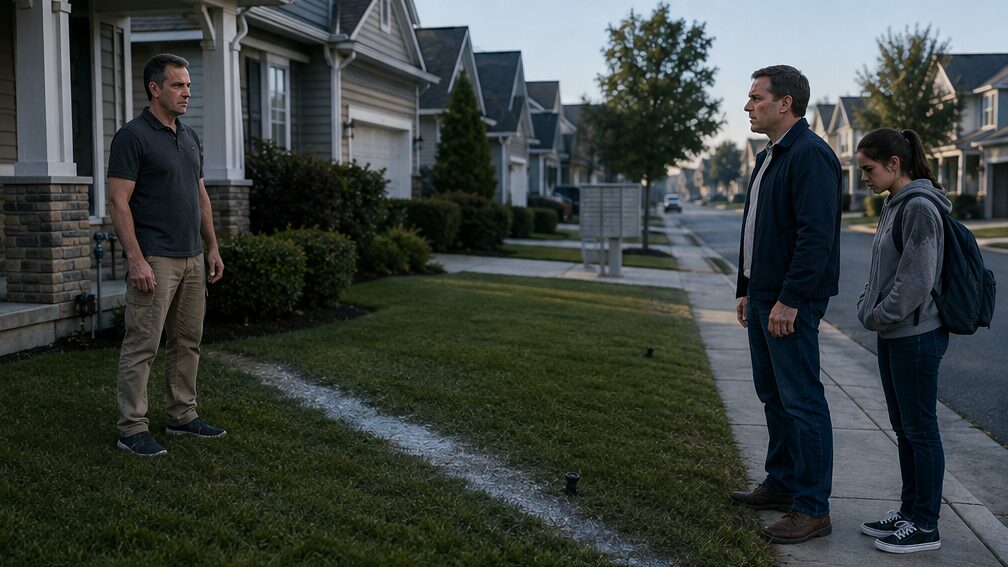
When They Turned His Front Lawn Into a Shortcut, He Built a Boundary They Couldn’t Ignore
Chapter 1: The Path Nobody Asked Permission to Make
The man stepped directly across the strip of fresh seed while Robert Hall was still holding the hose.
Robert watched one white sneaker sink into the dark soil, then the other. The man never looked toward the house. He crossed diagonally from the sidewalk beside Robert’s driveway to the corner near the community mailbox, shaving maybe forty seconds off the proper route.
The hose went slack in Robert’s hand.
“Excuse me.”
The man glanced over.
“I just reseeded that.”
“Sorry.”
He kept walking.
Robert looked down at the two clean footprints pressed into soil he had spent most of Sunday leveling.
Sorry, apparently, meant nothing had to change.
He turned the hose back on.
Two weeks earlier, the first shortcut had barely registered. A delivery driver had crossed the corner after leaving a package next door. Then two teenagers followed the same line the following afternoon.
After that, the route seemed to advertise itself.
Once one set of shoes bent the grass, another followed. Then another. By the end of the first week, a pale diagonal stripe had formed from the corner near the mailbox toward Robert’s driveway.
He had filled it with seed.
People walked across the seed.
He had covered it with straw.
People kicked the straw aside.
He had placed two small yard stakes at either end.
Someone stepped between them.
Robert worked as a facilities supervisor for a commercial office complex. His days were full of things other people ignored until they became his problem—doors that never latched correctly, drains people clogged and pretended not to notice, loading-dock sensors someone had knocked out of alignment.
He was used to solving problems.
What he was not used to was a problem that looked back at him, said sorry, and kept going.
At lunchtime, he wrote a note in thick black marker.
PLEASE USE SIDEWALK.
FRESH SEED.
He taped it to one of the stakes beside the worn path.
It looked slightly ridiculous.
That was intentional.
Robert did not want a confrontation. He wanted the lowest possible amount of drama required to make adults walk twenty extra yards.
He went inside, made coffee, and watched from the kitchen window while answering work emails.
At 12:47, a young woman carrying an iced drink approached from the mailbox.
She slowed.
Robert leaned slightly toward the glass.
She read the sign.
Then she stepped around it and crossed the lawn.
Robert straightened.
She followed the exact pale track.
Not beside it.
Not near it.
On it.
By 1:10, another man crossed carrying a grocery bag.
At 1:35, two younger men came from opposite directions, met near the middle of Robert’s property, and shifted sideways to pass each other.
Robert stared at them.
For one absurd second, his front lawn looked less like private property than a narrow neighborhood walkway.
He went outside before they reached the other side.
“Guys.”
Both stopped.
“There’s a sidewalk.”
One looked at the other.
“We’re just cutting through.”
“I know.”
Robert pointed at the worn line.
“That’s the problem.”
The taller one gave a small shrug. “Everybody does.”
Robert felt something inside him tighten.
Everybody does.
As if repetition created permission.
“I’m asking you not to.”
“Okay.”
They continued across the remaining grass instead of turning back.
Robert said nothing.
He stood there until they disappeared around the hedge near the mailbox.
Then he looked down.
From this angle, the damage was clearer.
The trail did not wander randomly. It formed one clean diagonal from a break between landscaping near the community mailbox straight across Robert’s front corner to the sidewalk beside his driveway.
It was efficient.
That was why people used it.
Robert walked the route himself.
From one side to the other, it took nineteen seconds.
He walked back using the sidewalk.
Fifty-eight seconds.
He stopped at the curb.
Thirty-nine seconds.
That was what his lawn was worth to them.
Thirty-nine seconds.
A door opened across the street. An older woman stepped out, checked her mail, then returned without crossing Robert’s property.
So it was possible.
Robert went back inside.
For the next hour, he tried working.
His attention kept drifting toward the window.
At 3:22, a teenager crossed.
At 3:46, another pedestrian stepped onto the grass, saw Robert standing in the doorway, hesitated, then kept going anyway.
That one bothered him most.
Not because of the damage.
Because the man had seen him.
Robert stepped outside.
“Did you see the sign?”
The man stopped.
“Yeah.”
“Then why are you crossing?”
A pause.
“It’s quicker.”
Robert almost laughed.
Not because it was funny.
Because the answer was so nakedly simple.
“My yard isn’t a shortcut.”
The man lifted one hand. “All right.”
Then he finished crossing.
Robert pulled the sign from the stake.
For a moment he considered putting something heavier there. A planter. Decorative stones. A small temporary fence.
Each option created a new problem.
The HOA restricted permanent fencing in front setbacks. Large decorative objects had placement rules. Anything sitting too close to the sidewalk could become a maintenance issue.
Robert knew enough about rules to know that people often loved them only when the rules protected what they wanted.
He carried the sign into the garage.
On the workbench sat a measuring tape.
He stared at it.
Then he picked it up.
Outside, he hooked the metal end around the first survey stake near the driveway and stretched the tape toward the opposite edge of the worn path.
Thirty-one feet.
He measured from another angle.
Thirty-eight.
Then from the side bed toward the mailbox.
Thirty-six.
Robert stood in the middle of the pale diagonal, tape measure in one hand.
He could hear a sprinkler running somewhere two houses down.
A slow mechanical click.
Pause.
Click.
Pause.
Robert turned toward the sound.
Then he looked back at the path.
He measured it one more time.
Chapter 2: Four Sprinklers and One Bad Idea
Robert placed four motion-activated sprinklers into the shopping cart.
He had intended to buy two.
The first box advertised a forty-foot range. That should have been enough.
But Robert had spent twenty minutes the previous night sketching angles on printer paper, and one sprinkler left too much uncovered ground near the driveway. Two created a blind pocket by the mailbox.
Four eliminated uncertainty.
He stood in the garden aisle reading the specifications again.
Detection arc.
Adjustable range.
Variable water pressure.
Ground spike.
The packaging showed a deer being sprayed away from flowers.
Robert looked at the picture.
“Close enough.”
At checkout, the total was a little over two hundred dollars.
He almost abandoned the idea when the number appeared.
Two hundred dollars to stop people from walking across grass.
That sounded irrational when reduced to a receipt.
Then he remembered the man saying, It’s quicker.
Robert paid.
Back home, he spread everything across the kitchen table: his property sketch, a tape measure, the HOA landscaping guidelines, irrigation rules he had printed from the neighborhood portal, and the four sprinkler manuals.
He was not going to spray the sidewalk.
That mattered.
He was not going to aim at the street.
That mattered too.
If the system operated entirely inside his property boundary and activated only when someone stepped onto his lawn, Robert could still tell himself this was irrigation with a side benefit.
He drew the first coverage circle.
Then the second.
The diagonal path ran through both.
The third covered the lower edge.
The fourth closed the remaining gap near the mailbox.
When Robert finished, the circles overlapped almost perfectly across the pale stripe.
He leaned back.
It looked less like a watering plan than a diagram for controlling movement.
That thought should have bothered him more than it did.
By late afternoon, he had the first sprinkler anchored beside the side bed.
The dark housing sat low against the grass.
From the sidewalk, it was barely noticeable.
Robert connected a garden hose, turned the water on, and walked slowly toward the sensor.
Nothing.
Another step.
The sprinkler snapped toward him.
A hard stream hit him directly in the chest.
Robert jumped backward.
Water ran down his shirt.
For the first time in two weeks, he laughed.
“Okay.”
He shut it off and adjusted the range.
The next test stopped three feet short of the sidewalk.
Exactly where he wanted it.
The second unit went near the driveway.
The third sat behind a low cluster of ornamental grass.
The fourth took the longest because Robert kept checking the lot line.
He found the survey marker, stretched a string between known points, and moved the unit six inches farther inward than necessary.
No one would be able to claim he had placed anything outside his property.
As sunset approached, he connected the hoses through a splitter and tested all four.
Click.
Spray.
Click.
Spray.
The first stream covered the center of the worn path. The next took over where the first faded. The remaining two protected the edges.
Robert walked the sidewalk.
Nothing happened.
He walked along the driveway.
Nothing.
Then he stepped onto the pale trail.
Three sprinkler heads turned almost simultaneously.
Water crossed in front of him.
Robert stopped.
The system stopped a moment later.
He looked toward the street.
No one was there.
He stepped forward again.
The nearest head fired.
A little satisfaction moved through him.
Not relief.
Satisfaction.
That distinction came and went too quickly for Robert to examine it.
He returned to the first sprinkler and turned the sensitivity dial higher.
The manufacturer recommended a moderate setting for animals and ordinary yard movement.
Robert moved it beyond that.
A little farther.
He told himself he was compensating for the early-morning temperature.
Then he increased the second one too.
At dinner, he kept glancing toward the front windows.
No one crossed.
At 7:15, a couple walked past but stayed on the sidewalk.
At 7:40, a teenager approached the corner, looked toward the lawn, then followed the proper route.
Robert felt disappointed.
That surprised him.
Wasn’t that the goal?
He cleared his plate and returned to the kitchen table.
His pencil sketch remained where he had left it.
Four circles.
One diagonal stripe.
He added small arrows showing the sprinkler direction.
Then he wrote activation ranges beside each one.
The drawing had the neatness of something created for inspection.
Robert folded it once and placed it inside the drawer beneath the phone charger.
By nine, the neighborhood was quiet.
He shut off the interior lights near the front windows and checked the system one final time from the porch.
The sprinkler heads disappeared almost completely against the lawn.
Only the pale path remained obvious.
Robert stood there for a moment, listening.
A house door closed somewhere down the block.
A dog barked once.
No footsteps came.
He went inside.
At 5:58 the next morning, Robert woke before his alarm.
He did not normally wake before six.
He made coffee and carried the mug to the front room.
The sprinklers were armed.
For nearly forty minutes, nothing happened.
Robert began feeling foolish.
Then, at 6:43, movement appeared near the community mailbox.
Someone in a dark hoodie came around the hedge.
Robert set his mug down.
The person did not turn toward the sidewalk.
They angled directly toward the pale stripe.
Robert moved closer to the window.
One foot crossed onto his lawn.
Then another.
The nearest sprinkler head turned.
Chapter 3: The Morning the Lawn Fought Back
The sprinkler snapped toward the path with a sharp mechanical click.
A stream of water struck the figure in the hoodie across the shoulder.
The person jerked sideways.
The second sprinkler detected the movement and fired.
Water crossed the diagonal path from the opposite direction.
The figure threw both arms up.
Robert stood behind the front window, one hand resting against the sill.
For one brief second, the scene looked exactly like he had imagined it.
Someone had ignored the boundary.
The system responded.
Problem solved.
Then the hood fell back.
It was a teenage girl.
She stumbled toward the sidewalk, soaked through one side of her sweatshirt, and shouted something Robert could not hear through the glass.
He immediately moved toward the front door.
By the time he stepped onto the porch, she had reached the curb.
Robert shut the water valve.
The sprinklers died.
“You okay?”
She spun toward him.
“Are you serious?”
“You stepped into the yard.”
“I’m wet.”
“I can see that.”
The answer came out flatter than Robert intended.
The girl stared at him.
“You did that on purpose.”
Robert looked toward the sprinkler heads.
“They’re motion-activated.”
“Because people walk here.”
Robert did not answer immediately.
That was answer enough.
She pulled at the soaked sleeve.
“My dad’s going to lose it.”
“Did you see the signs earlier this week?”
Her expression changed slightly.
Robert noticed.
“You did.”
“Everybody cuts through here.”
“That doesn’t make it public.”
She looked away.
There it was again.
Everybody.
Before Robert could say more, a pickup slowed near the curb.
It stopped hard.
David Clark stepped out.
Robert knew him mostly as the man two houses beyond the mailbox who always waved from his truck but rarely stopped to talk.
That morning he did not wave.
He looked at his daughter.
Then at Robert.
“What happened?”
“His sprinklers.”
David’s eyes moved toward the lawn.
“They just came on?”
His daughter pointed at Robert.
“He set them to hit people.”
Robert felt his shoulders tighten.
“That’s not what I said.”
David walked toward the curb but stopped short of stepping onto the grass.
“Then what exactly did you do?”
“I installed motion sprinklers on my property.”
“So they spray anyone who walks by?”
“No. They spray anyone who walks across the lawn.”
David stared at him.
“That’s my kid.”
“And she was crossing my property.”
The words were true.
Robert heard how they sounded anyway.
David looked at the wet sweatshirt again.
“You couldn’t speak to people?”
“I did.”
“To her?”
“I’ve spoken to people all week. I put up a sign.”
David looked at his daughter.
“Did you know about that?”
She hesitated.
That hesitation changed the scene.
Robert saw David notice it too.
“Did you?”
“There was a note.”
“And?”
She looked toward the sidewalk.
“People still walked through.”
David closed his eyes for half a second.
When he looked back at Robert, some certainty had left his face, but the anger remained.
“That still doesn’t mean you rig your yard to soak people.”
“Rigged is your word.”
“What would you call four motion sprinklers lined up on the exact route people use?”
Robert glanced toward the grass.
The pale diagonal path had darkened under the water.
It looked sharper now, almost drawn into the lawn.
“I’d call it irrigation.”
David gave a humorless laugh.
“No, you wouldn’t.”
Robert felt the urge to reach for the rule he had already saved on his phone.
He knew where it was.
Automated residential irrigation.
Private lot.
Permitted equipment.
He could probably win that part of the argument.
Instead he said, “Your daughter knew I’d asked people not to cross.”
David’s jaw tightened.
“My daughter made a bad choice. You’re an adult.”
That landed harder than Robert expected.
His daughter looked down.
David pointed toward the sprinkler nearest the ornamental grass.
“If that thing is still running when I come back, we’re taking this to the HOA.”
“You can take it wherever you want.”
The words came too quickly.
David stared at him.
“Fine.”
He opened the passenger door for his daughter.
Before getting into the truck, she looked once toward the lawn.
Not angry this time.
Embarrassed.
Robert stood on the porch as they drove away.
He should have felt vindicated.
She had known.
She had crossed anyway.
David had even admitted it was a bad choice.
But the satisfaction from the previous evening was gone.
At 7:20, a young man approached from the mailbox side.
Robert was still outside.
The man saw him.
Saw the sprinklers.
Then walked around using the sidewalk.
Robert watched until he disappeared down the block.
At 8:05, another pedestrian did the same.
At 9:30, nobody had crossed.
The pale path began drying.
By noon, Robert had counted six people taking the sidewalk.
The system had worked better than he expected.
He went outside and inspected the seed line.
No fresh footprints.
No crushed straw.
Nothing.
For the first time in nearly two weeks, the yard had gone half a day without someone crossing it.
That should have been the end of the problem.
Instead, Robert found himself looking toward David’s house.
Around lunchtime, a car slowed near his property.
The passenger held a phone toward the lawn.
Robert could not tell whether they were taking a picture.
At 1:15, someone posted a message in the neighborhood group asking whether motion sprinklers were permitted in front yards.
Robert did not respond.
At 1:47, another resident commented that “targeting pedestrians” could create liability.
Targeting.
Robert read the word twice.
He went to the kitchen drawer and removed his coverage sketch.
Four clean circles overlapped the diagonal track.
From his perspective, the drawing showed care.
Boundaries.
Containment.
The sidewalk untouched.
The street untouched.
Everything kept inside his lot.
From someone else’s perspective, it looked like he had designed a firing pattern around a footpath.
Robert folded the paper again.
At 3:00, he lowered the sensitivity on the first sprinkler.
He paused at the second.
Then left it where it was.
The choice irritated him because he knew why.
Part of him still wanted someone else to test it.
To prove the system was justified.
He shut the valve instead.
That evening, the doorbell rang.
Robert opened the door expecting David.
No one was there.
A large white envelope rested against the threshold.
The return address belonged to the homeowners association.
Robert opened it in the kitchen.
The notice requested his attendance at a formal compliance hearing the following Monday.
The stated concerns included irrigation placement, nuisance operation, pedestrian safety, and potential intentional activation.
Robert read the final phrase again.
Intentional activation.
His eyes moved toward the drawer containing the hand-drawn coverage plan.
For the first time since he bought the sprinklers, Robert understood that the question was no longer whether they were on his property.
The question was why he had put them there.
Chapter 4: The Rule Was Not the Whole Truth
“Why do your sprinkler zones follow the shortcut instead of the planting beds?”
Jessica Williams did not sound accusatory when she asked it, which made the question harder to dismiss.
Robert sat across from her at a small table in the HOA office Thursday afternoon. Between them lay a copy of the hearing notice, the neighborhood irrigation guidelines, and the sketch he had reluctantly brought from his kitchen drawer.
Jessica turned the page toward him.
Four circles overlapped across the pale diagonal line Robert had drawn through his property.
“The lawn is planted there,” he said.
“So is the rest of the lawn.”
Robert folded his hands.
“The traffic damage was there.”
Jessica looked at him for a moment.
“That’s a different answer.”
Robert disliked the room immediately.
Not because it was hostile. It wasn’t.
That was the problem.
There was no angry board, no neighbor shouting across a table, nothing obvious for him to resist. Jessica spoke carefully, as though her job was to remove every emotional word until only the facts remained.
Robert pointed to the printed irrigation rule.
“Automated residential irrigation is permitted on private lots. Nothing crossed onto the sidewalk. Nothing sprayed the street.”
“I’ve read the section.”
“Then what are we discussing?”
“Intent.”
There was that word again.
Jessica tapped the drawing.
“The rule allows irrigation. It doesn’t automatically protect every use of irrigation equipment.”
“I was watering my yard.”
“And discouraging pedestrians?”
Robert paused.
“Yes.”
“At the same time?”
“Yes.”
Jessica wrote something on a legal pad.
Robert felt irritation rise.
“People were walking across private property after I asked them not to. Why is that part suddenly irrelevant?”
“It isn’t.”
“Doesn’t sound that way.”
Jessica set the pen down.
“Robert, David Clark filed a complaint because his daughter was soaked. You filed two prior messages with the board asking whether anything could be done about people crossing your lawn. Those messages help you.”
Robert leaned back slightly.
He had forgotten about the second message.
“And?”
“And David submitted photographs.”
Jessica opened a folder.
The first photograph showed the lawn from across the street. Water cut diagonally through the frame.
The second showed a young man retreating toward the sidewalk.
The third showed another person raising both arms while a sprinkler fired behind him.
Robert stared.
“When were these taken?”
“Wednesday morning.”
“By David?”
“He submitted them. I don’t know who took each one.”
Robert looked closer.
The photographs did not show his careful lot-line measurements.
They did not show that the streams stopped before the sidewalk.
They showed people.
And water.
Repeatedly.
“How many activations were there?” Jessica asked.
“I don’t know.”
“You were home.”
“I wasn’t counting.”
That was not entirely true.
He had counted six people who chose the sidewalk after David left.
He remembered three activations before shutting the valve.
Jessica watched him.
“I’m not asking whether you’re allowed to water your lawn. I’m asking whether the equipment was configured primarily to irrigate or primarily to catch people crossing.”
Robert looked down at his sketch.
The answer had seemed simple when the drawing was in his kitchen.
Now the four neat circles looked almost aggressive.
“The lawn needed water.”
Jessica nodded.
“That helps.”
“Helps?”
“There’s no basis for an emergency removal order right now.”
Robert exhaled through his nose.
It was a small victory, but he took it.
“So they stay.”
“Until the hearing, provided you operate them normally.”
Normally.
Robert nearly asked her to define it.
Instead he said, “Fine.”
Jessica slid another sheet toward him.
“We’ll also need the original setup notes. Sensitivity settings, placement measurements, any adjustments.”
Robert did not touch the paper.
“Why?”
“Because David is claiming the system was deliberately configured around pedestrian movement.”
“It was configured around the damaged area.”
“That distinction is exactly what the board has to consider.”
Robert looked at her.
The small satisfaction he had felt when she said the sprinklers could remain was already gone.
His original notes contained the ranges.
And the arrows.
And, on the back of one page, two small pencil marks where he had recorded the sensitivity changes.
He had not intended those notes for anyone else.
Jessica gathered the photographs.
“Bring everything Monday.”
Robert stood.
At the door, he stopped.
“What happens if the board decides he’s right?”
Jessica’s expression stayed neutral.
“That depends on what they think you intended and whether there was a reasonable risk of injury.”
“No one was injured.”
“I know.”
“His daughter got wet.”
“I know that too.”
Robert opened the door.
Jessica added, “There’s another question the board may ask.”
He turned.
“Why people were crossing there in the first place.”
Robert frowned.
“I’ve already answered that. It’s faster.”
“Maybe.”
She looked toward the sketch again.
“But habits like that usually start somewhere.”
Robert left without responding.
Friday morning, he found Margaret Sanchez standing near the community mailbox.
She was moving slowly, one hand pressed against the rail beside the curb cut.
Robert knew her by sight more than conversation. She lived three houses beyond David and had been in the neighborhood longer than almost anyone.
She looked toward his lawn.
The sprinklers were off.
“Safe today?” she asked.
Robert could not tell whether she was joking.
“They’re just sprinklers.”
Margaret gave him a look.
“So I’ve heard.”
Robert shifted the mail in his hand.
“Did you cross too?”
“Sometimes.”
The answer was immediate.
“Even after I asked people not to?”
“No. Not after I saw your sign.”
That surprised him enough to silence his next response.
Margaret nodded toward the pale diagonal strip.
“My knees don’t like the long way anymore.”
“That doesn’t make it yours.”
“I didn’t say it did.”
Robert waited.
Margaret looked toward the hedge beside the mailbox.
“You know that path was there before you bought the house, right?”
Robert followed her gaze.
“What path?”
“The shortcut.”
“That’s not a path. It’s damage.”
“Now it is.”
She adjusted the envelopes under her arm.
“But people were walking through that corner years before you moved in.”
Robert stared at her.
“The previous owner allowed that?”
Margaret shook her head.
“I didn’t say that either.”
She pointed past the hedge, toward the narrow strip of HOA common ground beyond it.
“We used to walk over there.”
Robert looked again.
All he saw was thick landscaping, a fence section, and shrubs.
Margaret started home along the sidewalk.
Robert called after her.
“What happened to it?”
She stopped.
“The association changed the landscaping.”
Then she continued walking.
Robert stood beside the mailbox with Jessica’s question returning to him.
Why people were crossing there in the first place.
For the first time, the diagonal scar across his lawn looked less like the beginning of the problem.
It looked like the end of something older.
Chapter 5: The Shortcut Was Older Than Him
“There used to be a walkway right through that hedge.”
Margaret pointed with the end of her cane Saturday morning.
Robert stood beside her on the sidewalk, looking at a wall of waxy green shrubs so dense he could barely see the common lawn beyond them.
“Right there?”
“More or less.”
“That makes no sense.”
“It did before they put all this in.”
Margaret tapped one shrub lightly.
Robert had expected a vague story about neighborhood habits.
Instead, she described a narrow pedestrian connection from the mailbox area to the sidewalk running behind the common green. It had never been a formal concrete path, but residents used it for years because the original landscaping left a clear opening.
Then the HOA redesigned the corner.
New hedges.
Decorative fencing.
A larger planting bed.
The opening disappeared.
“And everyone just started walking across this lot?” Robert asked.
“Not immediately.”
Margaret looked at his house.
“The people who owned it before you didn’t care much about the lawn. There was already thin grass near the corner. Someone cut through. Other people followed.”
Robert looked toward the diagonal scar.
“That still doesn’t make it acceptable.”
“No.”
Margaret’s answer came without hesitation.
That took some of the argument out of him.
She leaned more heavily on the cane.
“I crossed because it saved me the extra distance. That was convenient for me and unfair to you. Both things can be true.”
Robert said nothing.
It was the first time anyone who used the shortcut had said that plainly.
Margaret glanced at him.
“David crossed too, by the way.”
Robert turned.
“What?”
“Years ago. Before his daughter was old enough to walk anywhere by herself.”
A humorless smile touched Robert’s mouth.
“That he forgot to mention.”
“People remember the part that helps them.”
Robert almost said, Exactly.
Then he realized the sentence applied equally well to him.
That afternoon he logged into the HOA document archive.
Most of the old files were poorly labeled. Minutes. Landscape proposals. Capital projects. Scanned contractor drawings.
He searched the address of the common green.
Nothing useful.
Then “mailbox landscaping.”
A PDF from seven years earlier appeared.
Robert opened it.
The first page showed a contractor proposal for upgraded plantings and screening around the mailbox cluster. He scrolled.
On the third page was a site plan.
Robert leaned toward the monitor.
The old configuration showed an open strip between the landscaping bed and the rear sidewalk.
The new plan closed it with hedges and a decorative fence panel.
He printed the page.
Then another.
Meeting minutes from the following month contained three resident comments about pedestrian access.
One asked whether the opening would remain.
Another warned that people would “cut the corner through the adjacent lot.”
Robert read that line twice.
The third requested some kind of paved connector.
The board had referred the issue to landscaping.
There was no follow-up in the next meeting.
Or the one after that.
Robert searched another year.
Nothing.
The problem had not been invisible.
It had been noticed, discussed, and then left for somebody else.
He carried the papers outside.
Standing near the mailbox, he aligned the old drawing with the present landscape.
The former opening pointed almost directly toward the upper end of the worn stripe across his lawn.
The neighborhood had not chosen his property at random.
The HOA had blocked one convenient route.
People had created another.
Understanding it did not erase the trespass.
But it changed the shape of his anger.
On Sunday afternoon, Robert walked the full official route Margaret now had to use.
From her driveway to the mailbox and back required a broad loop along two sidewalks.
For him, it was nothing.
For someone moving carefully with a cane, it was different.
Robert found Margaret sitting on her porch when he returned.
“You were right,” he said.
She raised her eyebrows.
“Don’t sound so surprised.”
He held up the old site plan.
“They knew.”
Margaret’s smile disappeared.
Robert sat on the edge of the porch chair opposite her.
“There were complaints before construction. Someone specifically warned them people would cross the adjoining lot.”
“That sounds familiar.”
“Why didn’t anybody keep pushing?”
“We did for a while.”
Margaret looked toward the common green.
“Then people got tired. Boards changed. People moved. It became easier to cut through than keep arguing.”
Robert folded the plan.
“That’s how my lawn became the solution.”
“For everyone except you.”
He looked at her.
Margaret nodded toward his house.
“You still had every right to tell us to stop.”
Us.
Not them.
Robert appreciated the word more than he expected.
When he returned home, he began organizing papers for Monday’s hearing.
Irrigation rules.
His earlier HOA complaints.
Photographs of the damaged grass.
The old landscape plan.
Meeting minutes.
Finally, he opened the kitchen drawer and removed his original sprinkler notes.
He unfolded the sheet.
Four coverage circles.
Four arrows.
Measurements.
On the margin beside sprinkler one, he had written a sensitivity setting.
Beside it was a second number.
Higher.
The same beside sprinkler two.
Robert remembered exactly when he had made those changes.
After the first manual test.
Before anyone had been sprayed.
He could have told himself he had increased the sensitivity because he wanted reliable detection.
That had been partly true.
Then he found another notation on the reverse side.
WED. 7:18 — INCREASE #1 AFTER FIRST HIT.
Robert stared at the handwriting.
He remembered the morning.
Not David’s daughter.
The first activation had been a hooded pedestrian minutes earlier than he had later focused on in his own memory—a brief spray at the edge of the zone, enough to make the person retreat before the full system engaged.
Robert had gone outside afterward.
He had turned the dial higher.
He had wanted the next crossing to trigger cleanly.
There was no engineering explanation that made the note disappear.
He sat at the table.
Across the room, the hearing folder waited.
Robert could leave this sheet home.
Jessica had asked for original configuration notes, but nobody knew exactly what existed.
He could bring the clean property sketch.
The measurements.
The rule.
The HOA’s old site plan.
He had enough to make a strong case.
His eyes returned to the words.
INCREASE #1 AFTER FIRST HIT.
The hearing was no longer only about what the neighborhood had done to him.
On Monday, Robert would have to decide whether he was willing to show what he had done with his anger.
Chapter 6: The Hearing Where Nobody Was Completely Right
“You designed those sprinklers to hit people.”
David Clark said it before Robert had fully settled into his chair.
The HOA president asked him to wait his turn.
David sat back, jaw tight.
Robert placed his folder on the table.
Jessica Williams sat to one side with the complaint packet open before her. Behind them, several residents occupied folding chairs along the clubhouse wall.
Robert had expected the room to make him angry.
Instead, he felt tired.
The president summarized the complaint: repeated motion-activated irrigation, potential nuisance operation, disputed intent, and a request that Robert remove or permanently disable the equipment.
Then David spoke.
“My daughter walked across his lawn. She shouldn’t have.”
Robert looked up.
He had not expected that opening.
David continued.
“But that doesn’t give a grown man the right to set up equipment to punish kids for walking through a yard.”
“They’re irrigation sprinklers,” Robert said.
David turned toward him.
“Four of them. Aimed at one strip.”
The president raised a hand.
“Robert will have his turn.”
David placed several photographs on the table.
The now-familiar images.
Water.
People turning away.
The diagonal path.
“My concern isn’t whether he owns the property. He does. My concern is that he decided he could teach the neighborhood a lesson.”
Robert felt the words land because they were close to something he had avoided naming.
When his turn came, he began with the facts.
He showed photographs of damaged seed.
Copies of his messages asking the association for guidance.
The handwritten warning.
The lot measurements.
“The equipment was entirely inside my property,” he said. “The spray range stopped before the public sidewalk.”
Jessica nodded.
“That part has been verified.”
Robert opened the irrigation guidelines.
“Automated irrigation is allowed.”
David leaned back.
“There it is.”
Robert looked at him.
“What?”
“The rule that makes everything okay.”
Robert almost answered immediately.
Instead, he closed the guideline packet.
“No.”
The room went still.
David’s expression changed.
Robert looked toward Jessica.
“The sprinklers were legal equipment. The placement was inside my lot. And I did install them because people kept crossing.”
The president asked, “Were they intended to deter pedestrians?”
“Yes.”
David shook his head.
Robert continued.
“At first, I wanted them to detect movement across the damaged area. Then someone triggered one.”
His hand rested on the folder.
“I went outside and increased the sensitivity.”
Jessica stopped writing.
Robert removed the original note and placed it on the table.
“I wanted the next person to get caught.”
No one spoke for several seconds.
David stared at him.
Robert felt heat rise along the back of his neck, but he did not look away.
“That doesn’t mean I wanted anyone hurt. I didn’t. But if the question is whether part of me wanted people soaked because I was angry, the answer is yes.”
The admission cost him something.
Not legally.
Something smaller and more personal.
The version of himself he had been defending all week had been the reasonable homeowner forced into action.
That version had been mostly true.
Mostly was the problem.
David looked toward his daughter, seated along the wall.
Then back at Robert.
“She knew about the sign.”
The room shifted again.
David rubbed one hand across his jaw.
“I asked her. She’d seen it. She crossed anyway.”
His daughter looked down.
David continued quietly.
“I’ve crossed there too. Years ago.”
Robert said nothing.
David met his eyes.
“I still think what you did went too far.”
“I know.”
“And I still think she was wrong to cross.”
The president glanced between them, perhaps realizing that the clean argument the board expected had dissolved.
Jessica spoke next.
“There’s another issue.”
Robert slid the old site plan from his folder.
“I know.”
He placed it beside his sprinkler sketch.
One showed the present diagonal across his lot.
The other showed the former opening through HOA common property.
The lines were not identical.
They did not need to be.
Everyone could see what had happened.
Robert explained the landscaping project and the old resident complaints.
Jessica had already found the corresponding board minutes.
“The association was warned the closure might redirect pedestrian traffic,” she said.
The president studied the papers.
“Why wasn’t a connector added?”
Jessica turned several pages.
“I haven’t found a final decision. It appears the matter was referred back to landscaping and never completed.”
A resident in the back muttered something.
The president asked for quiet.
Robert looked at the two drawings.
For days, his sketch had represented control.
Now, beside the older plan, it looked like one layer in a chain of people solving inconvenience by passing it to somebody else.
The HOA closed the opening.
Residents used Robert’s lawn.
Robert used sprinklers.
David used the complaint process.
Everyone had a rule.
Nobody had fixed the route.
The president asked, “What resolution are you requesting now, Robert?”
A week earlier, his answer would have been simple.
Keep the sprinklers.
Tell people to stay off his property.
Fine anyone who interfered.
Robert looked toward Margaret, seated near the end of the second row with her cane between her knees.
Then at the old site plan.
“I don’t want an easement across my lot.”
David shifted.
Robert continued.
“I bought private property. I’m not agreeing to turn it into the neighborhood walkway because the association made a bad landscaping decision seven years ago.”
The president nodded slowly.
“That’s understandable.”
“But there’s still common property behind the mailbox.”
Jessica looked up.
Robert pointed at the old opening.
“Reopen a connection there.”
The room became quiet again.
“Remove part of the hedge. Adjust the fence section. Put in a narrow hard-surface path if you need accessibility and maintenance control. Keep pedestrian traffic on association property.”
The president studied the plan.
“That would require bids.”
“Then get bids.”
“It would cost the membership.”
Robert folded his hands.
“The membership already paid for the landscaping that created the problem.”
David gave a short breath that might have been agreement.
Robert looked toward him.
“I’ll shut off motion activation while the board considers it.”
David’s eyebrows lifted.
“Permanently?”
“No.”
The old instinct returned, but weaker now.
“My property still needs irrigation. And I’m not giving up the right to protect it.”
The president asked, “What are you offering?”
“Normal irrigation settings. No aggressive motion sensitivity while a permanent route is being reviewed.”
Jessica wrote the words down.
David leaned forward.
“And if the board says no?”
Robert looked at the pale track visible through the clubhouse window across the common green.
“Then we come back here and argue about my lawn again.”
A few people shifted in their chairs.
No one laughed.
That was fine with Robert.
He had stopped wanting the room on his side.
He wanted the problem solved.
The president recessed the hearing for ten minutes.
When the board returned, they declined David’s request for immediate removal of the sprinklers. They also declined to declare Robert’s operation entirely compliant without conditions.
The equipment could remain.
Motion sensitivity would stay reduced pending review.
The landscaping committee would obtain estimates for reopening a pedestrian connection across common property.
Not a victory.
Not a punishment.
A process.
Outside the clubhouse, David caught up with Robert.
“I meant what I said.”
Robert stopped.
“So did I.”
David looked toward the parking lot.
“She shouldn’t have crossed.”
“No.”
“You shouldn’t have enjoyed catching people.”
Robert felt the old defensiveness rise.
Then fade.
“No.”
David gave a small nod.
They did not shake hands.
They did not apologize again.
David walked toward his truck.
Robert remained under the clubhouse light with the two drawings still in his folder.
Jessica came through the door behind him.
“The board will complain about the cost.”
“I know.”
“Some residents will say the shortcut has worked fine for years.”
“It worked fine for people who didn’t own the yard.”
Jessica almost smiled.
Robert handed her a copy of the old plan.
“Don’t study my property anymore.”
She looked at him.
“Study that opening.”
Robert pointed toward the common green.
“Put the path back where it belonged in the first place.”
Chapter 7: The Grass Grew Back Where the Argument Ended
The workers cut through the hedge at 8:12 on a Tuesday morning.
Robert Hall heard the trimmer before he saw them.
By the time he stepped onto his porch, a section of the dense landscaping beside the community mailbox had already been reduced to waist-high branches. Behind it, two workers were measuring a narrow strip of HOA common property while a compact machine idled beside the curb.
For six weeks, the board had debated estimates, drainage, accessibility requirements, landscaping replacement, and who should pay.
Now the opening was actually being made.
Robert stood with his coffee and watched a gap appear where Margaret had once pointed with her cane.
The old route.
Not across his lawn.
Around it.
A worker carried away an armful of cut branches, revealing the rear sidewalk beyond the common green.
The distance suddenly looked obvious.
Robert wondered how anyone had ever convinced themselves that sealing it had been an improvement.
A truck door closed behind him.
David Clark crossed the street.
Robert glanced over.
David stopped at the edge of the driveway instead of coming onto the grass.
“They finally started.”
“Looks like it.”
David watched the workers for a few seconds.
“They sent the assessment notice yesterday.”
Robert had received the same email. The HOA would absorb most of the construction through its common-area maintenance reserve, with a smaller portion coming from the landscaping budget.
“Could’ve been worse,” Robert said.
David gave him a sideways look.
“That your way of saying you’re happy?”
“It’s my way of saying they’re fixing it.”
A worker drove a shovel into the narrow strip where the new walkway would join the existing sidewalk.
David put his hands in his pockets.
“There are still people mad about the cost.”
“I know.”
“They think you forced the board into it.”
Robert looked at him.
“I didn’t close the old route.”
“No.”
“And I didn’t make people use my lawn.”
David nodded once.
Then, after a pause, he said, “You did make sure they regretted it.”
Robert almost answered defensively.
The old response rose easily enough.
They were on my property.
They were warned.
The sprinklers were legal.
All of it was still true.
He took a sip of coffee instead.
“Yeah,” he said.
David looked toward him, apparently surprised by the lack of argument.
Robert nodded at the construction.
“This is better.”
David watched the workers again.
“Yeah.”
They stood in silence until David walked away.
No handshake.
No reconciliation.
Robert preferred it that way.
By the end of the first day, the opening through the hedge was wide enough to show the route clearly. The next morning, the crew removed part of the decorative fence and formed a shallow base through the common strip.
Robert’s lawn remained untouched.
That had been one of his conditions.
The board had briefly considered asking him for a narrow pedestrian easement because it would have been cheaper than rebuilding the common-area connection.
Robert refused.
Not angrily.
Not negotiably.
His property did not become public simply because other people had found it useful.
Jessica Williams had understood.
The revised plan stayed entirely on association land.
Three days later, a narrow hard-surface walkway connected the mailbox area to the rear sidewalk.
The first person Robert saw use it was a delivery driver.
The driver came from the far sidewalk, glanced toward Robert’s lawn almost out of habit, then followed the new path through the opening.
Robert noticed something strange.
He did not feel victorious.
He felt relieved.
The difference mattered.
By the second week, almost everyone had adjusted.
The diagonal stripe across Robert’s lawn remained, but without daily foot traffic, the new seed finally took hold.
Dark green shoots emerged through the pale soil.
The line was still visible from the porch.
Just less certain.
One afternoon Robert saw David approaching the mailbox.
David collected two envelopes, turned, and for half a second looked directly at the old shortcut.
Robert was in the driveway coiling a hose.
Neither man spoke.
David shifted his direction and used the new walkway.
He did not wave.
Robert did not either.
But he watched David stay off the grass all the way home.
That was enough.
A few days later, Margaret Sanchez appeared with her cane.
Robert saw her before she reached the mailbox and set down the small bag of seed he was carrying.
She moved slowly to the boxes, collected her mail, then turned toward the new opening.
Her steps were careful but steady.
The path shortened the loop enough that she no longer had to circle the entire corner.
When she reached the far sidewalk, she looked toward Robert.
“Well,” she called.
He walked closer.
“Better?”
“My knees approve.”
Robert smiled.
Margaret looked at the recovering grass.
“You know, the previous owners never bothered trying to fix that strip.”
“I noticed.”
“They probably knew we’d just walk over it again.”
“Probably.”
She tapped her cane once on the new pavement.
“Now we don’t have to.”
Robert looked from the walkway to the pale diagonal scar.
For months, maybe years, the neighborhood had treated that line as though repeated use had transformed it into something legitimate.
Now the legitimate route existed a few yards away.
Nobody had lost access.
Robert had not lost his property.
The board had been forced to repair a mistake it had allowed to become somebody else’s burden.
It was not dramatic.
That was what made it feel finished.
Later that afternoon, Robert opened the irrigation box beside the house.
The four motion sprinklers were still installed.
Under the hearing agreement, he had kept their sensitivity low while the board reviewed the walkway. With construction complete, there was nothing preventing him from restoring the original motion settings.
He crouched beside the first unit.
The dial was exactly where he had left it.
Robert turned it.
Higher.
He stopped.
The sprinkler sat almost invisible against the lawn.
For a moment he remembered the first morning clearly: the mechanical click, the rush of water, the instant satisfaction when someone jumped backward.
He had told himself then that he wanted compliance.
But compliance had arrived before he shut the system down.
What he had wanted after that was confirmation.
Another person crossing.
Another person getting sprayed.
Another reason to feel right.
Robert turned the dial the opposite direction.
Normal irrigation sensitivity.
He adjusted the second.
Then the third.
Then the fourth.
When he finished, he activated the system manually.
The sprinklers rose and began sweeping broad, ordinary arcs across the grass.
No sudden targeting.
No hidden line of detection.
Just water.
One stream passed over the old diagonal path.
The soil darkened.
Robert stood and watched.
Six weeks earlier, that same dark line would have looked like proof that someone had crossed again.
Now new grass was filling it from both sides.
Inside, Robert opened the kitchen drawer.
His original sketch was still there.
Four coverage circles crossed the drawn shortcut.
The page had become wrinkled from being folded and carried to meetings.
He placed it on the counter.
With a pencil, he added the new common-area walkway beside the property line.
He drew it carefully through the opening near the mailbox.
Then he looked at the diagonal line through his own yard.
For a second, he considered erasing it.
Instead, Robert drew one clean mark through it.
Not to pretend it had never existed.
To show that it no longer functioned as a route.
Outside, the sprinkler clicked through another ordinary rotation.
Across the street, someone approached the mailbox and continued through the new opening without stepping onto Robert’s grass.
He folded the sketch and returned it to the drawer.
Then he went outside and moved the hose away from the recovering patch so the water would not pool there.
Under his shoes, the lawn felt firm again.
The diagonal scar was still faintly visible.
It would take more time before it disappeared completely.
Robert found that he no longer minded.
The line was no longer a challenge.
It was simply where the grass was growing back.
The story has ended.