He Threw the Bridge Papers Into the Mud, Then Learned Whose Road He Needed
Chapter 1: The Papers Landed Below the Red Notice
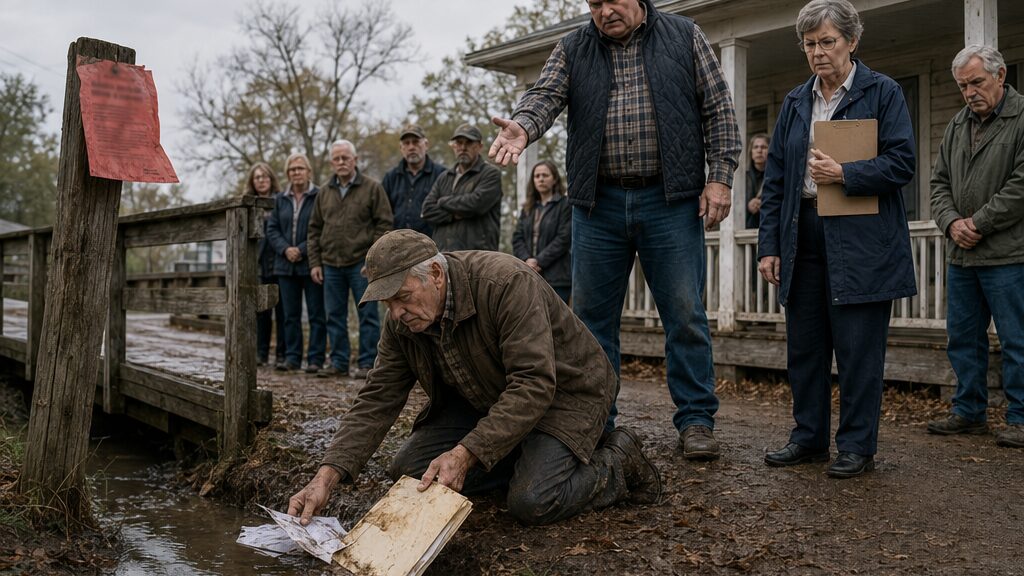
The folder struck the edge of the drainage ditch, opened in midair, and scattered Patrick White’s engineering report across six inches of muddy water.
A photograph of the bridge’s rotted support beam landed faceup. Brown runoff moved across it until the cracked timber disappeared beneath a film of grit.
Above the ditch, the red county notice nailed to the bridge post snapped in the wind.
UNSAFE STRUCTURE. CROSSING PROHIBITED PENDING REVIEW.
Patrick looked from the ruined pages to Jeffrey Harris, who stood on his porch with one hand resting on the railing. Jeffrey had invited half the neighborhood to what he called an emergency inspection, though the county inspector had already left.
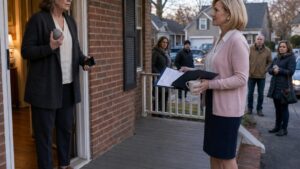
Kathleen Roberts, the HOA president, held a clipboard near the bridge entrance. Two board members stood behind her. Samuel Rivera waited beside his mailbox, his shoulders pulled tight against the morning cold. Other residents watched from the gravel road.
Jeffrey did not look embarrassed.
“I asked you to read it,” Patrick said.
“I read the estimate.” Jeffrey lifted the sheet Kathleen had circulated. “Eighteen thousand five hundred dollars. That is the number that matters.”
“The report explains why that number can be reduced.”
“It also says the bridge is unsafe.”
“It says one beam has failed and two deck sections need replacement. It recommends shoring before vehicle traffic resumes.”
Jeffrey pointed toward the bridge as if Patrick had confirmed his argument. The crossing was narrow, built from dark timber and patched over the years with mismatched planks. Beneath it, the creek moved around stones polished pale by decades of water.
“That bridge sits on your parcel,” Jeffrey said. “You maintained it when my father lived here. You collected no toll. You never complained. Now it is condemned, and suddenly you want the association to pay.”
Patrick glanced at Kathleen. “Is that the board’s position?”
Kathleen adjusted the papers on her clipboard. “The subdivision map identifies the crossing as the western access serving the Harris property and the three creek lots. Our attorney’s preliminary view is that the owner of the underlying structure bears primary responsibility.”
“Preliminary,” Patrick said.
“That is why we are here.”
Jeffrey gave a short laugh. “We’re here because he thinks delaying this makes him important.”
Patrick felt every face turn toward him.
He stepped down into the ditch.
Cold water entered the seam of his left boot. He bent and lifted the first page by its corner. Mud had already softened the ink along the engineer’s stamp.
No one moved to help.
Samuel took one step forward, then stopped when Jeffrey looked at him.
Patrick collected the photographs first. Then the stamped letter. Then the load table Sandra had prepared after measuring the remaining beam. He placed each sheet carefully on the folder’s plastic cover.
“You could have handed those back,” Kathleen said quietly.
Jeffrey shrugged. “He brought me paperwork instead of a repair plan.”
Patrick rose slowly. His knees resisted the motion, though he gave no sign of it. Mud ran from the folder onto his glove.
Jeffrey descended two porch steps, lowering his voice as if that made his words less public.
“We have feed deliveries. Contractors. Insurance inspections. Three households use this crossing. You’ve had years to fix it.”
“So have the people using it.”
“That is not how ownership works.”
Patrick studied him.
Jeffrey’s plaid shirt was clean. His boots were new enough that mud still sat on the surface rather than in the leather. Behind him, the house his father had built rose above the creek, larger now than it had been in 1981. A second story had been added, then a garage, then a stone façade across the front. The road approaching it had never changed.
Patrick wiped one muddy thumb across the folder’s edge.
“Say that again,” he said.
Jeffrey frowned. “Say what?”
“That ownership makes one person fully responsible.”
“It does when that person owns the bridge.”
“And you want me to accept the entire repair cost?”
“Yes.”
“Without access payments from you or the association?”
“You never asked for them.”
“Without a maintenance agreement?”
“You never required one.”
Patrick nodded once. “Put it in writing.”
For the first time that morning, Jeffrey hesitated.
Kathleen looked up from her clipboard. “A formal written demand would need board approval.”
“You approved the emergency assessment notice,” Jeffrey said.
“We approved notice of potential liability. That is not the same thing.”
“It will be by this afternoon.”
Patrick tucked the wet pages inside the folder. The plastic sleeve would not close over the swollen paper.
“Include that I alone own and control the bridge,” he said. “Include that you reject shared responsibility. Include the amount and the deadline.”
Jeffrey’s expression shifted. Not much, but enough.
“You think legal language is going to frighten me?”
“No.”
“Then what exactly are you doing?”
“Making sure we remember the same conversation.”
A murmur moved through the residents.
Samuel approached Patrick as Kathleen began speaking to the board members. “I did sign the petition,” he said under his breath. “I thought it was only asking for a repair schedule.”
Patrick looked at him.
Samuel’s gaze dropped to the mud. “My medication comes by courier twice a month. They won’t take the eastern farm lane.”
“The bridge is closed to everyone now.”
“I know.”
Patrick wanted to tell him the closure would be brief. He wanted to say he had already considered temporary shoring and controlled access. Instead, he looked toward Jeffrey.
Jeffrey was speaking rapidly to Kathleen, one hand cutting through the air. He had turned the scene into a contest before Patrick had arrived, and Patrick could feel the old instinct settling into place: let him speak, let him commit, let the record become heavier than the man making it.
That instinct had served Patrick for twelve years in the county records office. People lied most carelessly when they believed silence meant ignorance.
Kathleen walked over.
“The board will give you seven calendar days,” she said. “By next Monday, we expect either a signed repair contract or written proof that responsibility belongs elsewhere.”
“Elsewhere where?”
“That is for you to establish.”
“And until then?”
“The condemnation remains.”
Patrick looked past her to the bridge. One plank near the center had curled upward at the edge. The red notice struck the post again and again.
Kathleen lowered her voice. “I do not enjoy this.”
“You still signed it.”
“I signed a notice based on the documents we had.”
“You had my engineer’s report.”
“I had it for thirty seconds before Jeffrey threw it into the ditch.”
Her discomfort did not change the deadline.
Patrick carried the wet folder home. He spread the pages across his kitchen table beneath the ceiling fan, placing saltshakers and coffee mugs on the corners to keep them flat. Mud outlined Jeffrey’s boot print across the repair estimate.
At 9:17 that evening, Patrick’s computer chimed.
The email came from Jeffrey’s personal account and copied Kathleen, the two board members, and the HOA attorney.
It stated that Patrick White was the sole owner and controller of the bridge structure and was therefore solely responsible for all repair, inspection, and reopening costs. It rejected any obligation by Jeffrey or the association. It demanded a signed construction contract within seven days and warned of legal action for lost access.
At the bottom, beneath the words Respectfully submitted, Jeffrey had typed his full name and title.
Jeffrey Harris
Vice President, Creekside Ridge Homeowners Association
Patrick read the message twice.
Then he printed it, laid it beside the drying photographs, and opened the locked drawer beneath his desk.
Inside was a file tab marked 1981.
Chapter 2: Twelve Years of Records Behind One Quiet Question
The brass key resisted before the lock turned.
Patrick had not opened the drawer in nearly nine years. Dust marked the edges of the hanging files, but the tab labeled 1981 remained clean where his fingers had touched it too many times before.
He carried the file to the kitchen table.
The muddy report pages had dried into rippled shapes beneath the coffee mugs. Jeffrey’s email lay beside them, crisp and white, its language more absolute each time Patrick read it.
Sole owner and controller.
Solely responsible.
No obligation by any beneficiary of access.
Patrick removed a folded plat from the old file and spread it carefully across the table. Blue survey lines divided the creek parcel from the higher ground. The bridge appeared as two parallel pencil marks crossing the water.
The ownership line did not stop at the near bank.
It followed the creek, passed beneath the full bridge structure, and ended twelve feet beyond the far abutment. Every piling, beam, and approach timber sat inside land deeded to Patrick’s father and later transferred to Patrick.
A narrow easement line extended from the far end toward the property now owned by Jeffrey Harris.
It did not run both ways.
It did not grant ownership.
It granted passage.
Patrick placed Jeffrey’s email over the lower corner of the plat and felt the first clean satisfaction of the day. Jeffrey had written exactly what Patrick needed: acknowledgment that Patrick controlled the structure and that Jeffrey claimed no maintenance obligation.
Then Patrick noticed the notation beside the easement.
See private access agreement, Book 417, attachment C.
The file contained no attachment C.
He searched the drawer again. Tax maps. Transfer affidavits. An old bridge-material invoice. A photograph of the creek before the crossing was built. No agreement.
At eight the next morning, Patrick carried the file and the mud-stained folder into the county administration building.
The records department occupied the same first-floor corridor where he had worked before retirement. The countertops had been replaced, and the index terminals were smaller, but the room still smelled faintly of toner and old paper.
The county clerk recognized him.
“You look like you came to audit us.”
“If I had, you’d already be nervous.”
She smiled, then saw the folder. “What happened to that?”
“An argument.”
“Did the argument win?”
“Temporarily.”
Patrick requested the deed chain for the creek parcel, the recorded subdivision map, and Book 417. He did not ask for special treatment. He filled out the retrieval slip and waited beneath the clock as two title researchers spoke in whispers near the copier.
When the clerk returned, she placed a thick ledger and a scanned-record printout before him.
Book 417 confirmed the plat.
The bridge parcel belonged to Patrick. The Harris property held a limited right of ingress and egress, created before the surrounding lots were incorporated into the HOA. The association’s modern subdivision map showed the bridge as a neighborhood road, but the recorded deed never transferred it.
Patrick traced the blue line with one finger.
The easement ended at Jeffrey’s property.
The other creek-lot residents had used the bridge for years through informal permission and habit, not through recorded rights.
That distinction gave Patrick more control than he had expected—and more responsibility.
He turned to the next page.
Attachment C was referenced again but absent from the scanned record.
“Was this microfilmed separately?” he asked.
The clerk checked the index. “It may never have been recorded.”
“Then why cite it?”
“Could have been submitted and rejected. Could have stayed private. You know how these older packages were handled.”
Patrick did know. Families signed side agreements at kitchen tables, expecting memory and goodwill to outlast them. Then someone died, someone sold, and the unrecorded promise became a rumor.
He copied the deed, the plat, and the easement language. At the counter, he added Jeffrey’s email to the stack.
The clerk read the first paragraph. “He actually wrote that you alone control it?”
“He wanted clarity.”
“He gave you plenty.”
Outside, Sandra Garcia was leaning against her work truck. A hard hat rested on the passenger seat. Patrick had not called her, but the clerk had.
“You brought my load calculations to a public meeting,” Sandra said, “then let somebody throw them into a ditch.”
“I didn’t let him.”
“You watched him.”
“I was standing ten feet below him.”
“That has never stopped you from correcting anyone before.”
Patrick unlocked his truck. Sandra took the plat from his hand before he could put it away.
Her eyes moved quickly over the lines.
“This is yours,” she said.
“Yes.”
“All of it?”
“Yes.”
“And the HOA map is wrong.”
“Incomplete.”
She looked toward the administration building. “Then the fight is over.”
“No.”
“Dad, he signed an email saying you control the bridge. The county can verify the parcel. Close it, force a maintenance agreement, and be done.”
Patrick slid the copies into the muddy folder. “There was another agreement.”
“Where?”
“Missing.”
“With whom?”
He did not answer.
Sandra held the original 1981 file open against the hood of his truck. A yellowed photograph slipped from behind the plat. It showed Patrick as a younger man standing beside Jeffrey’s father near the unfinished bridge. Both held survey rods. Between them, the first support beam crossed the creek.
Sandra turned the photograph over.
A folded note had been clipped behind it.
The paper was thin enough that the ink showed through. Patrick recognized his father’s handwriting at the top and another hand beneath it.
Temporary access until eastern road is completed.
Patrick reached for the note.
Sandra moved it out of reach and read the final lines.
Patrick will keep the crossing open so the Harris family is never stranded. The new road will be built when financing permits.
Below that was a signature from Jeffrey’s father.
Beneath the signature, in Patrick’s own younger handwriting, were four words.
I’ll see it through.
Sandra stared at him.
“You knew.”
Patrick took the note from her carefully.
“I knew there had been an understanding.”
“You knew exactly what it was.”
“The eastern road was supposed to be built within five years.”
“But it wasn’t.”
“No.”
“And you never recorded this.”
“It wasn’t an easement. It was a promise.”
Sandra looked at the county copy, then at Jeffrey’s email. “A promise to a dead man that his son does not know about.”
Patrick placed the note inside the folder.
“He may know more than he says.”
“Do you believe that?”
Patrick closed the cover. Mud stains showed through the clear plastic like dark fingerprints.
For the first time since Jeffrey had thrown the papers, Patrick’s certainty loosened.
The deed told him what he could do.
The note reminded him why he had not done it before.
Chapter 3: The Gate Closed More Than One Road
The chain snapped tight across the bridge just before sunset on Wednesday.
Patrick tested the padlock twice, then fastened the county’s new condemnation sign to the metal gate he had anchored between two timber posts.
NO VEHICLE OR PEDESTRIAN CROSSING.
STRUCTURE CLOSED UNTIL CERTIFIED SAFE.
The county bridge inspector stood beside him with a camera.
“You understand this is your closure,” the inspector said. “The county confirms the condition, but enforcement on private property belongs to the owner.”
“I understand.”
“And emergency services have been notified that the eastern farm lane is the alternate route.”
“That lane floods.”
“I put that in the notice.”
Patrick signed the closure acknowledgment on top of the mud-stained folder. Jeffrey’s email was clipped immediately beneath it.
When the inspector left, the bridge looked smaller behind the gate. The red notice moved in the evening wind, but nothing else crossed the creek.
At 9:40, headlights swept across Patrick’s front windows.
A truck stopped hard at the gate. Its horn sounded once, long enough to wake every dog along the road.
Patrick walked down with a flashlight.
Jeffrey stood beside his truck, one hand wrapped around the chain.
“Open it.”
“No.”
“You cannot block access to my house.”
“The county condemned the bridge.”
“The county didn’t install this gate.”
“I did.”
Jeffrey pulled the chain as if testing whether anger could loosen steel. “My attorney said you had no right to interfere with an established access.”
Patrick held out a printed copy of the email.
Jeffrey did not take it.
“You wrote that I alone own and control the bridge,” Patrick said. “You rejected responsibility for maintenance, inspection, and reopening.”
“That does not mean you can trap me.”
“It means I control an unsafe structure on my property. You insisted on that point in writing.”
“You set me up.”
“I asked you to record your position.”
“You knew about the deed.”
“I knew what I owned.”
Jeffrey’s face reddened in the truck’s headlights. “Then why did you let us use it all these years?”
Patrick folded the email once.
“That is a different question.”
“Answer it.”
“Not tonight.”
Jeffrey stepped closer. “You think this makes you clever? My wife is parked on the other side. My equipment is at the house. I have a contractor coming Friday.”
“The eastern farm lane remains available.”
“For a four-wheel-drive truck, maybe. Not for deliveries.”
“You should discuss that with the association whose obligations you rejected.”
Jeffrey stared at him. For a moment, Patrick expected him to reach for the lock. Instead, Jeffrey returned to his truck and reversed so quickly that gravel struck the gate.
Patrick watched the taillights disappear.
The satisfaction came quietly. It sat in his chest like warmth from a small stove. Jeffrey had stood below the gate, demanding access to something he did not own. The balance had shifted exactly as Patrick intended.
By Thursday afternoon, the feed truck arrived.
The driver stopped at the bridge, read the sign, and called Jeffrey. Patrick watched from his porch as the driver tried backing toward the eastern lane. The rear wheels slipped near the ditch. After ten minutes, the truck returned to the county road.
Jeffrey came down on foot.
“You knew that truck couldn’t use the farm lane.”
“I knew the bridge couldn’t carry it.”
“I have livestock feed on that truck.”
“You have a condemned crossing.”
“You keep saying that like it absolves you.”
Patrick looked at him over the top of his glasses. “You wanted sole responsibility. Sole responsibility includes keeping unsafe loads off.”
Jeffrey glanced toward Samuel’s house, where curtains moved in the front window.
“This is not only hurting me.”
The words landed more heavily than Patrick expected.
That evening, Samuel knocked on Patrick’s back door.
He held a courier notice.
“They would not walk the package across,” Samuel said. “Company policy. The driver took it back to the depot.”
“What was in it?”
“Medication.”
Patrick’s hand tightened around the doorframe. “Do you have enough until tomorrow?”
“I do. My daughter can drive around and pick it up.”
“Then you’re covered.”
Samuel’s expression changed slightly. “That is not the same as the problem being solved.”
Patrick looked past him toward the dark bridge.
“You signed Jeffrey’s petition.”
“I did.”
“You agreed I should pay.”
“I agreed the bridge needed fixing. Jeffrey told us the petition only asked the owner to act.”
“You did not ask who the owner was.”
“No.” Samuel folded the courier notice. “And you did not tell us.”
Patrick had no answer that did not sound like an accusation.
On Friday morning, a flatbed carrying a compact excavator stopped at the gate. The contractor walked the length of the bridge approach, photographed the notice, and called Jeffrey.
A permit deadline for drainage repairs behind Jeffrey’s garage expired that afternoon. Without the excavator, the contractor could not begin. The county added a reinspection fee.
By then, photographs of the chained gate had circulated through the HOA email list. Some residents accused Jeffrey of mishandling the dispute. Others accused Patrick of using a technicality to hold the neighborhood hostage.
Kathleen arrived carrying a binder.
“We need a controlled pedestrian arrangement,” she said.
“No.”
“Samuel missed a delivery.”
“He received it the next day.”
“That is not the standard.”
“The standard is no crossing.”
Kathleen opened the binder to the subdivision map. “The board relied on this.”
“The recorded plat says otherwise.”
“I know that now.”
“Then correct your demand.”
“We will review it Monday.”
“Review is not correction.”
Her mouth tightened. “You wanted us to learn that procedure matters. We learned it. Now I am asking whether you intend to use procedure to punish everyone who was wrong.”
Patrick looked at the gate.
The chain was new, silver against the old wood. It looked stronger than anything else near the bridge.
“I intend to keep people from falling into the creek.”
Kathleen closed the binder. “Sandra says she is coming this afternoon.”
Patrick turned. “You spoke to her?”
“She spoke to the board’s attorney. She is concerned that residents are climbing around the gate.”
Patrick found footprints beside the near abutment after Kathleen left. Someone had descended the bank, stepped onto a lower support, and climbed back to the deck beyond the chain.
At three o’clock, Sandra arrived wearing work boots and carrying a probe, measuring tape, and flashlight. She did not greet him before kneeling near the failed beam.
Patrick held the light while she examined the timber.
“The rot is deeper than the first inspection showed,” she said.
“How much deeper?”
She pushed the probe into the beam. It disappeared almost to the handle.
Patrick said nothing.
Sandra moved beneath the approach and studied the connection plates. “The deck is transferring weight into the damaged member. Every vibration matters now.”
“No vehicles are crossing.”
“You have people going around the gate.”
“I found the tracks.”
“Then the sign is not enough.”
Patrick looked toward Samuel’s house. “Could we brace it for pedestrians?”
“Not without equipment on both banks and a temporary support in the channel.”
“How soon?”
“After permits and low-water review? Days, if everyone cooperates. Longer if they don’t.”
Patrick glanced at the folder tucked beneath his arm. The county closure, Jeffrey’s email, the plat, and the old note were all inside. The papers had given him control.
Sandra stood and wiped dirt from her gloves.
“You were right about ownership,” she said.
Patrick waited.
She pointed toward the bridge. “But if one person steps onto that deck tonight, being right will not hold it up.”
A plank creaked in the wind between them.
Then Sandra looked directly at him.
“This bridge can fail under the weight of a person.”
Chapter 4: The Promise Jeffrey Never Knew He Inherited
The HOA attorney did not soften the sentence.
“If this access remains blocked,” he said, “your property may become effectively unmarketable.”
Jeffrey sat at his kitchen table with the phone on speaker. Through the window, the chained bridge was visible between the trees. The red condemnation sign looked small from the house, but it had become the center of every conversation inside it.
His spouse stood near the sink, arms folded.
“What does effectively mean?” Jeffrey asked.
“It means a buyer’s lender may refuse financing. An insurer may exclude access-related claims. An appraiser may discount the property substantially.”
“How substantially?”
“I cannot answer without an appraisal.”
“Then give me a range.”
The attorney paused. “Enough that you should not assume a sale would cover what you owe.”
Jeffrey looked at the unopened envelopes beside the salt shaker. One bore the mortgage company’s return address. Another came from the county permit office.
“What about an injunction?”
“We can request temporary relief, but the bridge is condemned. A judge is unlikely to order Patrick to permit traffic across a structure an engineer has called unsafe.”
“He created the emergency by refusing to maintain it.”
“That argument is weaker now that the deed shows he owns the structure and your written demand rejects any shared duty.”
Jeffrey’s spouse turned toward him.
“You wrote that?”
“It was board language.”
“You signed it.”
The attorney continued. “There may be an argument based on long-term use, necessity, or reliance. But none of those makes the bridge safe. And if Patrick produces evidence that the access was intended to be temporary, our position becomes more difficult.”
Jeffrey stared at the phone.
“What evidence?”
“That is what we need to determine.”
When the call ended, the kitchen seemed too quiet.
His spouse picked up the mortgage envelope. “How far behind are we?”
“We are not behind.”
“How close?”
Jeffrey stood. “I have a meeting.”
“That was not my question.”
He took his truck as far as the gate, then walked the remaining distance to Patrick’s house. The chain shone in the morning sun. Someone had added orange mesh along the sides to stop residents from climbing around it.
Patrick answered the back door wearing an old gray sweater.
“We need to talk,” Jeffrey said.
Patrick looked past him toward the bridge. “You usually bring an audience.”
“Not today.”
Inside, Sandra sat at the kitchen table with the 1981 plat spread before her. The mud-stained folder lay inside a clear plastic sleeve, its warped pages visible through the cover.
Jeffrey stopped when he saw the map.
“You have been discussing my property.”
“We’ve been discussing mine,” Patrick said.
Sandra folded her arms. “Sit down.”
Jeffrey remained standing. “My attorney says there may have been a private agreement.”
Patrick pulled out a chair but did not sit. “There was.”
“You told me there was only an easement.”
“I told you what was recorded.”
“What was not recorded?”
Patrick took the old note from the folder and placed it on the table.
Jeffrey read the first two lines quickly, then slowed.
Temporary access until eastern road is completed.
His father’s signature remained recognizable despite the faded ink. Beneath it were Patrick’s four words.
I’ll see it through.
Jeffrey read the note again.
“My father never showed me this.”
“He may have intended to.”
“He left every other property paper in the steel cabinet.”
“This one stayed with me.”
“Why?”
Patrick looked toward the window. “Because the promise was mine.”
“To keep the bridge open?”
“To keep your family from being stranded while he built another road.”
Jeffrey’s jaw tightened. “There is no other road.”
“The corridor was surveyed.”
“Where?”
“Along the east pasture and behind the rear lots.”
“That land belongs to you.”
“Part of it.”
Jeffrey pushed the note back. “Then you knew this crossing was temporary and still let us expand the house, add the garage, join the HOA, and use it for forty years.”
“I did not approve your construction.”
“You never objected.”
“No one asked.”
Sandra looked sharply at Patrick.
Jeffrey leaned over the table. “You watched me inherit a house dependent on your bridge, and you said nothing.”
“Your father knew.”
“My father died before I took over the property.”
“He died before he finished what he promised.”
“And you decided I should somehow know.”
Patrick’s face hardened. “You decided I should pay eighteen thousand five hundred dollars without reading the report.”
“That was after years of you acting like the bridge was yours only when something went wrong.”
“It was always mine.”
“Then why did you let everyone believe otherwise?”
Patrick did not answer.
Jeffrey’s anger shifted. Some of it remained, but beneath it something more exposed appeared.
“My mortgage is higher than the house is worth without that access,” he said. “The drainage permit expires again next month. The garage wall is taking water. I cannot pay for the bridge, the drainage job, and the loan.”
Sandra looked at him. “Then why did you tell the board Patrick should pay everything?”
“Because someone had to move.”
“You wanted someone else to move.”
“I wanted the road open.”
“You threw the only repair plan into a ditch.”
Jeffrey straightened. “I made a bad decision.”
“You made it in front of the neighborhood,” Patrick said.
“So this is about that.”
Patrick’s silence was answer enough.
Sandra turned to him. “How long were you going to keep the note hidden?”
“Until I knew what Jeffrey intended.”
“He showed you what he intended.”
“No. He showed me what fear looks like when it gets authority.”
Jeffrey gave a bitter laugh. “And you showed me what resentment looks like when it owns the road.”
The words stayed in the room.
Patrick looked at the mud stains visible through the folder sleeve. He had preserved every page because he had wanted the record clean, even when the paper was not. Now the note beside them made his own position look less simple.
“I kept the bridge open after your father died,” he said. “I kept it open when the first railing failed, when the flood shifted the west footing, and when the association added more traffic without asking. I thought someone would eventually remember the promise.”
“Who?”
“You.”
“How could I remember something I was never told?”
Patrick’s fingers rested on the edge of the table.
Sandra’s voice was quiet. “That is the question.”
The HOA meeting that afternoon filled the small community room. Kathleen sat at the head of the table with the attorney beside her. Jeffrey took his usual chair but did not open the meeting.
Patrick remained near the back wall.
Kathleen reviewed the deed discrepancy, the condemnation, and the missing private agreement. When she asked whether anyone had known the access was temporary, no one raised a hand.
Samuel stared at the floor.
Jeffrey spoke without his usual confidence. “My father signed an agreement to build another road. I did not know about it.”
Murmurs moved through the room.
One board member asked Patrick, “Did you know?”
“Yes.”
“And you never disclosed it to the association?”
“No.”
“Why?”
Patrick looked at Jeffrey before answering. “Because I believed the promise belonged to his family, not to the board.”
“That does not explain the last ten years.”
“No,” Sandra said from the side wall. “It does not.”
Kathleen removed her glasses and rubbed the bridge of her nose.
“We need complete records before anyone files another claim,” she said. “Every assessment, repair discussion, and insurance notice related to that crossing.”
The other board member opened an old ledger retrieved from the storage cabinet.
A loose statement slid out.
Kathleen picked it up, read the heading, and went still.
“What is it?” Jeffrey asked.
She turned the page so the board could see.
“Bridge maintenance assessment,” she said. “Collected from the creek lots nine years ago.”
The room changed at once.
Samuel looked up.
Jeffrey stared at the amount.
Patrick’s hand tightened around the mud-stained folder.
Kathleen flipped to the next page.
“There are three years of these.”
Chapter 5: The Assessment Paid for a Bridge Nobody Inspected
Kathleen found the words bridge reserve crossed out in blue ink.
The original entry showed twelve thousand dollars assigned to bridge inspection and structural maintenance. Beside it, someone had written drainage emergency, approved by voice vote.
No formal resolution followed. No engineering report was attached. No notice had been sent to Patrick.
The HOA records room contained eight metal cabinets, two broken folding chairs, and boxes of papers labeled by year. By Monday morning, every surface was covered.
Kathleen stood at the central table with the old minutes open before her.
Jeffrey read over her shoulder. “Who authorized this?”
“The board at the time.”
“My father was president then.”
“So was Samuel treasurer.”
Samuel sat near the door, holding his cap between both hands.
Kathleen looked at him. “Do you remember the vote?”
He nodded slowly. “The lower lots flooded that spring. Water came through two basements.”
“Was the bridge inspected first?”
“No.”
“Did anyone tell Patrick the reserve was being redirected?”
“No.”
Jeffrey struck the table with the flat of his hand. “Then the association took money for the bridge and spent it somewhere else.”
Samuel’s head lifted. “We spent it on residents’ homes.”
“You spent it without fixing the access everyone depended on.”
“We believed the bridge would last.”
“Based on what?”
Samuel looked toward Patrick, who stood beside the cabinet with the mud-stained folder tucked under one arm.
“Based on the fact that it always had,” Samuel said.
The answer settled over them with uncomfortable weight.
Kathleen examined three years of ledgers. The first assessment had been described as a bridge and drainage reserve. The second had been reduced after residents complained about dues. The third disappeared entirely into emergency culvert work.
No one had stolen the money. No one had falsified a check.
They had postponed the expensive problem because another problem was visible, immediate, and politically easier to explain.
Kathleen closed the ledger.
“This is not fraud,” she said. “It is deferred liability.”
Jeffrey laughed once. “That sounds better in minutes.”
“It will not sound better to an insurer.”
Patrick pulled a chair away from the wall and sat. “Did the board ever commission an inspection?”
Samuel answered. “Your father used to look at it.”
“My father died fourteen years ago.”
“After that, you replaced planks.”
“I replaced what I could see.”
“You never sent an invoice.”
“I was not asked to maintain it for the association.”
Jeffrey turned on him. “But you did maintain it.”
“Occasionally.”
“Which reinforced everyone’s belief that it was your obligation.”
Patrick met his eyes. “And your use reinforced my belief that someone would eventually accept a share.”
Kathleen placed both palms on the table. “We can spend the day proving that every person here relied on an assumption. It will not make the beam sound.”
She assigned the board members to locate insurance notices and old budgets. Sandra reviewed the invoices with Patrick. The original bridge estimate included full replacement, but her reduced plan proposed temporary shoring, replacement of the failed beam, and limited reopening while a permanent design was prepared.
Jeffrey leaned over the figures.
“How much for temporary work?”
“Seven to nine thousand,” Sandra said. “More if the channel rises.”
“And permanent?”
“Depends on whether you rebuild timber or install a prefabricated span.”
Kathleen asked, “What can the reserve cover?”
“Not enough,” one board member said. “After legal fees and drainage repairs, maybe five thousand.”
Jeffrey looked at Samuel. “Then the creek-lot owners pay the rest.”
Samuel’s mouth tightened. “We already paid once.”
“And spent it.”
“We voted.”
“You voted because you did not want higher dues.”
Samuel stood so abruptly that his chair struck the wall.
“Yes,” he said. “We did.”
The room went quiet.
Samuel looked around at the residents gathered near the doorway.
“We knew the reserve was being moved. We knew the bridge had not been inspected. The basements were flooding, and everyone wanted the cheaper choice. We told ourselves Patrick had always fixed what broke.”
His eyes settled on Patrick.
“I signed Jeffrey’s petition for the same reason. I wanted the bridge open without paying what opening it cost.”
Patrick had expected denial. The admission left him with nowhere clean to place his anger.
Samuel sat again.
Kathleen wrote a note in the margin of the minutes. “Then the record will reflect that.”
By Tuesday afternoon, rain had begun upstream.
It arrived first as darker water beneath the bridge. The creek rose against the stones, carrying twigs and leaves into the west footing. Sandra placed a measuring stake at the bank and marked the level with red tape.
Patrick joined her under an umbrella.
“How fast?” he asked.
“Four inches since noon.”
“The forecast says another inch overnight.”
“That could put water against the lower beam.”
Patrick watched the current press debris into the pilings.
Jeffrey approached from the far side, wearing a rain jacket. He stopped at the gate.
“My garage contractor called,” he said. “He can come Thursday if equipment can cross.”
“It cannot,” Sandra said.
“What if you shore it first?”
“We need equipment to shore it.”
Jeffrey looked toward the eastern pasture. “There is room for a machine there.”
Patrick followed his gaze. The old surveyed corridor ran behind the rear lots and across the edge of Patrick’s pasture. He could see it even without markers: a shallow rise, a gap between trees, a line that had remained unused for four decades.
“That ground is soft,” Patrick said.
“So put down mats.”
“It is fenced.”
“Fences can open.”
Patrick’s tone cooled. “Not because you point at them.”
Jeffrey lowered his voice. “You know a way exists.”
“A possible route.”
“And you never offered it.”
“You never asked for access. You demanded ownership without duty.”
“This again.”
“Yes. This again.”
Sandra stepped between their lines of sight. “The creek does not care which one of you wins.”
A log struck the center piling with a dull knock.
All three turned.
The water had risen high enough to touch the underside of the damaged beam.
Sandra removed the red measuring tape and fixed it several inches higher.
“From now on,” she said, “no one approaches either abutment without another person present.”
Kathleen arrived with printed copies of a proposed emergency assessment. Residents gathered beneath umbrellas on both sides of the gate. The paper called for shared temporary repair costs, pending a permanent agreement.
One resident refused immediately. Another asked why the entire neighborhood should pay for a bridge serving only four lots. Samuel said he would pay his share but could not manage a large amount at once.
Jeffrey said nothing.
Patrick opened the mud-stained folder and took out Sandra’s shoring diagram.
“What equipment do you need?” he asked.
She studied him before answering. “A compact excavator, timber cribbing, channel supports, and access from both banks.”
“I can help mark the near-side placement.”
“And the far side?”
Patrick looked across the pasture.
Jeffrey waited.
“I said I would help with the structure,” Patrick said. “I did not say I would open the field.”
Sandra folded the diagram. “Then we may not get equipment in before the water peaks.”
A gust drove rain sideways through the group.
Kathleen held the proposed assessment against her coat. “We meet again at seven. By then I need a route, a contractor, and signatures.”
Patrick walked the bank with Sandra, measuring the distance from the pasture fence to the far abutment. He offered old survey stakes, equipment contacts, and the location of buried utility lines.
He did not offer the gate.
Near dusk, the wind strengthened. The creek had turned brown, its surface broken by branches.
Patrick was halfway back to his house when a cracking sound rolled across the water.
A tree on the upstream bank leaned slowly, roots lifting from the saturated soil. Its trunk struck the bridge railing and tore two sections free.
The impact shook the deck.
The damaged beam dropped enough for Patrick to see the shift from the road.
Sandra ran toward the measuring stake.
“Everybody back!” she shouted.
The tree remained pressed against the bridge while water piled behind its branches.
Then the first deck plank tilted into the creek.
Chapter 6: When Being Right Was No Longer Enough
The bridge dropped three inches with a sound like a heavy door breaking from its hinges.
Patrick felt the vibration through the gravel.
The chain sagged as the west gatepost shifted toward the creek. The fallen tree pressed against the upstream railing, gathering branches and trash until the water surged around it.
Sandra grabbed Patrick’s sleeve and pulled him away from the bank.
“Stay clear of the abutment.”
A light appeared on the far side.
Samuel stood beyond the gate in a yellow raincoat, one hand raised against the storm.
“What is he doing there?” Patrick shouted.
Kathleen answered from behind him. “He went to check the generator at the creek-lot pump house.”
Samuel pointed toward the eastern farm lane.
Even above the rain, they could hear his words.
“It’s under water.”
The farm lane had become a shallow brown channel. Samuel’s truck sat beyond it, blocked on the far side with him.
Jeffrey came running down the hill from his house.
“We can get him across,” he said.
“No,” Sandra and Patrick said together.
Jeffrey reached for the chain.
Patrick stepped in front of him.
“He can walk on the outer edge,” Jeffrey said. “One person won’t bring it down.”
“Sandra said it could.”
“He is seventy-three years old and trapped in a storm.”
“He is safer where he is.”
“For how long?”
A second plank shifted. Water slapped against the underside of the deck.
Patrick turned on his flashlight and aimed it toward Samuel.
“Go back to the pump house!” he shouted. “Stay inside!”
Samuel cupped a hand to his ear.
“The pump house,” Patrick repeated, pointing.
Samuel nodded and moved away from the gate.
Jeffrey unhooked one end of the orange mesh.
Patrick caught his wrist.
“Do not.”
“Take your hand off me.”
“You step onto that bridge, Samuel may follow.”
“I’m not leaving him there.”
“You are not helping him by making two people stranded.”
Jeffrey tried to pull free. Patrick tightened his grip.
For one sharp second, both men stood in the rain, close enough to see fear beneath anger.
Then the bridge moved again.
Jeffrey stopped fighting.
Patrick released him.
“What do we do?” Jeffrey asked.
It was the first time he had asked rather than demanded.
Patrick looked toward the pasture.
The answer had existed for forty years.
He pulled the mud-stained folder from beneath his coat and handed it to Sandra.
“Keep that dry.”
Her eyes narrowed. “Where are you going?”
“To open the east field.”
He drove his old tractor to the pasture gate while Kathleen called the county emergency coordinator and the contractor. The lock had rusted around the shackle. Patrick struck it twice with a hammer before it opened.
Beyond the gate, tall grass flattened under the rain. The surveyed corridor ran along the fence line, crossed a shallow swale, and climbed toward the rear lots.
Patrick had helped mark it as a young man. He still remembered where the soil held and where buried rock would support machinery.
Jeffrey arrived in his truck behind the tractor.
“Tell me where to drive.”
“Stay in my tracks.”
Patrick lowered the pasture fence at the far end. A section of wire snagged his glove and cut his palm, but he kept working until the opening was wide enough for equipment.
Sandra’s truck followed with warning lights flashing. Kathleen stood under the raised hatch using her phone as a temporary command point.
“The contractor is bringing the compact excavator,” she said. “County rescue has a high-clearance vehicle, but the flooded lane is worsening.”
“How long?” Patrick asked.
“Forty minutes.”
“The bridge may not have forty.”
“We are not using the bridge.”
“We need Samuel out before the pump house floods.”
Sandra studied the pasture and pointed toward the rear slope. “We can reach him from the east if the swale holds.”
Patrick shook his head. “The center looks firm, but it is clay underneath. Take the upper line along the fence.”
“That adds distance.”
“It keeps the truck from sinking.”
Jeffrey looked between them. “How do you know?”
“I surveyed it.”
“When?”
“With your father.”
The words landed without time for argument.
Patrick walked ahead of the first vehicle, probing the ground with an old steel rod. Rain ran from the brim of his cap. At the swale, he shifted the route uphill, following a strip of gravel buried beneath grass.
The contractor arrived with timber mats and the excavator on a trailer. They laid the mats across the softest section one at a time. Jeffrey carried them without being asked.
At the far fence, the old corridor met the rear access behind Samuel’s lot. The rescue vehicle passed through first and reached the pump house.
Samuel emerged holding a small plastic case above the water.
“My insulin,” he said when they reached him. “I wasn’t leaving it.”
Patrick almost laughed, but Samuel’s face stopped him.
“You should have stayed home.”
“I thought the pump would fail.”
“It may.”
“I signed the petition,” Samuel said. “I figured I could at least save something.”
“This is not the time.”
“It never seems to be.”
The rescue vehicle took Samuel across the pasture. Patrick rode beside him. Behind them, the excavator moved toward the far abutment, not to repair the bridge but to pull the fallen tree away before it formed a dam.
At the creek, the situation had worsened. Water had climbed over one edge of the deck. The tree held fast against the railing.
Sandra directed the operator from high ground.
“Pull upstream,” she shouted. “Do not touch the bridge.”
The machine’s bucket caught the trunk. For several seconds, nothing moved. Then the tree tore free with a rush of branches and spun downstream.
Water dropped against the beam.
The bridge settled but did not collapse.
Everyone remained still until Sandra approached the near post and measured the displacement.
“It is finished for traffic,” she said. “Maybe finished entirely.”
Jeffrey stood beside Patrick, breathing hard.
“My father surveyed that field with you.”
“Yes.”
“He meant to build the road there.”
“Yes.”
“And you knew it could work.”
Patrick looked at the machinery tracks cutting across his pasture.
“I knew it might.”
“Why did you never say so?”
“Because the road takes almost an acre from me. It divides the field. It lowers what the land is worth.”
Jeffrey stared at him. “So this was not only about a promise.”
“No.”
The admission tasted different from all the careful truths Patrick had offered before.
He continued.
“I told myself your father’s promise had expired when he died. Then I told myself it belonged to you whether you knew it or not. When you threw those papers, I wanted you to learn what dependence felt like.”
Jeffrey looked toward the dark bridge.
“You did.”
Patrick nodded.
“So did Samuel.”
Behind them, the rescue vehicle stopped near the pasture gate. Samuel stepped out safely, carrying the plastic case against his chest.
Patrick watched him cross land that could have been opened years earlier.
Kathleen approached with her phone and a digital recorder application open.
“The county wants written permission before this route remains in use overnight,” she said. “Emergency access only.”
Patrick looked at the tracks through his pasture, then at the gate he had kept locked.
“Record this,” he said.
Kathleen raised the phone.
“I authorize temporary emergency and contractor access across the east field corridor,” Patrick said. “No residential traffic unless directed by emergency personnel. The HOA will restore fencing and repair ground damage. This permission lasts until a written agreement replaces it.”
Kathleen stopped recording. “Are you sure?”
“No.”
Sandra stood beside him with the mud-stained folder tucked safely beneath her raincoat.
Patrick looked at her, then at Jeffrey.
“Send it before I change my mind.”
Chapter 7: The Agreement Inside the Mud-Stained Folder
Patrick placed the dirtiest page on top.
The sheet had once been Sandra’s clean estimate for temporary shoring. Now its lower half was brown and stiff, and Jeffrey’s boot print crossed the engineer’s stamp.
Beneath it lay the new agreement—twelve white pages, three exhibits, two survey drawings, and signature lines for every party that had spent years behaving as though the bridge belonged to someone else.
The county mediation room was small enough that no one could avoid looking at anyone.
Patrick sat across from Jeffrey. Kathleen occupied the end of the table with the HOA attorney. Samuel and two creek-lot residents sat along the wall. Sandra stood beside a mounted survey map, one hand resting on a cardboard tube containing the alternate-road plans.
The mediator touched the stained estimate.
“Is this intended as evidence?”
“It already was,” Patrick said.
Jeffrey looked at the page but said nothing.
The first proposed agreement granted temporary access across the rebuilt bridge for three years. During that period, the HOA would contribute reserve funds to repairs, the four benefiting properties would pay a separate assessment, and Jeffrey would provide permanent right-of-way through the rear edge of his lot for the alternate road.
Patrick would grant the remaining corridor across his pasture only after financing, drainage design, and construction deadlines were recorded.
Jeffrey turned to the final page.
“You want the bridge easement to expire.”
“Yes.”
“My house depends on it.”
“For now.”
“And if the alternate road is delayed?”
“The bridge agreement extends if the delay is beyond your control.”
“Who decides that?”
“The county.”
Jeffrey pushed the packet away. “No.”
Kathleen removed her glasses. “Which provision?”
“All of it. He gets a repaired bridge, control of the crossing, and a road through my property.”
Patrick leaned back. “I do not need a road through your property.”
“You need my land to connect the corridor.”
“You need the corridor more than I do.”
“That is exactly the problem. Every term depends on what you can withhold.”
Patrick looked at the muddy page.
Two weeks earlier, he would have enjoyed hearing Jeffrey admit that. Now the words felt like a warning.
The mediator turned to Patrick. “Would you consider a permanent easement over the bridge?”
“No.”
“Why?”
“Because then no one finishes the road.”
Jeffrey opened his hands. “You cannot know that.”
“I watched your father postpone it for years. Then I postponed forcing the issue for decades. Temporary arrangements become permanent when they remain convenient.”
Sandra unrolled the road plan.
“The alternate route is safer,” she said. “It has enough width for emergency vehicles, delivery trucks, and winter maintenance. The bridge can remain a secondary entrance after construction, with weight limits.”
One resident frowned. “And what will the road cost?”
Sandra named the preliminary range.
The room stirred.
“That is on top of the bridge assessment?” the resident asked.
Kathleen answered. “Yes.”
“Then why not rebuild the bridge permanently and stop there?”
“Because one narrow crossing over a flood-prone creek should never have become the sole access for four homes,” Sandra said.
The resident looked at Patrick. “Easy to say when the road takes our money and not your house.”
“It takes my land,” Patrick said.
“A strip along a pasture.”
“An acre when setbacks and drainage are included.”
“You still own the rest.”
Patrick felt the familiar impulse to stop explaining. The numbers were in the exhibits. The boundaries were marked. Anyone unwilling to understand could live with the consequences.
Sandra met his eyes from across the room.
Silence, her expression seemed to say, was how they had reached this table.
Patrick placed both hands beside the folder.
“I refused that road before any of you joined the association,” he said. “Not because it was impossible. Because I did not want my pasture divided.”
Jeffrey watched him closely.
Patrick continued. “After your father died, I told myself the promise died with him. When you inherited the house, I waited for you to ask about the access. You never did.”
“I did not know I needed to.”
“I know.”
The admission quieted the room.
Patrick lifted the mud-stained estimate.
“When you threw this into the ditch, I wanted you to learn that you needed my permission. I wanted the gate to make that plain.”
Jeffrey’s jaw shifted.
Patrick looked toward Samuel.
“It made other things plain too.”
Samuel lowered his eyes.
“The closure was necessary once the bridge failed,” Patrick said. “But I let my resentment decide how much truth to give you before that. I could have shown the plat years ago. I could have shown the note. I did not.”
The mediator asked, “Does that change your proposed terms?”
“It changes how I state them. Not why they are needed.”
Patrick removed a second version of the final page from the folder.
He had written the revision the night before.
“The bridge reopens under a recorded shared-maintenance agreement,” he said. “No sole control by me. No permanent exclusive dependence by the creek lots. The alternate road must be funded within eighteen months and substantially completed within thirty.”
Jeffrey read the revision.
“And if we miss the deadline?”
“Then bridge access continues, but the annual maintenance share increases until road work resumes.”
Kathleen looked at the attorney. He gave a small nod.
Jeffrey tapped the right-of-way exhibit.
“I cannot give this strip.”
“It is the only practical connection.”
“It cuts through the rear lot.”
“You do not use that section.”
“I may have to.”
“For what?”
Jeffrey looked at the mortgage envelope protruding from his briefcase.
No one spoke.
Finally, he said, “I have been talking to a broker.”
His spouse had not come to the mediation, but Patrick could hear her question from the kitchen as clearly as if she had.
How close?
Jeffrey turned the survey map toward himself.
“If I sell the rear portion as an access parcel to the association, the proceeds could cover my bridge share and the drainage work.”
Kathleen frowned. “The HOA cannot purchase land without a membership vote.”
“It can accept a dedicated right-of-way.”
“Not at the value you are suggesting.”
“I did not suggest a value.”
“You are not giving it away,” Patrick said.
“No.”
The old Jeffrey would have disguised that fact as principle. This one simply waited.
“How much do you owe?” Patrick asked.
Jeffrey’s eyes hardened. “That is private.”
“Then the land price remains public and independently appraised.”
Jeffrey looked down at the proposed agreement.
For several minutes, the only sounds were paper turning and the ventilation system clicking in the ceiling.
Then Jeffrey took a pen.
“I will dedicate the road corridor,” he said, “if the association purchases the unused rear triangle at appraised value. The corridor itself is not included in the price.”
Kathleen stared at him. “That is a substantial concession.”
“It is land I cannot reach without a road anyway.”
Patrick saw what the offer cost him. Not merely acreage. Status. Jeffrey had spent years presenting his property as something complete and secure. Selling part of it meant admitting it was neither.
The attorney marked revisions. Sandra adjusted the road exhibit. Kathleen added a requirement that reserve funds be restored over five years. Payment plans were included for Samuel and the other fixed-income residents.
When the revised assessment reached the observers, one resident refused.
“I will not pay for Jeffrey’s bad planning or Patrick’s grudge.”
“Then do not sign,” Patrick said.
Kathleen looked at him sharply.
He corrected himself.
“You are entitled to vote against the assessment. But continued access has a cost. We avoided naming it for too long.”
Another resident asked why the whole neighborhood should contribute.
Samuel rose from his chair.
His hands shook slightly as he took the agreement.
“I voted to move the bridge money,” he said. “I signed the petition that blamed Patrick. And when the gate closed, I complained as though I had never made either choice.”
He turned to the signature page.
“I cannot afford my share all at once. The payment plan is fair.”
He signed before anyone else.
The pen made a faint scratching sound across the paper.
Samuel pushed the agreement toward the next resident.
Kathleen signed for the association after the attorney approved the final wording. Jeffrey signed the right-of-way commitment but paused at the bridge agreement.
Patrick waited without speaking.
Jeffrey looked at the mud-stained estimate on top of the folder.
“You kept this.”
“Yes.”
“To use against me?”
“At first.”
“And now?”
Patrick placed the stained sheet behind the new contract rather than above it.
“To remember why the clean version was necessary.”
Jeffrey signed.
Patrick added his name last.
The signatures did not repair the bridge. They did not erase the assessments, the damaged pasture, or the things said beside the ditch. But when Patrick closed the folder, the swollen old pages and the clean agreement occupied the same clear sleeve.
Nothing inside it was hidden anymore.
Chapter 8: The Bridge Reopened Under Different Terms
Sandra pulled the final red condemnation tag from the gate and held it up for Patrick to see.
“Certified,” she said.
Behind her, the rebuilt bridge crossed the creek on a reinforced steel frame concealed beneath timber decking. It looked enough like the old structure to belong there, but no one who had watched the former beam sink into floodwater could mistake it for the same bridge.
A white weight-limit sign stood where the red notice had been.
Beyond the far bank, fresh grading marked the beginning of the alternate road. The route curved behind the rear lots, crossed the strip Jeffrey had dedicated, and continued through the edge of Patrick’s pasture. Gravel had been laid over the first section. Culvert work remained, along with final drainage and paving.
Four months had passed since the storm.
The gate was still locked.
Residents waited on both sides, not in a crowd but in small groups. Kathleen held the certification packet. Samuel stood beside his daughter’s car. The contractor’s truck idled near the county road.
Jeffrey waited alone at the far end.
He had arrived first and parked well back from the bridge. He had not called Patrick. He had not touched the chain.
Sandra handed Patrick the cut red tag.
“You should keep it.”
“I have enough paper.”
“This one stayed out of the mud.”
Patrick slipped it into his coat anyway.
Kathleen reviewed the reopening conditions aloud: passenger vehicles only until the alternate route was complete; no feed trucks, construction trailers, or heavy equipment; maintenance inspections every six months; costs divided according to the recorded agreement.
No one argued.
When she finished, all eyes turned toward Patrick.
The padlock key felt small in his hand.
He walked to the gate. Jeffrey remained on the opposite side.
“You could have opened it before the meeting,” Jeffrey said.
“I could have.”
“You did not.”
“The agreement says reopening follows certification and notice.”
Jeffrey nodded. “I read it.”
Patrick inserted the key but did not turn it.
For a moment, the scene resembled the night Jeffrey had arrived in headlights, furious and certain that access belonged to him because he needed it. Now he stood with both hands visible, waiting.
Patrick unlocked the padlock.
The chain dropped against the post.
Before opening the gate, he took a folded sheet from his coat and passed it between the bars.
Jeffrey read the heading.
“Maintenance schedule.”
“Quarterly visual checks. Formal inspection twice a year. Debris removal after every major storm.”
“I know what it says.”
“Then sign the acknowledgment.”
A faint smile touched Jeffrey’s mouth, though it did not become friendly.
“You brought paperwork to the opening.”
“I thought you had developed respect for it.”
Jeffrey signed against the gatepost and returned the sheet.
Patrick opened the gate.
No one applauded.
The contractor shut off his engine. Samuel’s daughter lowered her phone without taking a picture. Kathleen gathered the loose pages of the certification packet before the wind carried them away.
The lack of ceremony suited Patrick.
Jeffrey stepped onto the bridge first, then stopped after one pace.
“You are not crossing?” he asked.
Patrick had assumed he would remain on his side. The bridge was open. The contract was signed. There was no reason to turn the moment into anything more.
Sandra stood near the county post, watching him.
Patrick walked through the gate.
He and Jeffrey crossed without speaking. The new boards made a firm, even sound beneath their boots. At the center, Patrick looked down through the railing.
The creek was low. Water moved around the rebuilt supports without resistance.
Jeffrey rested one hand on the timber rail.
“I owe you an apology,” he said.
“You already gave one at mediation.”
“I admitted what I did. That is not the same thing.”
Patrick waited.
Jeffrey looked toward the porch where he had thrown the folder.
“I used the board because I was afraid of losing the house. I made that sound like responsibility. Then I humiliated you because you would not let me control the conversation.”
Patrick rubbed his thumb along the new railing.
“I was waiting for you to do it.”
“To throw the report?”
“To make your position impossible to defend.”
Jeffrey turned toward him.
Patrick continued before silence could protect him again.
“I knew what the email would give me. I knew the deed. I knew about the other road. I let you walk into all of it because I wanted you below the gate the way I had been below your porch.”
The creek moved beneath them.
Jeffrey’s expression tightened, but he did not deny the comparison.
“Then we both got what we wanted,” he said.
“No.”
Patrick looked toward Samuel, who waited beside the open gate.
“He missed medication. Sandra worked in a flooded pasture. The association spent money twice because none of us wanted the full cost the first time. That was not what I wanted.”
“What do you want now?”
“Consistency.”
Jeffrey frowned.
“Do the inspections,” Patrick said. “Pay your share. Finish the road. Ask before you assume. I will do the same.”
“You do not want the apology?”
“I want conduct that makes it unnecessary to repeat.”
Jeffrey looked back toward his house. Part of the rear property had been surveyed for transfer. Orange flags marked the future road corridor. The signs of his concession were visible from nearly every window.
“All right,” he said.
It was not forgiveness. Patrick did not offer that, and Jeffrey did not ask.
They completed the crossing.
Samuel was the next person through. He carried no package and had no appointment. He simply walked to the center, placed one hand on the railing, and looked down at the water.
“Feels solid,” he said.
“Sandra designed it,” Patrick replied.
Sandra shook her head. “The contractor built it.”
Kathleen added, “The residents paid for it.”
Samuel looked at Patrick. “And the owner allowed it.”
Patrick glanced toward the alternate-road grading.
“For now.”
Samuel smiled. “That phrase caused enough trouble.”
One by one, the residents crossed. They moved carefully at first, as though the old bridge’s weakness remained inside their bodies. Then ordinary motion returned. A car rolled over at the posted speed. Another followed after it cleared.
Jeffrey waited before driving his truck across. At the gate, he stopped and lowered the window.
“Inspection is due in October,” he said.
“I know.”
“I put it on the board calendar.”
Patrick nodded.
Jeffrey drove on.
Later that afternoon, when the bridge had become a road again rather than an event, Patrick returned home with the certification packet.
The mud-stained folder lay on his desk.
Its plastic sleeve had been replaced, but the original cover remained inside. Brown marks crossed the engineer’s estimate. Behind it rested the recorded agreement, the road dedication, the payment schedule, and the bridge inspection plan.
Patrick opened the filing cabinet.
Two labels waited in the front drawer.
CLOSED DISPUTES.
ACTIVE AGREEMENTS.
He held the folder between them.
For years, he had treated ownership as the final answer: a line on a plat, a name on a deed, a right no one could cross without permission. The bridge had taught him otherwise. A boundary could protect. It could also become a place to hide silence.
He placed the folder under ACTIVE AGREEMENTS.
Outside, tires passed over the bridge with a low, steady rhythm.
Patrick closed the drawer but did not lock it.
The story has ended.