The Fresh Carpet Hid a Death, but the HOA Had Buried Something Worse
Chapter 1: The Stain Beneath the Welcome Mat
The stain appeared when Margaret Taylor dragged the last moving box across the living-room carpet.
At first she thought the cardboard had leaked. The bottom of the box was damp from the morning grass, and a dark crescent had spread beneath one corner. She lifted it quickly, expecting wet fibers.
Instead, the stain remained.
It was no larger than her palm, reddish-brown beneath the beige pile, and too sharply defined to be ordinary moisture. Margaret pressed two fingers against it. The carpet was dry.
Behind her, Brian Scott stopped explaining how the afternoon light made the room feel larger.
“That wasn’t there during the walk-through,” he said.
Margaret looked up at him. Brian still held the key ring between two fingers. His smile had not vanished, but it had tightened at the corners.
“The carpet is new.”
“Three days old,” he said. “The seller’s estate had it installed as a courtesy.”
A courtesy. Margaret had spent nine years reading words chosen to make responsibility disappear. Courtesy. Cosmetic. As-is. No known defect.
She set the box aside and walked to the kitchen for a butter knife. When she returned, Brian had crouched near the stain without touching it.
“It could be adhesive,” he said.
“Adhesive doesn’t usually rise through the pile.”
“You’d be surprised.”
Margaret slid the knife beneath the edge of the carpet where it met the baseboard. The installer had tucked it tightly, but not well enough to resist steady pressure. A row of metal teeth released one by one.
Brian stood.
“Margaret, maybe we should let the flooring company handle that.”
She pulled the carpet back six inches.
The pad beneath it was bright white.
The wood beneath the pad was not.
A dark, irregular stain had soaked deep into the subfloor, spreading farther than the mark visible above. Its edges were nearly black. Someone had painted a thin coat of sealant over part of it, but the color had bled through.
The room went quiet except for the hum of the refrigerator.
Brian exhaled through his nose. “That looks old.”
Margaret turned her head. “You’ve seen it before?”
“No.”
“You said that very quickly.”
“I said it because you looked at me like I put it there.”
He gave a small laugh, but it fell away when she did not answer.
Margaret lowered the carpet carefully. She did not retuck it. The loose seam lay across the floor like an opened envelope.
Brian placed the keys on the kitchen counter.
“I’ll call the estate attorney,” he said. “There may have been water damage.”
“Water damage from what?”
“I don’t know.”
“Then don’t name it.”
His expression hardened for the first time. “I’m trying to help.”
Margaret watched him walk toward the front door. Before he left, he glanced once at the lifted edge of the carpet.
Not at her. At the seam.
By late afternoon, the boxes had become obstacles she no longer wanted to unpack. Margaret photographed the stain from four angles, then photographed the underside of the carpet, the new pad, the tack strip, and the baseboard. She placed a ruler beside the darkest area and took two more pictures.
The motions steadied her. Measure. Record. Preserve.
She had just finished when a dog barked outside.
An older woman stood on the sidewalk holding the leash of a small terrier. She wore a light jacket despite the heat and stared at the open front door with the uncertain expression of someone deciding whether kindness was worth the trouble it might bring.
Margaret stepped onto the porch.
“Hello.”
The woman looked at the moving boxes visible behind her. “You bought the Johnson house.”
It was not a question.
“Margaret Taylor.”
“Rebecca Nelson.”
They shook hands. Rebecca’s grip was cool and brief.
The terrier pulled toward the lawn. Rebecca pulled it back, then lowered her voice.
“Did they replace the carpet?”
Margaret felt the muscles in her shoulders tighten. “Why?”
Rebecca glanced toward the house across the street, then toward the white clubhouse at the end of the block.
“Because the previous owner didn’t move away.”
The dog began barking again. Rebecca tugged the leash.
“What does that mean?” Margaret asked.
Rebecca’s mouth opened, but a pickup turned onto the street. She stepped back.
“It means you should ask for every paper they gave you,” she said. “Not just the ones in the closing packet.”
“Rebecca.”
The older woman looked at her then, and Margaret saw fear beneath the embarrassment.
“She died in that house,” Rebecca said. “Upstairs, they said. But the paramedics were in the living room for a long time.”
Before Margaret could ask another question, Rebecca walked away, the terrier trotting beside her.
Margaret went back inside.
The patched area on the ceiling was easy to miss in afternoon light. She had noticed the fresh paint during the inspection but accepted the explanation that an old fixture had been replaced.
Now she stood beneath it and followed an imaginary vertical line to the floor.
It ended at the stain.
She opened the digital closing folder on her laptop. The disclosure form was sixteen pages long. She had read it before signing. She read it again.
Roof leaks: no.
Plumbing defects: no.
Insurance claims: none disclosed.
Deaths or incidents affecting the property: no known event requiring disclosure.
The language was careful. It did not say no one had died. It said no known event requiring disclosure.
Margaret opened the HOA resale certificate. No pending violations. No unresolved maintenance disputes. No material incidents associated with the lot.
She searched the property address in the county database. The ownership record showed the former owner’s name, but no transfer to a family member. The house had passed into an estate ten months earlier.
She called Brian. He did not answer.
At six forty-two, he sent a text.
Estate attorney says old plumbing leak. Flooring replaced as part of standard preparation. Nothing unusual.
Margaret read the message twice.
Then she called the property inspector.
He remembered the house. The ceiling patch had been dry, the moisture readings normal, the flooring inaccessible because the seller prohibited destructive inspection. He sounded mildly offended that she expected more.
“You signed the limitation,” he reminded her.
“I know what I signed.”
After the call, Margaret sat on the floor beside the opened seam. One loose beige fiber had caught on the corner of her document folder. She pulled it free, then stopped and placed it inside a small plastic bag.
It was an old habit, and she disliked how natural it still felt.
The following morning she drove to the address printed on the flooring warranty. The installer’s office occupied a narrow storefront behind a tire shop. A clerk searched the invoice number Margaret had found in the closing packet.
“Full living room replacement,” the clerk said. “Rush job.”
“Who ordered it?”
The clerk rotated the screen away. “Customer information is private.”
“The invoice is part of my property file.”
“That doesn’t make you the customer.”
Margaret placed the copy on the counter. The invoice listed the HOA management office as the billing contact. Payment had been issued from an association maintenance account.
The installation date was eleven months earlier.
Margaret looked again at the estate record on her phone.
The former owner’s estate had not legally closed until four months after the carpet was installed.
The flooring had been ordered before the estate had authority to prepare the house for sale.
Someone else had entered, paid, and covered the floor while the dead woman’s ownership was still unresolved.
Margaret folded the invoice along its original crease and slipped it into her folder.
“Who approved the rush?” she asked.
The clerk hesitated.
Then he tapped the association’s phone number printed beneath the billing address.
Chapter 2: The Fine for Shrubs She Never Planted
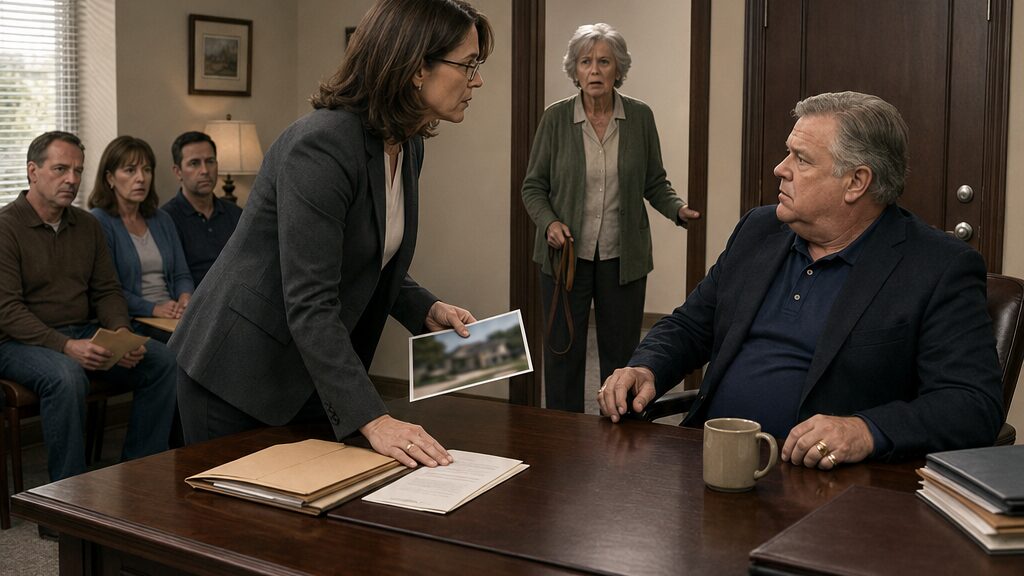
Edward Harris looked up from his desk and said, “So. You found the old stain.”
Margaret had not yet given her name.
The HOA office smelled of coffee and lemon furniture polish. Three homeowners waited in molded chairs along one wall, each holding an envelope or folder. Behind Edward, framed photographs showed ribbon cuttings, holiday contests, and a younger version of him standing beside a sign that read PROPERTY VALUES BEGIN WITH PRIDE.
Margaret remained in the doorway.
“You know which stain?”
Edward leaned back. He was broad through the shoulders and wore a navy polo embroidered with the association crest. A ceramic mug beside his hand declared him the World’s Best Boss.
“Brian said you were upset about the flooring.”
“Brian told you before I arrived?”
“We communicate. That’s what responsible communities do.”
Margaret crossed the room and placed the flooring invoice on his desk.
“The association paid for carpet in a privately owned house eleven months ago.”
Edward barely looked at it.
“We occasionally assist estates with urgent exterior or sanitation matters.”
“Carpet is neither exterior nor sanitation.”
“You’d be amazed what becomes an association concern when neighbors start calling.”
One of the waiting homeowners lowered her eyes.
Margaret pulled out the disclosure form. “What happened in the house?”
Edward’s mouth flattened. “The owner died.”
“Where?”
“In her home.”
“That is not what I asked.”
He picked up his mug but did not drink. “Mrs. Johnson was ill. Her daughter lived out of town. There was an accident, then there was a death. It was unpleasant. The house was cleaned.”
“And the floor covered.”
“The house was made marketable.”
Margaret heard the answer beneath the words. Not denial. Justification.
“Why wasn’t the incident included in the resale certificate?”
Edward set the mug down.
“Because there was no open violation attached to the lot.”
“The certificate says no material incident associated with the property.”
“That language concerns association liabilities.”
“Does it?”
He smiled without warmth. “You signed your closing documents, Ms. Taylor.”
It was the first time he had used her name.
“No one forced you to buy the house. If you’re experiencing buyer’s remorse, you should speak to your attorney.”
Margaret opened her folder and removed a county death record and the public incident-summary page she had obtained that morning. Neither described the scene in detail. The report confirmed an emergency response at the address and the death of the former owner on the same date.
Edward glanced at the documents, then at the waiting homeowners.
“You’re making a private matter public.”
“You did that when the association paid the flooring bill.”
A man near the door shifted in his chair.
Edward leaned forward. “Every house has a history. People die. Pipes burst. Families fall apart. We do not destroy the value of an entire street because a buyer wants every sad detail printed in bold.”
“So the board decided what I was allowed to know.”
“The law decides what must be disclosed.”
“And the association decided how narrowly to read it.”
Edward’s jaw tightened.
For a moment Margaret thought he would order her out. Instead, he opened a drawer and removed a bright white notice.
“Since you’re here, this saves us postage.”
He slid it across the desk.
NOTICE OF LANDSCAPE NONCOMPLIANCE. Four hundred dollars. Unapproved front-yard shrubs obstructing required sight lines. Correction required within ten days. Additional daily penalties may apply.
Margaret read it once.
“I have not changed the landscaping.”
“The shrubs are on your property.”
“They were there when I purchased it.”
“Ownership includes existing conditions.”
One of the homeowners gave a quiet, humorless laugh before covering it with a cough.
Edward tapped the notice with one finger. “You may appeal at the next board session.”
Margaret took out her phone.
His eyes narrowed. “Recording is not permitted in this office without consent.”
“I’m retrieving a photograph.”
She opened the real-estate listing and enlarged the front exterior image. The shrubs appeared beneath the windows, trimmed to the same height and width as they were now. The image carried a date from six weeks before closing and a small notation: HOA marketing approval on file.
Margaret printed the photograph before coming. She removed the copy from her folder and placed it beside the violation notice.
She aligned the top edges precisely.
The same shrubs. The same branches. The same decorative stone visible beneath them.
“Please state whether this violation concerns the landscaping shown in the association-approved listing photograph.”
Edward looked from the picture to the notice.
The room had gone still.
“You are not conducting a deposition.”
“No. I am asking whether the association approved a marketing photograph displaying the same condition it now claims is newly noncompliant.”
“That approval concerned advertising.”
“Then the condition was known.”
“Known does not mean approved.”
“The notice says I installed unapproved landscaping.”
Edward picked up the paper. “It says the property contains unapproved landscaping.”
Margaret pointed to the second paragraph. “Installed or materially altered by current owner.”
His gaze stopped.
That was the moment his amusement disappeared.
Margaret had seen it hundreds of times across conference tables: the instant someone realized the person opposite them read the clauses they expected to be ignored.
Edward folded the violation notice in half.
The crease matched the fold in her disclosure form.
“If you refuse correction,” he said, “the penalties increase daily. Continued noncompliance may trigger a lien review.”
“For shrubs documented before my purchase.”
“For a violation attached to your lot.”
“And if I withdraw my questions about the house?”
His face did not change, but his eyes moved past her shoulder.
Toward a closed door marked ASSOCIATION RECORDS—AUTHORIZED ACCESS ONLY.
“I don’t negotiate enforcement,” he said.
Margaret followed his glance.
The door had a keypad lock. Beside it stood three banker’s boxes, each labeled with a year. One lid was slightly open. Inside, she could see bound meeting packets.
She gathered her papers.
Edward pushed the folded notice toward her. “Ten days.”
Margaret placed it in her folder without smoothing the crease.
At the front door she turned back.
“How long have you been president?”
“Fourteen years.”
“And before that?”
“Treasurer.”
“So you were here when Mrs. Johnson died.”
Edward rested both hands on the desk.
“I was here when half this neighborhood owed more than their homes were worth,” he said. “You see a stain. I see forty families who could not survive another price collapse.”
It was the first answer that sounded less like a threat than a belief.
Margaret left without replying.
Outside, the afternoon heat pressed against the pavement. She had reached the sidewalk when Rebecca Nelson stepped from behind a flowering hedge with the terrier in her arms.
“You shouldn’t have mentioned the flooring invoice in front of everyone,” Rebecca said.
Margaret stopped. “How do you know I did?”
“The woman in the blue chair texted me.”
“Does the whole neighborhood report to Edward?”
“No. They report on him. There’s a difference.”
Rebecca set the dog down. It sniffed the grass near the disputed shrubs.
“Edward will say he protected people,” she continued. “Some of them will believe him because their houses recovered.”
“He retaliated with a false violation.”
“I didn’t say he was right.”
“You knew the carpet was replaced.”
Rebecca looked toward Margaret’s house.
“Yes.”
“You knew Mrs. Johnson died there.”
“Yes.”
“And you warned me only after I moved in.”
Color rose along Rebecca’s neck. “I warned you when I could.”
“That is not the same thing.”
Margaret heard the sharpness in her own voice but did not soften it.
Rebecca tightened the leash.
“You want a file,” she said. “You want dates, signatures, a clean line from what happened to who is responsible.”
“I want the truth.”
“No. You want something that survives review.”
Margaret stepped closer. “Did you sit on the board?”
Rebecca’s eyes shifted to the white clubhouse.
“I was secretary.”
“For how long?”
“Six years.”
“During Mrs. Johnson’s death?”
Rebecca nodded.
“Then you kept the minutes.”
The terrier pulled against the leash. Rebecca did not move.
“I kept what they approved,” she said.
“And what did they refuse to approve?”
Rebecca’s face closed.
“That,” she said, “is why you should stop treating the minutes like they’re only paper.”
She walked away before Margaret could stop her.
Chapter 3: Four Years of Minutes and One Missing Page
The minute book jumped from page 118 to page 120.
Margaret noticed it because the binding thread remained unbroken.
She sat alone at the long laminate table inside the HOA records room while Edward worked in the office beyond the closed door. He had granted her ninety minutes under the association’s document-inspection policy, with no photographs and no access to “privileged attachments.”
The restriction itself was questionable. Margaret had objected in writing. Edward had responded by certified mail, citing privacy and legal review.
Now page 119 was simply gone.
Page 118 contained the end of a routine maintenance discussion. Irrigation complaints. Pool-gate repairs. A motion to postpone repainting the clubhouse.
Page 120 began mid-sentence:
—continued attention to community stability and potential market sensitivity.
Margaret ran a fingertip along the inner margin. The page had not torn out. It had been omitted before binding.
She copied the surrounding language by hand.
The same phrase appeared again seven months later.
Community stability.
Then once more the following year.
Market sensitivity.
The words surfaced around property sales, maintenance claims, and one closed session involving the Johnson lot.
Edward opened the door.
“You have thirty minutes.”
“I was given ninety.”
“You’ve used sixty.”
Margaret looked at the wall clock. She had used forty-eight.
“Your clock is twelve minutes fast.”
Edward glanced at it. “Then work faster.”
She turned back to the binder.
The documents were not proof of fraud. They were breadcrumbs arranged by people who understood that ordinary language attracted less attention than direct instruction. Margaret had once reviewed a claim in which a contractor used “site refresh” to describe replacing fire-damaged drywall before an insurer inspected it. The euphemism had not proved intent, but it had revealed where to look.
She wrote down every date tied to the Johnson property.
At home, she spread four years of copied minutes across her dining table. A beige carpet fiber clung to the plastic sleeve holding the flooring invoice. She nearly brushed it away, then left it where it was.
The next morning, the county records clerk helped her search building permits and code complaints. The house had no major structural permits in the two years before the sale. But the complaint log showed three calls about water staining near an upstairs bathroom.
Two complaints came from the former owner.
The third came from a neighboring address.
Rebecca’s.
The first complaint had been referred to the HOA because the possible source involved a shared exterior drainage chase. The second was marked owner responsibility pending inspection. The third ended with a note: ASSOCIATION REPRESENTATIVE ADVISED NO EMERGENCY CONDITION.
The representative’s name was not listed.
Margaret requested the maintenance attachments.
“Those are archived off-site,” the clerk said. “Could take a week.”
“Is there a permit for the repair?”
“No.”
“So either it was never repaired or it was done without a permit.”
The clerk gave her the cautious look of someone familiar with people who tried to turn public employees into witnesses.
“I can only tell you what is in the system.”
Margaret nodded. “That’s enough.”
It was not enough.
The state real-estate investigator said so that afternoon.
Margaret had submitted a preliminary packet containing the disclosure form, resale certificate, flooring invoice, death record, incident summary, landscaping notice, listing photograph, and excerpts from the HOA minutes.
The investigator spoke in a careful, neutral tone.
“You have inconsistencies,” she said. “You may have retaliation. You may have evidence that people used narrow disclosure language intentionally. But the minutes you provided do not establish that the association ordered anyone to make a false statement.”
“They paid to cover the affected floor.”
“They may argue sanitation, preservation, or mitigation.”
“The property was privately owned.”
“Associations sometimes act and seek reimbursement.”
“They never did.”
“That helps. It does not complete the chain.”
Margaret looked at the packet on the investigator’s desk. She had indexed every tab. Yellow for association records. Blue for sale documents. Red for post-closing retaliation.
For years, organized files had made other people nervous. This woman simply turned the pages.
“What completes the chain?” Margaret asked.
“An unredacted communication. Testimony from someone involved. An original attachment explaining the coded entries. Evidence the agent received an instruction and relied on it.”
Margaret thought of Rebecca.
The investigator closed the folder.
“Be careful with the death itself,” she added. “Disclosure obligations vary. Your stronger issue may be affirmative misrepresentation, known defects, association interference, or retaliation—not the fact that someone died in the home.”
“I understand.”
“Do you?”
The question irritated her because it was the kind she used to ask claimants.
The investigator slid the folder back.
“You are building a case around what they hid. Do not assume every hidden thing is legally actionable. Find the thing they lied about.”
On the drive home, Margaret called Brian.
He answered on the fourth ring.
“I already told you what the estate attorney said.”
“You told me the HOA had no involvement in preparing the property.”
“I said I wasn’t aware of any.”
“You received the flooring invoice three weeks before closing.”
Silence.
Margaret had found the timestamp in the metadata of an email Brian forwarded during the transaction. The attachment itself had been removed from her copy, but the message header remained.
“I receive dozens of documents,” he said.
“You opened that one.”
“How would you know?”
“The forwarding system logged attachment access.”
His breathing changed.
“Margaret, I’m not discussing client files.”
“I was the buyer.”
“My client was the estate.”
“And the HOA?”
“No.”
“You copied Edward Harris on the message.”
“That could have been routine.”
“You denied knowing the association paid for the carpet.”
“I denied remembering it.”
“No. You wrote, ‘The HOA was not involved in interior preparation.’”
Brian lowered his voice. “You need to stop calling my office with accusations.”
“I called your cell.”
“That’s not the point.”
“The point is your timestamp contradicts your statement.”
He disconnected.
Margaret stared at the phone.
A small victory, but not the one she needed. Brian was frightened. Frightened people protected themselves before they protected the truth.
That evening, she walked to Rebecca’s house carrying no folder.
Rebecca opened the door but left the chain latched.
“I don’t have anything else to say.”
“Page 119 is missing.”
Rebecca’s hand tightened on the door.
Margaret watched the reaction and knew.
“You remember it.”
Rebecca said nothing.
“The binding was made without it. So someone removed the page before the annual book was assembled.”
“Go home.”
“The entries before and after it refer to market stability. County records show you made a complaint about the upstairs leak.”
Rebecca’s face changed.
“You had no right to search my address.”
“It is a public complaint log.”
“That doesn’t make it yours.”
Margaret felt the familiar urge to explain relevance, admissibility, chronology. She reached instinctively for a folder she had deliberately left at home.
“I need to know what page 119 said.”
Rebecca gave a short, bitter laugh.
“Of course you do.”
“Did it record a repair vote?”
The chain rattled as Rebecca began to close the door.
Margaret placed one hand against the frame, not blocking it, only steadying herself.
“Rebecca, if Edward refused a repair and someone died—”
“Page 119 did not say that.”
“Then what did it say?”
Rebecca looked past Margaret toward the dark shape of the Johnson house across the street.
When she spoke, her voice was barely audible.
“It said one nineteen because I typed the number myself.”
Margaret waited.
Rebecca’s eyes filled, but her expression remained hard.
“I know exactly what was on that page,” she said. “And I am not telling you why.”
The door closed, and the chain slid into place.
Chapter 4: The Night Rebecca Waited Too Long
Rebecca opened the door before Margaret could knock a second time.
“Do you want the truth,” she asked, “or only the part you can file?”
The chain was gone. So was the terrier. Rebecca stood in a pale kitchen light wearing the same jacket she had worn on the sidewalk the day Margaret moved in.
Margaret had brought her notebook, but she kept it inside her bag.
“The truth.”
Rebecca looked at the bag. “That is not what your hands say.”
Margaret let the strap slide from her shoulder and placed the bag beside the porch railing.
Rebecca stepped back.
Her kitchen was small and orderly. A yellow envelope lay unopened beside a bowl of dog treats. Certified mail. The association’s return address was visible through the window.
Rebecca turned it facedown.
“Edward sent me a reminder about unauthorized statements,” she said. “He calls them reminders when he wants them to sound less like warnings.”
Margaret sat at the table. Rebecca remained standing.
“What was on page 119?”
“A motion.”
“For the repair?”
“For an inspection.”
Margaret waited.
Rebecca rubbed both palms over the front of her jeans.
“Emily’s mother had been complaining about a leak for months. Not a burst pipe. Something slow. Water came through the upstairs wall when it rained hard, then disappeared. The first contractor said the exterior chase needed to be opened. That meant cutting into association-controlled siding.”
“And Edward postponed it.”
“He said we needed three bids.”
“That is normal.”
“We had two.”
“Why not get the third?”
“Because no one wanted the job at the price Edward had already told the board was reasonable.”
Rebecca crossed to the sink and filled a glass but did not drink.
“The association had just settled a drainage claim on the next street. Reserves were low. Three owners were behind on assessments. Edward kept saying one special assessment would push them into foreclosure.”
“So he delayed.”
“He called it preserving options.”
Margaret heard the phrase’s shape. The same polished vagueness as market stability.
“What did the page say?”
“That the board voted to defer invasive inspection until the next budget quarter unless an emergency condition developed.”
“And you recorded objections?”
Rebecca looked down.
“I recorded that the motion passed.”
“Were there objections?”
“Yes.”
“Whose?”
“Mine. One other board member’s.”
“Why weren’t they included?”
“Because Edward said the minutes were not a transcript.”
Margaret had heard that argument before. It was often true. It was also useful.
“Then why remove the page?”
Rebecca set the glass down too hard.
“Because after she died, I amended it.”
The refrigerator compressor clicked on.
Margaret leaned back.
“Without a board vote?”
“Yes.”
“What did you add?”
“That the board had received repeated notice of a possible safety condition. That the secretary had requested immediate action. That the president directed the issue to be delayed.”
Rebecca’s voice remained even, but her thumb scraped repeatedly along the glass rim.
“Edward found the draft before the annual book was bound. He said I was rewriting history to protect myself.”
“Were you?”
Rebecca looked at her.
“Yes.”
The answer landed harder than denial would have.
Margaret said nothing.
Rebecca pulled out the chair opposite her and sat.
“The night Emily’s mother died, I heard banging.”
“From the house?”
“From inside the wall at first. Or I thought it was. She used to hit the radiator pipe when the leak started because she believed it changed the pressure. I had asked her to stop. The sound carried.”
Rebecca’s mouth tightened.
“We had argued that week. She accused me of caring more about the board than about people. I told her she made every repair sound like an emergency.”
Margaret saw the room as Rebecca described it: two women across a property line, each tired of being disbelieved by the other.
“The banging stopped,” Rebecca continued. “Then it started again. Slower. Three times.”
“Did you call her?”
“I sent a text.”
No answer was needed to understand that there had been no reply.
“How long did you wait?”
Rebecca stared at the table.
“Forty-three minutes.”
Margaret’s fingers moved toward the bag beside the porch, though it was no longer within reach.
“What happened when you went over?”
“The front door was unlocked. Water had come through the ceiling near the stairs. She was on the upstairs landing. Conscious, barely. She had fallen trying to get around the wet floor.”
“The stain was downstairs.”
“The paramedics moved her.”
Rebecca’s voice cracked for the first time.
“They worked on her in the living room because there was more space. I stood near the front door. I remember the carpet seam under one paramedic’s boot. It had lifted where the water reached the tack strip.”
Margaret looked toward the window. Across the street, her living-room curtains were open. From here, she could see the patched ceiling.
“Did she die from the fall?”
“She had a heart condition. Emily knew she was sick, but not how sick. The report listed cardiac arrest after a fall. The leak did not kill her by itself. My waiting did not kill her by itself. Edward’s delay did not kill her by itself.”
Rebecca pressed both hands flat against the table.
“That was the sentence everyone used afterward. Nothing by itself.”
Margaret’s mind had already begun assembling a chronology: first complaint, second complaint, vote, delay, emergency call, carpet replacement. She despised the ease with which the structure formed.
“When did the board decide to cover the incident?”
“Two days after the funeral. Edward called an emergency session. He said rumors were spreading and an investor had withdrawn an offer on another house.”
“Was there a vote?”
“There was a discussion. Then a motion to authorize sanitation and stabilization.”
“Market stability.”
Rebecca nodded.
“The carpet was part of that?”
“Yes. So was removing references to the unresolved leak from the resale file.”
Margaret could feel the case opening in front of her, each piece clicking into place.
“I need you to sign a statement.”
Rebecca flinched as if Margaret had reached across the table.
“That is what you came for.”
“It would establish context for the missing page.”
“You mean it would make me useful.”
“It would make the record accurate.”
Rebecca stood.
“You sat here and listened to me say I waited while a woman was dying, and your first response is to ask for a signature.”
Margaret opened her mouth, then closed it.
The criticism was fair. That made it harder to answer.
Rebecca walked to the counter and picked up the certified envelope.
“Edward thinks I want to blame him because I cannot live with blaming myself. He is not entirely wrong.”
“He still made the choice to conceal it.”
“And I made the choice to help him.”
“You amended the minutes.”
“Afterward. When it might save me.”
Margaret finally looked away.
She thought of a claim file from years earlier: a family whose policy had excluded the exact kind of water intrusion that destroyed their home. Margaret had documented the exclusion, checked every procedural box, and recommended denial. The decision had been correct. She still remembered the father asking whether correct meant no one had to care.
She reached for her bag, brought it inside, and placed it on the floor without opening it.
“I am sorry,” she said.
Rebecca’s expression did not soften.
“I do need evidence. But I should not have made that the first thing I asked from you.”
Rebecca sat again slowly.
For several minutes, neither spoke.
Then Rebecca described the emergency meeting. Edward had not threatened anyone. He had spoken about retirees on fixed incomes, families still recovering from the market crash, and homeowners who would lose refinancing options if the neighborhood became known for negligence. He had made concealment sound like mutual protection.
“He believed it,” Rebecca said. “That was the worst part. We did too, for a while.”
“Will you tell the investigator?”
“Not unless Emily agrees.”
“She may refuse.”
“She has that right.”
“The records concern more than her family.”
“The death concerns her mother.”
Margaret nodded.
It was not the answer she wanted, but she understood why it mattered.
Her phone rang before she reached her own front steps.
The number was unfamiliar.
“Margaret Taylor?”
“Yes.”
“This is Emily Johnson.”
Margaret stopped beside the disputed shrubs.
Emily’s voice was controlled, but anger pressed through every word.
“Rebecca gave me your number. I know you bought my mother’s house. I know what you found.”
Margaret waited.
“You will stop contacting people about her,” Emily said. “You will stop passing around her records, and you will not turn the worst night of her life into your fraud case.”
Chapter 5: The Settlement That Required Her Silence
The buyback offer covered Margaret’s purchase price, closing costs, inspection fees, moving expenses, flooring replacement, and attorney consultation.
It expired at noon.
At eight fifteen, the document lay in front of her on a mediation-room table, held flat beneath a glass paperweight. The association’s attorney sat across from her. Edward occupied the chair at the far end, hands folded over his stomach.
Margaret read the final paragraph again.
Mutual confidentiality. No admission of wrongdoing. Withdrawal of all regulatory complaints. Destruction or return of nonpublic association records. Waiver of claims involving the property, sale, enforcement notices, or prior occupants.
The $400 landscaping fine would disappear.
So would everything else.
“This is a complete financial remedy,” the attorney said.
“It is a private erasure.”
“It is a negotiated resolution.”
Edward shifted in his chair. “You wanted out of the house.”
“I wanted the truth about what I bought.”
“You received more information than most buyers ever do.”
“After closing.”
“The offer puts you where you were before closing.”
Margaret looked at him. “It puts me somewhere quieter.”
Edward’s expression tightened.
The attorney spoke before he could answer.
“The association is prepared to purchase the property through a designated entity. You will not bear a resale loss. That is significant.”
It was significant. Margaret had calculated the alternatives. Litigation could take years. A regulatory complaint might produce fines but no buyback. Selling with corrected disclosures could cost her tens of thousands of dollars.
The offer gave her certainty.
That was why it frightened her.
Edward pushed a second folder across the table.
“You think I enjoyed any of this?” he asked. “When the market fell, seven homes on this street were underwater. Three owners were choosing between assessments and mortgage payments. Every rumor shaved another few thousand off appraisals.”
“So you concealed a maintenance failure.”
“We contained a panic.”
“A woman died.”
“A sick woman fell during a leak we had not yet determined was association responsibility.”
“You removed the complaint history.”
“We kept unproven allegations out of a resale package.”
“You pressured the agent.”
Edward looked toward the attorney.
The pause was small, but Margaret saw it.
“We communicated with professionals involved in the transaction,” he said.
The attorney slid a pen toward her.
“At noon, the offer is withdrawn.”
Margaret left without signing.
At home, a flooring contractor stood in the living room measuring the damaged section. Margaret had scheduled him before receiving the offer. He lifted the carpet and examined the blackened wood.
“The subfloor needs to come out,” he said. “We can feather in the replacement and stretch the carpet from the hallway.”
“Will the seam show?”
“Not if we do it right.”
He smiled, expecting approval.
Margaret looked at the line where the carpet had been opened. For days it had bothered her whenever she crossed the room. It caught dust. It interrupted the smooth beige surface.
Now the promise of making it disappear felt less comforting.
“Leave the estimate,” she said.
Her phone rang as the contractor packed his tools.
Brian.
“I need to see you,” he said.
“Send whatever you have.”
“Not electronically.”
His office was nearly empty when she arrived. The receptionist’s desk light was off, and the framed sales awards in the hallway had been removed, leaving pale rectangles on the wall.
Brian locked the front door behind her.
“Edward’s attorney called my broker,” he said. “They are preparing to claim I acted outside the scope of their instructions.”
“Did you?”
“No.”
“Then show me the instructions.”
He ran a hand over his face.
“You make everything sound simple.”
“It usually becomes simpler once people stop lying.”
“That is easy for someone who no longer depends on this neighborhood.”
Margaret said nothing.
Brian opened a filing cabinet and removed a printed email chain.
The first message came from Edward.
Please ensure all property descriptions emphasize completed sanitation, current habitability, and absence of unresolved association violations. Historical maintenance discussions were closed without admission and should not be raised with prospective purchasers unless legally required.
Brian had replied:
Understood. Please confirm whether buyer questions regarding the prior occupant should be directed to the estate.
Edward’s answer:
Direct all such questions away from association operations. We expect professional cooperation from vendors receiving community referrals.
A later email was less restrained.
Agents who create unnecessary market damage should not expect continued access to association-sponsored listings or homeowner referral materials.
Margaret looked up.
“How many referrals did you receive from this neighborhood?”
“Twenty-six transactions in four years.”
“That is not a referral stream. That is dependence.”
Brian’s face flushed.
“I told myself the death itself was not automatically disclosable. I asked the estate attorney. He said to answer only direct questions.”
“Did I ask whether anything serious had happened in the house?”
Brian looked toward the dark window.
“At the final walk-through.”
“And what did you say?”
“That there had been ordinary repairs.”
“You knew about the emergency response.”
“I knew someone died. I did not know the details.”
“You knew the HOA paid for the carpet.”
“Yes.”
The word barely carried across the room.
Brian removed a thumb drive from the drawer.
“The original emails are here. Headers, attachments, everything.”
“Why now?”
“Because Edward is going to say I invented the language to protect my commission.”
“Did you?”
“No.”
“Did the commission matter?”
“Yes.”
Margaret appreciated the answer more than she wanted to.
Brian placed the drive on the desk.
“He kept saying we were protecting owners from another collapse. Some of those people were my clients. I knew what a ten-percent drop would do to them.”
“And you decided the buyer should carry the risk instead.”
His eyes met hers.
“Yes.”
The honesty did not absolve him. It did change the shape of the room.
Margaret took the drive.
At eleven twenty-three, she returned to the mediation office. Edward and the attorney were waiting.
The attorney checked the clock.
“Have you made a decision?”
Margaret sat and opened the agreement.
She thought of the mortgage payment due next month. The exposed subfloor. The attorney invoices already accumulating. The possibility that the state would decline action. The ease of walking away with every dollar restored.
She signed the page acknowledging receipt of the offer.
Then she turned to the confidentiality agreement.
Edward leaned forward.
Margaret placed the pen beside the blank signature line.
“I acknowledge that you offered to make me whole,” she said. “I do not agree that silence is part of being made whole.”
Edward’s chair scraped the floor.
“You are choosing a fight that may leave you with nothing.”
“No. I am choosing not to sell you the record.”
The attorney gathered the unsigned pages.
“At noon, this offer expires.”
Margaret closed her folder.
“So does your chance to call this a private misunderstanding.”
She left the receipt page on the table.
The confidentiality agreement remained blank.
Chapter 6: The Daughter Who Refused Their Version
Emily placed a square of beige carpet on the table between them.
“What do you think this proves?”
It was smaller than Margaret’s hand. The fibers were flattened and slightly darker along one edge.
Emily’s apartment was spare but not empty. Three framed photographs stood on a shelf: a younger Emily in a graduation gown, her mother beside a garden trellis, and both of them at a diner booth sharing a plate of fries.
Margaret did not touch the carpet.
“It proves someone kept it.”
“That is all?”
“That is all the object proves by itself.”
Emily studied her.
Rebecca sat near the window, hands clasped in her lap. She had not spoken since Margaret arrived.
“My mother mailed this to me six months before she died,” Emily said. “She said the carpet kept getting wet near the stairs. She wanted me to see the discoloration.”
“Did you contact the board?”
“No.”
The answer carried a warning.
Emily turned the fragment over. A date had been written on the backing in blue ink.
“She also sent photographs. I told her to hire a plumber. She said it involved the outside wall. We argued.”
Margaret kept her voice quiet. “Rebecca said your mother was ill.”
“She had an arrhythmia. She was supposed to avoid stairs when she felt dizzy.”
“Did the board know?”
“Rebecca knew.”
Rebecca raised her head. “I knew she had heart trouble. I did not know how serious it was.”
“My mother made sure no one knew how serious anything was.”
Emily’s anger shifted direction without weakening.
“She did not want me to move back. She did not want help. She wanted repairs, but she also wanted everyone to believe she was managing.”
Margaret looked at the carpet fragment.
A document could show that a complaint existed. It could not show the pride behind it, or the argument that prevented a daughter from understanding what the complaint meant.
Emily slid a typed statement across the table.
“I will not sign your version.”
Margaret read it.
The proposed statement was narrow. It confirmed that Emily’s mother reported recurring water intrusion, provided photographs, and expressed concern about navigating the upstairs landing. It did not speculate about the cause of death. It did not accuse Rebecca of causing it. It did not describe private medical details beyond what was necessary.
“This is accurate,” Margaret said.
“It is hers,” Emily replied. “As much as anything can be now.”
Rebecca looked at the floor.
“I will sign if Emily does.”
Emily’s jaw tightened.
“Not today.”
Margaret felt the familiar impulse to point out deadlines, evidentiary value, and the emergency lien threat Edward had hinted at. She let the silence remain.
Emily noticed.
“You really did work fraud claims?”
“For nine years.”
“And then you stopped.”
“Yes.”
“Why?”
Margaret looked at the photograph of Emily and her mother in the diner.
“There was a family whose house had repeated water damage. The policy excluded seepage over time. The evidence supported denial.”
“So you denied it.”
“I recommended denial.”
“What happened?”
“They lost the house.”
Rebecca shifted in her chair.
Margaret continued before she could retreat into careful wording.
“The father asked me whether being correct meant no one had to care. I told him my role was to apply the contract.”
Emily’s eyes did not leave her face.
“And was it?”
“Yes.”
“That is not an answer.”
“No.”
Margaret folded her hands.
“I left six months later. I told people I wanted a change. The truth was I had become very good at turning harm into categories. Covered. Excluded. Supported. Insufficient.”
Emily glanced at the carpet fragment.
“And now you are doing it to my mother.”
“I was.”
The admission changed something in the room. Not forgiveness. Space.
Margaret took out the investigator’s requested statement form but left it face down.
“You decide what enters the record,” she said. “Not me. Not Edward. Not the association attorney.”
“And if I refuse?”
“I proceed with the documents I have and leave your mother’s private history out.”
“That makes your case weaker.”
“Yes.”
Emily leaned back.
Rebecca began to speak, but Emily raised one hand.
After a long moment, she picked up a pen.
“I will sign my wording,” she said. “Nothing added later.”
“Agreed.”
“And any public correction uses the same language.”
“Agreed.”
Rebecca’s statement took longer.
She described the delayed call, the repair vote, the missing page, and her amendment. Twice she stopped. Once she asked Emily whether to continue.
Emily said yes.
At the state regulatory office that afternoon, the investigator accepted the email chain from Brian, the two statements, the county complaint log, and the retaliation records.
“This is materially different,” she said.
“Is it enough?”
“It is enough to open a formal inquiry. That is not the same as proving every allegation.”
Margaret nodded.
The investigator examined Emily’s statement.
“This wording is careful.”
“It is hers.”
“Keep it that way.”
Margaret understood the warning.
The HOA meeting hall was already crowded when they arrived that evening. Edward stood at the front beside two board members. A projector displayed a slide labeled SPECIAL ENFORCEMENT SESSION.
Margaret had not received notice of such a session.
Edward tapped the microphone.
“Before tonight’s scheduled agenda, the board must address misinformation being circulated by former vendors, former officers, and a current owner seeking financial leverage.”
Brian stood near the back wall. His face hardened.
Rebecca stopped in the doorway.
Edward continued.
“The association acted on professional advice. Any incomplete sales statement originated with the listing agent. Any altered minutes originated with the former secretary.”
He did not use their names. He did not need to.
Emily whispered, “He is making them carry it.”
Margaret felt the room’s attention turn toward Rebecca and Brian.
A homeowner raised his hand. “Is this about the Johnson house?”
Edward ignored him.
“The board will also review accumulating violations at the Taylor property, including landscaping noncompliance, unauthorized records use, and conduct interfering with association operations.”
One board member looked down at the papers in front of him. The other appeared surprised.
Margaret walked toward the front.
Edward covered the microphone with his hand.
“You are not on the agenda.”
“You just placed me on it.”
“This is an informational statement.”
“Then correct the information.”
He removed his hand from the microphone.
“You rejected a full buyback and chose escalation.”
Murmurs spread through the room.
Margaret could feel the old version of herself reaching for the strongest fact, the sharpest contradiction, the cleanest path to victory.
Beside her, Emily held the signed statement against her chest.
Margaret did not take it.
She faced the room.
“I rejected an agreement that required every record to be sealed,” she said. “The state has opened an inquiry. Rebecca and Brian will speak for themselves if they choose. Emily Johnson’s statement will be used only in the form she approved.”
Edward’s expression flickered at Emily’s name.
He leaned toward the microphone.
“Given the owner’s continued refusal to cure violations, I am calling an emergency vote tomorrow night to authorize a lien against the Taylor property.”
The surprised board member turned sharply toward him.
“That was not in the packet.”
“It is now,” Edward said.
A process server entered through the side door carrying a certified envelope.
He crossed the room and handed it to Margaret.
The notice inside listed the proposed lien amount, including daily landscaping penalties, administrative fees, and legal review costs.
At the bottom, in bold type, was the time of the emergency vote.
Twenty-four hours.
Margaret looked at the total, then at Edward.
The confidential buyback had expired.
Now he intended to make keeping the house impossible.
Chapter 7: The Record They Could No Longer Edit
The lien vote began before Margaret was allowed to sit down.
Edward stood behind the long folding table at the front of the meeting hall, reading from a prepared motion while homeowners were still entering through the rear doors.
“Whereas the owner of Lot Forty-Two has failed to cure continuing violations—”
“One of those violations has already been disproved,” Margaret said.
Edward did not look at her.
“—and whereas costs associated with enforcement remain unpaid, the board moves to authorize preparation and recording of a lien.”
The board member seated to Edward’s left lifted a hand.
“We have not reviewed the supporting file.”
“You received the summary.”
“I received it twenty minutes ago.”
The second board member shuffled the packet in front of him. “There is no itemized accounting.”
Edward lowered the page.
“The owner has been given every opportunity to resolve this privately.”
Margaret walked to the front row. Emily sat beside Rebecca near the aisle. Brian remained against the back wall, holding a thin folder against his chest.
On the table before Edward lay the original $400 landscaping notice. Someone had added daily penalties, administrative charges, and legal-review fees until the proposed lien exceeded six thousand dollars.
Margaret placed the dated listing photograph beside it.
Then she laid a copy of the missing minute page over the notice.
The page was not the original. Rebecca had reconstructed it from an archived draft on an old computer, and the state investigator had authenticated the file’s creation date. The motion to delay invasive inspection appeared in plain language. Beneath it, Rebecca’s discarded amendment documented repeated warnings and Edward’s instruction to postpone action.
Edward stared at the papers.
“You are displaying confidential association records.”
“They are part of an active state inquiry.”
“That does not authorize public distribution.”
“I have not distributed them.”
“You placed them in front of the membership.”
“You placed a lien vote in front of the membership.”
A murmur moved through the room.
Edward turned to the board members.
“This is exactly the conduct I described. Selective documents, accusations, and pressure designed to force a payout.”
Margaret kept her hands at her sides.
“I rejected the payout.”
“That does not make your accusations true.”
“No. Evidence does.”
Edward looked toward Rebecca.
“And altered minutes from a former secretary protecting herself qualify as evidence?”
Rebecca flinched but did not lower her eyes.
“I altered a draft after the death,” she said. “I disclosed that in my statement.”
“You rewrote the record.”
“I added what you ordered removed.”
Edward’s voice sharpened. “You waited forty-three minutes before calling for help.”
The room went still.
Emily rose halfway from her chair.
Margaret turned toward her, but Emily shook her head once. Not now.
Rebecca’s face had gone pale.
“Yes,” she said. “I did.”
Edward appeared almost relieved.
“There. That is the truth being hidden. This is not an association failure. It is personal guilt being repackaged as governance.”
Margaret felt the room begin to tilt toward the simpler story. One frightened neighbor. One sick woman. One unfortunate fall.
Edward knew how to offer people an explanation they could live with.
Brian stepped away from the back wall.
“It was governance,” he said.
Edward’s head turned.
Brian walked forward and placed his folder beside the missing page.
“I received instructions to avoid discussing the prior incident, direct questions away from association operations, and protect market stability.”
Edward’s expression hardened. “You received routine guidance.”
Brian opened the folder.
“You also wrote that agents who created unnecessary market damage should not expect continued referrals.”
“That referred to reckless speculation.”
“You sent it after I asked whether the buyer should be told the association paid for the carpet.”
One board member reached for the email chain.
Edward put his hand over it.
“This correspondence is taken out of context.”
Brian did not release the folder.
“You told me this morning that if the complaint moved forward, you would tell the state I acted alone.”
Edward’s fingers tightened.
Brian looked around the room.
“I did not act alone. I also did not act innocently.”
The distinction settled over the hall.
The board member nearest Edward pulled the email chain free.
“We need independent counsel,” she said.
Edward turned to her. “We already have counsel.”
“Counsel representing the association under facts you controlled.”
The other board member closed the lien packet.
“I move to suspend the vote.”
Edward stared at him.
“You cannot suspend a motion already introduced without—”
“I second it,” the first board member said.
Hands rose across the room when the floor vote was called. Not every hand. Enough.
The lien motion stopped.
No one applauded.
The absence mattered to Margaret. This was not victory. Rebecca was crying silently. Brian looked as though he might be sick. Emily sat rigid, one hand closed around the carpet fragment in her pocket.
Edward remained standing behind the table.
“You think this saves the neighborhood?” he asked Margaret.
“No.”
“Property values fall when people lose confidence.”
“They also fall when boards falsify records.”
“I kept people in their homes.”
“You also decided other people could carry the cost without knowing.”
Edward looked past her toward the homeowners.
“When the market collapsed, I watched families beg banks for time. I watched retired couples calculate whether they could afford assessments. I promised this association I would never let panic destroy it again.”
Margaret believed him.
That was what made his next words worse.
“I will resign tonight,” he said, “if the public correction excludes Emily Johnson’s statement. The maintenance failure can be addressed. The sale can be corrected. There is no reason to publish a daughter’s private account.”
Emily stood.
Edward looked at her. “I am trying to protect your mother from becoming a permanent footnote in every resale.”
“You already made her a footnote,” Emily said. “You just wrote it without her name.”
Edward’s face changed, but he said nothing.
Margaret picked up Emily’s signed statement.
She had prepared a longer presentation. A timeline. Cross-referenced exhibits. Every contradiction arranged so no one could look away.
Instead, she read only the language Emily had approved.
The former owner had reported recurring water intrusion. She had provided photographs. She had expressed concern about safely using the upstairs landing. The board deferred invasive inspection. No statement was made that the leak alone caused her death.
Margaret stopped there.
Edward waited.
“That is all?” he asked.
“That is the record she authorized.”
“It leaves questions unanswered.”
“Yes.”
He gave a bitter laugh. “After all this, you are choosing an incomplete record.”
“I am choosing an accurate one.”
The independent review took four weeks.
The final agreement did not dissolve the HOA. It did not restore every dollar Margaret had spent, and it did not determine that one person had caused the death.
It voided the landscaping fine and all related penalties. It required corrected resale records for the property, disclosure of the prior maintenance complaints, and notice that the association had funded interior remediation before sale. It established a repair reserve funded partly through the association’s insurer and partly through deferred clubhouse improvements.
Edward resigned and signed the correction agreement. He did not apologize publicly.
Brian entered a consent arrangement with the state licensing office and surrendered his neighborhood referral contract. Rebecca submitted her statement, then met Emily privately. Margaret never asked what they said.
Emily directed the first repair-fund project toward exterior drainage inspections for older homes in the subdivision. She refused to name it after her mother.
When the living-room subfloor was finally replaced, the contractor again promised he could stretch the carpet so no seam would show.
Margaret told him not to.
He left a narrow, clean line where the repaired section met the original installation. It was visible only when the light crossed the room at an angle.
Weeks later, Emily visited the house once.
She stood over the seam and looked toward the patched ceiling.
“You kept it.”
“Not the stain,” Margaret said.
“I know.”
Emily placed the small piece of original carpet into Margaret’s hand.
Margaret did not bag it, label it, or place it in a folder.
She set it on the windowsill.
Outside, Rebecca walked her terrier past the disputed shrubs. The plants remained exactly where they had been on closing day, no longer a violation, no longer evidence that needed explaining.
Margaret looked down at the visible seam.
The floor had been repaired.
It had not been made to look untouched.
The story has ended.