They Kept Cutting His Gate Lock Until the Quiet Homeowner Opened the HOA’s Oldest File
Chapter 1: The Morning They Cut the New Chain
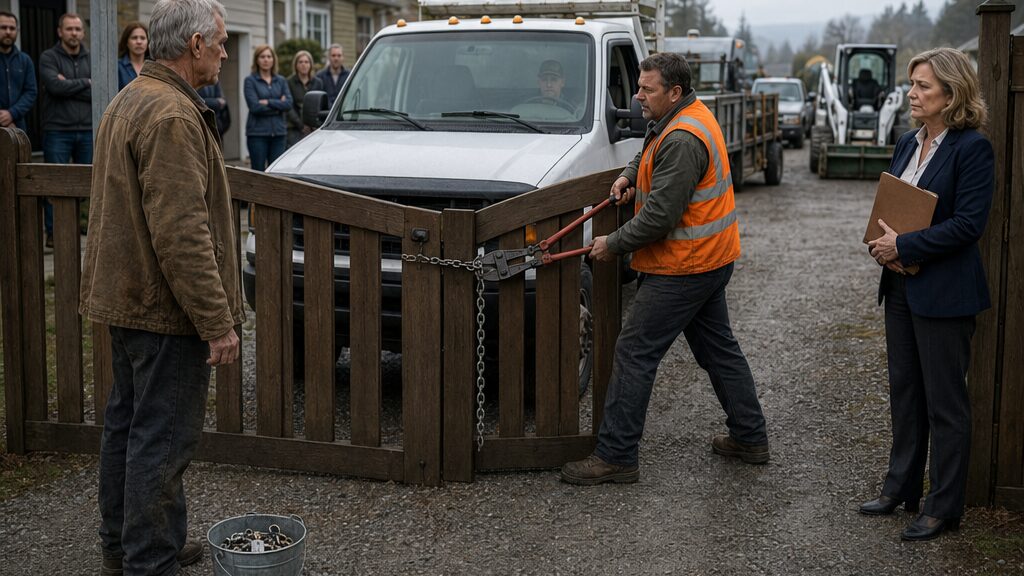
The bolt cutters closed on Charles Adams’s new chain before he reached the gate.
He was still thirty yards up the gravel lane, one hand gripping the handle of a steel rake, when the jaws bit down with a hard metallic crack. The chain dropped against the cedar post. Behind it, a white maintenance truck idled in low gear, amber light turning slowly on the roof.
Charles stopped walking.
The man holding the cutters looked over first. Gary Thompson had the broad shoulders of someone who spent more time directing crews than lifting anything himself. He wore a faded company jacket and orange safety vest. Two workers stood near the truck, watching the broken chain swing.
“Morning, Charles,” Gary called.
Charles resumed walking.
The lane ran behind his property for nearly four hundred feet before joining the narrow county road beyond the subdivision. It was not much to look at—two pale tracks of crushed stone, grass between them, drainage ditch on one side—but he had paid for every load of gravel spread there since he and Ruth bought the house.
Gary set the cutters in the truck bed.
“You cut my chain.”
Gary glanced at the gate as though Charles had pointed out a loose branch.
“We’ve got work scheduled.”
“That wasn’t my question.”
One of the workers looked away.
A second vehicle waited behind the first, loaded with landscaping equipment. Beyond it, Charles could see two homeowners standing at the ends of their driveways. Nobody came closer.
Gary exhaled through his nose.
“The association uses this access.”
“This is my property.”
“It’s been used for years.”
Charles looked at the severed link on the ground. The chain was less than a week old.
Then a woman’s voice came from behind him.
“Charles, please don’t turn this into something bigger than it needs to be.”
Debra Wilson approached from the subdivision side carrying a leather folder against her chest. She wore jeans, clean white sneakers, and the expression she used at HOA meetings when someone had already exceeded their allotted three minutes.
Charles had known her for eleven years.
He had never heard her raise her voice.
That was part of how she won arguments.
“You authorized this?” he asked.
“I authorized scheduled maintenance.”
“You authorized him to cut my lock?”
“I authorized access to a community service route.”
Charles looked from her to Gary.
“Show me.”
Debra’s mouth tightened slightly.
“Show you what?”
“The easement.”
“Charles.”
“The recorded easement. The access agreement. Whatever gives you the right to cut a chain on my gate.”
The amber light kept turning behind her. Each rotation washed the cedar posts in dull orange.
Debra shifted the folder to her other arm.
“This route has been used by association contractors for years.”
“That isn’t a document.”
“No, it’s a fact.”
Gary made a small impatient movement toward the truck.
“We’re burning time here.”
Charles stepped in front of the opening.
The driver’s engine note changed.
Debra lowered her voice.
“You are obstructing work that every homeowner pays for.”
“Then every homeowner can use the road that belongs to the association.”
“That route adds considerable time.”
“How much?”
Gary answered before Debra could.
“Twenty minutes, give or take.”
Charles stared at him.
“Twenty minutes.”
“It adds up over a day.”
Something in Gary’s tone made the situation suddenly simple.
Not emergency access. Not a blocked county road. Not a fire truck or ambulance.
Twenty minutes.
Charles turned toward the gate and saw the first truck’s front tire resting just past the broken chain. The tread had pressed deep into the damp shoulder. Beneath it, the fresh limestone gravel Charles had spread in February was already grinding into mud.
He crouched.
“What are you doing?” Debra asked.
He touched the rut with two fingers, then stood.
“That truck weighs enough to push the base course sideways when it’s wet.”
Gary gave a short laugh.
“It’s a gravel road.”
“It’s my gravel road.”
A neighbor across the drainage swale folded his arms.
Charles saw the gesture and felt heat rise behind his ears.
He knew how he looked.
Seventy years old. Work shirt buttoned wrong at one cuff. Rake abandoned in the middle of the lane. Arguing over gravel while three maintenance vehicles waited.
Debra knew how he looked too.
“Charles,” she said, louder now, for the benefit of those watching, “nobody is trying to take anything from you.”
He looked at the chain on the ground.
“No?”
Her expression changed for half a second.
Then it was gone.
“We can discuss this at the next board meeting. Today, the crew needs through.”
Charles did not move.
Gary stepped closer.
“Don’t make me call management.”
“Call whoever you like.”
Debra opened her folder.
“I would rather not begin an enforcement process.”
That stopped him.
Not because he feared the words themselves. Because he had heard the phrase before. Enforcement process meant notices. Hearings. Fines. Certified letters written by people who never put their names in the first paragraph.
“For what?” he asked.
“Interference with common operations.”
Charles looked toward the waiting vehicles.
Then toward the silent neighbors.
One of them went back inside.
The other stayed.
He stepped aside.
Gary gave the driver a small wave.
The truck passed within six feet of Charles. Its rear wheels sank into the softened edge of the lane, spraying two stones into the grass. The second vehicle followed. Then the trailer.
Debra closed her folder.
“Thank you.”
Charles did not answer.
He watched every axle.
After the last vehicle disappeared around the bend, he picked up the broken chain. The cut link was bright and raw where the metal had separated.
Debra started away.
“Debra.”
She stopped.
“I want the authority in writing.”
“You’ll receive whatever the association is required to provide.”
“That wasn’t what I said.”
She looked back at him.
“No,” she said. “It rarely is.”
By noon, Charles had photographed the rut, measured its depth with a folding rule, and placed the broken chain on his workbench.
At two seventeen, someone knocked once on his front door and left before he reached it.
A white envelope had been taped beneath the brass knocker.
At the top was the management company’s logo.
Below it, in bold:
NOTICE OF VIOLATION
Charles read the first paragraph standing on the porch.
The association alleged that he had obstructed established common operations, interfered with authorized contractors, and installed an unauthorized barrier across an HOA service route.
He read the last phrase twice.
HOA service route.
Then he looked past the house toward the rear lane.
For the first time that morning, his anger gave way to something colder.
He had spent thirty-two years checking survey descriptions for the city.
Words like route did not appear by accident.
Chapter 2: Every New Lock Became Their Argument
Charles found the second lock severed before sunrise.
The padlock lay open in the grass beside the gate, one side of the shackle cut clean through. He stood there in slippers and an old canvas coat, listening to a truck disappear beyond the trees.
He had installed that lock three days earlier.
At breakfast, he ordered another.
By Friday, that one was gone too.
The next chain was thicker. Gary’s crew cut it on a Tuesday afternoon.
Charles began keeping the remains in a small galvanized bucket in his workshop. He told himself there was no meaning in that. Metal was evidence. Evidence belonged together.
Still, every time a new piece struck the bottom, the sound seemed louder.
The management company sent two more notices.
The first warned that future obstruction could result in a hearing.
The second cited a provision requiring homeowners not to interfere with maintenance of “common facilities and access corridors.”
Charles read the declaration twice.
Then three times.
The phrase access corridors appeared in a section about sidewalks, drainage structures, and landscaped common areas. It did not identify his lane.
He wrote that in a reply.
The response arrived the next afternoon.
Mr. Adams,
The Association maintains that the service access has been established through longstanding use and operational necessity. Please direct further questions to management.
No attachment.
No deed reference.
No recorded instrument.
Charles printed the email and put it on the kitchen table.
That evening Emma Davis called.
“You sound irritated.”
“I’m not irritated.”
“You answer too fast when you’re irritated.”
He looked through the window toward the dark line of trees behind the house.
“They cut another lock.”
There was silence.
“Dad.”
“What?”
“Maybe stop buying locks.”
“It’s my gate.”
“I know.”
“You say that like you don’t.”
“I say it like I know you.”
Charles leaned against the counter.
Emma had inherited Ruth’s habit of waiting until he filled a silence himself.
He did not.
Finally she said, “Have you talked to an attorney?”
“I can read a deed.”
“That wasn’t my question.”
He ended the call five minutes later, polite enough to make clear that the subject was closed.
The next morning he bought another chain.
By the end of the second week, the bucket held four cut locks and three sections of chain.
Then Andrew Brown stopped him near the cluster mailbox.
Andrew was carrying a packet of HOA invoices under one arm.
“You got a minute?”
Charles looked at the packet.
“Depends.”
Andrew glanced toward the houses.
“Not here.”
They walked to the end of the cul-de-sac where the pavement gave way to an undeveloped strip of grass.
Andrew pushed his glasses up.
“I’m not saying Debra handled this right.”
“That’s usually how people begin when they intend to defend her.”
“I’m not defending her.”
“Then don’t.”
Andrew looked tired.
He was the HOA treasurer, which meant everyone blamed him when dues rose and no one remembered his name when the books balanced.
“The alternate contractor route adds time,” he said.
“So I heard.”
“It’s not just twenty minutes once. They go back and forth. Landscaping, drainage, tree work.”
Charles waited.
Andrew rubbed a thumb over the invoice packet.
“The contractor bid assumes rear access.”
“There it is.”
“What?”
“The reason.”
Andrew frowned.
“The association has used that route a long time.”
“That isn’t the reason you came over.”
“No.”
Charles folded his arms.
Andrew lowered his voice.
“The budget is tight. The reserve study came in worse than expected. If the contractor starts billing additional travel and staging time, it creates a problem.”
“How much of a problem?”
“I didn’t say this for you to use against me.”
“Then why did you say it?”
Andrew looked toward the mailboxes.
“Because I think you believe this is personal.”
Charles thought of the bucket in his workshop.
“It became personal when someone cut my chain.”
“I understand that.”
“No. You understand invoices.”
Andrew’s face hardened.
“That’s unfair.”
“Is it?”
For a moment neither spoke.
Then Andrew said, “The route saves money. That doesn’t automatically make it illegal.”
“No.”
Charles felt his anger settle into a different shape.
“It just tells me why nobody wants to answer a simple question.”
Andrew went still.
“What question?”
“Where’s the authority?”
Andrew looked away.
That was enough.
Charles saw it before the man said anything.
“You haven’t seen it either.”
“I didn’t say that.”
“You didn’t have to.”
Andrew’s jaw tightened.
“There are old records.”
“Which records?”
“You need to ask Debra.”
“I have.”
A delivery van turned into the subdivision. Andrew stepped back toward the curb.
“I shouldn’t have said anything.”
Charles almost laughed.
“You barely did.”
At home, he carried the bucket of broken locks from the workshop to the porch and set it beside his chair.
For the first time, he no longer saw seven separate insults.
He saw a pattern supported by a budget.
Convenience.
Twenty minutes.
Contractor bid.
Reserve problem.
The next notice arrived by certified mail.
It was more formal than the others.
Continued interference with common operations could result in fines, attorney referral, and recovery of costs incurred by the association.
Charles placed it beside the first two notices.
That afternoon, Debra emailed him directly.
The subject line read: SERVICE ACCESS CLARIFICATION.
Charles opened the attachment.
It was a color map of the subdivision.
Common areas were shaded green. Streets were gray. Drainage features were blue.
A narrow yellow line ran behind his house and crossed his rear lane.
Beside it were three words:
HOA SERVICE ACCESS.
Charles enlarged the image.
There was no date on the map.
No surveyor’s seal.
No recording number.
No source note.
But the yellow line was precise enough to look official.
He sat very still.
Then he clicked File Properties.
The document had been created six years earlier.
Not when the subdivision was built.
Not when he and Ruth bought the property.
Six years earlier.
Charles stared at the yellow line cutting across his land and wondered who had drawn it—and what they had been looking at when they did.
Chapter 3: When Charles Asked About the Axles
Gary raised the bolt cutters while Debra told Charles not to make a scene.
It was the third Saturday of the dispute, and this time half the neighborhood seemed to know something was going to happen.
A maintenance truck idled behind the gate. Two landscaping vehicles waited beyond it. Homeowners stood on porches with coffee cups. One man pretended to clean the windshield of his SUV.
Charles had placed a new chain through the gate at six that morning.
Not because he thought it would last.
Because he wanted everyone present to understand what was being done.
Gary positioned the jaws around a link.
Charles stood on the other side.
A galvanized bucket rested beside his right boot. Four broken padlocks and several cut lengths of chain were visible inside.
Debra looked at the bucket, then at him.
“This is exactly what I mean.”
Charles kept his eyes on Gary.
“Before you cut it, I’m asking one more time. What recorded instrument authorizes entry?”
Debra’s face tightened.
“We have provided a service map.”
“A map made six years ago.”
“We have longstanding access.”
“Recorded where?”
Gary lowered the bolt cutters an inch.
Debra turned toward him.
“Proceed.”
Charles looked at her.
“So you don’t know.”
“I know the association’s position.”
“That wasn’t my question.”
A woman from the nearest driveway shifted uncomfortably.
Debra heard it too—the silence around them, the sudden awareness that no one had produced a deed or easement.
Her voice became firmer.
“Charles, you have already received notice. This work is paid for by every homeowner in this community. You are delaying crews, increasing costs, and creating a public spectacle.”
He almost answered too quickly.
That was his habit.
Defend the line. Correct the wording. Refuse the implication.
Then he looked down at the bucket.
Every lock inside it represented the same mistake.
He had kept giving them something to cut.
Charles stepped back.
Gary blinked.
Debra did too.
Charles spoke clearly enough for the nearest homeowners to hear.
“I do not consent to entry over my property. I dispute that the HOA has a permanent access right. You are proceeding after direct notice.”
Debra opened her mouth.
Charles raised one hand.
“That’s all.”
Then he stepped aside.
Gary stared at him.
“You done?”
Charles nodded.
“Go ahead.”
The bolt cutters closed.
The chain snapped.
No one moved for a second.
Then Gary pulled the broken length free and tossed it toward the grass.
Charles bent, picked it up, and unthreaded the remaining section from the gate himself.
The change unsettled them more than shouting would have.
He folded the chain once and placed it in the bucket.
Then he took out his phone.
Gary frowned.
“What now?”
Charles walked to the front of the first truck and photographed the license plate.
“Documenting.”
“Documenting what?”
“The crossing.”
Debra stepped toward him.
“You cannot harass contractors.”
“I took a picture of a plate visible from my property.”
He moved to the side as the driver shifted into gear.
Then Charles looked at Gary.
“How many axles?”
Gary stared.
“What?”
“On this truck.”
“You serious?”
Charles glanced at the vehicle.
“Two?”
Gary gave a short laugh.
“You’ve lost me, old man.”
Charles counted aloud.
“Front steering axle. Rear drive axle. Two.”
The driver leaned from the window.
“What is this?”
Charles photographed the truck as it passed the gate.
“Saturday. Nine twelve a.m. White maintenance truck. Two axles.”
A murmur came from one of the driveways.
Gary’s smile faded.
The second vehicle approached.
Charles photographed the plate.
“Three axles,” he said.
Gary stepped closer.
“What are you trying to prove?”
Charles looked at him.
“I don’t know yet.”
That answer was true.
It was also the first honest thing he had said in days.
He had spent years working from control points, monuments, deed calls, field notes. You did not begin with the conclusion. You began with what could be measured.
The third vehicle passed.
He noted the time.
Debra stood with both hands gripping her folder.
“You’re making this unnecessarily hostile.”
Charles looked at the broken chain in the bucket.
“No. I think I’ve been making it unnecessarily repetitive.”
Her eyes narrowed.
“What does that mean?”
He did not answer.
By noon, the vehicles had crossed back twice.
Charles recorded each movement in a ruled notebook:
9:12 — white maintenance truck — plate photographed — 2 axles — entry
9:16 — landscaping truck — 3 axles — entry
9:19 — trailer combination — plate photographed — exit
11:42 — maintenance truck — return
He added one more column.
Notice given before crossing: yes.
At twelve fifteen, Gary walked past on foot.
He glanced at the notebook.
“Keeping score?”
Charles closed it.
“Something like that.”
Gary shook his head.
“You know, you could’ve saved yourself a lot of trouble by doing this three weeks ago.”
“Doing what?”
“Getting out of the way.”
Several yards behind him, Debra was speaking with two homeowners. One glanced toward Charles and smiled awkwardly.
He understood what they thought.
The old man had lost.
The HOA had shown him the notices, the map, the waiting trucks, the watching neighbors, and eventually he had given in.
Charles looked toward his open gate.
For a moment the thought stung more than he expected.
Then the first truck returned.
He raised his phone.
That evening, Emma came over without calling.
She found him in the workshop beneath the fluorescent light. The bucket of cut locks sat under the bench. The notebook lay open beside a ruler, printed photographs, and a copy of Debra’s yellow-line map.
Emma took in the room.
“Dad.”
“I know.”
“No, I don’t think you do.”
He kept writing.
She picked up one of the broken locks.
“You’ve been buying these just so they can cut them?”
“Not anymore.”
“You let them through today.”
He looked at her.
“Who told you?”
“I live eight minutes away. Also, people talk.”
“Good.”
Her expression changed.
“Good?”
Charles slid the notebook toward her.
She read the columns.
Dates. Times. Plates. Vehicle types. Axles. Direction. Notice status.
“What is this?”
“I’m finding out what they’re actually doing.”
“You still don’t know whether they have the right.”
“No.”
“Then why are you acting like you’ve already won?”
The question landed harder than he wanted it to.
Charles looked away.
“I’m not.”
Emma set the broken lock down.
“You always do this.”
“Do what?”
“Decide you’ll explain everything after you’ve fixed it alone.”
He shut the notebook.
“This isn’t about you.”
“I didn’t say it was.”
“Then don’t make it one.”
The silence that followed was immediate and ugly.
Emma stepped back.
Charles saw Ruth in the movement—not her face, exactly, but the way she had once withdrawn from an argument without leaving the room.
He rubbed both hands over his eyes.
“I’m sorry.”
Emma waited.
Charles looked toward the shelves along the rear wall.
There were tax records, survey plats, old insurance binders, boxes he had not opened since Ruth died.
One in particular had been moved from the house to the workshop because Charles had not been able to throw it away and had not wanted to see it.
A brown file box with Ruth’s handwriting on one side.
PROPERTY / DRAINAGE / HOA
Charles stared at it.
Emma followed his gaze.
“What?”
He felt something tighten in his chest.
Years earlier, during drainage work at the back of the subdivision, Ruth had handled most of the calls. Charles remembered trucks. Mud. Temporary fencing. He remembered being at the hospital too often to pay attention.
He remembered Ruth saying, once, sharply, Don’t throw that box away.
He had never asked why.
Charles stood.
“I need your help.”
Emma did not move.
He pointed toward the shelf.
“I need the box your mother told me never to throw away.”
Chapter 4: The Permission His Wife Never Meant Forever
Emma found Ruth’s signature before Charles finished cutting the tape.
The brown file box had been sealed so long that the cardboard tore under his thumb. Inside were folders warped by age, envelopes from the county, drainage diagrams, photographs of muddy trenches, and copies of letters Charles did not remember seeing.
Emma stood at the dining-room table sorting pages into rough piles.
Then she stopped.
“Dad.”
Charles looked up.
She held one sheet by the corners.
At the bottom, in blue ink faded almost gray, was Ruth Adams.
He knew the shape of the R before he read anything else.
“What is it?”
Emma did not answer immediately.
Charles took the page.
The letter was dated eleven years earlier. The subdivision’s drainage system had been failing behind the eastern row of houses. During repairs, the contractor needed temporary access to a rear ditch because the public route could not accommodate equipment while a culvert was open.
Ruth had written:
Temporary permission is granted for equipment access across the Adams rear lane solely for completion of the current drainage repair project, subject to restoration of disturbed gravel and closure of access upon completion.
Charles read it twice.
The room seemed to narrow around the paper.
Emma leaned against the chair.
“You knew about this?”
“No.”
“You were living here.”
“I know where I was living.”
“That’s not what I asked.”
Charles set the page down too carefully.
Eleven years earlier.
Hospital parking garages. Pharmacy receipts. Ruth pretending she was not tired. Charles measuring everything except the thing changing inside his own house.
He remembered drainage trucks now. Mud on the lane. A conversation from the kitchen that he had half heard because he was arguing with an insurance company.
He remembered Ruth saying, “I handled it.”
He had said, “Good.”
That might have been the whole conversation.
Emma read the letter again.
“This explains why people think they can use it.”
“It explains one project.”
“It explains some of it.”
Charles looked at her.
“Don’t do that.”
“Do what?”
“Turn temporary into permanent because it’s convenient.”
Emma’s expression hardened.
“I didn’t.”
“You were about to.”
“No. I was about to say you’ve been telling everyone there was never permission.”
“There wasn’t permanent permission.”
“That is not the same sentence.”
Charles pushed back from the table.
The chair legs scraped the floor.
He wanted to argue. The words were ready.
Instead he looked at Ruth’s signature.
Emma lowered her voice.
“This doesn’t make Debra right.”
“No.”
“But it means you might not be completely right either.”
That sentence followed him to the county recorder’s office the next morning.
The clerk behind the counter listened while Charles explained what he needed, then slid a request sheet toward him.
“You want the subdivision declaration, amendments, easements, access agreements, and anything tied to your parcel?”
“And board-related recorded instruments if indexed.”
The clerk looked at him over reading glasses.
“You’ve done this before.”
“Municipal survey department. Thirty-two years.”
“That explains the handwriting.”
Charles did not smile.
An hour later, he sat beneath fluorescent lights with a stack of copies and a yellow legal pad.
The original subdivision declaration contained no permanent service easement across his parcel.
The recorded plat showed the lane within the Adams boundary.
A drainage easement existed along the rear ditch, but it was narrow and did not grant unrestricted vehicle passage.
Charles wrote each fact down.
Then he found an agreement recorded after the drainage failure.
The first page referenced temporary construction access.
The second required written owner consent for any extension.
The third required restoration of disturbed surfaces.
The fourth stated that broader commercial use would require a separate written instrument.
Charles read the clause again.
Separate written instrument.
He searched the index.
Nothing.
He asked the clerk to check alternate parcel references.
Nothing.
He searched the HOA’s legal name, its earlier name, and the developer’s name.
Still nothing showing permanent commercial access across his lane.
A small pressure released in his chest.
Not victory.
Something better.
A boundary.
Then the clerk returned with another folder.
“You might want this.”
“What is it?”
“Cross-reference from the drainage agreement.”
Charles opened it.
Inside was Ruth’s temporary permission letter, preserved as an exhibit.
Her signature again.
For several seconds, he could not move.
The record did not erase her permission. It gave it legal weight.
Anyone reading only that page could understand why use had begun.
Anyone ignoring the limitations could pretend it had never needed to end.
Charles sat back.
He thought of Debra saying longstanding access.
Of Gary saying twenty minutes.
Of neighbors watching him stand beside the gate.
He had wanted a clean story. His land. Their trespass. His right. Their wrong.
Ruth had complicated it with one page and a practical act of kindness.
The clerk placed another index sheet beside him.
“There’s one more reference.”
Charles looked down.
The drainage agreement had been cited six years later in a board filing.
Six years.
The same age as Debra’s yellow-line map.
“What filing?”
The clerk tapped a recording number.
“Association operational exhibit.”
Charles copied it.
The document took another twenty minutes to retrieve.
It was not an easement.
It was a recorded exhibit attached to a broader HOA filing about maintenance responsibilities and service areas. The map looked familiar immediately.
Green common spaces.
Blue drainage features.
A yellow line behind Charles’s house.
HOA SERVICE ACCESS.
He leaned closer.
The source note did not cite a permanent easement.
It cited the temporary drainage agreement.
Charles felt the first true chill of the dispute.
Someone had taken a narrow, conditional permission and drawn it as a clean operational route.
No expiration.
No restoration condition.
No owner-consent requirement.
Just a yellow line.
At home, Emma found him at the dining table with the chain from the gate coiled beside the document copies.
“You were right?” she asked.
Charles shook his head.
“Not the way I wanted to be.”
He showed her Ruth’s letter first.
Then the recorded agreement.
Then the later map.
Emma traced the yellow line without touching the paper.
“They used Mom’s permission.”
“They simplified it.”
“That’s a polite word.”
“It’s the accurate one.”
She looked at him.
“Since when do you care about being polite?”
Charles almost answered.
Instead he looked at the coiled chain.
“I’ve spent three weeks telling everyone there was never permission.”
“There was never permanent permission.”
“I know.”
“You’re allowed to know more now than you knew then.”
He folded his hands.
“That isn’t how it sounds in a meeting.”
Emma sat opposite him.
“Then don’t make it sound clean.”
He looked up.
She nodded toward Ruth’s signature.
“Tell the whole thing.”
Charles was silent.
That evening, he returned to the county index online and entered the recording number from the later filing.
A secondary reference appeared beneath it.
Board amendment exhibit.
Different date.
Different recording number.
Charles frowned.
He had not seen that document in the first search.
He wrote the number on his legal pad.
At the bottom of the index entry was a preparer field.
Not a surveyor.
Not a county official.
An HOA management company.
Charles stared at the screen.
The yellow line had not merely appeared.
Someone had filed a later document using the temporary agreement as its foundation.
And Charles had no idea who had authorized it.
Chapter 5: The Shortcut Was Hiding a Bigger Deficit
“If this lane closes,” Debra said, “some of you may be looking at a special assessment.”
The room changed instantly.
Charles felt it before anyone spoke.
Thirty-two folding chairs had been set out in the HOA meeting room. Nearly all were occupied. Homeowners who had ignored the cut chains now leaned forward at the phrase special assessment.
Debra stood behind a narrow table with Andrew beside her and the management-company representative at the end.
A projector displayed a drainage reserve chart.
Charles sat in the second row with a canvas bag between his shoes.
Inside it were the broken locks.
He had brought them without deciding whether to show them.
Debra clicked to the next slide.
“The association’s drainage reserve is below the level recommended in the most recent study. We also have increased contractor costs, deferred inlet work, and erosion repairs.”
A homeowner near the wall raised a hand.
“How much are we talking about?”
“We are not proposing an assessment tonight.”
“That wasn’t the question.”
Debra paused.
Charles watched her.
For the first time, she did not look like the woman at his gate with a folder and an answer prepared.
She looked tired.
Andrew stared at the table.
Debra said, “If access and staging costs increase substantially, the board would have to consider all funding options.”
The room filled with low voices.
Charles understood then why she had chosen the phrase before mentioning his lane.
She was not simply defending access.
She was making every neighbor imagine a bill with his name attached to it.
When public comment began, Charles waited.
Two homeowners spoke before him. One complained about landscaping. Another asked whether dues would rise.
Then Charles stood.
Debra’s expression barely changed.
“Three minutes.”
“I know.”
He walked to the front without the canvas bag.
That surprised her.
He placed one sheet on the table.
“This is the recorded temporary construction-access agreement tied to the old drainage project.”
A few heads turned.
Debra looked at the page but did not touch it.
Charles continued.
“It required written owner consent for extension. It required restoration. It did not create permanent commercial access.”
The management-company representative leaned toward the microphone.
“The association disputes that interpretation.”
“On what recorded instrument?”
Debra answered.
“Charles, we’ve been through this.”
“No. We’ve been through a map.”
“The route has been in operational use for years.”
“Because my wife granted temporary permission during a drainage repair.”
That produced the first real silence of the night.
Charles heard Emma’s voice in his head.
Tell the whole thing.
He forced himself to continue.
“I did not know she had signed it when this dispute began.”
Debra looked at him sharply.
That was not the admission she had expected.
Charles felt the room shift again.
Some people looked less certain of him now, not more.
Good, he thought.
Let it be true.
He placed a second copy beside the first.
“The later HOA service map cites that temporary agreement. It does not cite a permanent easement.”
Andrew raised his head.
The management-company representative whispered something to Debra.
She shook her head once.
Then said, “The board has relied on longstanding practice and operational necessity.”
“Necessity?”
Charles looked toward the projected budget chart.
“Or cost?”
A murmur moved through the chairs.
Debra’s jaw tightened.
“We are trying to maintain a community.”
“With my road.”
“With infrastructure everyone depends on.”
Charles nodded.
“That’s an answer.”
She blinked.
“It’s just not a property right.”
His three minutes expired.
The management-company representative told him so twice.
Charles returned to his chair.
The canvas bag remained closed.
After the meeting, Andrew caught him in the parking lot.
“Walk a minute.”
Charles almost refused.
Then he saw Andrew’s face.
They moved beyond the building where parked cars screened them from the entrance.
Andrew spoke first.
“You asked at the meeting what instrument we rely on.”
“Yes.”
“There isn’t a legal opinion.”
Charles said nothing.
Andrew rubbed both palms together.
“The board never got one confirming permanent access.”
“You voted to keep using it.”
“I voted to continue existing operations while management reviewed the issue.”
“Did management review it?”
Andrew looked away.
Charles felt anger rise.
“Andrew.”
“They raised questions.”
“When?”
“Months ago.”
Charles stepped closer.
“Before my first chain was cut?”
Andrew hesitated.
That was the answer.
Charles stared at him.
“You knew.”
“I knew there was uncertainty.”
“You knew enough to tell me?”
“I told you there were old records.”
“You told me to ask Debra.”
Andrew’s voice sharpened.
“You think I don’t understand that?”
For the first time, he sounded angry rather than cautious.
“The reserve account is short. Not a little short. We delayed drainage work because people screamed about dues. Then costs went up. The alternate access requires staging from the county side, smaller loads, more labor. Gary’s bid changes.”
“Then charge the people who use the system.”
“That means everybody.”
“Yes.”
Andrew laughed once without humor.
“You say that like everybody reacts well to a six-hundred-dollar assessment.”
Charles went still.
Six hundred dollars.
Not ruin.
But enough to matter to retirees, young families, anyone balancing a mortgage.
Andrew continued.
“Debra thinks if she keeps things moving another year, the reserve can recover gradually.”
“So she decided my land was cheaper.”
“I didn’t say that.”
“You didn’t have to.”
Andrew looked back toward the meeting room.
“She believes the old permission plus years of use gives the board a defensible position.”
“Does she believe it?”
Andrew did not answer.
Charles felt something inside him change.
Until that moment, he had imagined the dispute in hard lines.
Debra wanted control.
Gary wanted convenience.
The board wanted compliance.
Now there was a deficit under all of it.
Fear.
A room full of homeowners hearing special assessment and immediately looking for someone to blame.
It did not excuse the cut chains.
But it explained why Debra kept reaching for certainty.
Two days later, Charles received a forwarded message from the management company by mistake.
At least, he assumed it was a mistake.
The email thread began months earlier.
The management representative had written:
Permanent access rights across the Adams parcel are not clearly established by the materials currently in our file. Recommend title review before relying on the route for expanded recurring contractor use.
Charles read the sentence three times.
Below it was Debra’s response.
We cannot suspend established operations every time one homeowner challenges a route that has been used for years. Continue under current practice while we address documentation.
The date was four months before Gary cut the first chain.
Charles sat at his kitchen table.
The canvas bag of locks rested near his foot.
For several minutes, he had the clean anger he had wanted all along.
Then he pictured the reserve chart.
The worried faces.
Andrew saying six hundred dollars.
Truth had become more useful and less satisfying at the same time.
That evening, Andrew called.
His voice was low.
“Debra wants something from me.”
“What?”
“She’s drafting a board statement for the file.”
Charles waited.
“She wants me to certify that the lane has been long-established HOA access.”
“Has it?”
Andrew exhaled.
“She wants it signed by the treasurer.”
Charles looked through the window toward the dark rear gate.
“What are you going to do?”
There was a long pause.
“I don’t know.”
Then the call ended.
Chapter 6: He Opened the Gate and Started Counting
Charles removed the chain himself at seven forty-two on Monday morning.
He lifted it from the cedar posts, carried it to the workshop, and hung it from a nail above the workbench.
The gate remained open.
At eight eleven, the first truck arrived.
Charles photographed the plate.
At eight twelve, it crossed.
He wrote down the time.
For three weeks, he did the same thing.
The routine became almost boring, which was exactly what he needed.
Date.
Time.
Vehicle.
Plate.
Axles.
Direction.
Weather.
Prior notice status.
He installed two small weatherproof cameras within his own property line. One faced the gate. The other captured vehicles farther down the lane where the full configuration could be seen.
Emma helped him build a spreadsheet from the notebook entries.
“You know,” she said one evening, “most people use retirement for things like fishing.”
“I don’t fish.”
“That is the least important part of what I said.”
He almost smiled.
The crossings accumulated.
Landscaping truck.
Maintenance truck.
Dump trailer.
Drainage inspection vehicle.
Return trip.
Second return.
The same plates appeared on contractor invoices Emma helped him match from HOA records distributed with meeting packets.
For the first time, Charles could see the scale of the route as a system rather than a series of insults.
It was not one truck.
It was scheduling.
Bid assumptions.
Repeated savings.
Wear concentrated on a private lane because no one had been required to calculate the cost elsewhere.
On the ninth day, Gary slowed beside him.
Charles was standing near the open gate with his phone lowered at his side.
Gary leaned from the window.
“Looks better without all that hardware.”
Charles said nothing.
Gary grinned.
“Knew you’d learn how the neighborhood works.”
Charles looked at the truck.
“Three axles today.”
Gary’s grin disappeared.
Then he drove on.
That afternoon, a neighbor stopped while Charles was measuring a rut.
“So this is over?”
Charles straightened.
“What is?”
“The gate thing.”
“No.”
The neighbor glanced at the open entrance.
“Looks over.”
Charles pushed the measuring rod deeper into the soft gravel.
“Things can look that way.”
By the second week, Emma had linked forty-one crossings to dates after Charles’s written objection.
She turned the laptop toward him.
“This matters.”
“Yes.”
“You don’t sound pleased.”
He studied the columns.
“I’m deciding what it proves.”
“That they kept using your lane.”
“We already knew that.”
“It proves frequency.”
“Yes.”
“And notice.”
“Yes.”
“And the plates match their invoices.”
Charles nodded.
Emma leaned back.
“You’re doing it again.”
“What?”
“Waiting until you understand everything before letting anyone else understand anything.”
He looked at her.
Then, without speaking, he slid the original Ruth permission letter across the table.
“I’ve been thinking about putting this with the rest.”
“In court?”
“In any demand. Any hearing. Everything.”
Emma watched him carefully.
“That hurts the clean version.”
“I know.”
“Good.”
Charles raised an eyebrow.
She smiled faintly.
“I mean good that you know.”
The rain began that night and did not stop for two days.
By Thursday morning, water ran in thin brown channels down the lane. A heavy truck crossed at ten seventeen. Its rear wheels sank near the drainage edge and pushed gravel outward in a fan.
Charles photographed the damage.
Then, at noon, a county utility vehicle appeared at the gate.
The driver stopped rather than entering.
“We’ve got a reported washout near the rear drainage structure.”
Charles looked past him.
No contractor logo.
No landscaping trailer.
An actual problem.
“How urgent?”
“Could undermine the inlet if it keeps running.”
Charles hesitated.
The lane was his.
The access claim was disputed.
Every part of him had spent weeks learning not to surrender another inch.
Then he looked at the water moving across the gravel.
“Come through.”
He opened the gate wider.
The utility vehicle crossed.
Charles did not log it with the contractor entries.
Emma noticed that evening.
“You left one out.”
“No.”
She pointed to the camera timestamp.
“Twelve oh six.”
“County utility response.”
“So?”
“Different use.”
“Still crossed.”
Charles looked at her.
“Not every crossing is the same.”
The sentence surprised both of them.
Emma sat back.
There it was—the problem beneath the problem.
Charles did not want a world in which nobody could ever enter.
He wanted consent to mean something.
The next week, the rain damage worsened. His measurement photographs showed rut depth nearly doubled along the heaviest travel line.
He overlaid the dates with vehicle records.
The pattern was clear enough that even he stopped questioning it.
Then Andrew sent him an email at 11:38 p.m.
No message.
One attachment.
Charles opened it.
The file was an internal board thread from four months earlier.
Debra had asked management whether continued contractor use could create exposure if the route was not supported by a permanent easement.
The reply was blunt.
Yes. Continued expanded use after owner objection would increase risk. Recommend suspension or negotiated written access pending title review.
Below that was Debra’s response.
Suspension is not financially workable. Maintain route. Do not characterize access as temporary in homeowner communications.
Charles read the last sentence twice.
Then a third time.
His phone rang.
Andrew.
Charles answered.
“I sent you the original.”
“Why?”
Andrew’s breathing was audible.
“Because she told the board that email didn’t exist.”
Charles looked toward the workshop.
The old chain hung unused above the bench.
“What happened with the certification?”
Andrew was silent for several seconds.
Then he said, “She asked me again tonight.”
“And?”
“I told her I won’t sign it.”
Charles closed his eyes.
The conflict had changed.
Not because Andrew had become his friend.
Not because Debra had made one careless mistake.
Because someone inside the board had finally refused to help turn uncertainty into a fact.
Charles opened the attachment again.
The line remained on the screen.
Do not characterize access as temporary.
For the first time, he knew exactly what Debra had understood before the first chain was cut.
Chapter 7: The Record Debra Could Not Call a Mistake
The first paragraph of Debra’s settlement offer gave Charles what he had been asking for.
The second took it back.
He sat in the mediation room with the document flat beneath both hands while the civil mediator waited at the head of the table.
The proposed agreement would reimburse part of the gravel repair, withdraw pending HOA violation notices, and create a schedule for contractor traffic.
In exchange, Charles would acknowledge the rear lane as established HOA service access.
He read that sentence again.
Across from him, Debra sat beside the HOA attorney. She looked composed, but there were dark half-moons beneath her eyes. Andrew occupied a chair farther down the table, separate from both sides.
Charles placed the agreement down.
“No.”
The mediator folded her hands.
“Mr. Adams, perhaps we should identify which provision concerns you.”
“That one.”
He tapped the acknowledgment clause.
The HOA attorney spoke.
“It is intended to clarify future operations.”
“It is intended to turn a disputed claim into my signature.”
Debra leaned forward.
“We are trying to end this.”
“Then end it without asking me to certify something you couldn’t prove.”
Her face tightened.
The mediator intervened.
“Let’s slow down.”
Charles reached for the canvas bag beside his chair.
He had carried it through three meetings and never opened it.
This time he did.
The first broken lock struck the table with a small metallic knock.
Then another.
Then another.
He laid out four padlocks and three cut pieces of chain in a row.
No one spoke.
Charles rested his hand beside them.
“These are what happened while you were ‘clarifying future operations.’”
The HOA attorney glanced toward Debra.
She looked only at Charles.
“You put barriers across a route the association had used for years.”
“After I asked for the authority.”
“You knew there had been access.”
“I learned later that my wife gave temporary permission for one drainage project.”
Debra’s eyes sharpened.
“So there was permission.”
“Yes.”
The answer seemed to surprise everyone except Emma, who sat behind Charles near the wall.
Charles continued.
“There was temporary permission. Written. Conditional. Limited. I should have known about it before I started accusing everyone of having no basis at all.”
The mediator watched him carefully.
He felt the cost of the admission in the room.
Then he pushed Ruth’s letter across the table.
“I am not hiding it.”
Debra did not reach for the page.
Charles placed the recorded agreement beside it.
“But neither are you going to use her temporary permission to create a permanent right she never gave.”
The HOA attorney began to respond.
Andrew spoke first.
“I need to say something.”
Every head turned.
Andrew’s hands were clasped so tightly his knuckles had whitened.
Debra said, “Andrew, this is privileged settlement discussion.”
“I know where I am.”
Her voice lowered.
“Then be careful.”
Andrew looked at the mediator.
“I was asked to sign a certification describing the Adams lane as long-established HOA access.”
Charles remained still.
Debra said, “That was a draft internal record.”
Andrew turned toward her.
“It said I was certifying it as treasurer.”
“Based on years of use.”
“Based on what we wished the file said.”
The room went silent.
Debra’s face lost color.
The HOA attorney leaned toward her, but she raised a hand.
“Andrew, you supported continued operations.”
“I did.”
“You approved budgets based on that route.”
“I did.”
“You knew the association could not absorb sudden cost increases.”
“Yes.”
“Then don’t sit there now pretending you were outside it.”
Andrew flinched.
Charles saw something he had not expected.
Debra was right.
Not about the access.
About him.
Andrew looked down.
“I’m not pretending.”
His voice was quieter now.
“I kept saying we needed more review. Then I voted to keep doing what we were doing because I didn’t want to be the person who triggered an assessment.”
He raised his head.
“That’s on me.”
Debra stared at him.
Andrew continued.
“But I won’t sign a statement that says uncertainty was certainty.”
The fracture in the room was almost physical.
Not ally against villain.
People who had made smaller compromises discovering they no longer agreed about the next one.
The mediator called for a recess.
In the hallway, Charles’s attorney drew him aside.
“You have leverage now.”
Charles looked through the narrow glass panel in the mediation-room door.
Debra stood alone near the table. The HOA attorney was speaking into a phone. Andrew had gone to the opposite end of the room.
“How much?”
“Potentially significant.”
The attorney kept his voice low.
“Documented physical damage. Continued use after notice. Governance issues. Contractor liability. Depending on how a court views the record and the board communications, we can pursue a strong damages theory.”
Charles thought of the locks on the table.
“Good.”
His attorney did not answer immediately.
Charles looked at him.
“What?”
“You need to understand where the money comes from.”
“The HOA.”
“The HOA is the homeowners.”
Charles felt irritation rise.
“I know what an association is.”
“Then hear me anyway.”
The attorney opened a folder.
“If insurance denies portions tied to knowing conduct, some exposure may hit reserves directly. Those reserves are already weak. Litigation costs increase it. A large award can lead to a special assessment.”
Charles said nothing.
“Your case may be worth pushing hard,” the attorney continued. “But maximum recovery and best outcome are not automatically the same thing.”
Charles looked back through the glass.
For weeks he had imagined a number.
Not a precise number, but something large enough to make the cutting stop forever.
Something Debra would have to explain.
Something Gary would remember every time he saw bolt cutters.
Now he saw the faces from the meeting room instead.
Retirees.
Young parents.
People who had watched from driveways and said nothing.
People who had benefited from the shortcut without asking what it cost.
His anger did not disappear.
It became harder to aim.
When mediation resumed, Debra placed a revised offer on the table.
The acknowledgment clause remained.
Charles pushed it back.
“No.”
Debra exhaled sharply.
“What exactly do you want?”
“For you to stop claiming permanent access.”
“We need service continuity.”
“Then negotiate actual access.”
“We cannot renegotiate every operational need around one homeowner.”
Charles felt the old instinct return.
Correct her. Corner her. Win.
Instead he asked, “Why didn’t you suspend the route when management warned you?”
The question landed differently now that everyone knew the email existed.
Debra looked at Andrew.
Then at Charles.
“Because we had a reserve deficit.”
“We know.”
“No, you know a number on a slide.”
Her control slipped—not into shouting, but into something more honest.
“The drainage system needed work. Costs rose. Homeowners fought a dues increase last year. Two board members resigned. Every time we proposed spending, people accused us of incompetence.”
She pressed two fingers to the table.
“Gary’s bid worked because the route worked. Suspending it meant delays, revised staging, more money. I thought the old permission and years of use gave us enough basis to continue until it was resolved.”
“And when you learned it might not?”
“I thought stopping would create a crisis before we knew whether there was one.”
Charles looked at her.
There it was.
Not confusion.
A choice.
“You were warned.”
“Yes.”
The word was barely audible.
“And you kept sending them through.”
Debra met his eyes.
“Yes.”
For the first time since the dispute began, Charles did not need her to say anything else.
That night, his attorney sent him a draft demand.
The total was higher than Charles expected.
Repair costs.
Use damages.
Legal fees.
Additional claims preserved.
Emma sat at his kitchen table while he read it.
“Well?” she asked.
He folded the pages.
“I don’t want Debra’s settlement.”
“I know.”
“I don’t want this either.”
Emma studied him.
“What do you want?”
Charles looked toward the workshop where the chain still hung from its nail.
For weeks, every answer had begun with stop.
Stop crossing.
Stop cutting.
Stop lying.
Now that he had proof, stopping was not enough.
He picked up a pen.
At the next mediation session, Charles rejected Debra’s proposed agreement.
Then he turned to his own attorney.
“I’m rejecting our demand too.”
The attorney stared at him.
Debra did not move.
The mediator leaned forward.
Charles placed a blank legal pad in front of himself.
“I want different terms.”
Chapter 8: The Gate Stayed Open for a Different Reason
Charles began the civil hearing by admitting the fact that weakened his easiest case.
“My wife gave them permission.”
The judge looked up.
Across the room, Debra’s attorney stopped writing.
Charles stood beside his own counsel with Ruth’s letter in front of him.
“Temporary permission,” he continued. “For drainage repair equipment. Eleven years ago. I did not know she had signed it when this dispute started.”
The courtroom remained quiet.
Emma sat behind him.
Andrew sat farther back, near the aisle.
Charles forced himself not to look at either of them.
“I replaced locks because I believed there had never been any permission. I was wrong about that.”
His attorney had warned him that the admission could be handled more carefully.
Charles had decided he was finished handling truth carefully enough to make it resemble something else.
He placed the recorded agreement beside Ruth’s letter.
“What I was not wrong about was the limit.”
The evidence unfolded slowly after that.
Not one miraculous document.
A chain.
Ruth’s temporary permission.
The recorded conditions requiring written renewal.
The absence of any permanent commercial-access instrument.
The later HOA map that converted a narrow project route into a yellow line labeled service access.
Charles’s written objections.
The cut locks.
The violation notices.
Camera timestamps.
Vehicle plates.
Axle counts.
Contractor invoices.
Photographs of the gravel before and after heavy crossings.
The management warning.
Debra’s instruction to maintain the route.
Do not characterize access as temporary.
Then Andrew testified.
He did not present himself as innocent.
That mattered.
He acknowledged voting for continued operations. He acknowledged budget pressure. He acknowledged wanting to avoid an assessment.
Then he described the certification Debra had asked him to sign.
“Why did you refuse?” the attorney asked.
Andrew looked toward the judge.
“Because use is not the same thing as a right. And I knew we didn’t have enough to say otherwise.”
Debra testified later.
Charles expected denial.
Instead, she gave him something more difficult.
She admitted receiving the management warning.
She admitted continuing the route.
She explained the reserve deficit, the failed dues proposal, the contractor pricing, the fear that suspending access would force costs onto homeowners already angry about money.
The opposing attorney asked whether she intended to take Charles’s property.
“No.”
“Did you believe the HOA had some basis for access?”
“Yes.”
“Do you still believe that?”
Debra paused.
“Not the basis I claimed.”
Charles looked down at his hands.
There was no satisfaction in hearing it.
Only weight.
The hearing did not end with a giant number written dramatically on a board.
It ended with orders, findings, deadlines, and language precise enough to matter.
The court found no permanent HOA service easement across Charles’s lane.
The association was ordered to remove the disputed access designation from its governing operational materials.
Documented repair costs were awarded.
A negotiated amount covered unauthorized use after explicit notice.
Pending violation notices against Charles were withdrawn.
Gary’s company bore part of the cost associated with continued contractor entry after direct objection.
The HOA was required to submit to an independent governance and records review concerning the access designation and board communications.
The total recovery was meaningful.
It was also lower than the maximum Charles might have pursued through broader claims and longer litigation.
When the judge asked about prospective access, Charles stood again.
His attorney glanced toward him.
This part was his.
“I don’t want routine contractor traffic through the lane.”
The judge nodded.
“And emergency access?”
Charles thought of the county utility vehicle in the rain.
“Real emergency access is different.”
He heard Emma shift behind him.
Charles continued.
“I’m willing to allow narrowly defined emergency entry when the public route cannot reasonably serve an immediate drainage, utility, or safety need. Written protocol. Notice when possible. Restoration afterward. No routine scheduling. No assumption that an open gate means permanent permission.”
The judge looked toward the HOA side.
Debra’s attorney conferred with her.
Then agreed to negotiate the language.
That was the final shape of it.
Not surrender.
Not revenge.
Terms.
Several weeks later, Charles stood at the rear gate with a new chain in his hands.
He threaded it through the cedar posts.
The metal was clean and uncut.
Beside the gate, inside a weatherproof box, was a copy of the signed access protocol.
Routine contractor use prohibited.
Emergency entry limited.
Notice requirements.
Restoration obligations.
Contact information.
The yellow service-access line had been removed from the association map.
Gary’s crews now used the longer road.
The first time Charles saw one of the maintenance trucks pass the subdivision entrance and continue toward the county staging route, the driver glanced toward him.
Charles did not wave.
He did not need to.
Emma came down the lane carrying two cups of coffee.
“You locked it again.”
“Yes.”
She handed him a cup.
“I thought the chain was the problem.”
Charles looked at the new links.
“No.”
“What was?”
He considered giving her a short answer.
Old habit.
Instead he said, “I kept thinking a boundary should explain itself.”
Emma waited.
“It doesn’t,” he continued. “Not when people benefit from pretending they can’t see it.”
She nodded toward the protocol box.
“So now it has paperwork.”
“Apparently I’ve become very modern.”
She laughed.
Charles took a drink.
A vehicle horn sounded from the county road.
Not Gary’s truck.
A utility crew vehicle stopped near the entrance.
The driver got out and approached the gate with a clipboard.
“We’ve got a sinkhole forming near the rear inlet,” he said. “Dispatch said there’s an emergency protocol for access here.”
Charles looked at the clipboard.
The authorization was signed.
The location matched.
Heavy rain upstream had compromised the drainage edge.
For one brief second, he thought of Ruth.
Temporary permission.
Not weakness.
Not surrender.
A choice made for a reason.
Charles unlocked the chain.
The utility vehicle rolled through slowly.
He stood aside, then closed the gate behind it without locking it.
Across the subdivision, a maintenance truck belonging to Gary’s company reached the intersection.
It turned left.
The long way around.
Charles watched it disappear.
Then he looked at the open gate, the signed protocol in its box, and the uncut chain resting loose in his hand.
This time, the gate was open because he had decided it should be.
The story has ended.