She Let the HOA President Keep Talking While His Excavator Tore Through Her Greenhouse
Chapter 1: The Bucket Crossed a Line No One Could See
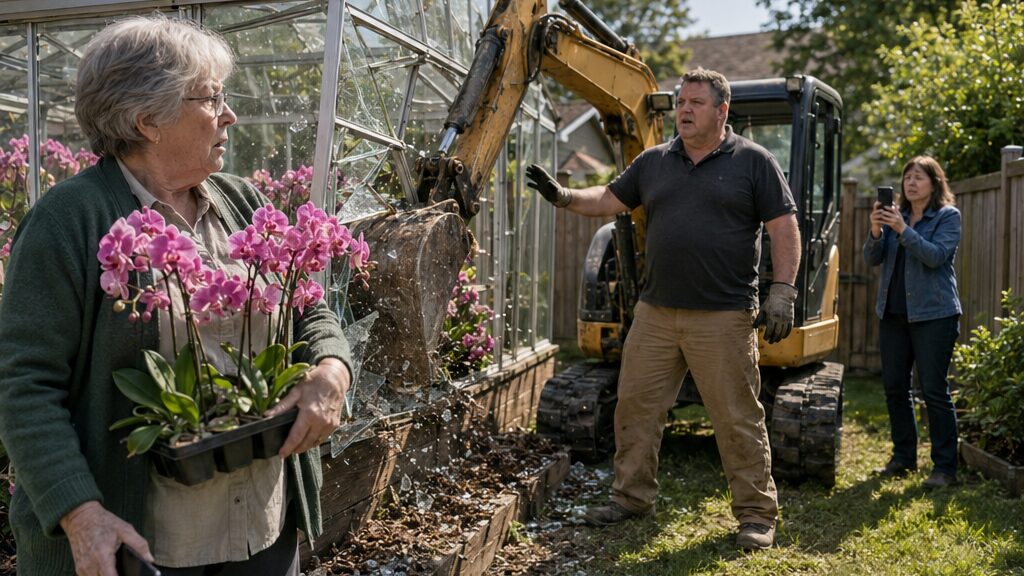
The excavator bucket came through the greenhouse wall before Sharon Carter understood that Scott Roberts intended to use it.
Glass burst inward with a flat, violent crack. One aluminum support folded. A hanging tray swung loose, struck another tray, and dropped three orchids onto the gravel floor.
Sharon froze with one hand still on the side-yard gate.
“Stop.”
The engine swallowed the word.
The yellow machine sat half on the grass and half on the narrow strip between her fence and greenhouse, its tracks pressing dark grooves into soil she had weeded the previous afternoon. Scott was in the cab. Through the glass, she saw his dark polo shirt, his left hand on a control, his mouth moving as if he were explaining something to someone who had already agreed.
The bucket pulled back.
“Scott!”
This time he looked at her.
Sharon crossed the yard faster than she had moved in years. Her shoe slipped on damp gravel. She caught herself against a cedar bed and felt a splinter enter her palm, but she kept going.
Inside the greenhouse, a bank of pink orchids had begun to lean where the frame had twisted.
Scott opened the cab door.
“You need to stay clear of the equipment.”
“You need to shut it off.”
“The structure is in violation.”
“It is on my property.”
“We’ve been through this.”
“No, you’ve sent me letters.”
Scott climbed down one step but did not leave the machine. Behind him, Kimberly Roberts stood near the sidewalk with her phone held upright. Sharon saw the red recording light. Kimberly’s mouth tightened, then made a small sound that might have been a laugh.
Sharon looked from the phone to the excavator.
“Are you filming this?”
Kimberly lowered the phone an inch. “For everybody’s protection.”
Another sound came from the greenhouse. Not glass this time. Wood.
One of the cedar beds had cracked where the first impact pushed the frame against it.
Sharon turned and saw an orchid tray slipping.
She ran.
By the time she reached it, two pots had fallen. One broke at her feet, bark chips and pale roots spilling into the dirt. She caught the remaining tray against her chest. A flower spike snapped beneath her wrist.
Six years.
That thought arrived without warning.
Not six years of money. Not six years of receipts.
Six years of mornings.
Scott called from behind her. “You can save yourself some trouble and take the rest down voluntarily.”
Sharon set the tray beside the house.
“What did you say?”
“If you remove the remaining structure yourself, we won’t need to come back.”
“We?”
“The association.”
The word settled more clearly than the noise of the engine.
Sharon reached into the pocket of her cardigan and took out her phone.
She did not raise it toward him. She looked at the screen, touched the camera icon, and pressed record.
Scott saw the movement and gave a tired shake of his head.
“This is exactly the problem,” he said. “Every time we try to enforce anything, somebody starts filming like they’re being persecuted.”
Sharon held the phone low at her side.
The excavator engine idled.
“Who authorized this?” she asked.
Scott glanced toward Kimberly.
“What?”
“This machine. Today. Who authorized you to bring it onto this strip?”
“You received notices.”
“That is not what I asked.”
His face changed slightly. Not doubt. Irritation at being made to repeat himself.
“I’m acting for the board.”
Sharon felt her fingers tighten around the phone.
“For the HOA board?”
“Yes, Sharon. The board. The association. However many ways you need it said.”
Kimberly gave a short breath of laughter.
Scott continued, encouraged by his own certainty. “You were given time. You were given the rule. You were given the fine. At some point enforcement has to mean something.”
Sharon looked at the greenhouse.
The line he had crossed was nowhere visible.
No rope. No fence post. No painted stripe.
Only a narrow run of grass and packed soil between the structure and the neighboring common landscaping, a strip she had been told for two weeks did not belong to her.
She had argued otherwise.
Scott had called that obstruction.
“Turn it off,” she said.
“I can’t leave a partially removed hazard.”
“You made it partial.”
“You refused compliance.”
Sharon’s hand shook once.
She put the phone against her thigh so he would not see.
Then the bucket moved again.
She had enough warning to step back.
The second strike caught the greenhouse farther down. A section of wall buckled. The roof frame twisted, and the sound that followed was worse than the first impact because it came in pieces: glass ticking down, metal creaking, wood splitting, pots hitting stone.
Sharon heard herself make a sound.
Not a scream.
Something smaller.
She dropped the phone into the deep pocket of her cardigan without stopping the recording and pushed toward the open greenhouse door.
“Stay out of there,” Scott shouted.
She ignored him.
A cedar shelf had collapsed across the center aisle. Several orchids lay beneath it. She reached for one tray, then another. The second was too heavy. She dragged it instead, scraping pots over the floor.
Outside, Kimberly said, “Scott, she’s going in.”
“I can see that.”
“Sharon!” Scott shouted. “If you get hurt, that’s on you.”
She almost laughed.
Instead, she lifted one orchid by the pot and stepped around broken glass.
When she came back out, Scott had shut off the machine.
The sudden silence made the yard feel enormous.
Sharon stood with the orchid against her chest. Its leaves were intact. One spray of flowers bent downward, still attached.
Scott climbed fully out of the cab.
“We’re done for today.”
“For today.”
“You need to remove what’s left.”
Sharon said nothing.
“If you don’t,” he continued, “I will come back.”
Kimberly still had the phone up.
Sharon looked at Scott.
“Say that again.”
His eyes narrowed.
“I said, remove the remainder yourself or I’ll come back with the excavator.”
The orchid trembled in Sharon’s arms.
Scott mistook that for weakness.
“You don’t own the neighborhood,” he said. “That’s what you need to understand.”
For the first time since the glass broke, Sharon looked directly at him.
“No,” she said. “I only asked about the part I do own.”
His expression hardened.
“Then you should have proved it when you had the chance.”
He turned away.
The excavator delivery driver, who had remained near the street with both hands in his jacket pockets, looked down as Scott passed him. Kimberly ended her recording and followed her husband.
No one apologized.
No one asked what had been under the fallen shelving.
Sharon waited until the machine backed away from the greenhouse before she moved.
Then she sat on the edge of the intact cedar bed.
The orchid remained in her lap.
A bright pink flower had landed on her sleeve. She picked it off and held it between two fingers.
The adjacent neighbor appeared at the fence.
“Sharon?”
“I’m fine.”
The answer came automatically.
The neighbor stared at the greenhouse.
“You’re not.”
“I said I’m fine.”
The woman’s face closed slightly.
Sharon regretted it at once, but not enough to call her back when she stepped away.
That was how Sharon had survived the years after her husband died: answer the question before it turned into concern. Fix the hinge. Pay the bill. Trim the dead roots. Do not become a project for anyone.
She stood.
Her phone was still recording inside her pocket.
She stopped it and looked at the screen.
Forty-three minutes.
The first minutes mattered. Scott saying he acted for the board mattered. The threat to return mattered.
She should call someone.
Instead, Sharon walked into the house, found a clean dish towel for her bleeding palm, and set the phone on the kitchen table beside the unopened mail.
For several minutes she simply watched the screen.
Then, through the window above the sink, she saw a small green light blinking beneath the eave.
Sharon stared at it.
One camera over the side yard.
And another above the back corner.
She had walked beneath them every day.
The phone in her hand had not been the only thing recording.
Chapter 2: Two Weeks of Letters Before the Glass Broke
The fine arrived before anyone answered Sharon’s objection.
She found the envelope in her mailbox on a Tuesday afternoon, thick cream paper with the Greenbrook Ridge Homeowners Association return address printed in the upper left corner. The amount appeared halfway down the first page.
$3,000.
Sharon read it twice while standing at the kitchen counter.
Then she carried it to the dining table and placed it beside the copy of the first warning.
That first letter had been almost polite.
It cited a setback provision and stated that “structures and permanent plant installations” had encroached on an association-controlled strip beside her property. Sharon had answered within a day. She attached a copy of the plot sketch from her deed packet and wrote, in four careful paragraphs, that the strip appeared to fall inside her parcel boundary.
No one replied.
Five days later, a second notice arrived.
Now the language was sharper. Continuing violation. Failure to cure. Possible assessment.
Sharon answered again.
Still nothing.
Then came the fine.
She sat down and reached for a pencil.
Retirement had not taken the bookkeeper out of her. Dates went in one column. Notices in another. Responses in a third.
Warning received.
Response sent.
Second notice.
Second response.
Fine.
She underlined the gap where an answer should have been.
That evening she walked to the HOA office carrying the plot sketch in a clear plastic sleeve.
Scott Roberts was alone behind the front desk.
The office had once been the sales center for the subdivision. Now it held a bulletin board, a folding table, framed landscaping photographs, and a metal file cabinet with a broken label holder.
Scott looked up.
“Sharon.”
“I need five minutes.”
“I’m heading into another meeting.”
“There is nobody here.”
His mouth tightened.
“Fine. Five.”
She laid the plot sketch flat.
“This is the strip you’re calling association property.”
Scott remained standing.
“Yes.”
“My boundary runs here.”
She touched the pencil line.
“The greenhouse is inside it.”
“That’s not the map we’re using.”
“Then show me the map you are using.”
“We already sent you the relevant rule.”
“A rule is not a deed.”
Scott exhaled through his nose.
“Sharon, the board decides what is compliant.”
“Compliance is not ownership.”
“You’re splitting hairs.”
“No. I’m drawing a line.”
For a moment, neither spoke.
Scott leaned over the paper.
“You have beds installed close to the common side. You have a greenhouse wall inside the required setback. We’ve had repeated complaints about inconsistent enforcement.”
“From whom?”
“That’s not the point.”
“It usually is.”
Scott straightened.
His voice lowered.
“Last year we spent months dealing with drainage complaints because one homeowner claimed we let another homeowner do whatever he wanted. Insurance got involved. People threatened lawsuits. Every time the board hesitates, someone says we play favorites.”
Sharon looked at him.
For the first time, she heard something beneath the officious tone.
Fear.
Not of her.
Of looking weak.
He tapped her sketch.
“We are enforcing the standard now.”
“On land you have not proved is yours.”
“We have an association map.”
“And I have this.”
“Then submit a formal appeal.”
“I did.”
“You submitted an objection.”
“I sent the evidence you asked for.”
Scott’s jaw shifted.
“You need to stop assuming that because you’ve lived here a long time, the rules are optional.”
Sharon picked up the plastic sleeve.
“And you need to stop assuming a board vote moves property lines.”
She left before he could answer.
On the walk home, three neighbors passed her.
One waved.
One looked away.
The third slowed near the corner.
“I heard there’s some issue with the greenhouse.”
Sharon kept walking.
“There’s an issue with paperwork.”
“Well, if you need anything—”
“I don’t.”
The neighbor stopped.
Sharon heard her own words and disliked them, but she did not turn back.
At home, she went directly to the hall closet.
The deed packet was not where she remembered.
She searched the filing cabinet, then the drawer under the telephone table, then the box where she kept tax records. Her frustration rose because Scott had done something she hated: made her doubt her own order.
At last she found the packet inside a blue folder marked HOUSE.
She carried it to the kitchen.
The old plot map was there.
The pencil boundary line looked exactly as she remembered.
A small satisfaction warmed her.
Then another document slipped out.
The original greenhouse permit.
Sharon nearly put it aside.
Instead, she read it.
The permit drawing listed a side clearance measurement.
She frowned.
Read it again.
The number did not match the distance shown on the plot sketch.
Not by much.
Enough.
She found a ruler.
Measured.
Checked again.
The permit had been issued years earlier, when she and her husband had built the greenhouse in stages. He had handled the contractor calls. Sharon had handled receipts and payments. She remembered arguments about drainage, electrical conduit, a delayed glass shipment.
She did not remember this measurement.
For the first time since the first notice, uncertainty entered cleanly.
What if Scott was wrong about ownership but right about the setback?
What if her own documents contradicted one another?
The following days tightened around her.
A board email referred to “continued noncompliance.” A printed notice appeared on her door. Scott sent one message saying voluntary correction remained the preferred option.
Sharon answered each item.
She did not call the neighbor who had offered help.
She did not tell anyone about the permit discrepancy.
She kept moving papers across the dining table as if arrangement could become certainty.
On Thursday night, an email arrived at 8:17.
She opened it standing in the kitchen.
The subject line read: FINAL ENFORCEMENT ACTION.
The message was brief.
Because the violation remained unresolved, removal action would proceed Friday morning.
Sharon read the phrase three times.
Removal action.
Not inspection.
Not hearing.
Not survey.
She wrote back immediately.
I dispute HOA ownership of the strip and do not consent to entry, removal, or demolition. No physical action should occur until title and boundary are verified.
She pressed send.
At 8:26, the message showed as delivered.
No reply came.
The next morning, Sharon heard a diesel engine before she finished her coffee.
Chapter 3: The Cameras Under the Eaves Remembered More
Sharon remembered the camera password because the green status light kept blinking at her through the kitchen window.
For twenty minutes after the excavator left, she had forgotten the cameras existed.
Now she stood beneath the eave with her phone in one hand and a dish towel wrapped around the other. The side-yard camera was no larger than a deck of cards. Her husband had insisted on installing two after packages disappeared from porches on the next street.
Sharon had argued they did not need them.
He had installed them anyway.
She opened the security app.
Password required.
She tried the obvious one.
Wrong.
Another.
Wrong.
The app warned her she had two attempts remaining.
“Think.”
Her own voice sounded strange in the damaged yard.
She looked at the greenhouse.
A section of roof leaned inward. Glass glittered among spilled bark. The excavator tracks remained pressed into the narrow strip.
Then she remembered the note her husband had taped inside the old router cabinet because he never trusted password managers.
Sharon went inside so quickly she left the back door open.
The note was still there.
She entered the password.
Two camera feeds appeared.
For several seconds she did not breathe.
Camera One showed the side yard from above the gate. The greenhouse occupied the right half of the frame. The disputed strip ran clearly between it and the common landscaping.
Camera Two looked from the rear corner toward the house.
Different angle.
Same machine.
Sharon touched the playback bar and dragged it backward.
There was Scott.
There was Kimberly.
There was Sharon herself entering through the gate.
Then the first impact.
On the small screen, the moment looked both less real and more precise.
The bucket moved.
The glass broke.
Sharon flinched even though she knew what came next.
She stopped playback.
Started again.
This time with sound.
The engine dominated everything, but voices were audible whenever it idled.
She heard herself say, “Who authorized this?”
Scott’s answer came clearly.
“I’m acting for the board.”
Sharon sat down at the kitchen table.
She played it again.
The words did not change.
She found the second camera angle.
The audio was rougher, but the machine’s movement was clearer. From that view, the tracks crossed the strip before the bucket touched the greenhouse.
Sharon opened a notebook.
Camera One.
Camera Two.
Phone.
Kimberly’s recording, possibly.
She wrote times beside each.
For the first time since morning, relief entered her.
Not happiness.
Structure.
By noon she had copied the files to her laptop and an external drive. She printed the emails and notices. She placed the fine on top.
Then she called John Taylor.
She had found his name years earlier through a local homeowners’ seminar and never expected to need him. His assistant arranged a phone consultation for late afternoon.
John’s voice was calm and unsentimental.
“Start with what happened today.”
Sharon told him.
He interrupted only to clarify dates.
“You have video?”
“Three recordings.”
“Three?”
“My phone and two exterior cameras.”
“Audio?”
“Yes.”
“Any visible property markers?”
Sharon looked through the window.
“No.”
“Survey pins?”
“Not that I can see.”
“I have a plot sketch.”
“A recorded survey?”
“I don’t know.”
That answer irritated her.
John seemed to hear it.
“Mrs. Carter, I’m not trying to undermine you.”
“Sharon.”
“Sharon. I’m trying to separate what we know.”
“He crossed onto my property.”
“Maybe.”
She went still.
“I thought you understood what I said.”
“I do. And the recordings may be excellent evidence of conduct. They may show entry, operation of the machine, damage, statements, threats. But a video cannot prove title by itself.”
Sharon looked at the notebook.
Her relief narrowed.
“I have a deed packet.”
“Good.”
“And a plot map.”
“Also good.”
“There’s a permit discrepancy.”
John paused.
“What kind?”
She told him.
Silence followed.
“That does not mean the HOA owns the strip,” he said. “It does mean we should not pretend all the paper points one direction.”
Sharon closed her eyes.
“So the video is useless.”
“No. I said the opposite.”
“You said it does not prove the property is mine.”
“It proves what happened. That matters. Ownership is a different question. Authority is another.”
Sharon opened her eyes.
“Authority.”
“Yes. Who ordered what. Under which rule. Whether the board approved physical entry. Whether there was a hearing. Whether they had a right to self-help. Whether the contractor understood the dispute.”
Sharon thought of Scott standing beside the excavator.
I’m acting for the board.
“I have that on audio.”
“What?”
“He said he was acting for the board.”
John’s tone changed slightly.
“Exact words?”
“I’m playing them now.”
She held the phone near the laptop speaker.
The recording ran.
Her question.
Scott’s answer.
Silence.
John said, “Save the original file.”
“I did.”
“Do not edit it.”
“I won’t.”
“Do not post it.”
“I wasn’t planning to.”
“Good.”
Sharon almost smiled.
He did not know her at all if he thought she wanted to become a neighborhood spectacle.
By evening she had created folders by date.
Warning.
Objection.
Second notice.
Fine.
Permit.
Videos.
She worked until her neck hurt.
At seven, the doorbell rang.
The adjacent neighbor stood outside with a casserole dish.
“I thought you might not have cooked.”
Sharon’s first answer rose automatically.
I’m fine.
She swallowed it.
“That’s kind of you.”
The neighbor looked past her toward the greenhouse.
“I saw some of it.”
Sharon stiffened.
“From my upstairs window,” the woman added. “I didn’t know whether to come over.”
“You didn’t need to.”
The old reflex again.
The neighbor nodded once.
“No. I suppose I didn’t.”
She handed Sharon the dish and left.
Sharon closed the door more slowly than necessary.
The next morning, Scott gave the neighborhood its first official version.
The message arrived through the HOA email list at 8:03.
Sharon was drinking coffee when she opened it.
The subject read: COMMUNITY SAFETY UPDATE.
She read the first paragraph.
Yesterday, the association completed authorized hazard removal involving a noncompliant structure after repeated notice and opportunity to cure.
Sharon stopped.
Authorized hazard removal.
The words were clean.
Professional.
Almost bloodless.
The email continued. It referred to safety risk, established setbacks, consistent enforcement, and regrettable homeowner resistance. It asked residents to avoid speculation while the board completed documentation.
Sharon read it twice.
Then a third time.
By the end, the broken greenhouse sounded like something the association had been forced to save everyone from.
Her phone buzzed.
A message from the neighbor.
I’m sorry. I didn’t realize it was a safety issue.
Sharon stared at the screen.
That was how quickly it happened.
Not with shouting.
Not with lies obvious enough to reject.
With a phrase.
Authorized hazard removal.
She turned toward the dining table where her evidence folders sat in careful rows.
The cameras could prove what Scott did.
They could prove what he said.
But somewhere between the broken glass and the neighborhood email, Scott had already begun turning action into authority.
And unless Sharon proved where the line truly belonged, his version might become the one everyone remembered.
Chapter 4: Fifteen Dollars Bought a Different History
“Do you want the original subdivision plat too?”
The county records clerk had already turned halfway toward the printer when she asked it.
Sharon looked up from the counter.
“The original?”
“The first recorded plat for the development.” The clerk tapped the file number on her screen. “You asked for current parcel history. Sometimes people want the earlier map when there’s a boundary dispute.”
For the first time that morning, Sharon stopped pretending she knew exactly what she was doing.
“Yes,” she said. “I want that.”
The clerk gave her a brief nod, as if uncertainty was the most ordinary reason in the world to ask for another document.
The county office was quieter than Sharon had expected. No dramatic rows of vaults. No dusty ledgers under glass. Just fluorescent lights, low partitions, printers, and people waiting with folders on their laps.
She had come carrying the deed packet, the permit drawing, Scott’s notices, and a copy of the HOA map attached to the fine.
John had told her to ask for recorded documents, not interpretations.
“Get the chain,” he had said. “Then we see what the chain actually says.”
The printer began feeding out large sheets.
The clerk placed the current parcel map on the counter first.
Sharon leaned over it.
Her lot was outlined in black. The side strip appeared attached to her parcel.
She did not move.
“Is that current?”
“Current tax parcel display,” the clerk said. “Not a survey. Don’t treat it as one.”
Sharon nodded.
The clerk set down another sheet.
A recorded plat from years earlier.
Then the original subdivision plat.
The paper was larger, the lines finer.
Sharon traced her street with one finger.
There was her lot.
There was the rear corner.
There was the narrow strip.
It did not look like the HOA map.
She took the association’s enforcement map from her folder and laid it beside the county print.
On Scott’s version, the disputed area seemed to blend into common landscaping.
On the recorded plat, the parcel line continued straight.
Sharon checked again.
Then a third time.
“How much are these?”
“Fifteen dollars total.”
Sharon almost smiled.
She paid with a twenty and waited for change.
Fifteen dollars.
The fine had been three thousand.
The greenhouse damage would cost far more.
And fifteen dollars had purchased a version of the neighborhood that did not bend toward Scott’s certainty.
Back home, Sharon cleared the dining table.
She placed every map side by side.
Current parcel display.
Recorded plat.
Original subdivision plat.
HOA enforcement map.
Permit drawing.
For an hour she resisted the temptation to decide too quickly.
That had become important.
Scott’s mistake had been certainty before verification.
She would not answer it with her own.
The permit discrepancy still bothered her.
The greenhouse clearance measurement did not align cleanly with the older plot sketch. That remained true no matter how satisfying the county record looked.
She called John.
“I have the original subdivision plat.”
“And?”
“The strip is inside my parcel line.”
“Appears to be?”
“Yes.”
“Good distinction.”
She ignored the mild correction.
“The association map shows something different.”
“What kind of map?”
“I don’t know yet.”
“Recorded?”
“There’s no recording information printed on it.”
“Then find out where it came from.”
Sharon looked at the four sheets.
“So this still isn’t enough.”
“It may be important. It may be very important. But title disputes are rarely improved by becoming emotionally attached to the first helpful paper.”
“I am not emotionally attached.”
John was silent.
Sharon looked at the broken greenhouse through the window.
“All right,” she said. “I am trying not to be.”
“That’s better.”
After the call, she examined the HOA map more carefully.
A small notation sat in the lower corner.
LANDSCAPE MAINTENANCE PLAN — REV. 2009.
Not subdivision plat.
Not recorded boundary survey.
Landscape maintenance plan.
Sharon felt something inside her shift.
She searched old HOA documents online.
Minutes.
Budget packets.
Archived newsletters.
A maintenance contract from years earlier referred to “association-serviced planting zones.”
A landscape drawing included shaded areas along several side yards.
Shaded for mowing and maintenance.
Not ownership.
Sharon stared at the screen.
The board’s enforcement map appeared to have been adapted from the landscape overlay.
At some point, a zone showing where contractors maintained grass had become a line showing what the association claimed to control.
She printed everything.
By afternoon, the dining table was covered.
The same narrow strip moved depending on which generation of paper she looked at.
On the original plat, it belonged with the lot.
On the later landscape overlay, it was shaded.
On the enforcement map, the shading had hardened into authority.
Sharon sat back.
For two weeks, Scott had spoken as if the line were obvious.
It had not been obvious.
It had been inherited from one document to another until nobody asked what the first line meant.
Her anger arrived differently this time.
Not hot.
Heavy.
Preventable.
The phone rang.
Sharon saw Rebecca King’s name and let it ring once more before answering.
“Hello.”
“Sharon.”
Rebecca’s voice was low.
“Yes.”
“I heard you went to county records.”
Sharon looked at the papers spread across the table.
“People hear quickly.”
“This isn’t gossip.”
“What is it?”
A pause.
“Did you pull the original plat?”
Sharon stood slowly.
“Yes.”
Another pause.
Longer.
Rebecca exhaled.
“Have you sent it to anyone?”
“My attorney.”
“I mean the neighborhood.”
“No.”
“Good.”
Sharon’s grip tightened on the phone.
“Why is that good?”
“Because I think we need to talk first.”
“We?”
“You and me.”
“You’re the board secretary.”
“I know.”
“And your president drove an excavator into my greenhouse.”
“I know that too.”
“Then say what you called to say.”
Rebecca’s voice nearly disappeared.
“Please don’t send the plat to the full email list yet.”
Sharon looked down at the original subdivision map.
“Why?”
There was a rustle on Rebecca’s end, as though she had moved into another room and shut a door.
“Because if that is the same plat I think it is,” she said, “the boundary may not be the only thing the board got wrong.”
Chapter 5: The Board Had Voted for Enforcement, Not This
“I voted yes,” Rebecca said. “But not to what he did.”
Sharon did not invite her to sit down.
Rebecca stood inside the kitchen with both hands wrapped around a paper cup she had brought from the coffee shop near the entrance to the subdivision. She had arrived ten minutes early and looked as if she had regretted coming for all ten.
Sharon remained by the dining table.
The county plats were still spread across it.
“Start again,” Sharon said.
Rebecca glanced toward the damaged greenhouse visible through the back window.
“We voted for enforcement.”
“What does that mean?”
“That’s the problem.”
“No. That’s the phrase. I asked what it means.”
Rebecca looked at her.
“It meant escalating unresolved violations. Formal notices. Fines where the declarations allowed them. Legal review if necessary.”
“Removal?”
Rebecca’s fingers tightened around the cup.
“Scott used that word.”
“When?”
“At the meeting.”
“And you voted yes.”
“I voted for the motion.”
“What did the motion say?”
Rebecca set down the cup and opened a folder.
She removed three pages of printed minutes.
Sharon did not take them immediately.
“Are those official?”
“Drafted and approved.”
Sharon finally accepted the pages.
The motion appeared halfway down the second sheet.
To proceed with consistent enforcement action on unresolved setback and common-area encroachment matters.
No demolition.
No greenhouse.
No machinery.
No property entry.
Sharon read it again.
“You recorded this.”
“I wrote the minutes.”
“And you let him tell me the board authorized what he did.”
Rebecca flinched.
“I didn’t know what he was doing that morning.”
“You knew there was a dispute.”
“Yes.”
“You knew I said the strip was mine.”
“Yes.”
“You knew he wanted removal.”
Rebecca looked away.
“He said delay would make us look weak.”
There it was.
Not ownership.
Not safety.
Weak.
Rebecca sat without being asked.
“We had the drainage mess last year,” she said. “People said we enforced against some homes and ignored others. One homeowner threatened to sue. Insurance premiums went up. Scott kept saying if we backed down again, nobody would follow anything.”
“And you believed him.”
“Partly.”
“Enough.”
“Yes.”
The word landed without defense.
Sharon sat across from her.
For several seconds, the kitchen held only the refrigerator hum.
“Why are you here?”
Rebecca stared at the minutes.
“Because the map bothered me.”
“Before or after the excavator?”
“Before.”
Sharon felt anger rise.
Rebecca saw it.
“I know.”
“No, I don’t think you do.”
“I saw the attachment you sent with your objection. The line didn’t match the maintenance map.”
“And?”
“I asked Scott whether we should get a survey.”
“What did he say?”
“That the board had used the same map for years.”
Sharon laughed once.
There was no humor in it.
Rebecca continued.
“He said if every homeowner could stop enforcement by waving an old sketch around, the association would never act.”
“So you did nothing.”
“I told myself it was not my area.”
“You are the secretary.”
“I know.”
“You wrote the vote down.”
“I know.”
“You watched him make the vote mean more than it said.”
Rebecca’s face changed.
Not anger.
Something worse.
Recognition.
“Yes.”
Sharon wanted to hate her cleanly.
It would have been easier.
But Rebecca did not look innocent, and she did not ask to be called innocent.
She looked like a person who had spent several days discovering that passivity could leave fingerprints.
“Why didn’t you come sooner?” Sharon asked.
Rebecca’s eyes moved toward the greenhouse.
“Because I was afraid.”
“Of Scott?”
“Of all of it.”
“That is not an answer.”
Rebecca swallowed.
“I thought if I questioned him publicly after the demolition, he would say I had approved enforcement and was changing my story because it went badly.”
“Would that be true?”
“Partly.”
Sharon sat back.
There was the complication.
Rebecca had not authorized a machine.
But she had supported the pressure that made Scott believe action was expected.
She had seen ambiguity.
She had chosen quiet.
“What do the other board members think?” Sharon asked.
“One thinks Scott acted within the vote. The other says he assumed Scott would consult counsel before anything physical.”
“And you?”
Rebecca looked directly at her.
“I think I helped create enough vagueness for him to tell himself he had permission.”
The honesty irritated Sharon more than a denial would have.
“Then say that publicly.”
Rebecca went still.
“At a board meeting.”
“Yes.”
“I can answer questions.”
“That is not what I said.”
“I can’t just send an accusation to the whole neighborhood.”
“Why not?”
“Because there are insurance issues. Counsel. Board duties.”
Sharon stood.
“Of course.”
Rebecca rose too.
“Sharon—”
“You came here to tell me the truth privately so you could continue being cautious publicly.”
“That’s not fair.”
“No?”
“I am trying to keep this from becoming worse.”
Sharon pointed toward the greenhouse.
“For whom?”
Rebecca had no answer.
The silence stretched.
Then Rebecca said, “If I am formally asked whether the board voted to authorize demolition, I will answer truthfully.”
Sharon stared at her.
“So I have to build the room where you can be brave.”
Rebecca’s face tightened.
“Yes,” she said.
The answer stopped Sharon.
No defense.
No excuse.
Just yes.
After Rebecca left, Sharon stood at the window.
She had expected the board to be a single thing.
That had been another kind of laziness.
Scott had acted.
Rebecca had hesitated.
Others had assumed.
Each person had contributed differently.
The result was still broken glass.
That evening, John called.
“I heard from the association’s representative.”
Sharon pulled out her notebook.
“What did they say?”
“Preliminary position only.”
“Meaning?”
“Meaning they are talking without committing.”
“Go on.”
“They dispute your characterization of unauthorized entry.”
Sharon’s jaw tightened.
“They have the video?”
“They know video exists.”
“And?”
“They suggested that if Scott acted under board guidance, individual liability may be limited.”
Sharon stopped writing.
“Say that again.”
John repeated it.
Under board guidance.
The phrase brought Rebecca’s minutes into sharp focus.
A vote for enforcement.
No vote for demolition.
Scott saying on camera he acted for the board.
Rebecca willing to answer only if formally asked.
Sharon looked at the line in her notebook.
“Did their representative say the board guided him?”
“Not exactly.”
“But they raised it.”
“Yes.”
Sharon set down the pen.
For the first time, the conflict divided cleanly.
If Scott acted alone, then Scott had crossed the line.
If the board guided him, then the board had.
Either way, someone had to choose which version they were willing to own.
Chapter 6: Put the Authority Behind Your Claim in Writing
The settlement offer was large enough to rebuild the greenhouse.
Sharon knew that before she finished the first page.
The association would fund replacement glazing, structural framing, cedar growing beds, electrical restoration, damaged irrigation components, and a specified amount for plant replacement. It would reimburse documented filing expenses and cover a professional survey.
John had marked the total with a yellow tab.
“This is not nothing,” he said.
They were on a conference call, but Sharon could hear the caution in his voice.
“No,” she said. “It isn’t.”
She turned the page.
The confidentiality clause was broad.
The non-disparagement clause broader.
Then she reached the factual statement.
The parties acknowledge a mutual misunderstanding concerning the location and maintenance responsibility of the disputed boundary area.
Sharon read it twice.
“Mutual.”
John said nothing.
She continued.
No admission of unauthorized entry.
No admission of wrongful destruction.
No statement identifying who ordered physical removal.
The settlement diagram was attached at the end.
Sharon almost missed the problem.
Then she laid it beside the county plat.
The line was still wrong.
Not dramatically.
Just enough.
She felt a slow disbelief.
“They are offering to pay for a survey while attaching the same bad line.”
John exhaled.
“I noticed.”
“And you did not begin with that?”
“I wanted you to read the offer as a whole.”
“I have.”
“What do you think?”
Sharon looked through the window.
The greenhouse remained braced with temporary lumber. She had stopped going inside except when necessary.
“I think they want to buy the ending before agreeing on what happened.”
“That is what settlements do.”
“No. Settlements buy risk.”
John was silent.
She knew she had sounded like the payroll supervisor she had once been.
Good.
Let him hear it.
A second voice joined the scheduled call ten minutes later: the HOA insurer’s representative.
Professional.
Measured.
Apologetic without apologizing.
“We recognize this has been distressing,” the representative said.
Sharon wrote the sentence down.
Distressing.
Not destroyed.
Not crossed.
Not ordered.
“We are trying to reach a practical resolution.”
John said, “My client has concerns about the characterization.”
“Understood.”
Sharon spoke.
“Who authorized the excavator?”
A pause.
The representative answered carefully.
“Our information is that Mr. Roberts was engaged in association enforcement activity.”
“That is not what I asked.”
Another pause.
John said nothing.
Sharon appreciated him for that.
She continued.
“Did the board authorize demolition of my greenhouse?”
“I can’t speak to internal deliberations in those terms.”
“Why not?”
“The governance record is still being reviewed.”
“Then why does your offer call it a mutual misunderstanding?”
“We are not attempting to assign blame.”
“You assigned enough blame to fine me three thousand dollars.”
The representative’s tone remained even.
“The fine is included in the proposed resolution.”
“Removed?”
“Yes.”
“Because it was wrong?”
“As part of settlement.”
Sharon looked at Rebecca’s minutes.
The representative continued.
“There are also issues concerning Mr. Roberts’s scope of action. If he acted pursuant to board guidance, the question of individual responsibility may be more complicated than you suggest.”
Sharon stopped moving.
There it was.
Not exactly an admission.
Enough.
“Put that in writing,” she said.
Silence.
John shifted on the call.
The representative said, “I’m sorry?”
“You just said that if Scott acted under board guidance, responsibility may be different.”
“I said it may be more complicated.”
“Fine. Put that position in writing.”
“I’m not sure that would be productive.”
“It would be very productive for me.”
The representative’s voice cooled slightly.
“We are here to discuss settlement.”
“So am I.”
“Then perhaps we should focus on terms.”
“I am. One term is that you tell me whether the board directed him to enter my property and remove my greenhouse.”
“That is a legal characterization.”
“No. It is a factual question.”
John finally spoke.
“I think Sharon’s request is clear.”
Another silence.
Sharon could almost feel the call changing shape.
The representative moved on.
“We can take the request under advisement.”
“Good.”
The conference ended without resolution.
The next day, no written statement arrived.
Nor the day after.
The silence gave Sharon no legal victory.
But it gave meaning.
Someone had been willing to invoke board guidance when it reduced Scott’s exposure.
No one seemed eager to confirm that guidance when it increased the board’s.
John came to Sharon’s house three days later.
He stood at the dining table, reading the revised settlement offer.
The money had increased.
The factual language had not improved.
“This could end it,” he said.
Sharon looked at him.
“Could it?”
“The practical dispute.”
“My greenhouse?”
“Rebuilt.”
“The beds?”
“Covered.”
“The orchids?”
“To the extent money can—”
“Exactly.”
John took off his glasses.
“I am not minimizing that.”
“You thought I wanted money.”
“At first, yes.”
“At first?”
“I think you want a record.”
“I want them not to call what happened mutual.”
John sat down.
“Litigation could take years.”
“I know.”
“It could cost more than the offer.”
“I know.”
“You could win on some issues and lose on others.”
“I know.”
“The permit discrepancy is still real.”
“I know.”
He studied her.
“Then what are you asking me?”
Sharon looked at the attached diagram.
The wrong line.
Again.
“I am asking you not to confuse my fear of a long fight with agreement.”
John’s expression softened, but she did not want softness.
She wanted precision.
He put his glasses back on.
“All right.”
Sharon opened a clean document on her laptop.
“What are you doing?”
“Responding.”
“To the offer?”
“Yes.”
She typed slowly.
No confidentiality concerning the factual circumstances of the demolition.
Correction of the boundary diagram subject to recorded survey.
Written identification of the authority relied upon for physical removal.
Restoration terms separate from characterization of fault.
John read over her shoulder.
“They may walk.”
“I know.”
“And if they do?”
Sharon stopped typing.
For a moment she saw the greenhouse as it had been before the excavator.
Her husband standing inside with a level.
One sleeve rolled higher than the other.
Sharon correcting the invoice total while he told her she worried too much about pennies.
She had kept that memory private because private things could not be used to pity her.
But privacy had become a wall.
Scott had filled the silence outside it.
The board had filled it.
The neighborhood email had filled it.
“I want to speak at the full board meeting,” she said.
John looked at her.
“Publicly?”
“Yes.”
“You have avoided that from the beginning.”
“I know.”
“What changed?”
Sharon closed the settlement file.
“They keep writing the story because I keep assuming the documents will speak for me.”
She sent the response.
Then she opened a second email addressed to the full HOA board.
Her fingers hovered above the keys only once.
I am requesting time at the next full board meeting to address the disputed boundary, the authorization for physical removal, and the association’s proposed characterization of the event.
She read it.
No threat.
No performance.
No plea.
She pressed send.
Within minutes, the message showed as delivered to every board member.
For the first time, Sharon had stopped asking for a private correction.
Now they would have to answer her in the same room.
Chapter 7: What Money Could Replace and What It Could Not
Scott Roberts arrived carrying a folder thick enough to suggest the meeting was already over.
Sharon saw him through the glass door of the clubhouse before he saw her. He wore the same dark polo style he favored for board business, though this one was pressed. Kimberly came in behind him and stopped near the back wall.
Scott gave Sharon a brief nod.
Not apology.
Not challenge.
Recognition of an obstacle.
The folding tables had been arranged into a wide U. Rebecca sat at one end with the meeting binder open in front of her. Two other board members were already there. John occupied a chair near Sharon but had placed no papers on the table.
“This is your meeting,” he had told her outside.
The room filled slowly.
Not a crowd.
Enough neighbors to make private language harder.
Scott sat and opened his folder.
“I understand we’re here to finalize settlement terms.”
Rebecca looked up.
“No.”
The single word changed the room.
Scott’s hand stopped on the first page.
“What?”
Rebecca glanced toward Sharon, then back at him.
“We are here to address the boundary record, the scope of prior board authorization, and the proposed resolution.”
Scott leaned back.
“That sounds like the same thing.”
“It isn’t.”
Sharon watched Rebecca’s face.
Fear was there.
So was the decision not to hide inside it.
The acting chair called the meeting to order. Procedural language followed. Agenda. Attendance. Limited comment period.
Sharon waited.
On the table before her lay two maps.
The old plot sketch from her deed packet.
The original recorded plat from the county.
She had brought no photographs of broken orchids.
No enlarged stills from the cameras.
No dramatic display.
When her turn came, she stood and placed the maps side by side.
“The first thing I want to correct,” she said, “is the line.”
Scott shifted.
Sharon continued.
“The association’s enforcement map appears to come from a landscaping overlay. The recorded subdivision plat does not place the disputed strip where that map places it.”
One board member leaned forward.
“Has that been verified by a surveyor?”
“Not finally. That is why I repeatedly asked that physical action stop until it could be.”
Scott spoke.
“We had an established map.”
Sharon looked at him.
“Established for what?”
“For association use.”
“That is not an answer.”
The acting chair warned them not to argue across the table.
Sharon nodded.
“Then I’ll ask it differently. Was the map recorded as a title change?”
No one answered.
Scott closed his folder.
“We were enforcing setback rules. This is being turned into something else after the fact.”
Sharon felt the old instinct rise.
Prove him wrong.
Win every sentence.
She let it pass.
Instead, she touched the permit file.
“My own paperwork was not perfect.”
The room quieted.
Scott looked up sharply.
“The original greenhouse permit contains a measurement that does not match the sketch I relied on.”
John did not move.
Sharon heard a murmur behind her.
She continued.
“That is why I am not asking anyone in this room to pretend I knew everything. I didn’t.”
Scott’s expression shifted toward opportunity.
“Exactly.”
Sharon looked at him.
“Which is why I asked you to wait.”
The opportunity disappeared.
“You knew the documents conflicted?” one board member asked.
“I discovered the permit inconsistency after the fine. Before demolition, I had already disputed ownership and asked that the boundary be verified.”
Scott said, “And meanwhile the structure remained noncompliant.”
“Possibly.”
“Not possibly.”
Sharon’s voice stayed level.
“You still did not know where the property line was.”
The room held that.
She sat down.
Then the acting chair turned toward Rebecca.
“Did the board vote to authorize demolition of the greenhouse?”
Rebecca’s face lost color.
Scott spoke first.
“We voted on enforcement.”
The chair raised one hand.
“I asked the secretary.”
Rebecca stared at the minutes before her.
Sharon remembered the kitchen.
I can answer questions.
Now the question had arrived.
Rebecca lifted her eyes.
“No.”
Scott turned toward her.
“That is misleading.”
Rebecca flinched but continued.
“The board voted for consistent enforcement action on unresolved setback and encroachment matters. The motion did not authorize greenhouse demolition. It did not authorize entry with excavation equipment. It did not identify Mrs. Carter’s property for physical removal.”
Scott leaned forward.
“You knew removal was on the table.”
“I knew you used the word.”
“And you voted yes.”
“Yes.”
The admission moved through the room more heavily than a denial.
Rebecca did not retreat.
“I should have forced the motion to be specific. I didn’t.”
Scott stared at her.
“So now I’m the only one responsible.”
“No,” Sharon said.
Every face turned toward her.
This was the moment she had not planned.
It would have been easy to let Rebecca become useful.
Useful witnesses were tempting.
Clean stories were tempting.
Sharon looked at Rebecca.
“No,” she repeated. “She is not innocent because you acted first.”
Rebecca’s eyes dropped.
Sharon continued.
“She saw ambiguity and stayed quiet. The board voted for language broad enough to be misused. Other people assumed. You chose to act before verification.”
Scott gave a bitter laugh.
“So everyone gets a share.”
“Yes.”
The room became still.
Sharon had expected satisfaction.
She felt none.
Only accuracy.
Scott pushed back from the table.
“I was trying to enforce rules this board asked me to enforce. After the drainage mess, after people accused us of favoritism, after every homeowner decided their case was special, somebody had to act.”
For the first time, his voice sounded less like authority than exhaustion.
Sharon believed him.
That did not absolve him.
“You were afraid delay would make you look weak,” she said.
Scott looked toward Rebecca.
There was his answer.
His face hardened.
“You don’t know what it’s like to have everyone demanding action and then disappearing when action is unpopular.”
Sharon almost said, I know exactly what it is to be left alone.
Instead she said, “Then you should have been more careful with the power you had.”
No one applauded.
Sharon was grateful.
The acting chair asked whether she wanted to discuss the settlement proposal.
Sharon opened the folder.
“The amount is enough to rebuild.”
Scott’s shoulders lowered slightly.
She saw him think the worst had passed.
“It can replace glass,” she said. “Cedar. Wiring. Irrigation. It can buy orchids.”
She stopped.
The next words were harder because no document could carry them.
“My husband and I built that greenhouse in stages.”
The room disappeared at the edges.
She looked at the old plot sketch.
“He did most of the framing. I did the invoices because he could never keep a receipt straight. We argued about the west vent for three weeks.”
A few people smiled faintly.
Sharon did not.
“He died before we finished everything we planned. I kept the greenhouse because work was easier than explaining what the empty house felt like.”
Her throat tightened.
She hated that.
For years she had avoided exactly this moment.
The pitying silence.
The softened faces.
She forced herself not to rush.
“Some of the orchids were six years old. A check can buy plants of the same species. It cannot buy those six years.”
Scott looked down.
Kimberly, at the back wall, lowered her phone into her lap.
Sharon closed the settlement folder.
“I am not refusing restoration. I am refusing language that says this was mutual confusion and nobody chose anything.”
The vote on Scott’s leadership came after a closed procedural discussion that felt longer than the demolition itself.
When the board returned, the acting chair read the result.
Scott Roberts was removed as HOA president, effective immediately.
He remained seated.
No one cheered.
Rebecca looked as if she might be sick.
Then came the second announcement.
The final restoration package would not be approved that night. The board wanted insurer review, survey confirmation, and revised terms.
Postponed.
Sharon felt the room tilt back toward uncertainty.
Scott had lost his title.
The greenhouse remained broken.
As people began collecting papers, Sharon looked at the two maps still lying side by side.
They had removed a man from a chair.
They had not yet repaired the line he crossed.
Chapter 8: The New Marker Did Not Give Her Back Six Years
The surveyor drove the concrete marker into the ground at 9:14 on a Tuesday morning.
Sharon watched every strike.
The first made a dull sound.
The second seated the marker deeper.
By the third, the narrow strip that had existed for months as accusation, map shading, pencil line, and legal wording became something a person could touch.
“There,” the surveyor said.
He brushed loose soil away with one glove.
The marker sat several inches inside the line shown on the HOA enforcement map.
On Sharon’s side.
She looked toward the greenhouse.
What remained of the old structure had finally been removed by a restoration contractor the previous week. Carefully this time. By agreement. With photographs taken before anything moved.
The board had approved the package after the recorded survey came back.
Restoration of the greenhouse.
Replacement cedar beds.
Electrical and irrigation work.
Reimbursement of filing costs.
Removal of the fine.
Correction of association mapping.
A new policy requiring documented authority and boundary verification before physical enforcement on disputed property.
Scott’s name appeared nowhere in the final terms except where prior actions were referenced.
Sharon had insisted on that too.
Not erasure.
Not spectacle.
Record.
The surveyor handed her a copy of the site sketch.
“You’ll want to keep this.”
“I keep everything.”
He smiled.
“I gathered that.”
After he left, Sharon stood beside the marker.
It was not beautiful.
Gray concrete.
Stamped cap.
Coordinates.
For weeks she had imagined satisfaction.
Instead, she felt tired.
A truck arrived before noon carrying cedar.
The adjacent neighbor appeared at the side gate five minutes later wearing work gloves.
Behind her stood two more residents.
Sharon’s first reaction was immediate.
“No.”
The neighbor stopped.
“We haven’t even done anything yet.”
“You don’t need to.”
“I know.”
“I hired a contractor.”
“We know.”
Sharon looked past them.
One of the residents held a cordless drill.
Another had brought coffee.
The old irritation rose because help, when it arrived without permission, could feel uncomfortably close to intrusion.
“I can manage.”
The neighbor’s face changed in the familiar way.
Not anger.
Withdrawal.
Sharon saw the moment before it completed.
She had seen it after the casserole.
After the early offer.
After every time she answered concern as if it were an accusation.
The contractor called from the yard.
“Mrs. Carter? We’re ready to set the first bed.”
Sharon looked at the cedar stacked on the truck.
The first bed.
Her husband had built the original one slightly out of square. Sharon had discovered it only after measuring for liners. He had blamed the fence.
She had blamed his level.
For years, one corner had remained off by half an inch.
She had never fixed it.
The neighbor began to step back.
Sharon heard herself say, “Wait.”
The woman stopped.
Sharon took a breath.
“You can help hold the frame.”
The neighbor stared at her.
“Just the frame?”
“For now.”
A smile appeared, small enough not to feel triumphant.
“For now.”
They carried the cedar together.
The first replacement bed went in beside the concrete marker.
Sharon insisted on checking the measurements herself.
No one argued.
By afternoon, the side yard held the beginning of a structure again.
Not the same one.
That distinction remained everywhere.
The new cedar smelled sharper.
The hardware was cleaner.
The replacement greenhouse panels would be safer and more efficient than the old glass.
Each improvement irritated her a little.
Loss did not become less because the substitute was newer.
Three days later, the orchids arrived.
Sharon had approved the nursery list herself.
She still was not prepared.
Boxes filled the back of the delivery van.
Pink phalaenopsis.
White dendrobiums.
Several cattleyas.
Healthy plants.
Excellent plants.
One tray alone cost more than she would once have permitted herself to spend in a year.
The restoration contractor carried the first box inside.
Sharon examined each pot.
Nothing was wrong.
That was the problem.
None had the bent cane she had tied to a green stake for four seasons.
None had the scar on the leaf from the winter the heater failed.
None had divided from the plant her husband bought her because he had forgotten their anniversary and stopped at a nursery on the way home.
The replacement list had species.
It did not have history.
Kimberly appeared at the gate while Sharon was unpacking the third box.
For a moment, neither woman spoke.
Kimberly held no phone.
“I won’t stay,” she said.
Sharon waited.
Kimberly looked toward the new structure.
“I thought you were going to come at him that morning.”
“What?”
“Scott.”
Sharon frowned.
“When I was filming.”
“You were laughing.”
Kimberly’s face tightened.
“I know.”
“Why?”
“Nerves.”
Sharon said nothing.
Kimberly looked ashamed, but not theatrically so.
“I had told myself I was recording in case you got aggressive. Scott said you had been threatening the board with legal action and refusing everything.”
“I disputed a boundary.”
“I know that now.”
“You knew I was sixty-nine.”
“That doesn’t mean—”
“No. It doesn’t.”
Kimberly stopped.
Sharon could see how the story had worked inside their house.
Scott under pressure.
Residents complaining.
Board authority questioned.
Sharon reduced to obstruction.
Kimberly protecting her husband from the difficult homeowner.
A camera raised for “everyone’s protection.”
Then laughter because fear sometimes dressed itself badly.
“You kept filming,” Sharon said.
“Yes.”
“That helped me.”
Kimberly looked toward the ground.
“I know.”
The irony did not produce satisfaction.
Sharon wiped bark dust from her hands.
“I’m not going to tell you it’s all right.”
“I didn’t come for that.”
“Good.”
Kimberly nodded and left.
A week later, the rebuilt greenhouse frame stood complete.
The board’s revised map had been circulated.
The filing reimbursement arrived by check.
Rebecca sent Sharon the new enforcement policy before it was published.
Sharon read every line.
She returned it with three corrections.
Rebecca accepted two.
Argued about one.
Sharon found that oddly reassuring.
On the first morning the new greenhouse was ready for planting, the adjacent neighbor came through the side yard carrying a small hand trowel.
The gate was closed.
Sharon stood inside with one surviving orchid.
Only a handful had made it through the collapse.
This one had lost two flowers and most of a root cluster. For weeks it had sat near the kitchen window in a plain plastic pot.
Sharon carried it to the bed nearest the survey marker.
The concrete post stood low beside the cedar.
The line was visible now.
Permanent.
She knelt.
The neighbor waited outside the gate.
“You want help?”
Sharon almost said no.
The word was ready.
Familiar.
Efficient.
She pressed the trowel into the planting mix.
Then she looked at the orchid.
Survival had never made it untouched.
That was not what survival meant.
She stood and walked to the gate.
The latch lifted easily.
Sharon opened it.
The neighbor did not move until Sharon stepped aside.
“Come in,” Sharon said.
Together they returned to the bed.
Sharon planted the surviving orchid on her side of the newly marked line.
Then she left the gate open.
The story has ended.