They Charged Her for Swimming Too Often, So She Built a Pool They Could Not Control
Chapter 1: The Whistle Blew While Lisa Was Still Dripping
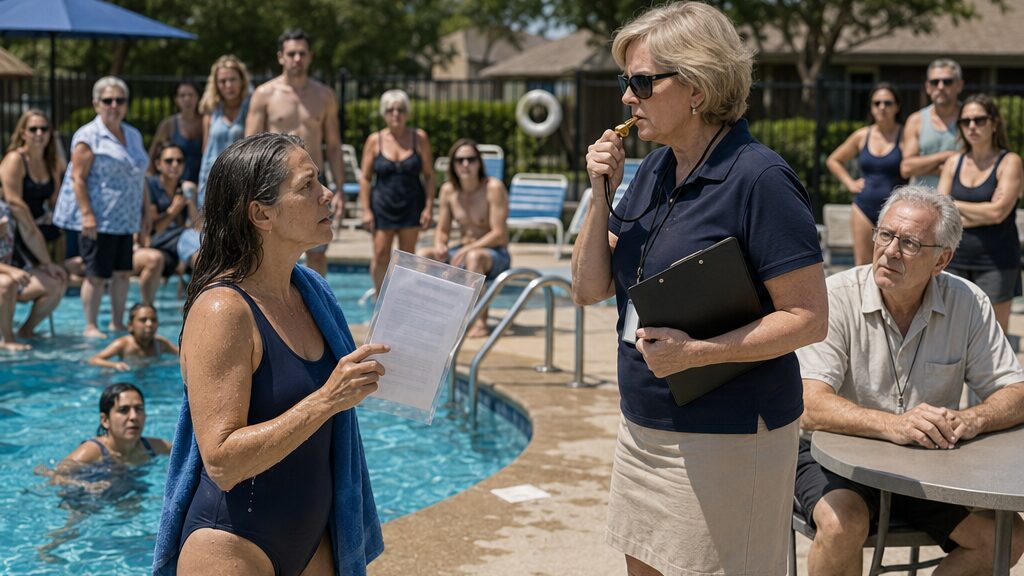
The whistle cut across the pool just as Lisa Torres placed one hand on the stainless-steel ladder.
Every head turned.
Children stopped splashing in the shallow end. A father lowered the foam ball he had been about to throw. Even the lifeguard, a college student who usually watched the water with sleepy patience, sat upright beneath the faded red umbrella.
Lisa remained on the second rung, water streaming from her shoulders.
Donna Baker stood at the edge of the deck in a navy polo and beige skirt, one hand gripping a clipboard. The brass whistle hung between her fingers. Sunlight flashed from its curved surface.
“Lisa,” Donna called, as though she were summoning someone who had ignored repeated warnings. “Step out, please.”
Lisa climbed the final rung. Her bare feet met the hot concrete. She reached for the blue towel folded on the chair beside her bag, but Donna stepped closer before she could wrap it around herself.
“This is an official notice.”
The paper Donna held was protected inside a clear plastic sleeve. At the top, beneath the neighborhood association logo, were the words RECREATIONAL AMENITY SURCHARGE.
Below that, in heavier type, Lisa saw the amount.
$340.
A few residents began studying anything except her. Others did not bother pretending.
Lisa took the notice. Water ran from her wrist onto the sleeve.
“What is the surcharge for?”
“Excessive use of the pool.”
For a moment Lisa thought she had misunderstood.
“This pool?”
Donna’s mouth tightened. “You have logged substantially more visits than the average resident.”
“I swim three mornings a week.”
“And sometimes on Saturdays.”
“This is my first Saturday this month.”
Donna tapped the clipboard. “The committee reviews total usage, not isolated days.”
Lisa wrapped the towel around herself. It did not help. The wet fabric clung to her, and Donna remained fully dressed, upright, official. The imbalance seemed to please no one, but no one interrupted it.
The pool had been Lisa’s quiet place for six years. Monday, Wednesday, and Friday, she entered through the side gate before sunrise and slid into the lane beneath the wall clock at exactly six. She swam forty lengths, showered, and returned home before most garage doors opened.
She had never played music. Never reserved a table. Never brought guests. During winter mornings, she sometimes finished without seeing another person.
“Where is the usage limit published?” Lisa asked.
Donna glanced toward the families around the pool. “The rules permit the committee to address excessive consumption of shared amenities.”
“How many visits are allowed?”
“That depends.”
“On what?”
“Circumstances.”
Lisa looked down at the paper. The notice cited Section 14 of the association bylaws but did not include the text. A thirty-day payment deadline appeared near the bottom.
“What number did I exceed?”
Donna exhaled through her nose. “This is not the setting for a legal debate.”
“You stopped the pool.”
A child in the shallow end whispered something. His mother drew him closer.
Donna’s voice became softer, which made it carry farther. “We are trying to protect fair access for everyone.”
Lisa glanced at the empty lap lane behind her. The floating divider moved gently across the water.
“Was someone unable to swim because I was here?”
“That isn’t the only consideration.”
“What is the other consideration?”
Donna shifted the clipboard under one arm. “Maintenance. Chemicals. Heating. Staffing. The facilities do not operate for free.”
“My dues include pool access.”
“Reasonable access.”
The word sat between them.
From beneath the umbrella, the lifeguard looked down at his rescue tube.
Lisa had worked twenty-three years in municipal records before taking early retirement. She knew the difference between a rule and a person’s interpretation of one. She also knew how quickly an ordinary question could be made to sound like defiance when asked in public.
Her first instinct was to stop. Take the paper. Leave. Read it at home where no one could watch her face.
That instinct had protected her through hospital corridors, condolence visits, and the year after her husband died, when neighbors arrived with casseroles and careful voices. Silence had prevented other people’s discomfort from becoming hers.
Donna turned as though the matter were finished.
“Excuse me,” a man said from a table near the fence.
Anthony King rose slowly, one palm resting on the tabletop. He had taught civics at the county high school for more than thirty years and still carried himself as if a discussion required everyone to remain seated until the term had been defined.
Donna looked at him. “Yes, Anthony?”
“You said the committee addresses excessive use.”
“That’s correct.”
“What constitutes excessive?”
Donna’s expression did not change, but the muscles near her jaw tightened.
“As I explained, it depends on the circumstances.”
“Then what circumstance distinguishes Lisa’s use from ordinary use?”
“She is here more frequently than most residents.”
“That describes frequency,” Anthony said. “It does not define excess.”
A few people looked at him now.
Donna’s thumb rubbed the whistle. “The recreation committee has discretion.”
“Unlimited discretion?”
“No authority is unlimited.”
“Then where is the limit?”
Donna’s gaze moved from Anthony to Lisa and back again. The atmosphere shifted. The question no longer belonged to the wet woman holding a towel. It now belonged to everyone who paid dues.
“The committee evaluates each case individually,” Donna said. “Excessive use is use the committee determines to be excessive.”
Someone near the shallow end gave a short, involuntary laugh. It stopped immediately.
Anthony sat down without smiling.
Donna lifted her clipboard. “This conversation can continue during the next open board session. Until then, the notice stands.”
She walked toward the gate. The brass whistle knocked against the plastic cover of her identification badge with each step.
The pool sounds resumed unevenly. A ball splashed. A child shouted. The lifeguard leaned back, but the easy Saturday mood did not return.
Lisa gathered her sandals and bag.
A woman she knew only from the next street touched her arm. “I’m sure they’ll straighten it out.”
Lisa nodded because that was what people expected when they offered a sentence that required no answer.
Anthony approached while she slid her feet into her sandals.
“You should ask for the adopted standard,” he said quietly.
“I intend to.”
“And the fee schedule.”
Lisa looked at him.
“If they can charge three hundred forty dollars,” he said, “someone had to approve three hundred forty dollars.”
Donna was standing beyond the fence, speaking to one of the committee members. She looked back once.
Lisa folded the notice and placed it inside her swim bag, though the plastic sleeve resisted the bend.
At home, she rinsed the chlorine from her hair and hung the blue towel over the shower rod. She made coffee but forgot to drink it. The notice lay on the kitchen counter beside a stack of unopened mail.
She did not touch it for almost an hour.
At 2:17 p.m., her phone vibrated.
The sender was the property management office.
The subject line read: FINALIZED AMENITY SURCHARGE—PAYMENT REQUIRED.
Lisa opened the message.
The same $340 amount appeared at the center of the screen. Beneath it was a warning that unpaid charges could be added to her association account and become subject to collection procedures.
At the bottom, a sentence had been bolded.
Payment is due within thirty calendar days.
Lisa read it twice.
Then she noticed the attachment Donna had included.
Section 14 had been highlighted in yellow.
Chapter 2: Section Fourteen Said Less Than Donna Claimed
The highlighted sentence looked decisive until Lisa read the sentence beneath it.
She sat at her kitchen table with the association bylaws open on her laptop and the printed handbook spread beside it. Donna’s attachment isolated one line:
The Association may impose reasonable charges related to extraordinary or excessive use of common recreational facilities.
The next sentence had not been highlighted.
Any such charge must conform to a published usage standard and fee schedule adopted by majority vote of the Board.
Lisa read both sentences again.
The first granted authority. The second restrained it.
Donna had sent only enough of the rule to make resistance seem pointless.
Lisa printed the page. The old printer shuddered before releasing it. She placed the surcharge notice beside Section 14 and drew a small line beneath the words published usage standard.
At the municipal records office, that phrase would have led to a resolution number, a meeting date, a vote tally, and a retention code. Rules did not appear simply because someone remembered wanting them.
She opened the association website and searched the board archives.
The documents were less orderly than any public office would have tolerated. Meeting minutes appeared under inconsistent names. Some packets included attachments; others contained only agendas. The search function treated “fee” and “fees” as unrelated concepts.
By midnight, Lisa had found pool rules governing guests, glass containers, children, lane sharing, and operating hours. She found a schedule for clubhouse rentals and replacement key cards. She found no numerical limit on resident visits and no fee schedule for excessive use.
She considered emailing Anthony.
Instead, she closed the draft before typing his name.
The discovery was clear enough. She did not need to turn it into a neighborhood campaign.
On Monday morning, the lane clock showed 5:59 when Lisa entered the pool enclosure. The sky was still dark blue. Underwater lights made pale rectangles across the bottom.
Donna was not there.
Lisa placed her towel on the same chair she always used and lowered herself into the water. The first length felt unusually loud. Each pull echoed against the tile. At the turn, she looked up at the clock.
6:02.
For six years, the clock had measured the part of her life no one else could claim. After her husband’s death, sleep had become unreliable. The pool gave morning a shape: forty lengths, eight breaths between turns, the black line beneath her.
Now every lap felt recorded.
At 6:20, another swimmer entered. He nodded, chose the far lane, and said nothing. Lisa wondered whether Donna kept a list and whether his name would appear next.
She finished early.
At nine, she visited the property management office, a narrow suite beside a dental practice. The property manager sat behind a counter with two framed certificates on the wall.
“I’m requesting the board resolution adopting the excessive-use standard,” Lisa said, “and the corresponding fee schedule.”
The manager clicked through folders on her computer.
“Donna’s committee handles recreation enforcement.”
“I’m asking for the board action required by Section 14.”
The manager’s fingers paused.
“Do you have a date?”
“No. That is part of the request.”
After several minutes, the manager printed a list of board packets from the previous four years. “You can inspect these here. Copies are twenty-five cents per page.”
Lisa spent two afternoons at a small conference table beneath fluorescent lights. She reviewed minutes, agendas, financial reports, policy drafts, and resident correspondence.
There was no adopted usage standard.
There was no approved $340 charge.
In one meeting packet, she found a recreation committee proposal recommending “discretionary recovery fees” for unusually burdensome use. The minutes recorded that the board had postponed discussion pending legal review. The proposal never returned for a vote.
Lisa asked for the full packet.
The manager handed it over reluctantly.
On the last page, a handwritten note appeared beside the proposal.
No objective threshold. Enforcement risk.
Lisa copied it.
The evidence should have relieved her. Instead, it made the decision more uncomfortable. If she challenged the charge formally, she would need to attend a hearing, speak before neighbors, and allow the dispute to become part of how people described her.
Lisa Torres, the woman fighting over pool time.
She could already hear the softened voices. She could imagine Donna saying that everyone had misunderstood a temporary administrative measure.
Three hundred forty dollars was not nothing. But it was less than an attorney, less than weeks of conflict, less than waking each morning with her name circulating through the neighborhood.
At home, she placed the copied packet beside the payment portal.
The cursor waited over the blue button.
She thought of Anthony’s question at the pool. Where is the limit?
She thought of the property manager’s careful neutrality.
She thought of the lane clock and the empty water at six in the morning.
Then she paid.
A confirmation number appeared on the screen.
Lisa printed it and laid it beside Section 14. The payment receipt covered the second sentence—the sentence Donna had omitted.
For several minutes, Lisa stared at the arrangement.
It looked like surrender because it was.
Not surrender to Donna’s interpretation. Lisa told herself that much. It was payment to prevent the charge from moving into collections while she decided what to do.
But the account would not record her reasons. It would record only that the amount had been assessed and paid.
On Thursday, Anthony caught up with her near the mailboxes.
“Did you find the standard?”
“There isn’t one.”
His eyebrows lifted. “Then you challenged it?”
“I paid it.”
He looked at her for a moment too long.
“To prevent collection,” she added.
“Of course.”
The kindness in his voice made the answer worse.
“I have the documents.”
“Documents are useful,” Anthony said. “But they don’t object by themselves.”
Lisa closed her mailbox. “I’m not trying to become the center of a neighborhood dispute.”
“No one ever is.”
He walked back toward his house carrying a grocery circular and two white envelopes.
The next morning, Donna was waiting near the pool entrance.
She did not blow the whistle. She simply checked Lisa’s key card and marked something on the clipboard.
“Your account is current,” Donna said.
Lisa passed through the gate.
For one week, nothing else happened.
Then a committee memorandum appeared in every resident’s email.
The subject was FAIR USE PROTECTION FOR SHARED RECREATIONAL FACILITIES.
The message thanked homeowners for supporting responsible resource management. It announced that the recreation committee would continue reviewing unusually frequent amenity use on a case-by-case basis.
Near the bottom, Donna had included a single sentence:
The Association’s first assessed excess-use charge has been paid in full, confirming implementation of the policy.
Lisa read the line with one hand resting on the kitchen counter.
Her payment had become the thing Donna could not find in the bylaws.
A precedent.
Chapter 3: The First Neighbor Received the Same Envelope
Carol Walker placed the envelope on Lisa’s kitchen table as if it might stain the wood.
It was identical to Lisa’s—same association logo, same clear sleeve, same bold heading.
The amount was different.
Two hundred eighty dollars.
“I only go twice a week,” Carol said. “The therapist told me to.”
Lisa remained standing. She had been carrying a basket of laundry when Carol knocked, and one of her husband’s old bath towels still lay folded across her arm.
Carol tapped the notice. “They counted every visit since January.”
“What reason did they give?”
“Habitual use outside the expected recreational pattern.”
Lisa sat across from her.
Carol was seventy-one and had lived in the development since the first row of houses went up. After knee surgery, she walked in the shallow end while holding the rail. She did not swim. She did not occupy a lane. She rarely stayed longer than thirty minutes.
“Donna said the therapy pool downtown charges almost forty dollars a session,” Carol continued. “She said this is still a bargain.”
“This isn’t a therapy pool.”
“That’s what I said.”
Carol’s hands rested together in her lap. “Then she reminded me the committee can suspend access for unpaid charges.”
Lisa looked at the envelope beside her own file of copied records.
She had imagined Donna using her payment as an abstract example. She had not imagined Carol at her kitchen table asking whether resistance was safe.
“There is no adopted fee schedule,” Lisa said.
Carol blinked. “What does that mean?”
“It means the board never approved these amounts. Section 14 requires an objective standard and a published schedule. Neither exists.”
“Are you certain?”
“Yes.”
“Then why did you pay yours?”
The question was asked without accusation. That made it harder to answer.
“I didn’t want it added to my account.”
Carol absorbed this. “Would that happen to me?”
“It could. They may send it to collections, though I don’t know whether they would succeed.”
“You worked with records. You understand these things.”
“I understand what the documents say.”
Carol looked toward the window. Beyond Lisa’s yard, the clubhouse roof showed above a line of maples.
“My son wants me to move closer to him,” she said. “I keep telling him this is my community. I don’t want to spend what time I have left fighting people at meetings.”
Lisa knew the logic because it was her own.
She unfolded the bath towel from her arm and set it aside.
“I’ll go with you tonight.”
The HOA meeting room filled early. Folding chairs stood in rows beneath harsh ceiling lights. Through the glass doors at the back, the pool deck was visible in the fading evening sun.
Donna sat at the front with the brass whistle placed beside her folders.
Elizabeth Gonzalez occupied the chair to Donna’s right. She had a calculator, three financial reports, and the expression of someone preparing to tell a room what it did not want to hear.
Anthony sat in the second row.
Lisa and Carol took seats near the aisle.
During homeowner comments, Carol approached the microphone with the surcharge notice held in both hands.
“I use the shallow end for physical therapy,” she said. “I was charged two hundred eighty dollars for habitual use. I would like to know the approved limit and the fee schedule.”
Donna leaned toward her microphone. “Medical purpose does not exempt a resident from fair-use controls.”
“I didn’t ask for an exemption.”
“The committee cannot discuss individual account details publicly.”
“Then discuss the rule.”
A murmur moved through the room.
Donna glanced at Lisa.
“The committee has already explained that excessive use is evaluated according to frequency, impact, and operating cost.”
Anthony raised his hand. “What measurement of impact was applied to Mrs. Walker?”
Donna ignored him. “We have an obligation to preserve this amenity.”
Elizabeth shifted in her chair.
Donna continued. “The pool budget is under unusual strain. Chemical costs increased. Utility costs increased. Maintenance costs increased. Residents who use the facility far more than average create expenses borne by everyone.”
Lisa had reviewed the monthly financial summaries. The chemical and utility increases were real, but not enough to explain the sudden enforcement campaign.
Elizabeth turned on her microphone.
“The recreation reserve is below its recommended level,” she said carefully. “We have deferred several expenditures.”
Donna looked at her. “That is not the issue before us.”
“It is related to the statement you just made.”
The room quieted.
Elizabeth aligned the edge of one report with another. “The operating account can cover normal seasonal use. The concern is not ordinary chemicals or staffing. The concern is potential mechanical work.”
“What kind of mechanical work?” someone asked.
Donna answered before Elizabeth could.
“No final determination has been made.”
Lisa watched Elizabeth’s face. The treasurer looked down at the reports rather than contradicting her.
Carol returned to her seat.
Donna moved to the next agenda item, but the room did not follow. Residents whispered. Someone asked whether family swim visits would be counted. Another wanted to know if guests increased a household’s total. A man near the wall said he had never seen the pool crowded before nine in the morning.
Donna struck the table lightly with the end of a pen.
“The committee will issue written guidance.”
“Was guidance approved before you issued charges?” Lisa asked.
Donna stopped.
It was the first time Lisa had addressed her publicly since the Saturday at the pool.
“The committee acted under existing authority.”
“Section 14 requires a published standard and a fee schedule adopted by the board.”
Several residents turned toward Lisa.
Donna’s hand moved toward the whistle but did not lift it.
“That is your interpretation.”
“It is the sentence after the one you highlighted in my notice.”
Anthony leaned forward.
Lisa continued before she could retreat into silence. “I reviewed four years of board packets. The only proposal I found was postponed. It was never adopted.”
Carol looked at her, startled not by the information but by the steadiness of Lisa’s voice.
Donna’s face reddened slightly. “Yet you paid your charge.”
“Yes.”
“So you accepted it.”
“No. I avoided collection.”
“The Association cannot administer policy according to private reservations residents disclose after payment.”
There it was: Lisa’s silence, turned outward.
Donna looked across the room. “We have one homeowner presenting herself as an expert after voluntarily complying, while this committee is trying to prevent a financial crisis.”
The accusation found its mark. Lisa felt the old instinct rising—the urge to let the documents answer, to sit down before her voice attracted more attention.
Then Carol slid her notice across the table between them.
“This is what your compliance bought,” she whispered.
Lisa remained standing.
“I should have challenged mine before you used it against someone else,” she said.
Donna opened her folder. “The committee will circulate updated enforcement guidance next week. Habitual users should expect assessments proportionate to their impact.”
The words changed the room. Residents who had treated Lisa’s fee as a personal disagreement now began calculating their own routines.
A mother asked about children’s swim team practice. A retired man asked whether walking laps counted. Someone near the door said the board could not invent prices after people used a service included in their dues.
Elizabeth turned off her microphone and spoke quietly to Donna. Donna shook her head.
From outside came a sharp whistle blast. The lifeguard was clearing the pool at closing time.
The sound traveled through the glass doors and over the meeting room, and every face seemed to turn toward it.
Lisa looked at the financial reports in front of Elizabeth.
“If normal use isn’t the real budget problem,” she said, “residents should be allowed to see what is.”
Donna closed the folder.
“The records process is handled through management.”
“Then I’ll use it.”
After the meeting, Carol waited beside Lisa while she wrote at the small counter near the entrance. The property manager had left a stack of request forms in a wall holder.
Lisa listed the documents carefully: maintenance contracts, repair estimates, inspection reports, recreation reserve statements, committee correspondence, and invoices for the previous eighteen months.
At the bottom, she requested all attachments.
The property manager accepted the form with visible reluctance.
Donna stood several feet away, the brass whistle resting against her navy shirt.
“You are making this larger than it needs to be,” she said.
Lisa looked at Carol’s envelope, then at the copy of her own payment confirmation inside the folder.
“No,” she said. “I think it was already larger.”
She signed the request.
Ten business days later, the records arrived in a gray box with five invoice numbers missing.
Chapter 4: The Pool Was Failing Before Anyone Was Fined
The maintenance log moved cleanly from invoice 47 to invoice 52.
Lisa checked the box again.
The gray records carton sat open on her dining table, its lid propped against a chair. She had arranged the contents in date order: chemical deliveries, routine inspections, lifeguard invoices, filter cleanings, utility statements. The sequence held until late February.
Invoice 47 covered a pump inspection.
Invoice 52 covered emergency electrical work in April.
Five invoice numbers were missing between them.
Lisa opened the index supplied by the property manager. It listed all fifty-two items, but entries 48 through 51 had been covered by a white correction label. Someone had typed over the label: NOT RESPONSIVE—INTERNAL DRAFT MATERIAL.
Invoices were not drafts.
She photographed the page and called the management office.
“The box is incomplete,” she said.
The property manager’s voice became cautious. “You received the responsive records.”
“I received a log showing five omitted invoices.”
“Those may fall outside your request.”
“My request included maintenance invoices, estimates, inspections, correspondence, and all attachments.”
“I’ll have to review the production with the board.”
“With the board or with Donna?”
A pause followed.
“The board controls association records.”
Lisa ended the call before irritation could sharpen her voice.
Two days later, she inspected the originals at the clubhouse records room. The room had no windows and smelled of paper, dust, and the lemon cleaner used on the hallway floors. Donna occupied the far end of the table with three folders and the brass whistle placed beside them.
The whistle was silent, but Lisa noticed it each time she turned a page.
The property manager brought another binder. “These are the remaining maintenance materials we located.”
“Do they contain invoices 48 through 51?”
“They contain everything approved for inspection.”
Donna looked up. “This process has already consumed a great deal of staff time.”
Lisa opened the binder. “Residents are entitled to inspect records connected to assessments.”
“No special assessment has been approved.”
“I said assessments. Carol and I were assessed usage charges.”
Donna’s fingers rested near the whistle. “You are combining separate matters.”
Lisa found invoice 48 within ten minutes. It was a diagnostic visit by the pool maintenance contractor. The attached report was missing.
Invoice 49 referred to circulation testing. No test results were attached.
Invoice 50 was an estimate deposit, but the estimate itself had been removed.
Invoice 51 was marked CONSULTATION—SYSTEM CAPACITY.
Lisa wrote each omission on a yellow legal pad.
“Where are the attachments?”
Donna closed one of her folders. “Technical working papers are not necessarily association records.”
“They were paid from association funds.”
“They contain preliminary observations.”
“That doesn’t answer the question.”
Donna leaned back. “You have been looking for evidence of misconduct since you received a fee you did not like.”
Lisa kept her eyes on the binder. “I’m looking for documents listed in the log.”
“There is a difference between precision and fixation.”
The remark landed more accurately than Donna probably knew. Lisa had spent much of her working life using order to make anxiety manageable. Dates, signatures, page numbers, and retention schedules behaved better than grief. They stayed where they were placed.
She turned to the next record.
A recreation committee email dated March 3 referred to “reducing peak circulation demand until the system question is resolved.”
Lisa read it twice.
“What system question?”
Donna stood. “Your inspection time ends at noon.”
It was eleven thirty-seven.
Lisa photographed the email.
At the next board workshop, residents filled only half the chairs, but the mood was tighter than before. Carol sat beside Lisa with her surcharge notice in a manila folder. Anthony occupied the aisle seat. Elizabeth had brought no calculator this time.
Lisa presented the missing invoice sequence without accusation. She described what existed, what did not, and what the committee emails implied.
Donna waited until she finished.
“The pool is an aging facility,” she said. “Routine questions arise every year. None of that changes the committee’s obligation to manage usage.”
“Was there a repair estimate?” Anthony asked.
“There are always estimates.”
“For what amount?”
Donna looked toward Elizabeth.
Elizabeth’s hands were folded over a financial packet. “The board received a preliminary figure.”
“How much?” someone called.
“Between seventy-eight and ninety-four thousand dollars,” Elizabeth said.
The room stirred.
Donna turned sharply. “That figure was not final.”
“No,” Elizabeth said. “But it was material.”
Lisa watched the exchange. Donna’s anger did not look like the irritation of someone caught inventing a fee. It looked more frightened than that.
Elizabeth continued carefully. “The contractor warned that continued deferred maintenance could lead to circulation failure and temporary closure.”
“When?” Lisa asked.
Elizabeth hesitated.
Donna’s voice cut in. “This is exactly why incomplete technical language should not be distributed without context.”
“When?” Lisa repeated.
Elizabeth looked at her. “January.”
The surcharge campaign had begun in March.
A resident in the back row asked why no one had been told.
Donna stood. “Because there was no final scope, no final cost, and no reason to create panic over a repair that might not be necessary.”
“The warning letter,” Lisa said. “Was it attached to invoice 48?”
Elizabeth’s silence answered first.
Then she said, “It was included in the original contractor packet.”
“And removed from the resident copy?”
Donna placed both hands on the table. “I asked management to withhold a speculative letter until we had responsible options.”
“Responsible for whom?” Carol asked.
Donna looked toward her, and for an instant her expression softened.
“For all of us,” she said. “Do you think residents would calmly accept another assessment? We raised dues last year. Roof reserves are behind. Insurance increased. People say they want transparency until transparency sends them a bill.”
The room went quiet.
Lisa could see the logic Donna had built around herself. If fewer people used the pool, perhaps the failing system would last longer. If it lasted until the next budget cycle, perhaps the board could move money quietly. If no assessment arrived, property listings would remain clean and residents would continue calling Donna competent.
The logic did not excuse Carol’s envelope.
But it made the harm more ordinary, and therefore harder to dismiss.
“Did the contractor say reducing swimmers would solve the problem?” Lisa asked.
Donna looked away.
Elizabeth answered. “No.”
The small payoff felt colder than victory.
Normal swimming had not caused the failing equipment. The surcharge had never been a repair plan. It had been a delay tactic.
After the meeting, Elizabeth caught Lisa near the side door.
“I approved exploring a usage policy,” she said. “I did not approve individual charges without a schedule.”
“You signed the committee budget.”
“I signed a budget line called cost recovery.”
“And didn’t ask how it would be collected?”
Elizabeth’s face tightened. “I should have.”
She removed a folded page from her packet and handed it to Lisa.
It was a copy of the contractor’s January warning. A handwritten note appeared at the top.
Delay resident distribution until assessment options reviewed. —D.B.
Below the warning, another line had been added in different handwriting.
Reduced attendance will not correct mechanical deterioration.
Lisa looked up.
“Why give this to me now?”
“Because Donna asked that it be left out of the packet,” Elizabeth said. “And because I let a clean spreadsheet matter more than what the numbers meant.”
Before Lisa could respond, Donna emerged from the meeting room.
Her gaze dropped to the paper.
“So this is where we are,” she said.
Elizabeth did not move.
Donna looked at Lisa. “You’ve requested licensing forms for private aquatic use.”
Lisa had downloaded general county materials the previous evening. Nothing more.
“I requested public information.”
“You are preparing to solicit residents for a competing facility.”
“I have no facility.”
“Not yet.”
The next morning, a certified envelope arrived.
The return address belonged to the HOA attorney.
Inside was a formal demand that Lisa cease using association records, resident information, or confidential committee materials to develop or promote any competing recreational enterprise.
Lisa read the letter twice.
Donna had threatened the business before Lisa had even decided to build it.
Chapter 5: She Resigned Before Opening the Second Door
Lisa submitted her resignation from the recreation program at 8:03 Monday morning.
She did it before replying to the attorney, before calling Carol, and before allowing herself to reconsider.
The association could not remove her from the neighborhood. It could not erase her general property obligations or bar her from attending meetings. But the recreation agreement contained a voluntary annual membership rider for pool and clubhouse access. Lisa signed the termination form, surrendered her key card, and requested written confirmation that she no longer held access rights.
At 8:19, Donna emailed.
Your resignation does not resolve potential misuse of Association information.
Lisa printed the message and placed it behind the cease-and-desist letter.
Then she called the attorney whose office occupied a converted house near the county courthouse. He read the association documents, Lisa’s records request, and the letter without visible surprise.
“You cannot use a confidential membership list to solicit customers,” he said.
“I don’t have one.”
“You cannot represent yourself as affiliated with the HOA.”
“I wouldn’t.”
“You cannot take proprietary operating materials.”
“The records I used were produced to me as a homeowner.”
He nodded. “Then the association can control its own pool. It cannot prohibit residents from independently purchasing services elsewhere unless there is a valid contract saying otherwise.”
“There isn’t.”
“Donna may still complain.”
“She already has.”
“That does not make the complaint enforceable.”
The words were reassuring in the limited way legal words often were. They clarified the boundary but did not remove the cost of standing near it.
Three days later, Lisa drove across town to a low brick building behind a physical therapy clinic. The sign by the door identified it only as an aquatic rehabilitation and training center.
Michael Allen met her beside the indoor pool.
The room was larger than the HOA facility but plainer. Four lanes stretched beneath industrial lights. A rack of foam equipment stood against one wall. The air smelled faintly of chlorine and warm concrete.
Only one lane was occupied, by a rehabilitation client walking beside a therapist.
Michael folded his arms. “You said six in the morning.”
“Two hours, three weekdays. Possibly Saturday.”
“And how many people?”
“Initially? Five or six.”
“That word concerns me.”
“Initially?”
“Yes.”
He led her into a small office overlooking the water. Bills were stacked beside a computer monitor. A calendar showed long empty blocks before eight each morning.
“My insurance is written for rehabilitation, lessons, and supervised fitness,” he said. “Not for a neighborhood migration.”
“They would purchase access from your business.”
“Individually?”
“Yes.”
“No club dues collected by you?”
“No.”
“No promise that you control the facility?”
“No.”
Michael studied her. “Then what do you get?”
“A place to swim.”
“That is not enough compensation for organizing people.”
“I’m not organizing people.”
He gave her a level look.
Lisa looked through the office window at the unused lanes.
She had intended to secure a schedule for herself and perhaps Carol. A lawful exit. A quiet correction.
But Donna’s expanding policy would not stop at two people.
“I may help establish the rules,” she said.
“That sounds like organizing.”
“Then I won’t pretend otherwise.”
Michael pulled a legal pad toward him. “Supervision. Liability releases. Capacity limits. Emergency procedures. Payment processing. If you bring people here, every one of those becomes my problem.”
“We can solve them.”
“You can propose solutions. I’m the one who loses the business if they fail.”
His bluntness steadied her. He was not rescuing her. He needed revenue, but not badly enough to accept invisible risk.
Over the next week, they built a narrow arrangement. Participants would register directly with Michael’s facility, pay sixty dollars per month for designated lap periods, sign waivers, and follow posted safety rules. Michael would provide a certified staff member. Lisa would not collect money or receive free access. Enrollment would stop at twenty-four until the county confirmed capacity.
At the licensing office, a county clerk reviewed the facility’s existing permits.
“This is not a new pool operation,” the clerk said. “It is an expanded scheduled program under the current license, assuming supervision and occupancy requirements are met.”
Lisa asked for the determination in writing.
The clerk smiled faintly. “You did records work.”
“For a long time.”
“I can tell.”
The first 6:00 a.m. session opened three weeks after Lisa resigned.
Michael had mounted a digital lane clock on the far wall. Its red numbers changed from 5:59 to 6:00 as Lisa stood beside the water.
For a moment, she remembered the outdoor pool before sunrise—the black line beneath her, the empty deck, the sense that grief could be reduced to measured lengths.
Then the side door opened.
Carol entered in a navy warm-up jacket, carrying a small mesh bag.
“You came,” Lisa said.
“You gave me an application.”
“I didn’t know whether you’d use it.”
Carol looked across the water. “Neither did I.”
She had paid her first month directly to Michael. No favor. No exemption. No secret invitation.
They were joined by Anthony, who said his doctor had recommended swimming but admitted he had mostly come to see whether the plan was real. Two other residents arrived separately. No one had been contacted through an HOA list. Each had heard from another neighbor.
At 6:05, Carol descended the shallow steps and gripped the rail.
“No whistle?” she asked.
“Only for emergencies,” Michael said from the deck.
Carol smiled and began walking.
The first morning passed without incident. So did the second.
By the following week, twelve residents had registered.
Michael stopped Lisa near the office. “We need to slow this down.”
“I haven’t invited anyone.”
“That isn’t what I said.”
He showed her the waiting list. Seventeen names.
“People are forwarding the public registration page,” he said. “If we fill every empty hour, my rehabilitation clients lose the quiet access they were promised.”
Lisa felt the same uncomfortable pull she had felt at the HOA pool: a shared facility, competing needs, someone deciding what counted as too much.
“What limit is safe?” she asked.
“Twenty-four for the early program. No more until we add staff.”
“Then publish twenty-four.”
Michael raised an eyebrow.
“And a waiting-list rule,” she added. “Timestamped applications. No discretion.”
“You really don’t like case-by-case decisions.”
“I’ve had enough of undefined cases.”
They posted the capacity rule that afternoon.
Lisa also insisted on a one-page summary explaining supervision costs, occupancy, and how the sixty-dollar fee was calculated. Michael complained that customers did not read explanations. Lisa replied that they still deserved one.
Carol became participant number one because her application had been submitted first. Lisa was number two.
The order mattered to her more than she expected.
Within days, cars began appearing outside the facility before dawn. Some residents came to swim. Others wanted to inspect the pool before deciding. One woman asked whether children’s lessons might be added later. A retired man offered to help with check-in but withdrew when Michael explained the certification requirements.
It was not effortless community. It was scheduling, insurance, wet floors, and people annoyed by waiting lists.
It was also real.
On the third Friday, Lisa finished her last length at 6:42. She rested both hands on the wall beneath the clock.
A brass note pierced the building.
The sound was sharp, familiar, and entirely out of place.
Several swimmers stopped at the wall. Carol turned in the shallow lane.
Lisa looked toward the glass entrance doors.
Donna stood outside in her navy polo, a complaint folder tucked under one arm and the whistle raised to her mouth.
Chapter 6: Donna Brought the Whistle Beyond Her Own Gate
Donna blew the whistle a second time.
No one left the water.
Michael crossed the deck toward the entrance and opened the outer door without unlocking the gate that separated the lobby from the pool.
“You cannot use that in here,” he said.
Donna lowered it. “I am here on official association business.”
“This is not association property.”
“I’m aware of that.”
Her eyes found Lisa through the glass.
The swimmers had resumed slowly, though attention kept drifting toward the lobby. Carol remained at the rail.
Lisa wrapped a towel around her shoulders and approached.
Donna held up the folder. “You have solicited association members using confidential information and established a competing amenity in violation of your obligations.”
“My recreation membership ended three weeks ago.”
“Your conduct began before resignation.”
“I requested public licensing information before resignation.”
“You also obtained internal financial records.”
“As a homeowner.”
Donna opened the folder. “Eighty-three residents have received information about this program.”
“Not from me.”
“That distinction is convenient.”
Michael looked between them. “Do you have an order requiring me to stop operating?”
“I have filed a county complaint.”
“Then the county can contact me.”
“They already have.”
A sedan turned into the lot as she spoke.
A county licensing officer stepped out carrying a tablet and a thin document case. Donna’s expression shifted—not to surprise, but expectation.
She had arranged the visit.
The officer introduced herself by title, then asked to inspect Michael’s occupancy certificate, aquatic license, staffing records, participant waivers, and published schedule.
Michael led her inside.
For the next forty minutes, Lisa sat on a bench beside the lobby wall while Donna stood across from her. The whistle hung against Donna’s shirt. Neither woman spoke.
Through the glass, the lane clock changed from 6:51 to 7:12. Swimmers finished, showered, and left in small groups. Some nodded to Lisa. Others avoided Donna’s gaze.
The officer returned with Michael.
“The program operates within the facility’s current license,” she said. “The early-session capacity is below the approved limit. Supervision requirements are met.”
Donna opened her folder. “What about the non-compete restriction?”
“What restriction?”
“The association’s governing documents prohibit competing use of member information and diversion of association services.”
The officer held out her hand. Donna supplied a copy.
After reading it, the officer said, “This provision prohibits current committee members and contractors from diverting association business for personal gain. Ms. Torres is neither.”
“She used information obtained through association records.”
“Financial records do not contain customer contact information.”
“She knew which residents used the pool.”
“So did anyone who attended it.”
Donna’s face tightened. “The effect is the same. She is taking members from a shared amenity.”
The officer looked through the glass at the pool. “Residents are purchasing services from a licensed business. I see no county restriction preventing that.”
“It undermines the association.”
“That is not a licensing issue.”
The words did not humiliate Donna. They did something worse: they removed the stage on which her authority made sense.
Michael unlocked the gate. “Inspection over?”
“Yes.”
Donna closed the folder hard enough to bend one corner.
“This is not finished,” she said to Lisa.
“No,” Lisa answered. “It isn’t.”
An emergency HOA meeting was scheduled for that evening.
By seven, the clubhouse room was full. Residents stood along the walls and in the doorway. Elizabeth sat at the front with the complete recreation ledger. Anthony had agreed to moderate homeowner comments after two committee members objected to Donna chairing a discussion about her own complaint.
Donna remained at the table.
The whistle lay beside her folders.
She began with the financial effect. Recreation memberships had been suspended. Automatic renewals had been canceled. Residents were questioning whether to fund an amenity while paying for access elsewhere.
“This operation is not harmless,” she said. “It is destabilizing a shared community asset.”
Michael, seated near the back, spoke without standing. “My business did not contact your residents.”
Donna ignored him.
She displayed Lisa’s payment confirmation on the projection screen.
The room changed.
Lisa recognized the page instantly: the transaction date, the $340 amount, the confirmation number partly obscured.
Donna faced the residents.
“Ms. Torres paid the charge in full. She did not file an appeal within the stated period. Her payment confirmed the committee’s implementation of the policy. Only after accepting the assessment did she begin undermining the association’s recreation program.”
The argument was misleading, but not empty.
Lisa had known the rule was defective. She had paid anyway. Then she had allowed Donna’s memo to stand until Carol was charged.
Anthony looked toward her. “Lisa?”
She could have answered with Section 14. She could have presented the postponed proposal, the missing fee schedule, the county determination, and the contractor warning. Each document was tabbed in the binder on her lap.
But Donna had found the part no document could erase.
Lisa stood.
“I paid because I was afraid of collections,” she said.
Donna opened her mouth.
Anthony raised one hand. “Let her finish.”
Lisa looked at Carol before facing the room.
“I told myself payment was not agreement. On my account, that may have been true. In the records, it looked exactly like agreement.”
No one moved.
“I knew the fee schedule had never been adopted. I did not tell other residents until Carol received the same envelope.”
Donna’s voice was quieter now. “Yet you expect this board to treat you as a defender of transparency.”
“No,” Lisa said. “I expect the board to examine what happened, including what I did.”
The answer unsettled the room more than denial would have.
Elizabeth switched on her microphone.
“The contractor warning was withheld from resident packets,” she said. “Donna requested that removal.”
Donna turned toward her. “Because it was preliminary.”
“It stated that reduced attendance would not correct the deterioration.”
“We were still evaluating options.”
“You opposed a special assessment,” Elizabeth said.
“I opposed alarming hundreds of homeowners with a number we could not yet verify.”
“You also supported discretionary usage charges immediately afterward.”
Donna’s hands flattened on the table. “Because lowering operating demand could buy time.”
“The contractor said it would not.”
“It might have reduced secondary costs.”
The room began to murmur.
Donna looked outward, no longer addressing only Lisa or Elizabeth.
“You all know what happens when an assessment notice arrives. People threaten lawsuits. They accuse the board of destroying resale values. They demand services and refuse to fund them. I was trying to keep the pool open until we had an answer people could survive.”
For the first time, Lisa heard the fear beneath Donna’s control.
Donna had made herself indispensable by appearing certain. Admitting that the pool might fail would have meant admitting she had no clean solution.
But fear had not written Carol’s charge. Donna had.
Anthony asked, “Did the full board approve the individual surcharges?”
“No formal vote was required under committee authority.”
“Did counsel agree?”
Donna did not answer.
Elizabeth opened the ledger. “The legal review attached to the original proposal advised against discretionary fees without a published standard.”
Another withheld attachment.
The room grew still.
Lisa removed the contractor warning and legal note from her binder. She placed them on the document table rather than holding them up.
“The surcharge campaign began after the repair estimate,” she said. “The charges did not protect the equipment. They discouraged people from seeing how serious the problem was.”
Donna looked at her. “And your answer was to drain the revenue needed to fix it.”
“My answer began as leaving.”
“That is not what it became.”
“No.”
Lisa let the word stand.
The indoor program now affected Michael’s staff, Carol’s therapy, and dozens of residents. It could not remain her private escape.
“I should have challenged the charge before paying,” she said. “I should have told people what I found before someone else was harmed.”
She turned toward the projection screen, where her payment confirmation still glowed.
“My payment did not make the charge lawful, but my silence made it easier.”
Chapter 7: The Morning Lanes Opened Without Anyone’s Permission
“Projected annual loss: ninety-six thousand dollars.”
Elizabeth Gonzalez did not raise her voice when she read the figure, but the number seemed to travel through the meeting room on its own.
Six weeks had passed since Lisa’s admission. The recreation committee had been suspended pending an independent review, and Anthony King now sat at the center table as temporary moderator. He had accepted the role only after making the board record his refusal to seek the permanent presidency.
Donna sat at the far end.
She no longer wore the navy committee polo. The brass whistle rested on the table beside a thick refund ledger and a paper cup of water.
Elizabeth turned one page.
“Eighty households have canceled or suspended recreation memberships. This estimate includes dues, guest passes, and scheduled program fees. It does not include possible legal costs or the repair assessment.”
No one applauded.
Some residents looked satisfied. Others looked sick.
The number represented consequence, but it also represented a community facility losing the money needed to survive. Lisa had never wanted the pool destroyed. She had wanted Donna’s authority to stop at the edge of the rule.
Anthony adjusted his glasses. “The review panel has three decisions before it. First, whether the individual usage surcharges were valid. Second, whether funds should be returned. Third, how the association will govern recreation access while the mechanical repairs are completed.”
The HOA attorney spoke from a chair near the wall.
“The surcharges were not validly adopted. Section 14 required a published usage standard and board-approved fee schedule. Neither existed.”
Carol released a breath beside Lisa.
“Refunds are therefore required,” the attorney continued. “Including administrative fees added to unpaid balances.”
A resident behind them whispered, “Finally.”
Anthony lifted one hand before the room could swell.
“The finding also states that the pool’s circulation system presents a significant risk of failure. The contractor recommends closure within ten days unless temporary stabilization work begins.”
The satisfaction vanished.
Donna stared at the refund ledger.
One resident stood without waiting to be recognized. “So we refund money and close the pool? What exactly did any of this fix?”
“It fixed an unlawful charge,” Carol said.
The resident turned. “And now families have nowhere to swim.”
“They were already being told not to use it,” Carol replied. “That is not the same as having access.”
Anthony called the room back to order.
Elizabeth presented three repair options. The least expensive would keep the pool closed for most of the summer. The most complete required a special assessment and a longer shutdown, but it would replace the failing circulation system rather than postpone the problem again.
Questions came quickly.
How much per household?
Could reserve funds cover part of it?
Would recreation dues resume during closure?
Why had the board waited?
The last question settled over Donna.
Anthony looked toward her. “You have the opportunity to respond.”
Donna’s fingers touched the whistle but did not lift it.
“The contractor’s first figure was preliminary,” she said. “The association had already increased dues. Insurance renewal was approaching. We had roof obligations and drainage work. I believed that if we reduced operating demand, we could delay the repair until the next budget cycle.”
“Even after the contractor said attendance was not causing the deterioration?” Elizabeth asked.
Donna looked at her. “I believed fewer operating hours would reduce strain.”
“That was not the recommendation.”
“No.”
The single word seemed to cost her.
Donna faced the room. “I also believed an assessment would create panic. People would sell. Others would refuse to pay. I thought keeping the pool open, even with restrictions, was better than admitting we could not afford what it needed.”
Lisa watched Donna’s posture change. Without the polo, the folders, and the authority to interrupt, she looked older. Not harmless. Not absolved. Simply human enough that punishment alone would not repair anything.
“You chose who had to carry the restriction,” Carol said.
Donna’s gaze moved to her.
“Yes,” she said.
“And you chose people you thought would pay quietly.”
Donna did not answer.
Carol nodded once. “That is the part I needed you to understand.”
The board voted to refund every surcharge. Elizabeth would oversee the account corrections and publish them by household number, with names removed. An outside firm would review the recreation records. Future amenity charges would require a numerical standard, a public fee schedule, and a recorded board vote.
The repair decision was harder.
Residents argued for nearly an hour before approving the full circulation replacement, funded through reserves, a reduced special assessment, and temporary suspension of recreation dues.
The original pool would close the following Monday.
No one called it a victory.
When the meeting ended, people gathered in small groups around the room. Some thanked Lisa. Others asked whether Michael’s facility could add children’s hours or weekend sessions. She directed each question to the published program address rather than answering from memory.
Rules, she had learned, were not made transparent by being held by a better person.
They were made transparent by being visible when that person was absent.
Donna remained seated after most residents had left.
Lisa collected her binder and moved toward the door.
“Lisa.”
She stopped.
Donna held out the brass whistle.
For a moment, Lisa thought it was an apology. Then she saw Donna’s expression and understood that Donna did not have language for one.
“You should take it,” Donna said. “You seem to be running the recreation program now.”
“I’m not.”
“People follow you.”
“They register with Michael’s business. The rules are published. I help review them with a participant committee.”
“That sounds like leadership.”
“It has limits.”
Donna looked down at the whistle in her palm. “Everything has limits after someone makes you write them.”
Lisa did not reach for it.
“The whistle belongs to the association.”
“I don’t think they want it.”
“That doesn’t make it mine.”
Donna set it on the table beside the refund ledger.
“I was trying to prevent the pool from closing,” she said.
“I know.”
“You could say that publicly.”
“I could also say what you did to Carol.”
Donna’s mouth tightened, but she nodded.
Both truths remained between them.
Lisa left the whistle where it was.
The following Monday, a chain was fastened across the original pool gate. A contractor’s notice explained the closure and repair schedule. For the first time, the cost estimate, funding source, and expected completion date were posted together.
At Michael’s facility, the early program had expanded to three supervised sessions while remaining within the published capacity. A participant committee rotated every three months. Lisa had agreed to serve for the first term only.
At 5:58 a.m., she stood beside the indoor pool with Carol.
The lane clock glowed red above the water.
Michael checked the deck and opened the access gate. No whistle sounded. No one needed one.
At six, the first swimmers began lowering themselves into the lanes.
Carol paused beside the shallow steps.
“You always take lane two,” she said to Lisa.
“I can take another.”
Carol looked across the open water. “Then let me choose.”
Lisa stepped back.
Carol studied the lanes as though the decision deserved care. Then she pointed to the first one, nearest the rail.
“That one.”
Lisa held out her hand while Carol descended. It was not necessary, but Carol accepted it anyway.
When Carol was steady, Lisa moved to lane two.
She placed both hands on the edge and looked up at the clock. For years, six in the morning had been the hour she disappeared from everyone else’s expectations. The water had belonged to silence, grief, and the safety of not being noticed.
Now voices moved softly across the deck. Someone adjusted a lane divider. Michael explained a safety rule to a new participant. Carol laughed when the water reached her waist.
Lisa pushed away from the wall.
At the first turn, she saw the clock through the surface, its red numbers broken by ripples.
No one had granted her the lane.
No one had been denied one so she could have it.
She reached forward and began the next length.
The story has ended.