The Contractor Came Back For More Money, But He Never Expected Her To Know What He Had Done
Chapter 1: The Kitchen That Never Became Finished
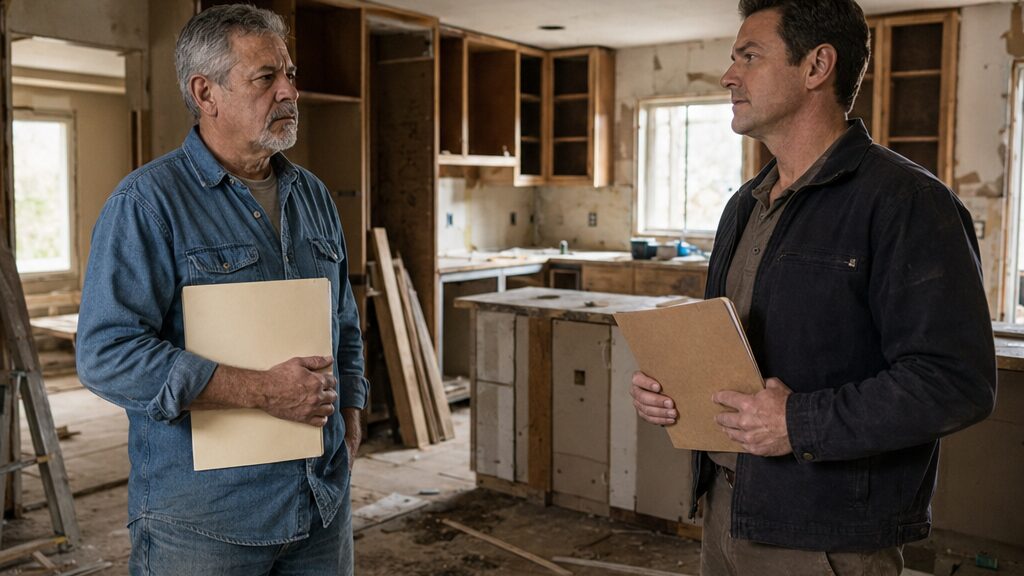
Daniel Harris was standing in the middle of John Rivera’s destroyed kitchen asking for another check.
The words sounded impossible in a room that looked like it had already been paid for twice.
The cabinets were gone. The old counters had been ripped away weeks earlier. The floor ended abruptly where new tile was supposed to begin, exposing patches of unfinished subfloor. A bundle of pipes waited behind an open section of wall where a sink should have been. The kitchen had become a construction site, but not the kind John had imagined when he signed the contract.
Daniel stood near the center island that no longer existed, holding a printed invoice in one hand.
“I’m not trying to pressure you, John,” he said. “I’m trying to keep this moving. If we don’t order the next materials now, the schedule gets pushed back again.”
John looked around the room.
The room that had been the heart of his house for almost thirty years.
The room where he had cooked Sunday breakfasts. The room where his wife had placed holiday dishes on the counter before she passed away. The room he had saved for years to finally update.
Now there was a plastic sheet covering one doorway and a pile of discarded materials stacked against the wall.
“What materials?” John asked.
Daniel lowered the invoice slightly.
“The cabinets. The fixtures. The remaining hardware.”
John looked at the invoice, then back at the empty spaces where those things were supposed to be.
“Daniel,” he said quietly, “you told me those were already included.”
“They were included in the original estimate,” Daniel replied. “The problem is costs changed.”
John felt the familiar discomfort rise in his chest.
The feeling that he was about to become the difficult customer.
For the last three weeks, he had told himself there had to be a reasonable explanation.
Contractors had delays.
Materials got held up.
Unexpected problems happened.
He had hired Daniel because Daniel had sounded confident from the beginning.
The first meeting had lasted almost two hours. Daniel had walked through the kitchen, tapped walls, measured spaces, and explained every step. He spoke like someone who had done this hundreds of times.
John remembered feeling relieved.
Finally, someone else knew what they were doing.
Daniel had given him a detailed proposal.
Forty-eight thousand dollars.
A complete kitchen renovation.
New cabinets.
New flooring.
Updated plumbing.
A modern layout.
John had signed the contract and paid the required installments exactly when they were requested.
At the time, he thought the difficult part was over.
He did not realize the difficult part was trusting someone.
“I paid the last installment two weeks ago,” John said.
Daniel sighed.
“And I appreciate that. But construction doesn’t work like buying something off a shelf.”
John noticed the way Daniel said it.
Not angry.
Not defensive.
Almost patient.
Like he was explaining something obvious to someone who did not understand.
That was what bothered John most.
Daniel was not acting like a man who had failed.
He was acting like John was the problem.
“I’m not asking for anything unreasonable,” Daniel continued. “I just need the next payment so we can finish.”
John looked at the invoice again.
There was a number circled near the bottom.
Another $12,000.
His hand tightened slightly around the edge of the paper.
“When exactly will the kitchen be finished?”
Daniel looked toward the exposed wall.
“Depends on when we can get moving again.”
“That wasn’t my question.”
For a second, the room became quiet.
Daniel looked at him.
It was not an angry look.
It was a measuring look.
John recognized it because he had seen it before in business meetings. The moment someone decided how much resistance they were going to get from another person.
“I think you’re letting the stress of the renovation affect your judgment,” Daniel said.
John almost answered immediately.
Almost apologized.
That was his instinct.
For years, he had built his life around avoiding unnecessary conflict. He had spent decades working with people, solving problems, finding compromises.
He believed reasonable people could always find a reasonable solution.
But standing in the middle of his unfinished kitchen, he realized something uncomfortable.
The only person acting certain about what would happen next was Daniel.
John was the one waiting.
“I need some time to look at this,” John said.
Daniel shook his head.
“That’s fine. But every day we wait costs time.”
John watched him walk toward the doorway.
Before leaving, Daniel stopped.
“I hope you understand I’m trying to help you here.”
The sentence stayed with John after the door closed.
Trying to help.
That was the phrase Daniel kept using.
John spent the next hour walking through the kitchen.
He took pictures.
Not because he knew what he was looking for.
Because something about the conversation felt wrong.
The room looked exactly the same as it had days before.
Maybe weeks before.
He opened the folder where he kept the renovation paperwork.
The original contract was there.
The payment receipts.
The proposal Daniel had printed.
John spread everything across the dining table.
He compared the pages carefully.
Then he noticed something.
A line item on the invoice Daniel had just given him.
“Cabinet materials deposit.”
John stared at it.
His eyebrows tightened.
He remembered paying for cabinet materials already.
He searched through the paperwork again.
Then he found the original payment record.
Cabinet materials were listed there too.
John leaned back slowly.
The feeling in his chest changed.
This was no longer just a delay.
He picked up the new invoice and looked at the old contract side by side.
Two different numbers.
Two different stories.
And both had Daniel Harris’s name attached.
For the first time since the renovation began, John stopped asking himself how he could make things easier.
He started asking a different question.
Where did the money actually go?
Chapter 2: The Contractor Who Controlled The Conversation
Daniel Harris called the next morning before John had even finished his coffee.
John looked at the phone screen.
For three weeks, he had been waiting for Daniel to call with an update.
Now that John had questions, the call came immediately.
He answered.
“Morning, Daniel.”
“John, I wanted to follow up. I don’t want there to be misunderstandings between us.”
John glanced toward the kitchen.
The missing cabinets.
The open wall.
The unfinished floor.
“I don’t want misunderstandings either.”
“Good,” Daniel said. “Because I think yesterday got emotional.”
John noticed that Daniel had not answered the question.
Not once.
“The invoice you gave me includes cabinet materials again.”
There was a pause.
A short one.
But long enough.
“John, we’ve talked about this.”
“No, we haven’t.”
“Construction pricing changes.”
“The original contract says the cabinet allowance was included.”
Daniel exhaled.
“This is exactly why these projects get complicated. Homeowners see a number on paper and don’t understand everything happening behind the scenes.”
John closed his eyes for a moment.
There it was again.
The same message.
You don’t understand.
He walked into the kitchen and looked at the empty space where cabinets should have been.
“Daniel, did you order the cabinets?”
Another pause.
“They’re being handled.”
“That’s not what I asked.”
“John—”
“Did you order them?”
Daniel’s voice became colder.
“I don’t appreciate being questioned like I’m doing something wrong.”
John almost stepped back.
The confidence in Daniel’s voice was impressive.
If John had not been standing inside the unfinished kitchen, he might have believed him.
“I’m not accusing you,” John said.
“But you’re treating me like a criminal.”
“No. I’m asking where my money went.”
Silence.
Then Daniel changed direction.
“Look, I’ve worked with a lot of homeowners. Renovations are stressful. Sometimes people panic halfway through.”
John looked at the walls.
Halfway through.
That was the phrase Daniel used.
As if the problem was that John was impatient.
As if an empty kitchen was normal.
“I need documentation,” John said.
“You have the contract.”
“I need proof of what has been purchased.”
Daniel’s voice tightened.
“Are you seriously going to make me stop work over paperwork?”
John looked around.
Then he said the sentence he had avoided saying for weeks.
“Daniel, there isn’t any work happening.”
The silence afterward was different.
Not surprised.
Not confused.
Just empty.
“I’ll call you later,” Daniel said.
The call ended.
John stayed standing in the kitchen.
He realized something.
Daniel had spent more time explaining why John should not worry than explaining what had actually happened.
That afternoon, John began making calls.
Not angry calls.
Not threatening calls.
Questions.
He found the supplier name listed on the original estimate.
A woman answered.
John explained he was checking on a cabinet order from Daniel Harris.
There was a pause.
“Can I ask what address this was for?”
John gave the address.
The woman searched.
Then she spoke carefully.
“I’m not seeing an active order.”
John felt his stomach tighten.
“Could you check again?”
“I did.”
“What about a deposit?”
Another pause.
“No deposit was placed under that contractor name for this address.”
John looked toward the kitchen.
The room seemed different now.
Not just unfinished.
Evidence.
“Are you sure?”
“Yes.”
John thanked her and ended the call.
He sat at the dining table with the contract in front of him.
For weeks, he had looked at the damaged kitchen and seen a problem.
Now he was starting to see a pattern.
But he still needed to know if this was a mistake.
A misunderstanding.
Something that could still be explained.
Because the alternative was harder to accept.
That Daniel had walked into his home, gained his trust, taken his money, and counted on him being too uncomfortable to ask where it went.
John opened his laptop.
He searched Daniel Harris Construction.
The first thing he noticed was not the reviews.
It was that the company website looked different from the brochure Daniel had given him.
Several pages were missing.
The contact page showed a different phone number.
John stared at the screen.
Then he noticed a small detail.
A review from months earlier.
A homeowner mentioned a delayed kitchen renovation.
John clicked.
The review had been removed.
But someone had replied.
A name appeared in the response.
Daniel Harris.
John sat back.
The question had changed.
It was no longer:
What happened to my kitchen?
Now it was:
How many kitchens had Daniel left behind?
Chapter 3: The Receipt That Changed The Meaning Of Everything
The supplier’s words followed John all the way home.
No active order.
No deposit.
No materials.
But Daniel had charged for them.
By Friday morning, John was standing in the kitchen again, holding the original contract in one hand and his phone in the other.
The room looked exactly the same.
That bothered him more than anything.
The contractor kept talking about delays.
Schedules.
Costs.
Progress.
But the only thing that changed was the amount of money Daniel wanted.
John took another photograph.
Then another.
He placed the phone beside the contract and compared the images.
The promised kitchen.
The actual kitchen.
The distance between them felt enormous.
John knew he needed more than suspicion.
He needed facts.
That afternoon, he drove to the address listed on Daniel’s business card.
He expected an office.
Maybe a small construction building.
Instead, he found a locked storefront with a faded sign from another company.
John sat in his car for several minutes.
He did not feel angry.
He felt embarrassed.
Not because Daniel had done something wrong.
Because John wondered how many signs he had ignored.
The confident explanations.
The rushed payments.
The way Daniel always had an answer before John finished asking the question.
John drove home and opened the folder again.
This time, he looked at everything differently.
The contract.
The invoices.
The payment records.
The dates.
He noticed something he had missed before.
The cabinet materials were listed as purchased three weeks earlier.
The same week Daniel had removed the old cabinets.
John looked toward the empty kitchen.
Three weeks.
Three weeks of nothing.
He searched for the receipt number listed beside the materials.
There was no attached receipt.
Only a line on Daniel’s invoice.
John picked up the phone.
He called the supplier again.
“I’m trying to understand something,” John said. “The contractor charged me for materials. But you’re saying there was no order.”
“That’s correct.”
“Could someone else have ordered under a different company name?”
The woman checked.
“No.”
John thanked her.
After hanging up, he sat quietly.
The first feeling was relief.
Because he finally knew he was not imagining the problem.
The second feeling was worse.
Because knowing the problem existed did not solve it.
The kitchen was still destroyed.
The money was still gone.
And Daniel still had the confidence to ask for more.
That evening, John searched online again.
This time he found a local community post.
A homeowner asking if anyone had experience with Daniel Harris.
The post was old.
Almost a year.
John read the comments.
Most were ordinary questions.
Then one person had written:
“Same thing happened to us.”
The name attached was Susan Martinez.
John stared at the screen.
He hesitated before sending a message.
Part of him still hoped this was coincidence.
A bad project.
A misunderstanding.
Something that had happened only once.
Susan replied twenty minutes later.
The first message was simple.
“Did he leave your kitchen unfinished too?”
John looked at the words for a long time.
Then he answered.
“Yes.”
A few minutes later, Susan sent a photograph.
John opened it.
His heart sank.
It was another damaged kitchen.
Missing cabinets.
Exposed walls.
The same unfinished feeling.
Different house.
Different family.
Same contractor.
Susan wrote:
“I thought I was the only one.”
John looked back at his own kitchen.
For weeks, he had felt trapped because Daniel knew more than him.
Construction terms.
Materials.
Contracts.
Industry language.
But now John understood something.
Daniel’s advantage was not that he knew everything.
It was that everyone else thought they knew nothing.
The next morning, John woke up to a message from Daniel.
A short one.
No explanation.
No apology.
Just:
“Need to discuss revised agreement. Please have it signed before work resumes.”
John stared at the screen.
A revised agreement.
After everything he had found.
He walked into the unfinished kitchen.
The open wall.
The exposed pipes.
The missing cabinets.
The room that was supposed to prove Daniel’s progress now proved something else.
John printed Daniel’s message.
Then he placed it beside the original contract.
For the first time, he was not preparing to ask Daniel for answers.
He was preparing to demand them.
Chapter 4: The Other House Left Behind
Susan Martinez opened the door before John had a chance to knock again.
For a moment, neither of them said anything.
They were strangers who already knew something important about each other.
John looked past her shoulder.
He saw the same kind of silence he had seen in his own house.
A room that was supposed to represent improvement had become a reminder of a promise that was never kept.
Susan stepped aside.
“Come in.”
John entered slowly.
Her kitchen was not identical to his, but the feeling was.
The cabinets had been removed. The walls had open sections where electrical work had been started and abandoned. A temporary light hung from a wire near the ceiling.
“He stopped showing up after the second payment,” Susan said.
John looked at her.
“Second payment?”
She nodded.
“I paid the deposit first. Then he said he needed money for materials. He showed me pictures of suppliers. He sounded like he was trying to protect me from delays.”
John almost smiled.
Not because it was funny.
Because the words were familiar.
“He told me the same thing,” John said.
Susan looked down.
“I thought I was the only one.”
That sentence carried more weight than John expected.
He had felt the same thing.
The embarrassment.
The quiet fear that maybe he had made a mistake nobody else would understand.
Susan walked toward the kitchen counter and picked up a folder.
“I kept everything.”
Inside were printed emails, invoices, photographs, and handwritten notes.
John recognized the organization immediately.
The same instinct he had developed over the last few days.
Save everything.
“Did you confront him?” John asked.
“Yes.”
“What happened?”
Susan laughed softly, but there was no humor in it.
“He became offended.”
John looked up.
“He said I was questioning his professionalism. He said customers like me were the reason contractors had trouble finishing jobs.”
John looked around the unfinished kitchen.
The words sounded almost impossible.
But he believed her.
Because he had heard a version of them himself.
Susan pulled out an invoice.
“This was the one that made me suspicious.”
John took it.
The format looked familiar.
A materials charge.
A labor adjustment.
A revised timeline.
The same confidence.
The same vague explanations.
“What did you do after this?” John asked.
“Nothing at first.”
Susan looked embarrassed.
“I waited.”
John understood.
“You thought he would come back.”
She nodded.
“I kept telling myself that. Every day I thought, maybe tomorrow. Maybe he had a problem. Maybe something happened.”
She looked toward the empty space where her cabinets should have been.
“But then I realized something.”
“What?”
“He wasn’t avoiding me because he couldn’t finish.”
John waited.
“He was avoiding me because he already got what he wanted.”
The room became quiet.
John looked at the papers again.
He had wanted proof that Daniel had made a mistake.
What he was finding was something harder.
A pattern.
Before leaving, Susan stopped him near the doorway.
“There are more people.”
John turned.
“What?”
“I found two others after I started searching his name. I didn’t contact them because I felt stupid.”
“You weren’t stupid.”
Susan looked at him.
“You don’t know that.”
“Yes, I do.”
John surprised himself by saying it.
Because a week earlier, he might have said the same thing about himself.
Susan gave him another name.
A homeowner who had contacted her.
Then another.
John wrote both down.
When he returned home, he placed everything on his dining table.
His own contract.
Susan’s invoices.
The photographs.
The messages.
The room behind him remained unfinished.
But something had changed.
The kitchen was no longer just damage.
It was evidence.
His phone rang.
Daniel.
John stared at the name.
A week ago, he would have answered immediately.
Now he let it ring once.
Then twice.
Then he picked up.
“John,” Daniel said. “I’ve been trying to reach you.”
John looked at the folder in front of him.
“No, you haven’t.”
A pause.
“I’m calling because we need to move forward.”
“Move forward how?”
Daniel sighed.
“By being practical.”
John waited.
“I’m sending over a revised agreement. If you sign it, we can get the project completed.”
John looked at the original contract.
Then at Susan’s paperwork.
“What happens if I don’t sign?”
Another pause.
“Then I can’t guarantee anything.”
John heard the threat hidden inside the sentence.
Not loud.
Not dramatic.
Just confident.
Daniel believed he still controlled the next move.
“Send it,” John said.
“Good. I knew you’d understand.”
John ended the call.
He did not feel victorious.
He felt something else.
Determined.
Because now he knew Daniel’s greatest advantage was not construction knowledge.
It was making people doubt themselves.
And John was done helping him do that.
Chapter 5: The Contract He Thought Nobody Would Read
Daniel arrived at John Rivera’s house carrying a folder.
He did not knock like someone entering a confrontation.
He knocked like someone arriving to finish a business meeting.
That was what made John more certain than ever.
Daniel still believed he was in control.
John opened the door.
Behind him, the destroyed kitchen was visible.
The missing cabinets.
The exposed pipes.
The unfinished floor.
The exact place where forty-eight thousand dollars had disappeared into promises.
Daniel stepped inside.
“You’ve had time to think?”
John looked at the folder.
“What is that?”
“The agreement we discussed.”
John did not take it.
Daniel held it out a little longer.
“This protects both of us.”
John almost laughed.
Almost.
Instead, he said:
“Does it?”
Daniel’s expression changed slightly.
Just enough.
“I don’t understand what you mean.”
John walked to the table.
The original contract was already there.
Beside it were printed photographs.
Payment records.
Susan’s invoices.
Daniel noticed the papers.
For the first time, his confidence weakened.
Only slightly.
But John saw it.
“I want to finish your kitchen,” Daniel said.
“Then why did you stop?”
“I didn’t stop.”
John looked around.
“Daniel, nothing has changed.”
“That’s because there were delays.”
“Were the cabinets ordered?”
Daniel looked away.
“That’s not the point.”
John nodded slowly.
That answer told him more than a confession would have.
“The point is that I need to trust you?”
Daniel’s jaw tightened.
“The point is that construction requires cooperation.”
John touched the original contract.
“This says the price was agreed.”
“Prices change.”
“This says materials were included.”
“Allowances change.”
“This says the work was supposed to be completed.”
Daniel stepped closer.
“And this is exactly why people misunderstand contracts. They think every sentence means what they want it to mean.”
John felt the old instinct return.
The desire to explain himself.
To soften the conversation.
To prove he was not being unreasonable.
Then he looked at the kitchen.
And remembered how long he had waited.
“No,” John said.
Daniel stopped.
“No?”
“I’m not signing this.”
Daniel looked surprised.
“You haven’t even read it.”
“I read enough.”
“That’s not responsible.”
John looked at him.
“You’re asking me to sign a document that changes the agreement after the work was already left unfinished.”
Daniel’s expression hardened.
“I’m trying to save this project.”
John reached for another paper.
“No. You’re trying to change the terms of this project.”
Daniel looked down.
It was the first moment John saw uncertainty.
Not guilt.
Not regret.
Concern.
Because Daniel realized John was no longer standing there as the customer who needed him.
John was standing there as someone who had started understanding the game.
“I have questions,” John said.
Daniel crossed his arms.
“About what?”
“The cabinet payment.”
Silence.
“The material deposit.”
Silence.
“The invoices.”
Daniel looked toward the door.
“I don’t have time for accusations.”
John did not move.
“I’m not accusing you.”
He placed the papers on the table.
“I’m asking you to explain.”
Daniel glanced at the documents.
Then back at John.
“You think because you have some paperwork, you understand this business?”
John looked around the damaged kitchen.
“No.”
That answer seemed to surprise Daniel.
John continued.
“I think I understand my own house.”
For several seconds, neither man spoke.
The sentence was simple.
But it changed the room.
Daniel picked up the folder.
“You’re making a mistake.”
John watched him walk away.
At the door, Daniel stopped.
“You should think carefully about what happens if this goes further.”
John knew what that meant.
Not a threat.
Not officially.
Something more subtle.
A reminder that Daniel believed he still had power.
After Daniel left, John returned to the table.
His hands were shaking slightly.
Not from fear.
From the realization that he had finally done what he had avoided for weeks.
He had said no.
The next morning, John received an email.
It was not from Daniel.
It was from another homeowner.
Attached was a photograph of an invoice.
The same format.
The same charges.
The same contractor.
At the bottom of the message was one sentence:
“Do you know how many people he has done this to?”
Chapter 6: The Inspection That Exposed The Hidden Damage
The inspector pointed at the wall and stopped talking.
That silence worried John more than bad news would have.
They were standing in the unfinished kitchen again.
But this time, John was not looking at it as a homeowner waiting for someone else to fix it.
He was looking at it as evidence.
Nicole King moved carefully through the room, checking the areas Daniel had worked on.
She had spent the last hour examining the plumbing, electrical changes, and unfinished sections.
Finally, she turned back.
“John, when did he say this work was completed?”
“He said he was almost finished.”
Nicole looked toward the open wall.
“He was not almost finished.”
John felt his stomach tighten.
“What do you mean?”
“I mean some of this work should never have been left this way.”
She pointed toward the exposed plumbing.
“This was not properly secured.”
Then toward the electrical area.
“This needs additional review.”
John looked around.
The room had always bothered him because it looked unfinished.
Now he understood something worse.
It was unfinished because it might not have been safe.
“How much of this needs to be redone?”
Nicole hesitated.
“That depends on what we find behind the surfaces.”
John looked at the walls.
The same walls Daniel had promised would be transformed.
Now they were hiding questions.
Nicole picked up the folder containing the original contract.
“Do you have everything he gave you?”
“Yes.”
“Keep all of it.”
John nodded.
“I already have.”
Nicole looked at him.
“That’s good.”
A few weeks earlier, that sentence would have embarrassed him.
He would have wondered why he needed to keep records.
Now he understood.
Records were the only thing Daniel could not talk over.
Later that afternoon, John sat at the dining table with the inspection notes in front of him.
The kitchen remained unfinished behind him.
But for the first time, the damage felt like it was moving toward an answer.
He called the licensing office.
He did not expect a miracle.
He expected paperwork.
Questions.
A process.
The person who answered explained the complaint procedure.
John wrote everything down.
Dates.
Documents.
Evidence.
When the call ended, he looked at the stack on the table.
His original contract.
Payment receipts.
Photographs.
Susan’s information.
Nicole’s notes.
No single piece of paper changed everything.
No single conversation fixed the problem.
That was the part he finally understood.
Daniel had counted on one moment.
One argument.
One frustrated homeowner giving up.
But every unanswered question had created another record.
Every excuse had created another reason to look closer.
That evening, Daniel sent one more message.
“I hope you understand this could have been handled differently.”
John read it twice.
The old John might have felt guilty.
The old John might have apologized.
Instead, he placed the phone beside the contract.
Then he opened the complaint form.
For the first time since the renovation began, John was not waiting for Daniel to decide what happened next.
He was deciding.
And when he submitted the complaint, he attached the first photograph.
The photograph of the kitchen exactly as it was.
The room Daniel left behind.
Chapter 7: The Room They Finally Rebuilt
The first morning John Rivera walked into his finished kitchen, he did not know what to feel.
The room looked almost exactly like the one he had imagined months earlier.
New cabinets lined the walls.
The counters were clean and solid.
The floor no longer stopped halfway across the room.
The exposed pipes were gone.
The temporary light hanging from the ceiling had been replaced with fixtures that actually belonged there.
A stranger walking into the house would have seen a beautiful kitchen.
John saw everything that had happened before it.
He saw the empty room.
The invoices.
The unanswered calls.
The folder on the dining table that had become heavier with every piece of evidence he collected.
The kitchen was finished.
But the memory of how it got there would stay.
John placed a coffee cup on the counter and stood quietly.
For a long time, he had believed the hardest part was repairing the damage.
It was not.
The hardest part was admitting that someone he trusted had counted on him not knowing enough to fight back.
The licensing board had completed its review.
The complaint had not disappeared.
The photographs mattered.
The invoices mattered.
Nicole King’s inspection notes mattered.
Susan Martinez’s records mattered.
Daniel Harris could no longer describe what happened as a simple misunderstanding.
There were too many questions.
Too many documents.
Too many homeowners who had the same story.
John had recovered part of the money through the settlement process, but not everything.
The hours were gone.
The stress was gone into him.
The months of living around a destroyed kitchen could not be returned.
That was the part nobody included in the paperwork.
A person could calculate the cost of cabinets.
They could calculate the cost of flooring.
They could calculate the cost of repairs.
But they could not calculate the cost of wondering every day whether someone had taken advantage of them.
A knock came at the door.
John opened it and saw Susan standing there.
She smiled when she saw the kitchen behind him.
“You finished.”
John nodded.
“Yeah.”
Susan stepped inside.
She looked around slowly.
“I almost forgot what a normal kitchen looked like.”
John smiled slightly.
“How is yours?”
“Getting there.”
They stood together for a moment.
Two people who had once felt isolated by the same mistake.
Now they understood something different.
They had not been weak because they trusted someone.
The mistake was believing trust meant they did not need to ask questions.
Susan touched the edge of the counter.
“You know what bothered me the most?”
John looked at her.
“What?”
“When he left, I kept thinking I should have known better.”
John looked toward the kitchen.
“I thought the same thing.”
“But we weren’t supposed to be experts.”
“No.”
John paused.
“We were supposed to be homeowners.”
Susan nodded.
That sentence stayed with him.
Because that was what Daniel had taken advantage of.
Not ignorance.
Trust.
Later that afternoon, John received a letter.
He recognized the envelope before opening it.
The licensing board.
He sat at the table where the original contract had once been spread out.
The same place where he had first noticed something was wrong.
The letter confirmed that action had been taken based on the findings.
It was not dramatic.
No announcement.
No public scene.
No moment where everyone gathered to celebrate.
Just a process finally acknowledging what had happened.
John folded the letter and placed it beside the old contract.
The contract that had once represented a promise.
Then a question.
Then evidence.
Now it represented something else.
A reminder.
He walked back into the kitchen.
The room was no longer proof of what Daniel had done.
It was proof of what John had refused to let happen.
He thought about the first day Daniel stood there asking for another payment.
Back then, the room had made John feel powerless.
Now it reminded him that power did not always look like confidence.
Sometimes it looked like someone quietly keeping every receipt.
Sometimes it looked like asking one more question.
Sometimes it looked like refusing to sign something that felt wrong.
The kitchen was finally rebuilt.
But the bigger repair had happened somewhere else.
John had rebuilt his ability to trust himself.
He turned off the lights and left the room.
The next morning, he placed the old folder into a drawer.
Not because he wanted to forget.
Because he no longer needed to carry it everywhere.
The room had changed.
And so had he.
The story had never really been about a contractor.
It had been about the moment an ordinary person realized that knowing less did not mean having less power.
The Contractor Came Back For More Money, But He Never Expected Her To Know What He Had Done
The story has ended.