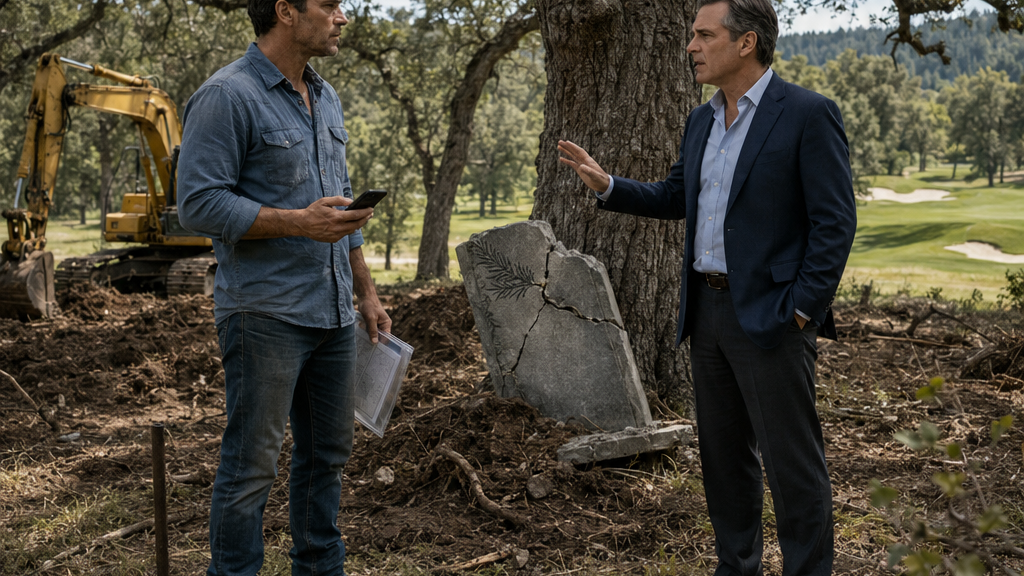
The HOA Dug Into My Family Cemetery for a Golf Expansion—Then Their Own Homeowners Learned What They Had Ignored
Chapter 1: The Excavator Was Still Warm Beside Margaret’s Grave
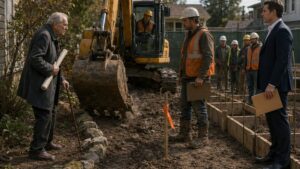
The excavator was still warm when Edward Martinez put his palm against the yellow engine housing.
He jerked his hand back as if the machine had answered him.
The bucket rested in loose brown soil beneath the three white oaks at the back of his property. Fresh tracks crossed the grass from the direction of Ridgemont’s golf course. One track had crushed the wire boundary marker Edward had been meaning to replace for three summers.
The machine itself did not frighten him. He spent his working life around equipment larger than this—skidders, loaders, tracked feller bunchers that could make the ground tremble.
What stopped him was the empty space six yards beyond it.
Margaret Martinez’s headstone was gone.
Edward walked toward the opening without realizing he had dropped the leather gloves he had been carrying. The grave site had been scraped down into raw earth. An orange survey flag leaned at the edge of the cut, almost cheerful against the dirt.
He found the stone against the trunk of the largest oak.
It had been set there on its side.
A crack ran diagonally through the carved pine branch at the top.
For several seconds Edward did nothing.
His grandmother had chosen that design herself. He remembered being fourteen, sitting in the passenger seat of Gary’s pickup while Margaret argued that roses would look foolish in Idaho.
“Pine stays green,” she had said.
Now half the branch was separated by a pale fracture.
Edward took out his phone.
The first picture shook.
He deleted it, planted his boots wider, and took another.
Then another.
The excavation. The displaced stone. The orange flags. The tire tracks. The excavator’s plate. The serial number stamped beside the hydraulic compartment.
He walked the entire work area instead of touching anything else.
Near the golf-course side of the trees, a shallow trench had been opened for what looked like drainage pipe. The trench curved directly across the strip of land his grandfather had always called the cemetery edge.
Edward crouched.
There were chunks of old concrete mixed with the spoil. He picked one up without thinking, then stopped.
A smooth gray face showed beneath the dirt.
Not concrete.
Granite.
He set it exactly where he had found it and photographed it.
Twenty feet farther on, a piece of decorative edging lay among broken roots and shredded landscape fabric. It matched the border Gary had poured by hand around the graves years ago.
Edward’s jaw tightened.
He called the sheriff’s office.
The dispatcher asked whether anyone was still on site.
“No.”
“Any immediate danger?”
“No.”
“Is this a property-line dispute?”
Edward looked at the empty grave space.
“I don’t know what it is yet.”
That answer bothered him after he hung up.
He did know what it looked like.
He simply refused to say more until he could prove it.
The Ridgemont golf course spread beyond the trees in unnatural shades of green. A sprinkler swept quietly across the nearest fairway. Behind it, roofs rose along the hillside—stone entries, three-car garages, decks aimed toward the mountains.
Edward had never hated the development.
That was what made the situation worse.
Ridgemont had been built in stages after Gary grew too old to work the south end of the property himself. Edward had complained about golf balls in the pasture and maintenance trucks turning too wide, but he had also waved those same trucks through when a gate was open.
It seemed easier.
He had spent most of his adult life believing that neighbors who knew where the line was did not need a letter reminding them.
A sheriff’s deputy arrived forty minutes later.
Edward walked him through the photographs before taking him beneath the trees.
The deputy stopped when he saw Margaret’s stone.
“That where it belongs?”
Edward pointed toward the excavation.
“Right there.”
The deputy looked from the stone to the machine.
“Who owns the equipment?”
“Contractor, probably. Ridgemont’s been rebuilding drainage along the twelfth fairway.”
“You talk to them?”
“Not yet.”
“Good.”
Edward glanced at him.
The deputy shrugged. “Not because you shouldn’t. Because everybody talks too much before anybody writes anything down.”
That sounded like something Gary would have said.
The deputy photographed the site and took Edward’s statement. He did not call it desecration. He did not call it vandalism. He wrote down what Edward could establish: private parcel, recorded cemetery, construction equipment, disturbed soil, damaged marker.
When he left, Edward had eighty-three photographs on his phone.
He took four more.
The eighty-seventh was of a rust-dark iron pin almost hidden beneath pine needles thirty feet north of Margaret’s grave.
Edward had forgotten it existed.
Gary had shown it to him when he was a boy.
“Old survey corner,” he had said. “Don’t pull that no matter how ugly it gets.”
The excavator tracks had passed within inches of it.
Edward cleared the needles with two fingers. The pin had not moved.
For the first time that morning, something inside him steadied.
Machines could cross grass. Flags could be placed wherever someone wanted. A headstone could be lifted.
That iron pin had been there before Ridgemont had a clubhouse.
He photographed it from four angles.
Then he drove to the house and brought back a steel tape, a notebook, and the plastic file box he kept old property papers in.
Most of those papers had come from Gary.
Most Edward had never read closely.
He had always assumed there would be time.
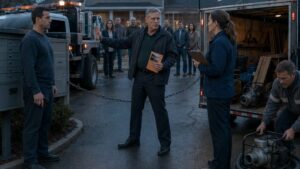
When he returned to the cemetery, two men in work vests stood beside the excavator. One was the operator. The other wore a Ridgemont maintenance shirt.
The maintenance man raised both hands.
“We were told not to touch anything.”
“Who told you?”
“Property manager.”
“Who told you to dig here yesterday?”
The man looked toward the fairway.
“We work off the stakes.”
Edward looked at the orange flag beside Margaret’s grave.
“That one?”
The operator said, “Survey layout came from the association.”
Edward wrote that down.
The maintenance man watched him do it.
“Look, nobody knew there was—”
Edward lifted his eyes.
The man stopped.
There were two granite markers still standing beneath the same trees.
He did not finish the sentence.
A vehicle approached from the development side before noon.
Not a contractor truck.
A dark SUV rolled carefully across the temporary access matting and stopped beside the torn ground. The driver remained inside for several seconds, looking at Edward, the deputy’s tire marks, and the displaced headstone.
Edward recognized Anthony King before the door opened.
He had seen him at two Ridgemont boundary meetings and once at the county planning office. Attorney. HOA president. Always measured. Always dressed one level more formally than anyone else in the room.
Anthony stepped out in a navy jacket without a tie.
His gaze went first to Edward’s phone.
Then to Margaret’s stone.
Then to the excavator.
“Edward,” he said. “Before this goes any further, I think we need to establish exactly what happened.”
Edward closed his notebook.
That was the first thing anyone from Ridgemont had said all morning that made him angrier than the broken stone.
Chapter 2: He Called It a Survey Problem Until Edward Opened the Plat
“Could you stop photographing the contractors for a minute?”
Those were Anthony King’s first words after greeting him.
Edward lowered the phone, but he did not put it away.
“Why?”
“They’re working under direction from the association. They’re not personally responsible for a boundary error.”
“Then the pictures shouldn’t hurt them.”
Anthony glanced toward the excavator operator.
“We don’t know that there was a boundary error.”
Edward looked at Margaret’s headstone leaning against the oak.
Anthony followed his eyes.
His expression shifted, though only slightly.
“I’m not minimizing the damage.”
“You called it a boundary error before you said that.”
“I said we don’t know what happened.”
“The grave used to be over there.”
Edward pointed.
“Now the stone is over here.”
Anthony exhaled through his nose.
“This project was laid out from a professional survey. The contractor was working inside an approved access and drainage area.”
“Approved by who?”
“The association, based on the engineering package.”
“That wasn’t my question.”
Anthony’s jaw tightened.
For a moment the difference between them seemed almost theatrical. Edward wore a faded work shirt with sawdust still caught in one cuff. Anthony’s boots had probably never been inside a slash pile.
Edward disliked noticing that.
It made the dispute feel simpler than it was.
Anthony crouched near the damaged stone.
“Has anyone moved this since you arrived?”
“No.”
“Did you see the excavation happen?”
“No.”
“Then we need to be careful about conclusions.”
Edward stared at him.
“My grandmother’s grave is open.”
“And if the contractor crossed the legal boundary, Ridgemont will address that.”
“If?”
Anthony stood.
“Yes. If.”
Edward nearly told him to leave.
The words rose quickly, clean and satisfying.
Then he remembered the sheriff’s deputy: everybody talks too much before anybody writes anything down.
So Edward turned away.
He walked to his pickup, opened the passenger door, and took out the plastic file box.
Anthony watched him return.
“What’s that?”
“Something I should’ve opened years ago.”
Edward set the box on the hood of his truck and removed a rolled county plat, two deeds, tax maps and a transparent sleeve holding a survey copy Gary had kept folded behind the property insurance documents.
The plat smelled faintly of dust and machine oil.
Edward carried it to the excavator.
Anthony followed.
Edward spread the plastic sleeve across the warm hood and set a wrench on one corner to stop the breeze from lifting it.
“There.”
Anthony leaned over.
Edward pointed to the rectangular notation beneath the trees.
MARTINEZ FAMILY CEMETERY.
Below that, an older survey line ran along the property edge.
Farther south, a narrow corridor crossed Edward’s land toward what was now Ridgemont.
UTILITY AND MAINTENANCE ACCESS.
The cemetery did not overlap it.
It was not close.
Anthony read the legend twice.
“What year is this?”
“Recorded version is from before Ridgemont. My grandfather had it updated when the first development parcel sold.”
“I need the instrument number.”
Edward tapped the lower corner.
Anthony’s eyes moved there.
For several seconds neither man spoke.
Behind them, a sprinkler clicked in slow mechanical rhythm.
Anthony straightened.
“This still needs to be reconciled with the current engineering survey.”
“Reconciled?”
“Old plats can contain inconsistencies.”
“So can new ones.”
“I’m aware.”
Edward pointed at the grave.
“Are you aware enough to stop the work?”
Anthony rubbed a thumb along the edge of his phone.
“The immediate work in this specific area is stopped.”
“The entire drainage run.”
“I can’t commit to shutting down the project until we know the actual conflict.”
“You know there’s a cemetery.”
“I know this document depicts one.”
Edward stared at him.
Anthony’s restraint was different from Edward’s. Edward kept quiet because if he started speaking when angry, he did not trust what might come out.
Anthony kept quiet because silence gave him room to control the next sentence.
“The drainage failure is costing Ridgemont money every day,” Anthony said. “We have saturated turf, slope instability near two lots and a contractor mobilized under a fixed schedule. Forty-seven households are paying for this work.”
“My grandmother isn’t one of them.”
“No.”
It was the first answer Anthony gave without qualification.
Something about it cooled Edward slightly.
Not because it excused anything.
Because he heard the pressure underneath Anthony’s tone.
Anthony was not standing here because he wanted a golf-course trench more than he cared about a grave. He was standing here because he believed his job was to keep a problem from becoming forty-seven problems.
That made his next decision worse.
Edward rolled up the plat.
“I want nobody across this line.”
“We’ll mark a temporary exclusion around the cemetery.”
“The recorded line.”
“We need the surveyors to verify it.”
“Then verify it from your side.”
Anthony looked at him for a long moment.
“You’ve allowed association maintenance access here before.”
“Not through the cemetery.”
“Across this parcel.”
Edward felt something shift.
Anthony opened his phone.
He scrolled, then held the screen toward him.
The photograph showed a blue Ridgemont irrigation truck near Edward’s south gate. Edward recognized the truck.
He also recognized himself.
He stood beside the open gate with one arm raised.
Waving the driver through.
The date stamp was three years old.
Anthony swiped.
Another picture. A maintenance cart on Edward’s grass.
Another. Workers beside a valve box.
“You never objected,” Anthony said.
Edward looked at the screen.
He remembered all three occasions.
The first truck had needed access after a winter freeze split a line. Edward had been leaving for work. The driver asked whether he could cut across instead of hauling equipment around.
Edward said sure.
The second time nobody asked. He had seen the cart, cursed under his breath, and kept driving.
The third time he had helped them find the valve.
He had never written Ridgemont.
Never marked the allowed route.
Never said, This is permission, not a right.
“I let maintenance through,” Edward said.
Anthony lowered the phone. “Which is why I’m telling you this is more complicated than someone simply deciding to trespass.”
Edward looked toward the iron survey pin beneath the trees.
He had spent years believing everybody knew the difference between being allowed through a gate and owning what lay beyond it.
Maybe Gary had believed the same thing.
Anthony stepped closer.
“I will get the current survey package. You get whatever records you have. Until then, nobody touches the grave site.”
“The drainage crew?”
“Continues outside the temporary exclusion.”
Edward’s head came up.
“You just saw the plat.”
“I saw an old recorded plat. I also have years of established maintenance access and a current project that affects occupied homes.”
“So you’re continuing.”
“Outside the cemetery.”
“You don’t know where you think the cemetery ends.”
“That’s why surveyors are coming.”
Anthony walked back toward his SUV.
Edward should have felt victorious.
The cemetery was on the record. Anthony had seen it with his own eyes. Work at Margaret’s grave itself had stopped.
Instead Edward stood beside the excavator with a worse question than the one he had started with.
Anthony was wrong about the cemetery.
But he was not wrong about Edward’s silence.
Chapter 3: The Old Water Agreement Helped Him—and Made Things Worse
Edward found the name Ridgemont in a file dated eleven years before Ridgemont existed.
He was sitting at Gary’s old kitchen table Tuesday night, surrounded by folders he had always meant to organize, when the typed word appeared halfway down a photocopied legal description.
RIDGEMONT SUCCESSORS AND ASSIGNS.
Edward sat back.
The subdivision had been fields then.
He read the page from the beginning.
It was not a deed.
It was an access agreement between Gary Martinez and the company that had purchased the neighboring acreage. The language granted a narrow corridor for installation and maintenance of an irrigation main crossing the southern edge of Gary’s property.
Edward traced the route on the attached sketch.
Not through the cemetery.
Not even near it.
He turned the page.
A separate paragraph required the grantee to restore disturbed ground after maintenance and prohibited expansion of the access beyond what was reasonably necessary to service the utility.
Edward read that paragraph three times.
Then he found a handwritten note in Gary’s block lettering.
VALVE BY CEDAR POST. TAG 14B.
Edward knew the post.
At first light Wednesday, he walked the southern fence line until he found it beneath blackberry vines.
The brass tag was still wired to the valve housing.
14B.
He knelt in wet grass and cleaned the metal with his thumb.
The pipe beneath him fed Ridgemont.
He had known that in the vague way a person knows where buried lines run on family land. Gary had explained it once. Edward had been twenty and more interested in leaving for a logging job than understanding easements.
Now he returned to the house carrying the copied agreement and photographed every page.
For ten minutes, a dangerous kind of satisfaction took hold.
Anthony wanted to talk about established access?
Fine.
Edward had the access.
And the document describing exactly what it was for.
He imagined closing the valve.
Not forever.
Just long enough.
Long enough for Ridgemont’s sprinklers to stop arcing across the fairway. Long enough for Anthony to stand in front of forty-seven homeowners and explain why the man whose family cemetery had been damaged controlled the irrigation line beneath their development.
Edward looked at the wrench hanging over his workbench.
Then he left it there.
By nine, he was at the county records office.
The clerk found the recorded instrument faster than Edward expected.
“You’ve got a copy?”
“Yes.”
“Then what are you looking for?”
“Anything after it.”
She searched the parcel history.
There had been amendments when the neighboring land was subdivided, utility assignments when Ridgemont’s association took ownership of common infrastructure, and a maintenance exhibit filed with one phase of construction.
None expanded the corridor into the cemetery.
Edward felt his shoulders loosen.
“So they don’t have access through the graves.”
The clerk looked at him over her glasses.
“I can tell you what’s recorded. I can’t tell you what rights somebody thinks they acquired another way.”
“Meaning?”
“Meaning people create problems when they treat twenty years of habits like paperwork.”
That sounded uncomfortably familiar.
Edward told her about the valve.
Her expression changed.
“What about it?”
“The line is on my land.”
“That doesn’t mean you should shut it off.”
“I didn’t say I would.”
“You were thinking loudly.”
Edward almost smiled.
She slid the instrument back toward him.
“This agreement gives them utility access. Whether they violated it, whether that affects continued access, whether you can interfere with service—those are separate questions. If houses rely on that system for anything beyond landscape irrigation, you especially don’t want to guess.”
Edward’s satisfaction drained away.
He had been searching for certainty.
Instead he had found leverage wrapped in liability.
“What can I do?”
“Document. Give notice. Get the current survey. Get legal advice if this becomes litigation.”
“I’m trying not to make it litigation.”
“Then don’t touch the valve because you’re angry.”
He left with certified copies.
At the truck, his phone showed three missed calls from Ridgemont’s property manager and one email from Anthony.
The subject line read: PRESERVATION OF UTILITY ACCESS.
Edward opened it.
The message was careful. It acknowledged the cemetery dispute without conceding the boundary, referenced historic maintenance access, and warned against interference with association infrastructure while survey review was pending.
Anthony had moved faster than he had.
Edward drove home by the south road.
Near the cedar post, he stopped.
The brass tag caught sunlight through the vines.
He walked to it again, this time with the agreement in hand.
Gary had given them something specific.
A pipe crossing.
A maintenance path.
Permission to keep water moving where neighboring fields would one day become houses.
He had not given them the hillside. He had not given them the cemetery.
But Edward had spent years behaving as if distinctions did not need to be spoken aloud.
A truck driver asked to pass. Edward waved.
A maintenance crew crossed. Edward ignored it.
Someone moved a marker ten feet for convenience. Edward meant to complain later.
Little permissions had piled up until Anthony could stand beside Margaret’s broken stone and produce photographs showing Edward himself holding open the gate.
That was the complication Edward had not wanted to find in Gary’s papers.
The documents helped him.
His own behavior helped Ridgemont.
At noon, he drove back to the cemetery.
The excavator was gone.
Orange temporary fencing now surrounded the disturbed grave area. Margaret’s stone remained against the oak because the sheriff’s office had asked that nothing be moved until photographs and measurements were complete.
Edward stood before it.
The crack cut directly through the carved pine branch.
He took no photograph this time.
His phone rang.
Unknown number.
He answered.
“Edward Martinez?”
“Yes.”
“My name is Samantha Lee. I live in Ridgemont.”
He waited.
“I’m calling because people over here are being told you’re threatening to shut off our water.”
Edward looked through the trees toward the green fairway.
“I haven’t shut off anything.”
“That’s not what people are hearing.”
“What are they hearing?”
“That you found some old agreement and you’re using it to pressure the HOA.”
Edward’s hand tightened around the phone.
“My grandmother’s grave was dug into.”
“I know what happened.”
“No. You know what somebody told you happened.”
There was a short silence.
When Samantha spoke again, her voice had hardened.
“I have two kids in that development, Mr. Martinez. Whatever the board screwed up, they shouldn’t lose water because of it.”
Edward looked south, toward the buried line and the old brass tag.
For the first time since Tuesday morning, he understood exactly how Anthony could turn the argument around.
Not by proving the grave belonged to Ridgemont.
By making Edward look willing to punish everyone who lived there.
“I haven’t touched your water,” Edward said.
“Then tell Anthony that.”
“I don’t answer to Anthony.”
“No,” Samantha said. “But right now, everybody over here thinks you’re about to make us answer for him.”
Chapter 4: The Neighbor Who Blamed Edward Found the Missing Survey Page
“My children shouldn’t lose water because your HOA has a property dispute.”
Samantha Lee said it before Edward had fully closed the door of his truck.
They were standing beside Ridgemont’s stone entrance sign Thursday morning, where the private road narrowed between landscaped berms. Samantha had asked him to meet there rather than at the clubhouse. Edward had agreed because he did not want Anthony deciding what the conversation was before it began.
“It isn’t my HOA,” Edward said.
“You know what I mean.”
“I do. That’s part of the problem.”
Samantha folded her arms.
She was younger than Edward had expected, probably late thirties, dressed for an office except for running shoes. Her expression carried the exhaustion of someone who had spent two days reading neighborhood messages she wished she had never opened.
“People are saying you have a valve on your property.”
“I do.”
“And that Ridgemont’s line crosses your land.”
“It does.”
“And that you threatened to terminate access.”
“I haven’t threatened anybody’s water.”
“Anthony says the association received notice that you’re challenging utility rights.”
“I asked for the documents.”
“That sounds different when forty-seven households depend on them.”
Edward almost told her exactly what the county clerk had told him: the line appeared to be irrigation infrastructure, not domestic drinking water. But he stopped.
He did not know enough yet.
“That’s why I haven’t touched it.”
Samantha studied him.
“You could?”
“I could physically turn a valve. That doesn’t mean I have the legal right to.”
Some of the tension left her shoulders.
Only some.
“Then why won’t you tell everyone that?”
“Because I’m not going to negotiate through a neighborhood message board.”
She glanced toward the golf course.
“People are scared.”
“So was I when I found an excavator beside my grandmother’s grave.”
Samantha looked back at him.
Edward had brought one photograph.
Not the excavation.
Not the damaged ground.
Just Margaret’s stone leaning against the white oak, the crack through the carved pine branch visible in afternoon light.
He held out his phone.
Samantha took it.
Her mouth tightened.
After a moment she handed it back.
“That shouldn’t have happened.”
“No.”
“But I voted for the drainage project.”
Edward said nothing.
“I was on the landscape committee last year,” she continued. “The fairway had been flooding. One homeowner had water moving toward his crawl space. We were told the revised drainage stayed inside existing easements.”
“By Anthony?”
“By the board.”
“That isn’t the same answer.”
Her eyes narrowed.
“You really don’t like him.”
“I don’t know him well enough to like or dislike him.”
“Could’ve fooled me.”
Edward put his phone away.
“I’m going to the county office. They have the recorded survey revision. If you want to know what your board was given, come look.”
Samantha hesitated.
Then she followed in her own car.
At the records counter, Edward asked for the drainage-plan filings associated with Ridgemont’s latest improvement permit.
The clerk returned with a digital file and a paper copy that had been scanned from the engineering submission.
Samantha pulled a folder from her bag.
“What’s that?”
“My homeowner packet.”
She opened it beside the county copy.
The first pages matched.
Drainage map.
Construction schedule.
Budget estimate.
Engineer’s summary.
Then Edward reached the sheet showing the western property edge.
On the county copy, a boxed note sat beside the cemetery boundary.
FIELD VERIFY RECORDED BURIAL AREA BEFORE DISTURBANCE.
Samantha flipped through her packet.
That note was missing.
Not covered.
Not reproduced faintly.
Missing.
She checked the page number.
The county version was Sheet 6B.
Her packet went from 6A directly to 7.
“That could be an attachment issue,” she said.
Edward looked at her.
She frowned. “I’m not defending it. I’m saying I want to know.”
The clerk pulled the filing history.
An email chain was attached to the submission.
The engineering firm had sent the revised sheet to the HOA after identifying uncertainty between the new drainage alignment and the recorded cemetery boundary.
A reply followed the same afternoon.
Edward recognized the sender.
Anthony King.
The message was brief.
Received. Proceed with mobilization. Boundary verification can occur concurrently so long as cemetery disturbance is avoided.
Samantha read it twice.
“He knew there was a cemetery issue.”
“He knew there was a boundary question.”
“That’s what I said.”
“No.” Edward pointed at the final words. “He thought they could work around it.”
Samantha looked surprised.
“You’re giving him that?”
“I’m reading what it says.”
She leaned back from the counter.
For the first time, Edward could see the argument from inside Ridgemont rather than across the fence.
Anthony had not written, Ignore the cemetery.
He had written something more ordinary.
Proceed.
Verify while moving.
Keep the schedule alive.
It was the kind of instruction people gave when they believed competent professionals could prevent the worst outcome.
Except they had not prevented it.
Samantha closed her folder.
“I trusted this packet.”
Edward nodded.
“So did everybody who voted.”
“You voted because of the flooding.”
“Yes.”
“And now?”
“Now I want to know what else wasn’t in it.”
They requested the complete board distribution record.
The clerk found another entry: the engineering firm’s revised survey had been emailed to Anthony, the property manager, and two board members.
Samantha’s name was not there.
Neither were the general homeowner distribution lists.
Outside, she stood beside Edward’s truck without speaking.
Finally she said, “I thought you were trying to use the cemetery to stop something you already hated.”
“I didn’t hate Ridgemont.”
“You complained about maintenance traffic.”
“I complained to myself. Mostly.”
“That’s not better.”
Edward almost laughed.
“No.”
Samantha looked toward the mountains beyond the county building.
“I need copies.”
“You can request them.”
“I mean for the meeting.”
“What meeting?”
“There isn’t one yet.”
She pulled out her phone.
“There will be.”
Before Edward could answer, she photographed the county filing receipt and the missing-sheet sequence from her packet.
Then she stopped.
“Anthony acknowledged this three weeks before the excavation.”
Edward looked again at the email.
Three weeks.
Enough time to stop.
Enough time to mark the cemetery properly.
Enough time to call him.
Anthony had done none of those things.
Samantha stared at the screen.
“If he knew this was unresolved,” she said, “why did he keep them moving?”
Chapter 5: Eleven Unapproved Structures Were Not the Real Problem
The county land-use inspector laid three site plans across a conference table and tapped three different lines with the eraser end of a pencil.
“Which cemetery setback am I supposed to believe?”
Edward leaned forward.
On the oldest plan, the family cemetery was clearly boxed beneath the oaks.
On the second, the boundary shifted several feet.
On the newest drainage exhibit, it shifted again.
“I was hoping you could tell me.”
The inspector gave him a tired look.
“That’s not how this works.”
It was Saturday morning, and Edward had come expecting to file a narrow complaint about the drainage excavation.
Instead, the inspector had started pulling permits.
Ridgemont had grown in phases over years. Gazebos, storage structures, golf-maintenance shelters, retaining walls and equipment enclosures had been added under different boards and contractors.
Several had permits.
Several had applications that never reached final inspection.
Eleven structures appeared in county records without completed approvals.
Edward stared at the list.
“That sounds worse than the cemetery.”
“It isn’t.”
The inspector capped his pen.
“It’s noisier. Different thing.”
He pointed at the plans again.
“A missing final inspection on a maintenance shed can be corrected. What I care about here is whether fill and drainage work moved outside the approved disturbance area.”
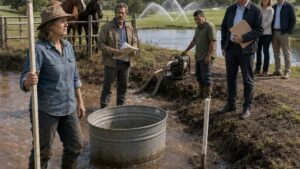
Aerial photographs showed fresh soil near a regulated drainage channel downhill from the golf course.
Not a pristine wetland. Not a dramatic environmental disaster.
Just a place where water naturally collected and moved toward a seasonal creek.
The inspector circled it.
“If this fill changed flow without approval, the county will want it corrected. Environmental compliance may want a look too.”
Edward felt the same brief surge he had felt beside valve 14B.
More leverage.
More problems Ridgemont had apparently left unattended.
He pushed the feeling down.
“I’m not here to find everything they ever did wrong.”
The inspector looked at him for a moment.
“Good.”
“Just what connects to the work at my property.”
“Then stay with that.”
It was the first advice Edward had received all week that felt like an accusation and a favor at the same time.
By Monday, county staff had requested the contractor’s field notes, staging plan, and drainage revisions.
An environmental compliance officer inspected the fill area separately.
Edward walked the Ridgemont perimeter with the land-use inspector but refused to enter the development unless invited.
Near the twelfth fairway, they could see the damaged section from Edward’s side of the line.
The inspector compared stakes with the plan.
“Contractor says they were told the cemetery exclusion was approximate pending survey verification.”
“Who told them?”
“Association.”
“Anthony?”
“Property manager says board direction.”
That was not enough for Edward.
He had learned that already.
A phrase like board direction could hide six decisions or none.
At noon Anthony arrived.
This time he wore work boots.
Edward noticed they had mud on them.
Anthony noticed Edward noticing.
“County asked me to walk the drainage route.”
The inspector moved ahead, leaving them behind.
Anthony looked older than he had on Tuesday.
“I assume Samantha showed you the homeowner packet.”
“She showed me what wasn’t in it.”
Anthony’s face hardened.
“The homeowners were not voting on technical survey exhibits.”
“They were voting on the project.”
“They received the engineering summary.”
“Without the warning.”
Anthony stopped walking.
“You think I hid a cemetery.”
“I think you received a warning.”
“I received a note to field-verify a recorded feature. That happens constantly in construction.”
“Then why not stop?”
Anthony looked toward the fairway.
“Because stopping meant remobilization fees, redesign, and potentially losing the contractor until next season.”
Edward said nothing.
Anthony continued.
“The drainage problem wasn’t cosmetic. We had saturated ground behind two homes. Insurance had already asked questions. If the project slipped into winter and somebody had foundation damage, the homeowners would pay for it.”
“There it is.”
“What?”
“The reason you thought you could wait.”
Anthony faced him.
“You think I wanted your family cemetery touched?”
“No.”
The answer clearly caught him off guard.
Edward looked toward the oaks.
“I think you believed you could manage the risk.”
Anthony was silent.
“That’s different,” Edward said. “It’s not better.”
For the first time since the dispute began, Anthony did not respond like an attorney.
He rubbed a hand over his face.
“I told the contractor to stay clear.”
“Verbally?”
“Yes.”
“You issued a stop order?”
“No.”
“You changed the plan?”
“No.”
“You called me?”
Anthony’s hand dropped.
“No.”
That single word carried more weight than any argument they had had beside the grave.
Edward could understand the pressure now.
Anthony had forty-seven households staring at a failing drainage project. A contractor was already mobilized. A delay might trigger a special assessment. Residents would ask why the board had spent months planning something that still was not ready.
Anthony had chosen motion over certainty.
Not because he wanted harm.
Because he thought the harm could be avoided while the schedule continued.
The result remained Margaret’s cracked stone.
The inspector called Anthony over.
A retaining structure near the drainage route lacked a final county approval.
Anthony visibly stiffened.
“Is this related?”
“It may affect how runoff was redirected.”
Anthony’s eyes closed for half a second.
The inspector continued. “We’ve also got fill near the regulated channel. Environmental compliance is reviewing it.”
Edward expected satisfaction.
Instead he imagined forty-seven households receiving a letter with a dollar amount attached.
Anthony looked at him.
“You understand what happens if the insurer denies portions of this.”
“I understand you’re going to tell me.”
“Special assessment.”
“How much?”
“I don’t know yet.”
“Then don’t give me a number.”
Anthony’s mouth tightened.
Edward turned toward the inspector.
“I only want my complaint tied to the drainage project and cemetery boundary. I’m not alleging unrelated violations.”
Anthony stared at him.
“You expect that to impress me?”
“No.”
“Then why say it?”
“Because I don’t want your mistakes turning into my hobby.”
Anthony almost replied.
Instead, his phone vibrated.
He read the message.
His posture changed.
“What?”
Anthony slipped the phone into his pocket.
“Homeowners have submitted the required signatures for a special meeting.”
Edward knew enough about HOA bylaws to understand what that meant.
“When?”
“Tonight.”
“That fast?”
“They’re calling it an emergency records meeting.”
Anthony looked toward Ridgemont’s clubhouse.
“And they’ve requested the complete survey correspondence.”
For once, neither man had anything useful to say.
By four that afternoon, Samantha sent Edward a copy of the meeting notice.
At the bottom was a final line:
PROPERTY OWNER EDWARD MARTINEZ REQUESTED TO ATTEND.
Edward read it twice.
The question was no longer whether Anthony knew enough to stop the work.
By evening, he would have to explain what he knew to the people who had trusted him not to make that question necessary.
Chapter 6: Thirty-Seven Homeowners Came for Answers, Not a Revenge Speech
Edward walked into the Ridgemont clubhouse and saw his grandmother’s broken headstone projected on a screen.
Under the photograph were two words.
UTILITY RISK.
He stopped inside the doorway.
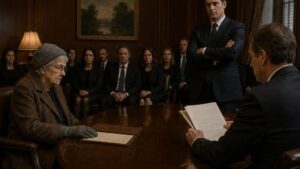
Thirty-seven homeowners sat in folding chairs facing the front of the room. Several turned when they noticed him.
No one applauded.
No one booed.
The silence was worse.
Anthony stood beside the projection screen with the property manager and two board members.
Samantha sat in the front row with a thick packet on her lap.
Edward chose a chair near the aisle.
Anthony began without greeting him.
“We are here because recent events have created uncertainty regarding association infrastructure, construction compliance and potential financial exposure.”
Edward looked at the photograph again.
It was his.
The same image he had taken Tuesday beneath the white oak.
Anthony clicked to the next slide.
A diagram of the irrigation main appeared.
“As many of you now know, a portion of Ridgemont infrastructure crosses the Martinez parcel under a recorded access agreement.”
A man near the back raised his hand.
“Can he shut it off?”
“That is one of the legal questions being evaluated.”
Heads turned toward Edward.
He stayed seated.
Anthony continued.
“The association’s position is that historic access and maintenance practices support continued service.”
Samantha raised her hand.
“You’re skipping the cemetery.”
Anthony’s face tightened.
“We are addressing all aspects.”
“No. You started with the water line.”
A murmur moved through the room.
Anthony looked toward Edward.
“Mr. Martinez has asserted rights under the access agreement that could affect association operations.”
Edward stood.
“I asked for the agreement.”
Anthony paused.
“That is not how your correspondence was understood.”
“I haven’t shut off anything. I haven’t told anyone I will.”
Someone in the second row said, “Then why did we get an email about potential interruption?”
Edward looked at Anthony.
Anthony answered.
“Because the board has an obligation to disclose material risks.”
Samantha opened her packet.
“Did that obligation exist three weeks ago?”
The room became quiet.
Anthony did not ask what she meant.
That told Edward more than any answer.
Samantha held up two sheets.
“This is the homeowner packet we received before the drainage vote.”
Then another.
“This is the version filed with the county.”
She walked to the projector table.
Anthony stepped slightly into her path.
“Samantha, if you want to submit documents—”
“They’re your documents.”
She placed both copies beneath the camera.
The projected image enlarged across the wall.
Sheet 6A.
Then Sheet 6B.
FIELD VERIFY RECORDED BURIAL AREA BEFORE DISTURBANCE.
Someone whispered, “What?”
Samantha looked at Anthony.
“Why wasn’t this page in our packet?”
“The homeowner packet was a summary package.”
“Who decided what got summarized?”
“The board and management prepared materials based on what was relevant to the vote.”
A woman near the aisle said, “A cemetery wasn’t relevant?”
Anthony’s composure thinned.
“The note did not indicate that the design crossed a grave.”
Edward spoke before the room could accelerate.
“That part is true.”
Several faces turned toward him.
He stepped into the aisle.
“It warned them to verify the recorded burial area before disturbance. It did not say the contractor had already crossed it.”
Anthony looked at him sharply.
Edward continued.
“That’s why I’m not saying everybody in this room knew what would happen.”
The temperature in the room changed.
Not much.
Enough.
A man behind Samantha leaned forward.
“So who did know there was a problem?”
Samantha placed the email on the projector.
Anthony’s acknowledgment appeared.
Received. Proceed with mobilization. Boundary verification can occur concurrently so long as cemetery disturbance is avoided.
No dramatic phrase.
No confession.
Just a decision.
Anthony faced the homeowners.
“Yes. I received that email.”
The room erupted into overlapping questions.
“Why proceed?”
“Was the contractor told?”
“Did the board vote on that?”
“Why didn’t we see it?”
Anthony raised both hands.
“The drainage failure was advancing. We had two homes at risk of continued saturation. The contractor had a limited mobilization window. I instructed the team to avoid the cemetery pending verification.”
“Did you stop them?” Samantha asked.
“I told them to stay clear.”
“That’s not what I asked.”
Anthony stared at her.
“No formal stop order was issued.”
There it was.
Edward expected triumph.
Instead he saw Anthony’s shoulders drop slightly, as though he had been carrying that sentence since Tuesday.
Anthony looked around the room.
“If we had halted mobilization, we were facing significant costs. Possibly a special assessment. Some of you were already angry about the existing project budget.”
Several homeowners shifted.
A man near the wall crossed his arms but looked away.
Another woman nodded reluctantly.
Anthony continued.
“I made a judgment that survey verification and construction could proceed concurrently without entering the cemetery.”
“And you were wrong,” Samantha said.
“Yes.”
The answer silenced the room.
Anthony did not soften it.
“I was wrong.”
Edward watched him carefully.
Anthony’s mistake had not suddenly become forgivable because he admitted it.
But the admission stripped away something Edward had been building in his own mind.
Anthony was not protecting a secret plan to seize his land.
He had made a pressured decision, then defended it too long because admitting it would expose the association—and himself—to consequences.
That was smaller than conspiracy.
And more believable.
The property manager handed Anthony another sheet.
Anthony looked at it, then addressed the room.
“There is another issue everyone needs to understand.”
He projected an insurance summary.
“Initial review indicates restoration, engineering correction and some regulatory expenses may not be fully covered.”
Someone asked, “How much are we talking?”
“We don’t have a final number.”
“Assessment?”
“Possible.”
The room turned restless again.
Edward could feel the direction changing.
It would be easy now for them to look at him and see a bill.
He stood before anyone could say it.
“I’m not asking you to shut down your water.”
Silence.
“I’m not asking for your golf course.”
Another pause.
“I’m asking for the cemetery boundary to be surveyed, recorded and protected. I want the damage restored by someone qualified to do it. I want the drainage work corrected if it crossed onto my land. And I want the utility access defined so this doesn’t happen again.”
A homeowner near the front said, “Are you suing us?”
“I haven’t filed a lawsuit.”
“Are you going to?”
“I don’t know.”
That answer unsettled them more than a promise would have.
Edward looked toward Margaret’s photograph on the wall.
“I found that stone against a tree Tuesday morning. I’m not going to pretend I know what the right number or document is four days later.”
Samantha closed her packet.
“Then maybe the first step is admitting the board doesn’t get to decide that alone.”
A board member beside Anthony leaned toward the microphone.
“What are you proposing?”
“A negotiation committee,” Samantha said. “Full records access. Independent survey. And no work near the Martinez boundary until it’s resolved.”
Several homeowners began talking at once.
This time the noise was different.
Not anger aimed at Edward.
Argument among themselves.
Procedure.
Cost.
Responsibility.
A homeowner moved that the association authorize immediate negotiations with Edward and release the complete survey correspondence to residents.
Another seconded.
Anthony stood still while the vote was taken.
The motion passed by a wide margin.
No applause followed.
Edward was grateful for that.
People gathered their folders. Some avoided his eyes. A few nodded to him. One man apologized without stopping long enough to make Edward answer.
Anthony remained at the front table.
Samantha approached Edward.
“They’re going to want terms.”
“I know.”
“What do you want?”
Edward looked toward the screen.
Margaret’s cracked pine branch filled half the wall.
Four days earlier, he might have answered differently.
Shut the line.
Pay for everything.
Move the course back.
Make them feel what he had felt beneath those trees.
Now thirty-seven homeowners were waiting to learn what the man with the old easement would do with the leverage they had finally admitted he possessed.
Edward did not have an answer yet.
And for the first time, the decision frightened him more than Anthony did.
Chapter 7: Gary’s Letter Changed What Edward Thought Winning Meant
The letter fell out of the easement file when Edward lifted it from the kitchen table.
It was folded twice, yellowed along the edges, and thin enough that he almost mistook it for scrap paper.
Gary’s handwriting covered the front.
EDWARD—IF YOU EVER HAVE TO SORT THIS OUT.
Edward stood still.
For a moment he did not open it.
The negotiation meeting was scheduled for ten that morning. On the table beside him sat two versions of the utility agreement: the old recorded instrument and the draft termination notice he had prepared after the clubhouse meeting.
The termination notice was only three pages.
It was clean.
It was forceful.
It would make Anthony understand exactly how much leverage Ridgemont had spent years assuming Edward would never use.
Edward unfolded Gary’s letter.
The first lines were ordinary.
Gary explained where the original agreement had been recorded, which valve controlled the line, and why the developer had asked for access in the first place. The neighboring land had been dry pasture then. The line saved the new owners from trenching around a rocky rise.
Gary had allowed it because the shorter route made sense.
Then Edward reached a sentence underlined once in pencil.
I never sold them that strip. I let them cross it.
Edward lowered himself into Gary’s old chair.
The distinction was so simple that it irritated him.
He had spent the last week learning how much damage could grow inside those two words.
Let them.
Gary wrote that the arrangement worked because the original developer called before entering, repaired fences, and stayed south of the family cemetery.
He also admitted he had never been as careful with paperwork as he should have been.
That made Edward stop.
Gary had always seemed exact to him. The iron survey pin. The labeled valve. The files saved for decades.
But the letter described a man Edward recognized too well.
Someone who believed people ought to understand the limits of generosity without being forced to sign for them.
Near the bottom, Gary had written:
If they ever forget the difference between permission and ownership, put it in writing. Don’t punish everybody for one fool’s mistake. Just make the line plain enough that the next fool can’t miss it.
Edward read it again.
Then a third time.
His eyes moved to the termination notice.
For days he had imagined handing that document across a table.
He had imagined Anthony reading the first paragraph and realizing the entire balance of power had changed.
It would feel good.
That was the problem.
Edward folded Gary’s letter carefully and put it beside the old agreement.
At the cemetery, the temporary fence still surrounded Margaret’s grave.
A restoration contractor had stabilized the damaged stone but had not moved it without written authorization. The crack through the pine branch had been wrapped with a protective brace.
Edward stood before it.
“You’d tell me I waited too long,” he said quietly.
He could almost hear Margaret correcting him.
No.
Gary would say that.
Margaret would ask what he planned to do next.
Edward touched the carved pine branch.
A flattened pine needle clung to the back of Gary’s letter where the paper had been stored against another sheet. It had left a faint brown impression through the fold.
Edward smiled despite himself.
Then he drove to town.
Before the negotiation, he stopped at the county recording office.
The clerk who had warned him about the valve looked up when he approached.
“You still haven’t shut anything off?”
“No.”
“Good.”
“I need to know how specific an amended access agreement can be.”
She gave him a cautious look.
“Very, if the parties agree.”
Edward placed his draft on the counter.
He had rewritten it before leaving the house.
No termination.
Instead:
A permanently surveyed utility corridor.
No construction access beyond it.
Advance written notice for non-emergency maintenance.
Emergency access limited to actual utility repair.
A recorded exclusion zone around the cemetery.
No grading, storage, staging, parking, drainage work, or landscaping inside that zone.
Restoration obligations for any disturbance.
And one sentence Edward had added last:
Continued access is conditioned upon compliance with the recorded boundaries herein.
The clerk read it.
“This is different from what you were asking about Wednesday.”
“Yes.”
“What changed?”
Edward put Gary’s letter back into his folder.
“I figured out what I actually want.”
At the Ridgemont meeting room, Anthony was already there.
Samantha sat beside two other homeowners and the property manager. The mood was less hostile than Monday night but more serious.
Anthony noticed the document in Edward’s hand.
“Termination?”
Edward took the seat opposite him.
“No.”
Anthony’s expression changed slightly.
Edward slid copies across the table.
“I’m willing to keep the utility access.”
Samantha looked up.
Anthony did not touch the document yet.
“Under what conditions?”
“Those.”
Anthony began reading.
Edward watched him reach the cemetery exclusion clause.
Then the maintenance-notice requirement.
Then the condition tying continued access to compliance.
Anthony leaned back.
“This is much narrower than the association’s historic practice.”
“Yes.”
“We’d lose informal access we’ve used for years.”
“Yes.”
Anthony tapped the paper.
“And if a contractor crosses outside the corridor?”
“You fix it. If it’s repeated or deliberate, the access agreement gives me an enforcement remedy.”
“You want that recorded.”
“I want everything recorded.”
Samantha looked at Edward.
“That’s what changed?”
Edward thought of the open gate in Anthony’s old photograph.
His own raised hand.
The maintenance truck passing through.
“I’m done relying on everybody knowing what I meant.”
Anthony read the first page again.
His expression was unreadable.
Finally he said, “The board will resist the permanent exclusion language.”
“Then they can explain why they need flexibility around a cemetery.”
Anthony’s eyes lifted.
Edward did not raise his voice.
He did not need to.
“I’m not asking for your water line,” he said. “I’m asking you to stop pretending access to one thing means access to everything.”
Samantha sat back.
Anthony looked from Edward to the homeowners beside him.
For the first time since Tuesday morning, the argument was no longer about what had happened.
It was about what Ridgemont would be allowed to do next.
Edward placed Gary’s letter inside his folder.
Across the table, Anthony picked up the revised easement again.
Chapter 8: They Restored the Stone, but Edward Changed the Boundary First
Edward signed the document that kept Ridgemont’s water line in place.
The county clerk stamped the recording cover and slid the certified copy back across the counter.
For a second Edward simply looked at his signature.
Three weeks earlier, he had imagined winning would mean using that same line against Ridgemont.
Instead, the new agreement preserved it.
The difference was that now the permission had edges.
A licensed survey had marked the utility corridor in permanent county records.
The cemetery had its own recorded exclusion zone.
No maintenance vehicle could cross Edward’s land outside the corridor without written authorization except during an actual utility emergency.
No grading, staging, drainage work or landscaping could occur within the cemetery boundary.
The agreement also required Ridgemont to restore any future disturbance it caused and allowed Edward to seek enforcement if the association ignored the limits again.
The clerk handed Samantha a second certified copy.
“You’re keeping one for the association?”
“Yes.”
Samantha had been elected to the temporary records committee after the emergency meeting. One of its first recommendations was simple: homeowners could inspect the full technical packet behind major capital projects instead of receiving only board summaries.
It had passed quietly.
No speeches.
No celebration.
Just thirty-one votes and a new line in the policy manual.
Outside the recording office, Samantha held up the stamped document.
“My husband says this is the most boring revolution in Idaho.”
Edward smiled.
“That’s probably a good sign.”
Ridgemont’s board approved the settlement two days later.
The HOA insurer agreed to cover most of the cemetery restoration and portions of the property damage. Reserve funds covered part of the remaining cost. The drainage correction was handled separately after county review determined that some work needed to be moved back and a section of fill near the regulated channel had to be removed.
The eleven incomplete structure approvals did not become a scandal.
Most became paperwork, inspections, and correction notices.
That pleased Edward more than he expected.
He had never wanted Ridgemont destroyed.
He had wanted them to stop acting as if anything inconvenient could be treated as temporary until somebody stronger objected.
Anthony resigned as HOA president the following week.
There was no dramatic meeting.
No public humiliation.
No crowd demanding his removal.
He sent homeowners a short letter stating that the association needed new leadership to complete the settlement and restore confidence in its project oversight.
Edward read it once.
Then deleted it.
Anthony called him two days later.
“I wanted you to hear something directly.”
Edward was standing near the cemetery while the restoration contractor prepared the replacement foundation.
“What?”
“I should have stopped the work.”
Edward looked at Margaret’s damaged stone resting on padded supports.
“Yes.”
A pause.
“I thought if I paused every project every time an engineer put a caution note on a plan, nothing would ever get finished.”
“I understand.”
“That doesn’t mean you agree.”
“No.”
Anthony gave a small breath that might have been a laugh.
“No. I suppose it doesn’t.”
Edward waited.
Anthony said, “The board accepted all the boundary language.”
“I heard.”
“You were in a position to ask for more.”
“I asked for what I needed.”
Another pause.
Then Anthony said, “I’m sorry about your grandmother’s stone.”
Edward looked at the crack running through the pine branch.
“Thank you.”
He meant it.
He did not tell Anthony everything was fine.
It wasn’t.
A replacement stone could be cut.
A foundation could be repaired.
Survey monuments could be installed.
None of that made Tuesday morning disappear.
The cemetery-restoration contractor had explained that the original marker could be stabilized but not made new again. The fracture could be bonded. The carved branch could be aligned. Close up, the repair line would remain visible.
Edward chose to keep it.
The new foundation was placed exactly where the county survey showed Margaret’s grave.
The contractor lowered the stone into position while Edward watched from beneath the white oak.
The granite settled upright.
For the first time in weeks, Margaret’s name faced the same direction it always had.
The pine branch was whole from ten feet away.
From two feet, the crack remained.
Edward preferred it that way.
Samantha came by that afternoon carrying the association’s final recorded copy of the cemetery survey.
“I could’ve mailed this.”
“You wanted to see it.”
“Yes.”
They walked the new boundary.
Small survey monuments marked the exclusion zone beyond the graves. They were not decorative. They were plain metal caps set low enough not to interrupt the ground.
At the south end, the utility corridor turned away from the cemetery and continued toward valve 14B.
Samantha looked through the trees toward Ridgemont.
“You know some people are still angry about the assessment.”
“I know.”
“Some of them blame Anthony. A couple blame you.”
“That sounds about right.”
She glanced at him.
“You’re not bothered?”
“I’d rather they blame me for paperwork than wonder where the line is.”
Samantha nodded.
Before leaving, she stopped beside Margaret’s marker.
“The repair looks good.”
Edward looked at the pine branch.
“It looks repaired.”
She seemed to understand the distinction.
After she drove away, Edward went to his workshop.
The restoration contractor had returned the broken granite fragment that could not be reused during stabilization. It was a narrow piece from the original edge, no longer structural.
Edward carried it back beneath the white oak.
He had considered putting it in the house.
That felt wrong.
He had considered throwing it away.
That felt worse.
Instead, he set it at the base of Margaret’s restored stone.
The broken piece rested against the new foundation, the old carved line still visible across its face.
Two versions of the same marker.
One standing.
One carrying the break.
Edward stepped back.
Beyond the trees, a Ridgemont maintenance truck moved along the golf course.
When it reached the southern access point, it stayed inside the newly marked corridor.
The driver did not wave.
Edward did not need him to.
He looked down at Margaret’s stone, then at the low survey cap near the edge of the cemetery.
For years he had believed good neighbors should not need lines explained to them.
Now the line was recorded.
The water still moved.
The houses were still there.
The golf course was still green.
And beneath the white oak, Margaret’s grave was no longer something anyone had to remember to respect.
They could look it up.
The story has ended.