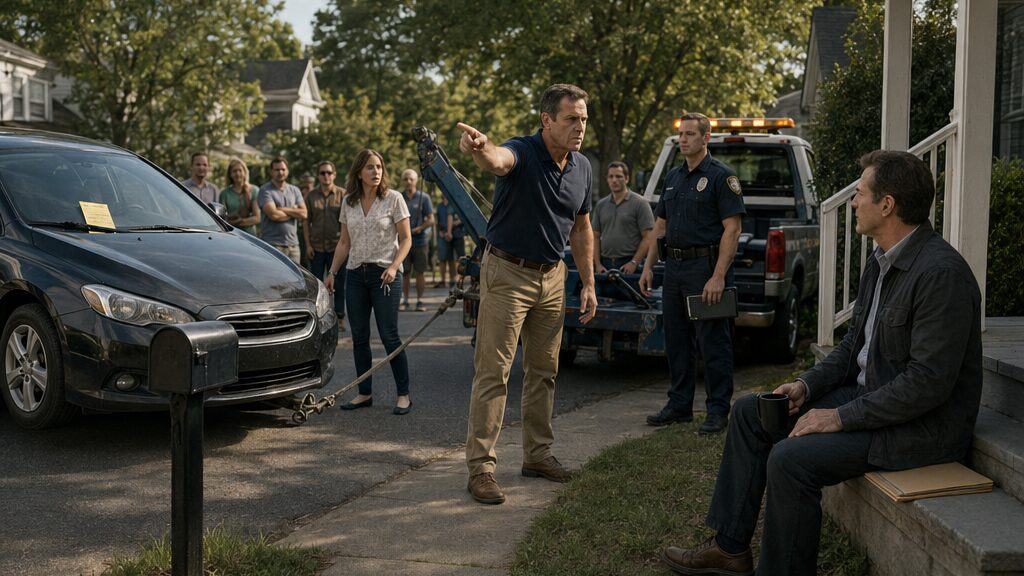
My Neighbor Turned Our Quiet Street Into His Private Parking Lot, So I Let the Rules Speak for Me
Chapter 1: The Eighth Yellow Slip Was Not an Accident
Sarah Campbell held the yellow slip between two fingers as if it were something damp she did not want to carry any farther.
“Eight,” she said.
Behind her, a silver crossover sat less than a foot from Matthew Lewis’s black mailbox. Its rear bumper nearly aligned with the little red flag. Across the street, bass thudded through Jeffrey Miller’s front windows hard enough to make the glass tremble.
Matthew looked at the slip instead of the car.
The top line was familiar: DELIVERY ATTEMPTED. ACCESS OBSTRUCTED.
The lower line was not.
Certified mail. Time-sensitive.
Sarah shifted the bundle against her hip. “I can’t pull close enough without stopping in the travel lane. I’ve told the route supervisor twice.”
“I know.”
Her expression tightened. “I’m not refusing your mail.”
“I know that too.”
A burst of laughter carried from Jeffrey’s backyard. Someone shouted for more ice. A car door slammed farther down the block, followed by the chirp of a lock.
Sarah gave Matthew the slip.
It was warm from her hand.
“You’ll have to pick it up Monday,” she said. “Bring identification.”
Matthew folded it once, precisely along the printed line. “Thank you.”
Sarah glanced toward Jeffrey’s house. “I shouldn’t say this, but you need to handle it before somebody decides this is normal.”
Then she continued down the street, her truck rolling past the crossover with barely enough room.
Matthew remained beside the mailbox.
The curb in front of his property was the shortest open stretch on the block. Jeffrey knew that. Every Saturday, before noon, his guests filled it first. They arrived carrying foil trays, coolers, folding chairs, balloons, sometimes garment bags. By two, the street looked less like a residential lane than overflow parking for an event hall.
The first time, Matthew had assumed it was a birthday.
The second time, he had asked Jeffrey to leave a few feet around the mailbox.
The third time, he had printed a polite note and placed it under two windshield wipers.
By the fifth, he had stopped counting conversations.
Now he counted slips.
Matthew took out his phone and framed the photograph carefully: mailbox, bumper, license plate, curb line. He stepped backward and took a second image showing the full approach from the direction of Sarah’s route.
The timestamp appeared in the corner.
Saturday, 2:17 p.m.
He saved both photographs to a folder labeled MAIL ACCESS.
The party music changed songs. For a moment, Jeffrey appeared behind the living-room blinds, a red plastic cup in one hand. Their eyes met through the narrow gap.
Jeffrey let the blind fall.
Matthew crossed the street.
He did not hurry. He did not clench his fists. He carried the yellow slip openly at his side.
The walkway to Jeffrey’s porch was crowded with shoes, a stroller and two empty cardboard boxes that had once held liquor bottles. Matthew pressed the doorbell.
The music dipped as though someone inside had noticed.
No one answered.
He waited thirty seconds and rang again.
A shadow passed behind the frosted glass.
“Jeffrey,” Matthew called. “I know you’re there.”
Someone inside laughed. Not Jeffrey, perhaps, but close enough to the door that Matthew heard it clearly.
He knocked three times.
The door stayed closed.
Matthew looked down at the yellow slip. Through the paper, he could see the faint square where Sarah had pressed her pen against the box marked OBSTRUCTION.
A memory moved at the edge of his mind: another yellow paper, older and curled at the corners, taped to the door of a storage facility. He pushed it back before the rest could follow.
The door opened two inches.
Jeffrey stood behind it, broad-shouldered, clean-shaven, his face shiny from the heat. Music and voices spilled through the gap.
“What is it?” Jeffrey asked.
“My mail wasn’t delivered again.”
Jeffrey glanced past him toward the street. “People park where they find space.”
“They’re your guests.”
“It’s a public curb.”
“It’s also blocking delivery.”
Jeffrey’s mouth flattened. “Then talk to the post office.”
“I have.”
“Good.”
The door began to close.
Matthew put one hand against the frame—not the door, not Jeffrey, only the painted wood beside the hinge.
“This is the eighth time.”
Jeffrey looked at the yellow slip. For an instant, something like concern crossed his face. Then someone inside called his name, and the concern hardened into annoyance.
“I can’t control where twenty adults park.”
“You could tell them not to block the mailbox.”
“I’m hosting people, Matthew. I’m not running traffic control.”
“You’re directing them here.”
Jeffrey gave a short laugh. “You always make everything sound official.”
The words landed with more force than the music.
Matthew lowered his hand.
Jeffrey closed the door.
The dead bolt turned.
On the walk back, Matthew passed the silver crossover. A paper invitation lay visible on the passenger seat, printed on heavy cream stock. He could make out a time, a price and the words PRIVATE SATURDAY TABLE before glare erased the rest.
He leaned closer, then stopped himself.
Photographing the interior felt different from photographing the obstruction. He straightened and walked away.
At home, he set the yellow slip on the kitchen counter beside seven others. He arranged them by date.
June 3.
June 17.
July 1.
July 15.
July 29.
August 5.
August 12.
August 26.
Eight Saturdays. Eight interruptions. Eight small official statements that something ordinary had been made unavailable.
He opened the postal tracking page and entered the number from the newest slip.
The screen loaded slowly.
CERTIFIED ITEM—FINAL NOTICE PENDING.
A return date appeared beneath it.
Ten business days.
Matthew read the sender line.
County Records Division.
His thumb hovered over the screen.
Years earlier, another certified notice had arrived after his father’s death. Matthew had been traveling for work. The notice had gone unclaimed. By the time he learned that the storage facility intended to auction the unit, the deadline had passed. His father’s tools, notebooks, military photographs and the cedar chest Matthew had promised to retrieve were already gone.
He had spent months telling himself the loss had been administrative.
He had never said aloud that he had ignored two calls from his father during that same week because he was angry about an argument neither of them had lived long enough to finish.
The kitchen clock clicked.
Across the street, people cheered.
Matthew closed the tracking page.
He took a manila folder from the cabinet where he kept insurance documents. Inside, he placed the eight slips, copies of the photographs and a page listing each date and time.
He wrote slowly across the tab.
INCIDENT EIGHT.
Then he opened his laptop and began searching for the rule Jeffrey had told him to find.
Chapter 2: The Board Preferred Peace Without Responsibility
Carolyn White removed Matthew’s complaint from the agenda before the meeting had officially begun.
She did it with a blue pen.
Matthew watched from the second row as she drew a line through Item Six, wrote “informal resolution” beside it, and passed the revised sheet to the HOA property manager.
“Carolyn,” he said.
The room was still filling. Folding chairs scraped across the clubhouse floor. The air conditioner rattled without cooling much of anything.
Carolyn looked up. “We’ll discuss it under resident concerns.”
“It was submitted as a formal complaint.”
“And it will be heard.”
“Not voted on.”
Her polite expression remained fixed. “Let’s not decide the outcome before the discussion.”
Matthew placed the manila folder on his lap. He had brought copies for each board member. Eight yellow slips. Eight photographs. A one-page timeline. No accusations he could not support.
Across the aisle, Jeffrey leaned back with one ankle resting on his knee. He wore a pressed polo shirt and looked as though he had come to explain a misunderstanding at work.
When the meeting began, Carolyn moved quickly through landscaping expenses, pool-gate repairs and a proposed increase in reserve contributions. Matthew waited through forty-two minutes of ordinary community business.
Then Carolyn folded her hands.
“We have a concern regarding weekend street parking.”
Not mail obstruction. Not repeated delivery failure. Weekend street parking.
Matthew felt the folder stiffen beneath his fingers.
“Matthew,” Carolyn said, “you may summarize.”
He stood.
“The curb in front of my home has been blocked during eight separate mail deliveries in three months. I spoke to Jeffrey directly more than once. I left written requests on vehicles. The problem continued. Last Saturday, I missed certified mail because the carrier could not safely approach the box.”
A woman near the back whispered to her husband.
Matthew opened the folder but did not remove anything yet.
“I’m asking the association to document the repeated use of Jeffrey’s property for large gatherings and require him to instruct guests not to block delivery access.”
Jeffrey raised his hand without waiting to be recognized.
“They’re family cookouts.”
Carolyn nodded toward him. “You’ll have a turn.”
“They’re being described like commercial events.”
Matthew looked at him. “Are they?”
A small silence opened.
Jeffrey sat forward. “My family is large. Friends come too. Sometimes people bring food and help with costs. That doesn’t make my home a business.”
“Do you tell them where to park?”
“I tell them not to block driveways.”
“Do you tell them not to block my mailbox?”
Jeffrey glanced toward the board. “This is what I mean. He watches everybody. Takes pictures of plates. Keeps files.”
Several faces turned toward the folder in Matthew’s lap.
Jeffrey continued. “People feel targeted.”
Matthew had expected denial. He had not expected the ease with which Jeffrey shifted the room’s attention from the blocked mailbox to the fact that Matthew had documented it.
Carolyn lifted one hand. “Let’s keep this constructive.”
“I have photographs,” Matthew said.
“No one doubts vehicles were present,” Carolyn replied.
“That is not the same as acknowledging the obstruction.”
The property manager cleared his throat. “Street parking is generally municipal jurisdiction.”
“The gatherings originate from an HOA property,” Matthew said. “The association has rules on nuisance activity and repeated interference with services.”
Carolyn’s eyes narrowed by a fraction. “The nuisance provision is intended for sustained conditions, not occasional social events.”
“Eight interrupted deliveries are sustained.”
Jeffrey shook his head. “You hear that? He wants the HOA to police my guests because his mail was late.”
“It was not late. It was withheld because access was blocked.”
A board member at the end of the table raised her hand. “We did receive two parking complaints about the Miller property last spring.”
Carolyn turned sharply. “Those were informal.”
“They mentioned traffic congestion and blocked curb access.”
“Were they entered into the violation log?” Matthew asked.
The property manager looked down.
The board member answered instead. “No.”
The room changed.
Only slightly, but enough.
Matthew opened the folder. He removed the eight yellow slips and arranged them on the empty chair beside him in two neat rows.
Jeffrey stared at them.
Carolyn drew a breath. “Matthew, we understand that you are frustrated.”
The word frustrated made the slips seem emotional instead of factual.
“I am asking for a written finding,” Matthew said.
“What would that accomplish that a neighborly conversation has not?”
“It would establish that the problem exists.”
Jeffrey laughed once. “You need a board vote to prove somebody parked near your mailbox?”
“No. I need the board to stop pretending it has never been told.”
Carolyn’s face lost its practiced softness.
“The board is trying to preserve relationships,” she said. “Escalating every disagreement into formal enforcement creates hostility, legal costs and reputational damage to the community.”
“Whose reputation?”
“Everyone’s.”
Matthew looked around the clubhouse. Some residents avoided his eyes. Others studied the yellow slips. Jeffrey sat motionless now, the confident tilt gone from his shoulders.
Carolyn proposed an informal agreement: Jeffrey would “encourage” guests to park farther down the street, and Matthew would refrain from photographing vehicles unless a driveway was blocked.
Matthew asked that the agreement include mail access.
Carolyn said the board could not interpret postal regulations.
He asked that prior complaints be entered into the record.
She said they had not been formally submitted.
He asked why his current complaint had been removed from the formal agenda.
Carolyn looked at the clock.
“We have spent enough time on this tonight.”
That was the end of it.
Outside, residents gathered in small groups beneath the clubhouse lights. Jeffrey passed Matthew without speaking. Carolyn stayed behind with the property manager.
Matthew drove home alone.
At 9:14 p.m., an email from the HOA arrived.
The subject line read: COMMUNITY COURTESY REMINDER.
It described “recent concerns raised by a resident regarding guest parking.” It encouraged neighbors to communicate directly and avoid “surveillance-style behavior that may cause visitors to feel unwelcome.”
There was no mention of blocked mail delivery.
No mention of eight notices.
No mention of Jeffrey.
Matthew read the message twice.
By 9:30, two replies had already gone to the full neighborhood list. One resident wrote that guests should not be photographed without consent. Another said people who disliked street parking should consider installing a wall-mounted mailbox.
Matthew closed the email.
The manila folder sat on the kitchen table, still shut. For the first time, it no longer felt like protection. It felt like the only thing in the room willing to say what had happened.
He considered walking across the street again.
He pictured Jeffrey opening the door with that same tired impatience. He pictured himself explaining the yellow slips, the certified letter, the old storage notice he had never shown anyone. He imagined Jeffrey listening.
The image did not hold.
Matthew opened his laptop instead.
He searched the postal service website for blocked delivery access. The first results were general guidance. The next explained that repeated obstruction could be reported through a regional consumer affairs office.
At the bottom of the page was a link.
REPORT REPEATED DELIVERY OBSTRUCTION.
Matthew clicked it.
A form opened with fields for dates, photographs, prior attempts at resolution and supporting documents.
He looked toward the closed folder.
Carolyn had wanted peace without a record.
The form wanted everything she had refused to keep.
Chapter 3: A Four-Minute Complaint Opened Two Doors
“Can you prove every missed delivery?” the postal compliance investigator asked.
Matthew held the phone between his shoulder and ear while opening the manila folder.
“Yes.”
“Not just the parked cars. The actual service interruption.”
“I have eight non-delivery slips.”
A pause followed. Keyboard keys clicked on the other end.
“All dated?”
“Yes.”
“Photographs from the same dates?”
“Seven. The first slip came before I started taking pictures.”
“Any communication with the neighbor?”
“Two conversations, one written request placed on vehicles, and an HOA meeting.”
“Documented?”
Matthew looked at Carolyn’s community email on his screen.
“The HOA meeting minutes are not posted yet.”
“That means no.”
The investigator’s tone was not unkind. It was exact.
Matthew disliked it because it sounded like him.
“I have the board’s email afterward,” he said.
“Send what you have. Do not characterize statutes you cannot verify. Do not tell the neighbor there is a federal case unless someone formally gives you a case number. We are reviewing delivery access, not prosecuting a feud.”
“I understand.”
“Do you?”
Matthew leaned back.
Across the street, Jeffrey’s driveway was empty. It was Wednesday morning, quiet enough that Matthew could hear sprinklers ticking three houses away.
“I’m not asking you to prosecute anyone.”
“What are you asking for?”
The answer came too quickly.
“For it to stop.”
The investigator let the silence remain.
“All right,” she said. “Upload the slips and images. I’ll contact the local delivery office and confirm route notes. If the obstruction is repeated and avoidable, we can issue written notice regarding continued service.”
“Continued service?”
“In severe cases, delivery can be suspended until access is restored.”
Matthew looked at the black mailbox through his office window.
He had expected validation to feel solid. Instead, it opened another possibility he had not considered: the postal service could solve the obstruction by withdrawing farther from him.
“I don’t want delivery suspended.”
“Then make that clear in your statement.”
He did.
The online complaint took four minutes once the documents were prepared.
Matthew uploaded each yellow slip, matched seven photographs to their dates, attached the HOA email and wrote a short description without using the words entitled, commercial or illegal.
At 10:06 a.m., a confirmation number appeared.
He printed it.
The page joined the others inside the folder.
The call from the local post office came the following afternoon. Sarah’s route supervisor confirmed that repeated access problems had been noted. The postal investigator sent Jeffrey a written advisory and copied Matthew on a summary.
The language was restrained: maintain sufficient access, avoid repeated obstruction, service may be affected.
It was less dramatic than Matthew had imagined.
It was also the first official document that stated the problem belonged to more than his temper.
He read the email three times.
Then he noticed the last paragraph.
Local parking enforcement may be appropriate where posted restrictions or municipal access regulations apply.
Matthew opened a new browser tab.
The city website was badly organized. Parking ordinances sat under Transportation Services, while permit maps were stored in an interactive planning portal that loaded one layer at a time. He spent forty minutes clicking through snow routes, fire lanes, school zones and street-cleaning schedules.
At last, the map centered on his subdivision.
His curb appeared as a thin blue line during designated service hours.
Matthew enlarged it.
MAIL DELIVERY ACCESS CORRIDOR—WEEKDAYS AND SATURDAY ROUTES.
He read the linked ordinance twice. It did not create an eighteen-inch protected bubble, as one neighborhood forum claimed. It did prohibit parking that materially interfered with an active delivery approach where route service had been documented.
The distinction mattered.
Matthew wrote it down.
He called the city records office and asked whether Jeffrey’s address had event or temporary-use permits.
The clerk searched.
“No active permits,” she said.
“Any expired ones?”
“One neighborhood block request from four years ago. Different resident.”
“What requires a permit?”
“That depends on use, attendance, payment, food service, structures and several other things.”
“I’ve seen invitations that appear to show a price.”
“Appear?”
“I could not read the full document.”
“Then you don’t know.”
Again, the exactness irritated him.
“What can I request?”
“Code complaints are public after disposition. Permit histories are public now. Private advertisements are not city records.”
Matthew thanked her and ended the call.
He had almost written PAID EVENT in his notes. Instead, he wrote POSSIBLE ORGANIZED GATHERING—UNCONFIRMED.
That evening, he walked the curb with a tape measure. He did not photograph Jeffrey’s windows or guests. He photographed the width of the street, the mailbox approach and the posted parking signs at the subdivision entrance.
Sarah’s truck arrived while he was kneeling near the curb.
“You’re building a case,” she said through the open window.
“I’m establishing the layout.”
“That sounds like building a case.”
Matthew stood.
Sarah rested one hand on the steering wheel. “The investigator called me.”
“I assumed she would.”
“I confirmed the slips.”
“Thank you.”
She studied him. “What happens if the city comes out?”
“They enforce whatever they find.”
“That is not what I asked.”
Matthew folded the tape measure.
Sarah continued. “You know they won’t just talk to Jeffrey. They’ll look at every car. Fire hydrants. driveway aprons. posted zones. expired plates if they’re obvious. Once an officer starts, it may not stay about your mailbox.”
“The drivers are responsible for where they park.”
“Yes.”
“And Jeffrey has been warned.”
“Yes.”
“But?”
“But you sound pleased.”
Matthew looked away.
Sarah’s truck idled between them.
“I am tired,” he said.
“That is not the same thing.”
She drove on before he could ask what she meant.
Friday morning, the postal investigator called again. Jeffrey had received the advisory. He had not responded.
“Your documentation supports repeated obstruction,” she said. “We’ve entered a route-access note. If it happens again, contact the local delivery office while the obstruction is active.”
“Will someone come out?”
“Postal staff are not parking enforcement.”
“I understand.”
“Do you? Because I’m going to say this clearly. Our finding does not authorize you to tow vehicles. It does not make you responsible for warning drivers either. Those are separate choices.”
Matthew wrote the words in the margin of his notes.
Separate choices.
After the call, he contacted the city’s non-emergency line. He gave the ordinance reference, the postal confirmation number and the history of Saturday obstruction.
The dispatcher said an officer could be requested during an active violation but could not be guaranteed.
“What time does it usually begin?” she asked.
“Before noon.”
“Call when vehicles are present.”
Matthew looked at the calendar.
Saturday.
Jeffrey’s largest gatherings usually occurred at the end of the month. More cars. More chairs. More people carrying covered dishes through the side gate.
He could place warning signs at the curb Friday night.
He could print copies of the postal advisory and hand them to arriving drivers.
He could knock once more.
Instead, Matthew opened the folder and reviewed every date.
Eight slips.
Two ignored conversations.
One altered HOA agenda.
One community email that had turned obstruction into his failure to be welcoming.
By late afternoon, he had created a one-page reference sheet for the dispatcher: address, ordinance, confirmation number, route hours.
At the bottom he added a sentence.
Prior informal warnings have been unsuccessful.
He did not add that no warning had been given to the guests who would arrive tomorrow.
At 8:00 Saturday morning, Matthew poured coffee into his black mug and set the evidence folder beside the phone.
Across the street, Jeffrey raised his garage door.
Folding tables were stacked inside.
Matthew called the city before the first car arrived.
Chapter 4: The Tow Trucks Arrived Before Anyone Believed Him
Daniel Roberts arrived at 11:43 a.m., stepped out of a white city vehicle, and began photographing the first car while Jeffrey’s guests laughed from the sidewalk.
The car was a dark sedan parked nose-to-mailbox, its rear tire pressed close to the curb. A yellow non-delivery slip fluttered beneath one windshield wiper. Matthew had placed nothing there. Sarah must have left it during her morning route before turning away.
Daniel crouched to frame the bumper, mailbox, and narrow lane behind them.
A man carrying a foil tray stopped beside him. “You taking pictures for the homeowner?”
Daniel stood. “City parking enforcement.”
The man smiled as if Daniel had made a joke.
Across the street, Matthew watched from his front step with his black coffee mug in one hand and the closed manila folder beside him. Sixteen vehicles already lined the block. Two more were turning in.
Jeffrey came through his side gate wearing a short-sleeved shirt and an expression meant to look welcoming.
“Officer,” he called. “There a problem?”
Daniel checked his tablet. “We received a complaint regarding repeated obstruction of active mail delivery access.”
Jeffrey looked at Matthew before answering. “That figures.”
Daniel walked toward the mailbox. “Is this your event?”
“It’s a gathering.”
“Are these your guests?”
“Some are.”
“Were they instructed where to park?”
Jeffrey spread his hands. “It’s a public street.”
Several guests had stopped unloading. The music from the backyard continued, but conversation along the curb grew quieter.
Daniel pointed toward the sedan. “This vehicle materially interferes with the approach to the mailbox. That’s a cited restriction during delivery hours.”
A woman near the porch rail said, “He can’t reserve the street because he owns that house.”
Matthew remained seated.
Daniel answered without looking at him. “The resident does not control the curb. The city controls enforcement.”
Jeffrey laughed once. “And you’re going to ticket everyone because one guy doesn’t like parties?”
“I’m going to inspect the block.”
That changed the crowd.
People moved toward their cars. Doors opened. Engines started. Daniel lifted one hand.
“Do not move a vehicle while I’m documenting it.”
A man in a baseball cap called toward Matthew, “You really called the city on everybody?”
Matthew took a sip of coffee. It had already gone lukewarm.
“I reported the obstruction,” he said.
“Same thing.”
“No.”
The man shook his head and walked away.
Daniel continued down the curb. He photographed a car partly across a driveway apron, another too close to the hydrant, and two vehicles parked inside the blue-marked delivery corridor. He entered plates into his tablet and placed printed notices beneath wipers.
Jeffrey followed him.
“This is excessive,” Jeffrey said. “People will move.”
“They were given time to move before I began issuing citations.”
“When?”
“Through posted restrictions, prior complaints, and the advisory delivered to this address.”
Jeffrey stopped.
Matthew saw the moment he understood that the postal notice had not been private.
“You sent that to the city?” Jeffrey asked him.
Matthew set the mug on the porch step. “I gave them the reference number.”
“You said this was about the mailbox.”
“It is.”
“Then tell him the mailbox is clear now.”
It was not. The sedan still blocked it.
Daniel glanced toward the intersection.
A tow truck turned onto the street.
The sound of its diesel engine cut through the music. A second truck followed behind it.
The laughter stopped entirely.
The first tow operator stepped down, spoke briefly with Daniel, then backed toward the sedan. Metal ramps lowered with a heavy clank.
A woman pushed through the gathering.
“That’s my car.”
Daniel checked his tablet. “You were called by plate description fifteen minutes ago.”
“I was in the backyard. Nobody told me.”
Jeffrey pointed at Matthew. “Tell them to stop.”
Matthew looked at the yellow slip trembling against the windshield.
The tow cable tightened beneath the sedan.
Jeffrey crossed the street so quickly that two guests moved aside.
“You made your point,” he said. “Call them off.”
“I can’t.”
“You started this.”
“I reported it.”
“You can withdraw the complaint.”
Daniel spoke from behind them. “The inspection is active. The resident cannot cancel citations or tow orders.”
Jeffrey turned on him. “You’re towing twenty cars over a mailbox?”
“Not twenty at this moment. Vehicles are being handled according to separate violations.”
The sedan’s front wheels lifted.
The owner stared at Matthew. “Jeffrey told me to park here.”
Matthew felt the coffee cooling on the step behind him.
“What?” he asked.
She pointed across the street. “He stood at the corner and waved us in. Said this side was fine because the guy who lived here worked from home and never used the curb.”
Several guests looked at Jeffrey.
Jeffrey’s face reddened. “I said the street was public.”
“You told us to use this side,” another man said.
“I told you where there was space.”
“You said not to worry about the mailbox.”
The tow truck began pulling the sedan onto the flatbed. The yellow slip remained trapped under the wiper, snapping in the breeze.
Matthew had imagined this scene more than once during the previous week. In those imaginings, Jeffrey had been loud, the officer had been calm, and the vehicles had disappeared one by one while Matthew’s evidence proved exactly what he had said.
He had not imagined the woman’s face.
“I didn’t know,” she said to him. “I would’ve moved.”
Matthew’s first answer was ready: You are responsible for where you park.
It remained behind his teeth.
Daniel moved to the next vehicle.
By one o’clock, six cars had been removed and nine more cited. Some guests paid the tow operators directly before their cars were fully loaded. Others called relatives or rideshare drivers. One woman cried into her phone. A man argued until Daniel warned him that interference could result in an additional citation.
Matthew’s mailbox stood exposed for the first time on a Saturday in months.
Sarah’s truck came down the street shortly after one-thirty.
She slowed, looked at the tow trucks, then looked at Matthew. She did not smile.
She pulled cleanly to the mailbox, placed the day’s letters inside, raised the flag on a small outgoing envelope, and drove away.
It was the practical result he had wanted.
The sight gave him almost no pleasure.
Jeffrey remained in his driveway while guests carried food back through the gate or left on foot. The music had stopped. Folding chairs sat empty across the lawn. A tray of melting ice leaked water down the steps.
Daniel approached Matthew with the tablet.
“Your complaint was supported,” he said. “The delivery approach is restored.”
“How many?”
“Twenty vehicles logged. Twelve towed. The others were cited or moved after authorization.”
Matthew looked toward the empty spaces.
“Will they all pay impound fees?”
“The towed owners will.”
“Even if Jeffrey directed them here?”
Daniel’s expression did not change. “Direction from a homeowner does not override posted restrictions.”
Jeffrey heard him.
“So that’s it?” he said. “You wreck a whole day, charge everybody, and walk away?”
Daniel turned. “You received a postal advisory and prior neighborhood complaints.”
“A letter isn’t a conversation.”
Matthew almost laughed at the sentence. It sounded too much like something he had refused to admit about himself.
Daniel handed Jeffrey a printed notice listing potential permit and nuisance reviews. “Any further questions go through the city.”
When the enforcement vehicle and the last tow truck left, the street felt larger than before.
A paper plate rolled across Jeffrey’s lawn.
He crossed toward Matthew slowly.
The crowd was gone now. No witnesses remained except a few neighbors watching through blinds.
“You think I did this because I like having strangers trample my grass?” Jeffrey asked.
Matthew stayed on the step.
“You charged them.”
Jeffrey looked at the folder. “You saw something through a car window and decided you knew the whole story.”
“Were they paying?”
“Yes.”
The word came without defense.
Jeffrey rubbed one hand over his face.
“My hours were cut in February. The mortgage didn’t get cut with them. Neither did the power bill. Neither did my daughter’s school expenses.”
Matthew said nothing.
Jeffrey pointed toward the empty curb. “Those Saturdays kept this house current.”
“You still directed cars to my mailbox.”
“I needed the space.”
“You needed my space.”
“I needed every space.”
The honesty of it was worse than denial.
Jeffrey looked at the black mug on the step.
“You didn’t tow cars,” he said. “You hit the only thing keeping us from falling behind.”
Then he turned and walked back across the street, leaving Matthew with a clear mailbox, a closed folder, and coffee he no longer wanted to touch.
Chapter 5: The Victory Looked Different Inside the Folder
The HOA demand arrived Monday morning with the subject line FORMAL EXPLANATION REQUIRED.
Matthew read it before opening any of the mail Sarah had delivered Saturday.
The board requested a written account of his “role in initiating a large-scale municipal towing action that caused financial harm and significant community disruption.” A public hearing would be scheduled after preliminary review.
The message did not ask why the vehicles had been cited.
It asked why Matthew had made the call.
By noon, three residents had left notes on his porch. One said he had embarrassed the neighborhood. Another demanded reimbursement for a relative’s impound fee. The third contained only a photocopy of the HOA courtesy email with the phrase TALK TO PEOPLE circled in red.
Matthew placed all three inside the folder.
Then he removed them.
They did not belong with the evidence of obstruction. They belonged to something else.
He stood at the kitchen table, staring at the separated piles.
Saturday had felt clean while the city vehicles were present. Rules had been observed. Plates had been recorded. Warnings had been printed. Every action belonged to someone wearing an official badge or carrying authorized equipment.
Now there was no badge in the room.
Only Matthew.
He opened the certified envelope at last.
It contained a county notice about a boundary-record correction affecting the rear strip of his property. The response deadline had not passed. He had eleven days to confirm the survey information.
His shoulders loosened.
The danger had been smaller than the fear.
He sat down and read the notice again. Nothing in it threatened ownership. Nothing would be auctioned. Nothing would disappear because he had failed to retrieve a letter in time.
Still, his hands shook slightly when he folded it.
At the bottom of the folder, beneath the recent photographs, lay an older sheet of yellow paper. He had not consciously placed it there.
The paper came from the storage facility where his father’s unit had been sold. FINAL NOTICE was printed across the top in fading black ink. The corners had curled inward over the years.
Matthew touched the date.
He remembered arriving at the facility two days after the auction. The manager had been patient and factual. Notices had been mailed. Calls had been placed. The unit had been processed according to contract.
Matthew had asked who bought it.
The manager did not know.
He had asked whether the cedar chest could be recovered.
The manager had said the contents were no longer theirs to track.
For years, Matthew told the story as a failure of notification. It was easier than saying he had seen his father’s number twice that week and let it ring because their last conversation ended badly.
The doorbell rang.
Jeffrey’s teenage daughter stood outside holding a small cardboard box.
“This was at our house,” she said.
Inside were envelopes, a magazine and two small packages addressed to Matthew.
He looked toward Jeffrey’s property. The curtains were closed.
“When did these arrive?”
“I don’t know. Some were behind a table in the entryway.”
“Why were they delivered there?”
She shrugged. “The numbers are close.”
Matthew checked the dates. One envelope was nearly a month old.
“Did your father ask you to bring them?”
“No.”
She shifted the box against her hip.
“I found them.”
Matthew took it. “Thank you.”
She started down the walkway, then stopped.
“My dad shouldn’t have told people to park there.”
Matthew waited.
“He also shouldn’t have charged them if he couldn’t handle where they went.”
There was no defense in her voice, only exhaustion.
“But you knew cars would get towed, right?”
Matthew looked down at the box.
“I knew enforcement was possible.”
“That’s not what I asked.”
She left before he answered.
Later that afternoon, Sarah’s truck stopped in front of the mailbox. She placed the day’s mail inside, then climbed down instead of driving on.
Matthew walked to meet her.
She nodded toward the clear curb. “Access is better.”
“That was the point.”
“Yes.”
He waited.
Sarah folded her arms. “You could have put up visible notices Friday.”
“Jeffrey had already been warned.”
“I said notices for the drivers.”
“They were responsible for reading signs.”
“That’s true.”
“So what are you saying?”
“I’m saying two things can be true without canceling each other.”
Matthew looked toward the row of empty curb spaces.
Sarah continued. “Jeffrey caused the problem. The city made the enforcement decisions. You also knew a lot of people would walk into something they didn’t understand.”
“I was not required to warn them.”
“No.”
Her answer came too easily.
Matthew felt irritation rise. “You think I wanted their cars taken?”
Sarah studied him.
“I think you wanted something large enough that Jeffrey could not dismiss it.”
The sentence settled between them.
Matthew looked at the mailbox flag.
Sarah softened slightly. “I’ve delivered here for six years. I know how many times you asked him. I also know what it looks like when somebody stops trying to solve a problem and starts trying to make it memorable.”
A vehicle approached behind her. She stepped aside.
Before returning to the truck, she glanced at the box in Matthew’s hands.
“Anything important?”
“Misdelivered mail.”
“From Jeffrey’s house?”
“His daughter brought it.”
Sarah nodded once, as though another piece had moved into place.
“You should mention that at the hearing.”
“It supports my complaint.”
“It also supports theirs.”
Then she drove on.
Inside, Matthew spread the contents of the box beside the certified notice and the old storage paper.
Two yellow slips lay side by side.
One had caused no permanent loss.
The other had become the explanation he used for every deadline, every file, every unanswered call and every person who told him not to worry.
His phone rang.
Carolyn’s name appeared on the screen.
“The board has scheduled the hearing for Thursday,” she said when he answered. “Residents affected by the towing may speak.”
“Will the earlier parking complaints be entered into the record?”
A pause.
“Yes.”
“Why weren’t they before?”
“We’ll address procedure at the hearing.”
“Carolyn.”
“We were trying to avoid escalation.”
“You avoided documentation.”
Her voice tightened. “And you escalated without informing the association.”
“I did inform the association.”
“You informed us of a parking concern. You did not tell us you were coordinating municipal enforcement.”
“I wasn’t required to.”
“No,” Carolyn said. “That appears to be everyone’s favorite sentence this week.”
Matthew looked at the two yellow slips.
“What exactly are you asking me to explain?”
“Whether your goal was restoring mail access or punishing Jeffrey.”
The question struck too close to the one Sarah had left with him.
Matthew closed the folder, but this time the sound did not feel decisive.
Carolyn gave him the hearing time and ended the call.
A moment later, a neighborhood-wide notice arrived.
PUBLIC HOA HEARING—THURSDAY, 7:00 P.M.
Matthew read the list of issues: parking obstruction, unapproved property use, municipal enforcement, resident conduct and board procedure.
For the first time, the record would contain everything.
That meant his choices too.
Chapter 6: Jeffrey’s Excuse Was Real but Not Enough
Jeffrey waited in his driveway the evening before the hearing, holding one of the yellow slips Matthew had once placed beneath a guest’s windshield wiper.
The street was empty.
No music came from the house. No coolers sat near the garage. The curb in front of Matthew’s mailbox remained clear in both directions.
Matthew slowed but did not stop until Jeffrey said, “I need you to withdraw the complaints.”
The yellow paper was wrinkled into a narrow strip between his fingers.
“Which complaints?” Matthew asked.
“The city permit review. The postal one. Whatever the HOA thinks it’s investigating.”
“I can’t withdraw the city citations.”
“You can tell them the gatherings were private.”
Matthew looked toward Jeffrey’s house. One upstairs light glowed behind a curtain.
“Were they?”
Jeffrey’s jaw tightened. “People contributed.”
“That is not an answer.”
“It wasn’t some nightclub.”
“I didn’t say it was.”
“You made it sound like I was running a business.”
“You charged admission.”
“For food.”
“The invitation showed a price.”
Jeffrey glanced at the slip in his hand. “Forty dollars a person. Sometimes fifty if we had live music.”
Matthew said nothing.
Jeffrey gave a humorless laugh. “There. You got the confession.”
“This isn’t a trial.”
“It feels like one.”
He leaned against the side of the garage.
“My company cut overtime in January. Then they reduced my regular hours. I applied everywhere within driving distance. Nothing paid enough without taking me out of town all week.”
“You could have told the board.”
“And have Carolyn send a sympathy email before issuing a violation?”
“You could have told me.”
Jeffrey looked at him directly. “Would it have changed your answer?”
Matthew considered lying.
“No.”
“Exactly.”
“It might have changed how I spoke to you.”
“That doesn’t pay a mortgage.”
“No. But it might have stopped this before twenty cars were involved.”
Jeffrey looked away.
For several seconds, the only sound was a sprinkler turning at the end of the block.
“My brother started the dinners,” he said. “He knew people who wanted a place to hold retirement parties, anniversaries, things like that. Nothing huge at first. Ten people. Twelve. They paid for food and setup.”
“Then it grew.”
“Yes.”
“And you told guests to use my curb.”
Jeffrey rubbed the yellow slip between his thumb and forefinger.
“I told them that side usually had room.”
“You told them not to worry about the mailbox.”
Jeffrey’s shoulders dropped.
“Yes.”
The admission was quiet.
Matthew had expected to feel relief hearing it. Instead, he pictured the woman beside the tow truck saying she would have moved.
“Why?” he asked.
“Because if I told them parking was a problem, some of them would book somewhere else. Because I needed twenty people, not twelve. Because your curb was the easiest one to fill without blocking my driveway.”
“You transferred the problem.”
“I know.”
“No. You knew then.”
Jeffrey’s head came up.
Matthew continued before he could retreat into silence.
“You knew Sarah couldn’t reach the box. You knew I had missed deliveries. You knew I had asked you more than once. You decided my inconvenience was cheaper than yours.”
Jeffrey crushed the slip once, then forced his fingers open.
“Yes.”
The word carried no excuse this time.
Matthew felt sympathy rise anyway, unwelcome and incomplete. A cut in work hours. A mortgage. A daughter upstairs hearing her father explain things through walls. These were real pressures.
They did not move the mailbox.
Jeffrey stepped closer.
“Tell the board they were family events,” he said. “I’ll stop hosting for a while. I’ll pay for the curb signs. Whatever they want.”
“You want me to lie.”
“I want you not to finish us off.”
“The permit review may result in fines. It may not.”
“You know what fines do when you’re already behind.”
Matthew did know.
He also knew what deadlines did when people assumed another person could absorb one more delay.
“You’re asking me to erase the part that makes you responsible,” he said.
“I’m asking you to show some mercy.”
“Mercy isn’t pretending it didn’t happen.”
Jeffrey’s expression hardened. “Easy to say from a paid-off house.”
Matthew flinched before he could hide it.
Jeffrey noticed.
“That’s what everybody thinks, right?” he said. “You sit over there with your files and your coffee. Everything arranged. Everything covered.”
“You do not know what is covered.”
“No. Because you don’t tell anyone anything. You just collect paper until you can prove them wrong.”
The yellow slip crackled in his hand.
Matthew looked at it and saw the older one beneath it, the storage notice curled at the corners.
“My father had a storage unit,” he said.
Jeffrey waited.
Matthew had not planned to continue. The words came anyway.
“After he died, there was certified mail about payment and auction dates. I did not collect it in time. His things were sold.”
Jeffrey’s anger eased, though not into pity.
“That’s why this mattered so much?”
“It is part of why.”
“Did I know that?”
“No.”
“Then how was I supposed to understand?”
“You did not need my history to stop blocking the mailbox.”
Jeffrey lowered his gaze.
“No,” he said. “I didn’t.”
The answer left both men with less protection.
Matthew stepped closer to the driveway.
“I will not tell the board the events were private.”
Jeffrey’s face closed again.
“But I will propose that they separate the violations.”
“What does that mean?”
“You accept responsibility for directing parking and hosting paid events without approval. The board creates a written parking plan instead of trying to force you out. You reimburse guests for part of the impound fees from whatever you earned. Future gatherings use permitted off-site parking or stop.”
Jeffrey stared at him.
“You think I have money to reimburse people?”
“Not all at once.”
“And the city fines?”
“I can ask that the HOA not add duplicative penalties.”
“You can ask.”
“Yes.”
Jeffrey looked toward the mailbox across the street.
“What do you get?”
“Reliable access.”
“That’s it?”
Matthew thought of the porch notes, the public hearing notice, Sarah’s question, and the satisfaction that had vanished the moment the first driver said Jeffrey had directed her.
“No,” he said. “I get to tell the truth about what I did too.”
Jeffrey’s eyes narrowed.
“What did you do?”
“I knew the city might inspect every car. I could have warned the guests. I chose not to.”
For the first time that evening, Jeffrey looked surprised.
“Why are you telling me?”
“Because tomorrow I am saying it in the room.”
Jeffrey stared at the crumpled slip, then smoothed it against his palm.
“If I admit the events were paid, the board can fine me.”
“Yes.”
“If I deny it?”
“I won’t support the denial.”
“And if I accept your proposal?”
“That depends on whether you accept the part that costs you.”
Jeffrey gave a tired breath.
“You already cost me plenty.”
Matthew looked toward the empty curb.
“So did you.”
He turned toward home.
Behind him, Jeffrey called, “Matthew.”
He stopped.
“I did hear you the first time,” Jeffrey said. “About the mailbox.”
Matthew did not answer.
That admission was not enough to repair anything.
But it was the first thing Jeffrey had said that could not be mistaken for an excuse.
Chapter 7: The Hearing Forced Both Men to Speak Plainly
Carolyn White opened the hearing by looking directly at Matthew and asking, “Did you want access to your mailbox, or did you want revenge?”
No one shifted in their chair.
The clubhouse was fuller than Matthew had ever seen it. Residents stood along the back wall. Jeffrey sat across the aisle with both hands clasped between his knees. The HOA property manager had placed two thick binders on the table, one marked PARKING and the other RESIDENT CONDUCT.
Matthew’s manila folder rested unopened in his lap.
Carolyn’s question had not appeared on the printed agenda.
“Both,” Matthew said.
A murmur moved across the room.
Carolyn blinked. Jeffrey turned toward him.
Matthew continued before he could retreat into a safer answer.
“I wanted delivery restored. I also wanted Jeffrey to face a consequence large enough that he could not dismiss it.”
A man near the back said, “At least he admits it.”
Carolyn raised one hand. “Residents will have an opportunity to speak.”
She looked at Matthew again. “Did you know the city might tow multiple vehicles?”
“Yes.”
“Did you warn the drivers?”
“No.”
“Why not?”
Matthew opened the folder.
The eight yellow slips lay inside, arranged by date. He removed them one at a time and placed them on the table before the board.
June 3.
June 17.
July 1.
July 15.
July 29.
August 5.
August 12.
August 26.
Each small rectangle made a dry sound against the wood.
“I warned Jeffrey,” Matthew said. “I left requests on vehicles earlier in the summer. I spoke at the board meeting. I convinced myself that was enough.”
“Was it?” Carolyn asked.
“No.”
The answer quieted the room more effectively than any defense could have.
Matthew looked toward the residents whose relatives had paid impound fees.
“I could have placed visible notices on Friday. I could have told arriving drivers that enforcement had been requested. I chose not to because part of me wanted the result to be public.”
Jeffrey’s jaw tightened.
“That does not change why the city cited the cars,” Matthew continued. “It does not change that my mail was repeatedly withheld because the approach was blocked. But I will not pretend I had no choice in how the situation reached that point.”
The board member who had mentioned the earlier complaints leaned forward. “Why were those complaints not entered into the violation log?”
Carolyn looked toward the property manager.
He opened the parking binder. “They were received informally.”
“That is not an answer,” the board member said.
Carolyn exhaled.
“I made the decision not to open a formal case,” she said. “At the time, I believed written enforcement would escalate a manageable neighbor dispute.”
“Manageable for whom?” Matthew asked.
Carolyn accepted the question without flinching.
“For the association,” she said. “We had recently received legal advice about inconsistent enforcement. I was concerned that opening a nuisance case without clear street-parking authority would expose us to a challenge.”
“So you kept it unofficial,” Jeffrey said.
Carolyn turned toward him. “Yes.”
“And then sent that email about Matthew photographing guests.”
“Yes.”
“You made him look like the problem.”
“I tried to reduce tension.”
“You protected yourself,” the board member said.
Carolyn lowered her eyes to the binder.
“Yes.”
The admission shifted something in the room. The conflict no longer fit neatly between two houses. The board had known enough to be concerned and chosen not to know enough to act.
The property manager read the city findings aloud. Twelve vehicles had been towed. Eight others had been cited or moved after authorization. Four violations involved hydrants or driveway access. The remaining violations involved the documented mail-delivery corridor.
Daniel Roberts had submitted a written statement explaining that Matthew initiated the complaint but did not determine which vehicles were cited or towed.
The distinction mattered.
It did not absolve Matthew.
A resident stood when Carolyn opened the floor.
“My sister paid $165 to get her car back,” she said. “Jeffrey told her the parking was approved.”
Jeffrey looked at the floor.
Another resident said, “My son parked too close to the hydrant. That is on him. But none of this happens if the board addresses the parties months ago.”
A third demanded that Matthew reimburse everyone.
Someone else demanded that Jeffrey be barred from holding any gathering for a year.
The room divided quickly: punishment or dismissal, victim or villain, rules or mercy.
Matthew listened until each side began repeating itself.
Then he stood again.
“If you want me to reimburse the people who parked where Jeffrey directed them, I will contribute.”
Jeffrey looked up sharply.
Matthew continued. “Not because the citations were invalid. Because I chose not to warn people when I could have.”
The resident whose sister had been towed folded her arms. “How much?”
“I do not know yet.”
“That is convenient.”
“It is honest.”
Carolyn tapped her pen against the table. “The board still needs to determine whether the gatherings were private social events or unapproved commercial use.”
Jeffrey’s attorney was not present. No city official had compelled him to answer. He could still describe the payments as shared expenses. He could deny organized admissions. He could let the permit office prove what it could.
Matthew looked across the aisle.
Jeffrey’s daughter stood near the back wall. Her arms were folded tightly, but her eyes remained on her father.
Carolyn asked, “Mr. Miller, were guests charged a fixed amount to attend?”
Jeffrey rubbed both palms over his knees.
“They contributed to food.”
“Was there a stated price?”
He looked at Matthew.
Matthew said nothing.
The silence was different now. It did not conceal a plan or demand a surrender. It left the choice where it belonged.
Jeffrey looked toward his daughter.
“Yes,” he said. “There was a price.”
The property manager stopped writing.
Jeffrey continued. “Forty dollars most weeks. Fifty when we hired music. I used the money for expenses and the mortgage.”
Carolyn asked, “Were the events advertised?”
“Privately.”
“Did you direct guests to park along Matthew’s curb?”
“Yes.”
“After receiving the postal advisory?”
Jeffrey’s face tightened.
“Yes.”
No one applauded. No one needed to.
Carolyn closed the parking binder.
The board recessed for twenty minutes. When members returned, they presented written conditions rather than a single punishment.
Jeffrey would cease paid events at the property. He would cooperate with the city permit review and reimburse affected guests through a payment schedule, prioritizing those he had personally directed to restricted spaces. He would also fund corrected curb signage near the active delivery approach.
The HOA would not impose additional monetary penalties duplicating the city’s action, provided he complied.
The board would adopt a formal guest-parking plan for large gatherings and document all future nuisance complaints.
Carolyn would enter the two earlier complaints into the historical record with an explanation of why they had been omitted.
Matthew would receive no conduct violation, but the board’s written findings would state that his decision not to warn arriving guests unnecessarily increased the conflict.
Carolyn looked at both men.
“This will cost each of you something,” she said.
Matthew nodded.
Jeffrey stared at the conditions.
“If I sign this,” he said, “the HOA won’t pursue removal proceedings?”
“No,” Carolyn said. “Not if you comply.”
Jeffrey picked up the pen.
Before signing, he looked at Matthew. “You still want me to pay for the signs?”
“Yes.”
“And you’ll contribute to the guest reimbursements?”
“Yes.”
“Even after all this?”
Matthew looked at the yellow slips spread across the table.
“I asked for correction,” he said. “Not your house.”
Jeffrey signed.
The pen made a faint scratching sound across the paper.
It was quieter than a tow cable, quieter than a slammed door, quieter than the music that had once shaken the clubhouse windows from half a block away.
But it changed more.
Chapter 8: The Mailbox Stayed Clear, but Nothing Returned Unchanged
Six weeks later, Sarah Campbell reached Matthew’s mailbox without slowing, swerving, or sounding her horn.
Her truck rolled into position beside the curb. She placed a small stack of envelopes inside, lifted the red flag on his outgoing letter, and pulled away in one smooth movement.
No yellow slip waited beneath the handle.
Matthew watched from the porch with his coffee.
The curb remained empty for several feet on either side of the mailbox. New city-approved markings were modest—two short painted boundaries and a small sign identifying active delivery access during route hours. Nothing declared victory. Nothing named Jeffrey.
Across the street, his driveway held only two cars.
The paid gatherings had stopped. Jeffrey had arranged approved parking at a nearby community lot for the one family event he had hosted since the hearing. Guests arrived in two vans and left before dark.
The city had issued fines, but not the ruinous total Jeffrey had feared. His reimbursement plan would continue for months. The HOA sent monthly compliance notices to both houses, identical in tone and length.
Matthew had contributed to four impound reimbursements. Each check felt necessary and unpleasant.
That seemed appropriate.
He lifted his mug and discovered it was empty.
“Matthew.”
Jeffrey stood at the foot of the porch.
He carried a black coffee mug in both hands.
Matthew recognized the thin gray line around its middle. His own mug had fallen from the step during the towing when a guest brushed past the railing. It had cracked in two places before disappearing among the confusion.
“I found it under the hedge,” Jeffrey said. “My daughter knew somebody who repairs ceramics.”
Matthew took it.
The cracks had been sealed but not hidden. Fine pale seams crossed the black surface.
“It won’t hold boiling water,” Jeffrey said. “Warm is fine.”
Matthew turned it slowly.
“You could have thrown it away.”
“I considered it.”
The honesty made Matthew look up.
Jeffrey glanced toward the mailbox.
“The new parking arrangement works.”
“Yes.”
“I should have done it before.”
“Yes.”
Jeffrey gave a small nod, accepting the answer.
“I’m not asking you to forget the rest.”
Matthew waited.
“I heard you the first time,” Jeffrey said. “I knew the carrier couldn’t reach the box. I decided your problem was easier to live with than mine.”
The street remained quiet behind him.
“I’m sorry,” he said. “Not because I got fined. Not only because of that.”
Matthew held the repaired mug by its handle.
Jeffrey did not ask whether they were friends. He did not offer excuses about his hours or mortgage. Those facts remained true without being useful as shields.
“I should have warned the guests,” Matthew said.
Jeffrey looked at him.
“I knew what might happen,” Matthew continued. “I wanted you to see it happen.”
“I did.”
“I know.”
Neither man moved for several seconds.
Then Matthew stepped inside and returned with another mug. He poured coffee from the kitchen pot, waited until it stopped steaming, and filled the repaired one halfway.
He handed it to Jeffrey.
They stood on the porch without sitting.
The conversation did not become easy. Jeffrey mentioned a new daytime position that paid less than his old job but offered steady hours. Matthew said the county had accepted his boundary correction. Neither asked for details the other did not offer.
Sarah’s truck turned at the end of the block and disappeared.
Jeffrey finished his coffee first.
“I’ll bring this back,” he said.
“Keep it.”
Jeffrey looked at the pale repaired seams.
“All right.”
He crossed the street carrying the mug carefully.
Matthew went inside and opened the kitchen drawer where he kept forms. On top lay a blank HOA complaint sheet Carolyn had distributed after the new policy took effect.
He folded it once and dropped it into the recycling bin.
Beneath it was the oldest yellow non-delivery slip, curled at the corners from months of handling.
Matthew did not throw that one away.
He placed it in the back of the drawer—not as evidence against Jeffrey, and not as proof that he had been right.
As a reminder that paper could record what happened, but it could not decide what a person did next.
Outside, the mailbox flag remained raised above an empty curb.
The story has ended.