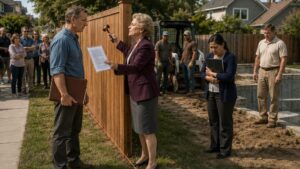
The HOA Tore Down His Shed, Then Learned Which Rules It Had Ignored
Chapter 1: The Shed Was Gone Before Larry Understood Why
Larry Miller stopped halfway through the gate because there was nothing left to unlock.
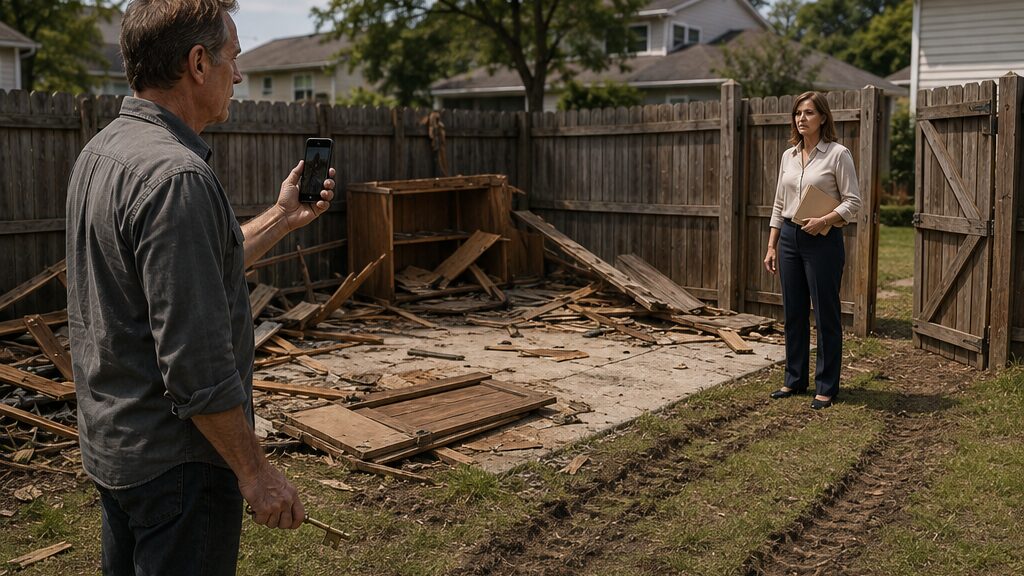
For three years, the narrow path beside his house had ended at a twelve-by-sixteen-foot wooden shed with double doors, a small side window, and a roof he had repainted himself the previous spring. Now the doors lay face-down in the grass.
Boards were scattered across the concrete pad. Splintered siding leaned against the fence. One section of roof rested upside down over a broken shelving unit.
For several seconds Larry stood with his overnight bag still hanging from one shoulder.
Then he set the bag down.
He did not touch anything.
His first instinct was anger, but habit arrived before anger could organize itself. Years of supervising warehouse operations had taught him that damaged equipment, disputed shipments, and workplace accidents became harder to explain the moment somebody started moving things.
Larry took out his phone.
Wide photographs first.
Then closer ones.
The pad.
The fence.
The tire tracks in the grass.
The bent hinges.
A cracked plastic tote that had once held extension cords.
He stepped carefully around the debris.
His lawn mower was gone.
So was the old metal toolbox he kept beneath the workbench.
The shelves had been crushed with the building.
He crouched beside a piece of doorframe and found the brass latch still attached.
His right hand went automatically to his pocket.
The shed key was there.
He pulled it out and looked at it.
A small brass key for a lock that no longer had a door.
That was when the anger finally caught up.
Larry stood and turned toward the neighboring houses. Nobody was outside. The subdivision looked exactly as it had when he left three days earlier—trim lawns, pale driveways, mailboxes lined along the curb, late-model SUVs in garages.
Only his backyard had been erased.
He walked around the side of the house and checked the front door.
Nothing disturbed.
No broken lock. No notice taped to the glass.
At the curb, his mailbox was packed with ordinary mail: a utility statement, two advertisements, a hardware-store flyer, and a thick white envelope bearing the homeowners association’s return address.
Larry stared at it.
He already knew.
Inside the kitchen, he opened the envelope with a butter knife.
The letter was dated two days earlier.
It stated that the association had completed enforcement action regarding an “unauthorized accessory structure” after the expiration of the removal deadline.
Larry read the sentence twice.
Completed enforcement action.
He went back to the beginning.
The letter referred to previous notices. It cited architectural standards. It said removal costs might be assessed to his account after final billing.
Larry put the page flat on the kitchen table.
“Unauthorized,” he said aloud.
The word sounded ridiculous in an empty room.
The shed had not appeared overnight.
It had stood in the backyard for three years.
Neighbors had borrowed tools from it. Board members had walked past it during annual inspections. A landscaping crew hired by the association had trimmed the common strip behind his fence dozens of times with the roof plainly visible.
More importantly, Larry had filed for approval before buying the first piece of lumber.
He could still remember carrying the application to the association office.
At least he thought he could.
The memory made him pause.
Three years was enough time for confidence to become assumption.
Larry disliked that realization.
He took the letter back outside and photographed it beside the debris, then called the number printed at the bottom.
Voicemail.
He did not leave one.
He called the association management line.
Another recording informed him that administrative questions would be returned within two business days.
Larry ended the call.
His neighbor across the street stepped out to roll a trash bin toward the garage. The man saw Larry beside the mailbox, glanced toward the side yard where the wreckage was visible, and slowed.
“You got back,” the neighbor said.
“About twenty minutes ago.”
A silence followed.
Larry waited.
The neighbor rubbed one hand over the trash-bin handle. “I figured somebody would’ve called you.”
“Who?”
“I don’t know. The board, maybe.”
“You saw what happened?”
“I saw a contractor truck yesterday morning. Small loader behind it.”
Larry’s jaw tightened.
“Did you see who told them to go in?”
“No. Catherine was around earlier, I think. I wasn’t really watching.”
Larry nodded.
The neighbor looked uncomfortable. “I’m sorry, Larry.”
“Thanks.”
He did not ask anything else.
Back inside, he opened the hallway closet where he kept household records.
Insurance policies occupied one box. Appliance manuals another.
A third plastic file box held documents from the year he bought the house.
Larry set it on the dining table and began sorting.
Closing statements.
Property survey.
HOA covenant booklet.
Paint specifications.
A faded packet labeled ARCHITECTURAL REVIEW.
His pulse changed.
He sat down.
The first page was the application he had filled out for the shed.
His own handwriting listed the dimensions, roof material, siding color, setback from the rear property line, and contractor information. Stapled behind it was a sketch showing where the structure would sit.
At the top right was a date stamp.
Larry ran his thumb over it.
He remembered the woman at the management office pressing the stamp down.
He remembered asking how long approval usually took.
“Up to thirty days,” she had said.
He remembered waiting.
He remembered checking the mailbox.
But memory was not enough.
Larry turned through the packet.
There was no approval letter.
That absence briefly hollowed out his certainty.
Maybe Catherine Roberts had been right. Maybe he had built based on an assumption he had allowed himself to forget.
Then Larry saw a folded photocopy tucked behind the site plan.
The association’s architectural guidelines.
Several paragraphs were highlighted in yellow.
Larry had done that himself.
He opened the page.
His eyes moved down toward the section governing review deadlines.
He stopped before reading it.
Outside, beyond the kitchen window, the remains of the shed were visible between the fence boards.
Three years ago he had believed the matter was finished.
Now a dated application sat under his left hand, the HOA’s demolition notice under his right, and somewhere between them was the rule that decided whether he had ignored the association—or the association had ignored him.
Chapter 2: Thirty Silent Days Had Once Meant Approval
On the thirtieth day, Larry opened the mailbox and found nothing from the homeowners association.
He stood at the curb holding a grocery circular and an electric bill, looking into the empty metal box as if an approval letter might have caught behind the door.
Nothing.
He checked the date on his phone.
Thirty days exactly.
The shed project had started as a practical annoyance.
His garage was crowded with yard equipment, seasonal decorations, two bicycles, folding chairs, and boxes he kept promising himself he would sort. He wanted the garage back for his truck before another summer of hailstorms.
So he had done what the covenants required.
He measured the backyard.
He chose a modest wooden design.
He hired a local contractor and collected the specifications the architectural committee requested.
Then he submitted everything.
The woman at the management office had stamped the first page and handed him a copy.
“Board usually turns these around pretty quickly,” she had said.
Larry had nodded.
He was not someone who enjoyed asking committees for permission to use his own property, but he had bought into an HOA knowingly. Rules were rules. Following them seemed easier than fighting about them later.
For the first week, he expected a response every afternoon.
By the second, he stopped thinking about it.
At three weeks, the contractor called.
“Any word?”
“Not yet.”
“We can hold the slot another week.”
Larry had looked through the kitchen window toward the bare patch near the rear fence.
“I’ll call you.”
Now the thirtieth day had arrived.
He brought the mail inside and placed it on the table.
The easiest thing would have been to call the association and ask.
Instead, Larry took out his copy of the governing documents.
He remembered something from the application packet about review periods.
The architectural section was dense enough to punish anyone who read it casually. Roof pitches, acceptable fencing materials, drainage responsibilities, paint restrictions.
Larry traced down the paragraphs with one finger.
Then he found it.
Applications submitted with the required materials were to be acted upon within thirty days.
He kept reading.
If no written decision was issued within that period, the request would be deemed approved.
Larry leaned back.
He read it again.
Not “may be approved.”
Not “subject to further review.”
Deemed approved.
He picked up the phone, then stopped.
Calling the office suddenly felt unnecessary.
The rule existed precisely because applications could not remain unanswered forever.
Still, he did not like relying on one paragraph without checking the rest.
He read the architectural section from beginning to end.
No exception jumped out.
No provision said an unanswered application expired.
No sentence required him to request confirmation after the thirty days.
Larry made a photocopy of the page and highlighted the clause.
Then he called the contractor.
“I think we’re clear.”
“You got the approval?”
“I got no denial within thirty days. The rules say that means approved.”
A pause.
“You comfortable with that?”
Larry looked at the highlighted paragraph.
“Yes.”
The answer sounded firmer than he felt.
Construction began the next week.
The contractor poured a small pad and framed the walls over two days. Larry watched the shed take shape from the kitchen window in the evenings.
A neighbor stopped by while the roof was being installed.
“Finally getting your garage back?”
“That’s the plan.”
“HOA give you trouble?”
“No.”
Larry almost added, They didn’t give me anything.
Instead he let the matter drop.
By Friday afternoon, the shed stood complete.
It was not fancy. That was part of what Larry liked about it.
Muted brown siding.
White trim.
Shingles matching the house.
A pair of double doors wide enough for the mower.
When the contractor handed him two brass keys, Larry unlocked and relocked the doors twice to make sure they caught cleanly.
Then he moved the mower inside.
For a while, the shed felt like proof that systems could work even when nobody was especially efficient.
Larry had submitted what was required.
The association had been given its deadline.
The deadline had passed.
Life continued.
He returned the application, the highlighted rule, the contractor invoice, and his site sketch to the plastic file box in the hall closet.
Months passed.
Then years.
Larry stopped paying much attention to association business beyond annual dues and notices that required action. He rarely attended meetings.
That was intentional.
Several years earlier, a management dispute at work had dragged him through months of meetings, emails, corrective plans, and conversations in which everybody seemed more interested in protecting their version of events than fixing the actual problem.
Larry had eventually been cleared of responsibility, but the experience changed him.
He decided paperwork could defend him better than arguments could.
Document it. Keep it. Move on.
The HOA seemed like another system best handled the same way.
He voted when ballots arrived.
He paid assessments on time.
He kept his yard neat.
He did not volunteer for committees.
And nobody questioned the shed.
Not during the first annual inspection.
Not during the second.
Not when contractors repaired the common fence behind his lot.
Not when an architectural-review volunteer walked past with a clipboard after a storm.
The structure gradually became part of the yard.
Its siding faded slightly.
Larry replaced a hinge.
He installed a shelf for small tools.
The brass keys lived on the same ring as his back-door key.
Three years after construction, a new association newsletter arrived.
Larry nearly threw it into the recycling without opening it.
A photograph showed Catherine Roberts, recently elected board president, standing beside a brief statement about improving consistency, protecting property values, and cleaning up unresolved compliance issues.
Larry skimmed the first paragraph.
Then he tossed it aside.
The next month, orange violation envelopes began appearing around the neighborhood.
A mailbox across the street was cited for the wrong shade of paint.
Someone farther down received a complaint about a satellite dish.
Larry heard about both from neighbors but paid little attention.
Neither concerned him.
Then one Tuesday evening, he pulled into his driveway after work and saw a bright envelope protruding from his own mailbox.
He carried it inside.
The first line identified an architectural violation on his property.
The second line identified the structure.
Accessory shed.
Larry looked through the kitchen window.
The building stood exactly where it had stood for three years.
He returned to the letter.
The new board was requesting proof of approval.
For the first time since he had locked the old paperwork away, Larry understood that thirty days of silence might not have ended the matter at all.
Chapter 3: Catherine Called It Cleanup, Larry Called It Rewriting History
Catherine Roberts was standing on the sidewalk behind Larry’s house when he saw her lift her phone and photograph his shed.
Larry had come home early after a supplier canceled a meeting. He was carrying a bag of groceries through the side gate when he heard voices beyond the rear fence.
Catherine was with an architectural-review volunteer.
The volunteer held a clipboard.
Catherine pointed toward the roofline.
Larry set the grocery bag on the patio table.
“Can I help you?”
Both turned.
Catherine did not look embarrassed.
“Mr. Miller.”
“You’re photographing my property.”
“We’re documenting exterior structures visible from common areas.”
“My shed is inside my fence.”
“The roof is visible.”
Larry looked at the phone in her hand.
“Why?”
Catherine lowered it.
“We’re reviewing files against existing structures. There are a number of older approvals we can’t locate.”
“I sent mine in.”
“Then there shouldn’t be a problem.”
“There wasn’t one for three years.”
The volunteer looked down at the clipboard.
Catherine’s expression barely changed.
“We’re trying to correct a lot of inconsistent recordkeeping. That’s all.”
She said it as if the explanation should have reassured him.
It did not.
Two days later, another envelope arrived.
This one did not merely request proof.
It stated that the association’s files contained no approval for the shed and directed Larry to submit documentation within ten days or face further enforcement.
Larry brought the old file box to the kitchen table that evening.
The application was still there.
So was the date stamp.
So was the highlighted clause.
He made copies of everything.
His response fit on one page.
He stated when the application had been submitted, enclosed the site plan, and quoted the thirty-day provision.
He did not accuse anyone.
He did not mention Catherine by name.
He ended with a simple request that the violation be withdrawn.
Then he placed the packet in the mailbox with the flag raised.
Three houses down, another homeowner was taping something to a faded mailbox post.
Larry walked over.
“Repair?”
The neighbor held up a small paint sample card.
“Apparently this is approved gray. Mine is an unacceptable gray.”
Larry looked at the mailbox. The distinction was nearly impossible to see.
“You got a notice?”
“Second one.”
The neighbor nodded toward Larry’s house.
“Heard they’re looking at your shed.”
“Where’d you hear that?”
“Board meeting.”
Larry’s attention sharpened.
“What about it?”
“Catherine used it as an example. Old structure, incomplete file, that kind of thing.”
Larry frowned. “What meeting?”
“Tuesday.”
Larry had received the agenda.
He remembered throwing it onto the counter beneath some work mail.
The neighbor seemed to read his face.
“You weren’t there.”
“No.”
“She said the board inherited years of sloppy approvals. They’re trying to make the records match what’s actually allowed.”
Larry folded his arms.
“Did she say mine was denied?”
“She said there wasn’t an approval.”
“That isn’t the same thing.”
The neighbor gave him a tired look. “You’d probably have to tell them that.”
Larry went home irritated with Catherine, but more irritated with himself.
The agenda was still beneath the mail.
Architectural compliance review occupied one line.
He had seen it.
He simply had not wanted to spend a Tuesday night in a clubhouse arguing about somebody else’s interpretation of paperwork he believed was already settled.
That instinct had once felt sensible.
Now Catherine had apparently discussed his property in a room where he was absent.
He considered emailing the board immediately.
Instead, he told himself his written response would do what conversation usually failed to do: make the facts clear.
Four days later Catherine answered.
Her letter was short.
She acknowledged the old application and the former thirty-day provision. That acknowledgment should have relieved him.
Instead, the next paragraph hardened something in his chest.
The current board, she wrote, did not recognize the absence of an archived approval as sufficient evidence of permanent authorization where compliance could not otherwise be established.
Larry read the sentence twice.
Then a third time.
It sounded careful.
It also avoided the actual rule.
He called the management office and requested a conversation with Catherine.
She returned the call late that afternoon.
“I received your letter,” Larry said.
“I assumed you would.”
“You acknowledge the thirty-day clause existed.”
“It existed.”
“My application wasn’t denied.”
“We can’t verify that it was approved.”
“The rule says no answer is approval.”
Catherine paused.
“That policy created problems.”
“That isn’t what I asked.”
“Mr. Miller, when this board took over, we found incomplete files everywhere. Structures with no decisions. Fences outside standards. Modifications nobody can explain. If every owner says silence means approval, we have no consistent way to enforce anything.”
Larry stood at the kitchen counter, staring through the window at the shed.
“That’s not every owner. That’s your written rule.”
“Was your shed ever inspected after construction?”
“I wasn’t required to request one.”
“Do you have a signed approval?”
“No, because your rule said I didn’t need one after thirty days.”
Catherine exhaled softly.
Larry could hear papers moving on her end.
“This isn’t personal.”
“I didn’t say it was.”
“We’re trying to clean up records that should have been cleaned up years ago.”
“You can clean the records. You don’t get to change what they meant three years ago.”
The line went quiet.
When Catherine answered, her voice was cooler.
“The board will review your response.”
Larry almost said, Good.
Instead he asked, “At an open meeting?”
“Yes.”
“When?”
“Next Thursday.”
Larry wrote the date on the back of an envelope.
For two days he intended to attend.
Then work intervened.
A distribution problem at one of his facilities forced him into a late afternoon call. By the time he got home Thursday, he was tired, hungry, and already forty minutes late.
He stood in the kitchen with the clubhouse agenda in his hand.
He could still go.
The meeting usually ran two hours.
He imagined folding chairs, neighbors complaining about landscaping, Catherine repeating that the records were incomplete, himself arguing over a paragraph everyone could simply read.
The old exhaustion returned—the same resentment he had felt during the workplace dispute years earlier, when meetings multiplied because no one trusted the documents sitting in front of them.
Larry placed the agenda on the counter.
His written submission was already in the record.
That should be enough.
It was his mistake, though he would not understand its cost until later.
The next morning, George Brown caught him at the mailbox.
George had lived in the subdivision almost as long as Larry and had recently become board treasurer.
“You missed a lively one,” George said.
“So I heard.”
George’s smile disappeared.
“They talked about your shed.”
“What did they decide?”
“Not formally. Catherine wants the compliance review finished first.”
Larry studied him.
“Do you agree with her?”
George looked down the street before answering.
“I think we’ve got a records problem.”
“That wasn’t my question.”
“No.”
George rubbed the back of his neck.
“But I understand what she’s worried about.”
“What?”
“If we accept every old situation based on missing paperwork, we may have to reopen a lot more than your shed.”
Larry waited for him to elaborate.
George did not.
Instead he said, “You should come to the next meeting.”
Larry felt irritation rise again.
“I submitted what the rules required. Three years ago.”
“I know.”
“Then why do I need to stand in a clubhouse and prove it again?”
George’s face tightened.
“Because Catherine is standing there.”
The answer stayed with Larry.
A week later, the board’s decision arrived.
The envelope was heavier than the earlier notices.
Larry opened it at the kitchen counter.
The first page formally rejected his claim that the shed had acquired permanent approval through administrative silence.
The second page gave him a deadline to remove the structure voluntarily.
Fourteen days.
If he failed to comply, the association reserved the right to pursue enforcement remedies allowed under the governing documents.
Larry set the pages down.
Fourteen days.
Outside the window, the shed door caught the afternoon light. The brass lock reflected a small, bright point.
For three years, Larry had believed keeping the old paperwork meant he never needed to argue about this.
Now the board had his application, the date, the exact rule—and had ordered the shed removed anyway.
That no longer looked like a misunderstanding.
What Larry still did not know was why Catherine Roberts seemed willing to push past the rule instead of admitting what it said.
Chapter 4: The Lawyer’s Letter Should Have Ended Everything
Samantha Perez did not begin by asking whether Larry had kept the application.
She looked across her desk and asked, “Why weren’t you at the meeting?”
Larry had expected questions about dates, covenants, notices, maybe photographs. Not that.
“I sent them everything.”
“That wasn’t my question.”
He shifted in the chair.
“I had work.”
Samantha glanced at the folder open between them. “And after work?”
Larry looked toward the window behind her. The office faced a row of medical and professional buildings separated by parking lots and low hedges.
“I could have gone.”
“But you didn’t.”
“No.”
She nodded once and returned to the documents.
Larry disliked the direction of the conversation because it sounded too much like the arguments he had spent years avoiding: if you were right, why didn’t you show up and say so?
“The paperwork is what matters,” he said.
“In court, often. In a board meeting, perception matters too.”
“I’m not interested in perception.”
“That doesn’t mean Catherine isn’t.”
Samantha turned the architectural guidelines toward him.
She had marked the same paragraph Larry highlighted three years earlier.
“Your position is not frivolous,” she said. “Actually, based on what you’ve shown me, it’s fairly strong.”
Larry leaned forward.
“Fairly?”
“I don’t use words like ‘guaranteed’ when other people’s money is involved.”
He almost smiled.
She continued.
“The version in effect when you applied says the committee has thirty days to act. If it doesn’t issue a written decision, the application is deemed approved. You have a stamped copy showing submission. You have the site plan. You have the contractor invoice. You have three years of the structure standing without enforcement.”
“So they can’t order it removed.”
Samantha held up one finger.
“I didn’t say that.”
Larry’s jaw tightened.
“I’m saying they have a serious problem if they try.”
She pulled another packet from her file.
“This is the current architectural policy.”
Larry had seen parts of it online but never read the whole revision.
Samantha flipped to the adoption page.
“Effective date is eighteen months after your shed was built.”
Larry looked at her.
“So Catherine is applying a new policy backward.”
“That appears to be part of what she’s doing. The current rules removed the automatic-approval language and require written confirmation before construction. That may be sensible going forward. It doesn’t automatically erase what happened under the old rules.”
Larry sat back.
For the first time since the violation notice arrived, he felt the pressure in his chest loosen.
The board’s language had made him question his own memory, then his own judgment. Seeing the dates beside each other changed that.
His shed had not slipped through some vague administrative crack.
There had been a rule.
He had followed it.
The board had later changed it.
Samantha tapped Catherine’s removal letter.
“The problem is this sentence.”
The association reserved the right to pursue enforcement remedies.
“What does that mean?” Larry asked.
“It means we don’t wait for them to explain.”
She drafted a letter that afternoon.
Larry watched her work through several versions of sentences he would have written much more bluntly.
She identified the submission date.
Quoted the old clause.
Referenced the later policy change.
Noted the shed’s long existence without prior action.
Then she included a warning that the association should not enter Larry’s property, remove the structure, damage it, or hire anyone else to do so while the dispute remained unresolved.
Larry pointed to that paragraph.
“Do you really think they’d do that?”
Samantha stopped typing.
“You received a removal deadline.”
“That doesn’t mean they’re going to walk into my backyard.”
“No,” she said. “But this makes sure they can’t later say they weren’t warned.”
That answer stayed with him.
He signed the engagement letter and paid the retainer.
On his way home he stopped at the community mailbox.
Nothing from the HOA.
The next day Samantha sent the letter by email and trackable mail.
Then they waited.
Two days passed.
Then four.
Larry checked his email more often than he wanted to admit.
At work, he found himself opening his personal inbox between calls.
Nothing.
At home, the mailbox became an irritation.
A credit-card offer.
A water bill.
A grocery flyer.
No response.
On the sixth day, Larry called Samantha.
“Maybe they’ve decided to drop it.”
“Maybe.”
“You don’t sound convinced.”
“I’d rather have that in writing.”
“Everything with you has to be in writing.”
“That’s why you hired me.”
Larry laughed once.
It felt good.
The following evening, he unlocked the shed and stood inside longer than necessary.
The mower occupied one corner. A ladder hung from hooks on the wall. Plastic bins sat on the shelves. The place smelled faintly of cut grass, plywood, and machine oil.
He ran his hand along the workbench.
It was absurd that such an ordinary building had taken over his thoughts.
He locked the doors again and tested the handle.
Solid.
The next morning, an email from his regional manager arrived before six.
A distribution site two states away had a staffing problem. Larry needed to travel for three days.
Normally he would have left without hesitation.
Instead he opened Samantha’s letter again.
The HOA had received it.
Delivery confirmed.
Still no answer.
He called the management office.
Voicemail.
He did not leave a message.
At noon, George Brown saw him loading a small suitcase into his truck.
“Heading out?”
“Work.”
George glanced toward Larry’s backyard.
“You hear anything from the board?”
“No.”
George looked as though he wanted to say more.
Larry waited.
“Catherine’s been busy,” George finally said.
“With my shed?”
“With a lot of things.”
“That’s not an answer.”
George gave a tired shrug. “It’s the only one I’ve got.”
Larry closed the truck door.
“Did you vote on enforcement?”
George’s eyes shifted.
“We discussed options.”
“What options?”
“Larry, I really can’t speak for the board outside a meeting.”
“You had no trouble speaking about my property when I wasn’t in the room.”
George looked stung.
For a moment Larry regretted saying it.
Then George said quietly, “That’s exactly why you should’ve been there.”
Larry felt the old resistance rise.
Meetings.
Debates.
Minutes.
People turning plain facts into positions.
“I hired an attorney,” he said. “She sent you the facts.”
“I know.”
“Then read them.”
Larry got into the truck.
Before leaving the subdivision, he stopped at the mailbox one last time.
Empty.
The silence should have reassured him.
Instead, Samantha’s warning returned to him: We don’t wait for them to explain.
Larry closed the metal door and drove away, believing the strongest letter in the dispute had already been sent.
He did not yet understand that the board had chosen not to answer it at all.
Chapter 5: The Board Chose Demolition Instead of an Answer
Larry saw the sky through the place where the shed had stood.
That was the detail he noticed first.
Not the lumber.
Not the tire tracks.
Not even the collapsed shelving.
The open rectangle of morning light where the roofline should have been told him, before his mind caught up, that the structure was gone.
He left his suitcase by the gate.
The photographs came next.
Wide shots.
Fence.
Ground.
Debris.
The concrete pad.
The tracks pressed into the grass.
One section of the double doors had been flattened near the rear corner of the yard. The brass latch was still attached, bent sideways.
Larry crouched.
His hand went into his pocket.
The key was there.
He held it above the broken hardware without touching either piece.
For several seconds, that small useless key made the destruction feel more personal than the entire pile of lumber.
A door had belonged to it three days ago.
He took another photograph.
Then his phone rang.
Samantha.
Larry answered without greeting.
“They tore it down.”
Silence.
“What?”
“The shed. It’s gone.”
“Do not move anything.”
“I’m not.”
“Is anyone there?”
“No.”
“Take photographs from every angle. Fence line, access points, tire impressions, anything damaged besides the structure.”
“I already started.”
“Good. Then stop after that.”
Larry looked at the broken shelves.
“My mower’s gone.”
“Photograph where it was stored.”
“Toolbox too.”
“Do not call the board yet.”
Larry straightened.
“I wasn’t planning to.”
That was not entirely true.
He wanted Catherine Roberts standing in front of him.
Not because he intended to threaten her.
Because he wanted to hear someone explain how a disputed shed turned into permission to enter his backyard with machinery.
He had just finished photographing the side gate when a white SUV stopped at the curb.
Catherine got out.
Larry almost laughed at the timing.
She walked toward him carrying a thin folder.
No board members.
No management representative.
Just Catherine.
She stopped outside the open gate.
“I heard you were back.”
Larry looked at her.
“You heard fast.”
“The contractor notified management that the work was completed.”
“Completed.”
Catherine’s expression remained controlled.
“The association issued a removal order. The compliance period expired.”
Larry glanced toward the rubble.
“You received my attorney’s letter.”
“Yes.”
“She specifically told you not to enter my property.”
Catherine’s jaw tightened.
“The board acted under its enforcement authority.”
“Who authorized entry?”
“We’re not going to litigate this in your yard.”
“Who authorized entry?”
“Larry—”
“That’s the only question I’m asking.”
Catherine looked past him at the debris.
For the first time since Larry had known her, she appeared uncertain.
Not frightened.
Not ashamed.
Just calculating how much to say.
“The board approved enforcement.”
“All of you?”
“The board authorized the action.”
“Who called the contractor?”
A pause.
“I did.”
Larry took out his phone.
Catherine’s eyes narrowed.
“Are you recording me?”
“No.”
He opened the camera and photographed the tire tracks again.
“I’m documenting my property.”
She seemed irritated by his refusal to fight with her.
“The structure was out of compliance.”
“My attorney disagrees.”
“The matter has been enforced. The structure is no longer there.”
Larry stopped moving.
There it was.
Not an apology.
Not an explanation.
An ending.
As if removing the thing being disputed had removed the dispute itself.
“You think that resolves it?” he asked.
“I think it removes the ongoing violation.”
Larry looked at the crushed door.
“You had a lawyer’s letter telling you the approval was legally disputed.”
“We had counsel too.”
“Did your counsel tell you to demolish it?”
Catherine’s mouth tightened.
Larry noticed.
It was the first crack in the certainty she had carried since the compliance campaign began.
He slipped the useless shed key back into his pocket.
“Who was present when the board approved this?”
Catherine shook her head.
“I’m not discussing privileged board deliberations.”
“Fine.”
“Larry, this didn’t have to become personal.”
He looked at her then.
She must have realized the mistake immediately.
The mower was gone. The shelves were broken. His grass had been torn by equipment. The building he had used for three years had been reduced to a debris pile while he was several hundred miles away.
“I’m not the one who came into your backyard,” he said.
Catherine’s face flushed.
“That isn’t what I meant.”
“I know.”
He walked to the gate.
For one second she seemed to assume he was coming toward her.
Instead Larry stepped aside and held the gate open.
“I’m done discussing this without Samantha.”
Catherine did not move.
“The board followed its process.”
Larry pointed through the gate.
“Then you won’t have any problem putting that process in writing.”
She left without replying.
Only after the SUV disappeared did Larry allow himself to sit.
He chose the back step because it was the only place in the yard not covered with debris.
His hands were shaking.
That surprised him.
He pressed them together.
He had imagined anger as something loud.
Instead it sat heavily behind his ribs.
A lawn mower could be replaced.
A shed could be rebuilt.
But what unsettled him most was the ease with which Catherine had said the matter was resolved.
The structure is no longer there.
As though destruction could become a substitute for being right.
Samantha arrived forty minutes later.
She wore flats instead of office shoes and carried a camera, legal pad, and plastic evidence bags.
She stopped inside the gate.
“Oh.”
It was the first unguarded reaction Larry had seen from her.
“Yeah.”
“Contractor?”
“Catherine says she called them after the board authorized it.”
Samantha looked sharply at him.
“She said that?”
“Yes.”
“Exact words?”
Larry repeated the exchange as closely as he could.
Samantha wrote it down.
Then she walked the perimeter without touching anything.
At the gate, she crouched near a fresh scrape in the post.
“Any lock here?”
“No. Gate latch.”
“Was the yard accessible?”
“If you opened the gate.”
She nodded.
“That doesn’t make it theirs.”
They spent nearly an hour cataloging damage.
Samantha photographed the flattened door, broken shelving, crushed plastic bins, and tracks. She asked Larry to list everything that had been inside.
When he mentioned the missing mower and toolbox, she added them separately.
“You think the contractor took them?”
“I don’t know.”
“We won’t assume.”
Larry watched her write.
That sentence steadied him.
No assumptions.
Only what they could prove.
When they finished, Samantha stood beside the concrete pad.
“The original approval issue is still important,” she said. “But this may now be about more than architectural enforcement.”
“Entry.”
“Entry. Property damage. Authority. Notice. Potential conversion if personal property was removed. We need the contractor records and board authorization.”
Larry looked at the pile.
“So what happens?”
“We preserve this. We send a demand immediately. We request insurance information and all records relating to the removal.”
“And if they ignore that too?”
Samantha closed her legal pad.
“Then we stop sending warnings.”
Larry turned toward her.
“What does that mean?”
“It means we file.”
For three years he had wanted nothing from the HOA except to be left alone.
Even after the first violation, that had remained his goal.
Keep the shed.
Close the file.
Avoid the meetings.
Now the shed was gone.
Being left alone was no longer an available outcome.
Larry reached into his pocket and felt the key again.
Samantha followed his glance toward the broken door hardware.
“Keep that,” she said.
He looked at her.
“The key?”
“Yes.”
“Why?”
“Because it belonged to what they say never had approval.”
That afternoon, Larry left the debris exactly where it lay.
By evening, Samantha had drafted a preservation demand.
By the next morning, she had prepared the complaint.
And when Larry asked when he could finally clear his backyard, Samantha gave him a different instruction.
“Not yet.”
He looked through the kitchen window at the wreckage.
“We’re really doing this.”
“Yes.”
“For the shed?”
Samantha shook her head.
“For what they chose to do after they knew there was a dispute.”
That was the moment Larry understood the argument had changed.
He was no longer asking permission to keep a building.
He was asking who had decided the HOA could destroy one.
Chapter 6: The Pavilion Records Explained More Than the Shed
The first document that worried Larry had nothing to do with his shed.
It was a county permit application for the new community pavilion.
Samantha slid it across the conference table months after the lawsuit began.
Larry glanced at the page and then at her.
“Why do we have this?”
“Discovery.”
“I know where it came from. Why does it matter?”
“Look at the applicant.”
The association’s name appeared near the top.
Larry recognized it.
Then Samantha pointed to the identification number beneath it.
“This number belongs to the association’s old entity record.”
Larry frowned.
“Old how?”
“Two years ago the HOA reorganized its legal structure. New tax identification, updated state registration, new banking documents.”
“And?”
“And this permit was filed four months ago using the old information.”
Larry read the page again.
It looked ordinary.
That made it worse.
No dramatic red stamp.
No giant word saying INVALID.
Just one number that apparently did not belong where it sat.
Samantha had three more permit documents in the folder.
Electrical.
Foundation.
Site work.
Same information.
“Does that mean the pavilion is illegal?”
“I said there’s a problem. Don’t turn it into something bigger yet.”
“What kind of problem?”
“The county approved work based on an applicant identity that may not match the entity actually responsible for the project. At minimum, it needs explaining.”
Larry leaned back.
Through the glass wall of the conference room, office staff moved quietly between desks.
“How did this come out of my shed case?”
“Because we requested records relating to the board’s enforcement policies, insurance communications, architectural compliance reviews, and projects requiring regulatory approval.”
Samantha opened another folder.
“Your board produced more than it intended to explain.”
An insurance email appeared first.
The carrier had raised concerns about inconsistent covenant enforcement and incomplete architectural records.
Another communication referenced potential underwriting consequences if the association could not demonstrate standardized procedures.
Then came correspondence relating to pavilion financing.
Larry read slowly.
“Clean compliance record,” he said.
Samantha nodded.
“Repeated several times.”
The words began rearranging the last few months in his mind.
Catherine photographing old structures.
The mailbox paint.
Satellite dishes.
The sudden insistence that missing archived approvals could not be accepted.
The refusal to treat the thirty-day clause as final.
“She wasn’t just cleaning up the neighborhood.”
“No.”
“She was cleaning the files.”
“That’s closer.”
Larry felt satisfaction for less than a second.
Then he looked back at the permit applications.
The pavilion was already under construction.
Residents had voted for it the previous year. A new covered gathering space beside the clubhouse, upgraded restrooms, accessible walkways.
He had voted yes.
Most people had.
“What happens if these permits have to be redone?”
“That depends on the county and the exact defect.”
“Cost?”
“Potentially.”
“How much?”
“I don’t know.”
“Who pays?”
Samantha gave him the answer without dressing it up.
“The association.”
Meaning the homeowners.
Larry looked away.
For months, he had imagined the moment when Catherine’s certainty finally encountered a rule she could not reinterpret.
He had expected it to feel clean.
It did not.
That afternoon they drove to the county records office.
A clerk confirmed the old entity number appeared on the permit file but would not speculate about consequences. The civil inspector assigned to the project had requested additional documentation after noticing inconsistencies in the ownership records.
“So it’s already flagged?” Larry asked.
The clerk nodded.
“Looks like it.”
Outside, Larry stood on the courthouse steps while Samantha checked an email.
“If they have to pause construction,” he said, “everybody’s going to blame me.”
“Some people might.”
“I didn’t file the permit wrong.”
“No.”
“But this lawsuit is why anyone looked at it.”
Samantha put away her phone.
“You need to decide whether you care about the distinction.”
Larry looked at her.
“What’s that supposed to mean?”
“You’ve spent most of this case wanting the documents to speak for themselves. They don’t. People tell stories around documents.”
He almost objected.
Then he thought about Catherine presenting his shed at the meeting he skipped.
“You think I should start going to board meetings.”
“I think at some point you may have to decide whether you want a private remedy or a public correction.”
“That sounds like lawyer language.”
“It is.”
They stopped by the pavilion site on the way back.
Construction fencing surrounded a partially framed roof structure beside the clubhouse.
Workers were setting material beneath temporary shade.
Larry parked across the street.
The project looked expensive.
More importantly, it looked communal.
Families had donated suggestions. Retired residents had pushed for shaded seating. The board had promoted the pavilion as something that would make the neighborhood feel less like rows of private houses and more like a community.
Larry had never cared much about that argument.
Now he understood why Catherine might.
Not enough to forgive her.
Enough to see the shape of the pressure.
A clean compliance record could support insurance.
Insurance could affect financing.
Financing could affect construction.
Old undocumented exceptions became more than annoyances.
They became liabilities on paper.
Catherine had looked at his shed and not seen a storage building.
She had seen one more uncontrolled record.
The realization made her behavior more understandable.
It did not make the wreckage in Larry’s yard less real.
Two weeks later, Samantha obtained board emails discussing enforcement.
Catherine’s messages were precise, never reckless.
She repeatedly warned that the association needed “uniform treatment” and could not maintain two classes of owners—those with clean written approvals and those relying on missing historical records.
George Brown appeared in several threads.
His messages focused on cost.
Potential claims.
Insurance renewals.
The possibility that reopening prior violations could expose the HOA financially.
Larry read one exchange twice.
George had asked whether aggressive enforcement against older structures could itself create liability.
Catherine’s answer was cautious.
Then another board member asked specifically about Larry’s attorney letter.
The response chain became shorter.
More guarded.
Larry felt the old anger return.
“She knew.”
Samantha did not answer immediately.
“She knew there was risk.”
“That’s the same thing.”
“No. Be precise.”
Larry pushed the papers away.
“She knew enough to stop.”
“That may be the argument.”
May be.
Larry hated that word.
The case was full of words that sounded solid until lawyers touched them.
Approval.
Authority.
Uniform.
Reasonable.
Risk.
That evening George appeared at Larry’s door.
It was the first time he had come over since the lawsuit was filed.
Larry opened the door but did not invite him inside.
George looked older than he had a few months earlier.
“Can we talk?”
“About what?”
“The board.”
Larry folded his arms.
“If this is official, talk to Samantha.”
“It’s not official.”
“That makes it worse.”
George gave a tired half-smile.
“Probably.”
Larry waited.
George looked toward the street.
“The permit issue is going to become public.”
“I figured.”
“People are going to be angry.”
“At me?”
“At everybody.”
Larry said nothing.
George lowered his voice.
“I wanted to tell you something before the next meeting.”
“What?”
“We knew the demolition could lead to a lawsuit.”
Larry stopped breathing for a beat.
“We?”
“The board.”
“Before it happened?”
George looked directly at him.
“Yes.”
Larry’s hand tightened around the edge of the door.
“Then why did you approve it?”
George looked down.
“I didn’t vote no.”
“That’s not what I asked.”
“We were told backing down after all the other enforcement actions could create a bigger problem. Catherine thought if your structure stayed, every owner we’d cited would use it against us.”
Larry stared at him.
“And you agreed.”
“I agreed that the finances were getting ugly.”
“That isn’t the same thing.”
“No,” George said quietly. “It isn’t.”
For the first time, Larry saw the flaw in George’s caution because it looked so much like his own.
George had sat in the room, disliked what was happening, worried privately, and allowed the people speaking most firmly to define the outcome.
Larry had done the same thing from outside the room.
The difference was that George had held a vote.
Larry looked past him toward the mailbox.
He had spent months wanting proof that Catherine’s decision had been reckless.
Now he had something more uncomfortable.
She had not acted because she misunderstood the danger.
She had acted because she believed the danger of backing down was worse.
George shifted his weight.
“I thought you should know.”
Larry met his eyes.
“Why tell me now?”
“Because I’m not sure saving the association money is the same thing as protecting it anymore.”
Then George turned and walked back toward the street.
Larry remained in the doorway.
The lawsuit had begun as a demand to replace what the board destroyed.
Now the association’s own project, its insurance, its finances, and dozens of neighbors were tied into the same dispute.
And for the first time, the next decision with the power to hurt everyone might belong to Larry.
Chapter 7: Winning the Case Was Not the Same as Fixing the Rules
The settlement offer was twelve pages long, and not one of them required the HOA to admit it had done anything wrong.
Larry read the first page twice before looking up.
Across the mediation table, Samantha Perez sat with one hand resting on a yellow legal pad. Catherine Roberts sat opposite them beside the association’s attorney. George Brown was farther down the table with two other board members.
A mediator occupied the end seat.
Larry tapped the document.
“So they pay for the shed.”
Samantha nodded slightly.
“And some of my legal fees.”
“Yes.”
“And the violation disappears.”
“Yes.”
He turned another page.
“But nothing changes.”
The association’s attorney leaned forward. “Mr. Miller, the proposed settlement resolves your individual dispute.”
“That’s what I said.”
Catherine’s expression tightened.
Larry continued.
“The same board that said my approval didn’t count gets to keep the same process?”
“The current process is different from the one you applied under,” Catherine said.
Larry looked at her.
“That’s not the point.”
The mediator raised a hand.
“Let’s keep this focused.”
Larry nearly laughed.
Focused was exactly what he had tried to be from the beginning.
One application.
One rule.
One shed.
Every time he had narrowed the issue, someone else had widened it.
Samantha leaned toward him.
“We can ask for revisions.”
Larry kept his eyes on the agreement.
“How much money do they think ends this?”
The amount was enough to replace the structure, replace the missing mower and tools, and reimburse a meaningful portion of his expenses.
Months earlier, Larry might have taken it.
He had wanted the file closed.
He had wanted his yard back.
He had wanted to stop checking his mailbox with the expectation that another problem would be waiting inside.
Now the money felt incomplete.
“What happens to everyone else?” he asked.
The association’s attorney frowned. “In what respect?”
“Old approvals.”
No one answered immediately.
Larry looked toward George.
George lowered his eyes.
“The ones you called inconsistent,” Larry said. “The ones Catherine said had to be cleaned up.”
Catherine spoke carefully.
“We have already suspended several enforcement actions pending review.”
“Temporary review.”
“Yes.”
“By the same people?”
The mediator shifted in his chair.
“Mr. Miller, are you proposing specific non-monetary terms?”
Larry looked at Samantha.
She had asked him that exact question two days earlier.
At the time, he had not known.
Now he did.
“Yes.”
Samantha uncapped her pen.
Larry spoke slowly.
“Independent review of disputed architectural approvals.”
The association’s attorney immediately began writing.
“A written rule for what happens when old files are missing.”
Catherine’s jaw tightened.
“Published procedures,” Larry continued. “Not whatever somebody decides at a meeting.”
“Larry,” Catherine said, “we already have procedures.”
“You had procedures when you came into my yard.”
Silence settled over the room.
He did not raise his voice.
That seemed to make the sentence land harder.
The mediator looked between them.
Samantha added, “We’d also want confirmation that no disputed structure can be removed while an appeal or documented approval claim remains pending.”
The association’s attorney started to object.
Larry cut in.
“That one isn’t optional.”
The attorney looked at him.
Larry held his gaze.
Months earlier he would have let Samantha make the point for him.
Not now.
The mediator called for a break.
Larry and Samantha stepped into the hallway.
“You realize,” she said, “the more non-monetary terms we demand, the less flexible they may be on damages.”
“I know.”
“Do you?”
Larry looked through the narrow window in the conference-room door.
Catherine was talking to the association attorney. George sat apart from them.
“I don’t want to buy a new shed with money from every neighbor and leave the same board process sitting there.”
“That may be the cleanest legal result.”
“Clean for who?”
Samantha studied him.
Then she nodded once.
“All right.”
When they returned, the discussion shifted.
The association attorney challenged the scope of independent review.
Catherine objected to language restricting board discretion.
Larry listened.
For once, he did not feel the urge to escape the meeting.
He heard what each objection actually meant.
Cost.
Control.
Fear of precedent.
The same pressures that had been present from the beginning.
Eventually Catherine stopped talking to her attorney and addressed Larry directly.
“You keep treating this like we wanted your shed gone.”
Larry looked at her.
“Didn’t you?”
“No.”
The answer surprised him.
Catherine folded her hands on the table.
“I wanted the inconsistency gone.”
Larry said nothing.
She continued.
“When I came onto the board, we had files missing approvals, approvals missing applications, structures that didn’t match anything on record, owners insisting somebody had told them something ten years ago.”
“That doesn’t make my application disappear.”
“I know that now.”
“You knew the clause existed before the demolition.”
“Yes.”
The room went still.
The association attorney shifted in his chair.
Catherine kept looking at Larry.
“We also knew if we accepted your approval, every unresolved case we had cited could point to yours.”
“That was the reason?”
“One of them.”
George finally spoke.
“The insurance review was another.”
Catherine glanced at him but did not stop him.
He continued.
“We were already being questioned about inconsistent enforcement. The pavilion financing was tied up with demonstrating that the association had functioning controls.”
Larry looked back at Catherine.
“So you decided I was easier to remove than the problem.”
Her face changed.
Not dramatically.
Just enough.
“I decided backing down could collapse everything we had been trying to fix.”
“And you thought tearing down my shed was safer.”
“I thought letting every exception stand would create a larger failure.”
Larry leaned back.
There it was.
Not ignorance.
Not a mistake.
A choice.
And, for the first time, a reason that was not absurd.
He could understand the pressure.
That did not reduce the damage.
“You were scared of losing control,” he said.
Catherine did not answer.
“You still chose my property to prove you had it.”
Her eyes dropped.
The mediator gave the room a moment before speaking.
“Can we work with that?”
The next two hours produced a revised framework.
Independent architectural review for disputed historical approvals.
Written appeal procedures.
No removal action during an active appeal where documentary evidence of prior approval existed.
A review of the pavilion permits and association entity records.
Formal cancellation of Larry’s violation.
Compensation for the destroyed structure and missing property.
No admission of intentional wrongdoing.
Larry disliked the last term.
Samantha knew it.
In the hallway she said, “You can keep pushing.”
“What happens if I do?”
“We litigate. You could recover more. Or less. It could take another year.”
“And the policy changes?”
“Not guaranteed.”
Larry looked toward the conference room.
“What about punitive damages?”
“If you want them, we keep that claim alive.”
He thought about the rubble.
About Catherine saying the structure was no longer there.
About George admitting he had not voted no.
About his own empty chair at the meeting when Catherine first defined the issue.
He had spent most of his life believing the safest position was outside the room.
Now he knew better.
When they returned, Larry set the original approval envelope on the table.
The paper was soft at the folds from years in the file box.
“This,” he said, “was enough three years ago.”
Catherine looked at it.
“It should have been.”
Larry nodded.
“I’ll drop the punitive claim if the board adopts the reforms as part of the settlement, not as a recommendation.”
The association attorney whispered something to Catherine.
George looked up.
“I’d support that.”
One of the other board members nodded reluctantly.
Catherine remained still.
Finally she said, “I can recommend it at the special meeting.”
Larry shook his head.
“No.”
Her eyes narrowed.
“I can’t promise the votes.”
“Then I don’t promise mine.”
For several seconds neither moved.
Then Catherine exhaled.
“If the reforms pass, you drop punitive damages.”
“Yes.”
“And the monetary terms remain within the current range.”
Larry looked at Samantha.
She gave the smallest nod.
“Yes.”
Catherine extended her hand across the table.
Larry did not take it immediately.
He looked at the old envelope between them.
Months ago he would have wanted her to admit she had been wrong.
Now he wanted something harder.
He wanted the mistake to become more difficult to repeat.
He shook her hand.
The agreement was not finished.
The board still had to vote.
And for the first time since the dispute began, Larry knew the final outcome would depend on him showing up in the room.
Chapter 8: The Next Letter in Every Mailbox Used Different Rules
The first HOA letter Larry opened without hesitation arrived on a Tuesday afternoon.
He saw the association return address through the small envelope window and almost carried it inside out of habit.
Then he stopped beside the mailbox.
For months, that metal box had delivered deadlines, violations, warnings, and silence disguised as procedure.
Larry opened the envelope at the curb.
The first page announced adoption of revised architectural-review standards.
No dramatic language.
No apology.
Just rules.
Applications received in writing would receive dated confirmation.
Historical approvals with incomplete files would be reviewed using the governing documents in effect at the time of submission.
Owners would receive a defined appeal period.
No physical removal of a disputed structure could occur while a documented approval appeal remained active.
Larry read that paragraph twice.
Across the street, another homeowner was opening the same envelope.
Farther down, a mailbox door snapped shut.
The new procedure had gone to every house.
Larry folded the letter.
The special meeting had been quieter than he expected.
No applause.
No dramatic resignation.
Just chairs, microphones, frustrated questions, and a long vote.
Larry had stood at the front of the clubhouse with his original approval envelope in one hand.
For once, he had not let Samantha speak first.
He explained the dates.
The old rule.
The demolition.
Then he stopped before turning the meeting into a prosecution of Catherine.
“This isn’t about making every old structure automatically valid,” he had said. “It’s about deciding cases under the rules that existed when people acted, and giving them a real way to challenge a decision before the association destroys something.”
That was all.
George had spoken next.
He admitted the board had underestimated the legal and financial risk of enforcement.
He did not excuse himself.
That mattered to Larry more than a polished apology would have.
The reforms passed.
Not unanimously.
Enough.
The settlement followed.
Larry received payment for the shed, missing equipment, property damage, and part of his legal costs. The pavilion permits were corrected after county review. Construction paused, then resumed.
The delay cost the association money.
Not catastrophic money.
Enough for residents to notice.
Some blamed Catherine.
Some blamed the previous board.
A few blamed Larry.
One neighbor told him the lawsuit had made everyone’s dues problem worse.
Larry did not argue.
“Maybe,” he said.
It was not the answer the neighbor wanted.
But it was more honest than pretending justice had been free.
Two weeks after the settlement became final, Catherine resigned as president.
She did not move.
That surprised people.
Larry saw her several times afterward walking the subdivision in ordinary clothes, no folder, no clipboard, no board business attached to her presence.
The first time they crossed paths near the mailbox cluster, both slowed.
Catherine spoke first.
“How’s the yard?”
“Cleaner.”
A small silence followed.
“I heard you’re rebuilding.”
“Smaller.”
She nodded.
“That makes sense.”
Larry almost asked why.
Instead Catherine looked at the letter in his hand.
“The procedures are better.”
“They are.”
“I should have pushed for that before enforcement.”
Larry studied her.
Months ago he had imagined what he would say if she ever acknowledged the mistake.
In his imagination, every line had been sharp.
None of them felt necessary now.
“You should have stopped before the shed,” he said.
Catherine looked down.
“Yes.”
That was as close to reconciliation as either of them seemed able to reach.
Larry was satisfied with it.
The new shed went up in early fall.
Ten by twelve instead of twelve by sixteen.
Enough for the mower, tools, and seasonal storage.
No workbench this time.
Larry decided he did not need one.
He submitted the application under the new procedure.
The confirmation arrived two days later.
The approval came twelve days after that.
Signed.
Dated.
Filed electronically and on paper.
Larry laughed when he opened it.
Not because it was funny.
Because it was almost offensively ordinary.
This was how the first process should have ended.
One letter.
One decision.
No mystery.
No need to build a life around proving what silence meant.
When the contractor finished the new structure, Larry stood in the doorway with a new key in his hand.
The building smelled of fresh lumber.
The shelves were simpler.
The mower fit easily.
He ran his palm over the doorframe.
For a moment he remembered the old shed exactly as it had been the night before his work trip.
He expected grief.
What came instead was recognition.
The settlement had paid for lumber.
It had not restored three years of use.
It had not erased the sight of broken boards across his yard.
It had not return him to the version of himself who believed the best way to deal with public conflict was to stay absent and keep good files.
Some losses did not reverse.
They changed shape.
That evening, Larry sorted the last of the case papers.
Samantha had told him he could discard most of the duplicates.
He did.
Copies of emails.
Draft letters.
Photographs he no longer needed.
Old board notices.
The original application stayed.
So did the revised architectural policy.
At the bottom of one drawer, beneath a stack of appliance manuals, he found the old shed key.
Larry held it between his thumb and forefinger.
The brass was dulled from years on his key ring.
There was no lock left for it.
He considered throwing it away.
Instead he placed it beside the new approval letter.
The two objects looked almost meaningless together.
One small key.
One ordinary piece of paper.
But Larry knew what separated them.
The key belonged to a door destroyed after people decided authority mattered more than restraint.
The letter belonged to a rule written after people finally admitted authority needed limits.
The following morning, Larry walked to the mailbox before work.
Several neighbors were doing the same.
Nothing about the street looked different.
Same lawns.
Same driveways.
Same rows of houses.
The pavilion roof was visible above the clubhouse trees, construction moving again.
George passed in his truck and raised one hand.
Larry returned the gesture.
He opened his mailbox.
Nothing from the HOA that day.
For years, silence from that little metal box had meant uncertainty.
Then approval.
Then danger.
Now it meant only that there was no mail.
Larry closed the door and walked back toward his house.
The old shed key remained in the drawer beside the new approval letter.
He had not kept it because he wanted to stay angry.
He kept it because being right had not protected him when he refused to participate.
The paperwork had mattered.
So had showing up.
The story has ended.