The HOA Called His Grandmother’s Headstone an Eyesore, Then He Found Every Missing Name
Chapter 1: The Voicemail Arrived After the Stone Was Gone
“The board considered the marker inconsistent with the updated appearance of Cypress Ridge.”
William Carter stopped the voicemail before Daniel Roberts could finish the sentence.
The room held the pale, undecided light of early morning. On the nightstand, the digital clock read 6:14. His glasses lay folded beside the phone, and without them the words on the screen blurred into a white block beneath Daniel’s name.
William put on the glasses and played the message again.
Daniel’s voice was measured, almost considerate. The board had acted under an emergency authorization. Several older monuments had been identified as unstable. Contractors had completed removal before the weekend to reduce risk. The stones would be available for family review at the maintenance compound. Approved replacements could be selected from the association’s new memorial catalogue.
Then came the sentence again.
“In Margaret Carter’s case, the board also considered the marker inconsistent with the updated appearance of Cypress Ridge.”
William listened a third time.
He did not raise his voice. There was no one in the room to hear it if he had. He sat on the edge of the bed in his gray sweater, one hand resting flat on his knee while Daniel explained that the association regretted any distress caused by the timing.
The timing.
William saved the message, emailed a copy to himself, and wrote down each phrase exactly as spoken.
Emergency authorization.
Unstable monuments.
Updated appearance.
Family review.
He circled the first two. Then, after a moment, he circled the third.
By seven, he was walking up the narrow paved path behind the last row of Cypress Ridge townhouses. The cemetery sat on a low hill beyond a split-rail fence, older than the roads, older than the clubhouse, older than the ornamental pear trees planted at identical intervals along the sidewalks.
A new chain-link barrier crossed the entrance.
White plastic sheeting had been tied to it with zip ties. Behind it, the earth was scarred by tire tracks. Yellow survey flags leaned at odd angles. Several rectangular impressions marked places where stones had stood for decades.
A temporary sign read SITE STABILIZATION IN PROGRESS.
William gripped the fence and looked toward Margaret’s grave.
The stone was gone.
The base remained, a rectangle of pale concrete surrounded by dark, churned soil. At one corner, the imprint of the marker’s carved rose showed faintly in the dust where the stone had rested against the footing. Fresh machine tracks ran less than two feet from the grave.
He had expected anger. Instead, he felt an emptiness so complete it seemed physical, as though the hill had opened and taken something from his chest.
Margaret had chosen the rose herself.
Nothing elaborate, she had told him. Just something your grandfather would recognize.
The stonecutter had made the petals uneven. One curled inward too sharply, and Margaret had laughed when she saw it.
“Leave it,” she had said. “Perfect things don’t look loved.”
William closed his eyes only once.
Then he stepped back from the fence and studied the site.
A laminated contractor map had been fastened to a wooden stake. It showed numbered grave plots, temporary storage codes, and red marks identifying monuments scheduled for replacement. William compared the plot listed for Margaret Carter with the position of the empty base.
The numbers did not match.
He checked twice.
Margaret’s grave had always been in the east row, fourth position from the cedar stump. The map placed her marker two spaces south, beside a family name William knew belonged near the western fence.
He took photographs of the base, the tire tracks, the map, and the fence. Then he photographed the entire hillside from three angles.
A maintenance supervisor emerged from behind a parked utility truck.
“You can’t be inside the barrier,” the man called.
“I’m not.”
“The area’s closed.”
“I can see that.”
The supervisor came closer, his boots sinking slightly into the fresh soil. He glanced at William’s phone.
“Board authorized emergency work. There were leaning stones.”
“How many?”
“I don’t know.”
“Who recorded the locations before removal?”
“The contractor.”
“Which contractor?”
The man hesitated. “You’ll have to ask the board.”
William pointed to the laminated map. “This plot number is wrong.”
“I just put up what they gave me.”
“Were the stones labeled before they were moved?”
“They’ve got tags.”
“Were the tags assigned at the graves or at the maintenance yard?”
The supervisor’s expression tightened. “Sir, I’m not involved in the paperwork.”
That answer told William more than the man intended.
He looked again at the map. In the lower corner, beneath the contractor’s logo, was a paragraph describing the association’s duty to mitigate known hazards and preserve safe common areas.
William knew the wording.
He had drafted a version of it twenty-six years earlier for a development risk memorandum. It had concerned broken sidewalks, retaining walls, and drainage structures. Not graves.
Someone had lifted the language almost verbatim and used it to justify removing monuments.
“Where are the stones?” William asked.
“The maintenance compound.”
“Are they secured?”
The supervisor folded his arms. “They’re not going anywhere.”
“That wasn’t my question.”
The man looked past William toward the townhouses, as if hoping someone else might arrive and take responsibility for the conversation.
William slipped the phone into his pocket. “Tell Daniel Roberts that no stone is to be altered, cleaned, cut, discarded, or assigned to a new grave.”
“You’ll need to speak to him.”
“I will.”
On the walk home, curtains moved in two upstairs windows. A woman walking a terrier slowed near the path and then continued without speaking. William understood the silence. Cypress Ridge had trained its residents to experience conflict indirectly—through notices, ballots, minutes, and carefully worded emails.
Inside his kitchen, he opened the association portal.
The emergency authorization had been posted at 5:52 the previous evening. It cited safety concerns, modernization standards, and preservation of community character. Three board members had approved the action electronically. The attached photograph showed one leaning stone, though the angle made it impossible to judge how far it actually leaned.
Below the notice was a bright banner.
CEMETERY LANDSCAPE PREVIEW
Saturday, 2:00 P.M.
Maintenance Compound
View approved replacement monuments and proposed improvements.
William read the phrase proposed improvements twice.
At 8:03, an email arrived from Daniel.
Mr. Carter,
I understand you visited the restricted area this morning. Please respect the safety closure. Your grandmother’s original marker has been retained and may be viewed during today’s preview. We hope you will select an appropriate replacement so installation can proceed without delay.
William printed the email.
Then he went upstairs to the narrow room where he kept old client files, county plats, and the papers he had once told himself he would organize after retirement.
He stood in the doorway without entering.
The answer might be in those boxes. The easement, the burial map, the correspondence from the first developer. He knew the language because he had helped shape it.
But the maintenance shed would open at two, and Daniel wanted photographs of families choosing polished replacements.
William looked at the clock.
Behind the chain-link fence, Margaret’s empty base sat exposed under the morning sun.
Behind another locked door, her name had become an inventory item.
Chapter 2: Every Headstone Wore a Bright Inventory Tag
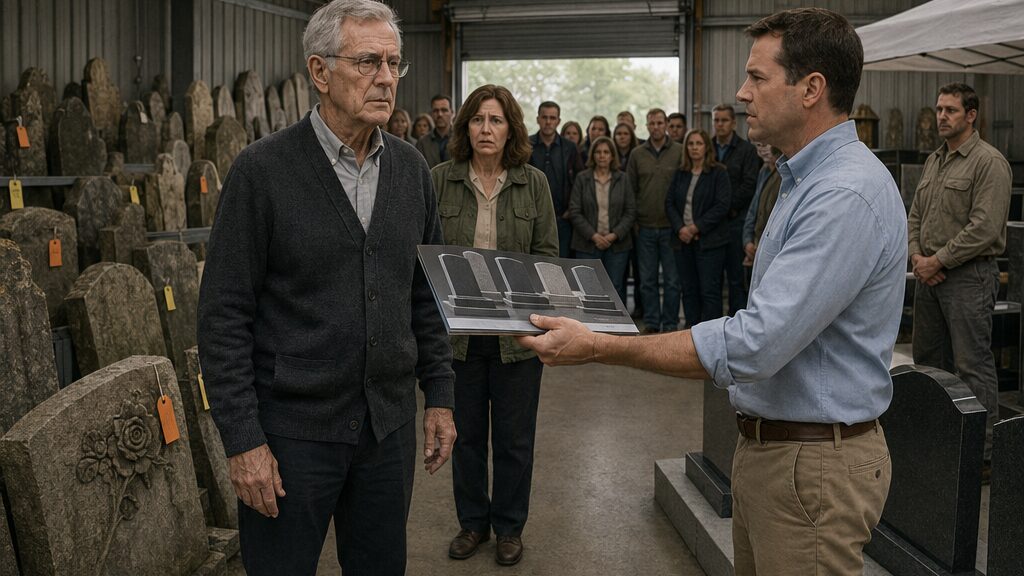
The maintenance shed doors rolled upward at exactly two, revealing the dead arranged like building supplies.
For several seconds, no one spoke.
Old headstones stood in two rows against the corrugated metal walls. Some were gray and narrow, some broad and mottled with lichen, some softened by decades of rain until their lettering could barely be seen. Bright fluorescent tags hung from cords looped around them.
A polished granite sample occupied the center of the shed beneath a white presentation canopy. Beside it, the approved monument contractor had arranged catalogues, stone-color chips, and a small sign offering three “community-compatible designs.”
Daniel Roberts stood near the display in a blue button-down shirt with his sleeves rolled precisely to the same point on each forearm.
“Thank you for coming,” he said as residents gathered. “I know this is sensitive.”
William remained near the back.
There were perhaps twenty people present. Some had come because they had family in the cemetery. Others had come because anything involving the board and potential expense drew attention. Kathleen Harris stood beside the open door, arms folded across a faded green jacket.
Daniel spoke about safety first. A recent insurance inspection had identified unstable stones, uneven access, and possible injury exposure. The board had acted quickly to prevent an accident and protect the association from premium increases.
“We are not erasing history,” he said. “We are preserving it responsibly.”
The contractor lifted a glossy brochure.
Each replacement looked almost identical.
Low rectangular granite. Beveled top. Name, dates, one approved symbol. No hand carving. No irregular shapes. No visible aging.
Daniel found William in the crowd.
“Mr. Carter, we set aside the charcoal option for you. It has excellent contrast and will hold up much better than the original stone.”
William did not look at the sample.
“Where is Margaret Carter’s marker?”
Daniel’s smile tightened. “Of course.”
He motioned to the maintenance supervisor, who crossed to the second row and pointed between two taller stones.
William walked toward it.
Margaret’s marker had been placed sideways, its face toward the wall. A fluorescent orange tag covered part of the carved rose. The tag read E-14 in black marker.
William crouched without touching it.
“Who assigned this number?”
“The contractor’s crew,” Daniel said.
“At the grave?”
“I assume so.”
“You approved emergency removal without knowing the inventory procedure?”
Daniel lowered his voice. “This isn’t a deposition.”
“No. In a deposition, assumptions are recorded.”
Several residents shifted. The contractor closed the catalogue he had been holding.
Daniel stepped closer. “The stones were documented. The purpose of today is to help families move forward.”
William stood. He looked down the row.
One marker showed the name Harris along its exposed edge.
“Kathleen,” he said.
She frowned. “What?”
“Come here.”
She hesitated, then crossed the shed.
William pointed. “Is that your father’s?”
Kathleen bent and read the partial inscription. Her arms dropped to her sides.
“I was told his was too damaged to retain.”
Daniel answered before she could say more. “Retain for use. Not retain physically.”
Kathleen looked at him. “You said it had broken during removal.”
“I said there was deterioration.”
“You said broken.”
The residents nearest them began looking at the other stones.
William faced the first marker in the row, placed both hands along its sides, and carefully rotated it until the inscription faced outward. He moved to the next one and did the same.
The maintenance supervisor stepped forward. “Sir, you shouldn’t be handling those.”
“Then help me.”
The man stopped.
William turned another stone. Then another.
Names emerged from the dimness.
Families that had lived on the hill before Cypress Ridge had roads. Children who had died within a month of birth. A husband and wife separated by six years and one narrow seam in the stone. Letters worn shallow but still present.
Residents moved closer.
Someone whispered, “That’s my mother’s family.”
William reached Margaret’s marker last. He turned it slowly. The orange tag dragged across the carved rose before falling aside on its cord.
The rose was chipped at one petal but intact.
He did not remove the tag.
Instead, he examined it.
E-14.
The marker beside Margaret’s also carried E-14.
William looked down the row. Two other tags had the same number written in different handwriting. One stone had no tag at all. Another was marked W-3, though William knew the surname belonged in the eastern row.
“Daniel,” he said, “how many graves were documented before the stones were removed?”
“Every affected plot.”
“By photograph?”
“Yes.”
“Individually?”
Daniel glanced at the contractor.
The contractor said, “We took site photographs.”
“That means what?”
“Wide shots. Work-progress shots.”
“Did you photograph each marker in place with its grave number visible?”
The contractor pressed his lips together. “Not in every case.”
The room changed.
It was not loud. No one shouted. But the polished granite samples in the center suddenly looked less like solutions than evidence of a decision made too early.
William pointed to the duplicate tags. “You may not know which stones belong to which plots.”
Daniel’s face hardened. “That’s an exaggeration.”
“It’s a question. One you should have answered before removal.”
“We had an obligation to address a documented hazard.”
“Stabilization does not require separating names from graves.”
Daniel turned toward the residents. “The insurance carrier made it clear that delay could expose every household to increased costs. The board acted to protect the community.”
William picked up one of the catalogues but did not open it.
“How much would premiums have increased?”
“We were advised the impact could be substantial.”
“How much?”
Daniel paused. “The formal renewal terms are still being evaluated.”
“So the carrier did not order removal.”
“The carrier identified unacceptable conditions.”
“That is not the same thing.”
Daniel’s control slipped just enough to show anger beneath it. “You have the luxury of treating this as an academic distinction. Most people here cannot absorb a sudden special assessment.”
Kathleen stared at her father’s stone.
“What assessment?” William asked.
Daniel said nothing.
Kathleen answered.
“He told me it could be more than ten thousand dollars per unit if the insurer refused renewal and the cemetery had to be repaired under county supervision.”
William looked at her. “When?”
“Wednesday.”
“Before the board voted?”
She nodded.
Daniel stepped between them. “That figure came from a worst-case planning discussion.”
Kathleen’s voice remained quiet. “You said if I signed the consent form, I could keep this from becoming everyone’s problem.”
William looked at the tag on her father’s marker.
“Consent to what?”
“To replace it.”
“Did you see the original before signing?”
“No.”
“Were you told it would be removed first?”
Kathleen shook her head. “I was told the new one would be safer.”
William looked around the shed. Several residents avoided his eyes. He understood then that Kathleen was not the only one.
Daniel had not needed everyone’s consent. He had needed enough frightened signatures to make the project look cooperative.
William placed the unopened catalogue on the table.
“No marker leaves this building,” he said.
Daniel gave a small, humorless laugh. “You don’t have authority to issue that instruction.”
“Perhaps not yet.”
“There it is,” Daniel said. “The threat everyone expected.”
William looked at Margaret’s uneven rose.
“No. The threat came when you told people they might lose their homes unless they surrendered their dead.”
He took out his phone and photographed every visible tag.
One by one, other residents began doing the same.
Chapter 3: The Covenant Protected More Than William Remembered
William opened the Cypress Ridge file expecting to find Daniel’s mistake.
Instead, he found his own signature.
It appeared on page fourteen beneath a paragraph titled DESCENDANT STEWARDSHIP AND CONTINUITY OF CONTACT. The ink had faded from black to brown, but the shape of his name was unmistakable.
William Carter
Counsel for Development Easement Preparation
He sat back from the folding table in his archive room.
All Sunday morning, boxes had accumulated around him. Original plats. County correspondence. Developer memoranda. Early photographs of the cemetery before the townhouses were built. He had arranged them by year with the rigid confidence of someone returning to a language he still believed he spoke fluently.
The burial easement was stronger than the HOA rules.
That much was clear.
The cemetery and a surrounding buffer had been reserved before Cypress Ridge existed. Descendant consent was required before monuments could be removed, replaced, or materially altered. Access could not be restricted except during narrowly defined emergency work.
William had underlined those provisions in pencil.
Then he reached page fourteen.
The easement required known descendants to maintain an active contact registry and appoint a care committee to coordinate repairs, inspections, and notices. If the committee became inactive, the property manager could perform temporary stabilization after making documented efforts to reach descendants.
William read the paragraph three times.
A sheet clipped behind it contained the most recent registry.
Eight names.
Six crossed out.
One returned-mail notation.
William’s own address was correct, but the telephone number ended in digits he had not used for nine years.
He found two envelopes farther down in the file. Both had been forwarded from his former office after retirement. One was dated three years earlier, the other eighteen months earlier.
Request to Confirm Descendant Committee Contact Information.
He remembered setting them aside.
At the time, his wife had been ill. After her death, the unopened files had become part of the architecture of the room—objects he stepped around without seeing.
William pressed his thumb against the bridge of his nose.
Daniel had still exceeded the easement. Temporary stabilization did not mean wholesale removal. It did not authorize replacement for appearance. It did not excuse careless inventory.
But the document did not give William the clean ground he had expected.
Near noon, he found an old photograph tucked inside Margaret’s correspondence.
She stood beside the headstone when it was new, one hand resting lightly on the top. The carved rose was pale and sharp-edged then. William stood several feet behind her, younger than Daniel was now, wearing a suit too dark for the afternoon heat.
On the back, Margaret had written: Keep the names together.
William placed the photograph face down.
By Monday morning, he was at the county records office before the public counter opened. Thomas Rivera met him in a small conference room carrying a yellow legal pad and two cups of coffee.
Thomas had worked under William years earlier, though never at his firm. Their professional history was old enough to be useful and distant enough to make both men careful.
“You said monuments were removed?” Thomas asked.
“Twenty-three, possibly more.”
“Human remains disturbed?”
“No evidence yet.”
“Ground penetration?”
“Machine tracks near several graves. I stayed outside the barrier.”
Thomas nodded approval at that. “Photos?”
William handed him a folder.
Thomas studied the empty bases, temporary map, inventory tags, and the association notice. He stopped at the photograph of duplicate numbers.
“That’s bad,” he said.
“It’s more than bad.”
“It may be more than bad. I’m not saying that until we inspect.”
William slid the easement across the table. “The buffer is protected. Removal required descendant consent.”
Thomas read in silence.
When he reached page fourteen, he looked up.
“You saw this?”
“Yes.”
“Is there an active committee?”
“No.”
“Current registry?”
“No.”
Thomas tapped the page. “Then the association may argue temporary authority.”
“Temporary stabilization. Not aesthetic replacement.”
“I agree those are different.”
“Can you issue an emergency preservation finding?”
“Not this morning.”
William stared at him. “The board votes tonight.”
“And I have photographs, one recorded easement, and no sworn statement from a current descendant committee because there is no current committee.”
“You know what this site is.”
“I know what the records suggest.”
“You’ve inspected it before.”
“Seven years ago.”
“The cemetery did not move.”
“The stones apparently did.”
William heard the edge in Thomas’s voice and disliked it because it was deserved.
Thomas leaned back. “You’re asking me to use public authority before I establish the facts.”
“I’m asking you to prevent irreversible damage.”
“And I’m telling you what I need. Current descendant affidavits. A list of removed markers. Proof of notice or failure of notice. The insurer’s actual report. Contractor scope. Board authorization.”
“The vote is in ten hours.”
“Then collect what you can in ten hours.”
William gathered the papers too sharply.
Thomas did not stop him. “You used to tell clients procedure mattered most when the facts made them angry.”
“That was before someone numbered my grandmother.”
“No,” Thomas said. “That was exactly when it mattered.”
At the public counter, the county clerk retrieved the recorded plat and easement history. The original cemetery buffer appeared clearly: a broad irregular strip extending beyond the visible graves, following the old tree line.
The current Cypress Ridge parcel map showed the same boundary.
That was the first clean piece of ground William had found.
The HOA controlled surrounding common property, but not the burial ground and not the buffer in the way Daniel’s notice implied.
William ordered certified copies.
While he waited, his phone vibrated.
An association email had gone to every resident.
SPECIAL BOARD MEETING
Monday, 7:00 P.M.
The board would consider permanent approval of standardized monuments, funding authority, and completion of cemetery landscape improvements.
Attached was a rendering of low granite markers set in uniform rows beside a smooth walking path.
William enlarged the image.
The path curved through the cemetery buffer.
He called Daniel.
The call went to voicemail.
William ended it without leaving a message.
At home, he spread the certified plat, easement, photographs, and unanswered contact notices across his dining table. He began drafting a demand for postponement.
The first paragraph came easily.
The second did not.
He wrote that the association had failed to contact all identifiable descendants.
He stopped.
Daniel’s attorney would ask whether William had kept the registry current. The answer would be no. Residents would ask why the man claiming guardianship of the cemetery had ignored requests concerning its care.
William removed the sentence and replaced it with narrower language.
Then he deleted that too.
At 3:17, Kathleen knocked on his door.
She held a copy of the consent form she had signed.
“I thought you should see the bottom,” she said.
In small print beneath the signature line, the document stated that the signer acknowledged the descendant committee was inactive and authorized the HOA to act in its place.
“Did you know what that meant?” William asked.
“I thought the committee was some county office.”
“It wasn’t.”
“Who was supposed to run it?”
William looked toward the dining table, where his signature lay on page fourteen beneath the duty he had allowed to disappear.
Kathleen followed his gaze.
“You?” she asked.
He did not answer quickly enough.
Her expression changed.
“You knew there was supposed to be a committee.”
“Yes.”
“And you let Daniel tell all of us there was nobody responsible.”
“I did not know what he was telling you.”
“That isn’t what I asked.”
William folded the consent form once, carefully, along its existing crease.
Kathleen stepped back from the door. “You’re both talking like this is about rules. He says the board had authority. You say it didn’t. Meanwhile, my father’s stone is in a shed.”
“The board still had no right to do what it did.”
“Maybe not. But where were you before Saturday?”
She left before he could answer.
At 4:02, Daniel sent another association-wide notice.
Due to threatened legal action by an individual resident, the board would proceed with the scheduled vote to protect Cypress Ridge from further uncertainty and expense.
William read the sentence twice.
An individual resident.
By evening, Daniel would present him as the source of the risk. William could challenge the vote with the easement and certified plat. He could expose the insurer claim if he obtained the report. He could show the duplicate tags.
But if Kathleen spoke, or if Daniel’s attorney had read page fourteen, William’s silence would become part of the meeting.
He placed Margaret’s photograph beside the covenant.
Keep the names together.
At 5:38, he closed the file, put both documents into his folder, and left for the clubhouse without deciding which truth he was prepared to tell.
Chapter 4: The Board Meeting Turned One Grave Into Everyone’s Bill
Daniel Roberts had placed the number on the screen before William entered the clubhouse.
$11,840 PER HOUSEHOLD
It appeared in white against a dark blue background, large enough to be read from the parking lot through the glass doors. Beneath it, smaller text listed emergency insurance, professional restoration, legal defense, and county compliance.
Every folding chair was occupied.
Residents stood along the rear wall with their arms crossed, paper notices folded in their hands. The polished replacement catalogue rested on a table beside the board, its cover showing identical gray stones in a lawn without weeds, roots, or names.
Daniel waited until William reached the center aisle.
“This,” he said, pointing at the screen, “is the potential exposure if the association loses coverage and the cemetery matter proceeds without a controlled plan.”
William set his folder on an empty chair.
“Potential according to whom?”
A few heads turned. Daniel remained standing.
“The board treasurer prepared the projection based on available estimates.”
“Available to the residents?”
“The figures are preliminary.”
“Then why is the total presented as if it were an assessment?”
Daniel’s jaw tightened. “Because people deserve to understand the risk before one resident forces the association into litigation.”
The phrase moved through the room more effectively than a shout. One resident near the wall exhaled sharply. Another whispered that eleven thousand dollars was more than a year of mortgage payments.
William looked toward Kathleen. She sat in the second row, her father’s consent form folded on her lap. She did not meet his eyes.
Daniel called the special meeting to order.
He described a safety inspection, unstable monuments, possible injury claims, and a renewal warning from the association’s carrier. He spoke without notes, his voice controlled, his concern plausible.
Two residents had recently asked for payment plans on ordinary dues, he said. Several households included retirees on fixed incomes. If coverage failed, the association could not simply leave the cemetery unsafe while lawyers debated an old document.
William listened.
Daniel was not inventing every pressure. That made the argument harder to dismantle.
When public comment opened, William approached the microphone carrying the certified plat and easement.
“The cemetery is not ordinary common landscaping,” he said. “The burial ground and its buffer existed before Cypress Ridge. The recorded easement requires descendant consent before permanent removal or replacement.”
Daniel leaned toward his microphone. “The same easement permits temporary action when the descendant committee is inactive.”
A murmur passed through the chairs.
William kept his gaze on Daniel. “Temporary stabilization.”
“The stones were identified as unstable.”
“Then brace them. Fence them. Lay individual markers flat with their positions documented. You do not remove twenty-three stones without a reliable inventory and call it stabilization.”
He placed photographs of the duplicate fluorescent tags beneath the document camera. The images appeared on the screen behind the board. E-14. E-14 again. A stone without any tag.
The room quieted.
The board treasurer leaned closer to the monitor.
Daniel said, “The contractor has assured us the records can be reconciled.”
“Has the contractor supplied a grave-by-grave removal log?”
The treasurer looked toward Daniel.
William waited.
“No,” she said finally. “Not yet.”
“Did the board complete a descendant contact search before authorizing removal?”
Daniel answered. “The active committee had lapsed.”
“That wasn’t the question.”
The treasurer lowered her eyes to the papers in front of her. “We used the addresses in the association records.”
“Not the county probate index? Not the prior registry? Not family notices attached to the easement file?”
“No.”
A small payoff, but not victory. William felt the room shift toward him and made the mistake of believing it would stay there.
Kathleen stood.
Her voice carried without the microphone.
“Ask him why the committee lapsed.”
William turned.
Daniel did not interrupt her.
Kathleen held up the consent form. “Mr. Carter drafted the document that created it. He was listed as a contact. The letters went to him.”
A resident behind her said, “Is that true?”
William looked at the rows of faces. He could have explained his wife’s illness. He could have said the notices arrived during the year when opening mail had become another form of admitting what waited inside the house.
He could have said that grief had narrowed his world.
Instead, he said, “The board’s failure is not excused by mine.”
The words were legally sound and humanly insufficient.
Kathleen’s face closed.
“That means yes,” she said.
Another resident rose. “So we’re being asked to pay because the board acted too fast and because the person responsible for the family side ignored it?”
“I was not solely responsible.”
“But you knew.”
William glanced at Margaret’s photograph inside his folder. He did not take it out.
Daniel’s voice softened. “This is exactly why the board had to act. The committee existed on paper, but in practice no one was maintaining the site.”
“You still had no authority to replace the stones for aesthetic reasons.”
“The appearance standard was secondary.”
“It was in your voicemail.”
Daniel paused.
William played the recording from his phone. Daniel’s own words filled the clubhouse: inconsistent with the updated appearance of Cypress Ridge.
Some residents looked toward the replacement catalogue.
Daniel did not deny the statement.
“I chose poor wording,” he said. “That does not eliminate the safety issue.”
For the first time that evening, William saw the full shape of Daniel’s position. He was embarrassed by the language but not by the removal. He believed speed had protected the community. He believed consultation would have produced delay, and delay would have produced cost.
The board treasurer requested the insurer’s written recommendation.
Daniel handed her a three-page report.
William watched her read. Halfway down the second page, she frowned.
“What does it say?” someone asked.
She looked at Daniel before answering.
“It recommends temporary barriers, professional evaluation, and stabilization of stones identified as immediate hazards.”
“Does it order removal?” William asked.
“No.”
“Does it recommend replacing every older marker?”
“No.”
Daniel took the report back. “The board had to select an efficient corrective method.”
“You selected the most irreversible one,” William said.
Kathleen stepped to the microphone. “And you told me the insurer might refuse renewal if I didn’t sign.”
“I told you refusal was a possible consequence.”
“You said my signature could keep my neighbors from receiving an assessment.”
Daniel’s composure thinned. “Because cooperation reduces legal and administrative costs.”
“So you frightened people into consenting.”
“I explained the risk.”
William should have stood beside Kathleen then. Instead, he opened the certified plat, eager to return the room to evidence he could control.
“The buffer boundary is here.”
The document camera projected the old map. A thick line followed the former tree line around the graves. William placed the current parcel map beside it.
The boundaries matched.
Then he noticed a third sheet beneath the replacement brochure on the board table.
Only one corner was visible, but it carried the same curve shown in the association’s landscape rendering.
“May I see that plan?” he asked.
Daniel put one hand over it.
“It is a conceptual draft.”
“For the cemetery?”
“For future common-area improvements.”
William stepped closer. “Inside the recorded buffer?”
Daniel’s hand remained in place.
The board treasurer looked from him to the plat. “Daniel, show us the plan.”
He did not move.
That refusal did what William’s arguments had failed to do. It changed suspicion into attention.
The treasurer pulled the sheet free.
A landscaped walking loop curved behind the uniform monuments, crossed the protected buffer, and connected to a proposed overlook marked FUTURE AMENITY PHASE.
At the bottom appeared the logo of the lender refinancing the clubhouse and common-area debt.
No one spoke for several seconds.
Daniel finally said, “The path was conceptual. It was not part of tonight’s vote.”
William stared at the curve running through the burial ground.
The stones had not merely been moved away from danger.
They had been moved out of the path.
Chapter 5: The New Walking Path Exposed the Older Plan
Orange survey paint crossed the cemetery buffer in a clean, deliberate arc.
William found it Tuesday morning beneath the chain-link fence, bright against the grass and fresh soil. The line entered near the western row, curved behind Margaret’s empty base, and continued toward the proposed overlook shown on Daniel’s plan.
Temporary stabilization did not require survey paint.
He photographed each mark with the certified plat held at the edge of the frame.
Kathleen arrived while he was measuring the distance from the old tree line.
“I thought the site was closed,” she said.
“I’m outside the barrier.”
“You always have an answer like that?”
William lowered the tape. “Usually.”
“That may be part of the problem.”
She carried a flat cardboard box against her side. Her expression was tired rather than hostile.
Inside the box were family photographs.
“My mother kept these,” she said. “I spent half the night looking.”
They sat on the low retaining wall beside the path. Kathleen spread the photographs between them: Memorial Day flowers, children standing stiffly beside grandparents, a winter burial under bare branches.
In one image, her father’s stone stood behind three smaller markers. The carved edge visible in the maintenance shed matched it exactly.
William placed the photograph beside his phone image of the tagged stones.
“This identifies position and orientation,” he said.
Kathleen pointed to another photograph. “That one belongs beside him. You can see the crack.”
A third image showed Margaret’s stone in the distance. Even blurred, the rose was recognizable.
Three misplaced markers could now be linked to their graves.
It was not enough to restore the cemetery, but it was the first repair that did not depend on Daniel’s records.
Kathleen gathered the photographs into groups.
“He came to my house,” she said.
“Daniel?”
“Before the vote. He had the consent form and a spreadsheet. He said the lender wanted proof the association was addressing deferred maintenance.”
William looked toward the painted line.
“What lender?”
“The one on the plan.”
“What exactly did he say?”
“That refinancing the clubhouse debt would prevent dues from increasing next year. He said the cemetery was the one unresolved liability in the common-area package.”
“And the path?”
“He called it an accessibility improvement. A level route to the overlook.”
William remembered the rendering: uniform stones, smooth edges, no old trees breaking the view.
“Did he tell you the path crossed protected land?”
“No.”
“Did he tell the board?”
“I don’t know.”
She slid one photograph back into the box. “I signed because my roof needs replacing. I can’t pay eleven thousand dollars and fix the roof. I thought agreeing to a safer stone was the responsible thing.”
William heard no apology in her voice, only the practical arithmetic of fear.
“You were entitled to accurate information,” he said.
“So were you.”
He looked at her.
“If you had kept the committee alive,” she continued, “he couldn’t have told us nobody spoke for the families.”
The tape measure lay across his knee. William retracted it. The metal blade snapped into its case.
“I know.”
It was the first time he had said it without qualification.
At the county office, Thomas reviewed the photographs and the lender plan. He would not call it fraud or unlawful conversion. He called it evidence of a purpose beyond emergency stabilization.
“The county can issue a temporary administrative hold on ground disturbance,” Thomas said. “Forty-eight hours while we inspect and determine jurisdiction.”
“What about the stones?”
“No alteration or disposal during the hold.”
“Replacement?”
“Also frozen.”
William should have felt relief.
Instead, he pictured the shed. Twenty-three names separated from twenty-three graves, several with no reliable link between them. A hold preserved the mistake exactly as it was.
Thomas signed the notice.
“You wanted time,” he said.
“I wanted restoration.”
“Those are not the same thing.”
By Wednesday afternoon, the hold was posted on the cemetery fence and maintenance shed. The board’s attorney requested mediation. The insurer sent an adjuster. A local reporter left two messages on William’s phone.
He returned neither.
Then the descendant responses began.
Kathleen had shared a request for family photographs and burial information. Some people offered help. Others wanted the original stones restored no matter the cost. Three preferred compensation and new markers rather than months of meetings and uncertain identification.
One message read: My mother is buried there, but I live four states away. Please do not turn this into a public spectacle.
Another said: Take the settlement if they offer one. The dead do not need us to bankrupt the living.
William printed each response and arranged them across his dining table.
There was no single descendant will waiting to be represented. There were only people with different griefs, finances, distances, and tolerances for conflict.
His old instinct was to sort them into legal positions.
Consent given.
Consent disputed.
Standing uncertain.
Instead, he called Kathleen.
“We need a shared file,” he said. “Photographs, names, contact information, preferences. Everyone sees the same material.”
“You want me to organize it?”
“I want us to.”
The word felt unfamiliar.
That evening, they worked at opposite ends of William’s dining table. Kathleen entered family contacts while William compared photographs with the original burial map. Every match was marked provisional until another source confirmed it.
Near ten, Kathleen opened a thin envelope that had slipped behind the framed photograph of Margaret.
“This yours?”
William recognized his grandmother’s handwriting before he touched it.
The paper inside was a note, not a formal letter. It had been folded into quarters and softened along the creases.
William—
The papers matter because people forget. But don’t mistake the papers for the promise. Keep the families coming back. If they come back, the names will take care of themselves.
Margaret
Kathleen read only what his face allowed her to see.
“When did she write it?”
“After the easement was recorded.”
“Did you answer?”
William folded the note along its old lines.
“No.”
After Margaret died, two relatives had argued over the remaining farmland and accused William of favoring the developer. He had withdrawn from family gatherings rather than defend choices no explanation could make painless. The committee meetings became less frequent. Then his wife became ill. Then the notices collected in a box.
He had preserved the legal right and abandoned the living structure meant to use it.
Kathleen closed the laptop.
“Daniel’s attorney sent a mediation proposal,” she said. “Thursday morning.”
William looked at Margaret’s note.
“What are they offering?”
“They didn’t say.”
He knew what a fast proposal usually meant. The association wanted certainty before the county inspection, the insurer’s review, and the lender’s questions converged.
On the table, Margaret’s rose appeared in four different photographs taken across twenty years. Around it, other families stood in changing clothes, growing older, bringing children, then grandchildren.
Keep the families coming back.
William had spent three days trying to recover one stone.
By Thursday, he would have to decide whether he was willing to tell everyone why the names had been left alone long enough to disappear.
Chapter 6: William Refused the Settlement That Restored Only One Name
Margaret’s headstone waited outside the mediation room beneath a gray moving blanket.
The carved rose showed through the fabric as a shallow rise.
William stopped in the hallway.
Daniel stood beside the covered stone with the association’s attorney and the insurance adjuster. Kathleen was already seated inside. Through the glass wall, William could see the county’s temporary hold, the easement, and a draft agreement arranged in separate stacks.
Daniel touched the edge of the blanket.
“We had it professionally cleaned,” he said. “No abrasive work. The conservator stabilized the chipped petal.”
William did not uncover it.
“Why is it here?”
“To demonstrate good faith.”
Inside, the proposal was simple enough to understand before the attorney finished explaining it.
The HOA would restore Margaret Carter’s original marker to its documented location. It would reimburse William’s legal expenses within a fixed cap. The walking path would be adjusted near her grave. In return, William would withdraw his objections, support dissolution of the county hold after safety work, and release the association from claims related to the remaining stones.
Daniel folded his hands.
“You said this began with your grandmother.”
“It did.”
“This restores her marker.”
“And leaves the others in the shed.”
“The association will provide compliant replacements where identity cannot be confirmed.”
Kathleen looked at William but said nothing.
The insurance adjuster explained that full restoration carried uncertainty. Some stones were unstable. Some locations were disputed. The carrier might contribute to conservation costs, but not if the process remained open-ended.
Daniel leaned forward.
“This gives you what you asked for on Saturday.”
William looked through the glass at the covered stone.
On Saturday, it would have been enough. He could imagine Margaret’s name returned to the hill, the rose facing east, the empty base filled. He could issue a statement about legal principle, close his files, and let the association manage the rest.
That version of victory had the clean edges of the approved granite catalogue.
He slid the proposal back.
“No.”
Daniel stared at him. “You haven’t read the final release.”
“I read enough.”
“Then tell us what you want.”
William took Margaret’s note from his folder.
Before speaking, he placed it beside the easement.
“I want the county hold extended while every original marker is evaluated. I want the insurer to fund conservation for damage caused during removal. I want the path suspended. I want reserve money redirected from the amenity phase. And I want a descendant-resident trust controlling future decisions.”
Daniel gave a short laugh. “You want the association to hand over part of its governance because you found an old note?”
“No. Because the existing structure failed.”
“The committee failed,” Daniel said. “Your committee.”
The room stilled.
William looked at Kathleen.
Then at the adjuster, the attorney, and Thomas, who had entered quietly and taken a chair near the door.
“Yes,” William said. “It did.”
Daniel’s expression changed. He had expected resistance, not agreement.
William opened the old registry.
“My address was current. My telephone number was not. Two requests to update descendant contacts reached my files. I did not answer them. I helped draft the care requirement and then allowed the committee to disappear.”
Kathleen lowered her eyes.
William continued before he could retreat into explanation.
“My wife was ill. My family had stopped speaking to one another. Those facts explain my silence. They do not make it harmless.”
The words left him without defense around them.
“I treated preservation as a document I had written rather than work I still owed. That gave the board room to claim no one represented the families.”
Daniel sat back. “Then you admit the association had to act.”
“I admit you faced a real safety problem. I also admit I helped make consultation harder.”
William pointed to the lender plan.
“You chose to use that failure. You removed more stones than the insurer recommended. You frightened descendants with estimates you presented as imminent. You linked safety work to a path through protected land. Your reason was not imaginary, Daniel. Your authority was.”
The insurance adjuster opened the original inspection report.
“The carrier can separate preexisting deterioration from handling damage,” she said. “We would require an independent conservator and verified chain of custody.”
“There is no complete chain,” Daniel said.
“That is why descendants are necessary,” Kathleen replied.
She opened the shared identification file on her laptop. Photographs, grave maps, obituaries, and provisional matches filled the screen.
“We have seven stones identified with high confidence,” she said. “Four more with two supporting sources. People are still sending records.”
Daniel looked at her. “You signed consent.”
“Because you told me cooperation would keep my neighbors from being assessed.”
“That was a legitimate concern.”
“It was. That doesn’t make everything you did legitimate.”
Thomas placed a proposed preservation framework on the table. The county could supervise restoration. The walking path would remain suspended. Insurance funds could cover handling damage and professional evaluation. The association could use reserve funds already assigned to the amenity phase, reducing but not eliminating household costs.
Daniel read the first page.
“This delays refinancing.”
“Yes,” the association attorney said.
“It may increase dues.”
“Possibly.”
“And you expect the board to approve that?”
William looked toward the covered stone in the hallway.
“No. I expect the residents to decide after seeing accurate numbers and the full plan.”
The mediation continued for three hours.
No one received everything.
The association would not admit criminal wrongdoing. The county would not promise that every stone could be returned. The insurer refused to cover ordinary deterioration. Several descendants still preferred replacement markers or compensation.
But a structure emerged.
An independent conservator would assess every original stone. No marker would be cleaned, altered, or installed without a documented match and descendant consultation. The walking loop would be removed from the refinancing package. Reserve funds designated for the overlook would pay the first portion of restoration. Insurance would address handling damage. A temporary trust would include residents and descendants, with county oversight during reconstruction.
The attorney drafted a signature page.
William read the proposed leadership clause.
It named him chair.
He crossed out his name.
Daniel noticed. “After all this, you don’t want control?”
“That is how this happened.”
Kathleen signed first as a descendant and resident representative.
William signed beneath her.
The board treasurer signed for the association, subject to ratification at an emergency resident vote. Daniel remained seated.
The attorney placed the pen before him.
“This agreement also requires you to withdraw from the restoration committee because of the undisclosed amenity plan,” she said.
“I acted with board authority.”
“Not full disclosure.”
Daniel looked around the table. “I am not resigning as president.”
“No one said you had to today,” William replied.
Daniel’s eyes narrowed. “You think this makes you better than me?”
William folded Margaret’s note and returned it to his folder.
“No. I think that is the part neither of us gets to decide for ourselves.”
Outside, the stone remained covered.
The association attorney asked whether William wanted to inspect the repair before it was returned to storage.
He stood beside it for a moment, then pulled the blanket more securely over the rose.
“Not yet,” he said.
Margaret’s name would not return to the hill alone.
Behind him, Kathleen carried the signed trust agreement into the hallway. Daniel came out last, without signing the resignation clause and without looking at the stone.
The community now had a plan for every name.
It still had no agreement on what accountability would cost the living.
Chapter 7: The Hill Kept Its Uneven Stones and Living Names
The first original marker returned to the hill on a steel lifting frame.
Two conservators guided it over the restored footing while Thomas Rivera watched from beyond the work line, a clipboard tucked beneath one arm. The stone descended inch by inch, its chipped edge supported by padded straps, until the base met the mortar bed prepared that morning.
No one applauded.
The families stood quietly along the temporary path, close enough to hear the straps loosen and the conservator’s level scrape across the top. Three months earlier, the cemetery had been fenced off behind plastic sheeting and emergency notices. Now the chain-link barrier had been replaced by a narrow rope marking the work area. Beyond it, the hill remained uneven, interrupted by old roots, sunken ground, and stones that refused to align into the clean rows shown in Daniel’s rendering.
William preferred it that way.
The first marker belonged to Kathleen’s father.
She stood beside William with both hands wrapped around a folder of family photographs. When the conservator stepped away, she did not move toward the grave immediately.
“They left the crack,” she said.
“They stabilized it.”
“I know.”
Her thumb pressed the folder’s edge.
“I thought they’d make it look new.”
William looked at the pale seam running across the lower corner. “It never looked new to you.”
Kathleen nodded once.
Seven stones had been matched with enough certainty for immediate restoration. Five more would follow after final review. Four were too damaged to stand safely and would be placed on low supports near their documented graves. The rest remained in conservation storage while families searched through photographs, funeral notices, church records, and old property maps.
Some answers had come quickly.
Others had not come at all.
Margaret’s marker waited beneath a canvas cover near the cedar stump. The rose had been cleaned only enough to remove the dirt packed into its cuts. The conservator had preserved the darker weathering inside the petals and repaired the chipped section without smoothing its uneven shape.
When William had first seen it after treatment, he had run one finger just above the carved surface without touching.
Perfect things don’t look loved.
He heard the words now as clearly as if Margaret stood behind him.
The descendant-resident trust had met nine times in twelve weeks. Kathleen chaired the identification group. A resident with accounting experience tracked reserve funds and insurance reimbursements. Thomas attended as county liaison but refused a vote. William handled easement questions when asked and stopped answering before anyone could mistake advice for authority.
That last part had taken practice.
At the second meeting, he had corrected a proposed procedure before the woman reading it had finished. Kathleen had closed the document and looked at him across the table.
“Are you helping us decide,” she had asked, “or deciding faster than us?”
He had apologized.
The procedure passed the following week with language he would not have chosen. It worked anyway.
Near noon, the conservators uncovered Margaret’s stone.
The canvas lifted. Her name returned to the hill beneath the small hand-carved rose.
William’s breath caught, but the feeling was not the sharp relief he had imagined during the first days of the dispute. The stone did not erase the empty base, the bright inventory tag, or the years when no committee had met. It did not absolve him because it stood upright again.
It simply belonged there.
Kathleen came beside him.
“You should say something,” she said.
“To whom?”
She glanced at the families, the residents, and the workers waiting for the footing to be checked.
“Maybe just to her.”
William looked at Margaret’s name.
“I came back,” he said quietly.
The annual HOA meeting began that evening in the same clubhouse where Daniel had projected the eleven-thousand-dollar estimate.
This time, the screen showed actual figures.
Insurance had covered handling damage and part of the professional assessment. The association had redirected money from the canceled overlook and walking-loop project. Residents would face a smaller dues increase spread across two years, not an emergency special assessment.
The increase still mattered.
A resident in the third row asked why everyone should pay for mistakes made by the board and the inactive descendant committee. Another asked whether Daniel would reimburse the association personally.
The board treasurer answered with the settlement terms. Daniel had agreed to repay a portion of unauthorized design expenditures and had accepted formal censure. He would leave the presidency at the end of the meeting and would not serve on any committee connected to the cemetery, refinancing, or capital planning.
He remained seated at the end of the board table, wearing the same blue shirt he had worn at the maintenance preview.
When the treasurer finished, Daniel stood.
“I believed delay would cost this community more than action,” he said. “I still believe the safety problem was real.”
No one interrupted.
“I also approved work beyond what the inspection required. I did not disclose the amenity plan fully. I treated consent as something to obtain instead of something to earn.”
His voice tightened on the last sentence.
“I will comply with the agreement.”
He did not apologize to William directly. William did not require him to.
After the vote accepting the restoration agreement, the new board asked William to serve as permanent chair of the trust.
He declined.
A few residents appeared surprised.
Kathleen did not.
“I’ll remain a member,” William said. “I’ll maintain the legal archive and answer questions. But the trust should not depend on one person’s memory, profession, or willingness to open his mail.”
The room went still, then moved on.
That was enough.
Two days later, William returned to the cemetery carrying a weatherproof binder. The fluorescent inventory tags had been preserved in an evidence envelope, but they no longer hung from the stones.
In their place, the trust had created a living register.
Each grave had a page for confirmed names, family contacts, photographs, maintenance history, and unresolved questions. Blank pages remained for unidentified plots. No one had been reduced to a number, and no uncertainty had been disguised as certainty.
William sat on the bench near Margaret’s grave and opened the binder.
Kathleen’s phone number appeared beneath her father’s entry. Three relatives living out of state had added email addresses. A family who had chosen a new marker had included a note explaining why. Another had requested that a broken original remain beside its replacement.
Margaret’s page came first.
Her photograph showed her standing beside the newly carved rose, one hand resting lightly on the stone. Beneath it was the promise she had written years ago.
Keep the families coming back.
William took out a pen.
For a moment, the old instinct returned—the desire to keep his role precise, limited, defensible.
Then he wrote his current phone number beneath the first living descendant entry.
He closed the binder and looked across the hill.
The stones stood unevenly. Some leaned despite repair. Some names remained faint. Several spaces held only low temporary markers while families continued searching.
Nothing matched.
Nothing had been made perfect.
But every name they knew faced outward.
The story has ended.