My Neighbor Kept Using My Driveway Until the HOA Forced Me to Prove Who Controlled It
Chapter 1: The Car That Wasn’t Supposed to Stay
Kevin Anderson turned onto his street and knew something was wrong before he reached his mailbox.
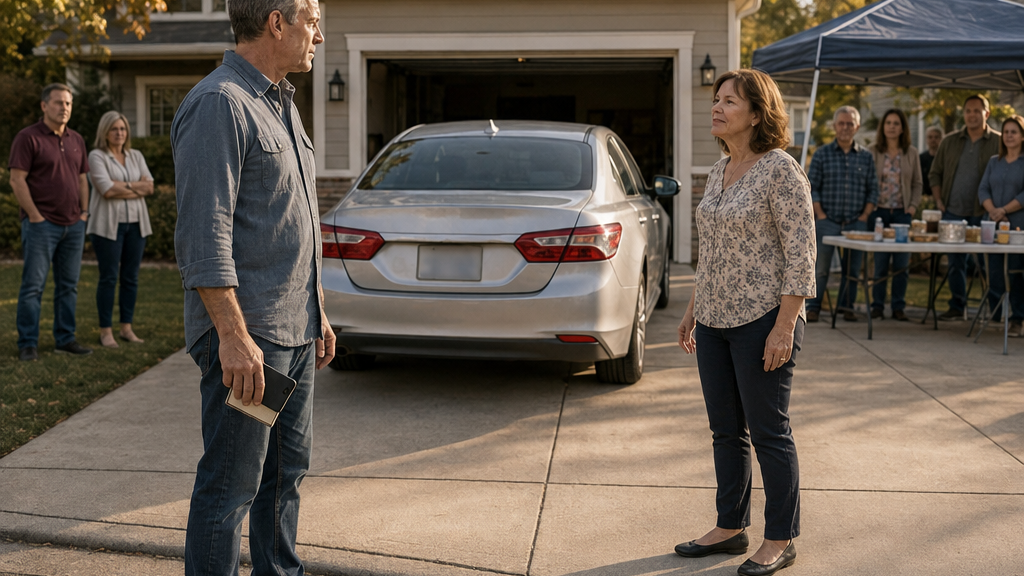
A silver sedan sat squarely in the middle of his driveway.
Not half on the curb. Not nosed in for a quick delivery. It was parked cleanly between the concrete edges as if whoever had left it there had every intention of staying.
Kevin slowed his pickup and stopped in the street.
Across the cul-de-sac, folding tables had been set up beneath two portable canopies for the HOA’s fall neighborhood gathering. Paper plates moved from hand to hand. Someone had dragged a cooler onto the grass. Children crossed between driveways while adults stood in loose circles with drinks.
Kevin recognized the sedan immediately.
Cynthia Roberts.
His next-door neighbor.
He sat behind the wheel for several seconds, both hands still resting on it.
There were other places to park. The curb beyond his mailbox was open. Two guest spaces sat farther down the street. Cynthia’s own driveway held one pickup, and another was parked along the curb in front of her house.
Yet her sedan was in his.
Again.
Kevin backed his pickup to the curb and parked there instead.
By the time he stepped out, Cynthia had seen him.
She was standing near one of the folding tables with a paper cup in her hand. She raised two fingers in a casual greeting.
Kevin walked toward her.
“Cynthia.”
“Hey, Kevin.”
“Your car’s in my driveway.”
She glanced past him, as if checking which car he meant.
“Oh. Yeah. I’ll be gone in ten minutes.”
She smiled.
It was the kind of smile people used when they believed the matter had already been settled.
Kevin looked toward his driveway.
“I need to use it.”
“You’re parked now.”
The answer came lightly, almost jokingly.
Kevin felt several neighbors within earshot become very interested in their cups and plates.
He had spent most of his working life supervising building maintenance crews. He had learned early that one poorly chosen sentence could stay alive in a workplace much longer than the problem that caused it. Years ago, after a sharp exchange with a contractor, Kevin had spent months rebuilding a relationship he still needed to get a job completed.
Since then, he had preferred calm.
Sometimes too much.
“I’d rather you didn’t park there,” he said.
Cynthia gave a small laugh.
“It’s just overflow. Everybody does it when we have one of these things.”
“Not in my driveway.”
“I said ten minutes.”
Kevin could feel the conversation starting to tilt toward the kind he disliked: public, small, and somehow more embarrassing because everyone could pretend it was nothing.
He nodded once.
“All right.”
Then he walked away.
That was the mistake.
He knew it before he reached his front door.
Inside, he set his keys on the kitchen counter harder than necessary. Through the window above the sink, he could see the rear quarter of Cynthia’s sedan.
Ten minutes passed.
Then fifteen.
Kevin made coffee, though he had already had two cups that morning.
At twenty-three minutes, the car was still there.
He carried his mug into the small room off the kitchen where he kept his computer. His doorbell camera application opened to a grid of motion events.
He selected the driveway view.
Cynthia’s sedan had arrived at 1:14 p.m.
Kevin looked at the clock.
1:41.
Twenty-seven minutes.
He scrubbed backward through the week’s clips.
There was another image of the sedan from Tuesday.
He remembered that one. He had come outside, found the car blocking the garage, and left a note beneath the windshield wiper.
Please don’t park in my driveway. I need access to my garage. Thanks.
The car had been gone when he returned an hour later.
At the time, Kevin had considered the matter handled.
Now he opened the Tuesday clip.
Arrival: 11:08 a.m.
Departure: 11:55.
Forty-seven minutes.
Kevin sat back.
He remembered knocking on Cynthia’s door afterward.
She had laughed then too.
“I was barely there.”
He had let that pass.
Forty-seven minutes was not barely there.
Kevin pulled a yellow legal pad from a drawer. For a moment he felt ridiculous.
Then he wrote:
Tuesday — silver sedan — 11:08 to 11:55 — 47 minutes.
He drew a line beneath it.
Outside, the neighborhood gathering continued.
A burst of laughter came through the closed window.
At 1:53, Cynthia finally appeared in the camera view.
She walked toward the sedan with no sign of hurry.
Kevin checked the time.
Thirty-nine minutes.
When he went outside, she was opening the driver’s door.
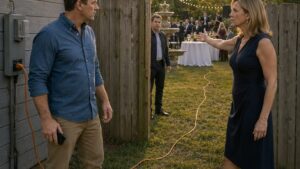
“You said ten,” he said.
Cynthia paused.
“I got talking.”
“It’s been almost forty.”
She looked toward the gathering.
“Kevin, this is what I meant. It’s temporary overflow. The HOA’s always been fine with it.”
He stared at her.
“The HOA is fine with people parking in my driveway?”
“During events, yes. People have done it for years.”
“Before I lived here?”
“Long before.”
She got into the car.
Kevin stepped back.
The sedan reversed into the street and rolled next door.
Nothing about the exchange had been dramatic. Nobody shouted. Nobody threatened anyone.
But Kevin stood in the empty driveway feeling as if the ground beneath it had shifted.
He had bought the house six years earlier. The concrete strip from the garage to the street had always seemed like the least complicated part of the property.
Now Cynthia had spoken about it as though ownership were only one opinion among several.
That evening Kevin returned to the camera archive.
He searched farther back.
The system kept months of cloud clips.
At first there was nothing unusual.
Delivery vans. Trash collection. Kevin carrying groceries. A neighbor’s dog wandering across the lawn.
Then he found the sedan.
A Friday afternoon in August.
Twenty-six minutes.
Another clip two weeks later.
Thirty-three minutes.
Then a third.
Cynthia’s sedan entering his driveway while Kevin’s pickup was gone.
He clicked the next event.
The sedan was still there twenty-two minutes later.
Kevin looked down at the legal pad.
The single entry no longer looked excessive.
It looked incomplete.
He added three more dates.
When he finished, four lines filled the top half of the page.
He stared at them for a long moment.
Then he wrote a fifth heading beneath them.
Previous incidents to review.
Chapter 2: When Courtesy Started Becoming Evidence
The following Wednesday, Cynthia’s sedan appeared in Kevin’s driveway before he finished breakfast.
He saw it through the kitchen window while reaching for the coffee pot.
For several seconds he did nothing.
The old response arrived automatically: finish breakfast, wait a few minutes, avoid making the morning unpleasant.
Then Kevin looked toward the legal pad lying beside his phone.
Four dated entries had become seven.
He set his mug down.
By the time he reached the driveway, Cynthia was halfway across her lawn.
“Cynthia.”
She turned.
Kevin pointed toward the sedan.
“I need you to move it.”
“I will.”
“Now, please.”
Her expression changed slightly.
Not anger. Surprise.
“You aren’t going anywhere.”
“That doesn’t matter.”
She folded her arms.
“Kevin, we’ve already talked about this.”
“We have. That’s why I’m asking you to move it.”
She gave the same short laugh he had heard before.
“You’re making this into something it doesn’t need to be.”
Kevin felt heat rise behind his collar.
He had spent several evenings reviewing camera footage precisely so he would not have to argue from memory.
“It’s happened seven times that I can verify.”
Cynthia stared at him.
“Seven?”
“Yes.”
“You’ve been counting?”
Kevin immediately disliked how that sounded.
But he nodded.
“I’ve been keeping track.”
“For what?”
“So we don’t keep having the same conversation.”
She looked at the sedan, then back at him.
“This is ridiculous.”
“No. What’s ridiculous is that I’ve asked you not to park here and you keep doing it.”
The sentence came out firmer than Kevin intended.
Cynthia’s face tightened.
For one moment he expected the argument he had spent years training himself to avoid.
Instead, she reached into the pocket of her sweatshirt and pulled out her phone.
“You know what? Fine.”
She tapped the screen several times.
“I knew I still had this.”
She held the phone toward him.
It was an old email.
The subject line referenced neighborhood parking during community events.
Kevin read the visible paragraph twice.
Residents are asked to keep street access clear and use available temporary overflow areas when necessary.
Below that was a list of general locations.
Guest spaces.
Clubhouse edge.
Unoccupied drive approaches with owner cooperation.
Kevin stopped.
“Owner cooperation.”
Cynthia took the phone back.
“That’s not how it was handled before you moved in.”
“That sentence says cooperation.”
“The whole street used to help each other.”
“Then ask me.”
“I shouldn’t have to submit a request every time someone parks for twenty minutes.”
“Forty-seven.”
Her eyes narrowed.
“What?”
“The Tuesday you said you were barely here. You were here forty-seven minutes.”
Cynthia’s mouth opened slightly.
Kevin pulled out his own phone.
He had already saved screenshots.
Arrival.
11:08.
Departure.
11:55.
Then another.
Twenty-six minutes.
Thirty-three.
Twenty-two.
The pictures looked strangely impersonal lined up on the screen.
That made them harder to dismiss.
Cynthia studied them.
For the first time since the dispute started, she did not laugh.
Then she looked up.
“You really went through all that footage.”
“Yes.”
“That says more about you than it does about me.”
The words landed harder than Kevin expected.
He knew there was some truth buried inside the insult.
He had become more comfortable collecting evidence than saying one clear sentence.
Still, evidence existed because the conversations had failed.
“It says I got tired of arguing about how long your car was here.”
“I wasn’t hurting anything.”
“You were using something that isn’t yours.”
She looked toward her garage.
The door was open a foot from the bottom.
Behind it Kevin could see the legs of a chair and several stacked boxes.
Cynthia followed his glance and lowered the door with the remote.
“I’ll move the car.”
“Thank you.”
She walked away.
Kevin stood beside the sedan until she returned with the keys.
That afternoon he printed still frames from the doorbell camera and placed them in a folder.
He added dates and durations to the legal pad.
It was no longer just a list of annoyances.
It was a pattern.
That should have made him feel better.
Instead, it made him wonder how many times he had failed to notice.
Two days later, he received an email from Cynthia.
No greeting.
Just a forwarded copy of the old HOA message.
At the top she had written:
This is what I was talking about. Temporary overflow has always been part of neighborhood practice.
Kevin read the original message again.
The phrase with owner cooperation was still there.
He searched his closing documents and found the HOA rules he had received when he bought the house.
Parking restrictions occupied four pages.
Street parking.
Commercial vehicles.
Trailers.
Guest spaces.
Common areas.
Nothing he found said the association could designate privately owned driveways for overflow.
But nothing explicitly said it could not either.
Kevin disliked that gap immediately.
Rules were easier when they said yes or no.
He emailed the community manager, Susan Campbell.
He kept the message brief.
Cynthia Roberts has repeatedly parked in my driveway and says the HOA permits temporary overflow parking there. Can you confirm whether my private driveway is an HOA-designated overflow area?
Susan replied the next morning.
Her answer did not answer him.
There has historically been some flexibility during neighborhood events. We encourage residents to work cooperatively when parking pressure is temporary.
Kevin read it twice.
Then he typed:
I understand. Is my driveway designated for overflow parking, yes or no?
He waited.
No reply came that day.
That evening he searched local private-property towing requirements.
He did not intend to call anyone.
At least that was what he told himself.
He wanted to know what options existed if asking failed.
The municipal website mentioned signs, notice requirements, approved towing operators, and conditions that depended on property type.
Kevin printed the page.
He put it beneath the camera records.
The next morning Susan finally answered.
Your driveway is not formally listed as HOA common parking. However, before placing any towing or warning signage visible from the street, please contact management because exterior signs may be subject to architectural restrictions.
Kevin sat still.
The first sentence should have ended the matter.
Instead, the second sentence felt like a hand placed directly in front of him.
He had asked whether Cynthia could use his driveway.
The HOA had answered by warning him about what he could put beside it.
Chapter 3: The Rule Nobody Had Written Down
“Longstanding parking arrangement” was the phrase Susan Campbell used when Kevin met her at the HOA office.
Kevin had brought a folder.
Susan had brought no rule.
The office occupied one room beside the subdivision clubhouse. A bulletin board displayed landscaping schedules, pool reminders, and a notice about trash-bin storage.
Susan sat behind a narrow desk with Kevin’s email open on her monitor.
“We’re not saying Cynthia has a permanent right to your driveway,” she said.
“I’m asking whether she has any right to it.”
Susan exhaled.
“There have always been informal accommodations during events.”
“Informal between who?”
“Residents.”
“Then where’s my agreement?”
Susan’s mouth tightened.
Kevin heard the tone in his own voice and forced himself to soften it.
“I’m not trying to make your job harder.”
“I know.”
“I just need a clear answer.”
“The difficulty is that you’re asking for a formal answer to something that hasn’t historically been handled formally.”
“That sounds like the problem.”
Susan leaned back.
For several seconds the hum of the small air-conditioning unit filled the room.
“Before you purchased your house,” she said, “that side of the street had several residents who were comfortable sharing drive approaches when parking got tight.”
“My driveway?”
“Apparently, yes.”
“Apparently?”
“I wasn’t managing the community then.”
Kevin opened the folder.
He slid the old HOA email across the desk.
“This says with owner cooperation.”
Susan looked at it.
“Yes.”
“I didn’t cooperate.”
“Not explicitly.”
Kevin stopped.
“What does that mean?”
“It means there may have been an assumption based on past practice.”
“Whose assumption?”
Susan did not answer immediately.
Kevin understood before she said anything.
“Cynthia’s.”
“And others.”
The phrase bothered him more than Cynthia’s parking did.
Others.
A private inconvenience had suddenly become a neighborhood expectation he had never been told existed.
Kevin opened his legal pad.
Seven entries.
Dates.
Arrival times.
Departure times.
Susan glanced at the page.
“You’ve documented all of this?”
“I started after she told me ten minutes and stayed almost forty. Then I checked the older clips.”
Susan’s eyes moved down the list.
“This one says forty-seven.”
“That was after she told me she’d barely been there.”
Susan sat back again.
“I understand why you’re frustrated.”
Kevin almost smiled.
It was the language people used when they wanted to recognize a problem without accepting responsibility for it.
“I don’t need the HOA to agree that I’m frustrated.”
“What do you need?”
“A rule.”
Susan looked at him.
“A written one.”
After the meeting, Kevin walked the neighborhood instead of driving straight home.
He wanted to see the parking problem Cynthia and Susan kept describing.
The subdivision had been built in phases. The older section had wider lots and longer driveways. Kevin’s street belonged to a later section where houses sat closer together and curb space disappeared quickly around mailboxes and fire hydrants.
During large gatherings, he could imagine cars stacking awkwardly along the street.
He could even understand why residents years earlier might have agreed to share spare concrete for an hour.
Understanding it did not make the agreement transferable.
At the corner, Raymond Carter was trimming dead flowers beside his mailbox.
Kevin knew him mostly from HOA newsletters and annual meetings.
Raymond shut off the trimmer when Kevin approached.
“Susan tells me you’re having a parking issue.”
“That makes it sound smaller than it feels.”
Raymond gave a tired half smile.
“Most HOA issues do.”
Kevin told him what had happened.
Raymond listened without interrupting.
When Kevin mentioned the old overflow email, Raymond looked toward the street.
“That practice is older than Susan.”
“So it is an HOA rule?”
“I didn’t say that.”
“Then what is it?”
Raymond set the trimmer against the mailbox post.
“A workaround.”
“For what?”
“Parking complaints.”
The answer came too quickly to be invented.
Raymond rubbed his thumb across the handle of the trimmer.
“Years ago, whenever we had a community event, residents complained about cars blocking mailboxes, crowding intersections, parking too close to hydrants. A few homeowners offered extra driveway space. It reduced the complaints.”
“Offered.”
“Yes.”
“Was my house one of them?”
“The previous owner was flexible.”
“That doesn’t answer whether the HOA designated it.”
Raymond looked at him directly.
“No board resolution that I remember.”
Kevin felt something settle into place.
Not victory.
Something colder.
“So Cynthia’s treating an old courtesy like a standing rule.”
Raymond frowned.
“I wouldn’t put it that way.”
“How would you put it?”
“I’d say nobody updated expectations when ownership changed.”
Kevin almost laughed.
“That sounds exactly like what I said.”
Raymond did not argue.
Then he added, “The board is trying not to turn this into a bigger issue.”
Kevin looked back toward his house.
“My car being blocked is already an issue.”
“I understand.”
“There it is again.”
“What?”
“Everyone understands. Nobody will say who has authority.”
Raymond’s expression hardened slightly.
“You also need to understand what happens if we start issuing definitive statements about every informal arrangement in the neighborhood. Fences. Shared landscaping. Drainage strips. Parking. People rely on things that were never written down.”
“That doesn’t make them enforceable.”
“No. But correcting one can expose ten more.”
For the first time, Kevin saw the pressure on Raymond clearly.
The board president was not protecting Cynthia because he believed she deserved Kevin’s driveway.
He was protecting stability.
That did not make Kevin feel better.
It made the problem more believable.
And therefore harder.
Two days later, Kevin received a formal HOA compliance notice.
The subject was not Cynthia’s car.
It was Kevin’s proposed towing sign.
The notice stated that freestanding signs visible from the street required architectural approval and warned him not to install unauthorized signage.
Kevin placed the letter on his kitchen table beside the parking log.
For several seconds he simply stared at the two documents.
One showed seven unauthorized parking incidents.
The other warned him about an object he had not even installed.
He felt, with uncomfortable clarity, that he was being managed more efficiently than the problem was.
That afternoon he called the municipal records office.
He explained that he needed to confirm where his private lot ended and whether any recorded easement or common parking designation affected his driveway.
The clerk asked for his address.
Kevin gave it.
Keyboard clicks followed.
Then the clerk said, “I can pull the recorded plat, but you should bring your HOA documents too.”
“Why?”
“Because you’re asking two different questions.”
Kevin picked up a pen.
“What two?”
“What the association regulates and what it owns or has recorded rights over aren’t necessarily the same thing.”
Kevin wrote the sentence down.
The clerk continued.
“Bring your closing documents, the HOA covenants, and anything they sent you about parking.”
Kevin looked at the compliance notice.
Then at his legal pad.
For the first time since Cynthia’s sedan had appeared in his driveway, the dispute seemed capable of producing an answer that did not depend on anybody’s memory.
He closed the folder.
On top he placed the HOA notice.
Under it went the parking log.
The next morning, he would take both to the records office and find out which one actually described the ground beneath his feet.
Chapter 4: Seventy-Two Hours Changed the Argument
The blue line on the recorded plat stopped exactly where Kevin’s concrete driveway met the street.
He leaned over the counter at the municipal records office and traced it once with his finger.
“There isn’t anything else attached to this?” he asked.
The clerk turned the page toward herself.
“No parking easement. No shared-access notation. Nothing recorded here that gives the association or an adjoining owner use of that driveway.”
Kevin looked at the copies he had brought from home.
The HOA covenants.
Susan’s emails.
The compliance notice about his proposed towing sign.
For weeks, the argument had felt slippery because everyone involved seemed to possess a different version of the rules.
The plat was less emotional.
A line was a line.
“But the HOA can still regulate signs,” the clerk said. “Ownership and association restrictions are separate questions.”
Kevin nodded.
“That part I understand.”
“Do you?”
The question was not hostile. It was almost amused.
Kevin looked at her.
She tapped the HOA notice.
“You’ve got three issues mixed together. Who owns the driveway. Whether your HOA can regulate what you put next to it. And what the city requires before a vehicle can be towed from private property.”
Kevin opened his legal pad.
“That’s why I’m here.”
The clerk gave him the municipal towing information and circled the number for the department that handled private-property signage requirements.
By the time Kevin returned to his truck, he had something he had wanted from the beginning.
Not revenge.
A sequence.
First establish ownership.
Then comply with city towing rules.
Then deal separately with HOA sign restrictions.
It should have calmed him.
Instead, Kevin sat behind the wheel staring at the HOA compliance notice on the passenger seat.
For several minutes he imagined how easy it would be to skip the remaining steps.
Cynthia had been warned.
The HOA had admitted there was no formal designation.
His driveway was private.
Why should he keep proving what everyone should already understand?
That thought was exactly why he did not move.
Kevin had spent thirty years around maintenance contracts, inspections, and liability reports. He knew how expensive the word should could become when something went wrong.
He drove home and made the calls.
The city confirmed the basic private-property towing requirements. The sign had to meet specific standards. The towing company had to be properly licensed. The notice had to be visible. A waiting period applied before Kevin could rely on the posted restriction for the type of property involved.
Seventy-two hours.
Kevin wrote the number in the parking log.
Then he called the police non-emergency line.
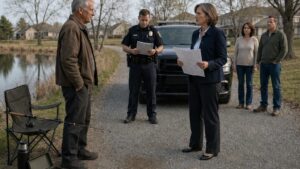
The officer who came out that afternoon listened while Kevin explained the repeated parking, Cynthia’s claim about HOA overflow, and the association’s own inability to produce a rule.
“You want her cited?” the officer asked.
“No.”
“Then what are you looking for?”
“A record that I told her to stop and that this has happened repeatedly.”
The officer glanced toward Cynthia’s house.
“Have you told her clearly?”
Kevin almost answered immediately.
Then he remembered his own phrases.
I’d rather you didn’t park there.
I need to use it.
Please don’t.
He had believed each was obvious.
But obvious had become the entire problem.
“I’ve told her,” Kevin said. “Maybe not as clearly as I should have the first few times.”
The officer nodded as if that answer made more sense than any legal explanation.
He took down the dates Kevin had documented and gave him an incident reference number.
“No guarantees about what a tow company will do,” the officer said. “They’ll follow their own requirements. But you’ve got a record now.”
Kevin wrote the number beneath the other entries.
For a moment the legal pad looked less like a list of grievances and more like a construction drawing.
Every line supported the next.
That evening he emailed Susan.
He attached a copy of the plat and the municipal sign specifications.
I understand the HOA regulates exterior signage. The city requires a compliant sign before private-property towing under these circumstances. Please provide an approved placement that satisfies both requirements.
Susan replied the next morning.
This time the answer was specific.
A small sign could be mounted beside the garage rather than placed at the curb, provided it met the city’s visibility requirement and used a neutral frame.
Kevin almost laughed.
Weeks of resistance had collapsed into instructions about a neutral frame.
He bought the approved hardware that afternoon.
Cynthia watched from her front walk while he installed the sign.
She did not cross the property line.
When he finished, Kevin stepped back and checked its visibility from the street.
“You’re really doing this?” Cynthia asked.
“Yes.”
“You could’ve just talked to me.”
Kevin turned.
“I did.”
“You documented me. You called the HOA. You called the police.”
“I also asked you to stop.”
Cynthia crossed her arms.
“And now what? You have my car hauled away the second I touch your concrete?”
Kevin looked at the sign.
“No. The rule requires seventy-two hours before I can rely on the posted notice.”
She stared at him.
He had not intended to tell her.
For one sharp second, he regretted it.
Then he realized that if the point was to stop the parking, secrecy would defeat the purpose.
“So there’s your notice,” he said. “I’m telling you directly too. Please don’t park in my driveway again.”
Cynthia’s jaw tightened.
“Fine.”
She went inside.
Kevin wrote the date and time the sign had been installed in his log.
Then he waited.
The first day, nothing happened.
The second, Cynthia’s sedan stayed on the street.
On the third evening, Kevin found himself looking through the kitchen window more often than necessary.
He disliked that about himself.
The driveway had become a trap in his mind.
Part of him wanted Cynthia never to park there again.
Another part wanted her to do it once, just once, so all the preparation would mean something.
The realization embarrassed him.
He closed the blinds.
The seventy-two-hour period expired at 8:10 the next morning.
At 8:17 Kevin was pouring coffee when an engine slowed outside.
He looked through the window.
Cynthia’s silver sedan turned across the curb cut.
The tires climbed onto his driveway.
She pulled forward until the car sat almost exactly where it had during the HOA gathering.
Then Cynthia got out, locked it, and walked toward her house.
Kevin stood motionless with the coffee pot still in his hand.
On the table beside him lay the towing-company number.
Chapter 5: The First Tow Solved Almost Nothing
Kevin watched Cynthia reach her front door.
She never looked back at the sedan.
That bothered him more than if she had.
If she had glanced toward his house, he could have told himself the parking was a deliberate challenge.
Instead, she behaved as though nothing had changed.
Kevin set down the coffee pot.
He opened the legal pad.
Sign installed: Monday, 8:10 a.m.
Seventy-two hours expired: Thursday, 8:10 a.m.
Vehicle arrival: Thursday, 8:17 a.m.
Police incident number.
Photographs.
He checked everything twice.
Then a third time.
The tow company’s dispatcher asked him the same questions.
“Private property?”
“Yes.”
“Required notice posted?”
“Yes.”
“Waiting period satisfied?”
“Yes.”
“Registered property?”
“Yes.”
“Vehicle owner been warned?”
Kevin looked through the window.
“Several times.”
The dispatcher told him a driver would verify the property before removing anything.
Kevin ended the call.
For the next twenty minutes, he could not decide what to do with himself.
He rinsed the same coffee mug twice.
He opened email and closed it.
He walked to the garage, then back to the kitchen.
When the tow truck finally appeared, Kevin felt no surge of triumph.
Mostly he felt exposed.
The driver photographed the sign, driveway, license plate, and street approach.
Then he knocked on Kevin’s door.
“Everything checks out on my end.”
Kevin nodded.
The driver studied him.
“You sure?”
Kevin looked past him at the sedan.
He thought of Tuesday’s forty-seven minutes.
The old clips.
The laugh.
Susan’s careful non-answers.
Raymond’s admission that a courtesy had become a neighborhood workaround.
Most of all, he thought of standing beside the newly installed sign and telling Cynthia plainly not to park there again.
“Yes,” Kevin said.
The driver hooked the sedan.
Metal clicked against metal.
The truck’s hydraulic system lifted the front wheels from the concrete.
Across the lawn, Cynthia’s front door opened.
She stopped.
“What are you doing?”
Kevin remained on his porch.
The tow driver continued working.
Cynthia hurried across the grass.
“Kevin.”
“You were warned.”
“You’re actually towing my car?”
“Yes.”
“For parking next door?”
“For parking on my driveway.”
She turned toward the driver.
“Put it down.”
The driver shook his head.
“You’ll have to contact the yard.”
Cynthia looked back at Kevin.
“This is unbelievable.”
Kevin felt the old instinct to soften the moment.
He nearly said he was sorry.
Instead he kept his voice level.
“I asked you not to park here. The sign’s been up three days. I told you exactly when the notice period started.”
Cynthia stared at him.
Then she pointed at the truck.
“You think this makes you right?”
“No.”
The answer surprised both of them.
Kevin continued.
“The records make the boundary clear. The warnings make my position clear. This is just the consequence.”
The tow truck pulled away.
For several seconds Cynthia remained in the driveway where her car had been.
Then she turned and walked home without another word.
Kevin went inside.
He poured the coffee he had abandoned earlier.
The driveway was empty.
For months that had been all he wanted.
Yet sitting at the kitchen table, Kevin discovered that emptiness did not feel like victory.
Two days later, Cynthia knocked on his door.
She held printed papers in one hand.
Kevin recognized the old HOA email before she unfolded it.
“It cost me three hundred seventy-five dollars.”
Kevin said nothing.
“Two hundred eighty-five to get it released, plus storage because I couldn’t pick it up the first day.”
“I didn’t set the fees.”
“No. You just made the call.”
Kevin could have answered that she had made the choice.
He almost did.
Instead he opened the door wider but did not invite her inside.
“What do you want me to say?”
“I want you to admit this was excessive.”
“I want you to admit you knew I didn’t want you parking there.”
Cynthia held up the email.
“And I want you to admit I wasn’t imagining the parking arrangement.”
Kevin went to the kitchen table and returned with his folder.
He showed her Susan’s email confirming the driveway was not formally designated as HOA parking.
Then the plat.
Then the police incident number.
Cynthia barely looked at the plat.
She kept her eyes on the old email.
“You keep acting like I invented this.”
“I don’t.”
That made her pause.
Kevin tapped the old message.
“I think the neighborhood got used to something the previous owner allowed. I think the HOA liked it because it kept cars off the street. And I think nobody bothered to explain that the arrangement ended when the owner changed.”
Cynthia’s anger did not disappear.
But it lost some of its certainty.
“You could’ve said no.”
“I did.”
“Not at first.”
Kevin fell silent.
Cynthia looked at him closely.
“You’d say, ‘I’d rather you didn’t.’ Or ‘I need the driveway.’ Then you’d walk away. Half the time I thought you were irritated, not forbidding it.”
“I left a note.”
“After months.”
Kevin wanted to reject the accusation.
Instead he remembered exactly how many times he had chosen vague courtesy because it let him escape the discomfort of a firm conversation.
“That doesn’t excuse what happened after I made it clear,” he said.
“No.”
It was the first time Cynthia had conceded anything.
Kevin leaned against the doorframe.
“Then why keep doing it?”
She looked toward her house.
Her garage door was closed.
For a moment Kevin thought she would leave.
Then she said, “Because I don’t have anywhere else to put the sedan without moving everything.”
“You have a garage.”
Cynthia laughed once, but there was no humor in it.
“That’s what everybody says.”
She stared at the driveway between their houses.
“My mother moved into assisted living last year. Most of her house ended up in my garage because she couldn’t decide what to get rid of.”
Kevin said nothing.
“She died in February.”
The sentence was flat.
Almost administrative.
Cynthia continued before he could offer sympathy.
“Every box in there became something I was supposed to sort. Her dishes. Her clothes. My father’s tools she’d kept for twenty years after he died. I open the garage and I just…”
She stopped.
Kevin looked at her hands.
The HOA email had bent where she was gripping it.
“So you don’t clear it,” he said.
“No.”
“And my driveway became easier.”
“Yes.”
The honesty was uncomfortable.
It did not erase the towing bill.
It did not erase seven incidents or the morning she had parked there despite explicit notice.
But it changed the shape of the conflict.
Cynthia looked at him.
“I still think you went too far.”
Kevin nodded.
“And I still think you knew exactly what would happen this time.”
She folded the papers.
Neither apologized.
After she left, Kevin returned to the kitchen table.
The parking log remained open to the latest entry.
Beside it sat his coffee, gone cold.
For the first time, the page did not look entirely like proof against Cynthia.
Some of it looked like a record of everything Kevin had waited too long to say.
Chapter 6: Three Weeks Later She Tested It Again
Three weeks after the tow, Cynthia’s sedan was back in Kevin’s driveway.
He saw it at 5:36 on a Tuesday evening.
Same silver paint.
Same angle.
Same concrete.
Kevin stood behind the kitchen window and felt the old anger arrive so quickly that it embarrassed him.
The towing company’s number was still saved in his phone.
He could make one call.
There was no seventy-two-hour question now. The notice remained posted. The property registration remained active. Cynthia knew the consequences better than anyone.
Kevin picked up the phone.
Then he noticed something different.
Cynthia was standing beside the sedan.
She was waiting.
Not walking home.
Not pretending the car belonged there.
Waiting.
Kevin went outside.
“What are you doing?”
Cynthia glanced toward the HOA clubhouse at the end of the street.
“The board meeting starts in twenty minutes.”
“I know.”
“I parked here on purpose.”
Kevin stared at her.
“You paid three hundred seventy-five dollars three weeks ago and decided to try again?”
“Yes.”
“Why?”
“Because they’re going to keep avoiding the question.”
Kevin’s grip tightened around his phone.
“What question?”
“Whether the HOA told people this was allowed.”
“They’ve already admitted there’s no formal designation.”
“To you.”
Cynthia shook her head.
“Privately. Susan sends careful emails. Raymond tells people it was an old custom. Nobody will put anything in the minutes.”
Kevin looked toward the clubhouse.
“So you parked in my driveway to force them?”
“I parked here because if you tow me again tonight, nobody can pretend this is a misunderstanding between two neighbors.”
The statement stunned him.
“You want me to tow you?”
“No.”
“Then move the car.”
Cynthia did not.
Kevin could feel his pulse in his jaw.
“This is exactly the problem. You keep deciding my driveway is useful whenever you need something.”
Her face tightened.
“I know.”
The answer stopped him.
Cynthia looked at the sedan.
“I know it’s yours.”
There it was.
No HOA email.
No old practice.
No claim of confusion.
Kevin waited.
She continued.
“I called Susan after the tow. She told me the board has no recorded right to your driveway.”
“And you parked here anyway.”
“Yes.”
“That makes it worse.”
“I know that too.”
Kevin stepped closer.
“Then explain it.”
Cynthia glanced toward her garage.
Its door was open.
For the first time since Kevin had known her, he could see several feet of clear floor inside.
Boxes had been stacked along one wall. A narrow path ran between furniture and shelving.
Not enough room for the sedan yet.
But somebody had started.
“The meeting agenda says ‘resident parking dispute,’” Cynthia said. “That’s how Raymond wants to handle it. You and me. Personality problem. Neighbor disagreement.”
“It is a neighbor disagreement.”
“Not only.”
Kevin looked at the phone in his hand.
The tow number sat one touch away.
Cynthia said, “If this stays between us, the next homeowner gets the same problem.”
Kevin almost answered that the next homeowner could read the plat.
But he knew better now.
Documents did not stop assumptions if nobody connected them to behavior.
“You could’ve asked me to raise it at the meeting.”
“You would’ve?”
“Yes.”
Cynthia gave him a look.
Kevin hated that he could not immediately prove it.
Three weeks earlier he would have chosen the tow truck over a room full of neighbors without hesitation.
Paperwork was clean.
Public disagreement was not.
Cynthia nodded toward his phone.
“You can call them. I’m not stopping you.”
Kevin stared at the sedan.
He imagined the truck arriving while residents walked toward the clubhouse.
He imagined Cynthia’s car lifted in front of everyone.
The visual would settle the private dispute instantly.
It would also make Cynthia the entire story.
Kevin looked at her.
“Move it before the meeting ends.”
Cynthia blinked.
“That’s it?”
“No. That’s not it.”
He opened the camera application, confirmed the arrival time, then opened his legal pad on the kitchen table through the window.
For a second he considered leaving the new incident undocumented.
Then he went inside.
5:36 p.m. — Cynthia deliberately parked before board meeting.
He stopped after the sentence.
Usually he would have added photographs, duration, notice status, tow eligibility.
Instead he drew a short line underneath.
Maybe the final entry.
He closed the pad.
When Kevin returned outside, Cynthia was still there.
“I’ll move it after we get an answer,” she said.
“No.”
Her expression changed.
“You said before the meeting ends.”
“I changed my mind.”
Kevin pointed at the sedan.
“You don’t get to use my property to make your argument about respecting my property.”
For several seconds neither moved.
Then Cynthia took out her keys.
She backed the sedan into the street and parked along the curb.
Kevin felt some tight internal knot loosen.
Not because she had obeyed.
Because he had finally said exactly what he meant without a note, camera clip, ordinance, or tow operator speaking for him.
They walked toward the clubhouse separately.
Inside, folding chairs faced a long table where Susan, Raymond, and two board members were arranging papers.
Neighbors spoke in low voices.
Kevin chose a chair near the aisle.
His parking log rested on his knee.
Cynthia sat several seats away.
Raymond glanced at both of them and looked tired already.
When the meeting reached the parking item, he folded his hands.
“I’d like to keep this narrow,” he said. “We have a dispute between adjacent homeowners that has unfortunately escalated.”
Kevin looked at Cynthia.
She did not speak.
Raymond continued.
“Our hope is to clarify expectations without turning an individual situation into a broader policy issue.”
Kevin felt the old reflex.
Wait.
Listen.
Avoid becoming difficult.
His hand rested on the closed parking log.
Then Raymond said, “Kevin, if you want to begin, please explain what outcome you’re asking the board for.”
Kevin looked down at his phone.
The towing-company number was still on the screen from earlier.
He pressed the side button and darkened it.
Then he placed the phone face down beneath his chair.
He stood with the log in his hand.
For once, there would be no call made on his behalf.
Chapter 7: The Boundary Finally Became Clear
Raymond Carter looked at Kevin across the folding tables.
“Before we spend the rest of the meeting on this,” he said, “I need to ask whether you really want one driveway dispute turned into permanent HOA policy.”
The room went quiet.
Kevin remained standing.
The parking log was in his left hand. Its cover had softened at the corners from weeks of being opened, carried, checked, and reopened. Seven incidents had become eight. Camera times. Photographs. The police reference number. The sign installation date. The towing requirements.
Everything he had accumulated because saying no had somehow never felt sufficient.
“Yes,” Kevin said.
Raymond frowned.
Kevin continued before he could lose the nerve.
“But not because I think every disagreement needs another rule.”
Susan Campbell sat beside Raymond with a stack of papers arranged neatly in front of her. Cynthia remained several chairs away from Kevin, arms folded but expression unreadable.
Kevin set the log on the table.
“I bought my house believing the driveway belonged to the house. Cynthia believed the neighborhood had always used it for temporary overflow. When I asked the HOA which of us was right, I got explanations about cooperation, tradition, signage, and keeping parking complaints under control.”
He looked at Raymond.
“What I didn’t get was a clear answer.”
Raymond shifted in his chair.
“We eventually provided one.”
“Privately.”
That word changed the room.
Susan glanced at Raymond.
Kevin opened the folder and placed her email beside his parking log.
“It says my driveway is not designated HOA parking.”
He added the recorded plat.
“This says there is no parking easement or common right over it.”
Then he placed the old overflow email Cynthia had shown him beside both.
“And this says private drive approaches could be used with owner cooperation.”
One of the board members leaned forward.
Kevin tapped the three documents.
“These don’t actually contradict each other. The problem is that for years people behaved as if they did.”
Cynthia looked down.
Raymond said, “No one intended to mislead anyone.”
“I believe you.”
That seemed to surprise him.
Kevin had expected anger to carry him through the meeting. Instead, standing there, he found it less useful than he had imagined.
“You had parking complaints,” he said. “A few homeowners volunteered driveway space. It worked. People got used to it. The HOA got used to fewer complaints.”
Raymond’s expression tightened.
“And eventually,” Kevin continued, “the volunteering part disappeared from the story.”
Susan slowly removed her glasses.
One of the nearby residents said, “That’s pretty much what happened on our street too.”
Raymond turned toward the voice, then back to Kevin.
“We never claimed ownership of your driveway.”
“No. But when Cynthia claimed she could use it, nobody wanted to tell her plainly that she couldn’t.”
Cynthia finally spoke.
“That part is true.”
Every head near the front turned toward her.
She uncrossed her arms.
“I thought Kevin was being difficult. I still think the way it escalated was unnecessary.”
Kevin did not interrupt.
“But I called Susan after the tow,” Cynthia continued. “She told me the HOA had no recorded right to his driveway.”
Susan nodded once.
Cynthia looked toward Kevin.
“I knew that before tonight.”
Kevin could feel several neighbors waiting for the next part.
Nobody knew she had deliberately parked there again before the meeting.
He could expose that now.
His log contained the exact time.
5:36 p.m.
It would prove, cleanly and publicly, that Cynthia had knowingly crossed the boundary after learning the truth.
Three weeks ago, Kevin would have wanted everyone in the room to hear it.
Instead he closed the log.
The sound was small, but Cynthia noticed.
Kevin looked at Raymond.
“This stopped being just about Cynthia when the HOA sent me a compliance warning about a towing sign before it gave me a direct answer about whether the parking practice applied to my property.”
Susan looked uncomfortable.
“That warning was based on the architectural rules.”
“I know.”
Kevin nodded toward her.
“And you eventually helped me place a compliant sign. I’m not saying the rule was fake.”
He paused.
“I’m saying the system was faster at telling me what I couldn’t do than it was at telling everyone else what they couldn’t assume.”
No one applauded.
Kevin was glad.
Applause would have turned the moment into a contest.
Instead, Raymond leaned back and rubbed one hand across his chin.
“You understand why I’m hesitant,” he said. “If we formally revisit every informal arrangement this neighborhood has used for twenty years, we may create more disputes than we solve.”
“I understand.”
“Shared landscaping. Drainage maintenance. Driveway turnarounds during gatherings. People have made accommodations.”
“Then keep accommodations.”
Raymond looked at him.
Kevin said, “Just don’t call them rights.”
For several seconds, nothing moved except the ceiling fan above them.
Then one of the board members reached for the old overflow email.
“This wording is bad.”
Susan nodded.
“It was written for a specific event years ago and kept getting forwarded.”
“How many times?”
“I don’t know.”
Raymond’s shoulders lowered slightly.
Kevin recognized the shift.
Not surrender.
Recognition.
Raymond looked at Cynthia.
“Did you believe that message gave you standing permission?”
“Yes.”
“Even after Kevin objected?”
Cynthia hesitated.
“At first, I thought he was objecting to the inconvenience, not ending the old arrangement.”
“And later?”
Her eyes moved toward Kevin.
“Later I knew.”
The answer stayed in the room without anyone rescuing her from it.
Kevin felt no satisfaction.
Only relief that the truth no longer required him to prove every minute of it.
Raymond picked up the recorded plat.
“I was on the board when the original overflow practice started,” he said.
Susan turned toward him.
Raymond continued.
“We knew those driveways were private. The idea was voluntary. It was never meant to become automatic.”
There it was.
The deeper answer Kevin had been chasing through emails, camera footage, municipal records, and towing regulations.
The HOA had known.
Not because it was corrupt.
Not because anyone had plotted to take his property.
Because a convenient temporary solution had survived longer than anyone’s memory of its limits.
Raymond exhaled.
“We should have corrected the wording years ago.”
Susan opened her laptop.
The board spent the next twenty minutes drafting something far less dramatic than the fight that had produced it.
Private residential driveways were not designated HOA overflow parking.
Any temporary use required permission from the current property owner.
No historical informal arrangement transferred automatically with a change in ownership.
Existing parking guidance would be revised accordingly.
One board member asked whether that would create problems during large events.
Raymond answered before Kevin could.
“Then we’ll solve the parking problem without assigning someone else’s driveway.”
The vote was not unanimous.
One member worried about reopening old disputes.
But it passed.
Susan promised to circulate the corrected guidance with the meeting minutes.
Kevin looked at Cynthia.
She was reading the new language upside down from where she sat.
Her face showed neither defeat nor relief.
After the meeting, residents drifted toward the doors in small groups.
Kevin stayed behind long enough to put the documents back into his folder.
Cynthia approached him.
“You could’ve told them what I did tonight.”
Kevin knew exactly what she meant.
“I could have.”
“Why didn’t you?”
“Because you moved the car when I told you to.”
She looked at him skeptically.
“That hasn’t stopped you from writing things down before.”
Kevin glanced at the closed log.
“No.”
Cynthia waited.
He said, “And because making you look worse wouldn’t make the policy clearer.”
She absorbed that.
Then she nodded toward the log.
“You still keeping that?”
Kevin considered the question.
“I don’t know.”
Cynthia gave a tired half smile.
“My garage has about six feet of floor now.”
“I saw.”
“It’s not enough yet.”
“No.”
“I threw away twelve boxes.”
Kevin almost asked what had been inside them.
He didn’t.
Cynthia looked toward the parking lot.
“My mother’s dishes were harder.”
“I’m sorry.”
It was the first time he had said it.
Cynthia nodded without looking at him.
“I’m not asking you to feel bad about the tow.”
“I don’t.”
That made her laugh softly.
Kevin added, “I don’t feel good about it either.”
“That sounds more like you.”
They walked outside separately.
Her sedan was parked on the street.
Kevin’s driveway was empty.
For the first time, he did not check the camera when he got home.
The corrected policy arrived by email two days later.
Susan had attached the board minutes and a short note.
Kevin printed the page.
He brought it to the kitchen table, where the parking log still sat beside a stack of photographs.
For several minutes he arranged the final document on top.
Then he closed the log.
He did not write the date.
He carried the folder into the small room off the kitchen and placed it in the bottom drawer of the filing cabinet.
The towing sign stayed beside the garage for another week.
Then Kevin requested permission to remove it.
Susan approved the request the same afternoon.
Three weeks later, Kevin stepped outside early one morning with coffee in his hand.
Cynthia’s garage door was open.
Most of the boxes were gone.
A bookcase remained against one wall. Several plastic tubs had been stacked neatly at the back. An old wooden chair sat beside them.
And inside the garage, centered between the walls, was Cynthia’s silver sedan.
Kevin stopped at the end of his driveway.
Cynthia was standing inside her garage with a flattened cardboard box.
She saw him looking.
Neither of them spoke for a moment.
Then she lifted the box slightly.
“Still working on it.”
Kevin raised his coffee.
“Looks different.”
“It is.”
She glanced toward his driveway.
Empty concrete from garage to street.
No sedan.
No tow truck.
No warning sign.
No argument.
Cynthia looked back at him.
“I should’ve asked.”
Kevin could have answered with the seven old incidents.
The forty-seven minutes.
The towing bill.
Instead he said, “I should’ve said no clearly the first time.”
She nodded.
That was all.
Kevin walked back toward his house.
The driveway remained behind him, ordinary again.
For months he had believed the final proof would be a plat, an ordinance, a police number, or a tow receipt.
Those things had mattered.
They had drawn the legal boundary.
But the part that finally changed his life next door had required no document at all.
It was the moment both of them stopped treating clarity as cruelty.
Kevin took another drink of coffee and went inside, leaving the empty driveway exactly as it was.
The story has ended.