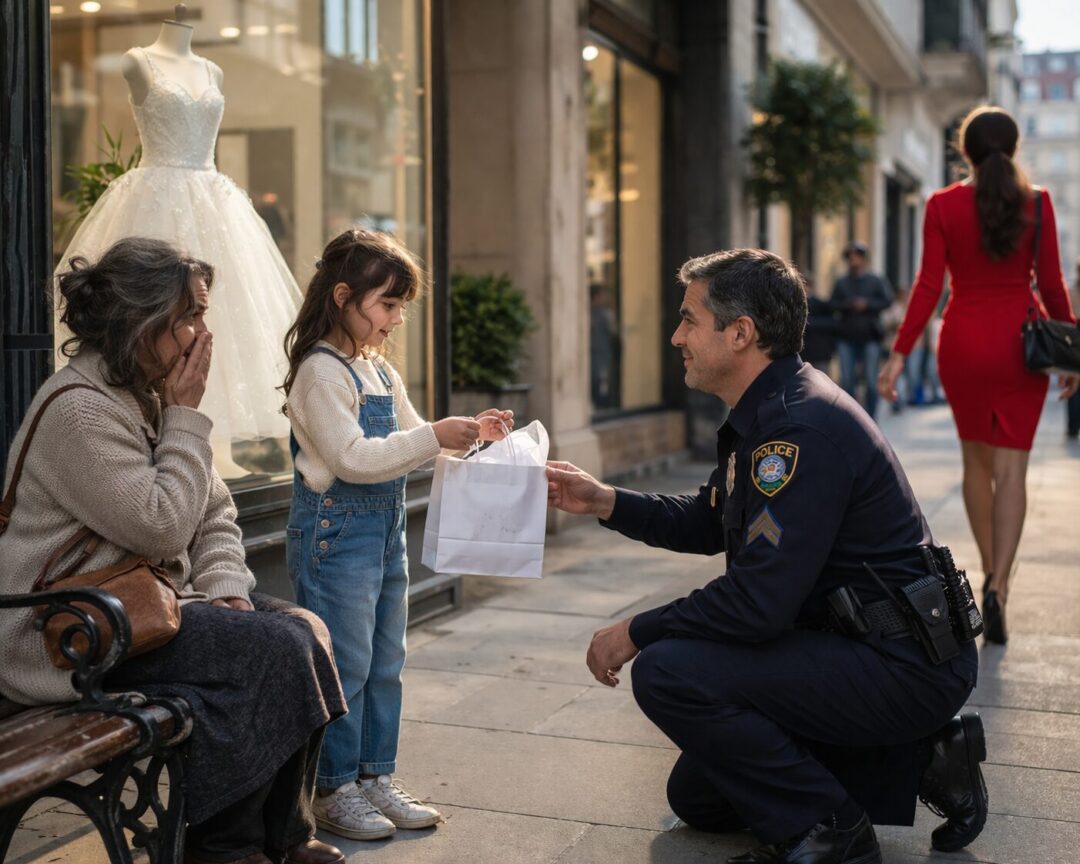
The Dress in the Window
The Dress in the Window
Part I — The Glass Between Them
By the time the little girl lifted her hand toward the boutique window, shame was already waiting for her.
It lived in places like this street, where the paving stones were washed every morning, where the store windows gleamed like promises, where women with polished shoes and glossy handbags drifted past as if beauty belonged naturally to them. Even the air felt different here—expensive somehow, touched by perfume and roasted coffee and the low hum of people who had never had to count coins before opening a door.
Leonie knew she did not belong on streets like this.
She knew it from the way people looked at her faded denim overalls and the cream sweater that had once belonged to someone older and larger. She knew it from the scuffed toes of her sneakers and the frayed cuff on one sleeve. She knew it from her grandmother’s hand, always gentle but always steering her away from places where wanting things could turn dangerous.
Still, when she saw the dress, she forgot all of that for half a heartbeat.
It floated in the display window on a child-sized mannequin, white as early snow, white as wedding cakes in bakery windows, white as the clouds Leonie used to trace with her finger on the rare days she had nothing to worry about. The skirt was full and soft. Tiny folds of fabric caught the afternoon light. It looked like the kind of dress worn by girls in framed photographs, girls whose hair was brushed smooth and whose smiles were never apologetic.
Leonie stepped closer without meaning to.
She didn’t press her hand against the glass. She barely touched the air in front of it. But her face tipped up with such open longing that anyone looking would have understood.
Her grandmother understood. Mirelle always understood.
Mirelle had been watching Leonie from beside the bench with the tired expression of a woman who had spent too many years measuring love against an empty purse. She knew what that look meant. She knew how dangerous it was when a child saw something beautiful and forgot, for one reckless second, what the world had already taught her.
“Leonie,” she began softly.
But someone else got there first.
“Don’t touch the glass.”
The voice was clipped and cool, like the snap of scissors cutting ribbon.
Leonie turned.
The woman standing beside her was all sharp edges and expensive certainty. She wore a bright red dress that fit her perfectly and heels that made a clean, precise sound when she shifted her weight. Her dark hair was pulled into a sleek low ponytail. A glossy handbag hung from her elbow. She wasn’t old, but she had the kind of face that had learned to arrange itself into permanent disapproval.
Leonie dropped her hand at once.
“I wasn’t—” she said, then stopped.
The woman gave the window a quick look, then Leonie, then the overalls, the shoes, the sweater, as if she were reading a label.
Mirelle had already come forward. “She only wanted to look,” she said, voice careful, almost apologetic.
That was the worst part. The carefulness. The apology that arrived before accusation.
Leonie felt heat flood her cheeks.
She kept looking at the dress because looking away would mean surrendering it completely. Her eyes stung. In the reflection, she saw herself distorted beside the white gown—small, brown-haired, poor, and painfully real.
“I just wanted to see it,” she whispered.
The woman’s mouth hardened, though whether from impatience or contempt Leonie could not tell.
“Then keep walking.”
It was not shouted. It was not dramatic. That made it worse.
Cruelty delivered quietly always seemed more certain of itself.
The woman turned and moved on, her heels tapping briskly against the pavement, her red dress vanishing into the bright afternoon crowd as though nothing at all had happened.
For a second Leonie stood perfectly still.
Then the ache arrived.
Not because of the dress. Not only because of the dress.
It was because the wanting had been seen.
Because there was no private space left even for a child to admire something beautiful.
Because for one humiliating moment she had looked like exactly what she was: a girl from the wrong side of town, in borrowed clothes, reaching toward a life that was not meant for her.
Mirelle came to her at once. “My darling,” she said, too softly, as if softness could disguise pain.
Leonie lowered her head.
She hated crying in public. Hated it with the fierce pride of children who have learned early that tears attract the wrong kind of attention. But her throat was closing, and the world had gone blurry around the white dress in the window.
Mirelle drew her close. Leonie pressed her face into her grandmother’s cardigan and breathed in laundry soap, old wool, and the faint medicinal scent of the cream Mirelle rubbed into her hands at night.
“Don’t look,” Mirelle murmured. “Don’t give her your eyes.”
But the truth was that Leonie did not know how to stop looking.
Because she had already imagined herself in the dress.
And once a child imagines herself beautiful, the ordinary world grows crueler for a while.
Part II — What Poverty Teaches
Mirelle had not meant to bring Leonie onto that street.
She usually avoided the city center, especially the quarter where the boutiques bloomed like private gardens behind spotless glass. But the bus route had changed again, and walking the longer way home would spare them a second fare. She had a loaf of discounted bread in her bag, two onions, and a packet of tea she had told herself was unnecessary but bought anyway because some luxuries cost almost nothing and still kept a person alive.
Leonie had been quiet most of the day.
That, too, Mirelle understood.
There were children who filled silence with noise, and children who filled it with thought. Leonie belonged to the second kind. She noticed things. She carried them. Sometimes Mirelle would find her granddaughter sitting near the window of their small apartment, staring at the neighboring rooftops as though trying to puzzle out what separated one life from another.
Since Leonie’s mother had died, the girl had become quieter still.
Not broken. Not even sad in the obvious ways. But careful. As if grief had made her wary of drawing too much attention to her own hopes.
Mirelle did what she could.
She mended clothes, stretched soup, took in ironing when arthritis allowed it, and lied cheerfully about bills. She made up games. She baked little cakes on birthdays even if the icing was only sugar and water. She brushed Leonie’s hair at night until the child went drowsy and pliant and almost forgot to miss anyone.
What she could not do was buy white dresses from expensive windows.
There had been a time, years ago, when Mirelle herself had loved beautiful things with the confidence of someone who believed beauty might one day be hers. Then came hospital corridors, funeral costs, rent hikes, and the slow humiliation of learning to want less because wanting more had consequences.
She had hoped Leonie might be spared that lesson a little longer.
But poverty, Mirelle knew, was not only about what you lacked. It was about how early the world taught you to recognize your place in it.
That was why the woman’s voice had cut so deep.
Not because strangers had never been rude before. They had. Mirelle could survive rudeness. So could Leonie, eventually.
But there was something unbearable in seeing a child’s small longing struck down before it had even become a request.
Mirelle held her granddaughter tighter.
“It is only a dress,” she said, though both of them knew it was not.
Leonie nodded against her shoulder.
That was when Mirelle noticed the police officer standing across the pavement.
He was not close enough to have been part of the moment, she thought at first. But then she saw where his eyes had landed: first on Leonie, then on the dress in the window, then on the retreating line of the woman in red. He was not a young man. His face was broad and calm, his dark hair neatly trimmed, his posture steady in the way of someone who had learned how to stand inside other people’s chaos without adding to it.
He did not approach them.
He did not ask what had happened.
For one uneasy second, Mirelle feared a different sort of humiliation. Official concern. Pity made formal. Questions she did not want to answer in the middle of the street.
But the officer only looked once more at Leonie’s lowered head, then turned and walked away.
Mirelle exhaled a breath she hadn’t known she was holding.
Leonie pulled back slightly, wiping her eyes with the heel of her hand. “I’m sorry,” she whispered.
“For what?”
“For being silly.”
That nearly broke her.
Mirelle took Leonie’s face between her palms. “Listen to me,” she said. “There is nothing silly about wanting something beautiful.”
Leonie tried to believe her. Mirelle saw that effort in the child’s face, and it hurt almost as much as the tears had.
They sat for a minute on the bench outside the boutique because Leonie needed a moment before walking again. She kept her eyes fixed on the cracks between the stones.
Neither of them noticed when the officer slipped inside the store.
Part III — The Quietest Kind of Kindness
His name was Dorian Vale, and he had spent nineteen years in uniform learning that most pain announced itself loudly.
A slammed door. A raised voice. A broken bottle. A call over the radio.
The quieter kinds could be harder to bear.
He had seen enough of the loud variety to recognize the quiet kind instantly. The bowed head. The rigid shoulders of the older woman trying to make herself smaller. The particular stillness of a child doing everything possible not to cry where someone could see.
He had daughters once. Not children anymore—grown women in cities of their own—but the memory lived in his body. The memory of small shoes by the door. The memory of a child pausing before a shop window and asking if something beautiful might, by some miracle, be hers.
He did not know the girl.
He did not know the grandmother.
He knew only that by the time he reached the boutique door, he had already made his decision.
Inside, the store was all pale wood and soft lighting. Dresses hung in orderly rows like expensive clouds. A saleswoman looked up, then at his uniform, then quickly away in the practiced politeness of someone recalibrating expectations.
Dorian went straight to the white dress.
Up close, it was simpler than it had appeared through the window. But somehow that made it better. Soft tulle. Clean lines. A dress made not for spectacle, but for a child to feel radiant in.
He imagined the girl seeing it again without shame attached.
“That one,” he said.
The saleswoman hesitated only a fraction before lifting it down. “What size?”
Dorian glanced toward the window, where he could just make out the little figure outside, slight and narrow-shouldered. “About this high,” he said, holding out a hand. “Seven or eight, maybe.”
The woman nodded and moved quickly.
He added a pair of simple white shoes after a moment’s thought. Not expensive ones. Just enough. Enough to complete the miracle.
He paid without asking for the total first.
Some gestures grew smaller if you measured them too carefully in the middle.
When the saleswoman handed him the bag, he thanked her and left before anyone could say anything that made the act feel larger than it was.
Outside, the bench was still there. The grandmother still sat beside the child, both of them turned inward toward the sore little world that humiliation makes.
Dorian approached slowly.
The older woman looked up first, suspicion flickering in her eyes. Not distrust of him exactly—only the wary look of people who have learned that surprises often carry hidden prices.
He stopped a respectful distance away.
The girl raised her face.
Her eyes were still bright from crying.
Dorian crouched a little so he would not tower over her. “This is yours,” he said.
And held out the bag.
For a second, no one moved.
The grandmother stared.
The girl looked from the bag to his face and back again, as though trying to find the trick in it.
“Me?” she asked.
Dorian had expected tears. He had expected refusal, maybe. He had not expected that one small word, spoken with such stunned fragility that it seemed to carry the full weight of everything she had already learned not to hope for.
“Yes,” he said simply.
The grandmother made a sound then—not quite a gasp, not quite a sob. Her hand flew to her mouth.
“No, sir, we couldn’t—”
“You can,” Dorian said, and not unkindly. “Please.”
He saw the exact moment pride and need and love collided behind the older woman’s eyes.
Then she nodded.
Leonie took the bag with both hands.
She touched it as if it might vanish.
Part IV — The Girl in White
There are moments when a child’s face becomes too open for adulthood to witness comfortably.
When Leonie emerged a few minutes later from the small fitting room inside the boutique, Mirelle had to press her knuckles against her lips to keep from crying out.
The dress fit.
Not perfectly in the way couture fits in magazines, but perfectly in the only way that mattered. It made Leonie stand differently. It lifted her. The shy inward fold of her shoulders had loosened. Her loose dark hair fell around her face like a frame. The white fabric caught the light and sent it back softer than before.
For the first time that day, Leonie looked at her own reflection without flinching.
She touched the skirt with careful fingertips.
Then she turned and saw Dorian waiting near the door, giving her space, as though he understood that the first person she had to believe was herself.
“Me?” she said again, but this time the word sounded different.
Not disbelief exactly.
Wonder.
Dorian smiled.
And that was enough.
Leonie ran to him.
The movement was sudden and unplanned, the way children move when gratitude outruns manners. She wrapped both arms around him with a force that startled him into stillness before he returned the embrace, one careful arm around narrow shoulders, the shopping street carrying on behind them as if the world had not just been altered by one small act of grace.
“Thank you,” she said into his uniform.
Mirelle did not bother hiding her tears anymore.
She stood a few steps away, one hand over her mouth, and let them fall.
The officer said almost nothing after that. Perhaps that was part of why the moment remained so pure. He did not ask for photographs. He did not make a speech about kindness. He did not tell Leonie to remember him. He simply stepped back when the hug ended and nodded once, as though the important part had already happened.
Mirelle tried to speak. The first attempt failed. The second came out ragged.
“I don’t know how to—”
“You don’t need to,” Dorian said.
Then, after a pause, “Take her somewhere she can feel pretty in it.”
It was such an ordinary sentence that Mirelle almost laughed.
So that was what they did.
They did not go home immediately.
Instead, Mirelle took Leonie to the river promenade, where the light opened wide above the water and no one hurried past closely enough to bruise the moment. Leonie walked carefully at first, afraid perhaps that the dress might somehow stop belonging to her if she moved too freely. Then more boldly. Then with the shy joy of a child allowing happiness to become visible.
A little later she twirled.
Only once.
But it was enough.
Mirelle sat on a bench and watched, and in that turning white shape she saw not only her granddaughter, but the child she might still become if the world did not harden her too quickly.
When evening came, they climbed the stairs to their apartment.
The rooms were small. The wallpaper peeled in one corner. The kettle took too long to boil. But something had shifted. Not in their finances. Not in the rent due next week. Not in the long arithmetic of survival.
In Leonie.
At bedtime, Mirelle helped her out of the dress with reverence, as if undressing a queen.
“Can I keep it near me?” Leonie asked.
“Yes,” Mirelle said, though she knew white fabric and small apartments were natural enemies.
Leonie folded the dress as carefully as she could and laid it across the chair beside her bed where moonlight touched it.
Then she climbed beneath the blanket and looked at it for a long time.
“Mamie?”
“Yes, my heart?”
“Why did he do it?”
Mirelle sat on the edge of the bed.
Because he saw you, she thought.
Because sometimes one human being notices the wound another is carrying and refuses to leave it there.
Because not everyone who has power uses it to remind others of their lack.
But what she said was, “Because kindness is real. Even when cruelty gets there first.”
Leonie considered that.
Children know when adults are simplifying the world for them. Yet now and then a simple answer is not a false one.
At last she nodded and closed her eyes.
Mirelle stayed until her breathing deepened.
Then she rose, crossed the room, and touched the white dress once with trembling fingers.
For years afterward, Leonie would remember the woman in red only in fragments—the handbag, the voice, the sharpness of being dismissed. That memory would fade the way ugly things often do when they are not fed.
But she would remember the officer clearly.
Not as a hero from a story.
As something rarer.
A witness who chose not to turn away.
And when life later tried, as life always does, to teach her once more that beauty belonged elsewhere, she would think of that day on the shopping street. Of glass and shame and the impossible softness of white fabric. Of the moment she had stepped out wearing the dress and found that the world had changed shape around her, if only for an afternoon.
Sometimes that is all it takes.
Not enough to erase grief.
Not enough to end poverty.
Not enough to make the future gentle.
But enough to interrupt a lesson in humiliation.
Enough to return a child to herself.
Enough to leave behind one stubborn, shining truth:
that dignity can be given back in the exact place it was taken,
and that kindness, when it arrives quietly, can sound almost like grace.