What Matters Most
What Matters Most
Part I — The Sound of Coins
The worst part was not being poor.
Luz could survive hunger. She had survived winter drafts that slipped through cracked windows, the ache of old bones in the cold, and the long humiliation of learning how to want less. Hunger was sharp, but it was honest. What she could never quite get used to was being watched while she tried not to come up short.
That was the feeling pressing against her throat as she stood at the checkout line that afternoon, her fingers curled around a handful of coins that suddenly seemed too loud, too small, too bright under the lights.
The grocery store was warm in the artificial way places like that always were—clean floors, soft music, bins of polished fruit that looked more expensive than they had any right to be. Luz had walked there because the bus fare mattered now. Every dollar mattered. She had taken longer than usual moving through the aisles, calculating and recalculating, setting things into her basket and then putting half of them back.
Bread had stayed.
Milk had stayed.
A few bananas with brown freckles had stayed because the bruised ones were cheaper.
A bottle of water had not been for her at first. She had picked it up because the tap in her apartment had run cloudy that morning, and though it would probably clear by evening, she no longer trusted “probably” the way she used to.
Now the items sat in a small cluster on the conveyor belt, modest enough to make their necessity obvious. Nothing sweet. Nothing frivolous. Nothing anyone could accuse her of not needing.
Still, the total on the register had tipped a few dollars past what she had.
She counted again, knowing before she finished that the answer would not change.
Behind her, the line was not long, but it was long enough. Enough to feel the heat of people waiting. Enough to hear the cough someone tried to make sound patient. Enough to feel herself becoming a public inconvenience instead of a woman.
The cashier was young, tired-eyed, and not cruel. Cruelty would have been easier, in some ways. Cruelty gave a person something to resist. This was only procedure. He looked at the coins in her hand, looked at the total, then glanced back at the small pile of groceries with the detached sorrow of someone who had done this before.
“I can take one or two things off,” he said.
His voice was gentle, but gentleness did not spare her.
Luz nodded because speech felt too expensive. Her throat tightened as his hand moved toward the bread.
Not the bread, she thought. Please not that.
She hated the desperation of the thought. Hated even more that it showed on her face. Her husband, years ago, had once told her that dignity lived in the spine. Stand straight, he used to say. Even if the world bends around you, don’t help it.
But her husband had been dead for eight years, and there were days dignity felt lighter than dust.
The cashier touched the loaf.
A man’s voice behind her cut through the air before the bread could leave the belt.
“Leave it there.”
The words were not loud. That was what made everyone hear them.
Luz turned first with embarrassment, then with alarm. She expected irritation. The kind that arrived wearing politeness like a clean shirt.
Instead, she saw a man in a light blue button-up standing one place back in line with a little boy at his side.
The man had the kind of still face that made room go around it rather than through it. Square jaw, tired but steady eyes, sleeves rolled up to the forearm as if he had come from work and never learned how to stop moving once the day had started. A brown watch sat on one wrist. One hand rested lightly on the cart handle. The other had already gone toward his pocket.
Beside him, the boy in a bright red T-shirt stared openly at Luz, not with pity exactly, but with a child’s painful honesty. He had not yet learned how adults pretend not to see.
The cashier paused. “Sir?”
The man stepped forward. “I said leave it there.”
It was only then Luz understood. The force in his voice had not been anger. It had been refusal. A refusal to let the moment continue in the direction it had been going.
Heat rose behind her eyes before she could stop it.
She hated that too.
The boy looked up at the man, then back at her groceries. His forehead pinched with concentration, as if he were trying to solve a problem that should not have existed in the first place.
“Dad,” he said quietly, “she needs that?”
The question landed harder than the command had.
Because it was so simple. Because it left no place for pretending. Because the child had said aloud what every adult in the line had already understood and avoided naming.
The man’s face softened. He took out his wallet, set bills on the counter, then nodded toward the water bottle.
“Grab the water, buddy.”
The boy reached for it with both hands, suddenly solemn, as though someone had given him an object of real importance.
Luz stood still.
There were moments in life so small they should have vanished as soon as they happened—a hand catching a door, a stranger returning dropped keys, a person making room on a bus bench. And yet some of those moments grew larger in memory than weddings, funerals, birthdays. Not because of the act itself, but because of the instant in which the world could have remained hard, and didn’t.
She had no language for what was happening except this: she was being spared.
The cashier finished the transaction without another word. The father gathered the groceries into a paper bag. The boy held the water bottle against his small chest like a task he meant to do properly.
Luz wanted to protest. Not out of pride—pride had worn thin years ago—but because receiving had become harder than going without. There was always a cost to needing things from other people. Sometimes the price was immediate. Sometimes it lingered in memory.
But the father did not look at her like a man buying gratitude.
He looked at her as if this were obvious. As if bread should stay with the woman who needed bread. As if the world had nearly made a mistake, and he had only corrected it.
That made it harder to speak.
So she said nothing.
And somehow, in that silence, the moment became even larger.
Part II — The Lesson Between Them
Marek had not planned on teaching his son anything that day.
He had only needed groceries, a missing folder from the office printer, and fifteen quiet minutes before heading home to deal with laundry, dinner, and the stack of permission slips that multiplied in his kitchen like paper weeds.
Life since the divorce had become an architecture of practical tasks. Some days he admired himself for keeping it all standing. Other days he felt like a man holding up a collapsing ceiling with one arm while smiling at his child with the other.
He was not unhappy exactly. But he was often tired in a place deeper than sleep could reach.
He had picked up Niko from school and promised him they would make grilled cheese for dinner. Niko had talked most of the drive about a science worksheet and a kid in his class who could burp the alphabet. Marek had laughed where laughter was required, asked questions where questions were needed, and tried not to think about the rent increase waiting in his email.
Then they had entered the grocery store, and life had narrowed to ordinary things—bread, butter, a bag of apples, the kind of cheese Niko liked.
Until he saw the woman at the register counting coins.
There had been no dramatic music, no visible catastrophe. Only one old woman in worn clothes trying very hard to make numbers obey her.
Maybe another man would have looked away. Not because he was bad, but because life trained people to mind their own containers. Their own carts. Their own deadlines. Their own fragile budgets.
Marek could not.
Perhaps because his mother had once stood at a pharmacy counter when he was twelve, putting back medicine she could not afford until a stranger behind her paid and walked away before she could thank him. He still remembered the way she cried in the car afterward—not loudly, not beautifully, but with the helpless anger of someone who had spent her life working and still needed mercy from people she did not know.
Or perhaps because he had spent the last year worrying about what sort of man his son would become in a world that rewarded speed, spectacle, and self-interest. There were lectures he could give. There were values he could name. But children did not learn goodness from speeches. They learned it by watching what adults did when kindness cost something.
So when the cashier reached for the bread, Marek heard himself speak before he had decided to.
Leave it there.
Later, he would replay the scene and realize that the real center of it was not the money. It was the second after Niko asked, She needs that?
That question held a child’s astonishment at the existence of unfairness.
Marek had looked at his son then and seen, with a clarity that hurt, how these moments became foundations. What a boy learned about strangers became what he believed about the world. What he believed about the world became what he would one day allow himself to be.
So Marek made the answer visible.
By the time they left the store, Niko had stopped chattering. He carried the bottle with careful seriousness. The grocery bag swung from Marek’s hand, modest in weight but heavier in meaning than anything else he had picked up that day.
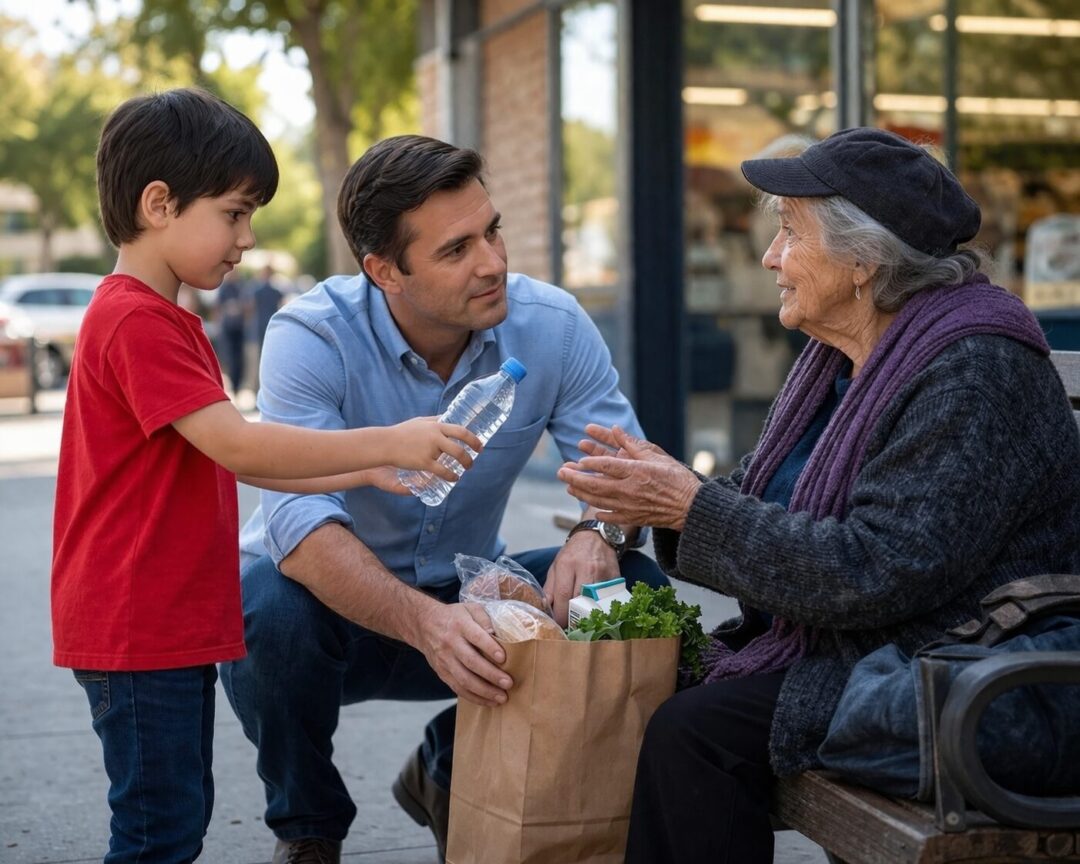
Outside, the late afternoon light had started to turn golden at the edges, softening the brick buildings and parked cars. Near the entrance, off to one side where shoppers passed without really seeing, there was a bench beneath a tired tree.
The woman sat there with the same purple shawl folded over her lap. She looked smaller outside than she had under the grocery lights. Frail in a way that felt dangerous.
Niko slowed.
“She’s there,” he whispered, though they could both see that.
Marek crouched slightly so they were almost eye level. “You can give it to her.”
Niko glanced at the bottle, then at the woman. “What do I say?”
The question broke something open in Marek’s chest.
Whatever else he failed at as a father, his son still wanted to get kindness right.
“Just tell her it’s for her,” Marek said. “That’s enough.”
Niko nodded.
He walked toward the bench in those small sneakers that still scuffed at the front because he ran hard and forgot to lift his feet. The bottle was in both hands. His shoulders were set with determination and nerves.
The woman looked up.
For one second, all three of them seemed held inside something delicate. A breath. A thread. A chance for the moment to become something sacred or awkward.
Niko extended the bottle.
“This is for you.”
His voice was quiet, but clear.
The woman blinked. She stared at the bottle first, then at the boy’s face, as though trying to make sense of a kindness she had not prepared herself to receive. Her hands rose slowly. Thin hands, careful hands, the hands of someone who had carried too much for too long.
When she took the water, her mouth trembled.
Marek came the rest of the way to the bench with the grocery bag and lowered himself so he was not standing over her. That mattered to him, though he could not have fully explained why. Too much help arrived from above. Too much charity demanded the recipient look up.
He set the bag beside her.
“You keep the groceries too.”
The woman made a small sound—not quite disbelief, not quite gratitude, but some human note that lived between the two. She looked from the bag to the bread peeking out from the top, then back to Marek.
“You bought this for me?”
Niko answered first, because children sometimes knew where truth belonged better than adults did.
“We wanted to help.”
And that, Marek thought, was the right sentence. Not I wanted. Not he decided. We.
The woman pressed the bottle to her chest as if it were warmer than it should have been.
Her eyes shone now, and she looked at the boy before she looked at the man.
“Thank you,” she said softly. “Both of you.”
Niko smiled then—not the wild grin he wore on playgrounds, but something quieter. Something changed. He stood a little differently, as though the shape of his body had learned a fact his mind would spend years unpacking.
Marek rested a hand on his son’s shoulder.
“That’s what matters,” he said.
He meant the groceries, yes. The water. The interruption of shame. But he meant more than that.
He meant the refusal to let the world’s harshness educate a child before compassion did.
Part III — Bread, Water, and Light
Luz ate one slice of bread that evening standing at her kitchen counter.
Not because she was ravenous, though she was hungry. Not because she was impatient, though her hands still shook enough to make buttering it feel ceremonial. She ate standing up because sitting down would have made her cry.
The apartment was quiet except for the old refrigerator humming in the corner. On the table lay the groceries the man had bought her, each item arranged with the care of someone still trying to convince herself they were real.
Bread. Milk. Bananas. Water.
Enough to turn a hard day into a survivable one.
Enough, more than anything, to remind her that she had not disappeared.
That was the true danger of poverty, she thought as the tears finally came. Not only the lack. It was the slow erasure. The way people trained themselves not to meet your eyes. The way your needs became awkward for others to witness. The way the world invited you to shrink before it actually asked you to leave.
But that little boy had looked directly at her.
Not rudely. Not curiously. Just honestly.
And then he had come toward her carrying water like it mattered.
The memory loosened something ancient inside her. Not only grief, but gratitude for a world that, even now, still contained interruption. Still contained people willing to step between a stranger and her humiliation and say: no, not this way.
Across town, Marek was burning the first batch of grilled cheese because he had drifted while standing at the stove.
Niko was sitting at the kitchen table, swinging one leg and drawing in the margins of his science worksheet.
“Dad?”
“Yeah?”
“Was that lady alone?”
Marek looked over his shoulder. “Maybe.”
Niko considered that. “Do you think she was scared?”
The pan hissed. Marek lowered the heat.
“Probably,” he said.
Niko was quiet for a moment. Then: “I’m glad we didn’t leave.”
Marek turned the sandwich and swallowed past the sudden thickness in his throat.
“Me too.”
Niko tapped his pencil against the table. “Can we do that again?”
Marek smiled despite himself. “You mean help someone?”
“Yeah.”
The simplicity of it almost undid him.
Adults made goodness complicated. They wrapped it in policy, debate, suspicion, exhaustion. Children often saw it in cleaner lines. Someone needs. Someone can help. So help.
“We can,” Marek said. “Whenever we can.”
Niko nodded as if this had settled an important question. Then he went back to drawing.
But Marek stood still a moment longer, hand on the spatula, thinking about the phrase he had used outside the store.
That’s what matters.
He had spoken it for Niko, but perhaps he had needed to hear it himself.
Because life had a way of dragging a man toward the measurable. Rent. Overtime. bills. Court dates. Missed calls. The humiliating arithmetic of adulthood. It could make him feel that survival was the whole story.
But maybe survival was only the floor. Maybe what mattered most was what kind of person he remained while surviving.
Weeks later, the moment would still live inside all three of them.
For Luz, it became one of those memories she touched in dark hours like a worn medal in a pocket. She never saw their names on any social media post. Never learned where they lived. The kindness remained what perhaps all true kindness should remain—partly anonymous, too full of grace to be traded for spectacle.
For Niko, it became a story he told once at school when the class was asked to describe a time they had seen someone be brave. His teacher gently corrected him. “That sounds like kindness,” she said.
Niko had shaken his head.
“I think it was both.”
And for Marek, it returned unexpectedly in ordinary moments: when he was tired in traffic, when he was tempted to harden, when money made him meaner in his thoughts than he wanted to be. He would remember the old woman’s face on the bench. The careful way she held the bottle. The soft gravity in his son’s voice when he said, We wanted to help.
Years from now, Niko might forget the exact date.
He might forget the grocery store’s name, the weather, the fact that his shirt that day had been red.
But he would not forget the shape of the lesson.
That sometimes the most important thing a person can do is interrupt another person’s shame.
That dignity can be restored in very small packages.
That bread matters. Water matters. But there is something that matters even more: the way a human being is treated while needing them.
And somewhere in the city, on an evening washed gold by the setting sun, an old woman carried a paper bag home with both arms around it, feeling for a little while less alone than she had that morning.
The bread was still warm from the store.
The water was cool against her palm.
And the world, which had nearly bent her again, had unexpectedly made room.