The Interview That Began on the Steps
The Interview That Began on the Steps
Part I — The Woman Who Stopped
By the time Maren saw the man on the steps, she was already late enough to feel it in her throat.
The morning had gone wrong in small, humiliating ways. The train had stalled between stations. A man with a rolling suitcase had clipped her ankle and kept going without apology. Rain had threatened but never properly fallen, leaving the city slick and gray and impatient. And now, as she hurried through the glass-and-stone canyon of downtown with her portfolio pressed against her ribs, the corporate tower in front of her looked less like a building and more like a verdict.
She had one chance left.
That was how it felt, anyway.
Maren had spent the last eight months pretending that rejection had not hollowed her out. She smiled through freelance work that barely covered rent. She told her mother not to worry. She learned how to answer questions about “the gap on her résumé” in ways that sounded brave instead of frightened. But the truth was simpler and harder: she needed this job.
Needed the health insurance. Needed the salary. Needed, perhaps more than either of those things, the proof that her life had not quietly slipped off track while everyone else her age had continued forward.
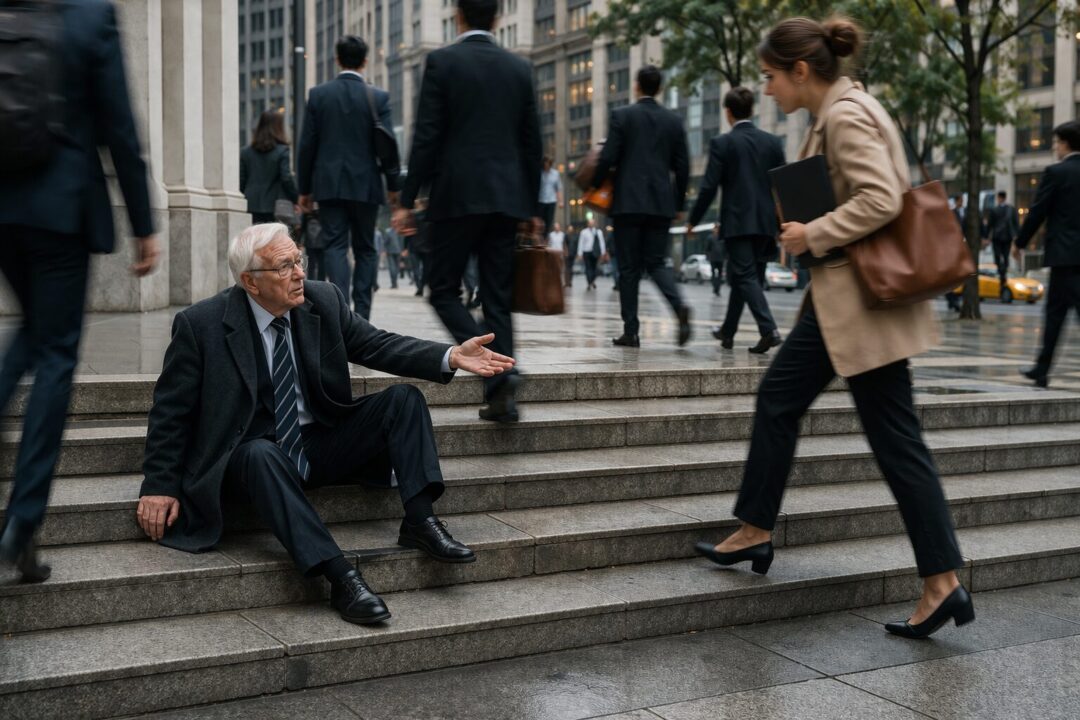
So when she reached the broad front steps of Halcyon Tower and saw a man sitting low against the stone, one hand braced beside him, the other lifted slightly as people flowed around him, her first instinct was not noble.
Her first instinct was to keep walking.
Three suited men passed him without breaking stride. A woman in heels glanced down, then toward the revolving door, as if eye contact itself might become a responsibility. Someone nearly stepped on the man’s shoe.
Maren slowed.
The old man’s overcoat was expensive, though rumpled. His tie had loosened and slipped to one side. Silver hair, combed back with care, had fallen a little out of place. His glasses sat crooked on his face. He did not look drunk. He did not look homeless. He looked, in a way that was somehow worse, abruptly breakable.
“Can someone help me?” he said.
Not loudly.
Not dramatically.
Just enough to prove he had asked before and been ignored.
Maren kept moving for another two steps. The revolving door turned ahead of her. Beyond the glass, the lobby gleamed with chrome and pale stone and all the polished indifference of money.
She could still make it upstairs, she told herself. She could explain. She could say the train was delayed, which was true. She could say downtown was a mess, which was also true. She could say anything except the real thing, which was that she had seen someone in trouble and almost chosen ambition over mercy.
She stopped.
For one suspended second, the whole morning seemed to hold itself still around her.
Then she turned back.
“Sir,” she said, kneeling beside him. “Are you hurt?”
Up close, he looked paler than she had thought. Not sickly, exactly. Just drained. The skin around his eyes was lined and finely drawn, and his breathing had the careful, measured quality of someone trying not to alarm the person helping him.
“I’m okay,” he said after a beat. “Just dizzy.”
There was a leather folder near his shoe, half-open. A few papers had slipped free, edges darkened by damp. Maren picked them up automatically, not reading a word. She set the folder beside him, then looked at his face again.
“Did you fall?”
“A little.”
“You shouldn’t be sitting out here alone.”
The words came out softer than she intended. Her own nerves were still sprinting. She could feel every second ticking in the back of her mind. Somewhere above them, on one of the top floors of this building, people in fitted suits were probably glancing at a schedule and frowning at the empty chair that was meant to be hers.
But the man only gave her a tired, apologetic look that made it impossible to resent him.
“I didn’t mean to make a scene,” he said.
Maren almost laughed at that. There was no scene. That was the terrible part. A scene required witnesses who cared.
She put her portfolio down on the step beside her and held out a hand.
“Here,” she said. “Take my hand.”
His grip was cool, dry, surprisingly steady. He leaned into the support she offered, and she rose with him, bracing her weight under his arm when his knees seemed uncertain. He was taller than she had expected, even stooped by weakness. There was something in the way he carried himself—even like this—that suggested old authority, long-practiced control.
But pain and power had little to do with one another on a cold public staircase. He was still a man who needed help standing.
“Lean on me,” she said. “Slowly.”
He obeyed without argument.
That, more than anything, made her trust him.
They moved together step by careful step toward the doors. Maren could feel the tremor in his body easing, could feel him gathering himself as they crossed the threshold between exposed stone and sheltered glass. Her heart was pounding now for two reasons.
One of them was still the interview.
The other was harder to name.
She became aware, as they neared the entrance, that the uniformed attendant by the inner doors had straightened. Not in surprise.
In recognition.
The man at the desk moved immediately to open the second door. Two other employees, crossing the lobby, stopped short and stepped aside without being asked.
The old man beside her said nothing.
He did not have to.
The air changed around him.
Maren felt it before she understood it. Some invisible social gravity tilted, and all at once the stranger leaning on her was no longer just a stranger. He belonged here. Deeply. Unequivocally.
She turned her head and looked at him.
His expression had altered too—not into something cold, but into something composed. The strain was still there, but it now sat underneath another self, one she had not yet met.
The attendant gave him a discreet nod. “Good morning, sir.”
Maren stopped walking.
The man beside her looked at her then, and in his eyes she saw the exact instant understanding moved between them.
Not full understanding.
Just enough.
Her stomach dropped.
Of all the people in the city.
Of all the buildings.
Of all the mornings.
“Oh,” she said.
It was barely a word.
He straightened a fraction more under her hand. “Thank you,” he said quietly.
And then someone from the lobby was approaching—not to question him, not to question her, but to say, in the careful tone people use around power, “We’ve prepared the conference room.”
Conference room.
Prepared.
Maren looked down at her own hand still gripping the sleeve of his coat. Then she looked at her portfolio lying where she had left it on the step just inside the door. Then back at him.
Something hot and mortifying flushed through her. She was late. She was disheveled. Her pulse was visible in her throat. And the man she had just lifted from the steps was very likely not a visiting client, or a chairman in need of assistance, or some senior partner she would never have to see again.
He was someone important enough that the entire lobby adjusted itself around his breathing.
Someone important enough to matter to her.
Someone, she thought with sudden dread, who might already know exactly who she was.
Part II — The Room Above the City
Forty minutes earlier, in the train tunnel, Maren had rehearsed her introduction.
She had planned to begin with calm professionalism. She had planned to mention the consulting project she had led the year before, the one that had saved a failing nonprofit from collapsing under bad software decisions. She had planned to say she was resilient. Adaptable. Hungry.
She had not planned to walk into the conference room with damp hair at the temples and a stranger’s weight still lingering in her arm.
No one mentioned the delay when she was finally escorted upstairs.
That was almost worse.
The room was all glass and pale wood and horizon. The city spread beyond it in clean geometric confidence, as if uncertainty belonged only at street level. Maren stood at one end of a long table, trying to will her breathing back into something normal.
At the other end sat the man from the steps.
His coat was gone now, draped neatly over a chair. His tie had been tightened, though not perfectly. His silver hair was smoothed back. The glasses were straight. He looked tired, yes, but no longer fragile. Whatever weakness had found him outside had been folded away behind habit and discipline.
Her portfolio sat on the table in front of him.
Not one of the assistants. Not HR. Him.
No one else was in the room.
Maren suddenly wished there had been. An audience might have made this feel less intimate, less dangerous. But the quiet here was total. Even the city beyond the glass seemed soundless.
He rested one hand lightly on the folder and looked at her with a calm she could not yet interpret.
“You’re right on time,” he said.
For a second Maren thought she had misheard him.
Then she understood what he was offering: not a rebuke, not even a joke exactly, but a way into the moment that did not humiliate her further.
She let out a breath she had not realized she was holding.
“I don’t think that’s technically true,” she said.
The corner of his mouth moved. “No,” he said. “Probably not.”
His voice in the room sounded different than it had on the steps. Stronger. Deeper. It carried the roughened edge of age, but also the practiced ease of someone accustomed to making decisions that changed other people’s lives.
He gestured toward the chair opposite him. “Please sit.”
Maren sat.
For one unnerving instant, neither of them spoke.
She could hear her own heartbeat. She could hear the faint whisper of the building’s climate system. She could hear, somewhere inside herself, every worst fear she had dragged into adulthood trying to rise all at once: that she was foolish, that she was always almost enough but not quite, that kindness was admirable only until it interfered with achievement.
He opened the portfolio.
Inside were the printed pages of her résumé, the cover letter she had rewritten nine times, and the carefully curated proof of competence she had spent the last week pretending mattered more than luck.
“You’ve had an uneven few years,” he said.
Maren almost smiled at the understatement.
“Yes.”
“You left a secure role.”
“I had to.”
He looked up.
There was no hostility in the question that followed. Only attention.
So she answered honestly.
She told him about the merger that had erased half a department and all its promises. She told him about her father’s illness and the months she had spent taking trains between work and hospital rooms until both worlds began to fray. She told him she had freelanced because she needed flexibility, then kept freelancing because stable jobs stopped arriving. She did not dramatize. She had grown tired of dramatizing her life for people who only wanted adversity packaged as a leadership anecdote.
When she finished, the room was quiet again.
He leaned back slightly in his chair.
“Do you know,” he said, “how many people walked past me this morning?”
Maren looked at him.
She had the strange sensation that the interview, formal as it appeared, was happening somewhere just beneath the surface of their words.
“I didn’t count.”
“I did.”
She waited.
“Twenty-three,” he said.
The number hit her harder than she expected.
Not because it was large. Because it was precise.
“You counted?”
“I had time.”
Something shifted inside her then—not pity, exactly, and not embarrassment either. Something more complicated. She saw, suddenly, that whatever had happened on the steps had not merely been an unfortunate physical episode. It had also become a kind of lens. A ruthless one.
A city could reveal itself quickly to someone seated low enough.
A company, perhaps, could too.
He folded his hands. “Most people weren’t cruel. They were busy. Or uncomfortable. Or unwilling to make uncertainty their problem.” His gaze remained on her. “That’s ordinary. I’m old enough to know the difference.”
Maren lowered her eyes for a second, then raised them again.
“I almost kept walking.”
He nodded once. “But you didn’t.”
The simplest facts are sometimes the most difficult to survive.
Something in her face must have changed, because his expression softened.
“This company,” he said, “can teach process. It can teach systems. It can teach anyone bright enough how to survive meetings and budgets and difficult clients.”
He paused.
“What it cannot teach,” he said, “is character under pressure.”
The words landed with terrible gentleness.
Maren’s throat tightened.
Outside, the city gleamed in its own reflection. Inside, a silence opened that was not empty at all. It was full—of the staircase, the rushing strangers, the damp papers, the hand she had held out because she could not bear the idea of becoming someone who didn’t.
He looked down once at her résumé, then closed the folder.
“I hire character first,” he said.
The room blurred.
Not literally. Not at first. Just around the edges, the way light does when emotion reaches it before thought can. Maren blinked hard and looked away toward the windows, ashamed of the tears that had risen so suddenly.
She had promised herself she would not cry in another interview.
She had promised herself that months ago, after one particularly humiliating meeting in which a man ten years younger than her had smiled sympathetically and asked whether she had considered “something less demanding.”
Now she pressed her lips together and willed herself into composure. It didn’t help. The first tear slid free anyway, quick and hot.
“I’m sorry,” she said.
“For what?”
She gave a small, breathless laugh. “This.”
He considered her for a moment.
Then, with a kindness so unsentimental it nearly undid her, he slid a box of tissues across the table without comment.
Maren laughed again, this time because it was either laugh or fold in half.
When she looked back at him, he was watching her not as someone who had won, or impressed, or performed correctly, but as someone who had been seen.
That was rarer than praise.
He asked her a few more questions after that. Real ones. Good ones. Not designed to trap or flatter, but to understand how she thought. By then the formal edges of the conversation had altered. She answered clearly. She stopped trying to sound like the person she imagined he wanted and spoke instead like herself.
At the end, he stood.
So did she.
He came around the table—not quickly, not theatrically—and extended his hand.
“This role is yours if you want it,” he said.
Maren stared at him.
The city beyond the windows looked suddenly unreal, too bright, too far away.
“I—” she began, and then failed.
He waited.
She swallowed hard. “Yes,” she said. “Yes, I want it.”
His hand was steadier now than it had been on the steps.
“Good,” he said.
Later, much later, she would remember that he smiled then. Not broadly. Just enough to change the shape of the whole morning.
Part III — What Was Seen
Maren did not tell the story immediately.
Not because she wanted to keep it private, though part of her did. And not because she feared people would think it had all been staged, though some probably would.
She kept it to herself at first because she did not yet know what exactly had happened to her inside that building.
A job offer, certainly.
Relief so intense it left her exhausted, yes.
But there was something else too. Some quieter rearrangement.
For years she had lived by the logic of scarcity. Take the train that gets you there fastest. Answer the message that might become money. Don’t look too long at anyone else’s pain when your own life is balanced on such a narrow edge. Need makes pragmatists of decent people; she knew that better than most.
And yet the moment that changed everything had come from choosing, however briefly, not to obey that logic.
Not because virtue had been rewarded by a magical universe.
She was not naive enough for that.
If the man on the steps had turned out to be no one of consequence, she would still have been late. She would still have been anxious. She might have lost the opportunity entirely.
The meaning was not that kindness always paid.
The meaning was harder, and better: that who you are when no reward is visible is still who you are.
On her first day at Halcyon, Maren arrived twenty minutes early.
The lobby attendant recognized her and smiled in a way that suggested office stories traveled faster than emails. She blushed and pretended not to notice. Upstairs, she was shown to a desk near a bank of windows and handed a laptop by a woman from operations who spoke too quickly and wore the expression of someone permanently overbooked.
By noon, Maren had learned the coffee machine, the bathroom code, and the fact that the old man from the steps—his name, she now knew, was Callum Vale—was not merely senior leadership.
He had founded the company.
By three o’clock, she had also learned that he was widely respected, slightly feared, and recovering from an episode his doctor had firmly described as “a warning,” though no one seemed willing to tell her much more than that.
She did not see him again until the end of the week.
It happened by accident.
She was leaving late, shoulders stiff from onboarding manuals and process charts, when the elevator doors opened onto the executive floor by mistake. Before she could step back, she saw him at the far end of the corridor, jacket over one arm, speaking quietly with an assistant.
He noticed her at the same moment.
The assistant moved away.
For a second, Maren considered pretending she had not seen him. Then he crossed the hall toward her with that same measured gait she now recognized as his.
“How’s the first week?” he asked.
“Humbling.”
He gave a soft huff of amusement. “Good answer.”
She hesitated. “How are you?”
It was a dangerous question to ask a man of his rank in a hallway after work. Too personal for some offices. Too intimate. But he did not seem offended by it.
“Annoyingly supervised,” he said. “Which probably means improving.”
She smiled.
For a few seconds they stood in the mellow quiet of the emptying floor, the city beyond the windows washed gold with evening. In daylight, power had seemed to sharpen this place. At dusk, it looked almost humane.
“I’ve been thinking about that morning,” Maren said before she could stop herself.
His expression shifted, not with surprise but with interest.
“So have I.”
She searched for the right words and found none that sounded graceful enough.
“I don’t want to turn it into a lesson,” she said. “I know real life doesn’t work like that.”
“No,” he said. “Usually it doesn’t.”
“But I’m glad I stopped.”
He held her gaze for a moment.
“So am I,” he said.
There was more beneath it. They both knew there was. The twenty-three people. The staircase. The world divided so neatly between those in motion and those who could not rise without help. But neither of them reached for a speech.
Not everything meaningful survives being explained.
The elevator chimed.
Maren stepped inside and turned back just before the doors closed.
He was still standing there, jacket over one arm, silver in his hair catching the last light, looking suddenly less like a figure of authority than simply an aging man who had sat on cold stone and asked strangers for help.
A person could be powerful and still be vulnerable.
A person could be desperate and still choose decency.
The city below them would go on proving the opposite every day. It would reward speed, certainty, self-containment. It would tell people, in a hundred polite ways, not to become involved.
But sometimes, on a morning when everything felt precarious, one person stopped.
And that was enough to change the shape of a life.
Months later, after Maren had settled into her role and learned the rhythms of the place, she found herself standing by the lobby windows one rainy evening, watching commuters stream past the building in dark coats and blurred reflections.
On the steps outside, a young delivery rider dismounted his bike to help an older woman whose grocery bag had split at the curb. Apples rolled into the rain. The rider crouched without hesitation, gathering them one by one while traffic hissed by and no one else slowed.
It lasted perhaps fifteen seconds.
Then each of them continued on.
Maren stood there longer than the moment required.
Not because she expected revelation.
Not because she believed every kindness would be returned by fortune in a glass office upstairs.
But because she understood now that these small, invisible moments were the truest interviews most people would ever face.
No panel. No résumé. No practiced answer.
Only the quiet question life asks when no one important seems to be watching.
Who are you, when another human being needs you?
Behind her, the lobby lights reflected warm and pale against the glass. Ahead, the city moved as it always had—fast, crowded, half-looking away.
Maren picked up her coat, stepped outside, and joined it, carrying with her the knowledge that the most decisive moment of her future had not happened in a conference room above the skyline.
It had happened on cold stone, beside a man everyone else had chosen not to see.