The Man in the Olive Jacket
The Man in the Olive Jacket
Part I — The Wrong Kind of Customer
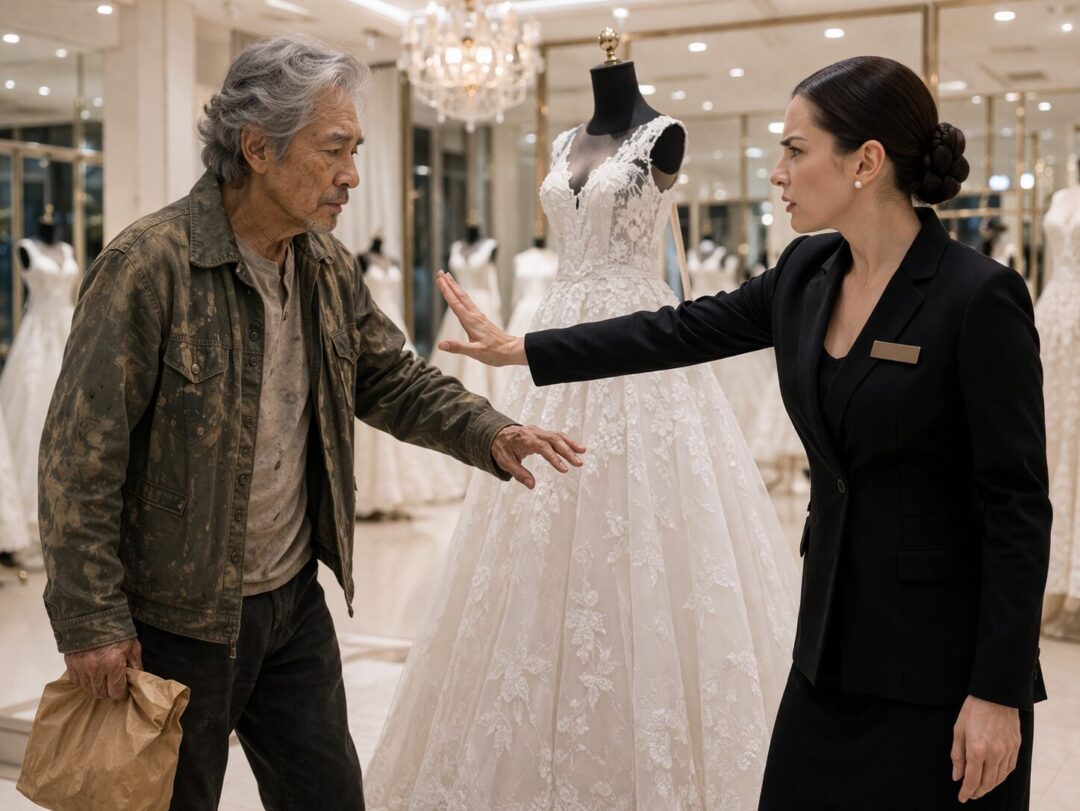
The first thing Celeste noticed was the hand.
Not the face. Not the age. Not even the paper bag hanging from his wrist like something pulled from a lunch counter decades ago.
Just the hand.
Rough, darkened with grime, the knuckles swollen and scarred, reaching toward the white silk of the dress on the center display as if he had every right in the world to touch something that cost more than most people’s rent.
“Don’t touch that.”
The words left her mouth before she fully crossed the polished floor.
By then, the entire showroom seemed to pause around them. The chandeliers above the bridal salon gave off their soft honeyed light. Mirrors threw back elegant reflections of mannequins and satin and cream-colored walls. Even the hush of the place felt expensive.
And in the middle of all that brightness stood a man who looked as though he had come straight out of a scrap yard.
He was old, though not fragile. His silver-gray hair was combed straight back, but it did nothing to soften the weathered severity of his face. Deep lines cut through his cheeks. Dust clung to the sleeves of his olive work jacket. His boots were thick and worn, the leather cracked from years of labor. Everything about him said outside.
Everything about the boutique said otherwise.
He drew his hand back at once.
For the briefest instant, embarrassment crossed his face, and Celeste felt the tiny, private satisfaction she always felt when she put disorder back in its place.
The boutique survived on control. Control of light, of presentation, of mood, of the kind of women who came in and the kind of people who did not. The place sold wedding gowns to people who treated price tags as afterthoughts. Mothers cried in these rooms. Brides spun beneath spotlights. Men in stained jackets did not wander in touching imported silk.
“Sir,” she said, pointing toward the glass doors at the front. “Leave. Now.”
He didn’t move.
Not in defiance. Not even in confusion.
Instead, he looked down at the brown paper bag in his hand.
Celeste had barely noticed it before. It looked ridiculous, crumpled and plain against the gleam of the showroom. But the top was folded open just enough for her to catch the edges of bills inside, thick and dense, bound in old paper bands.
Cash.
A lot of it.
Her chin tilted higher, not lower. If anything, the sight annoyed her more. Money didn’t make people belong. There were rules to belonging, and most of them had nothing to do with what someone carried.
“Did you hear me?” she snapped.
He tightened his grip on the bag. His fingers pressed into the paper until it wrinkled under them.
Then he lifted his eyes.
They were not angry eyes. That would have been easier. Anger would have made him ordinary.
What she saw instead was disappointment. Quiet, old, familiar disappointment, as if she had not surprised him at all.
“My store?” he said softly.
The words were so calm that for a moment she thought she had heard them wrong.
Then she laughed once, short and incredulous.
“Excuse me?”
But he had already turned away.
Not hurriedly. Not with humiliation. He simply pivoted toward the entrance and walked out through the front doors with the same steady gait he had entered with, the paper bag hanging at his side.
Celeste watched him go, her pulse still slightly elevated, and told herself that irritation was all she felt.
Yet something had shifted.
It was in the way he had spoken. In the way he had not pleaded, not argued, not apologized. In the way he had looked around the showroom—not like a trespasser dazzled by beauty, but like a man measuring damage.
She glanced toward the front desk, where one of the junior assistants was pretending very hard not to stare.
“Back to work,” Celeste said sharply.
The assistant dropped her gaze.
The boutique’s silence returned, but it was thinner than before. Celeste adjusted one of the satin ribbons on a nearby display and told herself the matter was over.
Only it wasn’t.
Because outside, just beyond the blurred elegance of the glass, a dark car had pulled to the curb.
And ten minutes later, the same man walked back in wearing a charcoal suit.
Part II — Before the Door Opened Again
His name was Renzo Vale, though almost nobody who passed him in work clothes ever guessed it belonged on the license of the man who owned half the block.
He had spent the morning where he preferred to spend most of his mornings: at the salvage yard on the edge of the city, where twisted metal came in by the ton and left in cleaner, more profitable forms. The yard smelled of oil, rainwater, rust, and heat. To most people, it looked like a graveyard for ruined things.
To Renzo, it had always looked like proof.
Proof that what people dismissed still had value.
He had bought the place forty-two years earlier with borrowed money, two trucks, and a faith so stubborn it often felt like rage. He had been poor then in a way fashionable people romanticized and real poor people understood: the kind that made sleep thin and food practical and humiliation ordinary. He had worked until his spine stiffened and his hands coarsened and his jaw set into the face of a man no one imagined in rooms with chandeliers.
He had made his fortune there.
Not fast. Not gracefully. Not through luck.
He earned it one ugly, stubborn day at a time.
The bridal boutique had come much later, after warehouses and leases and redevelopment plans and partnerships with people who used phrases like luxury experience and brand identity. It had been his daughter’s idea, at least at first. Mara had laughed when he’d told her he didn’t understand why anyone would pay so much for a dress they wore once.
“That’s because you’ve never seen a woman cry in the right mirror,” she had said.
Mara understood beauty the way Renzo understood machinery. She saw how desire worked, how memory attached itself to fabric and light and atmosphere. When she died three years later, the dresses were still arriving every season, and Renzo could never bring himself to sell the boutique. It had too much of her in it.
He rarely entered through the front.
He preferred side doors, office corridors, service elevators. He reviewed numbers, leases, staffing, inventory turnover, renovation proposals. The showroom itself remained half shrine, half business. Sometimes he stood unseen in the mezzanine office and watched brides step onto the little platform in the center of the room, watched mothers press trembling hands to their mouths, watched saleswomen move in careful, polished arcs around longing.
That afternoon he had gone down because one of Mara’s old design sketches had been found during a storage clean-out upstairs—a note about central display lighting, scribbled in her narrow handwriting. He wanted to see the platform again with his own eyes.
He had not changed first.
Why would he?
His olive jacket was what he wore when he was working, and he had been working since dawn. He had driven from the salvage yard with dust still on his sleeves. The paper bag held cash because he was old-fashioned about certain things and because one of the smaller contractors at the yard trusted bills more than transfers.
He hadn’t expected to be welcomed. He hadn’t needed ceremony.
He had only wanted a few quiet minutes in the room his daughter had once loved.
Instead, a woman he had approved on paper and never really met had looked at him and seen only a threat to the room’s polish.
And the worst part, Renzo thought as the driver pulled the car back to the curb, was not that she had mistaken him for poor.
It was that she had mistaken poverty for contamination.
He sat in the back seat while the city slid in reflections across the window. Beside him lay the garment bag one of his assistants had rushed down from the office.
He changed without drama.
Charcoal suit. White shirt. Dark tie. Steel watch. The armor of a world that believed authority only when it arrived properly dressed.
Across from him in the front seat, Yasmin Chen glanced back. She was his regional operations director, though titles never seemed large enough to hold her competence. In a cream blazer, tablet balanced on one knee, she looked as precise as a blade.
“You want me to handle this quietly?” she asked.
Renzo stared at the boutique doors.
“What do you think?”
Yasmin considered for half a second. “I think the issue isn’t that she didn’t know who you were.”
He looked at her then.
She met his gaze in the rearview mirror. “I think the issue is what she believed she could do to a man who looked like he had less.”
A small, humorless smile touched his mouth.
“That,” he said, “is exactly the issue.”
When the car stopped, he stepped out no longer looking like a man the showroom could reject without consequence.
But inside, under the suit and the watch and the carefully cut cloth, he was still wearing the hurt.
Part III — The Return
The boutique felt different the second Renzo crossed the threshold again.
It was not the lighting. Not the music. Not the white glow of the dresses.
It was fear.
He saw it first in the receptionist’s face, in the instant widening of her eyes before she stood too quickly. Then in the assistant near the fitting rooms, who went rigid and lowered her gaze. Then, finally, in Celeste, who turned from the display pedestal and seemed to stop breathing.
She recognized him at once.
The silver hair gave him away. The face did. But more than that, it was the terrible coherence of the two versions of him: the laborer and the owner collapsing into one body before her eyes.
Renzo did not hurry.
Yasmin entered beside him, one hand resting lightly on her tablet, her posture composed and unmistakably executive. Behind them, two silent staff members from management remained near the front, discreet and watchful.
Celeste’s eyes flicked from the suit to Yasmin and back again. The confidence she wore like perfume all day every day seemed to evaporate in visible stages.
Renzo stopped three paces from her.
He said nothing.
He didn’t have to.
Yasmin took one step forward.
“You threw out the owner?” she asked.
The question landed with the force of a verdict.
Celeste opened her mouth, but nothing came. Her hand, the same hand that had pointed him toward the door, rose halfway as if trying to hold on to some last scrap of authority.
“I—I didn’t know,” she said finally.
Her voice had changed. The edges were gone. Beneath the makeup and the polished training and the expensive stillness of the store, she sounded suddenly young.
Renzo watched her.
He thought of all the rooms where men like him learned to read themselves through other people’s eyes. Job sites. Banks. School offices. Restaurants. Lobbies. Weddings. Everywhere a certain kind of cleanliness was mistaken for virtue and a certain kind of wear was treated like moral failure.
He could have fired her himself in that moment. Perhaps he would have, had anger been the strongest thing in him.
But anger wasn’t what he felt.
What he felt was older and heavier.
Sadness, perhaps.
Not for her alone. For the whole small cruelty of the world that trained people to sort human beings by surface and then called that sorting discernment.
“That was the problem,” he said.
He did not raise his voice. He did not step closer.
Still, the words hit harder than a shout.
Celeste’s face lost color.
Somewhere behind her, one of the assistants inhaled sharply and then stilled herself at once. No one else moved. Even the music, soft and instrumental, seemed suddenly embarrassed to exist.
Yasmin turned her head only slightly. “Please wait in the office,” she said to Celeste.
It wasn’t loud. It didn’t need to be.
Celeste looked as if she wanted to explain herself, to insist that she had only been protecting inventory, maintaining standards, doing what the boutique required. But whatever defense might have once seemed reasonable to her now sounded hollow even before it was spoken.
She lowered her eyes.
For the first time since Renzo had met her, she looked directly at his boots.
Perhaps then she finally understood what he had seen the moment she blocked him: not a dress, not a showroom, not a trespass, but a line she believed she had the right to draw between one kind of person and another.
She walked away without another word.
The room stayed silent until the office door closed behind her.
Yasmin exhaled slowly. “I’ll take care of it.”
Renzo nodded.
But he did not leave.
Instead, he turned toward the central display, toward the white gown he had reached for the first time. Up close, the fabric shimmered faintly under the chandelier light, the beadwork delicate enough to look like frost.
Mara would have liked this one, he thought.
Not because it was the most expensive. Because it had restraint. Because it did not scream for attention. Because it trusted the woman wearing it to bring the life into it.
“You should keep the winter lighting,” he said quietly.
Yasmin blinked. “What?”
He gestured toward the display. “It’s better than the spring setup.”
For a second she simply stared at him, then gave a small laugh of disbelief and relief. “You came down here to check the display lighting?”
“And to remember my daughter,” he said.
The humor left her face at once.
He touched the edge of the pedestal with two fingers, not the gown this time, just the lacquered base beneath it.
“When people come here,” he said, “they’re already carrying enough. Fear. Hope. Memory. Money. Grief, sometimes. We sell them dresses, yes. But that isn’t all we do.”
Yasmin’s expression softened. She had worked with him long enough to know when business had become something more private.
“Mara built this place to make people feel chosen,” he said. “Not inspected.”
The words settled into the room like a rebuke far larger than one employee.
At the front desk, the receptionist lowered her eyes again.
Renzo let the silence stand.
Then he straightened his cuffs, turned once more to the display, and finally allowed himself to look at the dress the way he had intended to all along.
Part IV — What the Mirrors Remembered
Celeste was gone by the end of the day.
Not in a scene. Not with tears and pleading and dramatic accusations. Yasmin handled it efficiently, with documentation, policy language, and a composure that left no space for confusion. The incident would be framed correctly: not as an error in identifying ownership, but as conduct incompatible with the values of the business.
That distinction mattered.
Because Renzo had no interest in building a company where respect was reserved for the rich, the known, or the well-dressed.
In the weeks that followed, he made changes quietly.
Training was rewritten. Not polished into slogans, not reduced to smiling scripts. Real revisions. Real standards. Staff were told that courtesy was not a reward for visible status. Security and sales teams were retrained together. Language was reviewed. Complaint pathways changed. Hiring questions changed.
Yasmin, who knew how to translate conviction into systems, oversaw all of it.
When she brought him the new training materials, he looked through them at the long oak table in his office above the showroom.
“No mention of me,” he said.
“Of course not.”
“No dramatic cautionary tale.”
A flicker of amusement crossed her face. “You don’t want to become boutique folklore?”
He set the papers down. “I want the lesson to work even when the man at the door owns nothing.”
That, she understood.
Winter gave way to spring. New dresses arrived. Brides cried in the right mirrors, just as Mara had once promised they would. The central display changed twice, then three times, but Renzo kept the lighting softer than the consultants recommended.
One afternoon, months later, he stood again in the upstairs office looking through the interior glass to the showroom below.
A young woman in worn sneakers had come in with her grandmother. Neither of them looked expensive. The older woman clutched her handbag in both hands as if expecting at any second to be told they were in the wrong place. The granddaughter hovered near the entrance, trying and failing to hide the fact that she was counting every object in the room as if calculating what she could never afford.
A sales associate approached them.
Renzo felt his body harden before he even knew why.
Then the associate smiled—not the polished, selective smile of someone screening for worth, but a real one.
“Take your time,” she said warmly. “If you’d like, I can show you some of our sample options first.”
The grandmother’s shoulders dropped.
The granddaughter blinked in surprise.
No miracle occurred. No violin swelled. No cinematic revelation split the room in two.
Only this: a human being had been treated with dignity before she had proven she deserved it.
Renzo stood very still in the office above and felt, for the first time in a while, something in him unclench.
That evening, after the store closed, he went down alone.
The chandeliers were dimmed to their after-hours glow. The mirrors held only the room itself now—white mannequins, folded veils, quiet polished floors, the stillness of a place waiting to become meaningful again for someone tomorrow.
He stopped at the central platform.
In the silence, the memory returned with startling clarity: Celeste’s raised hand, the sting of her voice, the paper bag creasing in his grip. For a moment he could almost see both versions of himself standing there at once—the man in the olive jacket and the man in the charcoal suit.
But perhaps they had never been separate.
Perhaps that was the point.
He reached out and touched the base of the display again, just as he had the day everything changed.
Then he looked toward the mirrors.
They had reflected him dirty and they had reflected him polished. They had reflected contempt and fear and embarrassment and control. They had reflected the kind of mistake people made when they confused appearances with truth.
But they had also reflected something else: correction.
Not perfect, not permanent, not enough to heal every old wound the world handed out so casually—but real.
Renzo thought of Mara, of the salvage yard, of all the years he had spent being underestimated in rooms that mistook refinement for depth.
Then he smiled, tired and small and genuine.
The room looked beautiful in the winter lighting.
And somewhere in the hush of silk and shadow and glass, it felt—at last—like his again.