Where the Alley Learned Their Names
Where the Alley Learned Their Names
Part I — The Place People Passed
By the time Maren saw the dog, the alley had already decided what kind of place it was.
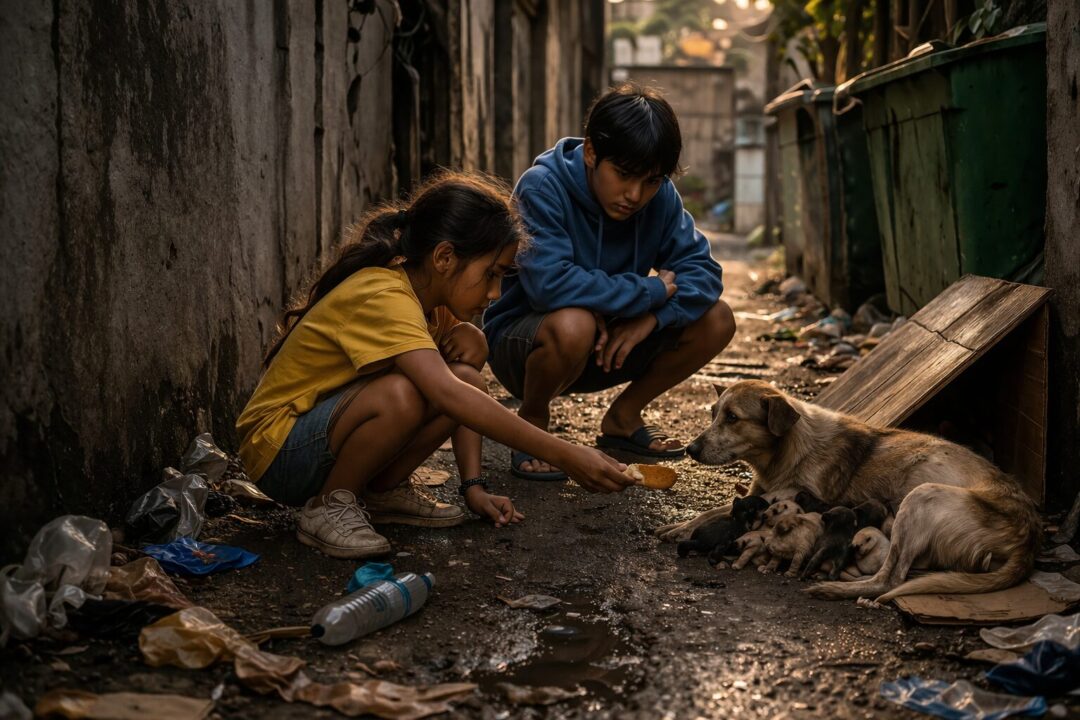
It was the kind of place people hurried past with their faces turned away. A narrow strip of cracked concrete behind a row of low apartment buildings, boxed in by stained walls and a dented metal gate, it collected the things nobody wanted to claim. Rainwater settled there in shallow gray puddles. Torn wrappers stuck to the ground like dead leaves. Old grease, mildew, and something sour from the dumpsters drifted in the heat. Even in daylight, the alley looked dim, as if the sun had learned not to linger.
Maren had come through it only because she was late.
She had cut behind the buildings with a loaf of day-old bread tucked under one arm and a plastic bottle of water knocking against her leg inside a cloth bag. Her grandmother had sent her to the corner shop for eggs and cheap rice. She was thinking about the scolding she would get for taking too long when something moved near the wall.
At first, it looked like a pile of rags shivering.
Then one of the rags raised its head.
Maren stopped so sharply the bread nearly slipped from her arm. On the ground, curled tight against the stained concrete, was a stray dog with a rib-thin body and watchful eyes. Her coat was dirt-streaked, once brown and white maybe, now dulled by dust and hunger. Pressed against her belly were several tiny puppies, half-hidden beneath her chest and forelegs, as if she were trying to fold her whole body around them and make herself into a shelter.
For one suspended second, Maren only stared.
The dog stared back.
There was no growl at first. Only a terrible stillness.
The puppies were so small that one of them barely looked alive. Another gave a weak twitch and nosed blindly under its mother’s front leg. The mother shifted, not away from Maren but over them, tightening the circle of her body. It was a movement so instinctive, so raw, that Maren felt it in her own chest before she understood it.
She dropped into a crouch without meaning to.
“Don’t touch her babies!”
The words flew out of her mouth toward the mouth of the alley, though she had not even heard anyone coming yet. A second later, she realized why she had shouted. She had sensed movement behind her—the slap of sandals on wet concrete, a figure slowing at the corner.
It was Ivo.
He was from the next building over and somehow always looked as if he had been pulled halfway out of some other plan and dropped into the wrong one. He wore the same oversized blue hoodie he wore on most days, sleeves pushed carelessly up his forearms, dark shorts, scuffed slides. He stopped a safe distance away and stared at the dog, then at the puppies, then at the ground around them as if he couldn’t decide which part was worst.
The alley smelled stronger now that he had stepped into it.
He grimaced. “Then leave them here?”
Maren looked back at the dog. The mother’s eyes were yellow-brown and exhausted, but they tracked every inch of movement. Not wild eyes, Maren thought. Not cruel. Just wrecked. Just cornered.
“Look at this place,” Maren muttered.
Ivo took one uncertain step forward, then thought better of it. “She could bite.”
Maren should have agreed. The dog’s body was wound tight with fear. The alley was filthy. The puppies could have been sick. Sensible people would have backed away and found an adult. Sensible people would have told themselves there were too many strays, too many hungry things in the world, too many losses too ordinary to stop for.
But the mother dog’s chin was resting on the smallest puppy as if the weight of her own head might keep it safe.
Maren heard herself say, softly this time, “She’s scared. Not mean.”
She had no proof. Only the feeling of it.
Maybe that feeling had started long before the alley.
Her mother used to say Maren was forever rescuing things that didn’t know they were in danger yet. Baby birds blown from nests. Lizards caught in buckets. A neighbor’s torn laundry left in the rain. It wasn’t that Maren thought she could save everything. She knew better than that. She had grown up around broken pipes, unpaid bills, illnesses nobody named until too late. She knew the shape of helplessness.
Maybe that was why she hated recognizing it.
Ivo stayed where he was. “And what if you’re wrong?”
Maren looked at the bread under her arm, then at the plastic bottle in her bag.
The dog was still staring at her, motionless except for the tight rhythm of her breathing.
“If I’m wrong,” Maren said, “then she tells us.”
That was the closest thing to a plan either of them had.
Part II — What Fear Looks Like
Maren tore the heel from the loaf with careful fingers.
The sound was small, but the mother dog reacted instantly. Her ears twitched. Her muzzle tightened. Not a snarl—more like a warning pulled taut through every muscle. Maren felt Ivo freeze behind her.
She lowered herself closer to the ground until one knee pressed into the damp concrete. The alley’s dirt soaked into the fabric of her shorts. Her red bracelet slipped down her wrist as she stretched out her hand.
Slowly, she set the bread down several feet away.
Not too close. Not close enough to make the dog think she was trying to reach the puppies.
The mother did not move.
“Maybe she can’t,” Ivo said quietly.
Maren heard something in his voice that had not been there a minute ago. Not skepticism. Something more frightened than that.
The possibility of arriving too late.
The smallest puppy shuddered again. Another let out a thin, nearly soundless whimper. Maren swallowed. There was no drama in what they saw—no music, no miracle, nothing shaped to make the pain noble. Just hunger. Just filth. Just an animal that had somehow kept her babies alive through a night in a place built for indifference.
Maren shifted the bread an inch closer with two fingers.
The mother dog’s eyes never left her. But she did not snap.
Ivo came one step nearer, then another. He still kept half a body’s distance from Maren, like fear had left a line on the ground only he could see. “What do we do?”
“Food first,” Maren said. “Then water.”
He stared at her. Maybe he was surprised that she had answered so quickly. Maybe he had expected panic, or a speech, or tears. But the truth was that once she knelt in front of the dog, the world became very simple. There was only what might scare her and what might not. There was only the next movement.
Ivo looked down at the bottle bulging from the cloth bag.
Then, almost grudgingly, he crouched.
“Okay,” he said. “Slow.”
It was the first time he had lowered himself to their level, and the moment mattered more than either of them admitted. Until then, he had still been a witness. Now he was inside the problem.
Maren passed him the water. His hand brushed hers—cold, tense.
Together, they unscrewed the cap as quietly as children handling a secret. There was an old plastic lid near the wall, probably kicked there weeks ago. Ivo rinsed it once with a splash, then poured water into it until it trembled near the edge.
Every motion was tentative. The kind of care people use around babies or broken glass.
The mother dog watched them through half-lidded suspicion.
Then one of the puppies crawled out from under her chest.
It was not graceful. It barely deserved the word crawl. The puppy dragged itself forward, belly scraping, head bobbing weakly, nose trembling toward the smell of bread. At once, the mother dog turned—not toward Maren, not toward Ivo, but toward the little body pulling away from her.
Maren held her breath.
Here, she thought. Here is the answer. Here is where fear shows what it really is.
If the dog was savage, she would lash out. If she trusted nothing, she would clamp down. If desperation had hollowed her into pure instinct, she might drag the puppy back and challenge anything that came near.
Instead, she only lifted her head.
That was all.
A tiny movement. A release so slight it might have meant nothing to anyone who wasn’t looking for it.
But Maren saw the difference immediately. The mother’s body was still protective, still braced, but not locked. The tight ring of her limbs loosened. Her head rose from her puppy’s back. Her gaze flicked from Maren’s face to the bread and back again.
She was deciding.
Not whether the alley was dangerous. She already knew that. Not whether hunger was cruel. She knew that too.
She was deciding whether these two children belonged to the danger.
Maren whispered, more to herself than anyone else, “She trusts us.”
Beside her, Ivo let out a breath that seemed to have been trapped in him for a long time.
The puppy reached the bread first and nuzzled it clumsily. Another puppy followed, then another. The mother dog did not stop them. She shifted again, slow and weary, and finally lowered her head to sniff the water.
Ivo made a sound that was almost a laugh and almost a sob. It disappeared before it fully became either.
He sat back on his heels, his hoodie darkening where it brushed the damp ground. When he spoke, his voice had changed.
“We can’t leave now.”
There are moments when a life bends so quietly that no one notices it until much later.
That sentence was one of them.
Part III — The Weight of Staying
They should have gone home.
That was the practical truth.
Maren’s grandmother would be waiting. Ivo’s older brother would start shouting if he didn’t come back soon. The rice would still need washing, the eggs would still cost money, the evening would still descend with all its usual demands.
But the alley no longer belonged only to the world of errands and schedules. It had become a place where a promise had been made, even if neither child had said the word.
Maren gave the mother dog the rest of the loaf in small pieces. Ivo found an old cardboard box near the gate and laid it flat over the wettest patch of concrete. The puppies were too weak to bark or tumble the way healthy puppies did. They just nudged and shivered and leaned toward warmth.
“Do we tell someone?” Ivo asked.
“We tell everyone,” Maren said.
It sounded dramatic, but that was because she was trying not to sound afraid.
The trouble with caring was that once you began, you kept discovering how much more was required. Food for one afternoon was not enough. Water for one hour was not enough. A box against the wet ground was not enough. Help was always larger than the first act that named it.
Maren sent Ivo to fetch his aunt, who fed every stray cat in the neighborhood and knew which pharmacy sold the cheapest antiseptic. She ran home herself and took the scolding she had expected and then some. Her grandmother snapped that she had ruined her shorts, wasted time, and brought home trouble in her eyes. But when Maren said, “There are puppies,” her grandmother’s face changed in the smallest way.
Some people did their softening in private.
She wrapped leftover rice in paper, added a small tin bowl from the back shelf, and muttered, “If that dog bites you, I’ll be furious.”
By dusk, three adults and four children had passed through the alley. Someone brought scraps. Someone brought an old blanket. Ivo’s aunt came with a broom and drove the wrappers and broken plastic away from the wall as if insulted by them. An old man from the first floor grumbled that strays multiplied like storms but returned twenty minutes later with a torn sack of dry kibble somebody had once given him for a different dog long gone.
No one called it a rescue.
Maybe because the word felt too grand for an alley and a handful of poor people improvising mercy with what they had.
But that was what it was.
The mother dog never became affectionate. She did not wag, did not lick hands, did not offer her gratitude in ways humans find easy to love. She remained watchful, suspicious, and tired. Yet each time Maren came, the dog allowed her a little more space. Each time Ivo refilled the bowl, the dog stepped back a little faster. Trust did not bloom. It accumulated.
That made it seem truer.
Over the next week, the alley changed in small, stubborn ways.
The cardboard became two stacked pieces, then a wooden board, then a shallow crate lined with cloth. The puddles dried under a stretch of clear weather. The wall remained stained, the gate remained dented, the smell remained bad when the wind turned—but the corner where the dog lay no longer looked abandoned.
It looked claimed.
The children from the neighborhood began circling past in the evenings. Some came only to stare. Some brought scraps their parents allowed them to spare. A few asked if the puppies had names.
“No names yet,” Ivo said once, leaning against the wall with the authority of someone newly appointed to a duty.
Maren glanced at him. “Why not?”
He shrugged, embarrassed. “Because if you name them, it means they’re staying.”
“And if they stay?”
He didn’t answer at first. His gaze followed one of the puppies, stronger now, climbing over the folded blanket in a clumsy show of ambition. Finally he said, “Then I guess they stay.”
It would have been easy to say that kindness transformed the whole neighborhood. It would have sounded right. It would have made a cleaner story.
The truth was messier.
Some people still complained. Some said the dogs would attract fleas, disease, noise. Others argued over who should pay for vaccinations, who had time, who was responsible, who was foolish enough to believe one alley could be remade by pity. More than once, Maren heard adults speaking in the tired language of limits. We can’t help everything. We can’t keep doing this. We have our own problems.
They were not wrong.
But neither was she.
One evening, after the puppies had learned to totter and nip at each other’s ears, Maren found Ivo sitting alone beside the crate. He had one knee up, one arm draped over it, watching the mother dog doze in that thin, guarded half-sleep of animals that have been unsafe too long.
“You never told me why you stopped that first day,” Maren said.
Ivo picked at a loose thread on his sleeve. “What do you mean?”
“You could’ve just kept walking.”
He looked almost offended. “You shouted like there was a fire.”
She smiled. “That’s not a reason.”
He was quiet for so long she thought he might leave the question unanswered. Then he said, “My sister had a rabbit once. When it got sick, everyone kept saying it was just a rabbit. Like that made it smaller to lose.” He shrugged, but this time the gesture was too quick, too careless to be real. “I hated that.”
Maren leaned back against the wall beside him.
In the crate, one puppy had fallen asleep with its head over the mother’s paw. The mother did not move.
“It wasn’t just a rabbit,” Maren said.
“No,” Ivo answered. “It wasn’t.”
The alley held the silence that came after, but it was no longer an empty silence. It had weight now. Memory. Witness.
Part IV — What Changed Hands
The rescue took longer than anyone expected and happened faster than none of them were ready for.
A local vet who knew Ivo’s aunt agreed to look at the dogs for almost nothing. Two puppies went first in a fruit crate lined with towels. The mother went later, trembling but manageable with patience and a leash borrowed from a neighbor. One puppy was too weak and had to be syringe-fed for days. Another developed the kind of bounce that seemed almost offensive after such a beginning.
Maren and Ivo did not save them alone. That was important. Stories liked to polish salvation into a single shining act, but most real rescues were built from multiple hands doing unremarkable things repeatedly. A bowl rinsed. A blanket washed. A coin contributed. A ride offered. A door opened.
Still, there had been a first hand.
A first crouch.
A first sentence flung into a filthy alley as if it could stop harm by naming it.
Months later, when the puppies were weaned and the mother had gained enough weight for her ribs to disappear, the neighborhood divided itself in the ordinary way of human communities. Two puppies were adopted by families in nearby buildings. One went with the old man from the first floor, who pretended he was only keeping it “for a while” and then never spoke of giving it away again. The mother dog stayed longest, not because nobody wanted her, but because trust had made her particular. She chose people slowly.
In the end, perhaps that was why Maren’s grandmother was the one she chose.
No one saw the moment exactly. One day the dog simply followed Maren and her grandmother from the alley to their doorway, paused there with wary dignity, and stepped inside as if entering a place she had considered for a long time. Her caution came with her. So did her silence. But she came.
Maren’s grandmother complained for three full days.
On the fourth, she began setting aside rice water for the dog without being asked.
The alley did not become beautiful after that. It remained narrow, stained, and practical. Deliveries still scraped the gate. Rain still brought out the smell of old concrete. Trash still collected in corners unless someone pushed it away.
But it had changed in the one way that mattered.
People no longer passed through without looking.
Even now, when Maren remembered that first afternoon, what came back to her most sharply was not the sadness of the place. Not the wrappers or the puddles or the ache of seeing a mother try to shelter her babies with a body too thin for the job.
It was the moment the dog lifted her head.
That tiny movement.
That fraction of surrender.
Some lives turned on thunder. On violence. On declarations. On doors slamming open or shut.
This one had turned on a starving animal deciding, against all evidence, that two children kneeling in the dirt might not mean harm.
Years later, Maren would understand something she only felt then: compassion was not a soft thing. It was not a mood. It was not the pleasant ache of feeling sorry and moving on.
It was the decision to stay long enough for fear to become recognizable.
To kneel low enough to see the difference between danger and pain.
To let another living thing decide whether to trust you.
And then, once it did, to accept what that trust required.
Sometimes she would pass the old alley and see children who were too young to remember the original rescue. They knew the story only in fragments. The puppies had grown, been adopted, scattered into other courtyards and homes. The mother dog had gone gray around the muzzle at her grandmother’s feet. Ivo had grown taller and less startled by the world. Maren herself no longer hurried through that stretch of the neighborhood as if it were only a shortcut.
Still, when people mentioned the place, they did not call it the back alley anymore.
They called it the alley by the dogs.
As if the place had been renamed by what happened there.
As if filth and neglect had once owned it, and then something else had taken possession.
Something quieter.
Something made of a girl in a yellow shirt, a boy in a blue hoodie, a mother too exhausted to pretend she wasn’t afraid, and a handful of creatures small enough to fit inside the circle of her ribs.
A stranger looking at it all from a distance might have missed the miracle because nothing about it looked miraculous. No one became rich. No one became famous. The world did not tilt in gratitude. There was only an alley, a decision, and the long labor of following that decision through.
But Maren knew better.
She had been there the first day the alley learned their names.