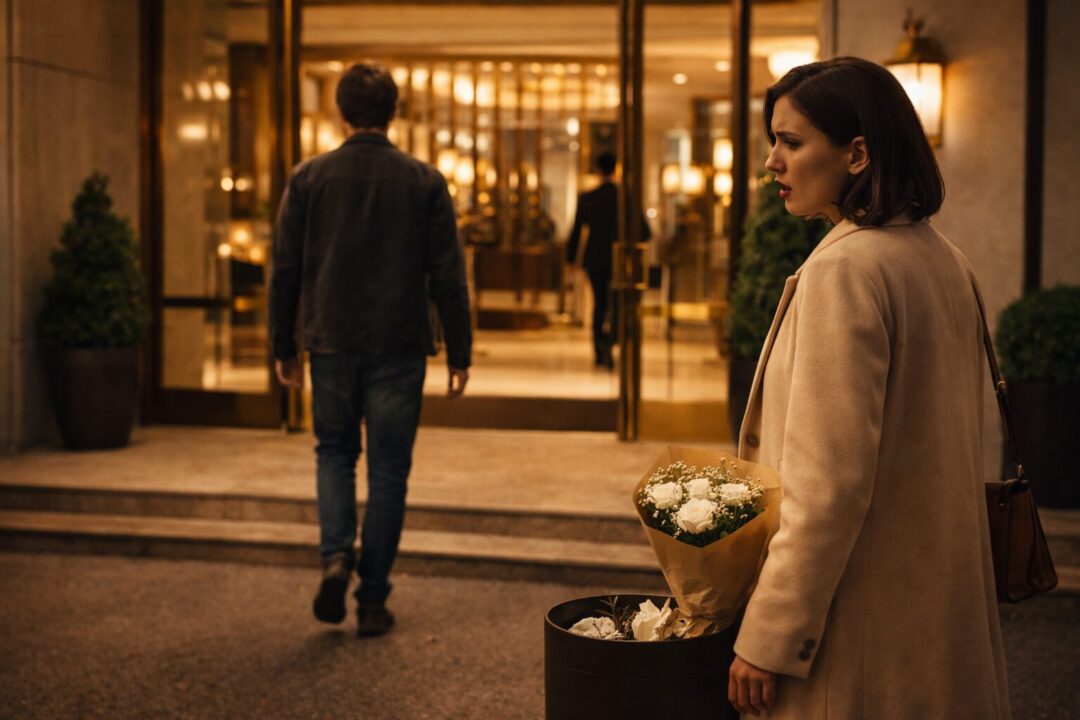
The Flowers in the Trash
The Flowers in the Trash
Part I — The Kind of Woman Who Noticed Shoes
By the time Nolan stepped out of the car two blocks away and started walking toward the Langford Hotel, he already knew he should have left the flowers behind.
Not because they were too much.
Because in that part of the city, anything sincere looked cheap.
The hotel rose above the street in polished glass and pale stone, its entrance bathed in gold light even before dusk had fully settled. Valets moved with choreographed precision. Guests in dark suits and sleek dresses drifted beneath the awning as if they had been born knowing how to belong there. Everything about the place announced money without ever naming it.
Nolan looked like he had taken a wrong turn on the way to somewhere else.
His dark jacket was clean but worn at the cuffs. His boots were practical, not polished. The bouquet in his hand was simple, wrapped in brown paper instead of glossy ribbon. Nothing about him matched the shine of the driveway or the people gliding through it.
He had dressed that way on purpose.
Not to test anyone. Not at first.
He had spent most of his adult life learning how quickly people made decisions when they thought no one important was watching. When he wore a tailored coat and stepped out of the right car, strangers smiled before he spoke. When he dressed like himself—like the boy who had once helped his father repair leaking pipes and unload supply trucks—those same strangers looked through him.
He hated that he understood the pattern so well.
And yet he had still brought the flowers.
Because of Elise.
Or maybe because of who he had once thought Elise might be.
He had met her six weeks earlier in the hotel lobby café, back when the Langford’s sale was still under layers of confidentiality and legal review. Nolan had been meeting with consultants, architects, and attorneys under assumed routines, keeping his role quiet until the acquisition was final. Elise had been there almost every afternoon, usually at the same marble table near the tall windows, always dressed as if the world might photograph her at any second.
At first, what drew him to her was not her beauty, though everyone noticed that first. It was the way she seemed to study every room before relaxing inside it. She looked like someone who had built herself carefully and feared one wrong detail could undo the whole construction.
They had spoken only a handful of times. Small things. Coffee recommendations. A joke about the hotel pianist playing sad songs too early in the day. Once, a brief conversation about white lilies when she paused near the florist display in the lobby and said they had been her mother’s favorite.
He had remembered that.
He remembered everything people said when they thought no one important was listening.
That morning, Nolan had signed the final pre-transfer documents in a private office upstairs. By tonight, the Langford would effectively be his. The public announcement would come later. The press strategy was already drafted. His attorney had suggested he arrive through a private garage entrance for the evening review.
Instead, Nolan parked off-site, bought white lilies from a small florist, and walked to the front.
He told himself it was because he wanted one ordinary moment before everything changed.
The truth was harder to admit.
He wanted to know whether Elise smiled at the man or the status.
When he spotted her outside the hotel entrance, he almost turned around.
She stood near the brass-framed revolving doors in a fitted cream coat, one hand resting lightly on a designer handbag, talking to another woman who left moments later in a black sedan. Alone now, Elise checked her reflection in the dark screen of her phone, then looked toward the driveway with the poised impatience of someone waiting to be seen.
Nolan crossed the final stretch of pavement with the bouquet in his hand.
Her expression changed the instant she recognized him.
Not surprise.
Alarm.
It was slight at first. A tightening around the mouth. A glance toward the valet stand. A quick survey of who might be watching.
“Hi,” Nolan said softly, holding out the flowers. “These are for you.”
For half a second, Elise just stared at the bouquet.
Then her eyes flicked to his jacket, his boots, the paper wrapping, and whatever softness had once existed between them disappeared behind something colder and sharper.
“You came here like this?” she asked.
Nolan felt the first crack open in his chest. “I thought you might like them.”
A couple passing under the awning slowed almost imperceptibly. One of the valets looked away with professional discipline, which somehow made the moment feel even more exposed.
Elise stepped closer, lowering her voice only enough to make it intimate, not kind.
“Not here,” she said. “Look at yourself.”
He should have left. He knew that even then.
But there are humiliations the heart refuses to understand until they happen completely.
“I remembered what you said,” he replied. “About lilies.”
That only seemed to make it worse.
Elise’s face hardened with a kind of polished panic. She looked around once more, saw the attention gathering at the edges of the scene, and chose cruelty because cruelty was faster than embarrassment.
“This is embarrassing,” she said.
Then she took the bouquet from his hand and dropped it into the metal trash can by the entrance.
Not thrown.
Not smashed.
Just dismissed.
As if that were somehow cleaner.
For a moment, Nolan heard nothing. Not the city, not the engines, not the doors opening and closing behind him. He only saw the pale heads of the lilies resting on coffee cups and crumpled napkins, their white petals absurdly bright against the garbage.
Elise let out a small breath, as though she had restored order.
“Please stop,” she said.
Nolan looked at her and realized something had ended before it had ever properly begun.
He was not angry yet.
That would come later.
What he felt first was clarity.
Part II — The Turn of the Driveway
The black SUV rolled up so smoothly that at first it felt like part of the hotel’s choreography.
Its headlights swept across the curb. A valet straightened. The doorman shifted his stance. Across the driveway, two staff members who had not seemed to notice Nolan a moment ago suddenly became alert in the subtle, disciplined way trained hospitality workers did when a person of consequence arrived.
Elise noticed it too.
Her posture changed before she even knew why.
The passenger-side door opened, and Garrett Voss stepped out with a leather folder tucked beneath one arm. Garrett was in his early forties, all exact lines and quiet authority, the kind of man who could stand still and still look busy. He scanned the entrance once, found Nolan immediately, and walked toward him without hesitation.
He did not glance at Elise.
That was the first real blow.
“Sir,” Garrett said, stopping in front of Nolan. “The transfer packet is ready. We just need your signature on the final ownership pages.”
The silence that followed was not empty. It was crowded.
Nolan could feel the eyes around them now. The valet nearest the curb. The older couple pausing just past the doors. A concierge visible through the lobby glass. Everyone understood something important had entered the scene, even if only one person still did not know what it meant.
Elise stared at Garrett, then at Nolan, then at the leather folder.
“I’m sorry,” she said, too quickly. “What?”
Garrett opened the folder with efficient calm. Inside were the final documents for the Langford transfer: signature tabs, embossed pages, a closing memo secured beneath a silver clip. There was nothing theatrical about them, which made them feel more real.
Nolan took the pen Garrett offered.
He did not rush.
He signed where he needed to sign, one page after another, while the hotel behind Elise quietly reoriented itself around the truth she had missed.
A valet hurried forward and stopped short, waiting for instruction. The doorman opened one side of the entrance without being asked. Through the glass, Nolan caught a glimpse of the general manager crossing the lobby with unmistakable purpose.
Elise’s face emptied, then refilled with disbelief.
“This is yours?” she whispered.
Nolan handed the pen back to Garrett. “By tonight, yes.”
The words were simple. They did not need decoration.
Elise looked toward the trash can as if only now remembering what she had done. The lilies were still there, their stems angled awkwardly against the rim. A flush crept up her neck.
“Nolan,” she said, and for the first time all evening, his name sounded fragile in her mouth. “I didn’t know.”
No, he thought. That was the point.
Garrett closed the folder. “Your review team is waiting upstairs.”
Nolan nodded, but his eyes remained on Elise.
This was the part movies often got wrong. They imagined revenge as noise—speech, accusation, dramatic satisfaction. But real reversals were quieter. The deepest shame came not from being punished, but from suddenly seeing yourself clearly.
Elise stepped closer, lowering her voice again, though now there was no control in it. Only urgency.
“Can we talk?” she asked. “Please. I think this got—”
“We already did,” Nolan said.
He meant the flowers. The look on her face. The trash can. The speed with which she had chosen humiliation over uncertainty.
He meant every invisible conversation people revealed when they thought a person had no power to answer back.
Elise swallowed hard. “That’s not fair.”
He almost smiled at that, not because it was funny, but because fairness had arrived too late to help either of them.
“For a second,” Nolan said quietly, “I thought you might be different.”
He let the sentence stop there.
That was more mercy than she had given him.
Then he turned toward the entrance.
The doorman pulled the door wider. Garrett stepped aside. The staff held themselves with new precision, not obsequious, just alert, the atmosphere of the hotel subtly reshaping around the man who had walked up moments earlier looking like an inconvenience.
Behind him, Elise said his name once more.
He did not stop.
Part III — What People Reveal
The private review upstairs lasted less than an hour.
Architectural revisions. Event strategy. Staffing notes. Brand repositioning. A list of suites scheduled for redesign. Garrett walked him through the final sequence for the announcement, while the general manager explained which department heads had already signed updated confidentiality agreements.
Nolan responded where needed. Approved the revised launch dinner. Deferred one press request. Moved a lobby renovation timeline. All the while, part of his mind remained downstairs by the entrance, fixed on a bouquet in a trash can and a woman discovering too late what kind of test she had actually failed.
He hated that she still occupied space in his thoughts.
By the time the meeting ended, the city outside had gone fully dark. From the upper windows, the boulevard looked less like a street than a ribbon of moving light. Nolan stood for a moment in silence after everyone else filed out. Garrett lingered by the door.
“You want me to have someone retrieve the flowers?” Garrett asked.
Nolan looked over. “You saw that.”
“I saw enough.”
After a pause, Nolan said, “No. Leave them.”
Garrett gave a small nod, understanding more than the words explained. “The car’s ready when you are.”
But Nolan did not leave immediately.
Instead, he took the service elevator down alone and cut through a side corridor to the mezzanine overlooking the lobby. From there he could see the front entrance without being seen. He was not proud of staying. He told himself he only wanted a final confirmation that he had read the moment correctly.
Elise was still there.
Not at the exact spot. A little farther off now, near one of the stone planters by the drive. Her coat was wrapped tighter around her body, and the composed stillness she had worn so naturally earlier had collapsed into something smaller. She checked her phone, then lowered it. Looked toward the street. Looked toward the entrance. Waited.
For him, maybe.
Or for the version of the evening she was trying to rewrite in her mind.
A bellman passed the trash can, paused, and carefully lifted the lilies out. For a brief second, Nolan thought the man meant to save them. Instead, he frowned at the crushed wrapping, hesitated, and placed them in a service bin just beyond the awning.
Something about that simple, practical gesture tightened Nolan’s throat more than Elise’s cruelty had.
Because it made the whole thing ordinary.
Flowers thrown away. Staff cleaning up. Night continuing.
He had spent years building a life so large it could absorb moments like this without shaking. Yet there he was, standing alone above a lobby, feeling like a man who had been foolish enough to hope.
Garrett joined him quietly after a minute. “You don’t owe anyone an explanation,” he said.
“I know.”
“She misread you.”
Nolan let out a short breath. “No. She read something real. Just not the whole thing.”
Garrett did not answer. He had worked with Nolan long enough to know the difference between a statement and a wound.
From below, Elise finally moved. She crossed to the curb as another car approached, then stopped when she saw it was not his. Her shoulders sagged. For the first time since he had known her, she looked young in a way that had nothing to do with age and everything to do with disappointment.
Not graceful disappointment.
Raw disappointment.
Nolan could have gone down then. He could have listened to the apology he already knew by heart before hearing it. I was surprised. I was overwhelmed. I didn’t realize. That isn’t who I am.
But sometimes who a person is arrives fastest when they are afraid to be seen with the wrong someone.
And sometimes the most honest thing love—or whatever fragile prelude had existed between them—can do is end before it mutates into something meaner.
He turned away from the mezzanine.
When he finally left through the private garage, the city felt colder than it had earlier, though the temperature had hardly changed. He sat in the back of the car and watched the hotel’s upper floors slip past the window.
“Home?” the driver asked.
Nolan looked back once, toward the glow of the Langford entrance.
“Not yet,” he said.
Part IV — The Shape of After
A week later, the Langford Hotel announcement dominated local business pages.
New ownership. Planned restoration. Leadership transition. A strategic repositioning that would preserve the hotel’s historic character while expanding its cultural footprint. Nolan’s name appeared in print more times in two days than Elise had probably heard it spoken in six weeks.
If she was surprised, she had to live with it privately.
He never contacted her.
She tried once.
The message came late on a Thursday evening, brief enough to pretend dignity and personal enough to betray it.
I owe you an apology. A real one. If you’ll let me.
Nolan read it in his kitchen with the city lit beyond the windows and the low hum of the refrigerator the only sound in the room. He did not answer immediately. He set the phone down, poured himself water, and stood at the counter remembering the lilies.
Not the public insult.
Not Garrett, or the folder, or the shift in the staff’s attention.
Just the flowers themselves. Carefully chosen. Briefly held. Quietly discarded.
At last he typed a reply.
You don’t owe me an apology for not knowing who I was.
Only for how you treated who you thought I was.
He stared at the message before sending it, not because he doubted it, but because it closed a door he had once walked toward willingly.
She did not answer after that.
Weeks passed. The work deepened. Demolition schedules, design approvals, vendor contracts, investor meetings. The Langford slowly became his in ways paperwork could never accomplish alone. He learned which corridor lights hummed at night, which banquet captain could calm a room in seconds, which baker started every shift at four-thirty without fail. Ownership, he discovered, was less glamorous than people imagined. It was attention. Repetition. Stewardship. Showing up for details no one else would notice.
One morning, he passed the lobby florist while they arranged fresh white lilies in a low stone bowl near the reception desk.
He stopped.
The florist, an older woman named Marina, looked up with a knowing softness that made him suspect the entire staff had assembled its own version of the story.
“Too much?” she asked, adjusting a stem.
Nolan studied the arrangement. “No,” he said after a moment. “They’re right.”
And they were.
Not because they reminded him of Elise.
Because they no longer belonged to her.
They had returned to being flowers. Clean, bright, unashamed of the hands that carried them.
That evening, as guests drifted through the lobby and soft music unspooled from the piano near the lounge, Nolan paused by the entrance where it had happened. The trash can was gone now, replaced by a tall planter filled with winter greenery and white blossoms. Most people would never know why he had ordered the change.
They would only see beauty where there had once been a small, forgettable place for discarded things.
He stood there for a while, watching the doors revolve open and closed.
People arrived dressed for celebration, for negotiation, for seduction, for performance. Some wore wealth easily. Some borrowed it for the night. Some looked ordinary until the room bent around them. The world kept making its fast decisions. That would never stop.
But Nolan had learned something useful from the flowers in the trash.
Not everyone needed to be corrected.
Some people only needed to be believed the first time they showed you who they were.
Outside, headlights washed over the glass. Inside, the lilies at the front desk held their shape in the warm light, untouched and upright.
Nolan glanced at them once, then walked deeper into the hotel he had chosen to build—not around status, but around the quieter thing that status could never imitate.
Dignity.