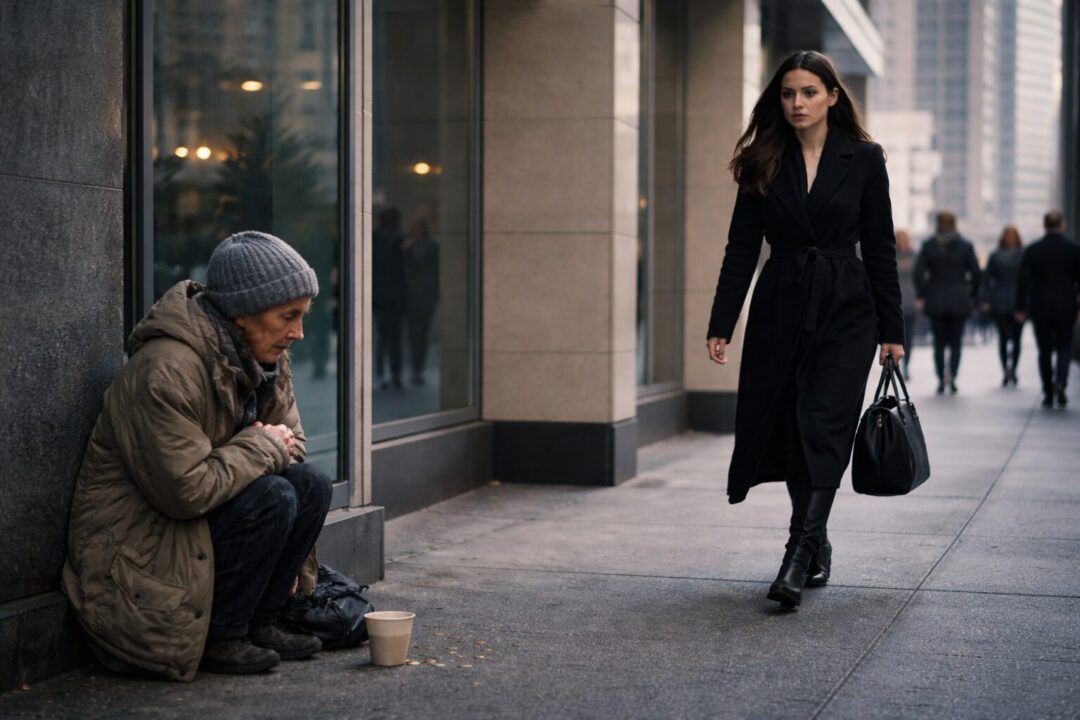
The Sound of Coins on Stone
The Sound of Coins on Stone
Part I — The Moment Everyone Misread
The cup flew farther than Lena meant it to.
It skidded across the polished stone outside the office tower, struck the edge of a planter, and tipped onto its side with a dry, papery crack. A scatter of coins rang out across the sidewalk—small metal sounds swallowed by the larger noise of downtown morning traffic, then somehow made louder by the silence that followed.
People turned.
Some slowed. Some stopped completely.
An old woman sitting against the glass wall stiffened as if she had been struck herself. Her shoulders drew up toward her ears, and her trembling hands lifted halfway off her lap, not quite reaching for the coins, not quite protecting herself either. She had the look of someone who had learned that the wrong movement could make a bad moment worse.
Lena felt every eye around her settle into judgment.
Good, she thought wildly. Let them look.
The woman on the ground stared at her with a confusion so raw it cut deeper than any accusation from the crowd could have. Her knit cap had slipped back a little, revealing thin silver hair flattened at the sides. Her coat was two winters older than it could afford to be, the cuffs soft with wear, the collar darkened from years of use. She looked frail in the way city people often pretended not to notice—small, folded in on herself, as if she were always trying to take up less room than hunger and cold had already taken from her.
Lena dropped into a crouch before anyone could step in or speak.
“Don’t move,” she said.
The woman flinched at the firmness in her voice.
Lena reached for the nearest quarter.
A man in a navy overcoat muttered something under his breath as he passed. A younger woman paused with her phone half-raised, as if deciding whether outrage was worth recording. The revolving doors behind Lena spun with a steady hiss, releasing one wave of polished shoes after another onto the sidewalk.
The old woman swallowed. “My cup…”
“I know.”
Lena picked up another coin. Then another. Her fingertips were already cold from the stone, and she could feel her pulse hammering against the inside of her wrist. She had rehearsed this in her mind three times on the walk from the garage, and in every version she had looked calmer than she felt now.
The old woman’s gaze moved from Lena’s face to the coins in her hand and back again. Fear sat there first. Then shame. And under both, something quieter and worse: resignation.
As if this made sense to her.
As if cruelty from strangers fit the shape of the morning better than kindness ever could.
That was the thing Lena had not been prepared for.
Not the eyes on her. Not the judgment. Not even the small, vicious thrill she could feel running through the crowd at the sight of a well-dressed woman making an old homeless stranger smaller.
It was the fact that the woman accepted the humiliation so quickly.
Lena gathered the last coin and closed her hand around all of them. For a second she remained crouched there, looking at the woman properly for the first time—not as part of the street, not as a blur beside the tower, but as a person she had been trying not to recognize for weeks.
The woman’s face was finer than Lena remembered and much older than it should have been. Her cheeks had hollowed. Her skin had the pale, wind-burned color of someone who spent too much time outdoors and too little time being warm. But there was something in the line of her mouth, something in the shape of her eyes, that refused to let Lena keep pretending.
The woman whispered, “Why did you do that?”
Lena opened her fist.
Then she placed every coin gently into the woman’s shaking palm.
“Because you need more than this,” she said.
The old woman frowned, not understanding.
Neither did anyone else.
Lena set the coins there, one careful press of metal against skin, and then reached into her handbag.
The first thing she pulled out was cash—folded tightly, much more than anyone watching would expect. The second was a neat stack of cards held together with a plain black binder clip. A prepaid hotel card. A card for a neighborhood pharmacy. A handwritten note with an address and a time. The business card of a social worker Lena had called the night before and nearly begged for help from.
She laid them all into the old woman’s hand until the trembling fingers could barely hold them.
The woman stared down.
One breath passed. Then another.
The whole street seemed to tilt with her understanding.
Part II — Before the Coins Fell
For three weeks, Lena had been seeing the woman outside Halcyon Tower every morning and telling herself it was an accident.
The city had thousands of people who needed help. Thousands. Her own block alone had become a map of familiar suffering: the man with the purple sleeping bag by the subway vent; the veteran who stood outside the grocery store with military patches sewn onto a coat that no longer fit; the couple who argued in whispers under the scaffolding near Seventh. Lena could not stop for all of them. She could not save everyone. She knew the script people used to keep living with themselves in cities like this one because she had used it herself.
You can’t carry every story.
You don’t know what’s safe.
Someone else will help.
There are systems for this.
But she had kept noticing the woman outside her office because something about her was wrong in a way Lena could not explain at first. Not wrong as in suspicious. Wrong as in displaced.
She sat too straight, even when exhausted. She folded and refolded a napkin in her lap as though she had once been embarrassed by visible disorder. She thanked people who ignored her. Once, Lena had watched her smooth the edge of an old receipt against her knee with the absent precision of someone who had spent years handling papers that mattered.
And then one rainy Tuesday, the woman had coughed into her sleeve and turned her face toward the streetlight, and Lena had seen her clearly.
Not known her. Not exactly.
But remembered.
A room with fluorescent lights. Her mother in a hospital bed. A volunteer in a soft cardigan helping families fill out forms no one could think clearly enough to read. A woman with tired eyes and silver-threaded hair saying, “Slow down. One line at a time. I’ve got you.”
Lena had been twenty-three then, wearing the same black pants for the third straight day and trying not to fall apart in front of strangers. Her mother had been dying by inches, and the woman with the gentle voice had sat beside her in the family services office long after her shift was supposed to end.
Her name—Lena had not remembered it at first.
Only the feeling.
Being steadied.
Being treated like a person when fear had turned everything else into noise.
The next morning Lena had stopped across the street and watched the old woman for almost ten minutes before going inside. She had thought about approaching her then. She had thought about saying, Were you at St. Matthew’s Hospital eight years ago? Did you help people in the oncology wing? Do you remember my mother?
Instead she had gone upstairs to the thirty-ninth floor and spent the day hating herself.
By Friday she remembered the name.
Marlene.
It came back while she was in a meeting, sitting under recessed lighting with a glass wall behind her and a quarterly projection deck in front of her. One of the partners was talking about distressed assets. Someone else laughed at something dry and expensive. And in the middle of that room, Lena suddenly knew with awful certainty that the woman downstairs had once held her hand when she thought she might lose her mind beside her mother’s bed.
After work she went back outside.
Marlene was gone.
The next week Lena started leaving the office earlier and arriving later, hoping their paths would cross at a moment that felt less public, less impossible. But every time she saw the old woman, something held her back.
Pride, maybe. Or guilt.
It was hard to walk up to the person who had once offered you dignity and admit you had needed a month to return even a fraction of it.
So Lena did what people like her often did when they were afraid of feeling too much: she turned emotion into logistics.
She made calls.
She found a women’s shelter with a temporary bed available, though only if Marlene could arrive before noon. She tracked down a mobile benefits advocate. She bought gift cards that could be used immediately, no ID needed. She withdrew cash because help that required paperwork was sometimes help delayed long enough to become useless.
By the time she had arranged everything, the plan looked absurdly clean on paper and impossible in real life.
Walk up. Introduce yourself. Offer help.
But when she imagined it, she saw only one outcome: Marlene refusing out of fear, pride, confusion, or the simple exhaustion of people who had been promised help before.
So Lena built a harder opening.
Something impossible to ignore.
Something that would interrupt the ritual of receiving coins without changing anything.
That was how she ended up standing outside Halcyon Tower on a cold Wednesday morning, waiting with a hotel card in her purse and too much adrenaline in her blood, ready to look like the worst kind of woman for five unbearable seconds if that was what it took to break the script of the day.
Now, crouched on the stone, looking into Marlene’s stunned face, she wondered whether she had been crueler than she meant to be.
Maybe there had been no good way to do this.
Maybe every rescue arrived carrying some injury of pride inside it.
“Look at me,” Lena said quietly.
Marlene did.
Recognition did not come all at once. It moved slowly through the older woman’s features, like warmth struggling back into cold hands.
Lena saw the exact moment memory reached her.
Part III — The Hand She Had Once Held
“Lena?” Marlene whispered.
The sound of her own name in that worn, uncertain voice nearly undid her.
“Yes.”
For a second the city fell away.
Not literally, of course. Traffic still rolled at the curb. Someone’s coffee lid snapped into place nearby. The revolving doors kept turning. But the spectacle of the sidewalk dissolved into something narrower and older—just two women caught in the thin bridge between what had once been given and what was now being returned.
Marlene looked from Lena’s face to the money and cards in her own hand.
“I didn’t know if it was you,” Lena said. “Not at first.”
Marlene let out a breath that broke in the middle. “I didn’t know if I wanted it to be.”
There was no bitterness in it. Only exhaustion. Only the terrible honesty of someone who had been seen at the wrong time in life.
Lena nodded. “I know.”
Around them, the small audience was beginning to lose interest now that the scene had turned from cruelty into something harder to categorize. Outrage was easy. Compassion demanded more patience than most strangers could spare before work.
A few people drifted on.
A few lingered, curious.
Lena took the paper cup from where it had rolled against the planter. It was bent at the rim and damp at the bottom. She held it for a moment, looking at the little vessel that had reduced survival to coins and pity and whatever fragment of conscience office workers had left before nine in the morning.
Then she turned it upside down on the pavement beside Marlene.
Empty.
No ceremony. No speech. Just a quiet refusal.
Marlene stared at it as if the gesture embarrassed her and freed her at the same time.
“There’s a room paid for through Friday,” Lena said, keeping her voice low. “Two blocks over. The card’s on top. The woman whose number is on that note can meet you there at eleven-thirty. She can help with ID replacement, benefits, medical intake. I already spoke to her.”
Marlene’s fingers tightened around the stack.
“You did all that?”
Lena almost laughed, though there was no humor in it. “You sat with me for six hours while my mother was dying, and you kept pretending to organize forms because you knew I needed someone beside me more than I needed paperwork.”
Marlene blinked hard.
“I never forgot that,” Lena said. “I just… I didn’t recognize you right away. And then I did. And then I didn’t know how to come over here without making it worse.”
Marlene looked down.
The traffic light changed. A wash of movement crossed the intersection. Somewhere behind them, a delivery truck hissed at the curb.
“When the hospital cut staff,” Marlene said after a while, “I thought I’d land somewhere else quickly. Then my sister got sick. Then rent went up. Then I was staying with people until I wasn’t.” She swallowed. “After a while the story gets shorter when you tell it.”
Lena knew what she meant. Long suffering turned into blunt summary because no one really wanted the whole chain of losses. They wanted a clean reason. A neat failure. Something they could hold separate from themselves.
She sat back on her heels and said the only truthful thing she had left.
“I’m sorry it took me this long.”
Marlene looked up at her again. There were tears in her eyes now, but there was something steadier too—some private resistance to being pitied.
“You were kind to your mother,” she said. “I remember that.”
The words hit Lena harder than thanks would have.
Kind. As if that were what had mattered. As if fear and panic and helplessness had not been the dominant facts of those hospital nights. As if Marlene had seen something decent in her when Lena herself had felt nothing but broken.
Lena glanced at the people still moving around them, the expensive coats, the badges clipped to belts, the glazed concentration of commuters already half inside their workday. For years this sidewalk had been a place she crossed without absorbing. A corridor between the street and the elevator, between one obligation and another.
Now it looked indecently bright.
Marlene’s hands were still shaking, so Lena reached out slowly and folded the older woman’s fingers around the cards and cash, one by one, until the grip held.
“This is yours,” she said. “All of it.”
“I can’t pay you back.”
Lena met her eyes. “That isn’t what this is.”
Marlene’s mouth trembled.
Then, to Lena’s surprise, the older woman laughed once—small, broken, almost disbelieving. “You always were stubborn.”
“I learned from difficult women.”
That earned a fuller breath, something close to a smile.
It should have been enough. The room key. The money. The contact card. A workable path into the next forty-eight hours.
But Lena knew help often failed in the final step. The offer could still collapse under confusion, fear, or the simple loneliness of having to walk into a new place alone.
So she stood and held out her hand.
“I’ll walk with you.”
Part IV — The Distance Between Two Blocks
The hotel was only two blocks away, but they crossed it slowly.
Marlene moved carefully, like someone unused to standing without planning each shift of weight. Lena matched her pace. The black handbag thudded against her hip with every step, absurdly corporate beside Marlene’s frayed sleeve looped through Lena’s arm.
No one stared for long. That was one mercy of the city: it normalized every pairing if you kept moving with enough purpose.
At the corner, Marlene paused before the light changed.
“I hated that cup,” she said.
Lena turned to her.
“I needed it,” Marlene added, “but I hated it.”
The truth of that settled between them with unusual tenderness. Need and shame were so often forced to share a room.
“I know,” Lena said.
When they reached the hotel, the clerk behind the desk looked first at Lena, then at Marlene, then at the prepaid card. His expression shifted through three recognizable phases—confusion, caution, then performative professionalism. Lena waited through all of them without softening.
“He has the reservation,” she said to Marlene, not taking her eyes off the clerk. “It’s under your name.”
The name landed with more force than any amount of money. Marlene straightened by instinct.
The clerk typed. Nodded. Printed.
A keycard slid across the counter.
Marlene took it like an object made of glass.
Upstairs, the room was modest: narrow bed, patterned curtains, heating unit clattering beneath the window, bathroom the size of a closet. It was not much by the standards of the building Lena worked in or the apartment Lena lived in. But when Marlene stepped inside and set her hand on the bedspread, her face changed in a way Lena would remember for years.
Privacy had returned to it.
Safety had returned to it.
A door that locked. A place to leave things. A sink. Two clean towels folded into thirds. The smallest architecture of dignity could still feel miraculous when someone had gone without it long enough.
Marlene sat on the edge of the bed without taking off her coat.
“I don’t know what to say,” she murmured.
Lena leaned against the dresser, suddenly exhausted. “You don’t have to say anything.”
Marlene looked at her for a long moment. “That day at the hospital,” she said, “you kept apologizing because you thought you were asking too many questions.”
Lena smiled faintly. “That sounds like me.”
“You weren’t apologizing for questions,” Marlene said. “You were apologizing because you thought being scared was inconvenient for other people.”
Lena looked down.
It was humiliating, being known by someone in one of your worst hours. It was also, strangely, a relief.
Marlene went on, “You were kinder than you gave yourself credit for then too.”
Lena felt something loosen in her chest that had been tight for longer than she realized.
Maybe that was part of the reason she had not approached sooner. Helping Marlene was not only about returning a debt. It was also about stepping back into a memory of herself she had abandoned—the younger woman in a hospital corridor who had needed grace and received it.
At eleven twenty-five, Lena walked Marlene downstairs to meet the outreach worker. A broad-shouldered woman named Patrice arrived with a canvas tote, a clipboard, and the brisk warmth of someone who had learned how to be useful without being patronizing. She greeted Marlene by name. She explained the next steps in plain language. She asked practical questions and waited for the answers.
Lena watched Marlene’s posture change almost by the minute—not relaxed, not yet, but less braced.
At last Patrice turned to Lena and said, “We’ve got it from here.”
It was what Lena wanted to hear. It was also harder than she expected.
Marlene stood in the lobby holding the keycard in one hand and the note in the other. “Will I see you again?”
Lena could have offered something vague. A promise softened by uncertainty. But the morning had already stripped them both of polite dishonesty.
“Yes,” she said. “If you want to.”
Marlene nodded once. “I do.”
Then Lena did something she had not planned and Marlene had not asked for.
She hugged her.
Not carefully. Not distantly. A real embrace, warm and human and imperfect, the kind that acknowledged how close life could bring strangers and how cruelly it could scatter them afterward.
For one brief second Marlene held on just as tightly.
Part V — What Remains After Kindness
That evening, Lena walked out of Halcyon Tower and looked automatically toward the place by the glass wall where Marlene had been sitting for weeks.
The space was empty.
Only a dark scuff on the stone near the planter remained, and for a wild instant she thought of the sound coins had made when they hit the pavement that morning—a small sharp music, humiliating and necessary, the sound of one life interrupting another.
She stood there longer than she meant to, letting people stream around her.
The city had not changed. It was still indifferent, still expensive, still full of people hurrying past needs they did not know how to touch. By tomorrow there would be another person in that stretch of sidewalk, another story flattened into a cup and a pair of cold hands.
Lena knew one act could not redeem any of that.
But it had changed something.
Not only for Marlene, though Lena hoped fiercely that it had. The shelter placement might hold. The documents might be replaced. The next steps might gather into something stable. There was no guarantee, and she refused the cheap comfort of pretending otherwise.
What had changed, unmistakably, was this: the woman who had once sat beside her in a hospital and steadied her through grief had not vanished into anonymity after all. She had fallen, yes. Been ignored, yes. Been reduced in the eyes of others, certainly. But she had remained herself long enough to be found again.
And Lena, for all her polished armor and expensive routines, had remained the girl who still remembered the mercy of a hand placed over hers when she was afraid.
Some debts were not meant to be repaid cleanly.
They were meant to be carried until life gave you one hard, imperfect chance to answer them with your own body, your own voice, your own willingness to be misunderstood for a moment in service of something larger than appearances.
Two days later, Marlene texted from a borrowed phone Patrice had helped her get.
Room’s warm. Slept twelve hours. Meeting about housing Monday. Thank you for seeing me.
Lena read the message three times.
Then she looked out the window of her office at the city below—silver, restless, glittering with all the usual ambition—and thought of the old paper cup lying upside down on the stone.
Empty at last.
And for the first time in years, that felt less like an image of loss than a beginning.