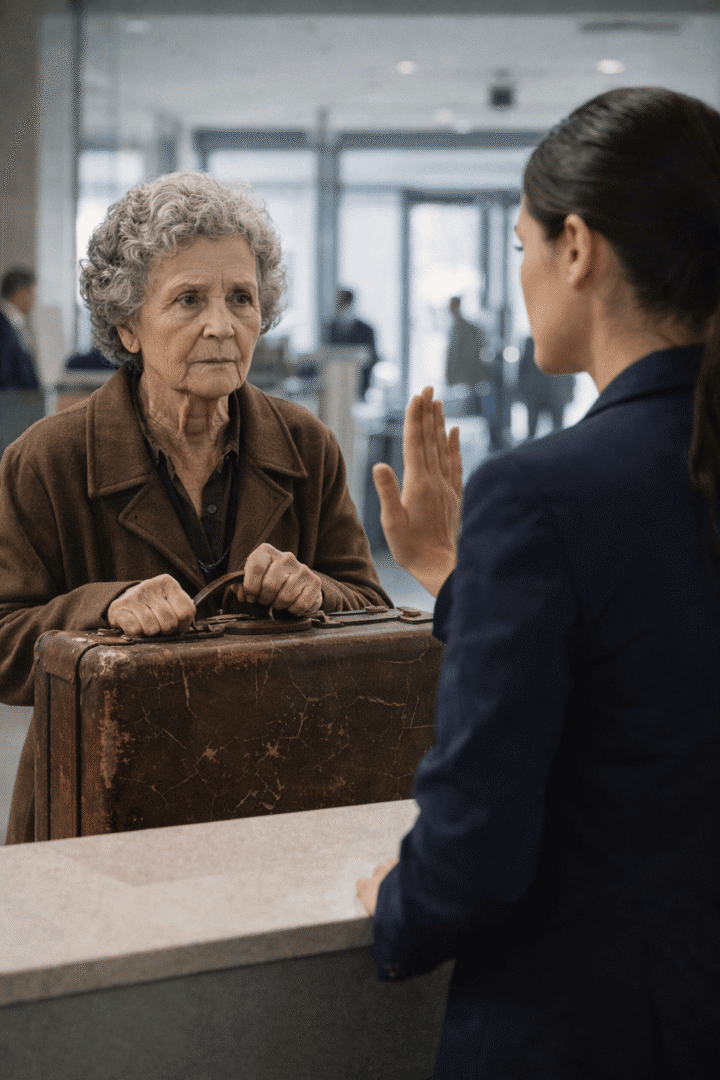
The Woman With the Cracked Suitcase
The Woman With the Cracked Suitcase
Part I — The Bag No One Wanted to Touch
The first thing people noticed was the suitcase.
Not the woman holding it. Not the way her shoulders shook slightly beneath her faded brown coat. Not the careful way she stood just inside the bank doors, as though she understood that one wrong move might get her thrown back out into the cold. It was the suitcase that drew every eye in the lobby—a cracked, weathered thing with dulled brass corners and a clasp that looked as if it had survived three different decades and none of them kindly.
In a place built from polished marble, brushed steel, and clean glass, it looked almost offensive.
The woman holding it looked no better to the people who mattered in that room.
She was small and thin, with silver-gray curls that had come loose around her temples and oversized glasses that magnified the tiredness in her eyes. Her shoes were practical and old. Her floral dress showed beneath the hem of her coat like something bought years ago and worn until softness had replaced shape. She might have been seventy. Maybe older. The kind of woman most people glanced past without meaning to be cruel.
Or perhaps with meaning to.
At the reception counter, Lenora Vance lifted her chin and watched the woman approach with open impatience.
Lenora had worked at Bellweather Trust for four years, long enough to perfect the clipped tone that told people she was in charge without ever raising her voice. She was good at reading a room, good at deciding who belonged and who did not, good at keeping the bank’s high-end clientele insulated from disruptions. On busy afternoons, she wore that confidence like part of her tailored navy blazer.
Lunch-hour customers stood in two neat lines. Phones glowed in manicured hands. A man in a charcoal suit checked his watch. Somewhere deeper inside the branch, a printer whirred. Everything about the place said order, money, control.
Then the old woman dragged that broken suitcase across the tile and said, in a soft but steady voice, “I need to make a deposit.”
Lenora’s eyes flicked over the woman’s coat, her hands, the suitcase, then back to her face.
“A deposit?” she repeated.
The woman nodded.
There was nothing dramatic in her expression. That, somehow, made it worse. She did not look wild or confused. She looked certain. Almost careful.
Lenora pressed her lips together. “Ma’am, oversized baggage isn’t permitted at the front counter.”
The woman tightened her fingers around the handle. “It won’t take long.”
By then, Darnell Price had already noticed the exchange.
Darnell stood near the entrance in a dark security uniform, broad-shouldered and expressionless in the way guards learned to be. He was in his mid-forties, clean-shaven except for a trimmed mustache, with a compact earpiece tucked against one ear. He had the posture of a man used to stepping between uncertainty and order. Usually, that posture reassured people.
Now it made the bank feel smaller.
Lenora gave him the slightest glance. Darnell moved at once.
“Ma’am,” he said, coming to stand beside the woman, “I’ll need you to step back from the desk.”
The woman looked from him to Lenora. “I’m here for business.”
“I’m sure you are,” Lenora said, though the words held no belief. “But you can’t bring that bag up here.”
A few customers turned. Not many. Just enough.
That was the beginning of the humiliation—not the refusal itself, but the fact that strangers had started watching.
The woman’s name, though no one there knew it yet, was Miriam Holloway. She had spent most of her life in rooms where people looked at her and saw exactly what they expected to see. A widow in a discount coat. A grandmother with tired shoes. Someone who had learned to wait patiently while younger people decided whether she deserved a moment of their attention.
She had also learned that silence was sometimes the last shape dignity could take.
Still, there were limits.
“I said,” Miriam answered quietly, “I need to make a deposit.”
Darnell reached for the suitcase handle.
It was not a violent gesture. Not quite. But it was presumptuous enough to change the air in the room.
Miriam pulled the suitcase back so fast the wheels skipped against the tile.
Lenora’s tone sharpened. “Take that bag outside.”
The words landed hard enough that even the man in the charcoal suit looked up.
For a moment, no one moved. The whole lobby seemed to gather itself around that one sentence.
Miriam stared at Lenora through the thick lenses of her glasses. Her face didn’t harden. She didn’t flare with outrage. She only seemed to grow still in some deeper, sadder way.
“I came to make a deposit,” she said again.
Lenora folded her arms. “Then you can do it properly. You’re holding up the line.”
Darnell shifted closer. “Ma’am. Outside. Right now.”
What made the moment ugly was not volume. No one shouted. No one caused a scene.
But the cruelty of it was worse for being efficient.
The customers in line pretended not to stare while staring anyway. One young woman near the brochures bit her lip as if she wanted to say something and then decided not to. A man in a camel coat took half a step aside, putting distance between himself and the old woman as though embarrassment might be contagious.
Miriam saw all of it.
She saw the bank employee who had already judged her. She saw the guard who had mistaken obedience for safety. She saw the silent witnesses who would remember the scene only as some disruption in the middle of their afternoon.
Then she bent, took both hands on the cracked leather handle, and lifted the suitcase herself.
“All right,” she said.
Darnell opened the door.
She walked out alone.
Part II — The Weight of Silence
Outside, the wind came sharply around the corner of the building.
Bellweather Trust sat on a downtown block lined with polished storefront windows and black iron planters no one really noticed. Cars rolled past in thin, expensive murmurs. Across the street, sunlight flashed off a tower of mirrored glass. It was the sort of avenue that encouraged people to walk quickly and look prosperous while doing it.
Miriam set the suitcase down just beyond the bank’s front steps and let out one careful breath.
Through the tall glass doors, she could still see the lobby. Lenora had returned to the counter, though not fully. Her body faced the desk, but her attention drifted outward. Darnell remained near the entrance, one hand resting at his belt, eyes trained on Miriam as if waiting to see whether she would become the kind of problem the bank preferred to imagine.
Miriam almost laughed.
For forty-two years, she and her husband had lived above a hardware store in a narrow row house on Mercer Street. They had repaired instead of replacing, saved instead of spending, and endured the quiet condescension reserved for people whose lives were too modest to make anyone curious. Her husband, Wallace, used to say that the world trusted shine more than substance.
“Let them,” he would murmur whenever a waiter ignored them for the larger table or a salesman redirected his smile toward wealthier-looking customers. “Cheap judgments cost the person making them.”
Wallace had been dead for nineteen months.
Pancreatic cancer, swift and merciless. By the time the doctors named it, he had already become a thinner version of himself. By the time the spring roses came in, she was a widow with a house too quiet for breathing.
After his death, Miriam discovered how much of marriage lived in habits. The second cup taken down by reflex. The turn of her head when a floorboard creaked. The desire to tell someone, every evening at five, the small ridiculous things that had happened that day.
She also discovered how much of Wallace remained hidden inside ordinary objects.
The battered suitcase had belonged to his father, then to him, then to the hall closet for years. It was ugly. The stitching at the edges had darkened with age. The leather had long ago surrendered any hope of elegance. But Wallace had kept it because he trusted old things that endured.
And in the final weeks of his life, when pain had stripped him down to his clearest self, he had sat with Miriam at the kitchen table and told her truths that rearranged her understanding of the man she had loved.
There had been investments. Early ones. Quiet ones. Money placed patiently over decades in companies no one in their neighborhood had heard of until suddenly everyone had. A partnership share sold at exactly the right time. An inheritance Wallace had never touched because he mistrusted people who changed the moment a number changed beside their name. Legal structures. Tax shelters. Accounts at institutions Miriam had never entered because Wallace handled them himself.
He had not hidden these things from her out of cruelty. He had hidden them out of superstition, almost reverence. He feared what money did to families, what it invited from strangers, how it taught people to perform around one another.
“We’ve lived well,” he had told her, his hand papery but steady over hers. “Quietly. That was the point.”
After he died, the attorneys came. Then the documents. Then the need to consolidate accounts, transfer holdings, and move a sum of liquid cash Wallace had kept outside the usual systems because he belonged to an older generation of cautious men.
Bellweather Trust had been chosen for the final transfer because Wallace once knew the branch manager’s father, long before the city polished itself into luxury. The connection was old. Respectable. Reliable.
Reliable, Miriam thought now, looking back at the bank through the glass, had become a more fashionable word than truthful.
She crouched slowly beside the suitcase. Her knees ached in the cold.
Inside the bank, Darnell shifted.
Miriam laid one hand over the worn clasp. For a brief second she considered simply walking away, driving across town, taking Wallace’s money somewhere less eager to insult her before hearing her name. The idea appealed to the part of her that was tired. Tired of explaining. Tired of being reduced by appearances. Tired of entering rooms where people had already decided the ending.
But another part of her stayed.
Not because she wanted revenge in the childish sense. She did not need a scene, nor an apology wrung from embarrassed mouths.
What she wanted was simpler.
She wanted them to know what they had done.
Inside, Lenora said something to a colleague without taking her eyes off the door. Darnell remained perfectly still. Two customers near the windows pretended to study their phones.
Miriam opened the clasp.
It gave with a tired metallic snap.
Then she lifted the lid.
Bundles of cash lay inside in ordered rows, secured with bank straps and stacked so neatly they looked unreal at first glance, like props arranged for a photograph. Beneath them sat transfer documents, account verifications, and a sealed envelope from Wallace’s attorney.
The transformation on the other side of the glass was immediate.
Darnell stepped forward before stopping himself.
Lenora’s face changed in stages—first confusion, then disbelief, then the unmistakable horror of someone realizing that the very thing she had dismissed was the evidence of her own failure.
Miriam did not hurry. She adjusted one of the folded forms, making sure the branch insignia on the deposit letter was visible from where they stood. Then she straightened as much as her back allowed and looked directly through the glass at the two people who had sent her outside.
No triumph moved across her face. No theatrical smile.
Only recognition.
You judged me, her silence said. You were certain.
The bank doors opened at once.
Darnell descended the steps first, suddenly stripped of the casual authority he had worn so easily inside. Lenora followed half a second later, the confidence in her stride replaced by a kind of panicked professionalism.
“Ma’am,” Lenora called, and the word sounded different now—fragile, overcorrected. “Please. Let us help you.”
Miriam closed the suitcase lid.
“No,” she said.
Lenora faltered. “There’s been a misunderstanding.”
Miriam’s gaze rested on her long enough to make the younger woman flush. “No,” she repeated. “There wasn’t.”
Behind them, the people inside the lobby were openly watching now.
That, Miriam thought, was fitting.
Part III — What People See
If the story had ended there, it would have been satisfying enough for anyone watching from a distance.
An old woman insulted. A hidden fortune revealed. A pair of bank employees left to choke on the speed of their own assumptions.
But real humiliation was rarely as simple as a single moment. It had roots. It had habits. It had an aftertaste.
Lenora stopped on the last step, color rising beneath her makeup. For the first time since Miriam had entered the bank, she looked young rather than composed. Not soft, not innocent—just suddenly exposed.
“We can correct this,” she said. “Please come back inside.”
Miriam looked past her to the lobby, to the polished counter where she had been told to remove her bag like a nuisance from a waiting room. She looked at the customers who had watched without speaking. She looked at the brochures arranged in perfect fan shapes on the chrome stand.
Then she looked at Darnell.
To his credit, he did not hide behind protocol now.
“I was out of line,” he said quietly.
The words startled Lenora, who glanced at him as if apology had not been included in the approved script.
Miriam held his gaze for a moment. There was shame in his face, and more than shame—recognition, perhaps, that he had let another person’s class instinct become his command. That he had enforced a judgment without examining it.
Somewhere in another life, before grief had thinned her patience, Miriam might have taken pity on him first.
Today she did not feel cruel enough to enjoy the moment, but neither did she feel generous enough to soften it.
“My husband trusted this branch,” she said.
Lenora’s expression flickered. “Mrs.—?”
“Holloway.”
The name landed belatedly. Not with intimacy, but with professional alarm. Lenora knew it now, or thought she did. Perhaps from account files. Perhaps from a memo she had skimmed and not remembered because it had not arrived in a polished car wearing an expensive watch.
Miriam saw the exact second recognition struck.
“Oh,” Lenora whispered.
Yes, Miriam thought. Oh.
She bent, reopened the suitcase just enough to withdraw the top document, and handed it to Darnell instead of Lenora. It was a temporary transfer authorization prepared by Wallace’s attorney, with figures typed cleanly enough to empty the face of anyone reading them.
Darnell scanned the page. His eyes widened once, almost imperceptibly. Then he handed it to Lenora.
The younger woman read more slowly. By the time she reached the bottom, the posture had gone out of her shoulders.
“I’m very sorry,” she said.
This time, the sentence held shape. Not enough truth to redeem her, perhaps, but more than performance.
Miriam believed, suddenly, that Lenora was sorry. Not only because of the money. Not only because a mistake had become visible. She was sorry because some part of her had been forced to confront the exact ugliness of her first instinct.
That was something.
But it was not everything.
“Sorry,” Miriam said, “is useful before the insult.”
The words were not loud. They did not need to be.
Darnell looked down.
The city moved around them—engines passing, a siren in the distance, footsteps from pedestrians weaving around the scene without understanding it. The world, as always, continued. Yet for that small cluster of people on the bank steps, time had narrowed into something exact and unmistakable.
Lenora swallowed. “If you give me a chance, I can make this right.”
Miriam thought of Wallace in the kitchen after dinner, polishing his glasses with the corner of a dish towel. She thought of the way he used to watch people when they believed no one important was looking at them. She thought of the night he had leaned back in his chair and said, almost playfully, “You can tell what people worship by what they notice first.”
Bellweather Trust worshipped polish. Order. Surface.
And surface had almost cost them everything.
A sleek black sedan rolled to the curb twenty feet away. Her attorney’s driver, punctual as always. He stepped out but did not approach, reading the scene well enough to wait.
Miriam shut the suitcase once more and held the handle with both hands.
“You don’t need to make it right,” she said. “You need to remember it.”
Lenora blinked.
“Remember what you saw when I walked in,” Miriam continued. “And what you failed to see.”
Something in the younger woman’s face shifted then—not merely embarrassment, but the deeper discomfort of a lesson that had attached itself to pride and would not come loose quickly.
Miriam turned to Darnell. “And next time,” she said, “ask before you take hold of someone else’s life.”
He nodded once. “Yes, ma’am.”
The title sounded respectful now. It also sounded too late.
Miriam walked to the sedan without waiting for either of them to move.
The driver took the suitcase from her with both hands, careful, almost reverent. She slid into the back seat and, before the door closed, glanced once more at the bank.
Lenora still stood on the steps holding the transfer document like evidence from a trial she had not known she was in. Darnell remained beside her, posture lowered by something heavier than protocol.
Miriam gave them a small nod.
Not forgiveness.
Not exactly.
Only acknowledgment.
Then the door shut, and the car pulled into traffic.
Part IV — The Cost of a First Glance
By evening, the story had already spread through the branch in fragments.
Some said a wealthy widow had been turned away because she looked homeless. Others said she had arrived with a suitcase full of cash. One teller claimed the amount was enough to buy three houses outright. Another insisted the branch manager had been summoned in a panic after the woman left. Human beings, Miriam had learned long ago, always embroidered what they did not fully understand.
Yet the heart of the story needed no embellishment.
An elderly woman had entered with money.
A younger woman had seen only her coat.
What Miriam did not know, and perhaps would never know, was that the story did not end when her sedan disappeared into traffic.
At three-thirty that afternoon, Lenora stood in the manager’s office and listened to a quiet but devastating conversation about discretion, bias, and institutional failure. No one shouted at her. Bellweather Trust was too refined for shouting. But restraint could cut more deeply than anger when wielded by the right hands.
Darnell, for his part, sat alone during his break with a paper cup of coffee gone cold beside him, replaying the moment he had reached for the suitcase. He kept seeing Miriam’s hand jerk it back. Kept hearing the steadiness in her voice when she said she had come to make a deposit. Kept recognizing, with mounting disgust, how easily he had accepted someone else’s contempt as instruction.
Neither of them would forget.
That, more than any apology, was what Miriam had wanted.
Two days later, she completed the transfer at another institution across town. The meeting was arranged privately. She was greeted at the door by name. They offered tea, which she refused, and respect, which she accepted with caution. The money moved where it needed to move. The documents were signed. Wallace’s final arrangements were settled.
Afterward, she walked out into the pale gold light of late afternoon and felt, for the first time in many months, not lighter exactly, but steadier.
Grief did not leave because paperwork ended. Loneliness did not dissolve because numbers found their proper columns. She still returned to a quiet house. She still reached, some mornings, for a voice that was no longer there.
But something in her had changed on those bank steps.
For months after Wallace’s death, she had felt as though the world had pushed her toward the edges—toward waiting rooms, diminished tones, forms slid across desks by people who never looked up long enough to see her. Widowhood had made her invisible in ways she had not expected. Age had made others feel entitled to assume fragility where there was merely restraint.
On that sidewalk, with the cold wind at her back and the whole polished machinery of judgment forced to stop and stare, Miriam had understood something Wallace had known all along.
There was power in being underestimated.
Not because it was pleasant. Not because insult ever became less ugly by proving it wrong.
But because truth, when revealed at the right moment, had a way of exposing everyone at once.
That evening, she took the cracked suitcase from the driver, carried it into her house, and set it on the kitchen table where Wallace used to sort receipts and sharpen pencils with a small knife older than their marriage.
She ran her fingers over the worn leather and thought of throwing it away.
Instead, she smiled.
It was a terrible-looking thing. Awkward. Scarred. Persistently unimpressive.
And, in its way, perfect.
She left it there until sunset painted the window orange and the room darkened around it. Then she switched on the lamp above the sink, made herself a modest supper, and sat down in the hush of the kitchen.
For the first time in a long while, the silence did not feel empty.
It felt earned.
Outside, the city kept racing toward the next polished impression, the next elegant lie, the next person mistaken for less than they were. Somewhere downtown, a woman in a navy blazer was likely replaying a sentence she wished she had never spoken. Somewhere else, a security guard was learning that authority without thought was only another kind of weakness.
And in a quiet house on Mercer Street, an old woman ate her dinner beside a cracked suitcase and understood that dignity, once defended, had a sound all its own.
It sounded very much like peace.