The Woman in Green
The Woman in Green
Part I — Rain at the Glass Door
By the time the rain turned the marble steps black, everyone inside the Grand Liora had already chosen what kind of woman she was.
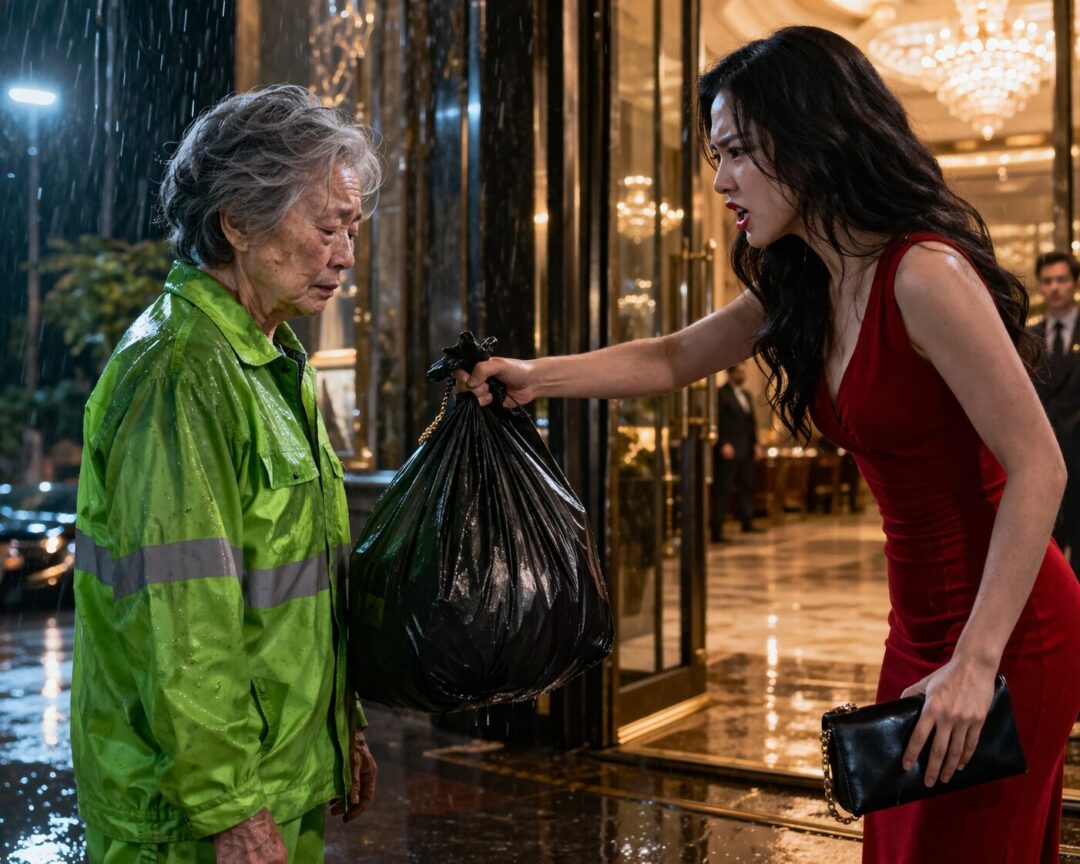
She stood just outside the revolving door in a neon-green work uniform that clung to her narrow shoulders, her gray hair darkened by water, her lined face bent toward the ground as though apologizing for taking up space. In the warm gold reflection of the hotel glass, she looked even smaller than she really was. Behind her, chandeliers glowed over polished floors, crystal stemware, and guests who never had to think about the price of anything.
No one asked why an old woman would remain in the rain that long.
No one asked why she held herself with such peculiar stillness.
They saw the uniform. They saw the age. They saw the wet hem of her trousers and the cheap shoes dark with water. That was enough for most people.
At the center of the hotel’s entrance, under the awning where the rain only reached in silver slants, Corinne Vale came sweeping out in red silk and impatience. She was the kind of woman people turned toward automatically. Not because she was kind. Because she had learned how to carry herself as though the world ought to part before her.
She had come to the Grand Liora for a charity dinner her fiancé’s family sponsored every spring—an evening of speeches about dignity, community, and responsibility delivered between champagne courses and camera flashes. Corinne was late, irritated, and still angry about a phone call that had ended five minutes earlier with one of her bridesmaids crying. She wore annoyance the way other women wore perfume: lightly, expensively, and with full confidence that no one would dare object.
When she saw the elderly woman near the door, she stopped.
At first it was only a look. A quick, slicing glance that moved from the soaked green jacket to the old woman’s lowered head.
Then her gaze found the black garbage bag sitting near the entrance column, waiting to be collected.
Something in Corinne’s mouth hardened.
“Take it,” she snapped, seizing the bag and thrusting it forward. “And move.”
The words cracked through the rain sharply enough that two men in tuxedos near the reception desk turned their heads.
The older woman did not lift her eyes.
Corinne stepped closer, one heel sliding slightly on the wet stone before she caught herself. The clutch in her other hand gleamed beneath the lights. She had the posture of someone offended by the very existence of inconvenience.
“You’re blocking the door.”
Still no answer.
The silence seemed to insult her more than any protest could have.
The old woman’s fingers twitched once near her side. Her mouth moved—not to speak, only to steady itself. Rainwater slid from the ends of her short gray hair and down the high curve of her cheekbone. She looked cold. She looked hurt. Worst of all, she looked as though she had lived long enough to know this kind of humiliation by heart.
From inside the hotel, several guests watched through the glass with the soft, guilty fascination people reserved for scenes they did not intend to interrupt.
Corinne noticed them.
That made it worse.
“Don’t just stand there,” she said, and gave the garbage bag a short, impatient shove toward the woman’s chest.
The old woman recoiled—not dramatically, only enough to show she had felt it. Her shoulders folded in for a second. One thin hand rose halfway to her mouth and stopped there, trembling.
For one suspended moment, the rain seemed louder than everything else.
Corinne expected anger. Or apology. Or pleading.
Instead the woman gave her nothing.
No defense. No indignation. No scene to win.
Only silence, and a face that had gone so still with pain it became difficult to look at.
Something flickered across Corinne’s thoughts then. Not guilt. Not yet. More like discomfort—the faint, inconvenient awareness that she had stepped slightly farther than she had meant to.
But she had an audience now.
And certain people would rather become crueler than appear unsure.
She lifted her chin. “Do your job.”
The old woman closed her eyes.
Not for long. Only a heartbeat. But in that heartbeat, something changed.
Corinne would think about that tiny shift much later—about the strange dignity in the woman’s silence, the way she seemed not smaller but farther away, as though she had stepped somewhere unreachable in her own mind.
Then the revolving door behind them turned.
Part II — What the Rain Couldn’t Wash Away
Her name was Elowen Hart.
No one at the Grand Liora knew it, not really. They knew the name on the registry of ownership documents, on the charitable foundation, on the private family trust that held more properties than most of them would see in a lifetime. They knew Mrs. Hart existed in the abstract, the way old money often did—more rumor than woman, more signature than flesh.
But very few knew her face.
That had been deliberate.
Elowen had spent the last seven years allowing the world to underestimate her.
After her husband died, the Hart family’s business advisers had circled like careful birds. They were never openly insulting. Men with education and polished voices seldom needed to be. They simply spoke to her son instead of to her. They referred questions through assistants. They smiled at her in meetings the way people smile at widows expected to retire into tasteful silence.
At first, grief had made obedience easy.
Then time sharpened her.
Elowen discovered that invisibility had uses. People revealed themselves when they believed power had left the room. Executives lied more casually. Managers cut corners more boldly. Philanthropic committees spent lavishly on their own comfort while discussing sacrifice over dessert. Employees who treated patrons like royalty treated service workers as if kindness were wasted on them.
The Grand Liora had once been her husband’s proudest acquisition. After his death, it became a monument to everything she had not yet put right.
So she began visiting the hotel without ceremony.
Sometimes she came through private entrances, escorted and announced. Other times, she came quietly, walking the lower corridors, the kitchens, the loading docks, the housekeeping floors, asking questions nobody important ever asked. She wore plain clothes. Once or twice she borrowed a uniform jacket and moved through the building without being noticed at all.
What she learned in those visits unsettled her.
The hotel still shone. But inside the shine were small cruelties. Wages delayed. Complaints buried. Staff too frightened to speak. Managers skilled at charming investors and bruising everyone beneath them. Nothing dramatic enough to make headlines. Just enough to rot a place from the inside.
Tonight she had come for two reasons.
The public one was the charity dinner.
The real one was an audit only three people knew about, concerning lost funds, false invoices, and a pattern of abuse hidden behind impeccable service.
She had arrived early and left her formal wrap in the car after seeing two dishwashers unloading catering equipment in the rain without proper cover. One of them had been no older than nineteen. The other had apologized to her—apologized—for the weather, as though it were somehow her burden to excuse.
Elowen had taken one of the extra green maintenance jackets hanging by the service corridor and walked outside to the side entrance to see how the front staff handled overflow deliveries during the storm.
That was when the delay began. A gate problem. A backed-up service cart. A frantic call from her driver. Ten minutes became fifteen.
And then Corinne Vale came through the front doors in silk and fury.
Elowen did not know who she was at first. Only that she was young, rich, admired, and accustomed to translating irritation into punishment.
The first command had stung.
The second had landed more deeply.
But it was the third—Do your job—that opened something old and sharp inside Elowen’s chest.
Not because the words were original.
Because they never were.
She had heard versions of them at twenty-three, when she accompanied her husband to his first investor gala and someone mistook her for a temporary waitress because her dress was too simple. She had heard them again at fifty-eight, after widowhood, when a younger board member suggested she let “the active men” handle negotiations. She had heard them in every elegant room where power preferred to imagine itself born rather than inherited, embodied rather than observed.
The rain on her face had hidden the first tears. Pride had hidden the rest.
She had lowered her gaze not from shame, but from effort. It took effort not to answer certain humiliations with the full weight of what one knew.
Then the door turned, and footsteps crossed the marble too fast to be casual.
Part III — The Bow
Julian Mercer, general manager of the Grand Liora, came through the revolving door with the expression of a man whose world had just shifted an inch off its axis.
He had been in the back corridor reviewing security footage related to the missing funds when one of the concierge staff whispered that there was an issue at the entrance—a guest causing a disturbance, an elderly worker caught in the rain.
Ordinarily he would have sent someone else.
Then he looked at the monitor.
The image froze him.
Not because of Corinne Vale, though he recognized her instantly.
Because the woman in green was Elowen Hart.
He crossed the lobby so quickly he nearly slipped on the polished floor.
Now, at the threshold, he stopped short.
“Elowen—” The name almost escaped him. He caught himself, chest tightening. “Madam.”
The word hung in the air like a struck bell.
Corinne turned.
For the first time that night, the color left her face.
Julian’s eyes did not go to her. Not once. He stepped down into the rain, straightened his jacket with hands that were not entirely steady, and bowed his head to Elowen.
“We’ve been waiting for you.”
Behind him, the lobby had gone still.
Not silent in the absolute sense—there was still rain, still music drifting faintly from the ballroom, still the mutter of distant conversation—but still in the human way. The way rooms become still when everyone inside realizes they have been standing in the wrong story.
Elowen raised her face at last.
The change in her was not theatrical. She did not suddenly grow taller. Her features did not harden into vengeance. Yet something unmistakable settled over her. The same woman who had stood in the rain moments earlier now seemed to gather the doorway, the lobby, the watching eyes, and the entire building into the radius of her calm.
Corinne’s hand loosened. The clutch nearly slipped.
“I…” she said, but the sentence broke before it found shape.
Julian stepped slightly aside, an instinctive gesture of deference. “Your car has been moved to the covered entrance,” he said carefully. “Everything is ready.”
Elowen looked at him for a moment, and in that glance Julian understood three things at once: she was hurt, she had seen enough, and whatever happened next would not be decided by his embarrassment.
Only then did her gaze shift to Corinne.
There were people who mistook softness for absence of force. Elowen had spent enough of her life among them to recognize the type instantly. Corinne had all the confidence of a woman who had been protected from consequence by pedigree, beauty, and expectation. She had likely been told all her life that cruelty was simply discernment in better fabric.
Now she looked young in the worst way. Not youthful. Unformed.
“I didn’t know,” Corinne said.
It was the wrong sentence, though not because it was untrue.
Elowen studied her with the kind of silence that left no place to hide. Rainwater still shone on the green jacket. A silver drop clung to one strand of gray hair near her temple. In that moment, the old maintenance coat looked less like a disguise than an indictment.
“No,” Elowen said softly. “You didn’t.”
She stepped past the garbage bag without touching it.
Julian moved to follow, but she lifted one hand slightly, and he stopped.
The lobby floor reflected gold above them. Guests near the reception desk lowered their eyes. Somewhere deeper inside, a ballroom door opened and released a ripple of applause from a speech nobody at the entrance was still listening to.
Corinne stood as if anchored in place.
Then Elowen turned back once—not all the way, just enough that her face remained in profile beneath the chandelier light.
“You saw enough,” she said.
Not loud. Not harsh. Yet the words landed more cleanly than a slap.
Corinne flinched.
Elowen walked inside.
Part IV — Rooms Full of Witnesses
The dinner should have continued normally after that.
In certain circles, the first rule of scandal was containment. Smile. Proceed. Keep the wine moving. Let discomfort dissolve into the next course.
But the Grand Liora had always been a house built for echoes.
By the time Elowen entered the ballroom in dry emerald silk, with Julian half a step behind her and the board chair nearly tripping over his own apology, the story had already outrun dignity. It passed from server to maître d’, from donor to spouse, from assistant to committee member in quick, electrified fragments.
The woman in green. At the door. Corinne Vale. In the rain. Mrs. Hart herself.
No one used the exact same words, but every version ended the same way: Corinne had humiliated the wrong woman.
Elowen took her seat at the head table without ceremony. If anyone expected a public rebuke, they were disappointed. She listened to the final speeches. She accepted greetings. She thanked the youth orchestra after their performance. She moved through the evening with a steadiness that made other people’s agitation feel coarse by comparison.
Only those who knew her well would have noticed the slight fatigue in her hands.
Near dessert, Julian approached her with a folder.
Not here, she signaled with a glance.
Later.
He inclined his head.
The missing funds, the false invoices, the managers who had used the hotel’s charitable arm to mask private indulgence—those matters would be handled before dawn. Not because of Corinne. Corinne was only the symptom. Tonight had simply stripped the polish off the disease.
Meanwhile, Corinne remained in the ballroom like someone walking through a dream she could not wake from.
Several people avoided her. Others offered brittle reassurance she could not bear to hear. Her fiancé, Everett, had first tried to dismiss the incident as misunderstanding, then fell silent when three separate witnesses contradicted him in careful detail.
At last he asked, with visible strain, “What exactly did you do?”
Corinne looked at him as though she might cry, but no tears came. Shame, she was discovering, was less dramatic than rage and much harder to perform.
“I thought she was staff.”
Everett stared at her.
That, too, was the wrong sentence.
Near midnight, Corinne left the ballroom and found herself drifting toward the now-empty entrance. The rain had lightened to a fine silver mist. The black garbage bag was gone. The steps had been cleaned. Nothing remained except the memory of where the old woman had stood.
Corinne saw it all now with humiliating clarity: the way the woman had held herself, the lack of panic in her eyes, the silence that had not been submission but distance. She had mistaken composure for weakness because she had never had to learn the difference.
For the first time in years, perhaps in her life, Corinne felt small in a way no mirror could fix.
Part V — The Weight of Being Seen
The next morning, Elowen summoned the executive team, the charity board, and every department head whose signature had touched the audit trail.
The meeting lasted three hours.
Two managers resigned before noon. One accountant was escorted out. A procurement contract was suspended. A staff grievance office was restructured under independent oversight. Emergency funds were released to kitchen and housekeeping teams whose overtime had been quietly delayed for months. By evening, the Grand Liora was no longer the same institution it had been the day before.
None of that made headlines.
What did spread, in quieter ways, was something else.
A server told her sister that the owner had once stood in the rain wearing a worker’s jacket and had seen everything.
A dishwasher told his mother that the old woman in green had looked like someone who knew exactly what pain cost.
A concierge whispered to another hotel across town that power had finally shown its face, and it had not looked the way people expected.
Three days later, Corinne requested a private meeting.
Julian asked whether Elowen wished to decline.
Elowen considered for a moment, then said, “No. Let her come.”
Corinne arrived without red silk, without cameras, without the armor of an event. She wore navy, plain enough to suggest effort. Her face was bare of theatrical distress. That, Elowen noted, was something.
She stood in the private sitting room overlooking the city gardens and held herself carefully, as though one careless movement might return her to the version of herself she now despised.
“I came to apologize,” Corinne said.
Elowen folded her hands in her lap and waited.
Not out of cruelty. Out of fairness.
An apology worth hearing had to learn how to survive silence.
Corinne swallowed. “I was arrogant. And ugly. I thought…” Her voice failed, then steadied. “I thought if someone looked powerless, I could treat them any way I wanted. I don’t know if I believed that before, but I know it now because I saw myself do it.”
That was better.
Still not enough. But better.
Elowen looked past her, briefly, toward the rain-washed garden. “Most people are kind when kindness costs them nothing.”
Corinne lowered her eyes.
“The useful measure,” Elowen continued, “is how they behave when they believe another person cannot answer back.”
Silence moved between them.
At last Corinne said, very quietly, “Is there any way to make amends?”
Elowen could have refused her. Could have dismissed her with the elegance of permanent contempt. Some wounds deserved no reconciliation.
But she had not built a life by confusing punishment with repair.
“There is no apology for what happened at the door,” she said. “There is only what you become after it.”
Corinne looked up slowly.
“If you want to make amends, stop performing goodness in rooms where people are watching. Start practicing it where they are not.”
The younger woman took that in as if it were more difficult than being insulted.
Perhaps it was.
When she left, she did so quietly.
Elowen remained by the window for a long while after, watching the light change over the wet stone paths below. Age had taught her something the young often resisted: revelation did not arrive as thunder. More often it came as a door, a pause, a sentence spoken in the exact tone required to separate one life from another.
A week later, she passed through the staff entrance again.
This time no one failed to recognize her.
What pleased her most was not the sudden politeness. That kind of fear-based courtesy never lasted.
It was the smaller thing.
A housekeeper hurrying past with folded linens slowed to hold the door open for a porter balancing a heavy crate. The porter thanked her. A young hostess stepped aside for an older dishwasher and smiled with genuine embarrassment when he insisted she go first. Tiny gestures. Nearly invisible. Yet institutions changed the same way weather did—by accumulation.
That evening, Elowen stood once more before the glass doors of the Grand Liora. Rain had begun again, soft and silver under the entrance lights.
For a moment, she saw the other night laid over this one: the garbage bag, the red dress, the sting of public contempt.
Then the image passed.
Inside, chandeliers burned warm against the dark.
Outside, the rain kept falling on everyone without distinction.
Elowen lifted her face to it and walked in anyway.